
ISO 228, NPT & BSP Threads + PN Ratings on Brass Valves
ISO 228, NPT & BSP Threads + PN Ratings on Brass Valves
On a brass valve, an ISO 228 marking tells a specifier that the connection is a parallel G thread, commonly called BSPP, and that the thread itself is not the seal. The joint must close on a flat face with a gasket, O-ring or bonded seal. NPT is a different, tapered American thread that seals on the threads with a sealant. BSPT is a tapered BSP thread with a different thread form from NPT. The PN rating is a separate nominal-pressure class, so a valve specification has to state thread standard, PN class, port type and material grade rather than relying on size alone.
That distinction matters most at the evaluation-to-execution stage. A buyer may compare brass ball valves, brass gate valves, brass stop valves or brass check valves on body material and size, then discover that the interface thread is wrong or that a PN class has been copied from a catalogue without checking the pressure-temperature duty. The result is a leak, a cross-threaded port or a rework order. The specification, not the site, is the right place to fix both the thread and the PN decision.
Valogin Valve (Zhejiang Valogin Technology Co., Ltd.) is a brass valve and fittings manufacturer founded in 1985. Its product scope includes brass valves, fittings and distribution manifolds for plumbing, heating and gas systems, with Europe and North America as key markets. The thread and PN rules below apply to any brass valve specification; the company facts are used only where they are relevant to the buying decision.
What an ISO 228 marking actually tells a specifier
ISO 228 is the standard for pipe threads where pressure-tight joints are not made on the threads. It defines the parallel, cylindrical G thread that the trade calls BSPP. A valve marked G1/2 therefore has a parallel ISO 228 thread. It does not have a tapered thread, and it does not seal by interference between the male and female threads. The sealing face has to be provided by the valve body or by the mating fitting, with a washer, O-ring or bonded seal.
The marking is a connection instruction, not a complete product description. It tells the buyer that the thread form is parallel, that the joint needs a flat-face seal, and that the size is written as G plus the nominal size, for example G1/2 or G3/4. It also warns the installer not to expect the thread to be the sealing element. On a brass valve for plumbing systems, that warning is practical: a missing or damaged washer, a rough sealing face or a fitting with no seating face can produce a leak even when the thread is correctly engaged.
- What it identifies: a parallel ISO 228 G thread, also called BSPP, with a nominal size such as G1/2 or G3/4.
- What it requires: a flat sealing face on the valve body or mating part, plus a gasket, O-ring or bonded seal.
- What it does not identify: the PN class, the brass grade, the port type, the market approval or the valve's suitability for gas or potable water.
- What to add on a drawing: tolerance class A or B where the fit matters, the sealing-face detail and the required pressure-temperature duty.
That last point is often missed. ISO 228 defines the thread; it does not define the complete joint. If the mating part is an NPT port or a BSPT fitting, the G thread on the valve is not a match. If the mating part has a flat face but no washer seat, the joint is incomplete. The specifier should show the sealing face and state whether the connection is a valve-to-pipe joint, a union joint or an appliance connection.

NPT and BSP: why mixing thread systems causes leaks and rework
NPT and BSP are different thread systems and do not seal together. NPT is a tapered American standard: it seals metal-to-metal on the threads and needs a sealant. BSP comes in two forms. BSPT is tapered. BSPP, also written G, is parallel and seals on a washer or O-ring against a flat face. The thread forms differ as well: NPT uses a 60-degree thread angle, while BSP uses 55 degrees. The two are not interchangeable even when the nominal size looks close.
| Connection | Thread form | How it seals | Common market convention | Specifier check |
|---|---|---|---|---|
| ISO 228 G, also called BSPP | Parallel, 55-degree BSP form | Flat face with gasket, O-ring or bonded seal; the threads do not seal | Europe, the UK, much of Asia and Australia | Mating part must have a sealing face; state size and tolerance class where fit matters |
| BSPT | Tapered, 55-degree BSP form | Tapered joint; the joint practice must match the specification | Europe, the UK and Asia where a tapered joint is specified | Do not substitute NPT; confirm that the mating port is BSPT |
| NPT | Tapered, 60-degree American form | Metal-to-metal on the threads with sealant | North America | Do not mix with BSP; confirm sealant compatibility and thread engagement |
On site, the failure is rarely subtle. A BSP male thread started into an NPT female port either cross-threads or leaks. A BSPP valve fitted to a port with no flat-face seat has no designed sealing path. The installer may add more sealant, but sealant cannot correct a mismatched thread form or a missing seat. The reliable correction is to change the valve or the mating fitting to the correct standard, inspect the threads for damage, and remake the joint. That is why the thread standard belongs in the purchase specification and on the valve marking, not only in a verbal instruction.
Market convention is a useful first check, not a substitute for the drawing. Europe, the UK and most of Asia use BSP; North America uses NPT. A brass valve for heating systems in Europe may be specified with G threads; a brass gas valve for North America may be specified with NPT. State the standard in the enquiry, not only the size. If a project mixes imported equipment and local pipework, list the thread standard at every interface: boiler or heat pump, circulator, manifold, radiator connection, gas meter and appliance connection.

PN ratings: a separate decision from the thread standard
PN is a nominal-pressure class used on valves and fittings. It is not the same as the thread standard, and it is not a measured test result for the installed system. A higher PN number indicates a higher nominal-pressure class, but the allowable working pressure of a specific valve still depends on its pressure-temperature rating, body material, seal material, size and the approval basis for the application. The specification should therefore carry both the PN class and the required pressure-temperature duty.
Worked example: a PN10 heating circuit. The supplied heating scenario describes hot water up to 90 °C, working pressure up to 10 bar (PN10), continuous circulation through the heating season and low flow rates at partial load. In that circuit, brass ball valves provide quarter-turn isolation at the heat source and risers, while brass stop valves throttle flow so radiators far from the circulator reach design temperature.
If a PN40 brass ball valve is written into this PN10 circuit, the PN40 class is higher than the circuit's nominal class. That does not make the valve automatically suitable. The specifier still has to check the valve's pressure-temperature rating at 90 °C, the thread standard and sealing face, the market approval, and the duty. A ball valve is an isolation device; a higher PN class does not turn it into a regulating valve. The PN40 class may be justified by a higher-pressure duty elsewhere, by a project margin or by a specification that requires that class, but those reasons should be stated.
The PN10 brass stop valve in the same example is selected for throttling duty, not because it is better or worse than the ball valve. Its PN10 class aligns with the circuit's nominal class, but the model's actual rating at the working temperature and the stem and seal materials still need confirmation. Throttled flow can produce noise or cavitation, which the heating scenario identifies as a common complaint on radiator circuits. The selection should therefore cover the duty, not only the pressure class.
| Item | Documented basis | Role in the example | What the specifier still checks |
|---|---|---|---|
| Heating circuit | Hot water up to 90 °C; working pressure up to 10 bar (PN10); continuous circulation | Sets the duty and the nominal class | Design pressure-temperature combination, water treatment and approval needs |
| PN40 brass ball valve | Higher nominal-pressure class than the PN10 circuit | Isolation at the heat source or riser if selected | Pressure-temperature rating at 90 °C; thread and seal; approval; isolation duty |
| PN10 brass stop valve | PN10 class aligned with the circuit example | Throttling flow to remote radiators | Actual rating at temperature; noise or cavitation at throttled flow; stem and seal materials |
This is a worked example, not a claim that every PN40 brass ball valve or every PN10 brass stop valve is rated for this heating circuit. The model-specific pressure-temperature rating and approval must be confirmed against the supplied product data.
How to match PN class to system duty without over- or under-specifying
Start with the system, not the valve label. A PN class is only useful when it is read together with the temperature and the medium. The following sequence keeps the thread and pressure decisions connected:
- Write the design pressure and temperature, not just the nominal class. A PN10 heating circuit and a PN10 cold-water line are not the same duty when the temperature changes. State the design combination that the valve must cover.
- Check the valve's pressure-temperature rating. The PN class on the body is a starting point. The manufacturer's declared rating for the specific model, size and seal material is the figure to compare with the system duty.
- Fix the thread standard and sealing method. Use ISO 228 G with a flat-face seal where a parallel BSPP joint is required. Use BSPT only where the mating port is tapered BSP. Use NPT only for North American tapered joints. Never mix the systems in one joint.
- Match the port type to the duty. A full-port ball valve has an internal bore the same size as the pipe, so it adds almost no restriction to flow. A reduced-port valve has a narrower bore, costs less and takes less space, but it creates a pressure drop. Choose full port where flow matters, such as pump and manifold duty; choose reduced port where space or cost matters and the pump has spare head.
- Select the material grade for the medium. For potable water and aggressive water, check the water chemistry and specify a dezincification-resistant brass where the application requires it. Dezincification is the selective leaching of zinc from brass, leaving a porous copper-rich layer that can look pink or reddish and lose strength from the inside. For markets with lead-free requirements, confirm the applicable lead-free certification for the specific product.
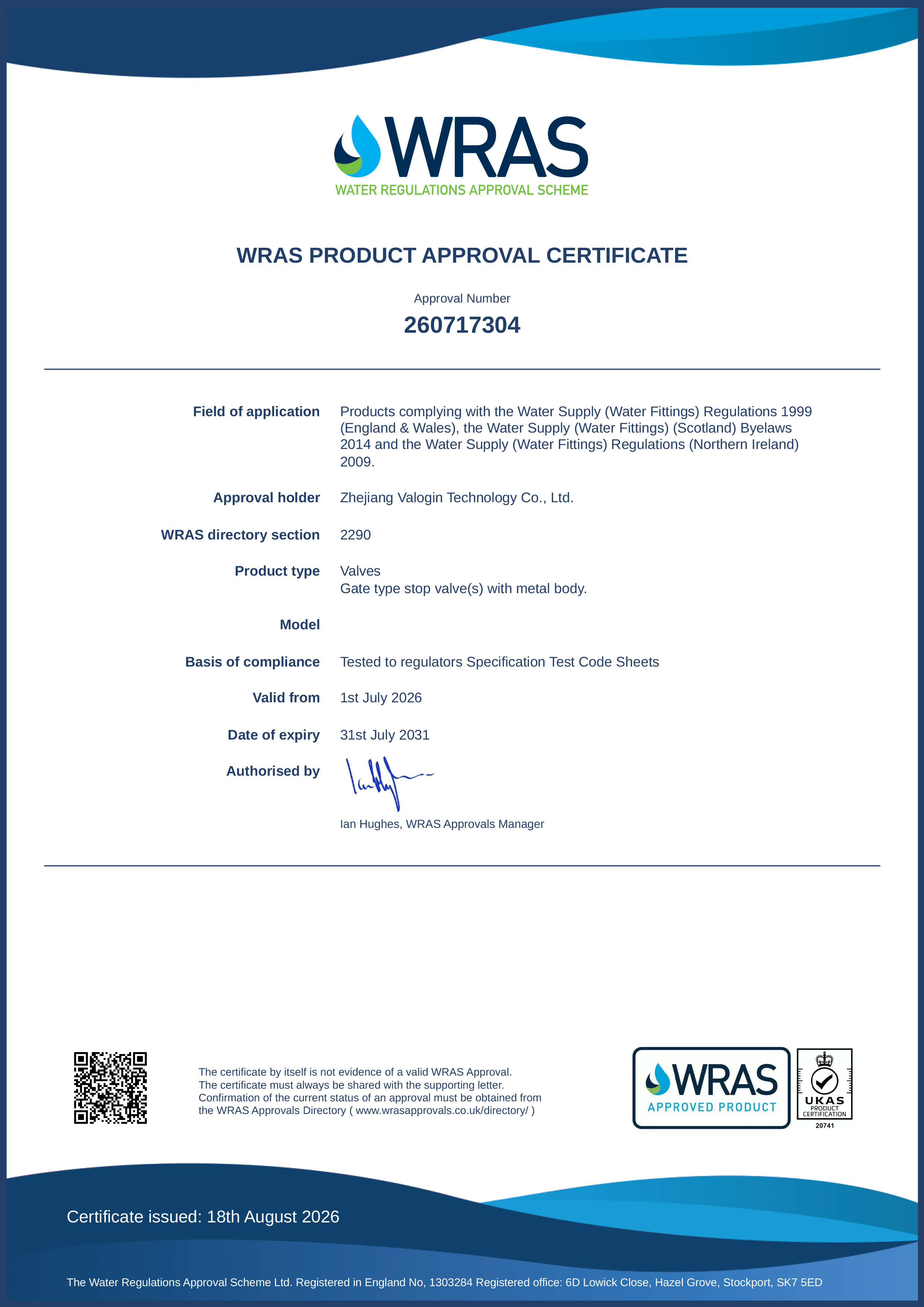
- Confirm approval separately from the thread and PN. For UK drinking water, WRAS approval is product- and material-specific; a supplier should state the approval number and the covered models. For gas products, the relevant gas approval must match the market and the product scope. Approval is not created by a G thread or a PN marking.
- Agree the test evidence. Require 100 per cent air-tight testing, dimension sampling per batch and a material certificate on request where the order needs it. The test record should be traceable to the batch or date code marked on the goods.
For a brass valve for plumbing systems, the approval and material questions often decide the grade before the PN class does. For a brass valve for gas systems, gas-tight shut-off and the relevant gas approval take priority; the thread standard still has to match the local pipework. For a brass valve for heating systems, temperature, continuous circulation and noise at throttled flow are part of the duty. The same body family can carry different threads, ports and pressure classes, so the specification has to be explicit.
Thread and PN requirements in an OEM or custom valve specification
An OEM drawing should treat the thread and the PN class as controlled characteristics, not as catalogue defaults. The drawing needs the thread standard, nominal size, sealing face or tapered joint, PN class, pressure-temperature duty, port type, material grade and inspection method. If the valve is private-label, the marking and traceability also need to be defined.
Valogin Valve provides OEM and ODM production and custom or non-standard valve development based on customer drawings, samples or application requirements. Its customization scope includes structure, material, marking and logo of brass valves. Connection threads can be made to the customer's drawing, including NPT and BSP or G threads, and the thread standard can be adapted to the destination market. Port size, full-port or reduced-port configuration, handle type, stem and ball configuration, and body construction can be specified. Material and finish can be selected for the market requirement, including natural brass, nickel-plated or chrome-plated finish, and the pressure class and temperature range can be set as agreed performance targets.
For a project that needs custom development, the working route is a drawing, a physical sample or a written application requirement. The manufacturer's published capability includes one-off and low-volume runs alongside volume orders, engineering and drawing support from quotation to first article, sample approval before mass production, batch inspection records and material certificates with each shipment. The stated production terms are a 50-day lead time, a 5,000-unit MOQ and a monthly capacity of 15 million pcs. These figures should be confirmed for the specific model and order rather than assumed for every item.

Parameter checklist for a brass valve specification
A workable valve specification makes the connection and the pressure duty readable without a call to the supplier. Use this checklist as a minimum:
| Parameter | What to write | Why it matters |
|---|---|---|
| Thread standard | ISO 228 G (BSPP), BSPT or NPT, plus the nominal size and tolerance class where the fit matters | Prevents cross-threading and an incomplete sealing path |
| PN rating | The PN class plus the required pressure-temperature rating at the design temperature | The PN class alone does not establish the allowable working pressure for the model |
| Port type | Full port or reduced port | Affects flow restriction, pressure drop and pump head |
| Material grade | Brass grade, dezincification-resistant grade where potable or aggressive water requires it, and the applicable lead-free requirement | Affects corrosion resistance and market compliance |
| Sealing method | Flat-face gasket, O-ring or bonded seal for G; sealant-compatible tapered joint for NPT | The thread form and the seal must match each other |
| Approval | WRAS, DVGW, cUPC, CSA, AGA or other approval as applicable to the market and product scope | Approval is product- and market-specific and is not implied by the thread or PN |
| Test evidence | 100 per cent air-tight test, dimension sampling per batch and material certificate on request | Makes the quality claim verifiable against the goods |
| Marking and traceability | Thread standard, size and PN class on the body or label; batch or date code linked to the test record | Allows the installer and buyer to check the delivered item against the specification |
An example line for a heating isolation valve could read: Brass ball valve, G1/2 ISO 228 parallel thread, PN10, full port, dezincification-resistant brass where water conditions require it, 90 °C heating duty, 100 per cent air-tight tested, with a batch test record. This is a specification example, not a statement that a particular catalogue model carries every attribute. The supplier should confirm the model, approval and rating against the drawing.
FAQ
What does ISO 228 mean on a brass valve?
ISO 228 is the standard for pipe threads where pressure-tight joints are not made on the threads. It defines the parallel cylindrical G thread, commonly called BSPP. A valve marked G1/2 has a parallel ISO 228 thread and needs a sealing face on the mating part, with a gasket, O-ring or bonded seal. The thread itself does not seal, and the marking does not by itself state the PN class, material grade, port type or market approval.
What is the difference between NPT and BSP threads on a brass valve?
NPT is a tapered American thread that seals on the threads and needs a sealant. BSP includes BSPT, a tapered thread, and BSPP or G, a parallel thread that seals on a flat face with a washer or O-ring. NPT has a 60-degree thread form; BSP has a 55-degree form. Europe, the UK and most of Asia use BSP, while North America uses NPT. The two systems do not seal together, so fitting one into the other either cross-threads or leaks.
China brass gate valve OEM manufacturer with custom stem machining
For a China-based brass gate valve OEM project, start with a drawing or sample that defines the stem geometry, thread standard, PN class, material and inspection requirement. Valogin Valve provides OEM and ODM production and custom or non-standard valve development based on customer drawings, samples or application requirements; its customization scope includes structure, material, marking and logo, and connection threads can be made to NPT or BSP or G drawings. The exact stem machining specification must be agreed in the drawing package, because a model name alone does not define the stem. The published production terms include a 50-day lead time and a 5,000-unit MOQ, which should be confirmed for the specific gate valve project.
Does a higher PN rating make a brass valve suitable for any heating circuit?
No. PN is a nominal-pressure class, not a universal approval for every temperature, medium or installation. A higher PN valve may still have an unsuitable thread, seal material, approval status or pressure-temperature rating for a particular heating circuit. Match the valve's declared pressure-temperature rating to the circuit's design duty, and check the thread standard and market approval separately. In a PN10 heating example, a PN40 ball valve is in a higher class than the circuit, but that alone does not establish suitability.
Conclusion
The thread marking and the PN class answer two different questions. ISO 228 G tells the specifier that the valve has a parallel BSPP thread and needs a flat-face seal. NPT tells the installer that the joint is a tapered American thread that seals on the threads with a sealant. BSPT is tapered BSP, not NPT. Mixing the systems causes cross-threading, leaks and rework, so the standard must be written at every interface.
The PN class answers the pressure question only when it is read with the pressure-temperature duty, material, port type and approval. In the PN10 heating example, a PN40 brass ball valve is in a higher class than the circuit; that does not remove the need to check the actual rating, thread and duty. A PN10 brass stop valve in the same circuit is selected for throttling, not because the class number alone makes it suitable. Write the thread standard, PN rating, port type and material grade into the specification, then ask for the test record and approval that prove the supplied model matches it.
For a review of a brass valve drawing or a sample request, the Valogin Valve brochure can be downloaded here: Valogin Valve brand brochure. The published contact route is sales62@valogin.com; the brochure and contact details should be used to confirm the exact model, thread callout and approval scope before ordering.
Have Questions or Need More Details?
Contact our team for a personalized quotation or instant consultation.
Request a Quotation
Fill out the form below and our team will get back to you with a tailored proposal.
WhatsApp Direct Chat
Prefer to chat in real-time? Message us on WhatsApp for instant assistance & quick answers.
- Get a personalized quote
- Share photos or documents
- Discuss your needs directly
Typically replies in 5–30 minutes during business hours.