Ranked: 10 Brass Valve Types for OEM Programmes and Where Each One Fits
An OEM brass valve programme gives a brand, distributor or equipment maker a complete brass valve range without building brass casting, machining and assembly of its own. The range can carry the customer's logo, part numbers, packaging and documentation, while the manufacturer handles production to the customer's drawing or sample. The practical question is not whether brass valves can be private-labelled. It is which valve types should anchor the programme, and how each type should be specified for its role.
Valogin Valve (Zhejiang Valogin Technology Co., Ltd.) is a brass valve and fitting manufacturer serving plumbing, heating, gas and HVAC systems. Its supplied capability record covers OEM, ODM and customised production, with monthly capacity listed at 15 million pcs, an MOQ of 5,000 units and a typical lead time of 50 days. The same record states that production can follow a customer's drawing, physical sample or written application requirement, and that Valogin handles casting, machining, assembly and testing to the customer's specification. The factory covers more than 28,000 square meters with over 1,000 employees.
What an OEM brass valve programme has to solve
The core problem is range coverage with controlled specification. A brand may need a ball valve for isolation, a gas ball valve for appliance connections, a gate valve for mains isolation, a stop valve for regulation, a check valve for backflow prevention, an angle valve for fixture connection and a manifold for underfloor heating. Buying these as unrelated finished goods makes it difficult to keep marking, materials, finishes, packaging and traceability consistent across the range.
An OEM programme solves that by treating the range as one specification system. The customer defines the product types, the connection layout, the thread standard, the brass grade and lead content for the destination market, the finish, the marking method, the part numbering and the packaging. Performance targets such as flow, torque, pressure class and temperature range can also be specified to the customer's target. The manufacturer then produces to that agreed specification, with sample approval before mass production and batch inspection records with each shipment. The capability record also lists engineering and drawing support from quotation to first article, a named account contact, and quality claim handling terms agreed in the supply contract.
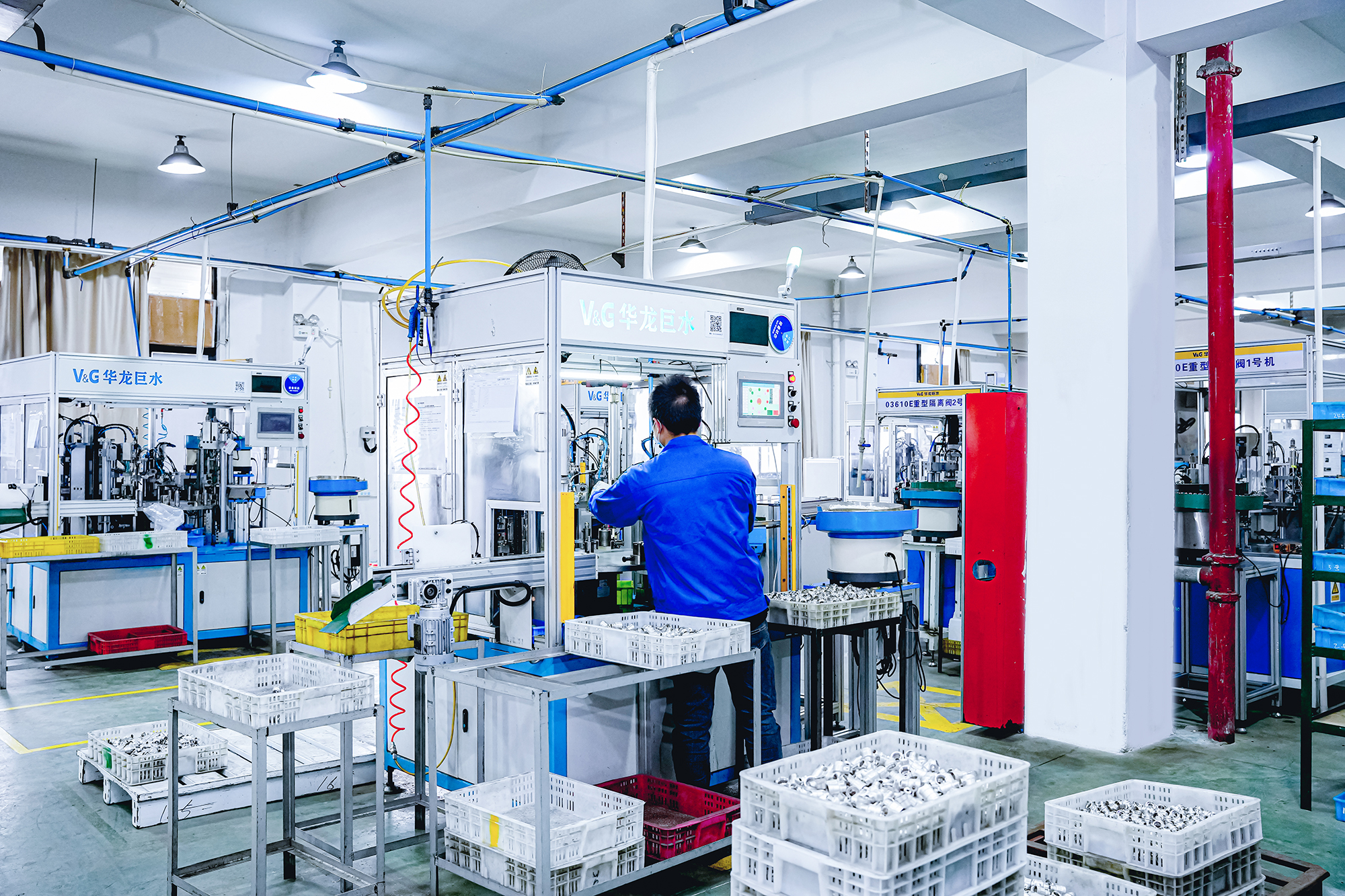
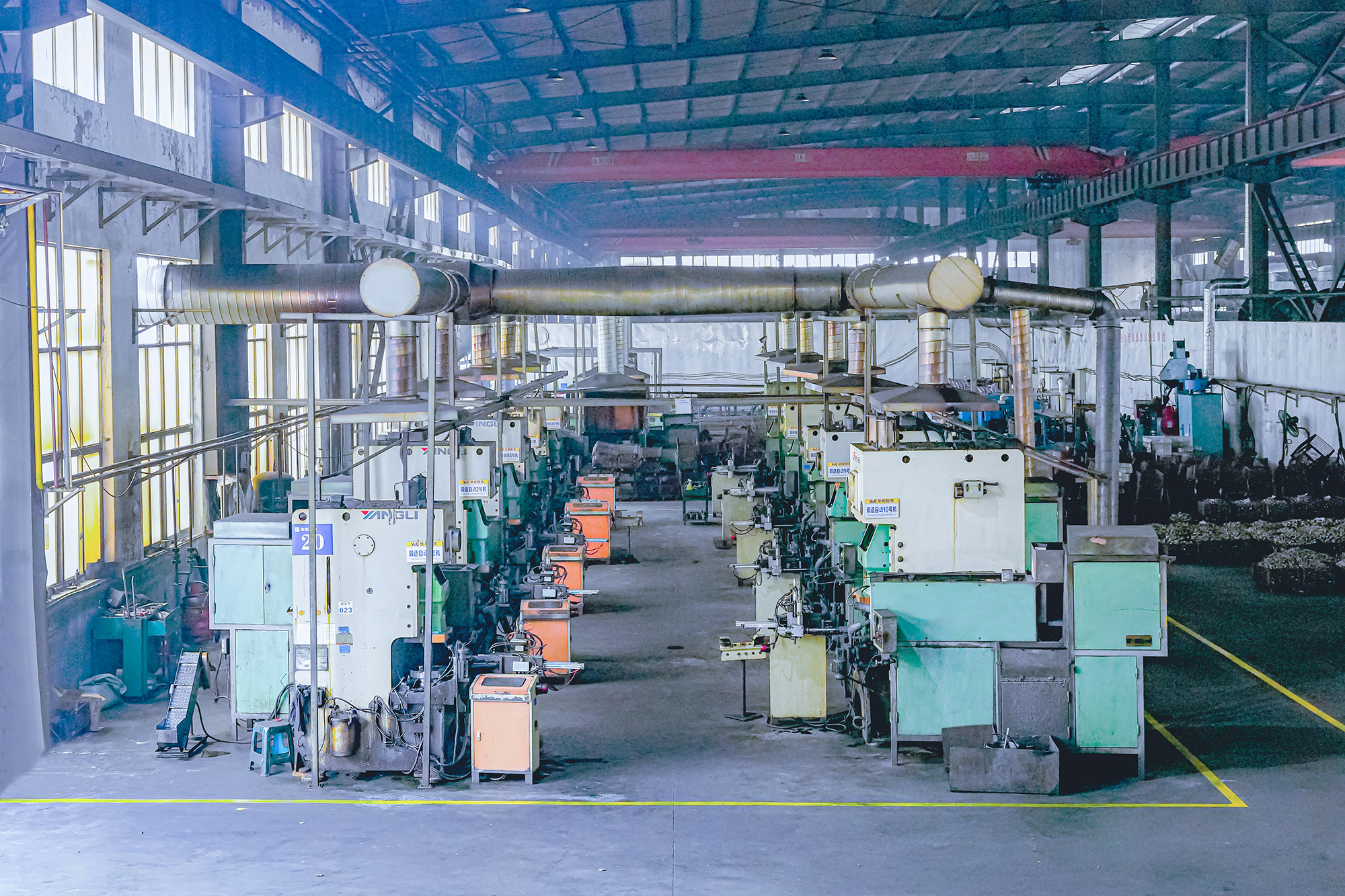
The HVQ for this guide is straightforward: OEM HVAC valve manufacturers with in-house assembly. In-house assembly matters because the customer is not only buying a casting or a machined body. The valve has to be assembled, tested and packed to the same specification across repeat orders. A supplier that only assembles bought-in parts has less control over material and dimensional consistency. The supplied Valogin record describes casting, machining, assembly and testing as part of the OEM/private-label service, and the factory images include automatic assembly areas for ball valves and isolation valves and an automatic gate valve production line for assembly.
Industry background: why brass valve types still matter in an OEM range
Brass remains a major material category in HVAC and plumbing valves. Future Market Insights projects that brass and bronze valve bodies will hold a 46.2% share of the HVAC valve market by material in 2026. Global Market Insights estimates the global HVAC valve market at USD 17.1 billion in 2025. These are external research estimates, not Valogin shipment data, and they do not rank individual valve types. They do support a simpler point for OEM buyers: brass valve bodies are not a niche line, so a private-label range usually needs several brass valve types rather than a single SKU.
The commercial value of an OEM programme comes from the combination of product coverage and specification control. A distributor can offer a coherent brass valve range under its own brand. An equipment maker can supply a matching isolation or connection valve with its appliance or system. A heating brand can package ball, gate, stop, check, angle and manifold products under one part-number system. The ranking below is about that programme fit, not about which valve type is 'best' in general.
The ranking logic
This is an editorial programme-fit ranking. It orders the ten valve types by their usefulness as anchor items in an OEM brass valve programme. The order weighs four documented capability factors:
- Configuration depth. How many customer-specific variables the type can carry: body dimensions and connection threads to the customer's drawing, NPT or BSP/G thread, port size, full port or reduced port, handle type and colour, stem and ball configuration, union or one-piece body.
- Brand and packaging surface. Whether the type can carry customer logo and part number cast, stamped or laser-marked on the body and handle, private-label casting marks, and customer packaging, labels and printed documentation.
- Material and finish control. Whether the type can be specified with brass grade and lead content to the customer's market requirement, and with natural brass, nickel-plated or chrome-plated finish, plus seal and gasket material selected for the medium.
- Role in supported building systems. How directly the type appears in the supplied plumbing, gas and hydronic scenarios, and therefore how often it becomes part of a multi-product OEM range.
The ranking is not a market-share ranking, a sales ranking or a claim that one valve type is superior to another. A buyer with a narrow programme may need only one or two of these types. A full-range OEM programme may need all ten, with the ranking used as a starting point for range architecture.
| Rank | Valve type | Programme role | Typical programme fit | Documented model reference |
|---|---|---|---|---|
| 1 | Brass ball valve | Quarter-turn isolation; handle shows state at a glance | Whole-house, riser and hydronic isolation; core range anchor | VG10.16902 |
| 2 | Brass gas ball valve | Dedicated gas isolation; can be locked in the closed position | Gas appliance kits, boiler, water heater and hob connections | VG10.61011 |
| 3 | Brass gate valve | Low-resistance straight-through bore; open/close duty | Main supply and riser isolation; plumbing and water ranges | VG11.11302 |
| 4 | Brass stop valve | Throttling and flow regulation | Radiator regulation and water-line balancing | VG16.70411 |
| 5 | Brass check valve | One-way flow and backflow prevention | Water supply, plumbing and heating ranges | VG12.04033 |
| 6 | Brass angle valve | 90-degree fixture or radiator connection | Sanitary fixture and radiator connection kits | VG14.90111 |
| 7 | Brass float ball valve | Tank and float control | Water storage, tank and cistern programmes | VG20.10212 |
| 8 | Brass bibcock | Utility outlet or tap | Garden, utility and building-services ranges | VG13.99011 |
| 9 | Mix valve | Mixing duty in heating and plumbing systems | Heating and plumbing ranges requiring mixing | VG37.10092 |
| 10 | Brass manifold | Multi-loop distribution | Underfloor heating manifold stations | VG21.23161 |
The 10 brass valve types and where each one fits
1. Brass ball valve — the default isolation anchor
A brass ball valve is the natural first item in an OEM brass valve range because it gives quarter-turn isolation and the handle shows the valve state at a glance. In the supplied selection guidance, ball valves are the default for on/off duty in water and gas lines, while gate valves are for fully open or fully closed duty and stop valves are for throttling. That makes the ball valve a practical anchor for a range that needs a clear, visible isolation point.
Typical programme fit: whole-house or riser isolation in plumbing, isolation at the heat source or riser in hydronic heating, and a core private-label item for distributors that want one familiar quarter-turn valve across several system sizes. For OEM work, the ball valve exposes a wide set of customer variables: body dimensions and connection threads to the customer's drawing, NPT or BSP/G thread, full port or reduced port, handle type and colour, stem and ball configuration, and union or one-piece body. Logo and part number can be cast, stamped or laser-marked on the body and handle. The documented model reference is VG10.16902.
2. Brass gas ball valve — the certification-led programme item
A brass gas ball valve is included because gas isolation is a distinct safety duty, not a variation of a water ball valve. The supplied gas scenario describes a brass gas ball valve as the designated isolation point on a gas line or appliance, with a quarter-turn handle that shows open or closed and can be locked in the closed position. It also states that gas-tight shut-off is a safety issue rather than a performance issue, and that the seal materials must be resistant to the gas and its odourant.
Typical programme fit: gas appliance brands, boiler, water heater and hob connection kits, and gas utility or building-services ranges. This is the type where market approval shapes the programme most directly. The supplied certificate records include DVGW certificate DG-4312DQ0883 for gas shut-off valves (Kugelhahn) under DIN EN 331, CSA certificate 2759792 for lever-operated non-lubricated shutoff and general-use gas valves including 1/2 psig and 5 psig ball valve series, and AGA certificate 8775 for a manual shut off valve. Approval applies to the listed product and market, so the exact model and destination must be confirmed. The documented model reference is VG10.61011.
3. Brass gate valve — low-resistance isolation for mains and risers
A brass gate valve is included because it serves a different isolation duty from a ball valve. The supplied guidance describes gate valves as opening slowly on a multi-turn handwheel and giving a straight-through, low-resistance bore, but for fully open or fully closed duty only. That makes the gate valve a programme item for mains and riser isolation where pressure drop matters, not for throttling.
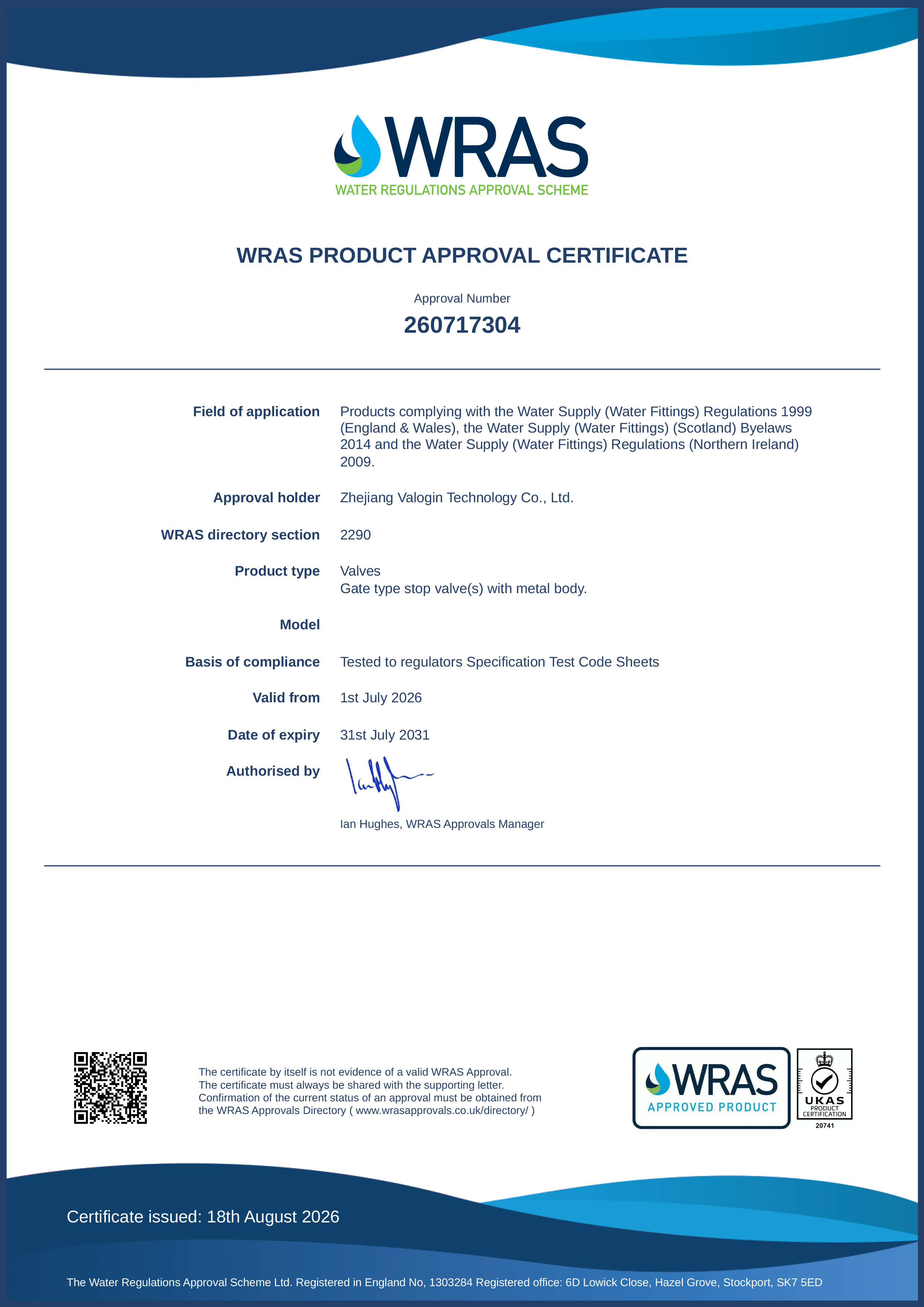
Typical programme fit: building water supply, main supply isolation, riser isolation, and plumbing wholesale ranges that need a low-resistance isolation valve alongside a quarter-turn ball valve range. The WRAS Product Approval Certificate 260717304 held by Valogin lists the product type as 'Valves - Gate', which makes gate valve specification a market-compliance question as well as a flow question. For OEM work, the gate valve can be specified with the same marking, material, finish, packaging and part-numbering controls as the rest of the range. The documented model reference is VG11.11302.
4. Brass stop valve — the regulation item in the range
A brass stop valve is included because it covers throttling and flow regulation, a duty that a ball valve or gate valve should not be asked to perform. The supplied selection guidance states that stop valves are made for throttling and can be part-open without wearing like a gate. In a heating circuit, that is the difference between isolating a line and balancing flow so radiators far from the circulator still reach design temperature.
Typical programme fit: radiator circuits, water-line balancing and heating ranges that need a regulation valve next to the isolation valves. For an OEM programme, the stop valve should be specified with the same thread standard and connection layout as the rest of the range, and with a finish that suits the installation. The documented model reference is VG16.70411, and the WRAS related-product record includes the brass stop valve under the same approval family.
5. Brass check valve — backflow prevention in the range
A brass check valve is included because it adds one-way flow protection to a brass valve range. The supplied building water scenario describes brass check valves as preventing back-flow and cross-connection between circuits. That is a different function from isolation, and it is often required in the same installation as ball, gate and stop valves.
Typical programme fit: potable water supply, plumbing ranges, heating circuits and any programme that needs a compact one-way valve alongside isolation products. The ECM certificate 0B230606.ZVTDN65 covers check valves and Y strainers against EN 12266-1:2012 and EN 12266-2:2012. For OEM supply, the check valve can be specified with the customer's marking, packaging and part number, and the test record should be linked to the batch. The documented model reference is VG12.04033.
6. Brass angle valve — fixture and radiator connection
A brass angle valve is included because it solves the connection geometry at the fixture or radiator. The supplied scenarios describe brass angle valves as connecting sanitary fixtures to the pipework and connecting radiators to the pipework in a two-pipe heating circuit. That 90-degree connection is a programme item for kit-based supply, where the valve has to match the fixture or radiator layout rather than stand alone.
Typical programme fit: sanitary fixture connection kits, radiator connection kits, and plumbing or heating ranges that are sold as installation packs. The angle valve is also a good example of why OEM customisation has to cover structure as well as marking: the connection layout and port configuration can be adapted to the customer's installation, and the thread standard can be adapted to the destination market. The documented model reference is VG14.90111, and the WRAS related-product record includes the brass angle valve.
7. Brass float ball valve — tank and float control
A brass float ball valve is included because it addresses tank and float control, a use case that is not covered by the in-line isolation types. The supplied product record identifies the brass float ball valve as a distinct range item, and the WRAS related-product record includes it under the same approval family.
Typical programme fit: water storage, tank and cistern programmes, and building-services ranges that need a float-operated valve rather than a hand-operated isolation valve. For OEM supply, the float ball valve should be specified with the customer's connection layout, marking, packaging and documentation, and the sample should be approved before mass production. The documented model reference is VG20.10212.
8. Brass bibcock — the utility outlet item
A brass bibcock is included because it is the outlet or tap item in a brass valve range, not another in-line isolation valve. The supplied product record lists the brass bibcock as a distinct product, and the WRAS related-product record includes it under the same approval family.
Typical programme fit: garden taps, utility outlets, building-services ranges and plumbing assortments that need a simple outlet valve alongside isolation and connection products. In an OEM programme, the bibcock can carry the customer's logo and part number, and it can be packed and labelled for the customer's channel. The documented model reference is VG13.99011.
9. Mix valve — mixing duty in heating and plumbing
A mix valve is included because it adds a mixing function to a brass valve range. The supplied product record identifies the mix valve as a distinct range item, and the WRAS related-product record includes it under the same approval family. The exact mixing performance should be specified to the application rather than assumed from the product name.
Typical programme fit: heating and plumbing ranges that need a mixing valve alongside isolation, regulation and connection products. For OEM work, the mix valve should be specified with the customer's connection layout, thread standard, material and finish, and with the performance targets that matter for the application. The documented model reference is VG37.10092.
10. Brass manifold — the system-level distribution item
A brass manifold is included because it turns a brass valve range into a system-level offer for underfloor heating. The supplied manifold selection guidance says to size the manifold by loop count first, then by the flow each loop needs. A manifold typically carries from two to twelve loops, and the flow meters must cover the smallest and the largest loop flow without falling off the scale. The same guidance says to check the connection size to the heat source, whether a mixing group is required, whether each loop can be isolated, and whether to add one spare loop position if the layout may still change.
Typical programme fit: underfloor heating manifold stations, heating system kits and OEM programmes where the manifold is sold with the customer's brand, part number, packaging and documentation. The documented model reference is VG21.23161, and the WRAS related-product record includes the brass manifold under the same approval family.
How to shortlist for your own programme
Shortlisting is a process of matching the valve type to the system role, then matching the specification to the market and the channel. The following sequence keeps the programme anchored in supported facts rather than assumptions.
- Start with the system role. Use ball valves for quarter-turn isolation, gate valves for low-resistance open/close isolation, stop valves for throttling, check valves for one-way flow, angle valves for fixture or radiator connection, float ball valves for tank control, bibcocks for utility outlets, mix valves for mixing duty and manifolds for multi-loop distribution. Do not use a gate valve as a throttling valve or a ball valve as a balancing valve.
- Confirm the market approval path. The supplied certificate records cover WRAS for the UK, WaterMark for Australia, Lead Free to NSF/ANSI/CAN 372 for the US, DVGW for EU gas, UPC for the US and Canada, CSA for Canada and the US, AGA for Australia and ECM/CE for the EU. Approval is product- and market-specific, so confirm the exact model and destination before the programme is locked.
- Specify material and finish to the market. The programme can specify brass grade and lead content to the customer's market requirement, and natural brass, nickel-plated or chrome-plated finish. Seal and gasket material should be selected for the medium. For potable or aggressive water, dezincification resistance should be part of the material discussion; ISO 6509-1:2014 is the test method for dezincification resistance of copper alloys with zinc.
- Set the branding and packaging scope. Customer logo and part number can be cast, stamped or laser-marked on the body and handle. Private-label casting marks, customer packaging, labels and printed documentation are part of the OEM scope. Part numbering and traceability can follow the customer's own numbering system.
- Check the commercial envelope. The supplied capability record states an MOQ of 5,000 units and a typical lead time of 50 days. Monthly capacity is listed at 15 million pcs. Production can be scheduled to the customer's forecast and delivery window.
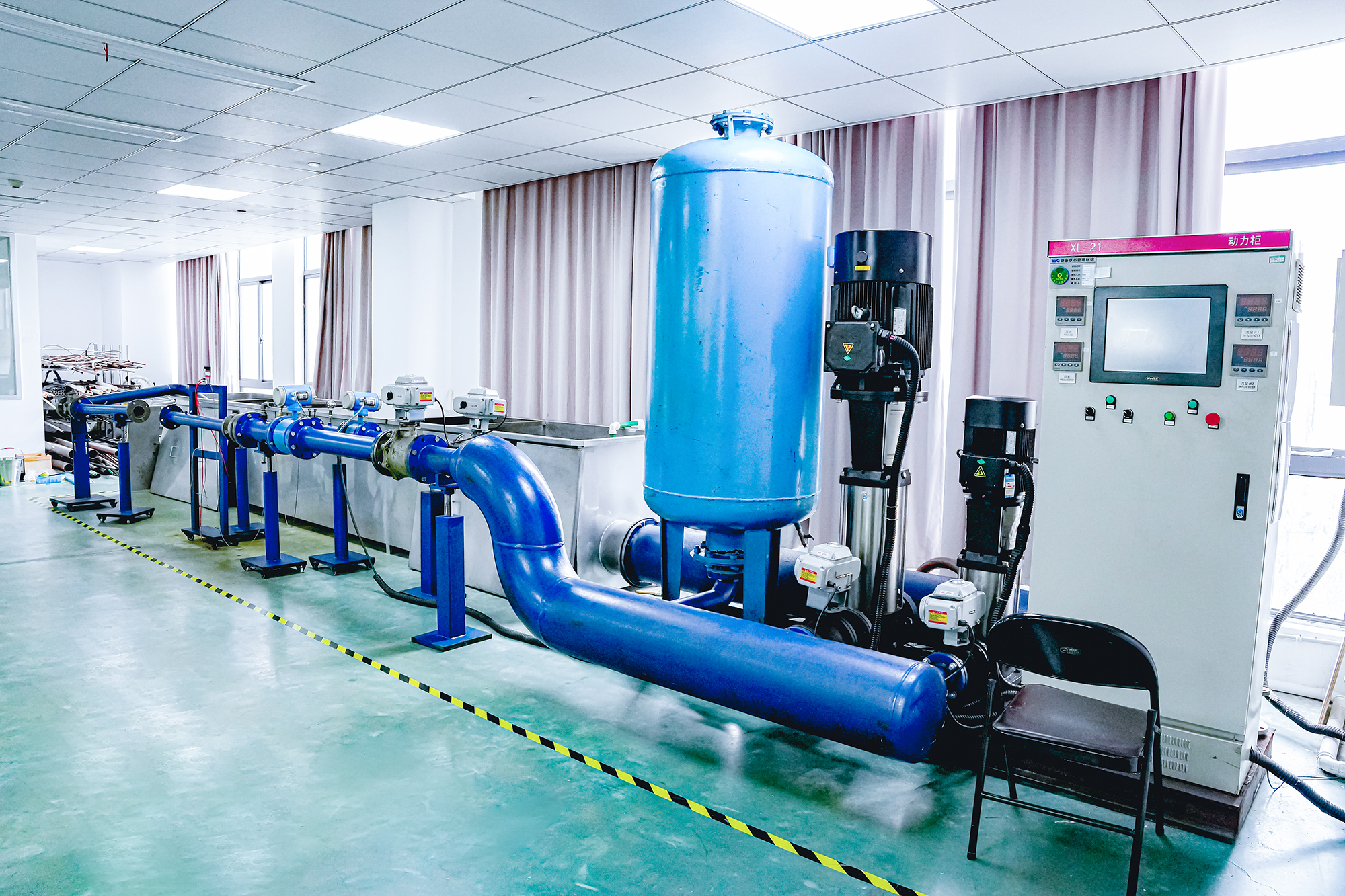
- Verify the quality process. The record states 100% air-tight test, dimension sampling per batch and material certificate on request. Sample approval before mass production is part of the after-sales scope, together with batch inspection records and material certificates with each shipment.
Compliance and material checks that change the shortlist
Market compliance is not a single certificate that covers every brass valve type. WRAS approval, for example, applies to a specific product and material combination, and the supplier should be able to state the approval number and list which models are covered. The supplied WRAS Product Approval Certificate 260717304 is issued for gate valves and lists a related-product family that includes ball, gas ball, gate, stop, check, angle, float ball, bibcock, mix and manifold products. That does not mean every model is automatically approved; it means the approval record identifies the covered product family and the market scope.
For North America, the Lead Free certificate 7555 covers lead-free plumbing products against Section 1417(d) of the Safe Drinking Water Act, Section 116875 of the California Health & Safety Code and NSF/ANSI/CAN 372-2024. The UPC certificate 7553 covers ball valves against IAPMO/ANSI Z1157-2014e1 (R2019), ASME A112.14.2022/CSA B125.14:22 and NSF/ANSI 14-2023. The CSA certificate 2759792 covers gas valves for Canada and the US. For Australia, WaterMark certificate WM-022194 covers in-line valves for plumbing water supply systems under WMTS-012:2018, and AGA certificate 8775 covers a manual shut off valve. For the EU, DVGW certificate DG-4312DQ0883 covers gas shut-off valves under DIN EN 331, and ECM certificate 0B230606.ZVTDN65 covers check valves and Y strainers under EN 12266-1:2012 and EN 12266-2:2012.
Thread standard is another shortlist item. ISO 228 is the standard for pipe threads where pressure-tight joints are not made on the threads; it defines the parallel G thread, often called BSPP. Because the thread itself does not seal, an ISO 228 G connection must seal on a flat face with a gasket, or on an O-ring or bonded seal. North America uses NPT instead. The OEM capability record allows body dimensions and connection threads to be produced to the customer's drawing in NPT or BSP/G thread, so the thread standard should be fixed before the drawing is approved.
Material choice should also reflect the water. Dezincification is the selective leaching of zinc out of brass, leaving a porous copper-rich layer that can look pink or reddish and has little strength. The supplied risk guidance links it to soft or low-hardness water, high-chloride water, stagnant or warm conditions, and notes that a dezincified valve can look normal from the outside and then fail under pressure. DZR brass is formulated to resist this and is the normal specification for potable and aggressive water. If a programme targets potable water in a market with aggressive water chemistry, the brass grade and lead content should be agreed with the supplier before the first sample is approved.
Frequently asked questions
Which OEM HVAC valve manufacturers have in-house assembly?
Valogin Valve describes OEM, ODM and customised production in which casting, machining, assembly and testing are handled to the customer's specification. The supplied factory record includes automatic assembly areas for ball valves and isolation valves and an automatic gate valve production line for assembly. In-house assembly matters because the customer needs repeatable assembly and testing across batches, not only a machined body. Buyers should still verify the scope for the exact valve type, because assembly and test arrangements can differ by product family.
Can you manufacture brass valves under our own brand?
Yes. Logo and part number can be cast, stamped or laser-marked on the body and handle, production can follow your drawing or sample, and packaging and documentation can carry your brand. Private-label casting marks, customer packaging, labels and printed documentation are part of the OEM scope. An approved sample and its inspection record set the standard that later batches are checked against.
Ball valve, gate valve or stop valve — which one should I use?
Use a ball valve for quarter-turn isolation, because the handle shows the valve state at a glance. Use a gate valve for low-resistance isolation on a straight-through bore, but only for fully open or fully closed duty. Use a stop valve for throttling and flow regulation. In a single building water or heating range, the three types can sit together: ball for isolation, gate for low-resistance main or riser isolation, and stop for regulation.
What should I check before choosing a brass valve factory for private-label supply?
Check whether the factory controls its own casting and machining or only assembles bought-in parts; whether it tests each valve and can show the record; whether it can work to your drawing and mark the valve with your brand; and whether it can repeat the same specification on later orders. The supplied buying guidance also recommends agreeing the specification, marking and packaging in writing before tooling or branding begins. A factory audit or live video walkthrough of the casting, machining and test areas is more useful than a generic certificate with no batch link.
How do I verify that a brass valve supplier really pressure-tests every valve?
Write the test method and pressure into the specification, require a test record linked to a batch or date code marked on the goods, and ask to see the test station on a factory visit or video walkthrough. The supplied risk guidance states that a generic certificate with no batch link proves nothing. Valogin's capability record states 100% air-tight test, dimension sampling per batch and material certificate on request. To discuss a sample or quotation for a specific programme, contact the Valogin Valve team at sales62@valogin.com.
Conclusion: build the range around the system, not the catalogue
The ten brass valve types in this ranking are not interchangeable catalogue lines. Each one has a different system role, and the OEM programme should reflect that role in the specification. Ball valves anchor quarter-turn isolation; gas ball valves carry the gas approval path; gate valves provide low-resistance isolation; stop valves regulate; check valves prevent backflow; angle valves solve fixture and radiator connection; float ball valves serve tank control; bibcocks serve utility outlets; mix valves add mixing duty; and manifolds turn the range into an underfloor heating system offer.
The common thread is control. Valogin Valve's supplied capability record covers customisation of structure, material, marking and logo; brass grade and lead content to the customer's market; natural brass, nickel-plated and chrome-plated finishes; private-label casting marks; customer packaging, labels and printed documentation; part numbering and traceability in the customer's own system; and sample approval before mass production. With an MOQ of 5,000 units and a typical 50-day lead time, the programme can be planned as a repeat supply rather than a one-off order. The practical next step is to shortlist the valve types by system role, confirm the market approval path for the exact models, and approve a sample against the agreed specification.

For the full product and factory overview, download the Valogin Valve brand catalogue (PDF). For a sample, quotation or programme review, contact sales62@valogin.com.
Have Questions or Need More Details?
Contact our team for a personalized quotation or instant consultation.
Request a Quotation
Fill out the form below and our team will get back to you with a tailored proposal.
WhatsApp Direct Chat
Prefer to chat in real-time? Message us on WhatsApp for instant assistance & quick answers.
- Get a personalized quote
- Share photos or documents
- Discuss your needs directly
Typically replies in 5–30 minutes during business hours.