
VT-1000 vs VT 900: Single or Double-Layer Roll Forming
VT-1000 vs VT 900: Single-Profile vs Double-Layer Roll Forming Machine Guide
The choice between the VT-1000 and the VT 900 is a panel-mix decision before it is a price decision. The VT-1000 is a single-profile metal roof sheet roll forming machine: one set of forming stations, one panel profile, one line layout. The VT 900 is a double-layer roll forming machine built on a dual-structure frame that carries two profile sets on one machine instead of two independent lines.
If nearly all of your output is one roof profile, the single-profile line is the simpler asset to specify, install and maintain. If you routinely ship two roof profiles — an 840 and an 860, for example — the double-layer frame is the configuration worth comparing against a two-machine layout, and the comparison belongs on panel mix, floor space, thickness range, control and tolerance rather than on purchase price alone.
Quick answer
- One profile, one line: VT-1000, stated at ±1.0 mm cut-length tolerance and ±0.5 mm profile tolerance.
- Two profiles, one frame: VT 900, specified for 0.3–0.8 mm material.
- Cost benchmark: Vantools states the dual-structure design, with a double-layer option, reduces equipment investment by 30–40% against buying two independent machines.
- Measure output in metres per shift, including coil change and cut cycle — not in metres per minute alone.
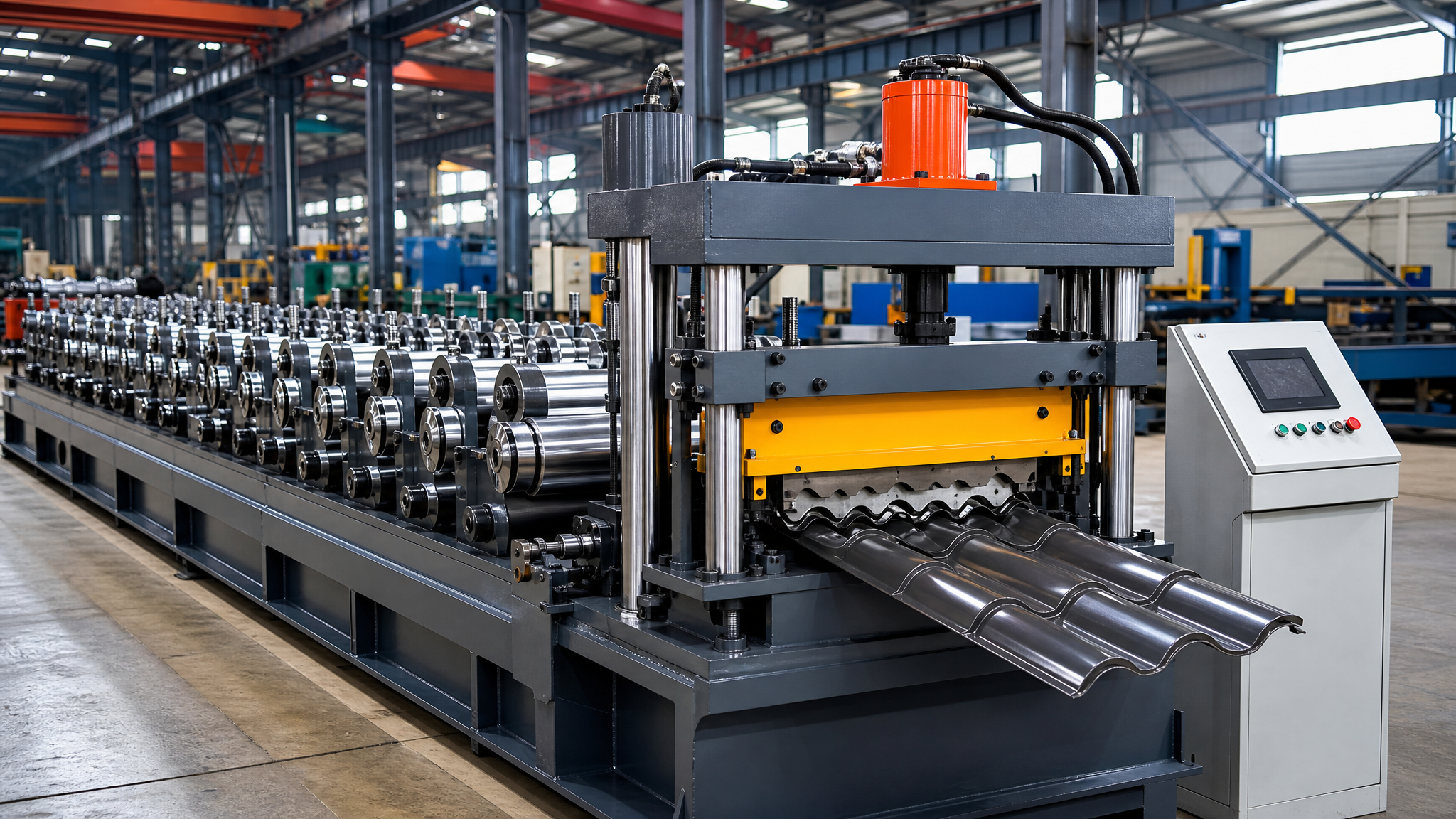
1. What a single-profile line and a double-layer frame actually are
A single-profile roll forming machine forms one panel profile. Everything in the specification follows from that one profile: the number of forming stations must match the profile depth and should not be treated as a fixed number across machine models, the shaft diameter must scale with panel width and thickness, and the welded frame is stress-relieved after welding so the geometry holds during continuous running. Roller material, hardness and plating belong in the written order, not in a verbal discussion.
A double-layer machine places two profile sets on one dual-structure frame. Vantools states that this dual-structure design, offered with a double-layer option, is an alternative to buying two independent machines and lowers equipment investment by 30–40% compared with that two-machine route. The practical meaning is narrower than it sounds: one base frame, one control system and one installation instead of two.
Tangshan Vantools Industries Co., Ltd. (Vantools), the manufacturer behind the vantools roll forming machine range, is a manufacturer and exporter of metal processing machinery headquartered in Tangshan, Hebei Province, China, with a 12,000 m² factory organised into seven production zones and exports to more than 100 countries. Its colour-steel cold roll forming range covers corrugated, trapezoidal, double-layer and glazed tile roof lines, purlin and light steel keel machines, plus roof curving and ridge cap equipment.
The limit matters at the quotation stage. A double-layer machine gives two profiles, not a changeable library. A third roof profile still needs a third set of rolls and its own specification, so the configuration only pays off when the two profiles on the frame are the two you actually sell.
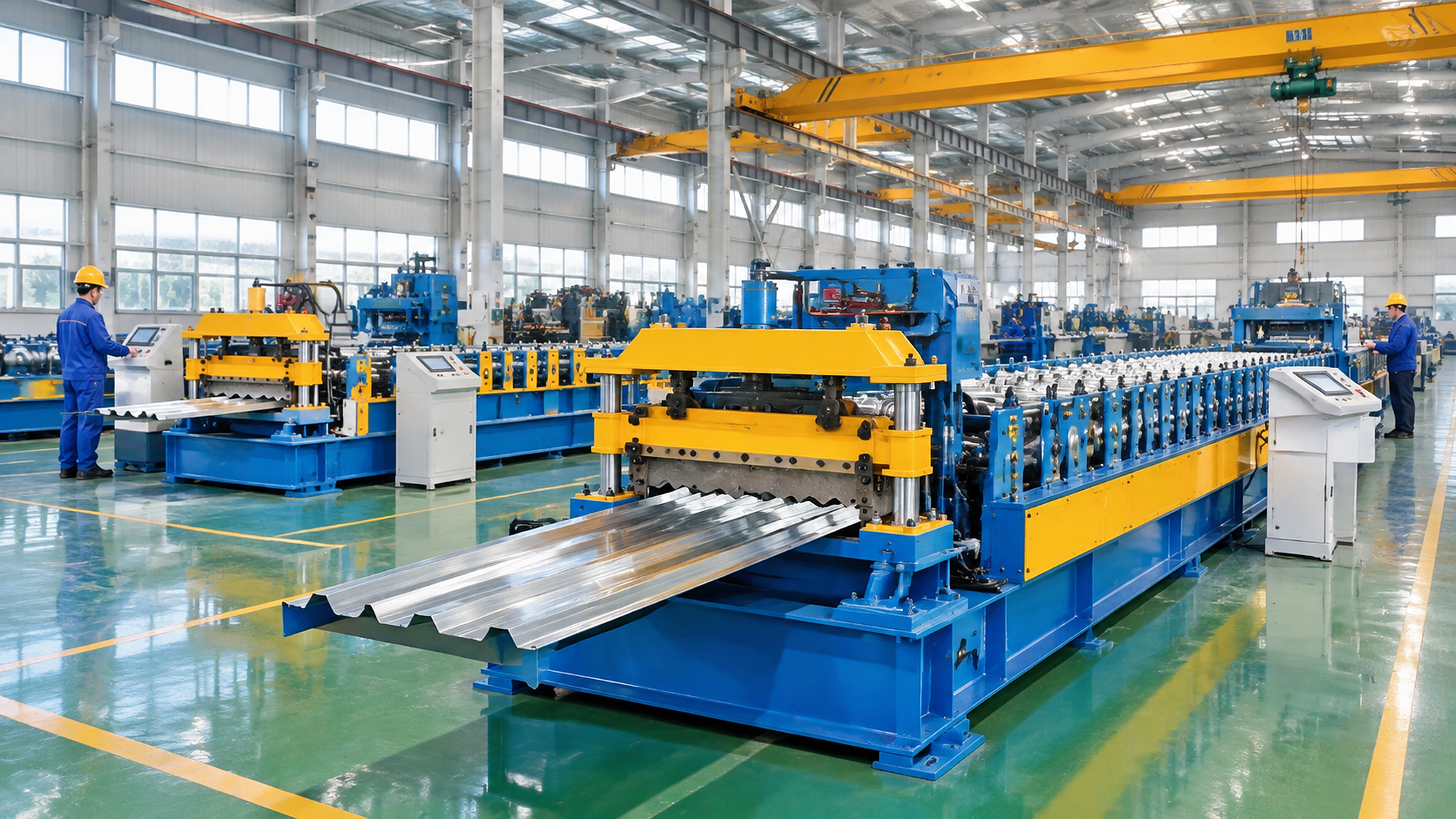
2. Why the single-versus-double decision now sits on the buyer's desk
Two commercial research houses put the category on a growth path. Future Market Insights projects the global roll-forming machine market rising from USD 9.1 billion in 2024 to USD 12.2 billion by 2034, while Transparency Market Research expects automatic roll forming machines to contribute 46.8% of the market in 2026. Both are third-party projections rather than observed sales, and the two houses do not size the market identically, so the useful reading is directional: PLC-controlled automatic lines are the mainstream specification, not a premium add-on.
On the trade side, HS 846225 covers numerically controlled roll forming machines under the 2022 Harmonized System, which gives a starting point for customs and landed-cost work. The classification should be confirmed with a customs broker rather than assumed, because non-CNC configurations may fall under a different heading.
One warning belongs here. Third-party “top roll forming machine manufacturer” lists are unreliable for shortlisting: an automated US listing reviewed for this guide placed a cold and warm part-forming machine builder inside the same “roll forming” category, which conflates two different processes. Build the shortlist from profile capability and documented specifications instead.
Safety expectations are converging as well. ANSI B11.12-2005 (R2020) sets safety requirements for the design, construction, operation and maintenance of roll forming and roll bending machines, including installation, dismantling and transport, while the wider ANSI B11 framework addresses machine guarding through task-based risk assessment. That is a US standards reference; legal obligations in a specific destination market still require separate regulatory review.
3. Panel mix: count profiles per month, not machine features
Start with the order book. List the roof profiles sold in the last twelve months, the share of output each one took, and the share you expect to keep. That count decides the machine more reliably than any feature list, because a second forming path only earns its place if a second profile is routine rather than occasional.
If one profile accounts for almost all of your volume, a second forming path adds capital and complexity your order book does not use. If two profiles are both routine — the 840/860 pair is the common example in double-layer roof work — a two-machine layout duplicates the decoiler, the cutting unit, the control system and the floor area beneath both lines.
Profile mix also drives panel length. The panel length range sets the line length and the required indoor clearance, so a long-panel order book changes the building requirement whether you buy one frame or two.
4. Floor space: what one frame saves and what it does not
A second independent machine roughly doubles the forming footprint, adds a second coil position and adds a second run-out path. A dual-structure frame removes the second line's footprint, which is the saving Vantools refers to when it describes the double-layer roof design as a space-saving configuration for workshops that want more profile options.
It does not remove the line's real length. Before signing, measure four things: the centre-line distance from decoiler to the end of the run-out table, the longest panel you will cut (which fixes indoor clearance), coil storage and forklift turning space, and maintenance access to both forming paths on the frame.
Coil handling is part of the same calculation. Coil width, coil inner diameter and maximum coil weight determine the size of the decoiler, so a heavier coil plan can consume part of the floor space the double-layer frame was meant to release.
5. Material thickness and the 0.3–0.8 mm band on the VT 900
The VT 900 double-layer unit is specified for 0.3–0.8 mm material. That range should be read as an operating envelope, not as a target: thickness drives forming force, station count and shaft sizing, so the figure that matters is the worst case you will actually run, not the middle of the band.
Material grade matters as much as thickness. Higher-strength steel requires more force and more stations for the same profile, and pre-painted coil needs non-marking rollers to protect the finish. On the Vantools platform the roll set is described as 45# forged steel, hard-chrome plated to 0.05 mm with a mirror finish, with a stated pre-painted surface scratch rate below 0.01%; the main shaft is a Φ75–80 mm 40Cr solid shaft, quenched and tempered, on a heavy-duty I-beam base frame.
Ask two questions before accepting the range. Which thicknesses is this specific roll set optimised for, and do the two profiles you want both sit inside that working band? A double-layer frame carrying one profile that runs comfortably and one that runs at the edge of its range is a different asset from one carrying two comfortable profiles.
6. PLC, touch screen and recipe storage on a two-profile machine
Both machines run from a PLC with touch-screen operation, which simplifies parameter setting and lowers the learning curve for a new operator. The difference is how much the control system has to remember. Length tolerance in millimetres, pre-cut versus post-cut, offcut handling and PLC recipe storage should all be confirmed in the machine specification, and on a two-profile machine the recipe function carries more weight because two parameter sets live on one control.
Treat recipe storage as an error-prevention feature rather than a convenience. When an operator can recall a stored parameter set instead of retyping station and cut values, the risk of a mis-set run falls — but it does not disappear, so the first panel after a profile change still needs a check.
The drive and cutting specification is worth reading alongside the control section: VFD soft start with a cycloidal pinwheel reducer, a hydraulic proportional valve for oil supply, and a simple hydraulic cutting system with easy access for routine inspection and part replacement. Vantools quotes a calibration interval above 12 months and unplanned downtime below 2 days per year for the platform.
7. Tolerances: ±1.0 mm cut length and ±0.5 mm profile on the VT-1000
Two different tolerances decide whether a panel fits on site. Cut-length tolerance is the accuracy of the finished panel length after cutting; profile tolerance is the accuracy of the formed cross-section. The VT-1000 is stated at ±1.0 mm cut length and ±0.5 mm profile. Squareness is a third check: the platform's diagonal tolerance is stated at ±1.0 mm over 6 m.
For context, Vantools specifies forming precision tolerance at ≤ ±0.5 mm against ±1.0–1.5 mm for common market machines, with a sheet deformation rate below 1%, which the company links to flatter, more uniform sheets and a lower scrap rate. These are manufacturer-stated figures; a buyer should ask for the measurement basis that goes with them.
That basis is what makes a tolerance enforceable. A tolerance quoted without a stated measurement method and measuring position cannot be checked at acceptance, so request both in writing and agree where the check is taken on the finished panel.
Speed and energy belong in the same conversation. Vantools states forming speed up to 18 m/min, described as 20–30% higher than standard roll formers, with specific energy consumption of 0.32 kWh per 100 m of sheet and overall power savings of 25–30% compared with generic machines. Convert that into metres per shift, including coil change and cut cycle, before you compare two quotations.
8. Step-by-step: how to run the VT-1000 versus VT 900 evaluation
The sequence below keeps the comparison honest, because each step produces a document you can hold a supplier to.
- Profile drawing first. Provide a dimensioned drawing covering cover width, rib height, rib pitch and every bend. Without the drawing, the machine cannot be specified, and any quotation received before it is a placeholder.
- Fix the thickness and material. State the range and the worst case you will really run, plus yield strength and coating. For a VT 900 enquiry, confirm that both intended profiles fall inside the 0.3–0.8 mm band.
- Define output correctly. Ask for metres per shift including coil change and the cut cycle, not metres per minute. Panel length range then fixes line length and indoor clearance.
- Lock the skeleton, cut and control specification. Station count against profile depth, shaft diameter against panel width and thickness, roller material, hardness and plating in writing, and length tolerance with pre-cut or post-cut, offcut handling and PLC recipe storage.
- Confirm the electrical and environmental envelope. Voltage and frequency for the destination market, and any special temperature or working-environment requirement. Published working-condition data for Vantools roof and wall panel lines includes an IP54 sealed electrical cabinet, ambient operation from -20 °C to +50 °C, and stable running under ±10% grid fluctuation.
- Require pre-shipment proof. A test machine video must be checked before the machine leaves the factory, and inspection documentation should be agreed as part of the order.
- Normalise the quotes. Compare the same scope: decoiler, running system, cut, control platform, tooling, voltage, documentation and packing. A lower headline price with a manual decoiler and no recipe storage is not the same machine.
9. The 840/860 double-layer case: what it shows and what it does not
The most useful decision evidence for this comparison is the 840/860 double-layer project case. One machine producing two profiles was reported with a 40% output increase, scrap below 0.4%, and annual coil-loss savings above USD 28,000.
What the case shows is the mechanism, not a promise. Running two profiles from one frame removes the duplicated handling and idle time that a two-line layout carries between product runs, and the measurable results appear in two places a buyer can audit: scrap rate and coil loss.
What it does not show is your result. A 40% output increase is relative to that project's baseline, not to a named competitor, and the USD 28,000 coil-loss figure depends on coil price, annual tonnage, scrap baseline and how often the profile changes. Ask for the assumptions behind the calculation and rebuild it with your own coil cost and volume before you treat the number as a budget line.
10. VT-1000 vs VT 900 at a glance
The table compares only dimensions that can be stated from the specification and the case evidence. Where a value depends on your profile, the correct cell is the question to ask rather than a number to copy.
| Decision dimension | VT-1000 (single-profile) | VT 900 (double-layer) |
|---|---|---|
| Profiles per machine | One roof profile | Two roof profiles on one frame |
| Frame architecture | Single forming path; station count matched to profile depth; stress-relieved welded frame | Dual-structure frame carrying two profile sets with one control system |
| Material thickness | Roll set sized to the worst-case thickness you will run | Specified for 0.3–0.8 mm |
| Tolerance | Cut length ±1.0 mm; profile ±0.5 mm | Cut-length and profile tolerance confirmed in the order specification |
| Control | PLC with touch-screen operation and recipe storage | PLC with touch-screen operation; recipe storage for both profiles |
| Floor space | One line footprint plus run-out length for the longest panel | One frame instead of two lines; saves the second line's footprint |
| Investment benchmark | Single-machine baseline | 30–40% lower than buying two independent machines (Vantools statement) |
| Best fit | One dominant profile, high volume, dedicated line | Two routine roof profiles with constrained floor area |
| Main limitation | A second profile needs a second machine | Two profiles only; not a flexible profile library |
11. Which buyer should choose which
Dedicated single-profile production. A roofing sheet factory running daily production and shipping panels straight to project sites gains little from a second forming path it rarely uses. The VT-1000 keeps setup, training and maintenance focused on one profile.
Two routine roof profiles in a tight building. A producer whose order book splits between two profiles — again, the 840/860 pattern — and whose building bay is already committed should price the VT 900 against two machines rather than against one, because the relevant baseline is the two-line layout the frame replaces.
A new entrant with limited capital. Starting on one profile and confirming the market before adding capacity is a defensible path, provided the panel length range and coil plan are specified for the line you may later expand around.
A job shop quoting mixed roof work. The double-layer frame suits a producer who needs to switch between two profiles within a week, but only if both profiles sit comfortably inside the 0.3–0.8 mm band and the recipe sets are stored and verified at commissioning.
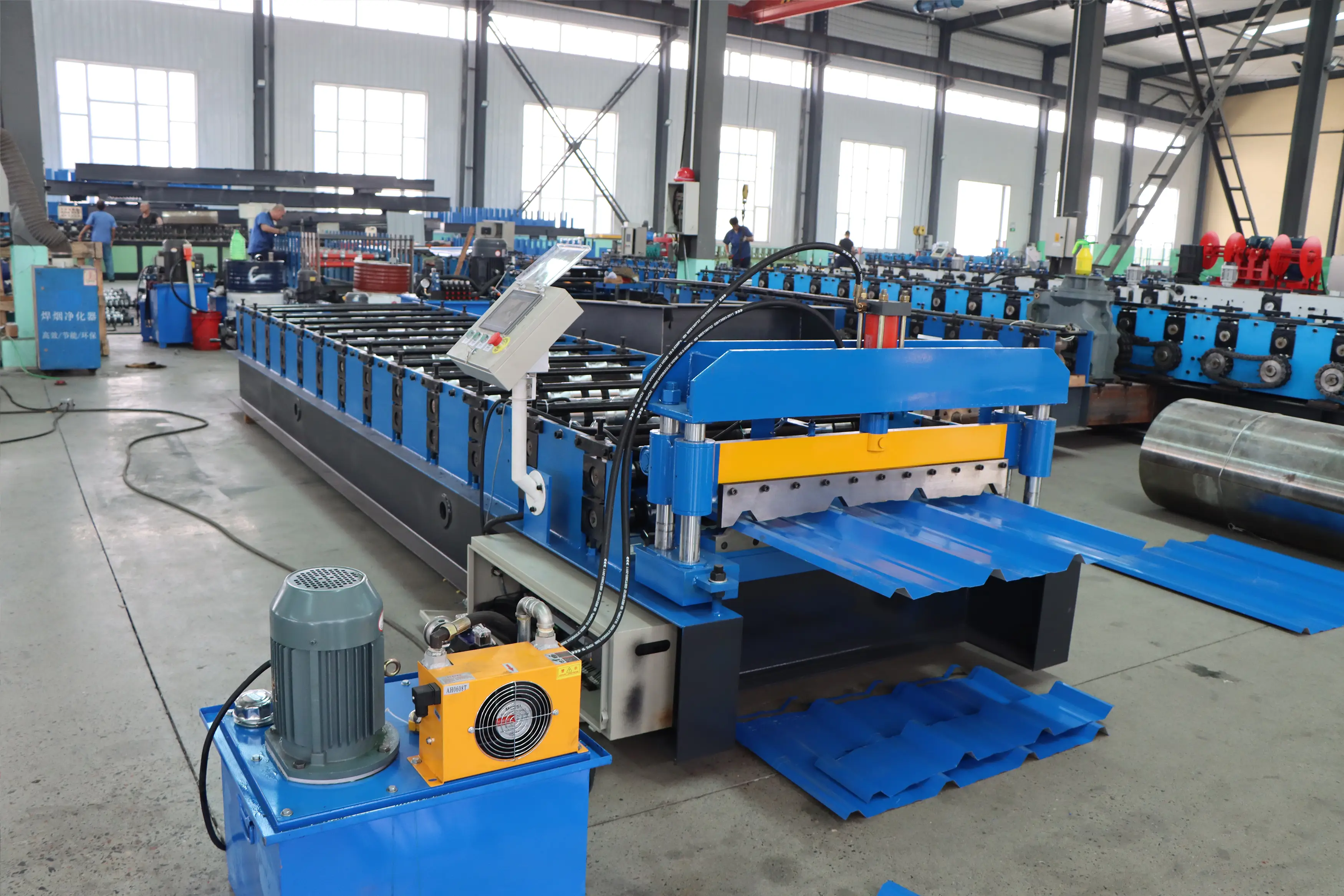
12. Limitations and checks before you sign
- Two profiles is a ceiling, not a range. A third profile requires a third roll set and a separate specification.
- Space saved is footprint, not total length. Run-out length for the longest panel and coil handling still occupy floor area.
- Tolerances need a measurement basis. Agree the method and the measuring position, or the number cannot be checked at acceptance.
- Safety is a specification item. Use ANSI B11.12-2005 (R2020) scope and the ANSI B11 guarding framework as a reference, and confirm destination-market obligations separately.
- Market projections are projections. The USD 9.1 billion to USD 12.2 billion pathway and the 46.8% automation share describe a research house's model, not observed orders.
- Verify the supplier, not the list. Ask for the test video, inspection report and material certificates rather than relying on third-party rankings.
Frequently asked questions
What safety standard applies to a VT-1000 or VT 900 roll forming machine order?
ANSI B11.12-2005 (R2020) specifies safety requirements for the design, construction, operation and maintenance of roll forming and roll bending machines, including installation, dismantling and transport, and the wider ANSI B11 framework covers machine guarding through task-based risk assessment. That framework is a starting reference for an RFQ and acceptance checklist; it does not establish legal compliance in every destination market, so jurisdiction-specific regulatory review is still required. In practice, add guarding, emergency stop, the correct voltage and frequency for the destination market, and any special temperature or working-environment requirement to the written order.
Can one double-layer machine produce two roof profiles without a second line?
Yes, within the configured pair. The VT 900 carries two profile sets on one dual-structure frame and is specified for 0.3–0.8 mm material. In the 840/860 project case, one machine producing two profiles was reported with a 40% output increase, scrap below 0.4% and annual coil-loss savings above USD 28,000. Those figures belong to that configuration and operating pattern, not to every installation. Before ordering, confirm that both profiles sit inside the working thickness band and that the PLC recipe sets for both are stored and verified at commissioning.
Which China roof roll forming machine manufacturers offer competitive quotes for South Asian buyers?
Competitive is a specification question before it is a price question. A quote can only be compared when both suppliers price the same profile drawing, thickness range, station count basis, cutting type, control platform, voltage and included equipment. Vantools supplies factory direct, exports to more than 100 countries with South Asia listed among its main markets, and supports OEM, ODM and full customization of profile drawings, machine parameters, voltage and frequency, branding and packaging. For an order-of-magnitude reference only, customs data republished under HS 84552200 put the average import unit value of roofing machines at roughly USD 34,318 per set in 2016 — a historical figure that predates current automation levels and should not be treated as today's price. Confirm the applicable HS classification, such as 846225 for numerically controlled roll forming machines, with your customs broker.
Can I check a sample panel or test video before the machine ships?
A test machine video must be checked before the machine leaves the factory, and that requirement should be written into the order rather than assumed. Vantools runs a three-tier inspection system and provides inspection videos, paper inspection reports and material certificates on request, with pre-delivery inspection covering electrical safety, hydraulic sealing, forming accuracy and safety protection. For a two-profile machine, ask for footage of both profiles running, not one.
What does installation and leveling involve, and what support follows?
Place the line on a level concrete floor that can carry the machine weight, and level from the forming frame rather than from the floor: mark the centre line and anchor the main frame, level the frame in both directions with a machinist level and shim the feet, mount the decoiler at the correct height so the coil feeds straight into the first station with no rise or fall, align the run-out table to the exit line, and check chain tension. Guards must stay in place and power must be isolated before maintenance. Vantools provides 7×24 remote technical support, online commissioning guidance and operator training for the service life of the equipment. If you want to take the specification discussion further, the roll forming machine catalogue sets out the wider range, and a profile drawing is the fastest way to get a configuration-specific answer.
Conclusion
The VT-1000 and the VT 900 answer two different order books. One profile, one line and a stated ±1.0 mm cut length with ±0.5 mm profile tolerance suits a producer whose volume concentrates on a single roof sheet. Two profiles on one dual-structure frame, specified for 0.3–0.8 mm material, suits a producer who regularly ships an 840/860 pair and cannot justify the footprint, capital and duplicate equipment of a second independent line.
Decide on the profile drawing first, then on the thickness band, then on metres per shift, and only then on price. Use the 840/860 case as evidence of a mechanism — one frame, two profiles, measurable scrap and coil-loss effects — and rebuild its savings with your own coil cost and volume rather than adopting its number.
Still comparing one line against two profiles on one frame? Send the dimensioned profile drawing and the thickness range you will actually run, and the configuration can be quoted against your own production pattern.
Have Questions or Need More Details?
Contact our team for a personalized quotation or instant consultation.
Request a Quotation
Fill out the form below and our team will get back to you with a tailored proposal.
WhatsApp Direct Chat
Prefer to chat in real-time? Message us on WhatsApp for instant assistance & quick answers.
- Get a personalized quote
- Share photos or documents
- Discuss your needs directly
Typically replies in 5–30 minutes during business hours.