Ceramic Bonded Grinding Wheel Spec Guide: Internal, Centerless & Cylindrical Grinding
Ceramic Bonded Grinding Wheel Spec Guide: Internal, Centerless & Cylindrical Grinding
A ceramic bonded grinding wheel is a bonded abrasive product in which abrasive grain is held together by a vitrified bond, with porosity between grain and bond. That single construction description covers a 150 mm bore wheel and a 700 mm roll wheel alike — yet the two are not interchangeable. What decides whether a wheel survives in internal (bore), centerless or cylindrical grinding is not the phrase “ceramic grinding wheel” on the drawing. It is the combined specification of abrasive type, grit, grade, structure, bond, geometry and permitted peripheral speed.
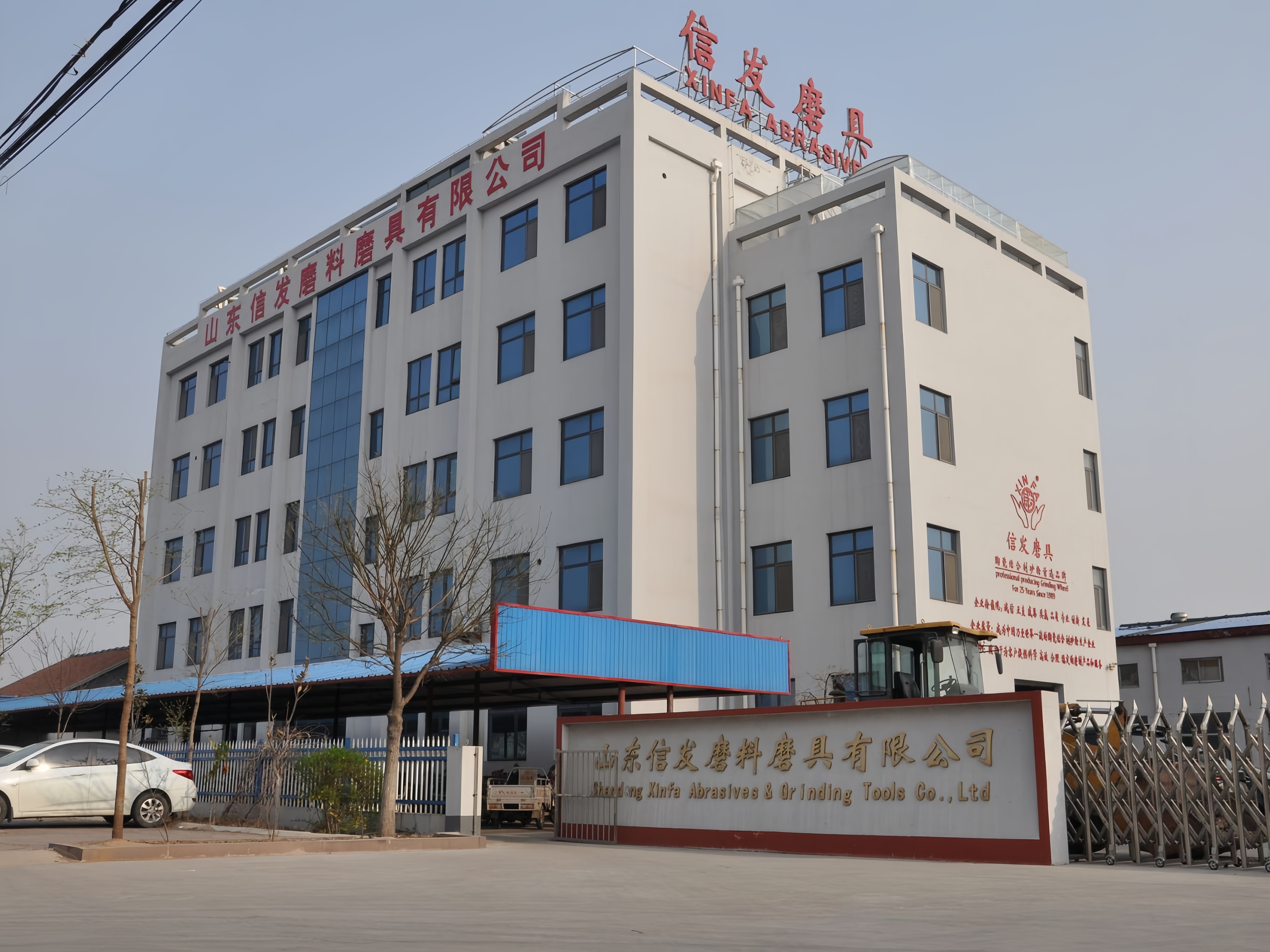
This guide maps six abrasive types — Brown Fused Alumina (A), White Fused Alumina (WA), Pink Fused Alumina (PA), Green Silicon Carbide (GC), Black Silicon Carbide (C) and SG ceramic alumina — onto the three grinding scenarios, then sets out the parameter checks that should be completed before a purchase order is issued. Reference markings and capability data are taken from the vitrified bond grinding wheel range of Shandong Xinfa Abrasives & Grinding Tools Co., Ltd., a bonded abrasive manufacturer established in 1989 and located in Junan County, Linyi City, Shandong Province, China, whose product categories include Internal (Bore), Centerless, Cylindrical, Bearing, Gear, Worm, Roll, and Crankshaft & Cam Shaft grinding wheels.
Problem Definition: Why Wheel-Form Specifications Fail Before the Wheel Is Even Made
The most common failure in ceramic grinding wheel procurement is a request written at the wrong level of abstraction. A buyer specifies “ceramic grinding wheel, 60 grit” and the quotation returns a wheel that matches the words but not the machine. Three mechanical facts make this predictable.
- The mounting interface decides the geometry envelope. An internal (bore) wheel must fit inside the bore it grinds and on a spindle whose diameter sets the wheel bore. A centerless wheel must be wide enough for the through-feed or plunge length and must be matched to the regulating wheel. A cylindrical wheel must align its face width with the traverse length. Diameter, bore and width are therefore fixed by the machine, not by preference.
- The marking string hides four independent variables. A marking such as 350×100×127 A 60 N 5 V 35m/s encodes dimensions, abrasive type, grit, grade, structure, bond and maximum peripheral speed in one line. Change any one of them and the wheel behaves differently, even though the diameter and the words on the box are unchanged.
- Wheel condition drives surface quality. Peer-reviewed research published in 2024 states that the condition of a grinding wheel directly affects the surface quality of the workpiece, and that monitoring wheel wear state allows evaluation of wheel condition. A wheel that is dimensionally correct but metallurgically wrong will show up as burn, chatter or size drift — long after delivery.
The practical consequence: a ceramic grinding wheel specification should be built scenario-first, not name-first. Decide the grinding operation, then the abrasive, then the geometry, then the grade and structure, then confirm the speed rating against the machine spindle.
Industry Background: Standardisation, Demand and the Limits of Generic Standards
Several independent signals explain why wheel-form-specific specification is now a normal procurement discipline rather than an engineering nicety.
Demand for precision machining continues to pull the category forward. Commercial market research projects the global grinding wheel market to grow at a compound annual growth rate of 6.7% between 2025 and 2032, with precision machining demand identified as the driver. Within the raw material layer, Brown Fused Alumina held the largest product-type share of the fused alumina market at 52.4% in 2025 — a useful indicator of how heavily general-purpose ferrous grinding still relies on that grain. One commercial forecast places the centerless grinding wheel segment at USD 4.7 billion in 2025, rising to USD 7.2 billion by 2033.
Standards activity tells a more cautious story. ISO 603-14:2022 specifies common nominal dimensions for shape types 6, 11, 27, 28 and 29 bonded abrasive products intended for deburring, fettling and snagging with hand-held grinding machines. That scope matters: it is a dimensional standard for hand-held tooling, and it should not be presented as the governing dimensional rule for internal, centerless or cylindrical wheels. Safety conformity references appear in a different place — commercially published wheel technical data sheets, such as 3M’s Cubitron 3 depressed-center sheet, cite EN 12413 and ANSI B7.1. ANSI B7.1 is the recognised United States benchmark for the safety requirements covering use, care and protection of abrasive wheels. ISO 603-14 and ANSI B7.1 therefore answer different questions, and neither one replaces a specification drawing.
Detailed Solution: Mapping Abrasive Type to Internal, Centerless and Cylindrical Grinding
Abrasive type is the first decision because it sets the relationship between the grain and the workpiece material. The descriptions below are selection logic based on established abrasive practice; final confirmation belongs to a trial on the customer’s own machine.
A — Brown Fused Alumina
Brown Fused Alumina is the general-purpose workhorse grain for ferrous materials, and its dominant position in the fused alumina market (52.4% share by product type in 2025) reflects how much routine grinding still depends on it. It is the default starting point for cylindrical and centerless work on carbon and low-alloy steels where a balance of toughness and cost matters more than the last increment of surface finish. In Xinfa’s listed ceramic bonded wheel models, A appears across a wide dimensional span, from 150×25×31.75 A 46 R 5 V 35m/s up to 700×19×203 A 60 N 5 V 35m/s.
WA — White Fused Alumina
White Fused Alumina is a higher-purity aluminium oxide grain that fractures more readily than Brown Fused Alumina, which keeps sharp edges exposed and reduces the heat pushed into the workpiece. It is commonly evaluated for tool steels, high-speed steel and heat-sensitive cylindrical or internal work where burn control dominates the decision. It is expensive relative to A, so it is normally specified where the finish or burn requirement justifies it.
PA — Pink Fused Alumina
Pink Fused Alumina sits between A and WA in behaviour: tougher than white grain, freer-cutting than brown grain. It is frequently used for precision cylindrical and tool-grinding work where a middle position between form holding and cool cutting is required. Xinfa’s model list includes PA wheels such as 175×30×65 132*10 PA80Q5V 35m/s and 175×30×65 132*10 PA60M5V 35m/s, in which the 132*10 string is part of the original model designation rather than a decoded dimension.
GC — Green Silicon Carbide
Green Silicon Carbide is a sharp, hard grain used for cemented carbide, non-ferrous metals, and hard brittle materials that would dull aluminium oxide grain quickly. It is the natural candidate for internal (bore) work on carbide tooling and for small-diameter wheels where a free-cutting grain prevents loading. A representative model in the Xinfa range is 250×25×25.4 GC 80 M 5 V 35m/s.
C — Black Silicon Carbide
Black Silicon Carbide is the tougher silicon carbide variant, used where low-tensile-strength materials such as cast iron and certain non-ferrous alloys are ground and a more durable grain is preferable to the sharper green variety. Because it tolerates higher unit pressure, it appears in heavier section wheels; Xinfa’s 500×200×304.8 C 60 K 5 V 35m/s is an example of a wide, large-bore C wheel format.
SG — SG Ceramic Alumina
SG ceramic alumina is a microcrystalline ceramic grain rather than a fused grain. Its structure keeps sharp cutting points available as the grain wears, which is why it is evaluated in centerless and cylindrical operations where wheel life and form holding across long production runs matter more than initial cost. It is usually considered a deliberate upgrade over A for high-volume work, and it earns its place only when the trial data shows reduced dressing frequency or extended wheel life under the customer’s own conditions.
Wheel Parameter Checks: Dimensions, Bond, Grade, Structure and Speed
Once the abrasive family is chosen, six parameters must be verified against both the machine and the workpiece.
- Dimensions — outside diameter, thickness, bore. These are non-negotiable because they are set by the spindle, the wheel guard and the contact length. Confirm which dimension is the limiting one: on an internal wheel the bore and the maximum outside diameter are usually constrained by the bore being ground; on a centerless wheel the width is constrained by the feed length; on a cylindrical wheel the width is constrained by the traverse.
- Bond — V for vitrified. Vitrified bond is the “V” in every marking string in this guide, and it is the bond that makes a wheel a ceramic bonded wheel. Bond hardness is expressed through the grade letter, not through the bond type, so “vitrified” alone says nothing about how hard the wheel acts.
- Grade — the letter after the grit. Xinfa’s listed models use grades K, M, N, Q and R. Softer grades (earlier letters) suit small contact areas and heat-sensitive work; harder grades suit high unit pressure and form retention. Grade is the parameter most often changed to solve burn, and the change should be made one step at a time.
- Structure — the number before the bond. Structure describes the porosity or grain-to-bond ratio. In the Xinfa models listed here the structure number is 5 throughout, which illustrates that structure is a deliberately held constant across a range rather than a variable to be adjusted casually.
- Grit size. The listed models span 46, 60 and 80 grit. Coarser grit removes stock; finer grit controls finish. Grit and grade interact, so they should be moved together only when the trial plan accounts for both.
- Maximum peripheral speed. Every Xinfa model in this guide carries a 35 m/s rating. The rating is a safety limit, not a target: verify the machine’s spindle speed in revolutions per minute against the wheel diameter, confirm the guard and flanges match the wheel geometry, and keep the wheel’s marked limit above the calculated working speed.
Step-by-Step Breakdown: A Six-Step Specification Workflow
The sequence below keeps the specification traceable from machining operation to purchase order.
Step 1 — Name the operation and the machine. State internal (bore), centerless or cylindrical, together with the machine model, spindle speed range, wheel head mounting and coolant type. Two of the three scenario decisions are already fixed at this step, before any wheel is discussed.
Step 2 — Fix the geometry from the machine. Record outside diameter, thickness and bore, and confirm the wheel fits inside the guard with the required clearance. Check the diameter against the manufacturer’s available range: Xinfa’s vitrified bond grinding wheels cover diameters from 100 mm to 1100 mm, so most bore, centerless and cylindrical envelopes fall inside the standard span rather than requiring a special.
Step 3 — Select the abrasive family. Start from the workpiece material: ferrous and general purpose (A), heat-sensitive and tool steel (WA), precision ferrous mid-point (PA), carbide and non-ferrous (GC), cast iron and low-tensile material (C), high-volume work where wheel life dominates (SG ceramic alumina).
Step 4 — Set grit, grade and structure. Take a reference point from the closest validated model, then adjust one variable per trial. For example, the Xinfa reference points include 200×25×31.75 A 60 R 5 V 35m/s and 350×100×127 A 60 N 5 V 35m/s — same grain and grit, different grade and very different geometry.
Step 5 — Confirm speed rating and mounting. Check the marked maximum peripheral speed against the machine, verify flange dimensions and balance requirements, and record the safety conformity documentation the buyer needs. Note that dimensional standards such as ISO 603-14:2022 cover defined shape types and applications, so the applicable standard should be named explicitly in the RFQ rather than assumed.
Step 6 — Write the RFQ as a marking string plus application data. A complete line item states dimensions, abrasive, grit, grade, structure, bond and speed, and adds workpiece material, stock allowance, target surface finish and coolant. This is the format that removes the ambiguity described in the problem section above.
Use Cases: Three Grinding Scenarios and the Adjacent Wheel Families
Internal (Bore) Grinding. The wheel head enters the bore, so the wheel diameter is small relative to the bore and the spindle is slender. The dominant risks are deflection and burn, because the contact arc is long relative to the wheel diameter and the wheel is the least rigid element in the system. Wheel choice usually favours free-cutting grain — WA, PA, or GC on hard materials — combined with a grade soft enough to self-sharpen before the bore distorts. Geometry checks concentrate on bore diameter, face width against bore length, and the spindle speed needed to reach the rated peripheral speed with a small wheel.
Centerless Grinding. The workpiece is supported by a blade and driven by a regulating wheel, so the grinding wheel width, the regulating wheel match and the blade height together determine roundness and size stability. Because centerless operations run at volume, wheel life and consistent grade become economic variables rather than technical preferences; this is where SG ceramic alumina is often evaluated alongside A and WA. Centerless wheel diameter and width should be quoted together with the regulating wheel specification, since a correct grinding wheel paired with a mismatched regulating wheel produces taper and drift.
Cylindrical Grinding. The wheel contacts the outside diameter, either between centres or in a chuck, and the face width must align with the traverse length. Chatter, taper and traverse marks are the usual defect signatures. Grade and structure control the balance between stock removal and finish, and the wheel diameter must be large enough to keep the spindle rigid while remaining within the guard. A and PA are common starting points on ferrous work; C is used where cast iron or non-ferrous materials are involved.
Adjacent families. The same specification logic extends to the rest of the Xinfa range, which includes Bearing, Gear, Worm, Roll, and Crankshaft & Cam Shaft grinding wheels. These are narrower applications of the same three contact geometries: roll grinding shares the large-diameter cylindrical logic, crankshaft and camshaft grinding shares the form-holding and heat-control logic, and bearing and gear grinding shares the precision internal and cylindrical logic. A buyer who has already fixed the marking string for a cylindrical operation holds most of the fields needed for these adjacent families.
Comparison Tables
The first table reproduces marking reference points from Xinfa’s ceramic bonded grinding wheel range. It is intentionally presented as raw marking data rather than as an application ranking, because the same marking can be specified for different operations depending on the machine.
| Marking example (as listed) | Dimensions (mm) | Grain | Grit | Grade | Structure | Bond | Max speed |
|---|---|---|---|---|---|---|---|
| 150×25×31.75 A 46 R 5 V 35m/s | 150 × 25 × 31.75 | A | 46 | R | 5 | V | 35 m/s |
| 200×25×31.75 A 60 R 5 V 35m/s | 200 × 25 × 31.75 | A | 60 | R | 5 | V | 35 m/s |
| 350×100×127 A 60 N 5 V 35m/s | 350 × 100 × 127 | A | 60 | N | 5 | V | 35 m/s |
| 350×100×152.4 A 60 N 5 V 35m/s | 350 × 100 × 152.4 | A | 60 | N | 5 | V | 35 m/s |
| 500×200×304.8 C 60 K 5 V 35m/s | 500 × 200 × 304.8 | C | 60 | K | 5 | V | 35 m/s |
| 660×16×203 A 60 N 5 V 35m/s | 660 × 16 × 203 | A | 60 | N | 5 | V | 35 m/s |
| 700×19×203 A 60 N 5 V 35m/s | 700 × 19 × 203 | A | 60 | N | 5 | V | 35 m/s |
| 250×25×25.4 GC 80 M 5 V 35m/s | 250 × 25 × 25.4 | GC | 80 | M | 5 | V | 35 m/s |
| 175×30×65 132*10 PA80Q5V 35m/s | 175 × 30 × 65 (132*10 as listed) | PA | 80 | Q | 5 | V | 35 m/s |
| 175×30×65 132*10 PA60M5V 35m/s | 175 × 30 × 65 (132*10 as listed) | PA | 60 | M | 5 | V | 35 m/s |
The second table summarises how the three grinding scenarios differ in what they demand from a ceramic bonded wheel. It is selection logic, not comparative test data; the final grain and grade decision requires a trial under the customer’s own machine conditions.
| Selection factor | Internal (Bore) | Centerless | Cylindrical |
|---|---|---|---|
| Wheel–workpiece contact | Wheel head enters the bore; contact arc set by bore diameter | Workpiece supported by blade, regulating wheel and grinding wheel | Wheel contacts the outside diameter between centres or in a chuck |
| Geometry emphasis | Small outside diameter, face width limited by bore length, bore sized to spindle | Width matched to feed or plunge length and to the regulating wheel | Width aligned with traverse length; diameter sized for rigidity within the guard |
| Abrasive families commonly evaluated | WA, PA, GC (carbide and hard materials), A | A, WA, SG ceramic alumina for volume work | A, PA, WA, SG; C for cast iron and low-tensile materials |
| Primary process risk | Burn and deflection on slender bores | Roundness and size drift across long runs | Chatter, taper and traverse marks |
| Fields to verify in the RFQ | Bore diameter, face width, spindle speed | Wheel width, regulating wheel match, blade height | Wheel width, diameter, spindle speed, coolant |
FAQ
Which standards and documents should accompany a ceramic bonded grinding wheel order?
Three separate layers should be distinguished. For dimensions, ISO 603-14:2022 specifies common nominal dimensions for shape types 6, 11, 27, 28 and 29 bonded abrasive products intended for hand-held grinding machines — a scope that should not be extended to internal, centerless or cylindrical wheels without checking the applicable shape type. For safety conformity, EN 12413 and ANSI B7.1 are the references cited in commercially published wheel technical data sheets, and ANSI B7.1 is the recognised United States benchmark for safety requirements covering use, care and protection of abrasive wheels. For quality management, Shandong Xinfa Abrasives & Grinding Tools Co., Ltd. holds certification to GB/T19001-2016/ISO9001:2015 under certificate 60624Q0262R1M, issued by Zonyun International Certification Co., Ltd on 12 August 2021 and valid to 11 August 2027, with the scope “Manufacture of Abrasives & Grinding Wheels.” Buyers should request the current certificate and the test record for the specific wheel, not only the standard number.
Can abrasive type, bond, dimensions and marking be customized for internal, centerless and cylindrical wheels?
Yes. Xinfa provides OEM and ODM production services, with technical support covering customization of specification, size, logo, bond type and abrasive material. Capacity data supports that scope: monthly capacity of 900 tons against annual output of 10,000 tons, more than 100 sets of advanced production and testing equipment, and an R&D team of 6 engineers whose technology research and development center was listed as a municipal-level enterprise technology R&D center in 2015. The company is a member of the China Abrasives Association. For a custom bore, centerless or cylindrical wheel, the practical starting point is a marking string plus workpiece data, which is then confirmed against tooling before quotation.
What commercial terms apply to a ceramic grinding wheel order?
Published purchasing terms list delivery under FOB, CIF or CNF, payment terms of 30/70, and acceptance based on pre-shipment inspection. Minimum order quantity is quoted per specification rather than as a single figure for the whole range, because bore, centerless and cylindrical wheels differ in tooling and batch structure. Buyers comparing quotations across suppliers should normalise the marking string, the inspection basis and the delivery term before comparing anything else; a lower unit price on a differently specified wheel is not a like-for-like comparison.
How can a buyer validate a specification before committing to volume?
Validation rests on two elements: the test record and the trial. Quality control follows 100% testing standards, and technical support plus remote after-sales support are available during the trial. A documented example is a Grinding Wheel OEM customer in Pakistan who has taken 20 tons for grinding workpiece applications over a two-year relationship, with stable operation and long-lasting wheel performance reported. That pattern — sample trial, then production volume, then repeat order — is the sequence that converts a marking string into a reliable line item.
What is the lead time for a customized vitrified bond grinding wheel?
Production lead time for OEM and ODM work is 30–45 days. The variables that move that window are the wheel geometry, whether new tooling is required for a non-standard bore or profile, and the specification of the abrasive and bond. Sending the full marking string, machine details and required inspection documents with the initial enquiry shortens the loop, because the specification can be confirmed in one exchange rather than three. To start that exchange, send the wheel dimensions, abrasive type, grit, grade, structure, bond, required maximum speed and workpiece material to Shandong Xinfa Abrasives & Grinding Tools Co., Ltd. at sales@xinfaabrasives.com, or contact Jackie Wang on +86 13562923298 (telephone and WhatsApp). The full product and specification catalogue is available for download below.
Conclusion
Internal, centerless and cylindrical grinding place different mechanical demands on a ceramic bonded grinding wheel, and the difference is expressed entirely in the specification rather than in the product name. The working sequence is stable: fix geometry from the machine, choose the abrasive from the workpiece material, tune grit, grade and structure from a validated reference point, then confirm the speed rating and the documentation. Brown Fused Alumina remains the general-purpose baseline, White and Pink Fused Alumina move the balance toward cooler cutting and precision work, Green and Black Silicon Carbide cover carbide, cast iron and non-ferrous materials, and SG ceramic alumina is the option that must earn its place through trial data on wheel life and form holding.
Xinfa’s vitrified bond grinding wheel range covers diameters from 100 mm to 1100 mm across Internal (Bore), Centerless, Cylindrical, Bearing, Gear, Worm, Roll, and Crankshaft & Cam Shaft categories, with markings listed up to a 35 m/s maximum peripheral speed. That range is broad enough that most specification work is a matter of narrowing rather than inventing — which is exactly why the marking string, not the product name, should be the unit of procurement.
Send your marking string, get a spec-matched quotation
Share the wheel dimensions, abrasive type, grit, grade, structure, bond, required maximum speed and workpiece material. Xinfa will confirm the closest validated specification and quote against it. OEM and ODM customization of specification, size, logo, bond type and abrasive material is available, with 30–45 day production lead time.
Email: sales@xinfaabrasives.com | Tel / WhatsApp: +86 13562923298 | Website: www.xinfa-abrasives.com
Download the Xinfa product catalogue (PDF)Have Questions or Need More Details?
Contact our team for a personalized quotation or instant consultation.
Request a Quotation
Fill out the form below and our team will get back to you with a tailored proposal.
WhatsApp Direct Chat
Prefer to chat in real-time? Message us on WhatsApp for instant assistance & quick answers.
- Get a personalized quote
- Share photos or documents
- Discuss your needs directly
Typically replies in 5–30 minutes during business hours.