Ceramic Grinding Wheel Certification: Read the Scope Before Import
Ceramic grinding wheel compliance is settled in documents before it is settled on a machine. A buyer importing vitrified bond wheels has to answer three separate questions — is the factory's quality system certified, can the specific wheel be shown to meet a named standard, and what does the destination market require at the border — and suppliers frequently answer all three with a single PDF. That is where the errors enter the file.
This guide is a buyer's procedure for sourcing ceramic grinding wheels into Southeast Asia, India, South Korea, Japan, the Middle East, Europe, the United States and Brazil. It sets out what a document pack should contain, how to read a certificate's scope without over-reading it, how to trace a certificate down to a specific wheel designation, which market references can be documented and which cannot, and how to separate a supplier's claim from evidence you can verify. Shandong Xinfa Abrasives & Grinding Tools Co., Ltd., a vitrified bond manufacturer established in 1989, is used as the worked example — including the limits of what its records establish.
Three layers of compliance that are rarely the same document
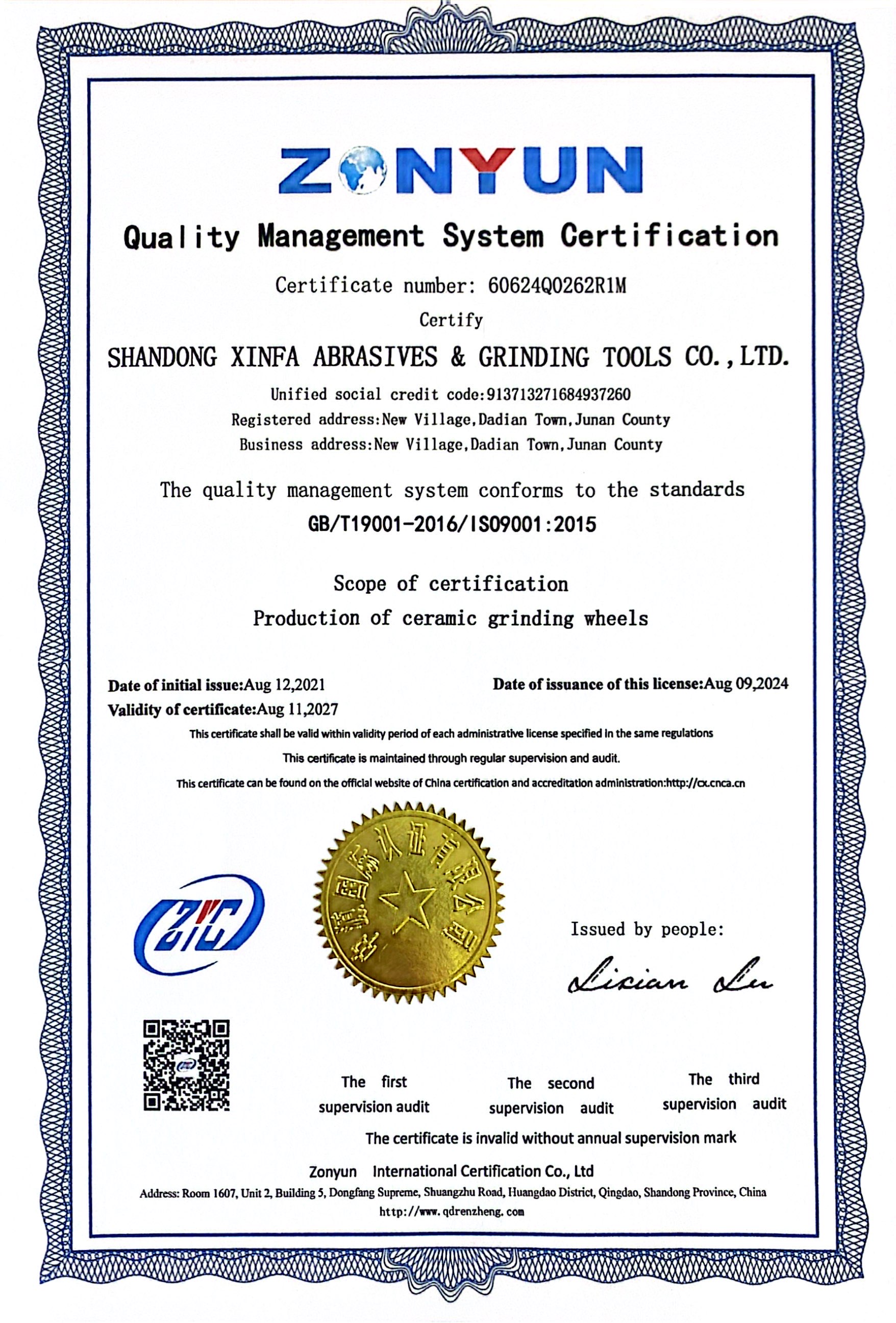
Layer one is the management system. An ISO 9001 certificate states that a certification body has assessed a quality management system against a standard, for a defined scope, at a defined site, for a defined period. Xinfa's record cites certificate 60624Q0262R1M against GB/T19001-2016/ISO9001:2015, issued by Zonyun International Certification Co., Ltd., with the scope "Manufacture of Abrasives & Grinding Wheels" and validity from 2021-08-12 to 2027-08-11. That is a statement about a manufacturing system. It is not a statement about a wheel.
Layer two is product conformity, where dimensional standards, safety references, drawings, batch inspection records and test reports belong. ISO 603-14:2022, for example, specifies common nominal dimensions for shape types 6, 11, 27, 28 and 29 of bonded abrasive products used on hand-held grinding machines for deburring and fettling or snagging. A manufacturer's technical data sheet may instead list conformity references such as EN 12413 and ANSI B7.1 for one named product family, as 3M's Cubitron 3 depressed-centre grinding wheel sheet does. These are different kinds of statements, and none substitutes for another.
Layer three is market access: customs classification, importer obligations, and any national registration or declaration layer. A correct tariff line and a correct product standard can both be satisfied while a shipment still stops at the border for a missing document.
Because the three layers are distinct, "we are ISO certified" is not an answer to a product question, and a product test report is not an answer to a customs question. The rest of this guide builds the file layer by layer.
Four evidence tiers, and what each one can actually prove
Before comparing suppliers, classify every document you receive into one of four tiers. The tier, not the letterhead, tells you how far the document can travel into a purchase decision.
| Tier | Typical document | What it can establish | What it does not establish | Verification step |
|---|---|---|---|---|
| 1 | Catalogue page, data sheet, email statement | That the supplier asserts a property | That any outside check took place | Ask for the source document the statement is based on |
| 2 | ISO 9001 certificate | That a certification body has certified a named scope, site and period | Product conformity, market access, or the performance of one wheel | Check the number and status with the issuer; read scope wording, site and dates |
| 3 | Dimensional drawing, batch inspection record, internal test report, declaration of conformity | That a defined specification was checked under a stated method | Independence, or coverage of sizes the document does not name | Check specimen identity, method, date and who produced the record |
| 4 | Accredited laboratory report, third-party pre-shipment inspection, registrar confirmation, customs ruling | That an outside party reached a stated conclusion on a stated sample | Anything about production the sample does not represent | Keep the report reference and the sample identity together |
The practical consequence is simple: a tier-2 certificate opens a supplier qualification file, while a tier-3 or tier-4 document closes a product question. Buyers who accept a tier-2 document as the answer to a tier-3 question are the ones who find the gap at the port or at the machine.
How to read a certificate: seven fields that change the answer
Reading a management-system certificate takes ten minutes if you work through the same seven fields every time. Xinfa's certificate appears below only to show what each field looks like when it is complete.
Field 1 — certificate number
60624Q0262R1M is a number you can quote in a purchase order, repeat in a non-conformance report and check with the issuer. A certificate copy with the number cropped or blurred is a picture, not a record.
Field 2 — standard and version
GB/T19001-2016/ISO9001:2015 states the audit basis. The version matters: wording written against an earlier edition of a standard describes a different basis, and a website page may still carry text from a previous certificate cycle. Ask which version is current at the order date, and keep only the current document in the file rather than blending two editions into one claim.
Field 3 — issuer
Zonyun International Certification Co., Ltd. issued this certificate. If your own purchasing procedure requires an accredited certification body, ask the supplier for the accreditation details behind the issuer and confirm them with the issuer, not with the sales contact.
Field 4 — scope wording
"Manufacture of Abrasives & Grinding Wheels" is an activity statement. It names what the certified system covers at the level of a product category. It is broad enough to sit behind a ceramic wheel order, and that breadth is exactly why the certificate cannot by itself answer whether one wheel size meets one national standard.
Field 5 — validity
Issued 2021-08-12, expiring 2027-08-11. Check status at the time of the order rather than at the time the file was created; a certificate remains usable only while surveillance activity continues.
Field 6 — site coverage
Certification attaches to a manufacturing site. Xinfa's operations are described at Xincun Village, Dadian Town, Junan County, Linyi City, Shandong Province, in a 30,000 m² factory with more than 100 sets of production and testing equipment. When the commercial invoice comes from a trading company, confirm which site is certified and whether that site makes the order.
Field 7 — market applicability
The record states global applicability and coverage of ceramic bonded grinding wheels. Read that as "the certificate is not restricted to one country", not as "the product satisfies every national requirement", because no management-system certificate can make the second statement.
Tracing scope down to a vitrified bond wheel: the scope ladder
A certificate covers a category; your order is one wheel. The bridge between them has six rungs, and a supplier should be able to stand on each one.
- Legal entity — the company that will appear on the commercial invoice.
- Site — the factory that will make the wheel.
- Activity scope — the certified wording, for example "Manufacture of Abrasives & Grinding Wheels".
- Product family — the named family in the catalogue, such as cylindrical, centerless, crankshaft and camshaft, gear, bearing, internal (bore), flat surface, tool, saw tooth or general purpose wheels.
- Model designation — the marking string that defines the wheel.
- Order line — dimensions, tolerance, marking, quantity, packaging and the maximum operating speed printed on the wheel.
The model designation carries most of the product information, so it is worth reading in full. In "1 - 350 × 100 × 127 A 60 N 5 V 35 m/s", the sequence runs shape, dimensions in millimetres (diameter × thickness × bore), abrasive, grit, grade, structure, bond and maximum operating speed. In Xinfa's material list, A denotes brown fused alumina, while other letters identify white, pink, single-crystal or microcrystalline alumina, green or black silicon carbide, and SG grain. The V position identifies the vitrified bond that makes the wheel a ceramic wheel.
Two checks follow from that string. First, the abrasive and bond letters must match what you intended to buy: 1 - 500 × 200 × 304.8 C 60 K 5 V 35 m/s is a black silicon carbide vitrified wheel rather than an alumina one, and 5 - 175 × 30 × 65 132*10 PA80Q5V 35 m/s is a pink alumina wheel in a different shape. Second, the marked speed is the ceiling for use, so compare it with the rated spindle speed of the machine it will run on. Xinfa's ranges show how much the value varies: general purpose wheels are offered at 32, 35, 40, 45, 50 and 60 m/s; flat surface wheels list maximum linear velocities from 20 to 70 m/s; bench grinder wheels run from 32 to 60 m/s with outer diameters of 100 to 450 mm, thickness from 12 to 80 mm and bore from 12.7 to 50.8 mm. A document pack that does not show the marked speed for your order line is incomplete.
Dimensions deserve a separate check when the order uses a hand-held shape. ISO 603-14:2022 gives nominal dimensions for shape types 6, 11, 27, 28 and 29. If your wheel is one of those shapes, the standard is a usable reference point in the file. If it is another shape, ask the supplier which dimensional reference it works to; this guide does not establish coverage outside that list.
Regional requirement checks: what can be documented, and what has to be asked
The table below separates three things that are usually merged in supplier emails: a reference that can be verified in published evidence, the question only the importer of record can answer, and the item to keep in the file. Where this guide's evidence does not establish a market-specific scheme, the entry says so, because a guessed standard number is worse than an open question.
| Market | Reference documented in this guide | Question for the importer of record | Keep in the file |
|---|---|---|---|
| Europe | EN 12413 appears as a conformity reference on the published data sheet of a named 3M depressed-centre wheel; ISO 603-14:2022 gives nominal dimensions for shapes 6, 11, 27, 28 and 29. | Which standard version and conformity route applies to this wheel type, and which documents must travel with the shipment? | A written conformity statement naming standard and version, the test report reference and the marking artwork. |
| United States | ANSI B7.1, "Safety Requirements for the Use, Care, and Protection of Abrasive Wheels" (ANSI, 2017); a tariff example placing abrasive wheels under 6804.22.40. | Does the supplier's declaration reference B7.1, which edition, and are mounting, guarding and use instructions supplied? | The declaration, the data sheet, the use instructions and the broker's classification confirmation. |
| Southeast Asia (Vietnam, Thailand, Malaysia) | No market-specific scheme is confirmed in the evidence used for this guide; Xinfa lists these as export markets, and export activity is not compliance evidence. | Which national requirement and labelling language applies, and which party clears the goods? | The importer's written answer, any national document the supplier holds, and the tariff confirmation. |
| India, South Korea, Japan, Middle East (UAE, Saudi Arabia, Iran), Brazil | Same status: no market-specific scheme is confirmed here. For the Middle East, add the question of whether a conformity certificate must be issued in the destination country before release. | Which national scheme applies to bonded abrasive wheels of this type, and may an existing supplier document be accepted? | The named document, issuer, number and validity period, or a written statement that none is held. |
Two conclusions follow. Absence of a named scheme in this table is not evidence that no requirement exists; it means the question must be answered for the specific order by the party carrying the import obligation. And a supplier cannot answer a market question from memory: a usable answer names the document, the issuer, the number and the validity period. Anything shorter belongs in the claims column, not the evidence column.
The parallel check: customs classification
Product compliance and tariff classification are separate workstreams that share one file. Tariff references place abrasive wheels of agglomerated abrasives or of ceramics in the HS 6804.22 family, with 6804.22.40 given as a United States subheading example for abrasive wheels, while a separate commercial reference uses 68042290 for grinding wheels and bonded abrasive discs without a confirmed jurisdiction. Those two cannot be merged into a single global code. Obtain the national tariff line from the broker or the official schedule for the destination, keep that confirmation beside the certificate, and remember that a correct code never proves product compliance — and a compliant product under the wrong code still creates delay.
Separating a supplier claim from verifiable evidence
Most compliance failures are visible before the goods ship, in the wording of what was sent. Six patterns are worth checking on every document set:
- A certification claim with no certificate number, no scope wording and no validity dates.
- A management-system certificate presented as product approval or as market access.
- A test report without specimen identity, test method, date or laboratory name.
- A certificate whose scope names a different legal entity from the one invoicing you.
- A standard number quoted without a version, when the version changes the requirement.
- A case reference — country, tonnage, duration — that cannot be traced to a document you are allowed to see.
The same discipline applies to a manufacturer's own background. Xinfa's record establishes a set of first-party facts: established in 1989 and specialised in the research, development and manufacture of vitrified bond grinding wheels; a member of the China Abrasives Association; its technology R&D centre listed as a municipal-level enterprise technology R&D centre in 2015; a municipal "Honoring Unit" title for contract performance; a 30,000 m² facility with 120 employees, six engineers and annual output of 10,000 tons; a 35% export ratio with products shipped to more than 20 countries; and a stated monthly capacity of 900 tons with 30–45 day lead times, a 2-ton minimum order quantity and 100% testing.
Those facts support a supplier qualification decision — longevity, specialisation, capacity and process control. They do not establish that a particular wheel complies with a particular national standard, and they do not establish that market-specific approvals are held for any of the eight destinations discussed above. Those remain order-level questions, which is precisely the distinction this guide is built on.
A twelve-item document pack to request with the enquiry
Request the pack with the enquiry, not after the order, so that checks run in parallel with production.
- Current quality management system certificate with legible number, scope, issue and expiry dates.
- The issuer's name and, if your procedure requires it, its accreditation details.
- A written statement of which standards the supplier applies to the product family, with versions.
- The full marking string for the quoted wheel, including shape, dimensions, abrasive, grit, grade, structure, bond and maximum operating speed.
- A dimensional drawing or table for the quoted size and its tolerance.
- The batch inspection record format used for the order.
- Any test report, with specimen identity, method and date.
- Marking and packaging artwork, including any speed marking shown on the wheel.
- The supplier's proposed tariff classification, for confirmation by your broker.
- A country of origin statement.
- A declaration of conformity if your market requires one, naming the standard and the responsible party.
- Written permission to verify the certificate directly with the issuer.
An eight-step check with acceptance criteria
- Define the order line exactly, in the supplier's marking format, and attach it to the enquiry. Acceptance: the supplier quotes the same string back.
- Map the destination market and ask the importer of record which national scheme applies. Acceptance: a named document, or a written statement that none applies.
- Send the twelve-item pack as a checklist with an evidence column. Acceptance: every line answered with a document reference, not a sentence.
- Verify the certificate with the issuer. Acceptance: number, scope, site and dates confirmed independently of the sales contact.
- Walk the scope ladder from legal entity to order line. Acceptance: each of the six rungs answered in writing.
- Match the marked maximum operating speed to the machine's rated spindle speed. Acceptance: the marked value is not below the machine's capability, and the marking is visible on the wheel.
- Run a trial and record wheel identification, dressing behaviour, surface result and life against your current supply. Acceptance: the trial record names the wheel, not only the outcome.
- File the pack with an expiry date and re-check before the certificate lapses. Acceptance: a diary entry ahead of 2027-08-11 for any order placed against the current certificate.
Three buying situations where the file changes shape
An importer or distributor carries the border question, so the file must contain the importer's written answer on the national scheme alongside the supplier's certificate and marking data. The document set is broader than the product question, and the tariff line matters as much as the standard reference.
An OEM procurement engineer usually starts from a drawing and a process requirement, so the priority shifts to the model designation, dimensional reference, speed marking and batch inspection record. The management-system certificate is a qualification gate; the product documents are the working evidence.
A plant or MRO buyer replacing wheels on existing machines begins with the spindle speed and the mounting arrangement. Here the fastest risk reduction is confirming that the marked maximum operating speed and the bore and thickness match the machine before any paperwork is discussed.
Frequently asked questions
Does an ISO 9001 certificate prove that a ceramic grinding wheel meets EU or US requirements?
No. A management-system certificate covers the manufacturing system at a certified site, for a stated scope and period. Product-level questions need product documents: a dimensional reference such as ISO 603-14:2022 for the shapes it covers, a conformity statement naming a standard and version, a test report, or an independent inspection report. Keep the certificate in the file, but do not let it answer a product question.
What documentation can a vitrified bond manufacturer actually issue for a specific order?
In Xinfa's case the documented certificate record is ISO 9001:2015 certificate 60624Q0262R1M covering the manufacture of abrasives and grinding wheels, valid from 2021-08-12 to 2027-08-11. Order-level documents — the marking string, the speed rating, dimensional data and inspection records — are produced for that order and should be requested in writing. Whether an additional market-specific document can be issued for a given destination is a direct question to the supplier, and a usable answer names the document, issuer, number and validity period.
Do compliance documents change the price of an order?
This guide does not establish price effects, and no quotation data is used here. What can be said is that the cost variables a buyer controls are fixed at the enquiry stage: specification, quantity against the 2-ton minimum order quantity, packaging, inspection scope and the document set required. Asking for the document list before the quotation is issued is cheaper than adding it afterwards.
What should accompany a trial or sample order?
The trial wheel should carry the same marking string as the production order, its marked maximum operating speed, a dimensional check record and a statement of the abrasive and bond it uses. Xinfa's stated quality control is 100% testing. Trials are also where wheel life, surface finish and dressing behaviour are compared with your current supply; published research on grinding wheel wear notes that wheel condition directly affects workpiece surface quality, which is why the trial record should identify the wheel itself, not only the result.
How long do documentation and production take?
Xinfa's stated lead time is 30–45 days, with a 2-ton minimum order quantity and monthly capacity of 900 tons, so document requests should travel with the order rather than follow it. The certificate covering the system expires on 2027-08-11, and an order placed close to that date should be accompanied by a current copy. Buyers who want the product range and specification background before the enquiry can download the Xinfa product brochure, or send the marking string and destination market to sales@xinfaabrasives.com and ask for the document pack against that order line.
Conclusion
Read ceramic grinding wheel compliance as three files, not one. The certificate proves a system, the product documents prove a wheel, and the importer's written answer proves the market — and each of the three has to name a document, an issuer and a validity period to be worth keeping.
Shandong Xinfa Abrasives & Grinding Tools Co., Ltd. has manufactured vitrified bond grinding wheels since 1989, and its documented quality management system certificate 60624Q0262R1M covers the manufacture of abrasives and grinding wheels until 2027-08-11. What that record supports is a supplier qualification decision; what it does not support is a claim about any single wheel in any single market, and a supplier that draws that line clearly is easier to audit than one that does not.
Compliance pack next step
Send the wheel marking string and the destination market, and ask for the certificate copy, scope wording, marking data and inspection record format for that order line. Product range and specification background: download the brochure.
Shandong Xinfa Abrasives & Grinding Tools Co., Ltd. — xinfa-abrasives.com | Email: sales@xinfaabrasives.com | Tel / WhatsApp: +86 13562923298 | Xincun Village, Dadian Town, Junan County, Linyi City, Shandong Province, China
Have Questions or Need More Details?
Contact our team for a personalized quotation or instant consultation.
Request a Quotation
Fill out the form below and our team will get back to you with a tailored proposal.
WhatsApp Direct Chat
Prefer to chat in real-time? Message us on WhatsApp for instant assistance & quick answers.
- Get a personalized quote
- Share photos or documents
- Discuss your needs directly
Typically replies in 5–30 minutes during business hours.