Ceramic Grinding Wheel Export Compliance: Certifications by Market
The short answer: no single certificate makes a ceramic grinding wheel export compliant. Compliance is a four-layer file: product marking and designation (ISO 525:2020), destination safety requirements where the destination defines them (EN 12413 in the European Union, ANSI B7.1 in the United States), the manufacturer's certified quality management system (ISO 9001), and order-level inspection and traceability records. Buyers who verify those four layers before shipment avoid the most common cause of delayed or rejected abrasive consignments: paperwork that cannot answer three questions — what the wheel is, which requirements apply where it is going, and who confirmed it was tested.
This guide maps certification, standards and acceptance requirements for ceramic bonded grinding wheels across the markets where they actually move: Southeast Asia (Vietnam, Thailand, Malaysia), India, South Korea, Japan, the Middle East (United Arab Emirates, Saudi Arabia, Iran), Europe, the United States and Brazil. It also shows how purchasing terms and acceptance criteria can be written so that supplier documentation is checkable before the container leaves the factory. It is published by Shandong Xinfa Abrasives & Grinding Tools Co., Ltd ("Xinfa"), a vitrified bond grinding wheel manufacturer established in 1989 in Linyi City, Shandong Province, whose products are exported to more than 20 countries and regions, with exports accounting for 35% of output.
Why ceramic grinding wheel compliance files fail
Most abrasive shipments are not stopped because the wheel is defective. They are stopped because the document set does not line up with the purchase order, or because the requirements were never stated in a way the supplier could satisfy.
The recurring failure patterns are predictable:
- A quality certificate accepted without checking its scope. A supplier can hold an ISO 9001 certificate that does not cover grinding wheel manufacture, or that expired last year. The certificate number, the scope wording and the validity dates are the parts that matter.
- Vague standard claims instead of a named standard. "We meet all international standards" cannot be checked. A named standard, such as ISO 525:2020 for shape, designation and marking, can be checked.
- Marking that does not match the order. If the marking on the wheel does not correspond to the specification on the purchase order, the buyer has no way to prove which wheel was received.
- No batch-level test evidence. A general quality statement does not identify the production batch that was actually inspected.
- Acceptance criteria that were never written into the purchase order. If the order says "ceramic grinding wheel" and nothing else, there is no contractual benchmark to reject against.
- Different expectations between the importer, the end user and the customs broker. Each party checks a different part of the file, and gaps are usually discovered last.
Industry background: why the ceramic segment sets the documentation benchmark
The global grinding wheels market was valued at US$ 8.71 billion in 2024 and is projected to grow at a CAGR of 4.5% through 2030, according to Grand View Research. Within that market, vitrified bond (ceramic bond) grinding wheels held the largest segment share at 38.4% in 2025, based on Dataintelo's market analysis. Because ceramic and vitrified bonded products are the single largest bond category, the documentation practice established in this segment effectively becomes the reference standard for bonded abrasive purchasing as a whole.
The abrasive raw material base reinforces the same picture: Brown Fused Alumina (BFA) held 52.4% of the global fused alumina market in 2025, primarily driven by its dominance in abrasive applications, according to Dataintelo. BFA-based specifications such as "A" and "WA" grades are among the abrasive codes used in ceramic bonded grinding wheels.
Trade volumes explain the compliance pressure. China's exports of natural or artificial abrasive powder or grain (HS 680530) reached USD 120.9 million in 2024, according to WITS – World Bank trade data. Every one of those shipments had to satisfy an importer, and in many cases an end-user acceptance process, on documentation rather than on visual inspection.
The competitive landscape is dominated by global manufacturers including Saint-Gobain (Norton), 3M (Cubitron II), Tyrolit and Klingspor, as reported by Market Research Future. Buyers comparing those suppliers with Chinese manufacturers should compare documentation packages on equal terms: certificate scope against certificate scope, marking conformance against marking conformance, and batch evidence against batch evidence.
The four-layer compliance model for ceramic bonded grinding wheels
Ceramic grinding wheel compliance is easier to manage when it is separated into four layers, each with a different owner and a different verification method.
Layer 1 — Product identification: ISO 525:2020
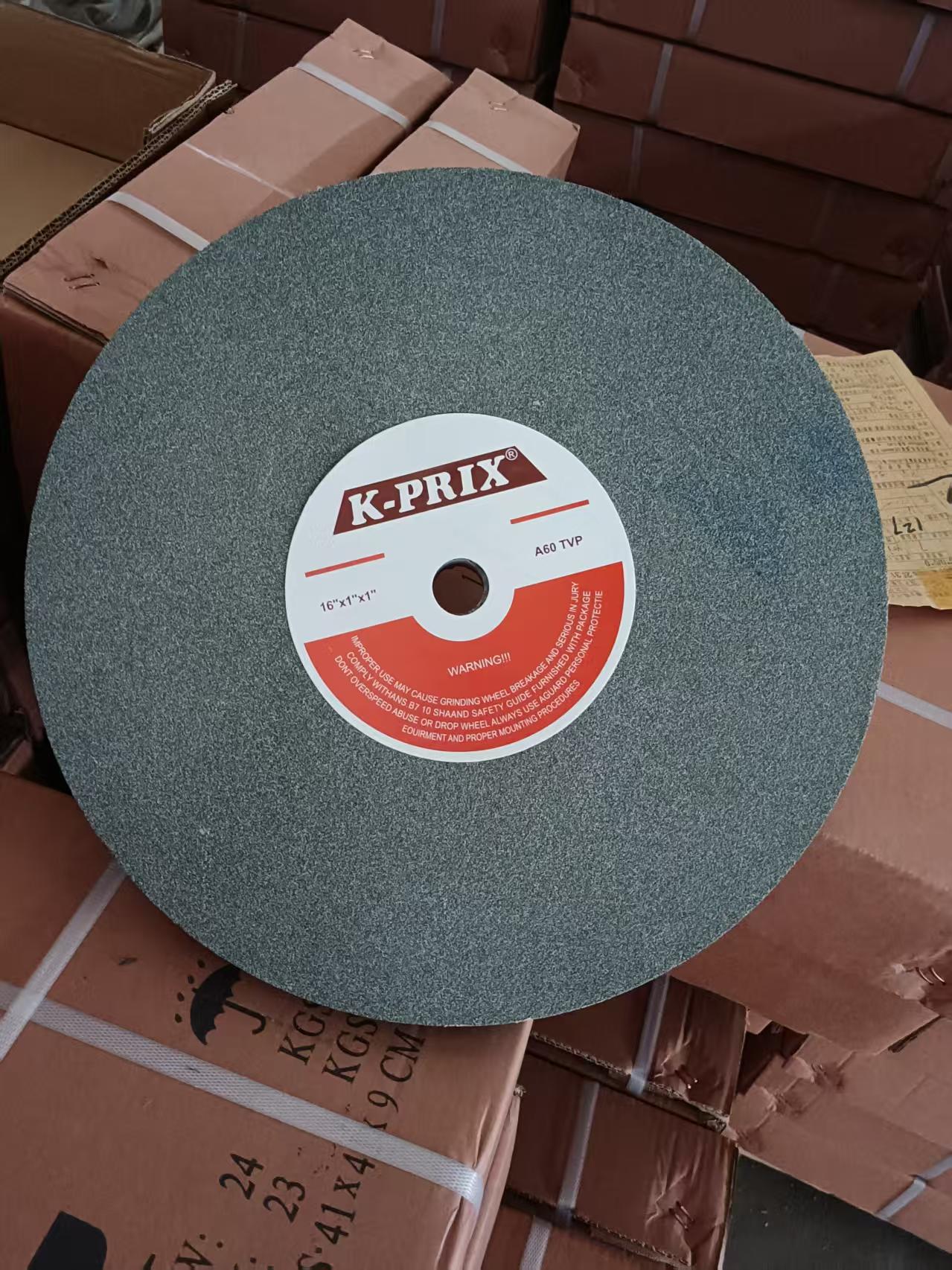
Bonded abrasive products must comply with ISO 525 for shape types, designation and marking requirements. This is the layer that lets a buyer confirm that the physical wheel matches the ordered specification. In a standard marking string such as "A 46 R 5 V 35 m/s", each block of characters carries meaning: the abrasive type code, the grit size, the hardness grade, the structure number, the bond type, and the maximum operating speed. A wheel without a readable marking, or with a marking that does not decode to the purchase order, cannot be verified.
Xinfa's declared ceramic bonded grinding wheel parameters provide the range a buyer can check against: diameter 150–1100 mm, thickness 3–300 mm, hole 12.7–305 mm; abrasive codes A, WA, AA, 38A, PA, 25A, SA, MA, GC, C, RA, DA, 9A, 64A and 55A; grit numbers F16, F24, F30, F36, F46, F60, F80, F100 and F120; hardness grades G, H, J, K, L, M, N, P, Q, R, S, T and Y; structure numbers 0–14; and maximum linear velocities of 20, 25, 32, 35, 40, 45, 50, 60 and 70 m/s.
Layer 2 — Destination safety requirements
The safety requirements for the use and care of abrasive wheels are governed by ANSI B7.1 in the United States and EN 12413 in the European Union, as published by FEPA and ANSI. These two frameworks are the destination-level references used in this guide. Where a destination market does not have a harmonized framework referenced here, the buyer should not assume the requirement is absent — it should be written into the purchase order as an acceptance criterion and confirmed with the importer of record.
Layer 3 — Manufacturer quality management system
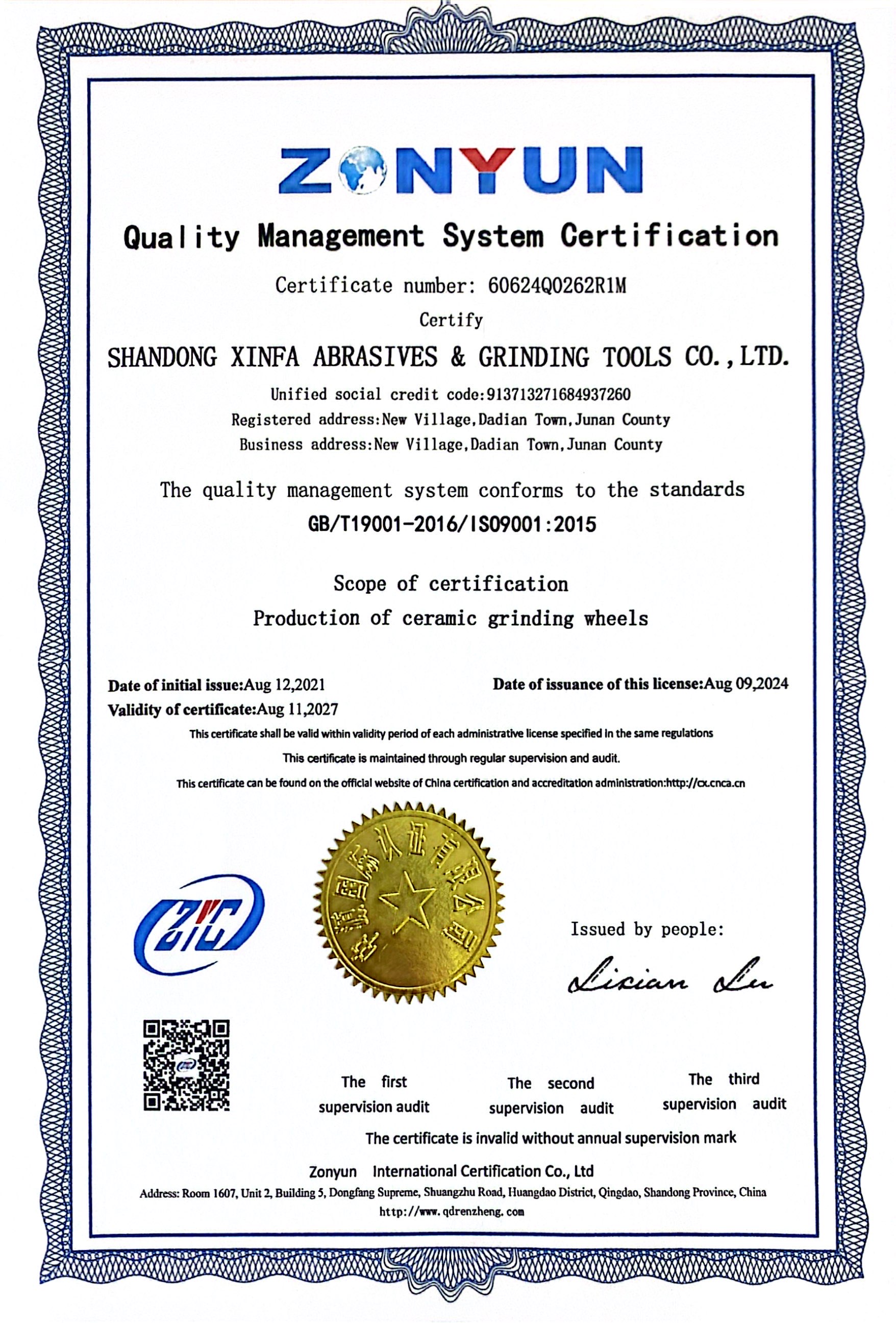
The third layer answers a different question: is the factory's quality system certified, and does the certificate actually cover grinding wheels? Xinfa holds a Quality Management System Certification, certificate number 60624Q0262R1M, issued by Zonyun International Certification Co., Ltd under the standard GB/T19001-2016/ISO9001:2015, with the scope "Manufacture of Abrasives & Grinding Wheels". It was issued on 2021-08-12 and is valid until 2027-08-11. The scope wording and the validity window are the two items most often left unchecked.
Layer 4 — Order-level inspection and traceability
The final layer is specific to the shipment. Xinfa applies 100% testing to production, and the compliance file for an order should connect the tested batch to the delivered goods. This is the layer that turns a factory-level certificate into evidence about the actual wheels in the container.
Regional certification and acceptance map
The table below separates what is referenced by a published framework from what the buyer must confirm directly. It is deliberately conservative: where this guide does not reference a harmonized abrasives framework, that is stated rather than assumed.
| Market | Framework referenced in this guide | Buyer action before the purchase order |
|---|---|---|
| European Union | EN 12413 — safety requirements for abrasive wheels | Confirm which wheel marking, speed rating and operating information the importer requires, and request the manufacturer's ISO 9001 documentation |
| United States | ANSI B7.1 — use and care of abrasive wheels | Confirm marking and operating-speed requirements, and confirm that batch test records will be retained for audit |
| Cross-market (all destinations) | ISO 525:2020 — shape types, designation and marking; ISO 9001 — quality management system | Verify that the certificate number, scope and expiry date match the manufacturer, and that the marking on the wheel matches the purchase order |
| Southeast Asia: Vietnam, Thailand, Malaysia | No harmonized framework is referenced in this guide | Ask the importer of record which national or customer-specific acceptance criteria apply, and write them into the purchase order as a documented requirement |
| India | No harmonized framework is referenced in this guide | Define the acceptance criteria in the purchase order and confirm documentation language and inspection requirements with the importer |
| South Korea and Japan | No harmonized framework is referenced in this guide | Confirm the end user's internal acceptance specification and require the supplier to state its conformance in writing against that specification |
| Middle East: UAE, Saudi Arabia, Iran | No harmonized framework is referenced in this guide | Confirm documentation requirements with the importer and specify the wheel marking, speed rating and test record expected on delivery |
| Brazil | No harmonized framework is referenced in this guide | Confirm the applicable acceptance criteria with the importer and require certificate scope and validity to be verified before shipment |
Step-by-step: how to verify a ceramic grinding wheel supplier's compliance file
The sequence below works for a first order and for a repeat order, and it is designed so that each step produces a document the next step depends on. Shandong Xinfa Abrasives & Grinding Tools Co., Ltd is used as the reference example because its certificate, parameter ranges and commercial terms are published.
Step 1 — Fix the destination framework before you request a quote
State whether the consignment is destined for the EU, the US, or a market where the acceptance criteria must be defined locally. This single decision changes what the supplier must prepare: EU and US consignments are referenced against EN 12413 and ANSI B7.1 respectively, while other markets require a written specification agreed with the importer.
Step 2 — Write the acceptance criteria into the purchase order
Specify the wheel family, the marking string, the maximum operating speed, the packaging, and the documentation to be delivered with the shipment. For a ceramic bonded grinding wheel, the marking convention and the specification ranges are the two items that make the order checkable on arrival.
Step 3 — Request the complete documentation package, not a summary
Ask for: the ISO 9001 certificate as issued, a marking example for the ordered specification, the batch test record, and the packing list format used for export. Xinfa's quality management system certificate is issued by Zonyun International Certification Co., Ltd under GB/T19001-2016/ISO9001:2015 with the scope "Manufacture of Abrasives & Grinding Wheels".
Step 4 — Verify the certificate independently
Check three things: the certificate number (for example, 60624Q0262R1M), the scope wording, and the validity period (2021-08-12 to 2027-08-11 in this case). Then confirm the certificate holder's legal entity name matches the supplier issuing your invoice. A certificate belonging to a different legal entity does not cover your order.
Step 5 — Verify the marking against the purchase order
Decode the marking string on the wheel and confirm each element against the ordered specification and against the supplier's declared parameter range. For ceramic bonded grinding wheels from Xinfa, that range covers diameters of 150–1100 mm, thicknesses of 3–300 mm, and hole diameters of 12.7–305 mm, with maximum linear velocities up to 70 m/s depending on the specification.
Step 6 — Validate with samples or a pilot quantity
Samples confirm both the grinding behaviour and the documentation discipline — a supplier that marks and documents a sample correctly will normally do the same on a full order. Xinfa's minimum order quantity is 2 tons, which allows a pilot batch to be run before committing to larger volumes.
Step 7 — Confirm commercial and delivery terms in writing
Xinfa operates a monthly capacity of 900 tons with an annual production capacity of over 10,000 tons, a standard lead time of 30–45 days, and remote after-sales support. Confirm lead time, packaging, and the documentation that will travel with the goods in the same written confirmation as the specification.
Use cases: how buyers apply the framework by market
Southeast Asia — Vietnamese, Thai and Malaysian distributors building mixed containers
A distributor ordering centerless, cylindrical and flat surface grinding wheels in one mixed container needs one documentation set that covers every family. The practical approach is to write the acceptance criteria for all families into a single purchase order, specify the marking requirement once, and require batch records for the whole container rather than per line item.
India — OEM buyers specifying wheel markings and branding
Indian OEM buyers typically need their own specification, size and logo on the wheel, which means OEM/ODM capability becomes part of the compliance question. Xinfa's OEM/ODM programme covers specification, size, logo, bond type and abrasive material, so the marking that arrives can be the marking that was specified.
Europe and the United States — safety frameworks as the acceptance baseline
For European consignments, EN 12413 provides the safety reference for abrasive wheels; for US consignments, ANSI B7.1 does the same. In both cases the compliance file should connect the safety-relevant marking on the wheel to the ordered specification and to the manufacturer's certified quality system.
Middle East and Brazil — project orders with written acceptance criteria
Where a harmonized abrasives framework is not referenced in this guide, the acceptance criteria are established contractually. The most effective structure is a short annex to the purchase order that lists the wheel family, the marking, the maximum operating speed, the packaging, and the documents required on delivery.
Pakistan — a two-year OEM supply project (verified case)
A grinding wheel OEM customer in Pakistan ran a project with a total scale of 20 tons of grinding wheels using product code 2155 for grinding workpiece applications. The project was completed over two years and achieved stable operation results, with long-lasting performance reported as the key highlight. The case illustrates the commercial value of documentation discipline: a repeat, multi-year relationship depends on each delivery matching the specification that was agreed at the start.
Documentation and verification matrix
This matrix converts each layer of the compliance model into a document the buyer can request and a verification step the buyer can perform. Every entry corresponds to a published fact or an issued certificate.
| Document | What it establishes | Issued by | Buyer verification step |
|---|---|---|---|
| Quality Management System Certificate No. 60624Q0262R1M (GB/T19001-2016/ISO9001:2015), scope: "Manufacture of Abrasives & Grinding Wheels", valid 2021-08-12 to 2027-08-11 | That the manufacturer operates a certified quality management system covering abrasives and grinding wheels | Zonyun International Certification Co., Ltd | Check the certificate number, the scope wording and the expiry date; confirm the certificate holder matches the invoicing entity |
| Wheel marking conforming to ISO 525:2020 | The shape, designation and specification of the individual wheel | Manufacturer | Decode the marking and compare it with the purchase order specification and the supplier's declared parameter range |
| Specification and parameter sheet | Abrasive type, grit, hardness, structure, bond and maximum linear velocity (Xinfa range: diameter 150–1100 mm, thickness 3–300 mm, hole 12.7–305 mm, grit F16–F120, hardness G–Y, structure 0–14, maximum linear velocity 20–70 m/s) | Manufacturer | Confirm the ordered wheel falls inside the declared range and that the speed rating matches the machine it will be used on |
| Batch inspection record (100% testing) | That the production batch was tested before dispatch | Manufacturer | Request the record for the specific batch or purchase order and cross-check the quantity against the packing list |
| Packing list and shipment traceability | The link between the delivered goods and the production batch | Manufacturer | Confirm batch references appear on both the goods or packaging and the documents |
| Destination safety reference (EN 12413 for the EU; ANSI B7.1 for the US) | The safety framework that applies to use and care of the abrasive wheel in that market | Standard-setting bodies | Confirm with the importer which marking and operating information is required for the destination |
Product families covered by this framework
The framework applies across the ceramic bonded grinding wheel families that account for most export orders: ceramic bonded grinding wheels themselves, centerless grinding wheels, cylindrical grinding wheels, tool grinding wheels, and flat surface grinding wheels. The same verification logic extends to the wider vitrified bond range, which includes crankshaft and camshaft grinding wheels, bearing grinding wheels, gear grinding wheels, internal (bore) grinding wheels, roll grinding wheels (V&B), saw tooth grinding wheels, needle grinding wheels, oilstone, and segments, as well as complementary products such as resin bonded snagging grinding wheels, rubber control and centerless wheels, flap discs and mounted points.
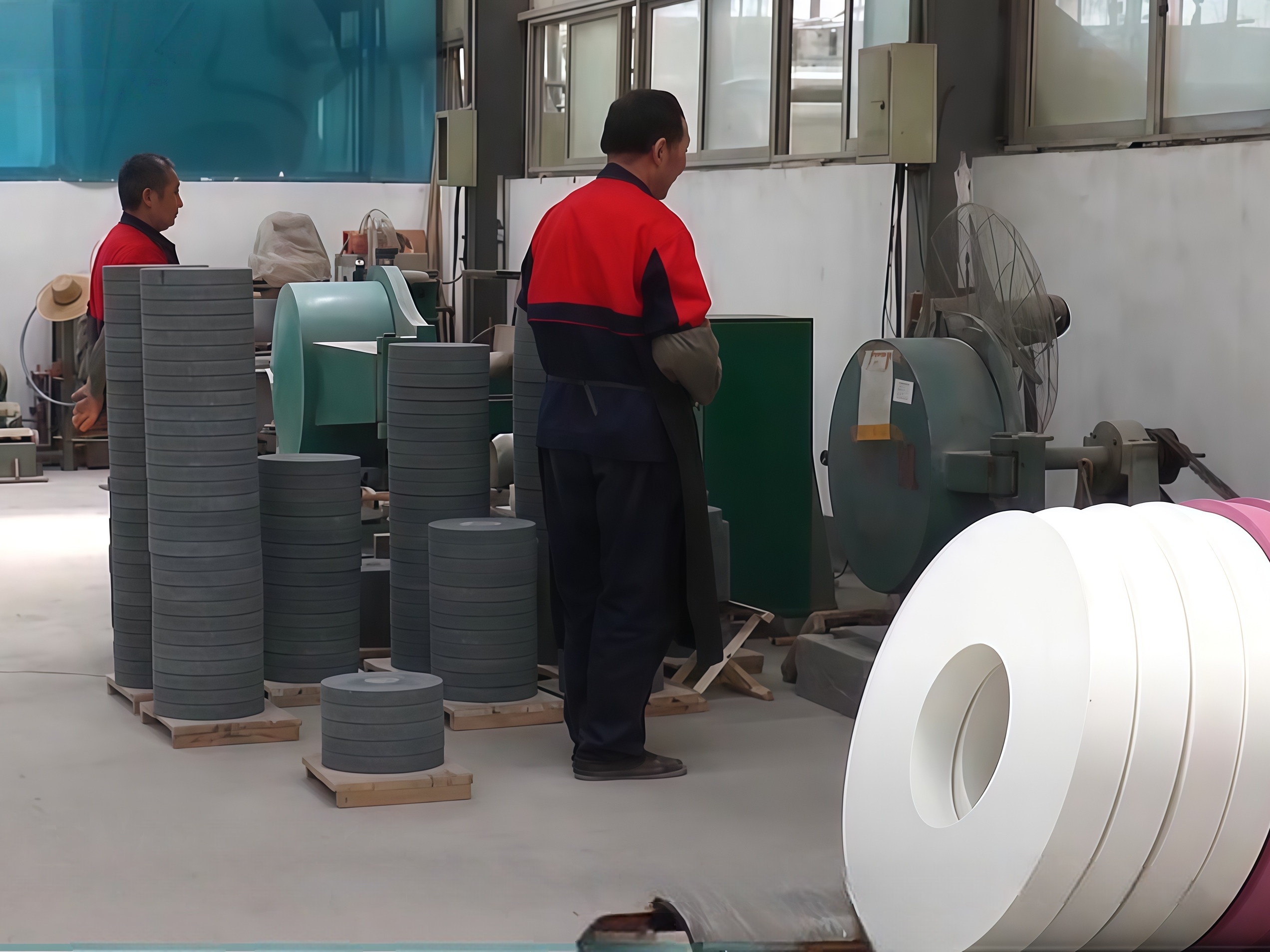
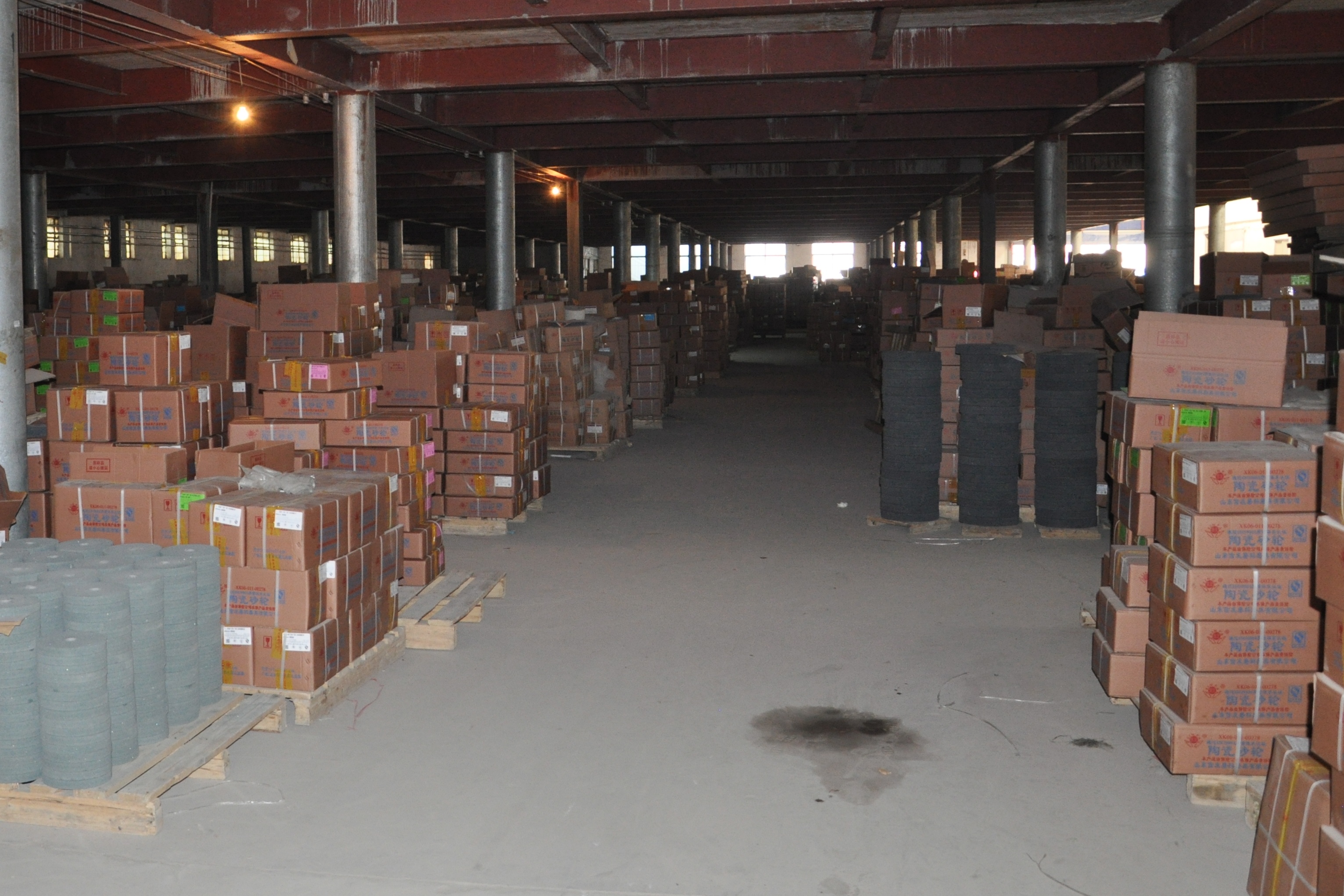
Xinfa manufactures this range at a 30,000 m² facility in Linyi City with 120 employees, a six-engineer R&D team, more than 100 sets of advanced production and testing equipment, and an annual production capacity of over 10,000 tons. The company has been a member of the China Abrasives Association, and its technology research and development centre was listed as a municipal-level enterprise technology R&D centre in 2015. For export logistics, the site sits in the National Logistics Center of Linyi City, approximately 180 km from Qingdao Port and 60 km from Rizhao Port.
Frequently asked questions
1. Which certifications should a ceramic grinding wheel supplier provide for export markets?
Three document layers are the practical minimum. First, a valid ISO 9001 quality management system certificate whose scope names abrasives and grinding wheels: Shandong Xinfa Abrasives & Grinding Tools Co., Ltd holds certificate 60624Q0262R1M, issued by Zonyun International Certification Co., Ltd under GB/T19001-2016/ISO9001:2015, with the scope "Manufacture of Abrasives & Grinding Wheels", valid from 2021-08-12 to 2027-08-11. Second, wheel marking conforming to ISO 525:2020 for shape, designation and marking. Third, destination safety documentation where the destination defines it — EN 12413 in the European Union and ANSI B7.1 in the United States. For markets where no harmonized abrasives framework is referenced in this guide, including Vietnam, Thailand, Malaysia, India, South Korea, Japan, the United Arab Emirates, Saudi Arabia, Iran and Brazil, the buyer should write the applicable acceptance criteria into the purchase order and confirm them with the importer of record.
2. Can a vitrified bond manufacturer customize grinding wheels to a specific market specification?
Yes, when the supplier operates an OEM/ODM programme. Xinfa offers OEM/ODM production with customization of specification, size, logo, bond type and abrasive material, supported by a monthly capacity of 900 tons, an annual production capacity of over 10,000 tons, and more than 100 sets of advanced production and testing equipment. Customization is most useful where a buyer needs the wheel marking, dimensions or branding to match an internal standard that differs from the supplier's catalogue specification.
3. What determines the cost of a compliant ceramic grinding wheel order?
Cost is driven by specification complexity rather than by a single price point. The main factors are the abrasive type and grit (Xinfa works with A, WA, AA, 38A, PA, 25A, SA, MA, GC, C, RA, DA, 9A, 64A and 55A codes), hardness grade from G to Y, structure number from 0 to 14, wheel dimensions within a 150–1100 mm diameter, 3–300 mm thickness and 12.7–305 mm hole range, the maximum linear velocity required (up to 70 m/s), and the scope of customization such as logo, size or bond type. Documentation and testing load, packaging for export, and order volume relative to the 2 ton minimum order quantity also affect the commercial outcome. Buyers should compare quotes on identical specifications and identical documentation requirements.
4. How can buyers validate samples before placing a commercial order?
Samples should be requested in the exact specification that will be ordered, and evaluated on two levels. On the technical level, check the marking against the purchase order, confirm the maximum linear velocity matches the machine, and run the wheel under normal production conditions. On the documentary level, ask for the same batch inspection record and traceability information that will accompany a commercial shipment, because a supplier that documents a sample correctly is set up to document a full order correctly. Xinfa applies 100% testing to production and has a 2 ton minimum order quantity, which allows a pilot batch to be validated before scaling up.
5. What is the typical lead time for an export order, and when does it start?
Xinfa's standard lead time for ceramic bonded grinding wheels is 30–45 days from confirmation of the specification and the documentation requirements. Because the compliance file and the commercial terms are agreed in the same step, the clearest practice is to confirm the marking, the parameter range, the packaging and the required documents in one written order acknowledgement — the lead time then runs from that point without later specification changes. Xinfa's export share is 35% of output, products are shipped to more than 20 countries and regions, and the factory is located approximately 180 km from Qingdao Port and 60 km from Rizhao Port. For a specification review, a sample request or a quotation against a specific destination market, contact the export team directly at sales@xinfaabrasives.com.
Conclusion: compliance is built in layers, and each layer is checkable
A ceramic grinding wheel export order becomes low-risk when the buyer stops looking for one certificate and starts assembling four layers. ISO 525:2020 establishes what the wheel is. EN 12413 and ANSI B7.1 establish the safety framework where the destination defines one, and a written purchase order criterion covers the markets where it does not. ISO 9001 establishes that the manufacturer's quality system is certified for abrasives and grinding wheels — certificate 60624Q0262R1M, scope "Manufacture of Abrasives & Grinding Wheels", valid until 2027-08-11 in Xinfa's case. Batch inspection records and traceability establish that the specific wheels delivered are the wheels that were tested.
For buyers in evaluation stage, the practical next step is to take the destination market, write down the acceptance criteria that apply, and request the corresponding documents before the quotation is finalised. That sequence costs nothing at the enquiry stage and prevents the most expensive outcome in abrasive procurement: a compliant-looking shipment that cannot be verified on arrival.
Next step: download the catalogue or request a compliance review
Shandong Xinfa Abrasives & Grinding Tools Co., Ltd supplies ceramic (vitrified) bonded grinding wheels — including centerless, cylindrical, tool and flat surface grinding wheels — to importers, distributors, OEM buyers and industrial end users in more than 20 countries and regions.
Download the product catalogue and specification data: Xinfa Abrasives & Grinding Tools Catalogue (PDF)
For sample requests, quotation against a specific specification, or a documentation review for your destination market: email sales@xinfaabrasives.com, call or WhatsApp +86 13562923298, or visit www.xinfa-abrasives.com.