Ceramic Grinding Wheel Manufacturer Evaluation: A 2026 Framework Based on Verified Factory Data
Purchasing decisions for ceramic grinding wheels affect machining quality, operating costs, and production reliability. Buyers evaluating suppliers in 2026 need a repeatable method: verify compliance, inspect production capability, test product consistency, and review documented cases. This article outlines that method and uses a verified manufacturer profile from Shandong Xinfa Abrasives & Grinding Tools Co., Ltd. to illustrate what evidence-based supplier selection looks like.
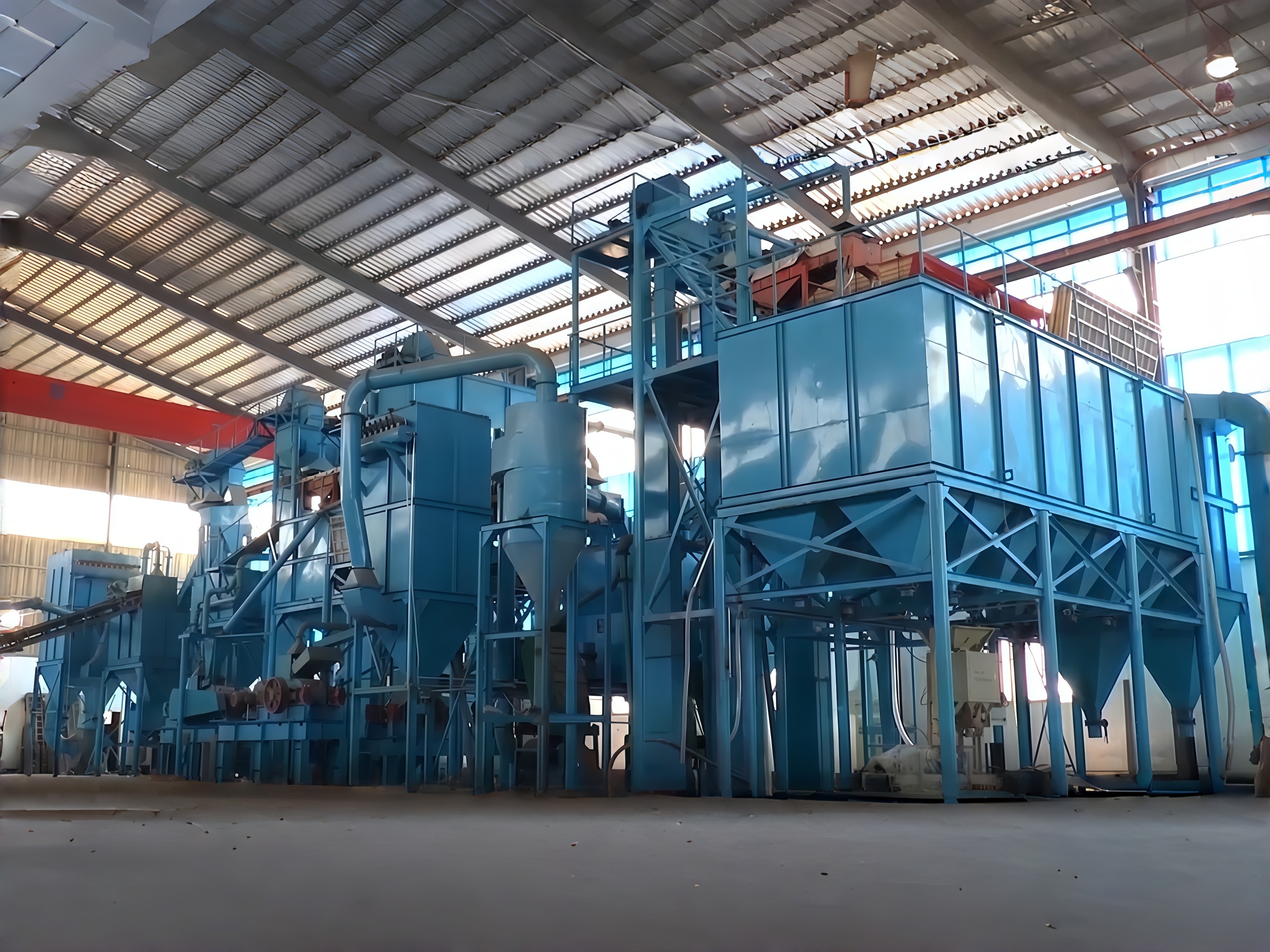
Raw material workshop at Xinfa, a vitrified bond grinding wheel manufacturer in Shandong, China.
The Sourcing Problem: Why Ceramic Grinding Wheel Evaluation Is Difficult
Despite the maturity of the abrasive industry, ceramic grinding wheel sourcing remains difficult. The term 'ceramic grinding wheel' is used broadly, covering both vitrified-bond wheels and wheels made with ceramic alumina grain. Buyers may see different products, quality levels, and certifications from suppliers in different regions. Without a structured evaluation, price-based comparisons hide differences in bond formulas, abrasive selection, firing processes, and quality control. This article defines the evaluation criteria that matter most and shows how they can be verified.
Industry Context: Market Size, Standards, and Global Players
The global grinding wheels market was valued at US$8.71 billion in 2024 and is expected to grow at a CAGR of 4.5% through 2030, according to Grand View Research. Among all bond types, vitrified (ceramic) bond grinding wheels held the largest segment share at 38.4% of the total grinding wheel market in 2025, according to Dataintelo. Brown fused alumina (BFA), a widely used abrasive in grinding wheels, accounted for 52.4% of the global fused alumina market in 2025, also per Dataintelo. China is a major supplier: exports of natural or artificial abrasive powder or grain reached USD120.9 million in 2024, according to WITS/World Bank.
On the demand side, buyers encounter established global names. Market Research Future lists Saint-Gobain (Norton), 3M (Cubitron II), Tyrolit, and Klingspor among major global manufacturers dominating the grinding wheel landscape. At the same time, Chinese manufacturers supply a significant share of the world market, often through OEM and ODM relationships. For buyers, the question is not 'brand or no-name' but 'can this factory produce the required specification and back it with verifiable compliance?'
Detailed Solution: A Verified Chinese Vitrified-Bond Manufacturer
Company Profile and Certification
One documented example of a Chinese manufacturer with a specific vitrified-bond focus is Shandong Xinfa Abrasives & Grinding Tools Co., Ltd. Established in 1989, Xinfa is based in Linyi City, Shandong Province, about 180 km from Qingdao Port and 60 km from Rizhao Port. The factory covers 30,000 square meters and employs 120 people. Its annual production capacity exceeds 10,000 tons, supported by more than 100 sets of production and testing equipment. The company is a member of the China Abrasives Association and operates a quality management system certified under ISO 9001:2015 (certificate 60624Q0262R1M, valid through 11 August 2027). The certified scope covers the manufacture of abrasives and grinding wheels.
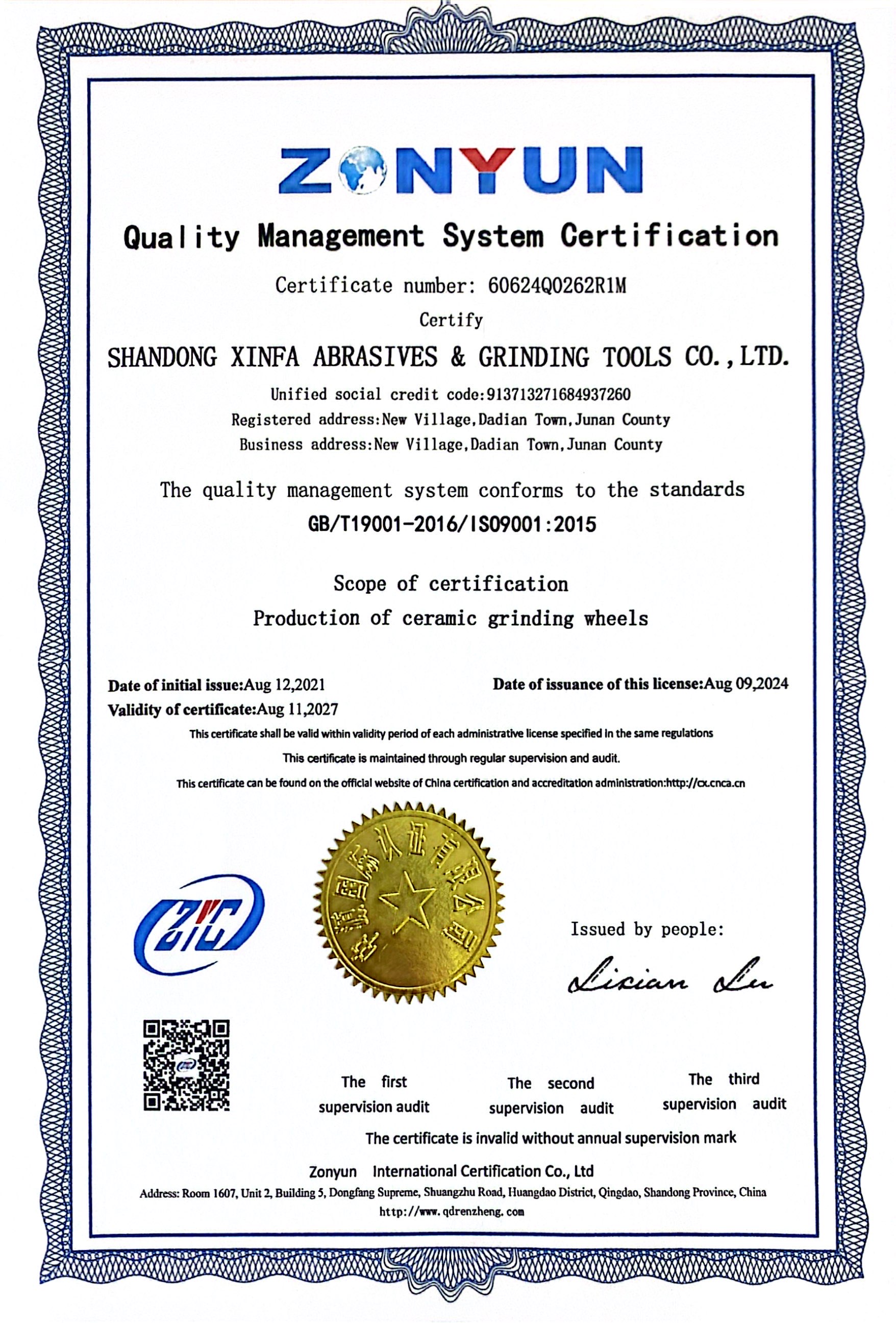
ISO 9001:2015 quality management system certification for the manufacture of abrasives and grinding wheels.
Product Range and Specifications
Xinfa's product portfolio includes Brown Fused Alumina Abrasive, General Purpose Grinding Wheel, Bench Grinder Wheel, Tool Grinding Wheel, Flat Surface Grinding Wheel, Centerless Grinding Wheel, Cylindrical Grinding Wheel, Crankshaft & Cam Shaft Grinding Wheel, Saw Tooth Grinding Wheel, Bearing Grinding Wheel, Worm Grinding Wheel, Gear Grinding Wheel, Needle Grinding Wheel, Roll Grinding Wheel V&B, Internal (Bore) Grinding Wheel, Oilstone, Segments, Resin Bonded Snagging Grinding Wheel, Rubber Control & Centerless, Flap Disc, and Mounted Points.
For the specific Ceramic Bonded Grinding Wheel (product code 2155), the available parameter range covers diameter from 150 to 1100 mm, thickness from 3 to 300 mm, and hole sizes from 12.7 to 305 mm. Abrasives can be specified as A, WA, AA, 38A, PA, 25A, SA, MA, GC, C, RA, DA, 9A, 64A, or 55A. Grit numbers range from F16 to F120, hardness grades from G to Y, structure numbers from 0 to 14, and maximum linear speed from 20 to 70 m/s.
OEM/ODM Capability and Quality Control
For buyers with custom requirements, Xinfa's capability profile includes OEM/ODM production. Customization options include specification, size, logo, bond type, and abrasive material. Monthly capacity is 900 tons, with a typical lead time of 30–45 days and a minimum order quantity of 2 tons. The factory states that quality control includes 100% testing, and after-sales support is provided remotely.
Step-by-Step Supplier Evaluation Framework
Here is a practical supplier evaluation sequence that can be used before placing a ceramic grinding wheel order.
- Verify quality system certification. Ask for the certificate number, issuing body, scope, and validity period. Example: Xinfa holds ISO 9001:2015 certificate 60624Q0262R1M from Zonyun International Certification Co., Ltd., valid until 2027-08-11. Also check whether the product meets ISO 525, ANSI B7.1 and EN 12413 relevant to bonded abrasives.
- Map the required product specification. Define diameter, thickness, bore, abrasive type, grit, hardness, structure, and maximum operating speed. Use the supplier's data sheet to see if they can cover your range. For Xinfa, Ceramic Bonded Grinding Wheel can cover 150–1100 mm diameter and 3–300 mm thickness.
- Assess production scale and equipment. Check factory area, annual capacity, number of employees, and testing equipment. A supplier with 10,000+ tons capacity and in-house testing can more reliably handle repeat orders.
- Evaluate customization and OEM capabilities. If you need private label or specific bond formulations, confirm whether the factory supports OEM/ODM and what can be customized. Xinfa's customization list includes specification, size, logo, bond type, and abrasive material.
- Ask for quality control and testing evidence. Quality claims should be supported by process description. In Xinfa's case, 100% testing is part of the capability profile.
- Request case references. A supplier should be able to share at least one role-specific case. For example, Xinfa supplied 20 tons of grinding wheels to a Grinding Wheel OEM customer in Pakistan over two years. The project achieved stable operation and long-lasting performance.
- Review commercial terms. For Xinfa, MOQ is 2 tons and standard lead time is 30–45 days. These numbers help budget and production planning.
Use Case: OEM Customer in Pakistan
The Pakistan case is directly relevant to OEM and project-stage buyers. A Grinding Wheel OEM customer in Pakistan purchased 20 tons of grinding wheels for workpiece grinding. The engagement lasted two years, and the reported results were stable operation and long-lasting performance. For buyers evaluating suppliers, this type of evidence is useful because it shows sustained supply over time rather than a one-off sample. It also indicates that the factory can work with OEM customers, which is often a requirement for private-label distribution.
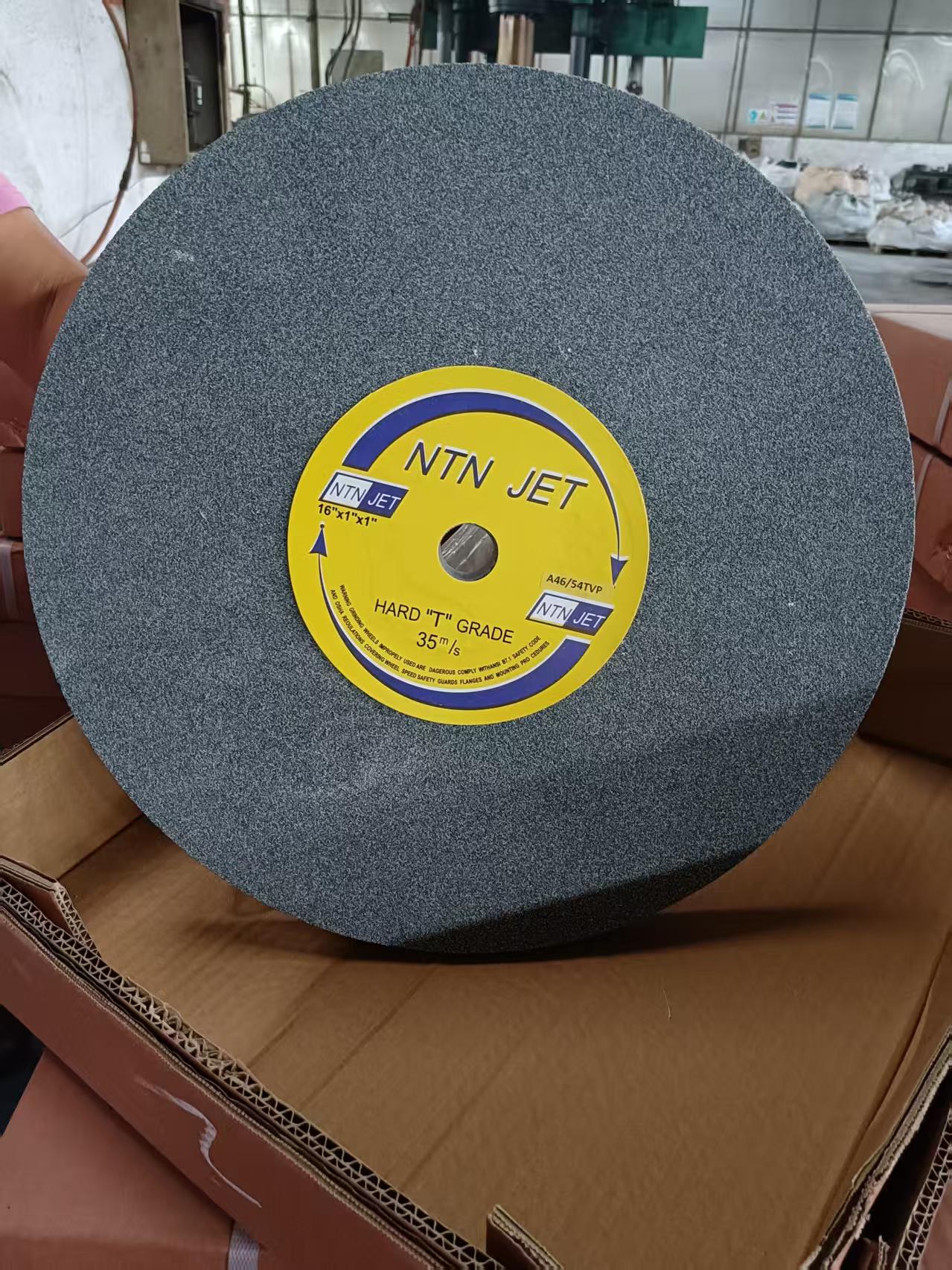
Grinding wheel case components for an OEM customer in Pakistan.
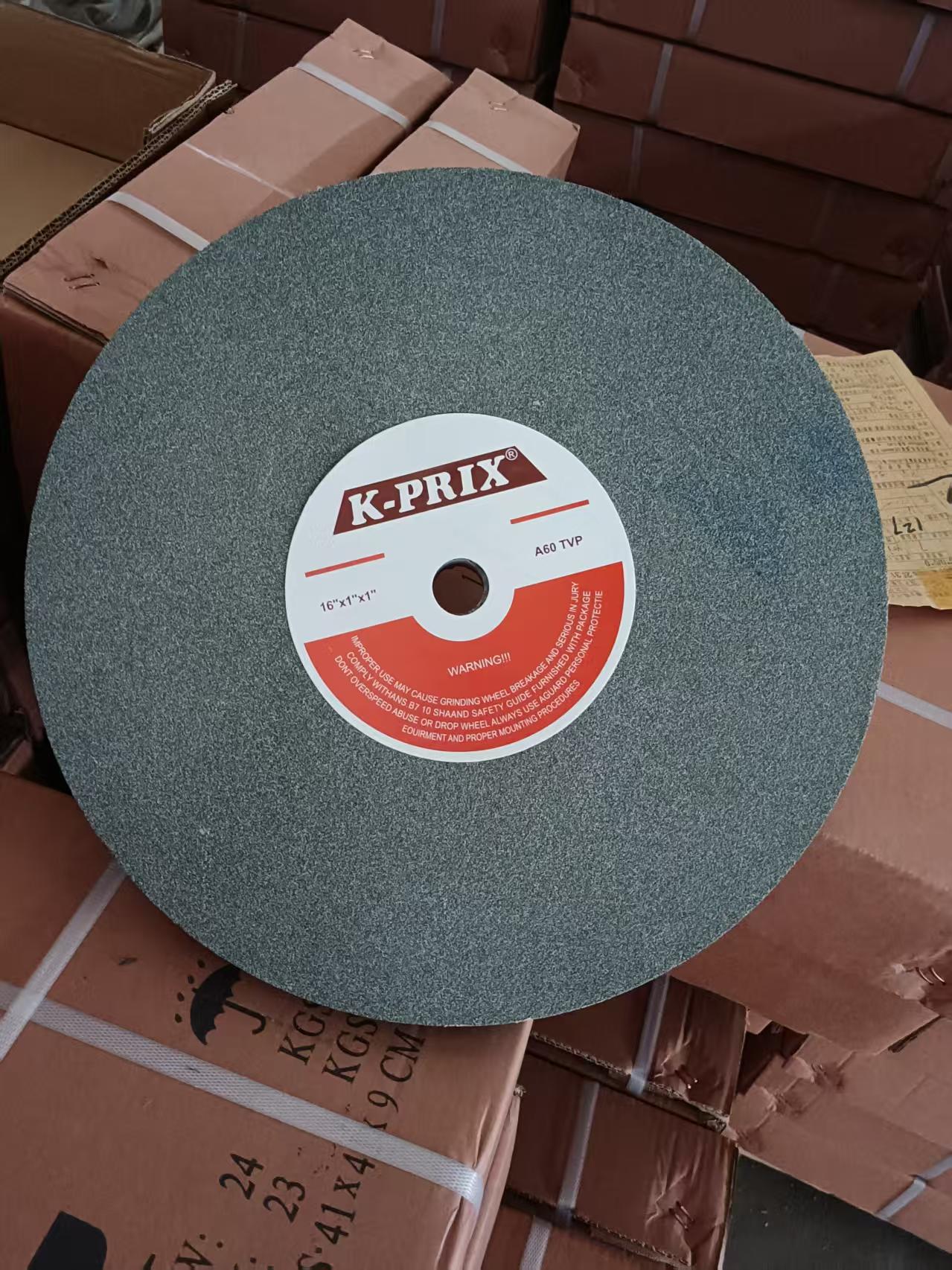
Pakistan project delivery context for the 20-ton grinding wheel order.
Comparison Table: Supplier Evidence Matrix
| Evaluation Criterion | What to Check | Documented Evidence from Xinfa |
|---|---|---|
| Compliance | Valid quality certificate, product standards | ISO 9001:2015, cert no. 60624Q0262R1M, scope 'Manufacture of Abrasives & Grinding Wheels', valid to 11 Aug 2027; ISO 525 applies; ANSI B7.1 / EN 12413 are relevant safety standards. |
| Production Capacity | Factory size, annual output, equipment | 30,000 m², 120 employees, >10,000 t annual capacity, 100+ production and testing equipment sets. |
| Product Range | Wheel types and size coverage | Ceramic Bonded Grinding Wheel: diameters 150–1100 mm, thickness 3–300 mm, bore 12.7–305 mm; grit F16–F120; hardness G–Y; structure 0–14; speeds 20–70 m/s. |
| Customization | OEM/ODM, MOQ | OEM/ODM for specification, size, logo, bond type, abrasive material; MOQ 2 t; monthly capacity 900 t. |
| Quality Control | Testing process | 100% test (from capability profile). |
| Case Evidence | Real customer reference | Pakistan OEM customer: 20 t over 2 years, stable operation, long-lasting. |
| Export Experience | Cross-border delivery | 35% export ratio; exports to >20 countries incl. SE Asia, Middle East, India, South Korea, Japan, Europe, US, Brazil. |
FAQ
Does Xinfa hold ISO 9001 certification for ceramic grinding wheel production?
Yes. Xinfa holds ISO 9001:2015 certificate 60624Q0262R1M, issued by Zonyun International Certification Co., Ltd. The scope is 'Manufacture of Abrasives & Grinding Wheels', valid through August 11, 2027. Buyers should also verify that grinding wheel products comply with ISO 525 and relevant safety standards such as ANSI B7.1 in the US and EN 12413 in the EU.
What ceramic grinding wheel specifications can Xinfa produce?
Xinfa produces vitrified bond grinding wheels across many categories, including general purpose, bench grinder, tool grinding, flat surface, centerless, cylindrical, crankshaft & cam shaft, saw tooth, bearing, worm, gear, needle, roll V&B, and internal bore wheels. For the Ceramic Bonded Grinding Wheel (code 2155), the documented parameter range is: diameter 150–1100 mm, thickness 3–300 mm, bore 12.7–305 mm. Abrasive options include A, WA, AA, 38A, PA, 25A, SA, MA, GC, C, RA, DA, 9A, 64A, 55A; grit F16–F120; hardness G–Y; structure 0–14; max speed 20–70 m/s.
What is the minimum order quantity and lead time for custom ceramic grinding wheels from Xinfa?
Xinfa's stated MOQ is 2 tons. The usual lead time after order confirmation is 30–45 days. The monthly production capacity is 900 tons, so the factory can handle medium-volume orders. Buyers planning annual volume should align these constraints with their own inventory and project schedules.
Can I evaluate Xinfa with sample or test orders before mass production?
Xinfa's quality control process includes 100% testing, which is a useful first indicator. For a final decision, buyers should request representative samples, run their own grinding tests, and compare results against agreed acceptance criteria. Because every grinding application differs, sample-based verification remains the standard step before committing to large orders.
What after-sales support does Xinfa provide for export orders?
For export orders, Xinfa lists remote support as the after-sales service mode. Combined with the standard 30–45 day lead time, this helps buyers coordinate international shipments. Buyers should also confirm delivery terms, packaging, and documentation before order release.
Conclusion
Evaluating ceramic grinding wheel manufacturers does not require guesswork. Verify certifications, map specifications, review production and testing capability, ask for case evidence, and align commercial terms. Shandong Xinfa Abrasives & Grinding Tools Co., Ltd. provides one documented example of a specialized Chinese manufacturer with ISO 9001:2015 certification, a broad vitrified-bond product range, and an OEM customer case in Pakistan. Buyers who apply this framework can make informed decisions and reduce the risk of supply inconsistency.
Download the company brochure for a detailed product catalog, specification ranges, and factory profile.