Ceramic Grinding Wheel Verification Checklist: Bond, Grain, Hardness, and ISO 9001
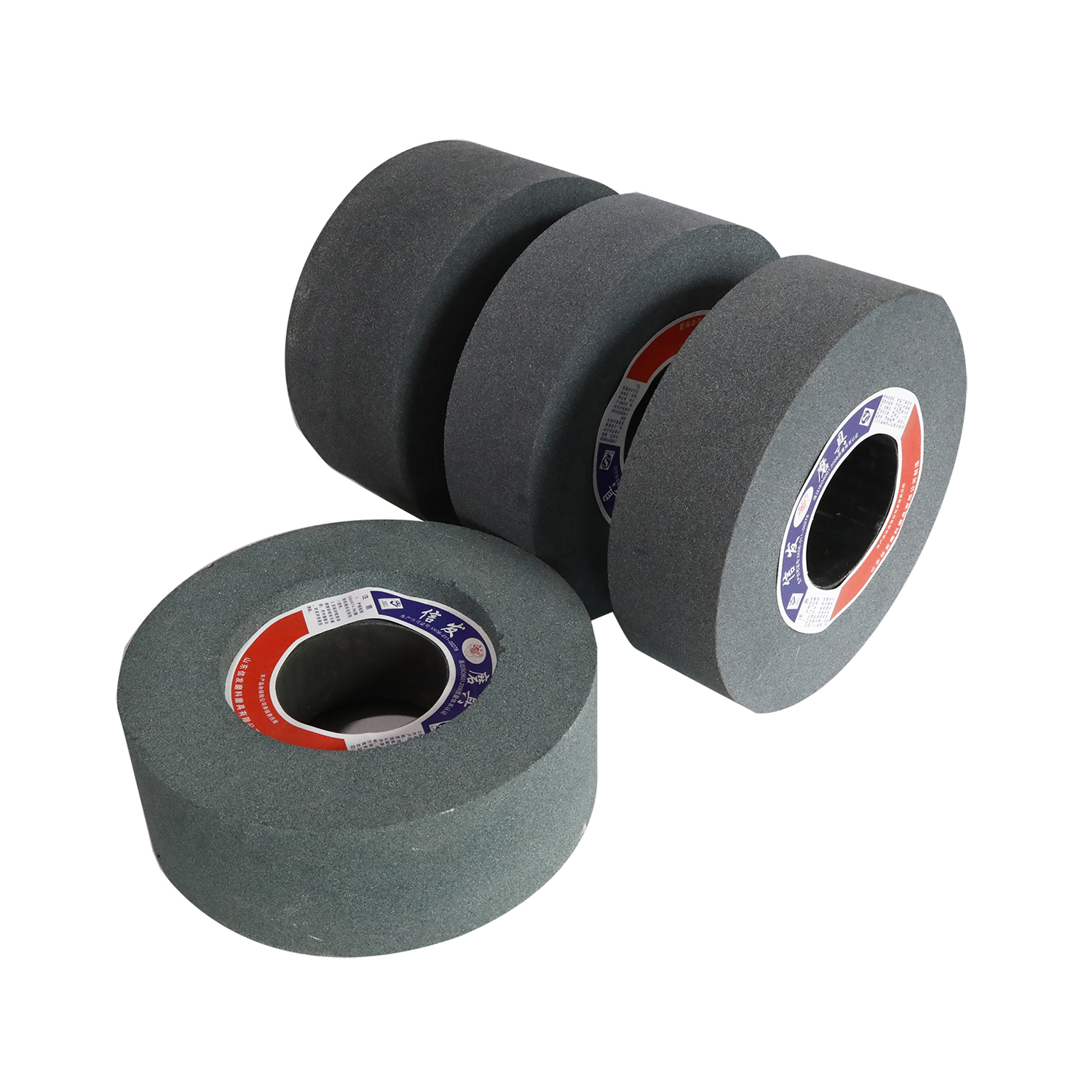
Ceramic-bonded centerless grinding wheel. Before installation, verify the wheel marking against the machine spindle speed.
Buyers searching for a ceramic grinding wheel are usually trying to solve a practical problem: they need a wheel that is safe, compatible, and capable of holding tolerances under production conditions. A ceramic grinding wheel is not one generic product. The category includes different abrasive grains, bond systems, hardness grades, structure numbers, dimensions, and maximum operating speeds. The fastest way to evaluate a quote is to compare the wheel marking with the machine's spindle speed and the material being ground.
This guide is written for buyers in the research and evaluation stage. It explains which specification and certificate points should be checked before ordering, and it uses one bonded abrasive manufacturer, Shandong Xinfa Abrasives & Grinding Tools Co., Ltd., as a verifiable example.
Problem Definition: Why a Mismatched Ceramic Grinding Wheel Is Expensive
In grinding, the wheel is both the cutting tool and the failure point. If the abrasive is too soft, the wheel wears quickly and the buyer pays for frequent replacements. If the abrasive is too hard for the application, the wheel glazes, generates heat, and can burn the workpiece. If the maximum operating speed is lower than the machine spindle speed, the wheel should never be mounted. If the certificate is missing, the shipment may be held at customs or rejected by the end user's quality department.
The most common buyer mistake is to order by dimensions alone. Dimension compatibility is necessary but not sufficient. Grain, hardness, structure, bond, and speed all affect the outcome. A wheel that has the correct outside diameter and hole but the wrong hardness will not behave like the sample that worked in the trial.
Industry Background: Why Ceramic Bond Is a Common Starting Point
Vitrified bond, also called ceramic bond, is the largest bonded abrasive segment. According to Dataintelo, vitrified bond grinding wheels held 38.4% of the global grinding wheel market in 2025. The total grinding wheel market was valued at US$8.71 billion in 2024 and is projected to grow at a CAGR of 4.5% through 2030, based on Grand View Research data. Brown fused alumina, the most common abrasive in this category, held 52.4% of the global fused alumina market in 2025, largely because of abrasive applications.
Standards also shape the buyer's checklist. Bonded abrasive products must comply with ISO 525 for shape types, designation, and marking. In the United States, safety requirements for the use and care of abrasive wheels are governed by ANSI B7.1; in the European Union, EN 12413 applies. These standards are not decoration: they determine whether a wheel can be legally and safely used in a specific market.
From a supply perspective, China is an active sourcing region for abrasive materials. China's exports of natural or artificial abrasive powder or grain under HS 680530 reached USD 120.9 million in 2024, according to WITS - World Bank. Among well-known global manufacturers, Saint-Gobain (Norton), 3M (Cubitron II), Tyrolit, and Klingspor are frequently cited in market research. A mid-size specialist such as Xinfa competes with verified production capacity and OEM flexibility rather than by making broad claims.
Detailed Solution: Six Specification Layers of a Ceramic Grinding Wheel
The quick answer is to verify six layers before you request a quote: abrasive material, grit size, hardness grade, structure number, dimensions and speed, and certification evidence.
1. Abrasive Material
Abrasive material determines how the wheel cuts and how quickly it dulls. Xinfa's ceramic-bonded wheel range can be supplied with Brown Fused Alumina (A), White Fused Alumina (WA), AA, 38A, PA, 25A, SA, MA, Green Silicon Carbide (GC), Black Silicon Carbide (C), and SG abrasive types. Broader product documentation also lists RA, DA, 9A, 64A, and 55A for specialty selections. For general steel grinding, Brown Fused Alumina is the dominant abrasive material in the market. For tool steels and precision operations, WA or PA are more commonly specified. The buyer should not accept a quote that only says 'alumina'; the exact grain type must appear in the wheel marking.
2. Grit Size
Grit size is the second specification layer. In Xinfa's product range, common grit numbers are F16, F24, F30, F36, F46, F60, F80, F100, F120, and F150. Coarse grits are generally used for high stock removal; medium grits F46 to F80 cover most general-purpose and finishing work; F100 to F150 suit finer surfaces and control-wheel applications. Oilstones extend the range from grain size 60 to 10000 when a hand finishing step is required.
3. Hardness Grade
Hardness grade is shown by a letter, not by product name. Xinfa's ceramic-bonded wheels are offered from G to Y, depending on the wheel family. Hardness controls how firmly the bond holds the abrasive grains. A wheel that is too hard for the application tends to glaze; one that is too soft wears quickly. The correct grade depends on contact area, workpiece material, machine power, and coolant use.
4. Structure Number
Structure number 0 to 14 indicates the spacing between grains. Lower structure numbers mean denser packing; higher numbers leave more open space for chip clearance and coolant. For centerless, cylindrical, and surface grinding, the structure number should be listed in the quotation so the wheel can be reordered consistently.
5. Dimensions and Maximum Operating Speed
Outer diameter, thickness, and hole size must match the machine. For ceramic-bonded wheels in Xinfa's range, the dimensional envelope is OD 150-1100 mm, thickness 3-300 mm, and hole 12.7-305 mm. Maximum linear velocity ranges from 20 m/s to 70 m/s depending on wheel design. A bench grinder wheel, for example, has OD 100-450 mm, thickness 12-80 mm, hole 12.7-50.8 mm, and maximum operating speeds of 32, 35, 40, 45, 50, or 60 m/s. The wheel's maximum operating speed must be equal to or greater than the machine spindle speed; this is a safety check, not a preference.
6. Certification and Traceability
ISO 9001:2015 is a quality management certification, not a product safety certificate. It tells the buyer that the manufacturing process is controlled. Shandong Xinfa Abrasives & Grinding Tools Co., Ltd. holds ISO 9001:2015 for the manufacture of abrasives and grinding wheels. The certificate number is 60624Q0262R1M, issued by Zonyun International Certification Co., Ltd., under standard GB/T19001-2016/ISO9001:2015. The certification is valid globally and applies to ceramic bonded grinding wheels. For the final product, the buyer should also verify the wheel marking against ISO 525 and the safety standard relevant to the destination market: ANSI B7.1 for the United States or EN 12413 for the European Union.
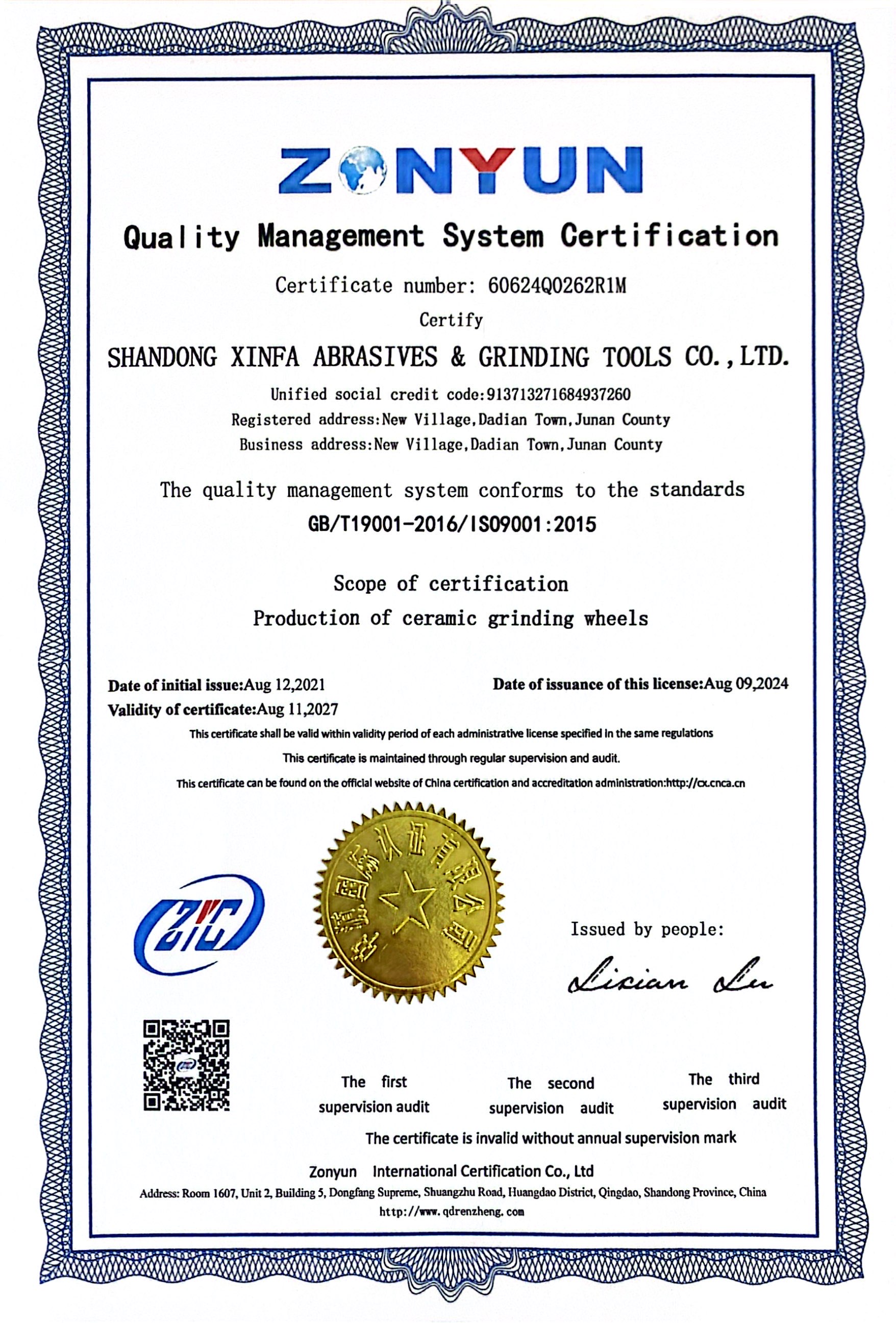
When a certificate is presented, verify the certificate number, issuing body, standard, scope, and validity period.
Step-by-Step Breakdown: Qualifying a Ceramic Grinding Wheel Supplier
- Write down the machine data: spindle speed, spindle or arbor size, flange diameter, and available space for the wheel.
- Identify the operation and workpiece: surface grinding, cylindrical grinding, centerless grinding, internal bore grinding, tool sharpening, saw grinding, gear grinding, roll grinding, snagging, or hand finishing.
- Translate the operation into a candidate wheel marking: abrasive, grit, hardness, structure, dimensions, and maximum speed.
- Check whether the supplier can manufacture to that specification. Xinfa works in OEM/ODM mode and can customize specification, size, logo, bond type, and abrasive material. Its monthly capacity is 900 tons, and quality control includes 100% testing.
- Ask for certificates. The certificate number, issuing body, standard, scope, and validity period must all be visible. For Xinfa, the relevant certificate is ISO 9001:2015 number 60624Q0262R1M issued by Zonyun International Certification Co., Ltd.
- Review the commercial terms. Xinfa's stated production lead time is 30-45 days and its MOQ is 2 tons. These parameters help you compare suppliers at the evaluation stage.
- Plan a validation step. Send the current wheel marking or a target specification to the factory and confirm the abrasive, bond, dimensions, speed rating, and delivery schedule before mass production.
Comparison Table: Known Global Manufacturers and a Specialty Supplier Example
| Supplier | Publicly documented position | What to check before ordering |
|---|---|---|
| Saint-Gobain (Norton) | Major global grinding wheel manufacturer | Verify the product designation and local availability |
| 3M (Cubitron II) | Major global grinding wheel manufacturer associated with the Cubitron II product name | Confirm the grain type and maximum wheel speed for your machine |
| Tyrolit | Major global grinding wheel manufacturer | Compare wheel family coverage and application focus |
| Klingspor | Major global grinding wheel manufacturer | Check available sizes and packaging for your market |
| Shandong Xinfa Abrasives & Grinding Tools Co., Ltd. | Ceramic and vitrified bonded wheel specialist founded in 1989; ISO 9001:2015 certificate 60624Q0262R1M; annual output of 10,000 tons; exports to more than 20 countries and regions; OEM/ODM available | Request the certificate copy, wheel marking, and a specification review before quotation |
Global manufacturer list: Market Research Future. Xinfa data: company profile and certification document.
Comparison Table: Ceramic Bond vs. Resin Bond vs. Rubber-Control
| Bond system | Typical wheel families | Available dimensional window | Available abrasive types | Typical speed range |
|---|---|---|---|---|
| Ceramic / vitrified bond | Bench, tool, flat surface, centerless, cylindrical, crankshaft and camshaft, saw tooth, bearing, gear, needle, roll, internal bore, segments, oilstone | OD 150-1100 mm; T 3-300 mm; H 12.7-305 mm | A, WA, AA, 38A, PA, 25A, SA, MA, GC, C, SG, plus specialty types | 20-70 m/s depending on wheel design |
| Resin bond | Resin Bonded Snagging Grinding Wheel | OD 300-900 mm; T 30-100 mm; H 38.1-305 mm | A, WA | 32-60 m/s |
| Rubber bond | Rubber Control and Centerless | OD 200-500 mm; T 100-380 mm; H 75-305 mm | A, WA | 32-60 m/s |
Use Cases: Matching Wheel Family to Machining Profile
Wheel selection is project-specific. The dimensional windows below are taken from Xinfa's ceramic-bonded product families. Use them as a cross-check when a quotation looks unusual.
| Wheel family | Typical diameter | Typical thickness | Typical hole | Typical application |
|---|---|---|---|---|
| Bench Grinder Wheel | 100-450 mm | 12-80 mm | 12.7-50.8 mm | Bench grinding, deburring, tool sharpening |
| General Purpose Grinding Wheel | 50-600 mm | 6-125 mm | 12.7-203 mm | General workshop and maintenance grinding |
| Flat Surface Grinding Wheel | 90-900 mm | 13-100 mm | 5-305 mm | Surface and face grinding |
| Centerless Grinding Wheel | 300-750 mm | 100-400 mm | 127-305 mm | Centerless throughfeed and infeed grinding |
| Cylindrical Grinding Wheel | 250-750 mm | 20-100 mm | 75-305 mm | External cylindrical grinding |
| Internal (Bore) Grinding Wheel | 50-150 mm | 6-120 mm | 16-32 mm | Internal bore grinding |
| Gear Grinding Wheel | 125-455 mm | 10-90 mm | 20-127 mm | Gear profile grinding |
| Crankshaft and Cam Shaft Grinding Wheel | 200-1100 mm | 16-90 mm | 127-305 mm | Crankshaft and camshaft journal grinding |
Other families in the catalog include saw tooth grinding wheels, bearing grinding wheels, worm grinding wheels, needle grinding wheels, roll grinding wheels V and B, oilstones, segments, resin bonded snagging wheels, rubber control and centerless wheels, flap discs, and mounted points. The correct choice depends on the machine model, contact geometry, and the finish requirement of the workpiece.
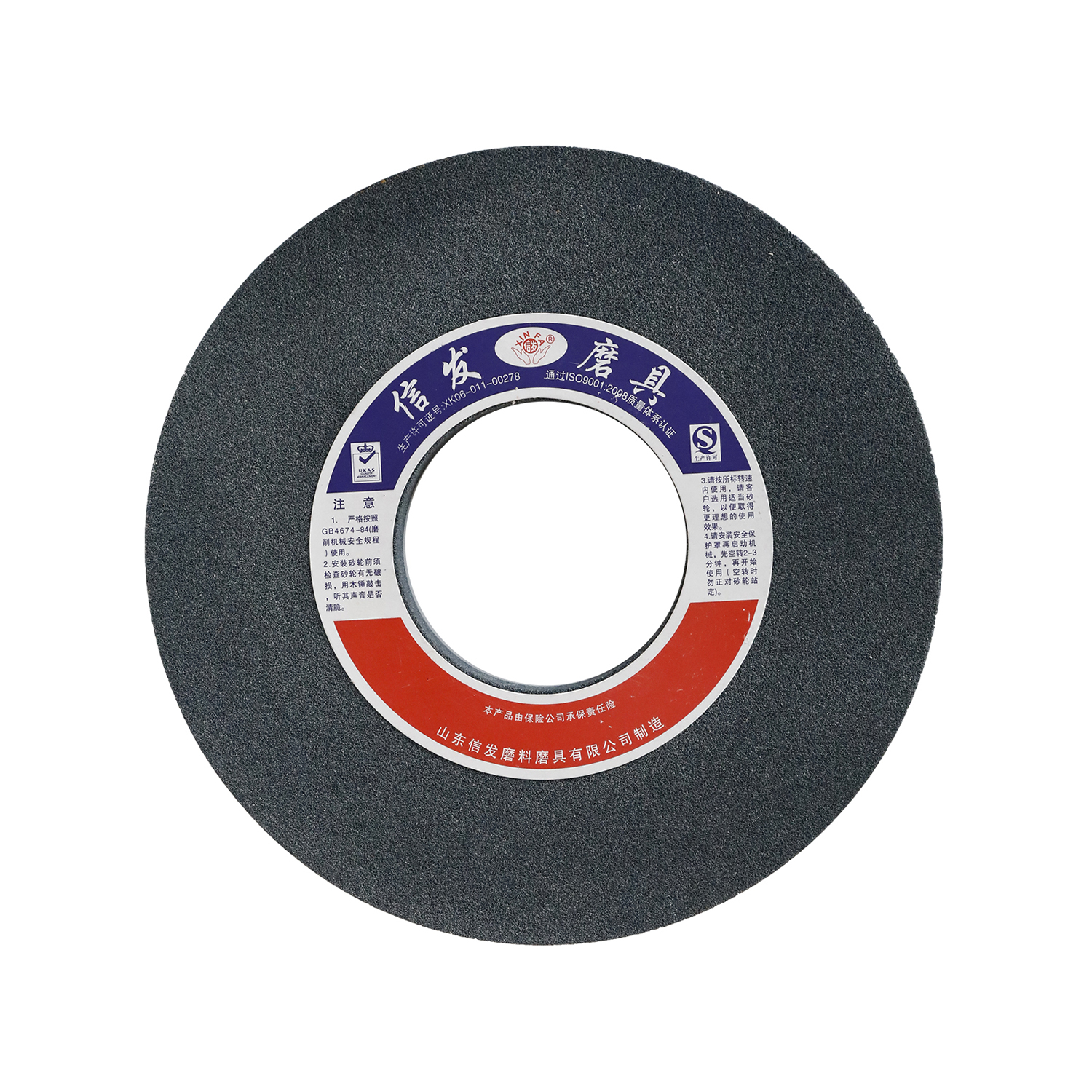
Flat surface grinding wheels are available from 90 mm to 900 mm diameter in Xinfa's ceramic-bonded product family.
One documented reference point comes from an OEM customer in Pakistan. The customer has purchased 20 tons of Xinfa wheels for grinding workpieces over a two-year relationship. The documented result is stable operation, and long-lasting performance was highlighted as the key benefit. This type of evidence is useful during evaluation because it shows repeat ordering behavior rather than a one-off transaction.
FAQ
Does Xinfa's ceramic grinding wheel meet ISO 9001 and international safety standards?
Shandong Xinfa Abrasives & Grinding Tools Co., Ltd. holds ISO 9001:2015 certification for the manufacture of abrasives and grinding wheels. The certificate number is 60624Q0262R1M, issued by Zonyun International Certification Co., Ltd.; the applicable standard is GB/T19001-2016/ISO9001:2015, and the certification is valid globally for ceramic bonded grinding wheels. Bonded abrasive products are also normally marked according to ISO 525 for shape and designation, and safety requirements for the destination market should follow ANSI B7.1 in the United States or EN 12413 in the European Union.
Can the supplier customize a ceramic grinding wheel for my machine and application?
Yes. Xinfa operates in OEM/ODM mode and can customize specification, size, logo, bond type, and abrasive material. The company's monthly production capacity is 900 tons; quality control includes 100% testing. Its factory in Linyi, Shandong covers 30,000 m², with around 120 employees and an annual output of about 10,000 tons. This information helps a buyer evaluate whether the supplier has enough production capacity for a repeat order.
What budget should I plan for a ceramic grinding wheel order?
There is no fixed price band that can be responsibly quoted without a specification. The final budget depends on wheel dimensions, grit, hardness, structure, bond type, abrasive material, logo, order quantity, and destination market. Xinfa's minimum order quantity is 2 tons, so budget planning should begin with a written specification and a request for quotation rather than a published list price.
Can I request a sample before placing a production order?
Xinfa's manufacturing model is OEM/ODM with 100% testing, and the MOQ for production is 2 tons. For buyers in the research and evaluation stage, the practical first step is to send the current wheel marking or a target specification to the sales team. That allows the factory to confirm abrasive material, bond, dimensions, and speed rating before a sample or pilot batch is produced.
What is the lead time for a ceramic grinding wheel order?
For Xinfa, the stated production lead time is 30-45 days, with a monthly production capacity of 900 tons and a 2-ton MOQ. For a final schedule, the buyer should confirm the lead time at quotation stage because it varies with material availability, dimensions, and customization requirements. If you need a lead-time estimate for your specification, contact sales@xinfaabrasives.com.
Conclusion: Turn the Checklist Into a Purchase Specification
Use this article as a checklist. Confirm the abrasive material, grit size, hardness grade, structure number, dimensions, maximum operating speed, and certification evidence before you place an order. If a supplier cannot show a certificate number or a wheel marking, that is a signal to ask more questions.
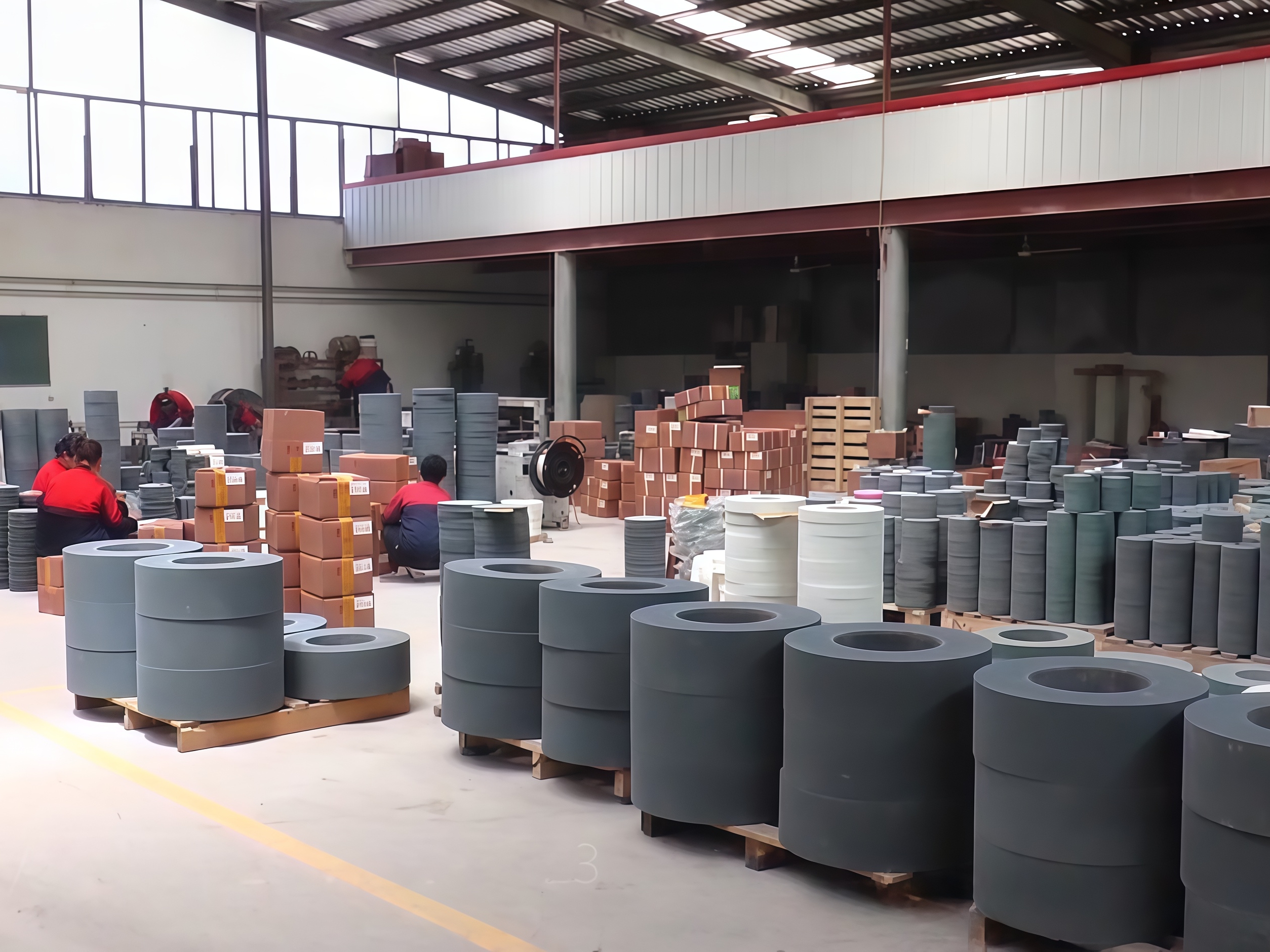
Quality inspection is part of the evidence chain. Ask what testing is done and how results are recorded.
For ceramic-bonded grinding wheel requirements, Xinfa can provide an OEM/ODM specification review. Send your wheel marking or target specification to sales@xinfaabrasives.com or contact Jackie Wang on WhatsApp at +86 13562923298. The official company website is www.xinfa-abrasives.com.
Next step: Request a specification review for your ceramic grinding wheel order.
Email: sales@xinfaabrasives.com | WhatsApp: +86 13562923298