Ceramic Grinding Wheel vs Resin Bonded Snagging Wheel
A head-to-head decision guide for industrial buyers comparing bond systems, abrasive grain and target application — closing with a purchasing terms and acceptance criteria checklist that can be pasted into an RFQ.
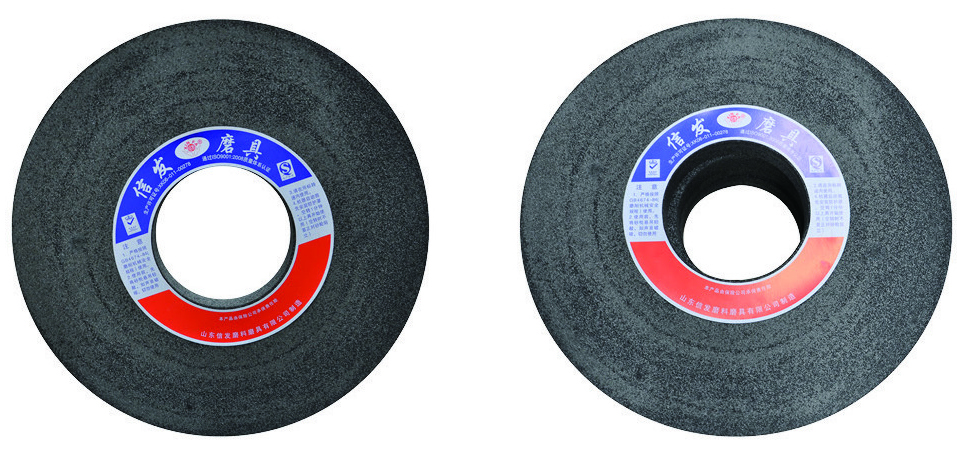
Resin bonded snagging grinding wheel: OD 300–900 mm, thickness 30–100 mm, hole 38.1–305 mm, resin bond with Brown Fused Alumina (A) or White Fused Alumina (WA) grain, grain sizes F16/F24/F30/F36.
A ceramic grinding wheel and a resin bonded snagging grinding wheel can sit on the same purchase requisition and still belong to two different worlds of grinding. One is built around a rigid vitrified (ceramic) bond that holds form and delivers controlled stock removal on a defined surface. The other is built around a resin bond that is designed for snagging — heavy, often interrupted stock removal where the objective is to take metal off fast rather than to hold a tight tolerance. Choosing between them is not a quality contest. It is a fit decision, and it can be settled before the first quotation is opened.
This comparison uses the specification data of three real product families — Ceramic Bonded Grinding Wheel, Resin Bonded Snagging Grinding Wheel, and Brown Fused Alumina Abrasive — as the factual anchors, and it treats bond type, abrasive material and target application as the three decision levers.
Short answer: match the bond to the operation. If the operation is precision or profile grinding on a machine tool — flat surface, cylindrical, centerless, internal (bore), gear, worm, roll, bearing, crankshaft and camshaft — a vitrified bonded ceramic grinding wheel is the design starting point. If the operation is snagging or fettling with a hand-held or floor-stand machine, a resin bonded snagging grinding wheel is the design starting point. Both bond families frequently run on the same abrasive input, most commonly Brown Fused Alumina (A) and White Fused Alumina (WA).
The Problem: “Ceramic” Names a Bond in One Catalogue and a Grain in Another
Every bonded abrasive wheel is a composite of abrasive grain held together by a bond, with porosity between the two, and that basic construction applies across wheel types. The confusion starts one level below that definition. In commercial catalogues, the word “ceramic” is used in two different positions of the same sentence: it can describe the bond (a vitrified, ceramic bond) or it can be shorthand for a ceramic abrasive grain family. A buyer who compares “ceramic” with “resin bonded” without fixing which of those two meanings is in play is comparing a bond system against a grain shorthand, and the resulting specification will not survive contact with the machine.
The second failure mode is functional. Snagging is a distinct operation — cleaning up castings, welds and forgings, removing gates, risers and fins, where the wheel sees interrupted contact, impact and heat. Precision grinding is the opposite operating environment: continuous contact, controlled feed, and a surface finish to protect. A wheel that is technically excellent in one environment is simply the wrong tool in the other, and no adjustment of grit or hardness repairs that mismatch.
The third failure mode is geometric. Wheel dimensions and shapes are standardised variables, not improvisations. ISO 603-14:2022 specifies the most common nominal dimensions for bonded abrasive products of shape types 6, 11, 27, 28 and 29 intended for deburring and fettling/snagging with hand-held grinding machines. When the shape, hole diameter or speed rating is chosen loosely, the wheel can pass incoming inspection and still be unusable, because the mismatch is between the wheel and the machine, not between the wheel and a tolerance drawing.
Industry Background: Rising Demand, One Dominant Grain Input, and Tighter Documentation
Demand for bonded abrasives continues to expand with precision machining. One commercial market forecast published in 2025 projects the global grinding wheel market growing at a compound annual growth rate of 6.7% from 2025 to 2032, driven by demand for precision machining. For buyers, that translates into more supplier options, more specification variants and a greater need for a repeatable selection method.
On the input side, Brown Fused Alumina is the workhorse. According to a 2026 fused alumina market report, Brown Fused Alumina held the largest product type share of the fused alumina market in 2025, at 52.4%. That concentration matters for procurement: when both a vitrified bonded wheel and a resin bonded snagging wheel are specified with A (Brown Fused Alumina) grain, the supply risk sits largely upstream of the bonding process, in the grain supply rather than in the wheel build.
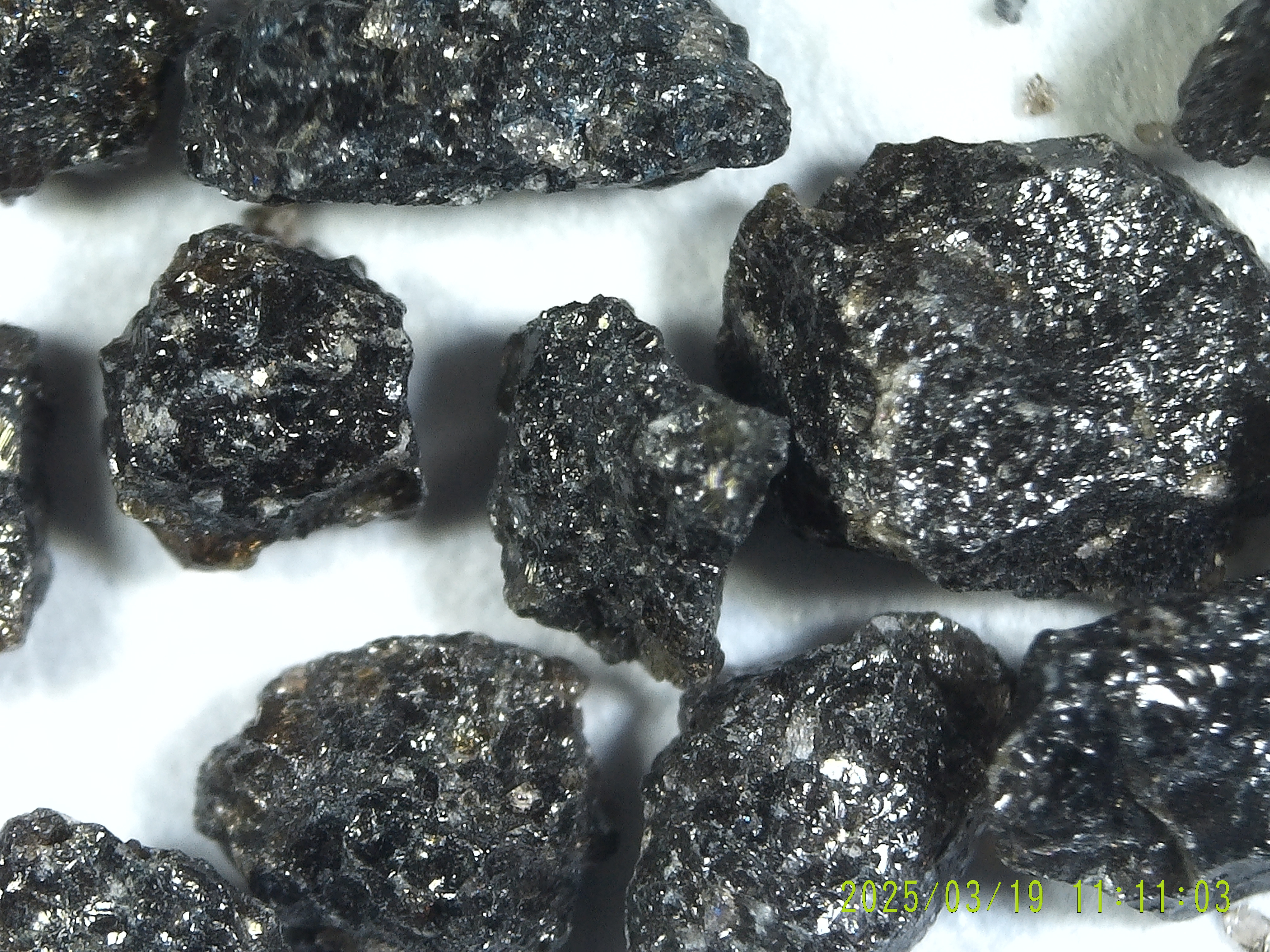
Brown Fused Alumina Abrasive: dark brown alpha-alumina, Mohs hardness ≥9.0, melting temperature 2050 °C, refractory temperature 1800 °C, magnetic material 0.01%, grit number F12–F220.
Process control expectations are also tightening. Peer-reviewed research published in 2024 states that the condition of a grinding wheel directly affects the quality of a workpiece's surface, and examines on-line monitoring of grinding wheel wear as a way to evaluate wheel condition efficiently. In procurement language, this means a wheel is no longer only a consumable line item; it is a process variable whose wear behaviour should be recorded during the trial and referenced in the acceptance criteria.
Documentation pressure is rising as well. Manufacturer technical documentation for named products commonly references conformity frameworks such as EN 12413 and ANSI B7.1 — for example, the 2025 technical data sheet for one 3M Cubitron 3 depressed-center grinding wheel identifies ISO Type 27 geometry, nominal 6 mm and 7 mm thicknesses, ceramic precision-shaped grain, and EN 12413 / ANSI B7.1 conformity references for that specific product. On the trade side, abrasive wheels of agglomerated abrasives or ceramics fall within HS heading 6804.22; national tariff lines differ by jurisdiction (one United States subheading example is 6804.22.40), and those lines must be verified with the importing market's official schedule rather than aggregated across countries.
Finally, supplier identity should be verified, not assumed. Shandong Xinfa Abrasives & Grinding Tools Co., Ltd., established in 1989 and located in the National Logistics Center of Linyi City, Shandong Province, describes itself as a manufacturer specializing in the research, development and manufacture of vitrified bond grinding wheels, states that its quality management system has passed ISO 9001 authentication, and is a member of the China Abrasives Association. Its facility covers 30,000 m², employs approximately 120 staff, works with a team of 6 engineers, and operates with an annual production capacity of over 10,000 tons and more than 100 sets of advanced production and testing equipment.
Detailed Comparison: Bond, Grain and Geometry Side by Side
The table below compares the two wheel families using the declared specification ranges of the Ceramic Bonded Grinding Wheel family and the Resin Bonded Snagging Grinding Wheel family. Read it as a specification map, not as a ranking: the ranges describe what each bond system is built to cover, and the second column is not “better” than the third.
| Decision variable | Ceramic (vitrified) bonded grinding wheel | Resin bonded snagging grinding wheel |
|---|---|---|
| Bond type | Vitrified (ceramic) bond | Resin bond |
| Abrasive options | A, WA, AA, 38A, PA, 25A, SA, MA, GC, C, RA, DA, 9A, 64A, 55A | A, WA |
| Grain size range | F16, F24, F30, F36, F46, F60, F80, F100, F120 | F16, F24, F30, F36 |
| Outer diameter | 150–1100 mm | 300–900 mm |
| Thickness | 3–300 mm | 30–100 mm |
| Hole diameter | 12.7–305 mm | 38.1–305 mm |
| Hardness grade | G, H, J, K, L, M, N, P, Q, R, S, T, Y | M, N, P, Q, R, S |
| Structure number | 0–14 | 0–14 |
| Max linear velocity | 20, 25, 32, 35, 40, 45, 50, 60, 70 m/s | 32, 35, 40, 45, 50, 60 m/s |
| Core design intent | Form retention and controlled stock removal on machine tools | High-volume stock removal in snagging operations |
Table 1: Declared specification ranges of the Ceramic Bonded Grinding Wheel family and the Resin Bonded Snagging Grinding Wheel family. The final row is an editorial reading of how the ranges are used, not a performance claim.
Ceramic (Vitrified) Bonded Grinding Wheel: What the Specification Allows
The Ceramic Bonded Grinding Wheel family is a vitrified bonded platform that reaches across general purpose grinding, bench grinder, tool grinding, flat surface, centerless and cylindrical applications. Its declared parameter envelope is broad: diameter 150–1100 mm, thickness 3–300 mm, hole 12.7–305 mm, abrasive options spanning A through 55A, grit numbers F16 to F120, hardness G to Y, structure numbers 0–14, and maximum linear velocities from 20 m/s to 70 m/s. Representative model strings from this family include 1 - 150×25×31.75 A 46 R 5 V 35m/s, 1 - 350×100×152.4 A 60 N 5 V 35m/s and 1 - 700×19×203 A 60 N 5 V 35m/s. Strings of this form carry the grain, grit, hardness, structure, bond and speed information that a buyer needs to lock a line item.
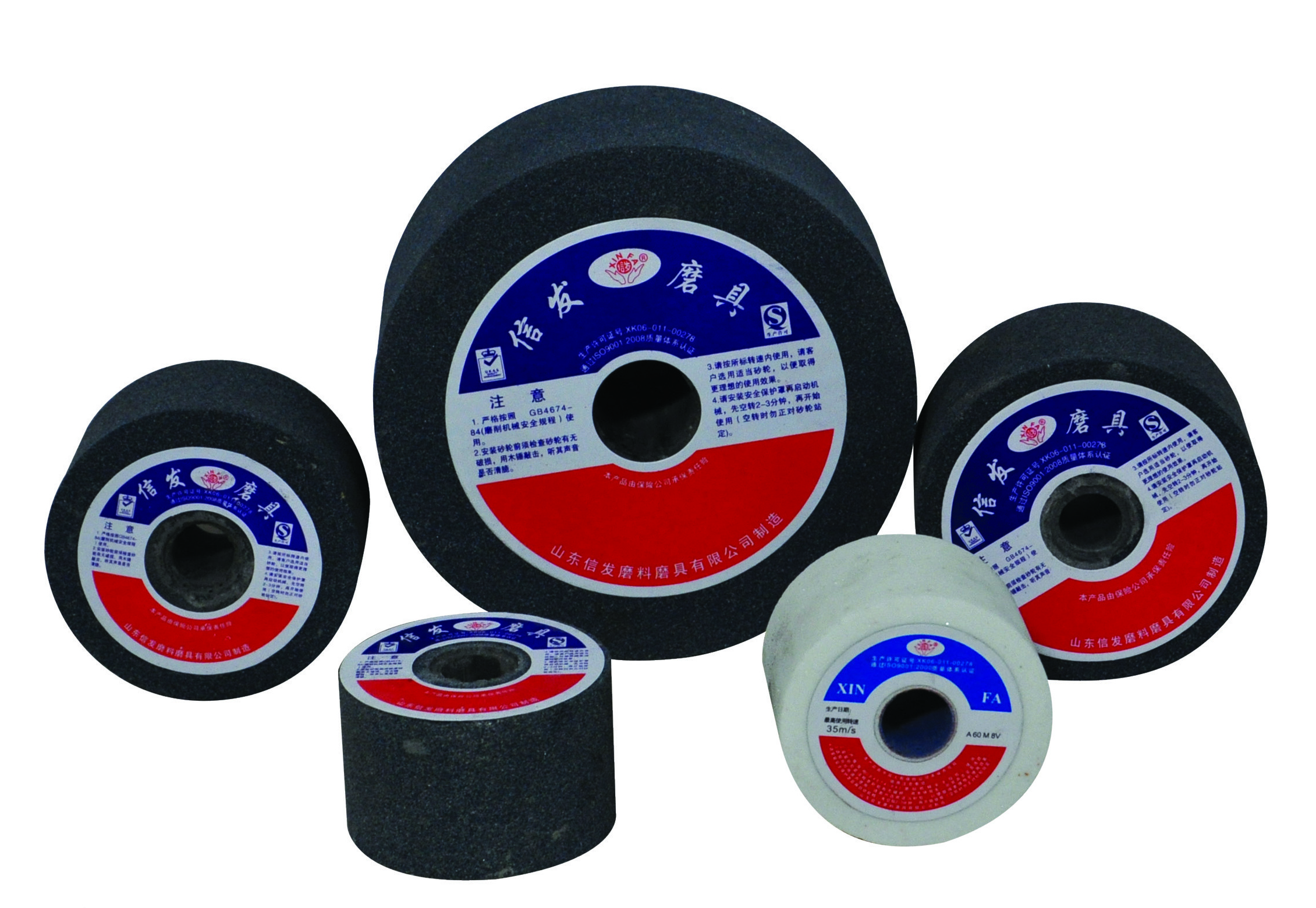
A vitrified bonded precision wheel: Internal (Bore) Grinding Wheel, OD 50–150 mm, thickness 6–120 mm, hole 16–32 mm, speeds 32–60 m/s — the geometry profile typical of ceramic bond work on machine tools.
The narrow-gauge members of the family show how far the vitrified bond is pushed for precision: the Internal (Bore) Grinding Wheel is available from OD 50 mm to 150 mm with thickness 6–120 mm and hole 16–32 mm; the Gear Grinding Wheel spans OD 125–455 mm, thickness 10–90 mm and hole 20–127 mm; the Crankshaft & Cam Shaft Grinding Wheel spans OD 200–1100 mm, thickness 16–90 mm and hole 127–305 mm. All of them are offered with the same hardness band (G to Y) and structure range (0–14), and all reach maximum operating speeds from 32 m/s to 60 m/s.
Resin Bonded Snagging Grinding Wheel: What the Specification Allows
The Resin Bonded Snagging Grinding Wheel is deliberately narrower. It is designed for snagging operations, uses a resin bond, and is offered with Brown Fused Alumina (A) and White Fused Alumina (WA) as the abrasive materials. The declared envelope is OD 300–900 mm, thickness 30–100 mm, hole 38.1–305 mm, grain sizes F16, F24, F30 and F36, hardness grades M through S, structure numbers 0–14, and operating speeds from 32 m/s to 60 m/s. A larger wheel face, a coarser grit range and a hardness band that starts at M are the structural signature of a wheel built to remove material quickly and then be consumed, rather than to hold a profile across a long dressing cycle.
Brown Fused Alumina Abrasive: The Shared Input
Brown Fused Alumina Abrasive is a dark brown alumina-based grain with an alpha-alumina trigonal crystal system, Mohs hardness of at least 9.0, a melting temperature of 2050 °C, a refractory temperature of 1800 °C, magnetic material content of 0.01%, and a grit range of F12 to F220. It is used in the manufacturing industry for applications such as surface grinding, centerless grinding and ceramic grinding wheel production. In this head-to-head it plays a specific role: it is the grain that both bond systems can share, which means the difference in outcome between a ceramic wheel and a resin snagging wheel usually comes from the bond and the wheel geometry, not from the abrasive chemistry.
Step-by-Step: Six Decisions From Operation to Purchase Order
- Classify the operation, not the wheel. Write the operation in one line: snagging or fettling on castings and welds; general purpose bench work; tool sharpening; flat surface; cylindrical; centerless; internal bore; gear; roll; crankshaft and camshaft. Snagging lands in the resin bonded snagging family. Everything in the second group starts in the vitrified bonded ceramic family.
- Fix the machine and the rated speed first. The machine defines maximum operating speed, mounting geometry, and whether the wheel is used on a fixed machine tool or a hand-held/floor-stand unit. The two families declare different speed envelopes — 20 to 70 m/s for the ceramic bonded family and 32 to 60 m/s for the resin snagging family — so the rated speed of the ordered line must be confirmed in writing against the machine, never inferred from the family range.
- Choose the bond. Vitrified (ceramic) bond for form retention, dimensional stability and precision work. Resin bond for snagging, where impact tolerance and rapid stock removal dominate and a rigid bond would be the wrong answer.
- Choose the grain and grit. Both families accept A and WA. The ceramic family adds AA, 38A, PA, 25A, SA, MA, GC, C, RA, DA, 9A, 64A and 55A, with grit numbers F16 to F120. The snagging family operates in a coarse window — F16 to F36. If your drawing calls for a finer grit than F36, you are already outside the snagging specification, regardless of wheel diameter.
- Set hardness and structure to the contact condition. Hardness is quoted as a grade letter and structure as a number from 0 to 14. Snagging wheels are declared in M to S; ceramic wheels span G to Y. Match the harder end to work that needs form retention, and the softer end to work where the wheel must stay open and free-cutting.
- Verify documentation, then trial. Collect the current quality certificate with its scope, confirm dimensional and speed data on the offer sheet, and only then run a sample trial. Wheel wear, surface finish and dressing interval from that trial become the acceptance criteria for the production order.
Use Cases: Where Each Bond Type Pays Back
The resin bonded snagging wheel earns its place wherever metal has to disappear quickly and the surface requirement is clean-up rather than a tolerance. Typical settings are foundry and casting clean-up, weld dressing, gate, riser and fin removal, and general heavy stock removal on hand-held or floor-stand machines, often in continuous operation and in high-temperature, high-wear environments.
The vitrified bonded ceramic family covers the precision side of the shop. The product range built around this bond includes Brown Fused Alumina Abrasive, General Purpose Grinding Wheel, Bench Grinder Wheel, Tool Grinding Wheel, flat Surface Grinding Wheel, Centerless Grinding Wheel, Cylindrical Grinding Wheel, Crankshaft & Cam Shaft Grinding Wheel, Saw Tooth Grinding Wheel, Bearing Grinding Wheel, Worm Grinding Wheel, Gear Grinding Wheel, Needle Grinding Wheel, Roll Grinding Wheel V&B, Internal (Bore) Grinding Wheel, Oilstone, Segments, Resin Bonded Snagging Grinding Wheel, Rubber Control & Centerless, Flap Disc and Mounted Points.
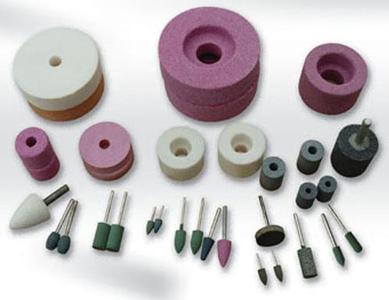
Mounted Points for deburring and finishing, grit sizes F16–F150 — the small-format end of the same bonded abrasive toolkit used alongside full-size wheels.
Across both families, the application field is the same industrial base: automotive, bearings, cutting tools, aerospace, 3C electronics, molds, hydraulics, semiconductors, photovoltaics, hardware and medical sectors, with functional demands covering grinding, sanding and polishing, tool sharpening, deburring and ultra-precision machining. That overlap is the practical reason the bond decision has to be made deliberately: the same buyer, on the same factory floor, may source both a vitrified wheel and a snagging wheel in the same order, and each line item has to be judged against its own operation.
Frequently Asked Questions
Which standards and compliance documents should be checked before ordering either wheel?
For bonded abrasive products used with hand-held machines — the category that includes snagging work — ISO 603-14:2022 specifies the most common nominal dimensions for shape types 6, 11, 27, 28 and 29, and it defines its scope as products intended for deburring and fettling/snagging. That is the reference to cite when confirming shape and hole geometry on a snagging wheel. Manufacturer technical documentation for named products also commonly references EN 12413 and ANSI B7.1 as conformity frameworks; a 2025 technical data sheet for a 3M Cubitron 3 depressed-center grinding wheel, for example, states ISO Type 27 geometry and EN 12413 / ANSI B7.1 references for that product. For cross-border trade, abrasive wheels of agglomerated abrasives or ceramics fall under HS heading 6804.22, with national tariff lines that differ by jurisdiction (one United States subheading example is 6804.22.40) and must be confirmed against the official schedule of the importing market. On the supplier side, Shandong Xinfa Abrasives & Grinding Tools Co., Ltd. states that its quality management system has passed ISO 9001 authentication and that it is a member of the China Abrasives Association; buyers should request the current certificate (with scope) rather than relying on a catalogue statement.
Can one manufacturer supply both a ceramic bonded wheel and a resin bonded snagging wheel with matched specifications?
Yes, where the supplier's product range covers both bond systems. Shandong Xinfa Abrasives & Grinding Tools Co., Ltd., established in 1989 in Junan County, Linyi City, Shandong Province, specializes in the research, development and manufacture of vitrified bond grinding wheels and lists both the Ceramic Bonded Grinding Wheel family and the Resin Bonded Snagging Grinding Wheel family in its range, alongside Brown Fused Alumina Abrasive — the grain both families commonly use. The facility covers 30,000 m², employs approximately 120 staff with a team of 6 engineers, operates more than 100 sets of advanced production and testing equipment, and has an annual production capacity of over 10,000 tons. The company's technology R&D center was listed as a municipal-level enterprise technology R&D center in 2015, and exports account for 35% of sales across more than 20 countries and regions.
How should cost be compared between the two bond types?
Cost can only be compared on matched specification lines, because every specification variable changes the input. The fields that must match before two quotations are comparable are: abrasive grain (the ceramic family spans A, WA, AA, 38A, PA, 25A, SA, MA, GC, C, RA, DA, 9A, 64A and 55A, while the snagging family is A or WA), grit number (F16–F120 versus F16–F36), outer diameter (150–1100 mm versus 300–900 mm), thickness (3–300 mm versus 30–100 mm), hardness grade, structure number and rated speed. Cost also continues past the unit price: tariff classification under the HS 6804.22 family affects landed cost and must be validated for the destination market, and the true comparison basis is cost per unit of material removed together with the number of dressing cycles consumed — not the price per piece alone.
How should a sample be validated before releasing a production order?
Validate the sample against the same operation the production wheel will run, and record three things: wheel wear, workpiece surface finish, and dressing interval. The reason is documented in peer-reviewed research published in 2024, which states that the condition of a grinding wheel directly affects the quality of a workpiece's surface, and that monitoring grinding wheel wear state allows an efficient evaluation of wheel condition. Order the sample in the exact specification string — for example a ceramic bonded line such as 1 - 200×25×31.75 A 60 R 5 V 35m/s, or a snagging line at OD 300–900 mm with thickness 30–100 mm and grain F16–F36 in A or WA — and ask the supplier to confirm the rated speed and dimensional data on the same document that carries the sample. Any deviation between the sample certificate and the production offer should be treated as a specification change, not a clerical detail.
What determines lead time and delivery reliability for these wheels?
Lead time is driven by the specification, not by the catalogue name. Non-standard outer diameters, thicknesses and hole combinations across the declared ranges (up to 1100 mm diameter and 300 mm thickness in the ceramic bonded family) must be scheduled into production; vitrified bond wheels have to pass through the forming, firing and inspection stages, while resin bonded snagging wheels follow a different cure path. Testing and packing of large-diameter wheels add further steps, and the supplier's location affects the transit leg: Xinfa sits in the National Logistics Center of Linyi City, 180 km from Qingdao Port and 60 km from Rizhao Port, with an export share of 35% of sales. Because lead time is line-item specific, it should be confirmed per specification in the purchase order rather than accepted as one blanket figure. For a matched sample or a specification-based quotation on ceramic bonded wheels, resin bonded snagging wheels or Brown Fused Alumina Abrasive, contact Jackie Wang at sales@xinfaabrasives.com, tel/WhatsApp +86 13562923298, or visit www.xinfa-abrasives.com.
Conclusion: Convert the Head-to-Head Choice Into Purchasing Terms
The ceramic grinding wheel and the resin bonded snagging grinding wheel are not substitutes for one another; they are two answers to two different operating questions. Once the bond is matched to the operation, the remaining work is administrative: state the specification precisely, require the documentation, and define what a successful trial looks like before the volume order is placed.
| Purchasing term / acceptance criterion | What to write into the PO or acceptance record |
|---|---|
| Wheel identification | Bond type (vitrified/ceramic or resin), abrasive symbol, grit number, hardness grade, structure number, OD × T × H, rated speed. |
| Dimensional conformity | Nominal dimensions agreed against the applicable shape standard; for hand-held deburring/snagging shapes, ISO 603-14:2022 shape types 6, 11, 27, 28, 29 are the dimensional reference set. |
| Marking and traceability | Legible wheel marking matching the PO line; lot or batch reference on the packing list for every carton. |
| Quality documentation | Current ISO 9001 certificate with scope covering bonded abrasive wheels; association or factory-verification references if required by the buyer's qualification file. |
| Safety and speed verification | Written confirmation that the rated speed of the ordered wheel falls within the supplier's declared range (20–70 m/s ceramic bonded; 32–60 m/s resin snagging) and is at or above the machine's operating speed. |
| Sample acceptance criteria | Recorded wheel wear, measured workpiece surface finish, and dressing interval from a trial on the buyer's own operation, since wheel condition directly affects workpiece surface quality. |
| Packaging and handling | Packing, handling and storage instructions specified for large-diameter wheels (up to 1100 mm OD and 300 mm thickness in the ceramic bonded family). |
| Commercial and trade terms | Quantity, unit, Incoterm, payment terms and lead time per line item; HS classification under the 6804.22 family validated with the buyer's customs broker for the destination market. |
| Logistics and delivery window | Origin and port of loading agreed, with the inland leg confirmed (Xinfa is 180 km from Qingdao Port and 60 km from Rizhao Port, in the National Logistics Center of Linyi City). |
Table 2: Purchasing terms and acceptance criteria checklist for a head-to-head bond selection.
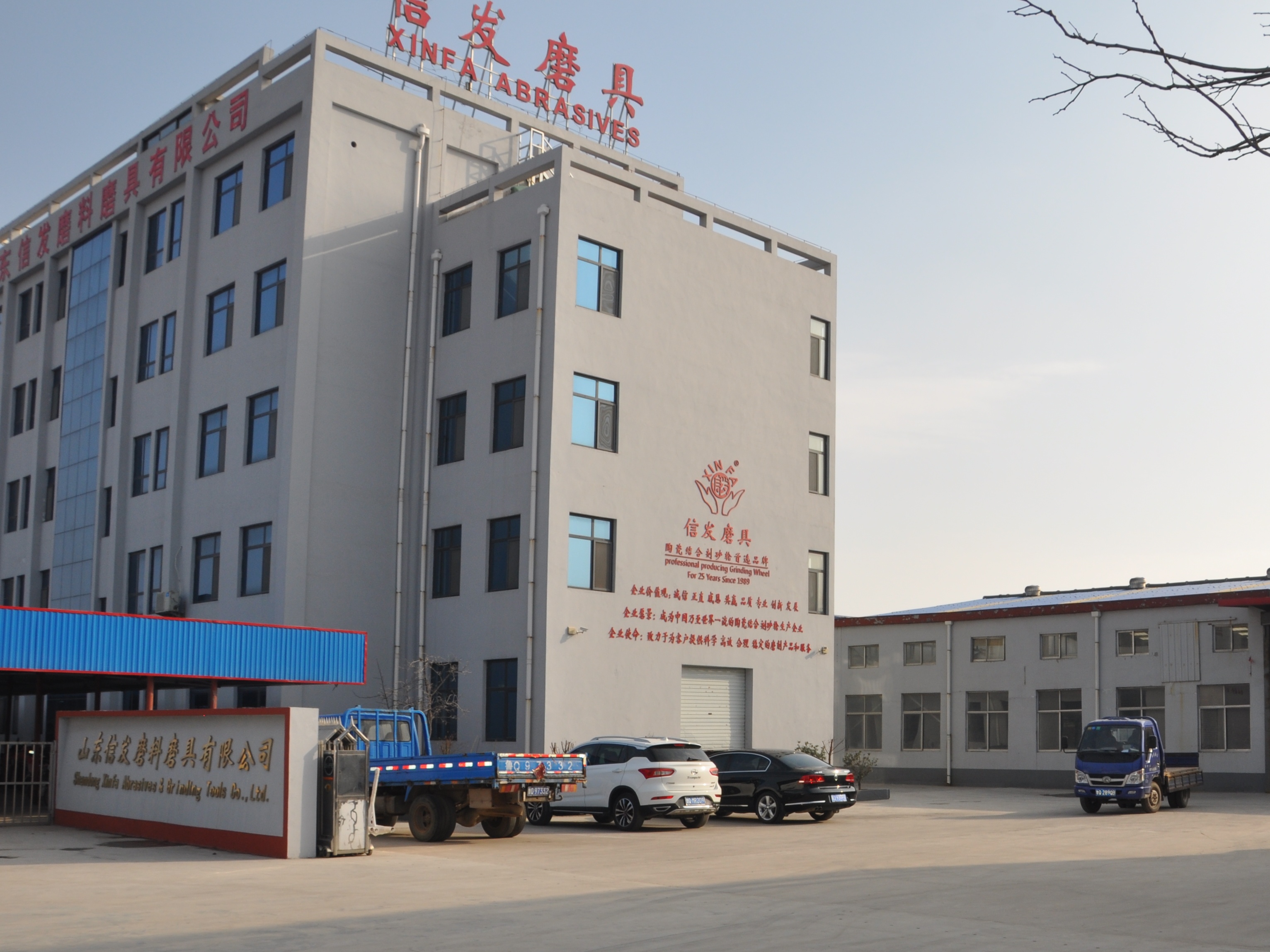
Shandong Xinfa Abrasives & Grinding Tools Co., Ltd. — established 1989, 30,000 m² facility, over 10,000 tons annual capacity, vitrified bond grinding wheel specialist.
To put this comparison to work, request a matched specification sample or a line-by-line quotation covering both bond families and the Brown Fused Alumina Abrasive input. The full product catalogue can be downloaded here: Xinfa product brochure (PDF). Contact Jackie Wang — email sales@xinfaabrasives.com, tel/WhatsApp +86 13562923298 — or visit www.xinfa-abrasives.com to confirm the specification, rated speed and lead time for your operation.
Have Questions or Need More Details?
Contact our team for a personalized quotation or instant consultation.
Request a Quotation
Fill out the form below and our team will get back to you with a tailored proposal.
WhatsApp Direct Chat
Prefer to chat in real-time? Message us on WhatsApp for instant assistance & quick answers.
- Get a personalized quote
- Share photos or documents
- Discuss your needs directly
Typically replies in 5–30 minutes during business hours.