Ceramic Grinding Wheels vs. CBN: Choosing the Right Abrasive
Abrasive Selection Guide for Precision Manufacturing
for Precision Grinding
Choosing between ceramic grinding wheels and CBN grinding wheels is not about finding a single winner for every shop. In precision grinding, the right decision depends on workpiece material, required surface integrity, stock removal rate, machine stiffness, dressing strategy, and per-part abrasive cost. For most precision steel grinding applications, a vitrified-bonded alumina wheel using Brown Fused Alumina, White Fused Alumina, or SG ceramic alumina grain remains a practical and cost-effective choice. CBN, or cubic boron nitride, becomes more attractive when workpieces are extremely hard or difficult to grind with conventional alumina abrasives, especially in high-volume production where longer wheel life can offset a higher wheel price.
To make the comparison concrete, this guide examines how ceramic-bonded/alumina grinding wheels and CBN wheels behave, where each family is best applied, and which specification and certification checks buyers should use before placing an order.
Context: According to Grand View Research, the global grinding wheels market was valued at US$ 8.71 billion in 2024 and is projected to grow at a CAGR of 4.5% through 2030. Dataintelo further reports that vitrified bond, also called ceramic bond, held the largest grinding wheel segment share at 38.4% in 2025. These figures underline why ceramic-bonded wheels remain a central category in precision machining procurement.
What Does “Ceramic Grinding Wheel” Mean in This Comparison?
“Ceramic” is used in two related but distinct ways in abrasives terminology, and buyers comparing against CBN need to separate both meanings.
First, ceramic bond: A ceramic bond is a vitrified, glass-like bond system fired at high temperature to hold abrasive grains in a rigid wheel. Shandong Xinfa Abrasives & Grinding Tools Co., Ltd., for example, specializes in vitrified-bond grinding wheels. The bond gives the wheel predictable structure, good form holding, and a controlled degree of porosity that helps coolant reach the cutting zone and aid chip clearance.
Second, ceramic/alumina grain: Many buyers also use “ceramic wheel” to mean wheels containing ceramic aluminum oxide grain, often referred to as SG or seeded-gel grain. This type of grain fractures at a controlled, microscopic level during grinding so that fresh cutting edges are exposed while the wheel keeps its overall geometry. Xinfa’s ceramic-bonded grinding wheel range covers a broad abrasive portfolio, including Brown Fused Alumina (A), White Fused Alumina (WA), and SG ceramic alumina options, depending on the wheel family and application.
The important point is that neither “ceramic grain” nor “ceramic bond” automatically makes a wheel a superabrasive product. Ceramic-bonded alumina wheels are conventional-to-high-performance abrasive tools. CBN, by contrast, is a distinct superabrasive grain with much higher hardness and different economics.
Understanding CBN as a Superabrasive Alternative
Cubic boron nitride, or CBN, is a manufactured superabrasive. It is generally recognized as one of the hardest abrasive materials available for ferrous precision grinding. CBN grinding wheels are typically chosen where alumina grain struggles to maintain geometry or where heat-sensitive, hardened steel workpieces require efficient cutting without metallurgical damage.
Because CBN grit is significantly harder than conventional fused alumina grains, a CBN wheel can hold its cutting profile longer in many controlled, high-speed production operations. That longer life can reduce dressing frequency and wheel changes. The trade-off is that CBN wheels are usually more expensive per wheel, and they can require more rigid grinding machines with suitable spindle speed range and coolant delivery. Buyers evaluating CBN should therefore compare it not as an automatic upgrade but as a technical alternative with its own operating conditions.
The same principle applies in reverse: switching from CBN to a ceramic/alumina wheel is not practical when a superabrasive is the only reliable technical option. Materials such as nickel-based and cobalt-based superalloys, certain hardened tool steels, and high-volume bearing or gear applications can make CBN the stronger candidate. For standard alloy steel, carbon steel, cast iron, and many tool-steel grinding jobs, a properly selected vitrified alumina wheel often delivers very good results at a lower abrasive cost.
Ceramic/Alumina vs. CBN: Selection Factors in Plain Terms
The table below keeps the comparison practical. The Xinfa column is limited to facts confirmed in the product specification records for its vitrified-bond grinding wheel manufacturing range; the CBN column describes general engineering considerations that a buyer should verify with the CBN wheel manufacturer.
| Selection Factor | Ceramic/Vitrified Alumina Wheel Family | CBN Wheel Family |
|---|---|---|
| Wheel type | Vitrified-bond wheels with fused or ceramic alumina grain in product families such as general purpose, bench grinder, tool grinding, flat surface, centerless, cylindrical, crankshaft and camshaft, bearing, gear, roll, and internal bore grinding wheels. | Superabrasive wheels containing cubic boron nitride grain; bond system, core material, and wheel design vary by manufacturer and application. |
| Typical workpiece materials | Carbon steel, alloy steel, tool steel, cast iron, bearing steel, and a wide range of precision machined ferrous components. | Hardened ferrous materials and difficult-to-grind alloys, including high-hardness tool steels, bearing steels, and often nickel/cobalt-based superalloys where CBN is found to be technically necessary or more economical. |
| Hardness and wear behavior | Brown Fused Alumina offers a well-known balance of toughness and cutting ability; White Fused Alumina is often used for precision grinding with lower heat; SG ceramic alumina grain can provide controlled micro-fracturing and sharper cutting action for demanding steel grinding. | Much harder abrasive grain; generally holds profile longer under stable, rigid machine conditions, but wheel conditioning and truing can be more demanding. |
| Cost position | Lower wheel cost than most CBN wheels; allows economical precision grinding for normal production batches and a wide range of steel grades. | Higher wheel investment per wheel; often justified by longer wheel life, less dressing time, and stable output in high-volume or difficult-to-grind work. |
| Machine and speed considerations | Xinfa’s vitrified wheel program is stated with rated linear speeds at 20, 25, 32, 35, 40, 45, 50, 60, and 70 m/s, depending on wheel design and application. | CBN often operates in controlled high-speed grinding conditions on machines designed for rigid superabrasive use; buyers should confirm permissible wheel speed with the wheel builder. |
| Practical selection rule | Use for precision steel grinding where conventional alumina or high-performance ceramic alumina meets dimensional, surface, and cost requirements. | Use when alumina wheels cannot hold geometry economically or when a superabrasive wheel is required by the material, machine, quality, or production-cost target. |
How Xinfa Structures Its Ceramic-Bonded Wheel Range
Xinfa is a China-based abrasive manufacturer established in 1989, located in Linyi City, Shandong Province. The company is a member of the China Abrasives Association and holds ISO 9001:2015 quality management system certification for the manufacture of abrasives and grinding wheels. Its manufacturing and product program focuses on vitrified-bond grinding wheels, and its product categories include Brown Fused Alumina Abrasive, General Purpose Grinding Wheel, Bench Grinder Wheel, Tool Grinding Wheel, Flat Surface Grinding Wheel, Centerless Grinding Wheel, Cylindrical Grinding Wheel, Crankshaft & Cam Shaft Grinding Wheel, Saw Tooth Grinding Wheel, Bearing Grinding Wheel, Gear Grinding Wheel, Needle Grinding Wheel, Roll Grinding Wheel V&B, Internal (Bore) Grinding Wheel, and other bonded abrasive formats.
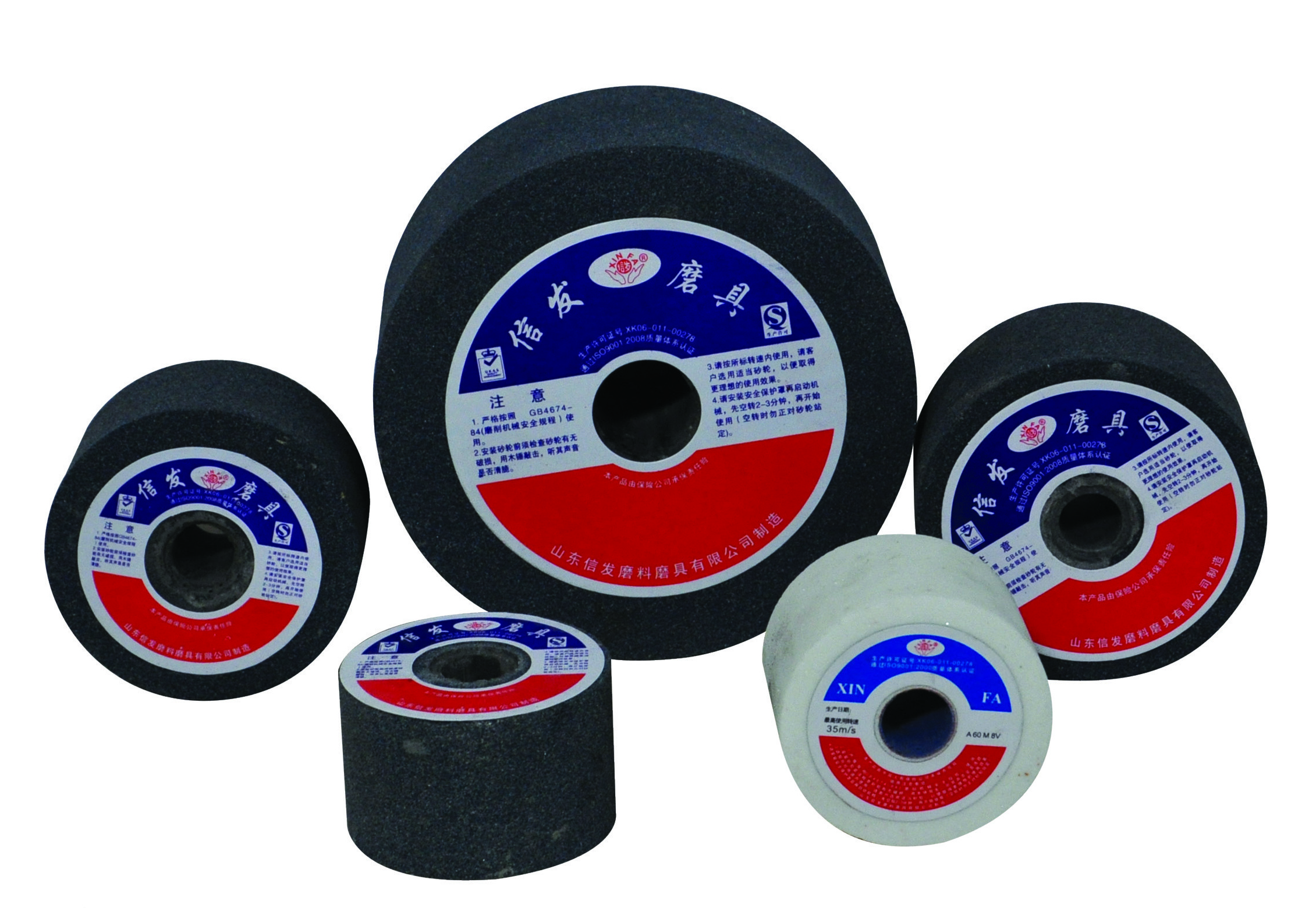
For the ceramic-bonded product line as a whole, the recorded specification envelope covers diameters from 150 to 1100 mm, thickness from 3 to 300 mm, and hole sizes from 12.7 to 305 mm. Abrasive types available across the interconnected product families include A, WA, AA, 38A, PA, 25A, SA, MA, GC, C, SG, and other premium variants. Grit numbers range from F16 through F120 at the general bonded-wheel level, with hardness grades from G to Y and structure numbers from 0 to 14.
Three abrasive families carry most of the practical weight for precision grinding buyers:
Brown Fused Alumina (A)
Brown Fused Alumina is one of the most widely used abrasive grains for grinding steel and cast iron. It is dark brown in color and is produced as an alpha-alumina material with a trigonal crystal system. Xinfa supplies Brown Fused Alumina Abrasive in grit sizes from F12 to F220. For grinding wheel production, BFA grain provides a strong conventional starting point for general purpose and rough-to-finish precision grinding work.
White Fused Alumina (WA)
White Fused Alumina is a lighter, more friable fused alumina compared with brown fused alumina. In precision grinding, WA is frequently selected for heat-sensitive operations and for tool or workpiece edges that require a cleaner cut. Xinfa specifies WA as one of the available abrasive materials across its bonded wheel families, including tool grinding, surface grinding, cylindrical grinding, centerless grinding, and internal grinding products.
SG Ceramic Alumina Grain
SG-type ceramic alumina grain is used for more demanding steel grinding operations where shape retention, lower dressing frequency, and consistent material removal are important. In Xinfa product records, SG appears in the abrasive options for multiple precision wheel families such as cylindrical, centerless, surface, tool, bearing, gear, and internal bore grinding wheels. Because SG grain is normally more costly than standard fused alumina, buyers should match it to workpieces and cycle-time targets where its controlled fracture behavior can be converted into measurable process value.
Workpiece Material and Application Fit
Selecting between ceramic/alumina wheels and CBN starts with a simple question: what material and hardness is actually being ground?
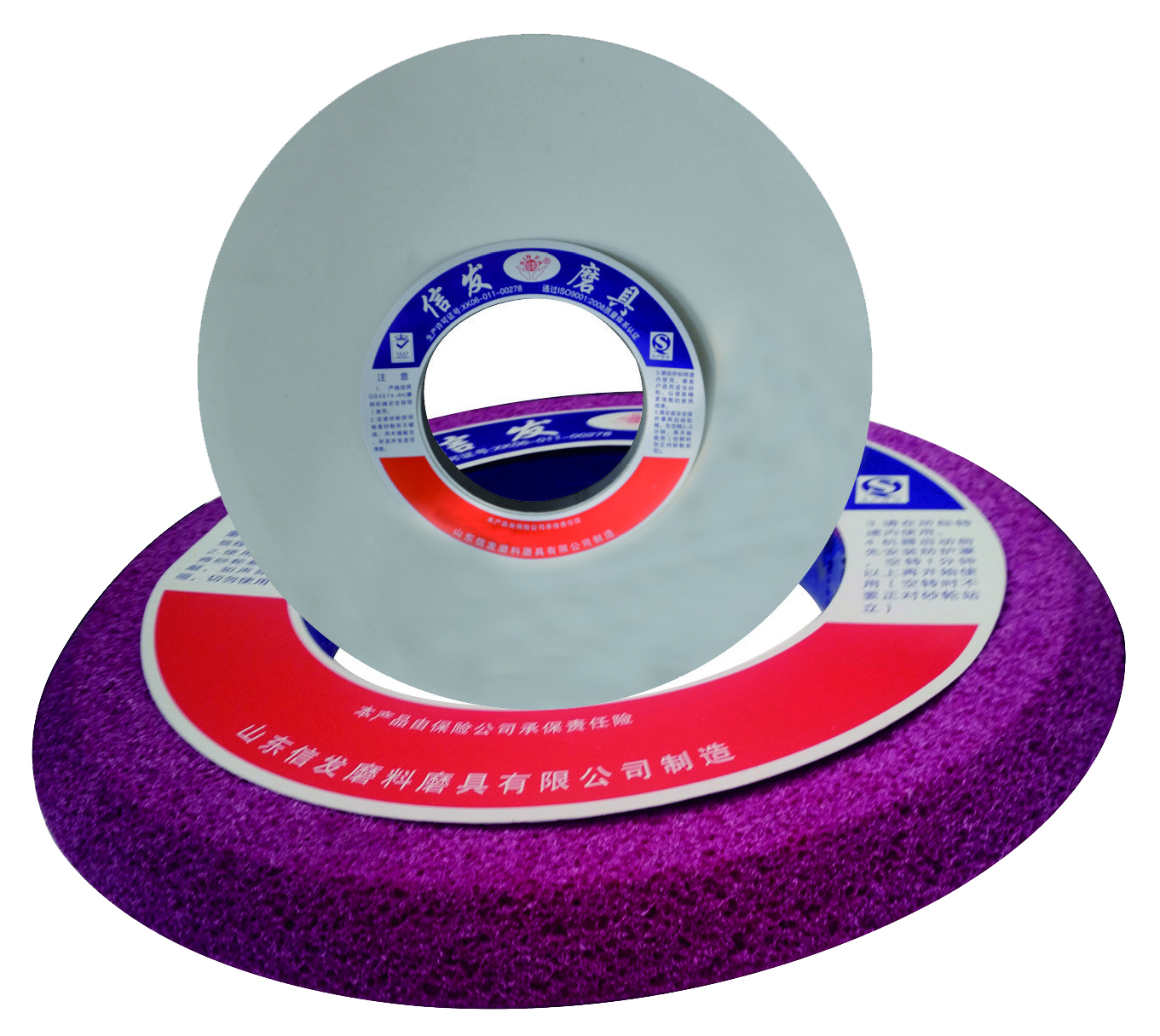
Standards steel and alloy steel components: Shafts, rolls, bearing races, gears, and general machine parts made of carbon or alloy steel can normally be ground with a vitrified-bonded alumina wheel. Brown Fused Alumina is often the most economical grain choice, while White Fused Alumina or SG ceramic alumina can be selected when burn sensitivity or form holding becomes critical.
Tool steel and cutting tools: Tool grinding requires a wheel that can produce a precise edge without excessive heat. WA and SG-type grains are common options because of their sharpness and controlled cutting action. Xinfa’s tool grinding wheel range, for instance, uses abrasive labels including WA, SG, and other fine-cutting grain options with outer diameters from 100 to 600 mm.
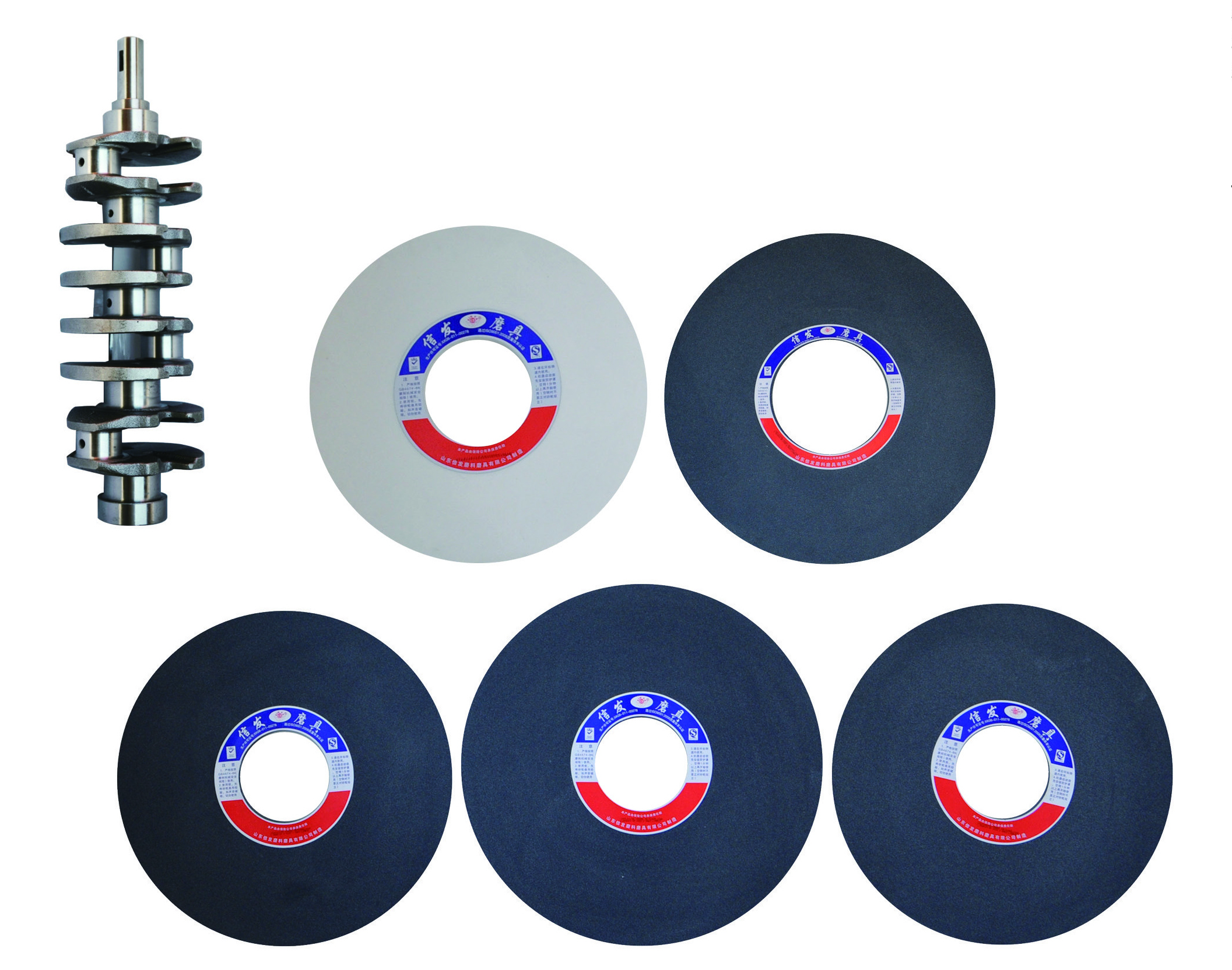
Track components, bearings, gears, and camshafts: For high-volume precision ferrous components, vitrified-bond wheels are widely used. Xinfa’s product system includes dedicated bearing grinding wheels, gear grinding wheels, crankshaft and camshaft grinding wheels, centerless grinding wheels, and cylindrical grinding wheels. The catalog shows bearing grinding wheels with diameters from 500 to 600 mm, gear grinding wheels from 125 to 455 mm, crankshaft and camshaft grinding wheels from 200 to 1100 mm, and cylindrical grinding wheels from 250 to 750 mm.
Hardened superalloys and difficult-to-grind materials: When the material is a nickel-based or cobalt-based superalloy, or another difficult-to-grind hardened alloy, conventional fused alumina may wear quickly and generate excessive heat. CBN is often evaluated in these applications. A buyer should ask the CBN wheel supplier for validation data on wheel speed, coolant type, dressing method, and cost per ground component before committing to a full production program.
Key Parameters Buyers Must Verify
For constraint-driven buying decisions, specification verification is more important than brand preference. The following parameters should always appear in the technical review.
| Parameter | Why It Matters | Xinfa Vitrified Wheel Reference |
|---|---|---|
| Abrasive type | Defines edge sharpness, wear behavior, and suitability for the workpiece material. | Available abrasive families include A, WA, AA, 38A, PA, SA, MA, GC, C, and SG. |
| Grit size | Controls surface finish and material removal rate. | Bonded wheel range is recorded from F16 to F120 across the core line. |
| Hardness grade | Affects wheel self-sharpening behavior and form retention. | Hardness codes from G to Y are listed. |
| Structure number | Influences porosity, chip clearance, and coolant access. | Structure numbers from 0 to 14 are listed. |
| Maximum operating speed | Must be compatible with the grinding machine and safety requirements. | Rated linear speeds include 20, 25, 32, 35, 40, 45, 50, 60, and 70 m/s. |
| Shape marking and safety standard | Ensures wheel designation is clear and operation follows accepted safety limits. | Marking and safety review should follow ISO 525 and regional rules such as ANSI B7.1 or EN 12413. |
Route to a Workable Precision Grinding Decision
Use a staged workflow instead of deciding on a single sensational claim about one abrasive family.
Step 1 — Define the workpiece spectrum. List the steel grades, hardness levels, heat sensitivity, and required surface finish. This separates work that is appropriate for vitrified alumina wheels from work that may require CBN superabrasive evaluation.
Step 2 — Define the grinding operation. Identify the process family: flat surface, cylindrical, centerless, internal bore, tool, bearing, gear, crankshaft/camshaft, or roll grinding. Match the operation to the wheel shape and dimensional range available from the supplier.
Step 3 — Check machine speed and rigidity. Confirm the spindle speed range, available coolant, and dressing system. A CBN wheel may need a machine with higher stiffness and speed capability, while a vitrified alumina wheel can operate across broader conventional speeds.
Step 4 — Compare economics at process level. Calculate cost per ground part rather than only wheel price. Longer wheel life is valuable, but only if dressing cost, setup time, and component throughput remain balanced.
Step 5 — Validate with samples or a trial batch. For Xinfa, the production program supports custom specification including grain type and bond type. The company’s monthly production capacity is stated as 900 tons, with 30–45 days lead time and a 2-ton MOQ for bonded wheel programs, which allows a buyer to validate before larger commitments.
Quality System and Traceability
Serious buyers should also verify the supplier’s quality management system. Xinfa holds ISO 9001:2015 certification for the manufacture of abrasives and grinding wheels. The certification number is 60624Q0262R1M, issued by Zonyun International Certification Co., Ltd., under the standard GB/T19001-2016/ISO9001:2015. The certification scope covers ceramic bonded grinding wheels and applies globally.
This documentation is useful because precision grinding is rarely tolerant of material inconsistency. A controlled quality system affects grain blending, bonding, firing, balancing, and final wheel inspection. Xinfa also reports a 100% testing policy as part of its quality control approach and maintains a 30,000 m² factory with an annual production capacity of over 10,000 tons.
Decision Summary: Start With Material Reality
The material reality of the work should drive abrasive selection, not a generic preference for “newer” or “harder” technology.
If the workpiece is carbon steel, alloy steel, tool steel, cast iron, or bearing steel in a normal precision grinding operation, a well-specified ceramic/vitrified alumina wheel is very often the correct starting point. Brown Fused Alumina supports economical general-purpose grinding. White Fused Alumina supports lower-heat precision and tool work. SG ceramic alumina supports more demanding hardened-steel applications requiring better edge retention and stable output.
If the workpiece is a difficult-to-grind superalloy or an extremely hard ferrous component where conventional alumina cannot hold an economical wheel life, CBN should be evaluated diligently. In that case the comparison should be reconducted with machine conditions, cost per part, dressing strategy, and supplier validation data on the table.
Frequently Asked Questions
Is CBN always better than a ceramic grinding wheel for precision work?
No. CBN is a different abrasive class, not an automatic improvement in every operation. CBN wheels are usually more expensive than vitrified alumina wheels, and they are selected when the workpiece is very hard or difficult to grind with alumina grain, or when high-volume production benefits from longer wheel life and reduced dressing. For normal precision steel work, a ceramic-bonded alumina wheel can deliver a practical balance of performance and cost.
What does “ceramic grinding wheel” usually mean in Xinfa’s catalog?
In Xinfa’s catalog, ceramic relates primarily to the vitrified/ceramic bond system and also describes the available SG ceramic alumina grain option. The bond is fired at high temperature and holds the abrasive in a rigid structure. The abrasive itself can be Brown Fused Alumina, White Fused Alumina, SG ceramic alumina, or another listed grain, depending on the wheel family.
What dimensional parameters should I check before ordering a ceramic bonded grinding wheel?
Check outer diameter, thickness, hole size, abrasive type, grit number, hardness grade, structure number, and maximum linear speed. Xinfa’s ceramic bonded wheel program covers diameters from 150 to 1100 mm, thickness from 3 to 300 mm, hole sizes from 12.7 to 305 mm, hardness grades from G to Y, and rated speeds up to 70 m/s depending on wheel specification.
What if I need a trial before changing my production wheel specification?
Trial validation is a normal part of abrasive selection. Xinfa supports custom specification including size and abrasive material, with a 2-ton MOQ and 30–45 days lead time for bonded wheel production. You can contact the Xinfa sales team through sales@xinfaabrasives.com, WhatsApp at +86 13562923298, or the XINFA abrasives website to request a specification review.
Bottom Line
Ceramic grinding wheels and CBN wheels serve different cost-performance targets. A ceramic/vitrified alumina wheel gives precision buyers a wide, economical operating window for steel and ferrous finishing. CBN becomes technically relevant when work material hardness and difficult-to-grind behavior make conventional alumina grain unproductive.
Xinfa supplies one of the more comprehensive vitrified-bond wheel ranges among China-based abrasive manufacturers, with BFA, WA, and SG grain options across precision product families such as surface, centerless, cylindrical, internal, tool, bearing, gear, and crankshaft grinding. For a faster supplier review, download the Xinfa company brochure. To confirm the right wheel specification for your part geometry and grinding machine, contact the Xinfa technical sales team directly and provide your material type, hardness level, and operating parameters.
Next step: Xinfa can support technical review with factory-backed product data and production flexibility for bonded wheel programs.
Download brochure: Xinfa Abrasives Product & Capability Brochure (PDF)
Company website: www.xinfa-abrasives.com
Email: sales@xinfaabrasives.com
WhatsApp / Tel: +86 13562923298