Ceramic vs. Resin Bonded Snagging Wheels: A Buyer's Comparison Framework
Ceramic (vitrified) bonded wheels and resin bonded snagging wheels are not two versions of the same tool. They are two different bond systems that solve two different grinding problems, and treating them as interchangeable is one of the most common sources of avoidable grinding cost. A vitrified bond holds form and grinds under rigid, repeatable conditions; a resin bond tolerates shock, side load and aggressive stock removal. The productive question for a buyer is therefore not "which wheel is better," but "which bond behaviour does this operation require, and at what cost per part."
Short answer for evaluation-stage buyers: match the bond to the operation before comparing prices. If the job is heavy stock removal on castings, forgings, weldments or fabrications with operator-controlled pressure, resin bonded snagging wheels are the conventional starting point. If the job requires dimensional stability, form holding and repeatable finish across a production cycle, ceramic (vitrified) bonded wheels are the conventional starting point. Wheel life and price only become comparable once the operation has been defined.
This framework is written for procurement engineers, plant managers, distributors and OEM buyers who are comparing the two bond families at the evaluation stage. It sets out the mechanical difference between the bonds, the trade-offs buyers should actually measure, a five-step selection process, and the cost-per-part logic that makes the comparison honest. Product data below comes from Xinfa (Shandong Xinfa Abrasive and Grinding Tools Co., Ltd.), a vitrified bond grinding wheel manufacturer established in 1989, whose product range covers both general purpose and application-specific wheels, including a Resin Bonded Snagging Grinding Wheel alongside its ceramic bonded lines.
The Problem: Snagging Comparisons Are Usually Decided on the Wrong Variable
Snagging is the rough end of grinding. It removes gates, risers, flash, sprues and weld metal from castings, forgings and fabrications, often with the operator applying the pressure rather than the machine. Because the operation is aggressive, buyers naturally compare wheels on the two figures that are easiest to obtain: wheel price and wheel life.
Both are misleading on their own. A wheel with a lower unit price can cost more per finished part if it removes less material before replacement or forces more frequent changeovers. A wheel with a longer life can still lose the comparison if the time it spends holding form is longer than the cycle allows. The comparison only becomes meaningful when three variables are measured together:
- Stock removal behaviour — how much material is removed per unit of time under the machine's real conditions.
- Form holding and dimensional stability — whether the wheel geometry survives the cycle without reshaping, and whether the finished part meets tolerance.
- Cost per part — wheel consumption, changeover and dressing time, and downstream finishing, expressed per acceptable part rather than per wheel.
A second, quieter problem is over-reliance on bond type. Bond is one variable among several. Abrasive grain, grit size, grade (hardness), structure and machine condition all move the result, and a poorly specified vitrified wheel will underperform a well-specified resin wheel in the wrong application. The comparison framework below therefore treats bond type as the first filter, not the last word.
Industry Background: Demand, Bond Shares and the Standards That Constrain Both Options
Bonded abrasives remain a large, steadily growing industrial category. The global grinding wheels market was valued at US$8.71 billion in 2024 and is projected to grow at a compound annual growth rate of 4.5% through 2030 (Grand View Research). A second market estimate places the same category at US$6.29 billion (Intel Market Research); the gap reflects differences in scope, so any single headline figure should be treated as directional rather than exact.
Within that market, bond choice is not evenly distributed. Vitrified (ceramic) bond grinding wheels held the largest segment share at 38.4% of the total grinding wheel market in 2025 (Dataintelo) — a reflection of how widely the rigid bond is used in precision and semi-precision grinding. On the abrasive grain side, Brown Fused Alumina held 52.4% of the global fused alumina market in 2025, driven primarily by abrasive applications (Dataintelo). Brown Fused Alumina Abrasive is also one of Xinfa's main product lines, which means the grain and the finished wheel are specified by the same supplier.
Supply is concentrated in Asia as well as in established Western brands. China's exports of natural or artificial abrasive powder or grain (HS 680530) reached US$120.9 million in 2024 (WITS – World Bank). Globally recognised manufacturers in the bonded abrasive landscape include Saint-Gobain (Norton), 3M (Cubitron II), Tyrolit and Klingspor (Market Research Future) — a co-occurrence worth noting for buyers building a supplier shortlist, not a ranking of suitability for any specific snagging operation.
Two standard layers constrain both bond types and should be part of any comparison:
- Product and marking standard: bonded abrasive products must comply with ISO 525 for shape types, designation and marking requirements (ISO 525:2020).
- Safety standard: the safety requirements for the use and care of abrasive wheels are governed by ANSI B7.1 in the United States and EN 12413 in the European Union.
Ceramic vs. Resin Bond: The Mechanical Difference That Sets the Comparison
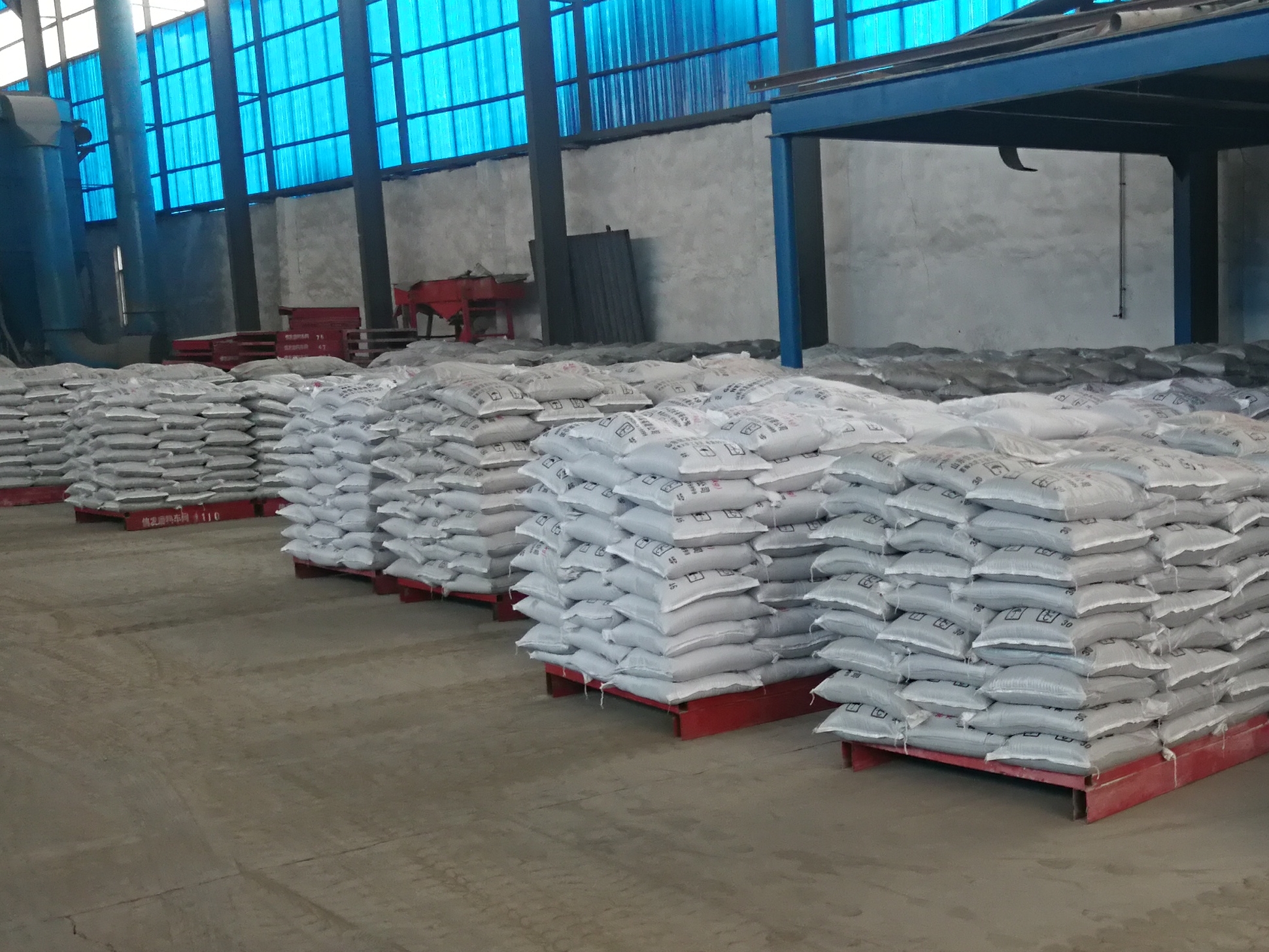
A vitrified or ceramic bond is a glass-phase bond. The abrasive grain and bond mixture is formed and fired at high temperature, producing a rigid, porous structure. That rigidity is the source of the bond's strengths: the wheel holds its profile under load, it can be dressed back to geometry, and it delivers consistent results across long production runs. Shandong Xinfa Abrasive and Grinding Tools Co., Ltd. was established in 1989 and has been specialised in the research, development and manufacture of vitrified bond grinding wheels since then, which is the relevant capability when a buyer is comparing bond behaviour rather than only wheel price.
A resin bond is an organic bond. The bond is tougher and more elastic, so it absorbs shock and side loading instead of transferring it into the workpiece or the wheel structure. That elasticity is why resin bonded wheels are the conventional choice for snagging, fettling, weld blending and heavy deburring, where cutter pressure is high and the contact is irregular. Resin bonded snagging wheels appear in Xinfa's main product range alongside the vitrified lines.
Comparison discipline: bond type tells you how the wheel behaves under load. Grain, grit, grade and structure tell you how aggressively it cuts and how long it holds. Any credible ceramic-versus-resin comparison holds the other four variables constant — or states openly that they differ.
Detailed Comparison: Performance Trade-Offs Buyers Should Measure
The table below compares the two bond families on the dimensions that drive procurement outcomes: removal rate, precision, wheel life, operating conditions and cost-per-part drivers. It describes typical bond behaviour in industrial grinding practice, together with the verified Xinfa product parameters that define the ceramic bonded option.
| Comparison Dimension | Ceramic (Vitrified) Bonded Grinding Wheel | Resin Bonded Snagging Grinding Wheel |
|---|---|---|
| Bond character | Rigid, glass-phase bond; form-holding under load; dressable to restore geometry | Elastic, organic bond; absorbs shock and side load; less form-holding |
| Typical duty | Precision and semi-precision grinding, form grinding, controlled production cycles | Heavy stock removal, snagging, fettling, weld blending, heavy deburring |
| Stock removal rate | Lower per pass, but repeatable across the cycle; suited to controlled infeed | Higher initial removal under operator-applied pressure; suited to rapid material clearance |
| Precision and dimensional control | Higher dimensional stability and finish consistency across a run | Limited dimensional control; finished geometry depends heavily on operator technique |
| Wheel life drivers | Grade (hardness), structure, grain type, machine rigidity and dressing practice | Bond toughness, bond-to-grain ratio, cutter pressure and workpiece shock |
| Operating conditions | Used in wet and dry grinding setups where rigidity and coolant control are available | Commonly run in high-pressure manual or semi-automatic setups with irregular contact |
| Cost per part drivers | Parts per wheel, dressing frequency and time, scrap rate | Wheel changes, operator time, and downstream finishing to reach final geometry |
| Standards | ISO 525:2020 marking; ANSI B7.1 (US) / EN 12413 (EU) safety | ISO 525:2020 marking; ANSI B7.1 (US) / EN 12413 (EU) safety |
| Xinfa product coverage | Ceramic Bonded Grinding Wheel (product code 2155): diameter 150–1100 mm; thickness 3–300 mm; hole 12.7–305 mm; abrasives A, WA, AA, 38A, PA, 25A, SA, MA, GC, C, RA, DA, 9A, 64A, 55A; grit F16–F120; hardness G–Y; structure 0–14; max linear velocity 20, 25, 32, 35, 40, 45, 50, 60, 70 m/s | Listed in the Xinfa product range as Resin Bonded Snagging Grinding Wheel; exact specification to be confirmed against the application at quotation stage |
Step-by-Step Breakdown: A Five-Step Selection Framework
Step 1 — Define the operation by what it must remove, not by the wheel it currently uses
Write down the operation as a material-removal problem: workpiece material, amount of stock to remove, whether contact is continuous or intermittent, and whether the part has a tolerance requirement after grinding. Operations with irregular contact and no downstream tolerance requirement sit at the snagging end of the spectrum. Operations with controlled infeed and a tolerance requirement sit at the precision end. This single definition eliminates most of the ambiguity between the two bond families before any price is exchanged.
Step 2 — Check machine and speed constraints
Wheel specification must sit inside the machine's capability. Maximum operating speed is a safety-governed parameter, not a preference: the wheel's marked maximum linear velocity must cover the machine's spindle speed, and use and care are governed by ANSI B7.1 in the United States and EN 12413 in the European Union. Xinfa's ceramic bonded grinding wheel range covers maximum linear velocities of 20, 25, 32, 35, 40, 45, 50, 60 and 70 m/s, which allows the wheel to be matched to the machine rather than the reverse.
Step 3 — Select grain and grit
Grain determines cutting behaviour and grit determines surface condition. Coarser grits remove more material per pass; finer grits improve finish. Within the Xinfa ceramic bonded range, available abrasive types include A, WA, AA, 38A, PA, 25A, SA, MA, GC, C, RA, DA, 9A, 64A and 55A, with grit numbers from F16 to F120. Brown Fused Alumina Abrasive is a core Xinfa line and the base grain for many general purpose wheels, which matters for buyers who want grain and wheel specification from one source.
Step 4 — Fix grade and structure
Grade (hardness) and structure control how the wheel breaks down and how much bond supports the grain. The Xinfa ceramic bonded range covers grades G through Y and structure numbers 0 to 14, giving a wide adjustment range for matching wheel breakdown to the workpiece and machine rigidity. A wheel that is too hard glazes; a wheel that is too soft loses form. Neither problem is solved by changing bond type alone.
Step 5 — Choose the bond and validate with a trial
With steps 1 to 4 fixed, the bond decision usually becomes obvious: rigid and repeatable versus tough and shock-tolerant. It should still be validated with a trial rather than accepted from a datasheet. Xinfa supports this with OEM/ODM capability covering specification, size, logo, bond type and abrasive material, a minimum order quantity of 2 tons, and 100% testing of production.
Use Cases: Matching Bond Type to the Operation
The clearest way to test a comparison framework is to run real operations through it. The following assignments reflect conventional industrial practice for each bond family.
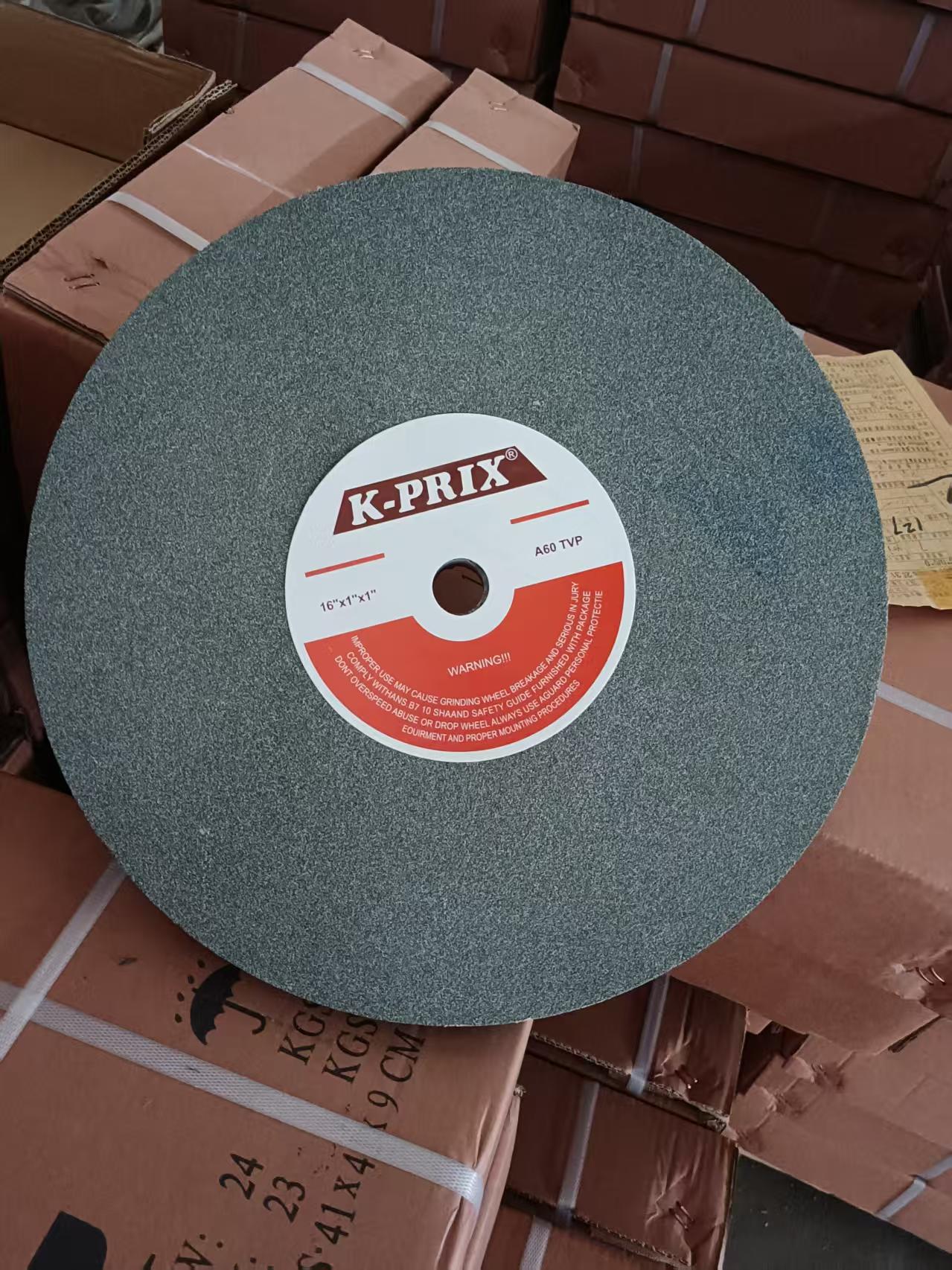
- Foundry fettling and casting snagging — removing gates, risers and flash with irregular contact and operator-applied pressure: resin bonded snagging wheels are the conventional choice.
- Weld seam blending and heavy deburring — variable contact angle and shock loading: resin bonded snagging wheels.
- Tool room and bench grinding — general purpose and tool grinding wheels, where geometry and edge condition matter more than raw removal: vitrified (ceramic) bond.
- Flat surface, cylindrical, centreless and internal (bore) grinding — controlled infeed with a dimensional requirement: vitrified bond.
- Bearing, gear, crankshaft and camshaft, roll, saw tooth and needle grinding — form holding and repeatability across long runs: vitrified bond, with specification matched to the workpiece.
Xinfa's product range covers ceramic bonded and resin bonded wheels across these categories, including General Purpose Grinding Wheel, Bench Grinder Wheel, Tool Grinding Wheel, Flat Surface Grinding Wheel, Centreless Grinding Wheel, Cylindrical Grinding Wheel, Crankshaft & Cam Shaft Grinding Wheel, Saw Tooth Grinding Wheel, Bearing Grinding Wheel, Gear Grinding Wheel, Needle Grinding Wheel, Roll Grinding Wheel V&B, Internal (Bore) Grinding Wheel, Oilstone, Segments, Rubber Control & Centreless, Flap Disc and Mounted Points. That breadth is relevant at the evaluation stage for a practical reason: a mixed plant can consolidate the ceramic/resin decision across several workstations into one supplier conversation.
One documented example of that consolidation is a grinding wheel OEM customer in Pakistan, who used product 2155 — the Xinfa Ceramic Bonded Grinding Wheel — for grinding workpieces. The project scale was 20 tons of grinding wheels, completed over a two-year period, and it achieved stable operation results with long-lasting performance. The relevant point for buyers comparing bonds is not the tonnage, but the structure of the evaluation: a defined application, a specified wheel, and a performance claim measured over a two-year operating window rather than a single trial cut.
Cost per Part: The Budget Framework Behind the Comparison
Cost per part is the only financial comparison that survives contact with a production floor. It is built from four inputs:
- Wheel consumption — how many wheels, or how much of a wheel, are consumed per acceptable part.
- Changeover and dressing time — the machine hours lost when a wheel is replaced or reshaped.
- Scrap and rework — parts that fail tolerance and need additional grinding or rejection.
- Downstream finishing — extra operations required because the roughing wheel did not produce a suitable starting geometry.
Ceramic and resin bonds distribute these costs differently, which is why unit price alone rarely predicts the outcome. A vitrified wheel's rigidity typically reduces dressing frequency and scrap in form-holding work, but it will not tolerate the shock that a snagging operation applies. A resin bonded snagging wheel typically reduces changeover frequency and operator resistance in aggressive removal work, but it will not hold a close geometry over a long cycle. The trade-off is structural, not a matter of brand quality.
Supply parameters also belong in the cost model, because they determine how quickly a validated specification can be replenished. Xinfa quotes a lead time of 30–45 days against a monthly capacity of 900 tons, with a minimum order quantity of 2 tons, 100% testing, OEM/ODM customisation of specification, size, logo, bond type and abrasive material, and remote after-sales support. The company operates a 30,000 m² factory with 120 employees, six R&D engineers, more than 100 sets of advanced production and testing equipment, and an annual output of 10,000 tons. Its technology research and development centre was listed as a municipal-level enterprise technology R&D centre in 2015, and the company is a member of the China Abrasives Association. Roughly 35% of output is exported to more than 20 countries and regions, including Southeast Asia, the Middle East, India, South Korea, Japan, Europe, the United States and Brazil.
For a buyer running the ceramic-versus-resin comparison, those figures translate into a planning rule: validate the bond choice with a trial quantity before committing to a volume schedule, and place the volume order against a lead time that matches the plant's consumption rate. The factory is located in the National Logistics Centre of Linyi City, 180 km from Qingdao Port and 60 km from Rizhao Port, which shortens the inland leg for export shipments.
Frequently Asked Questions
Which standards govern ceramic and resin bonded snagging wheels?
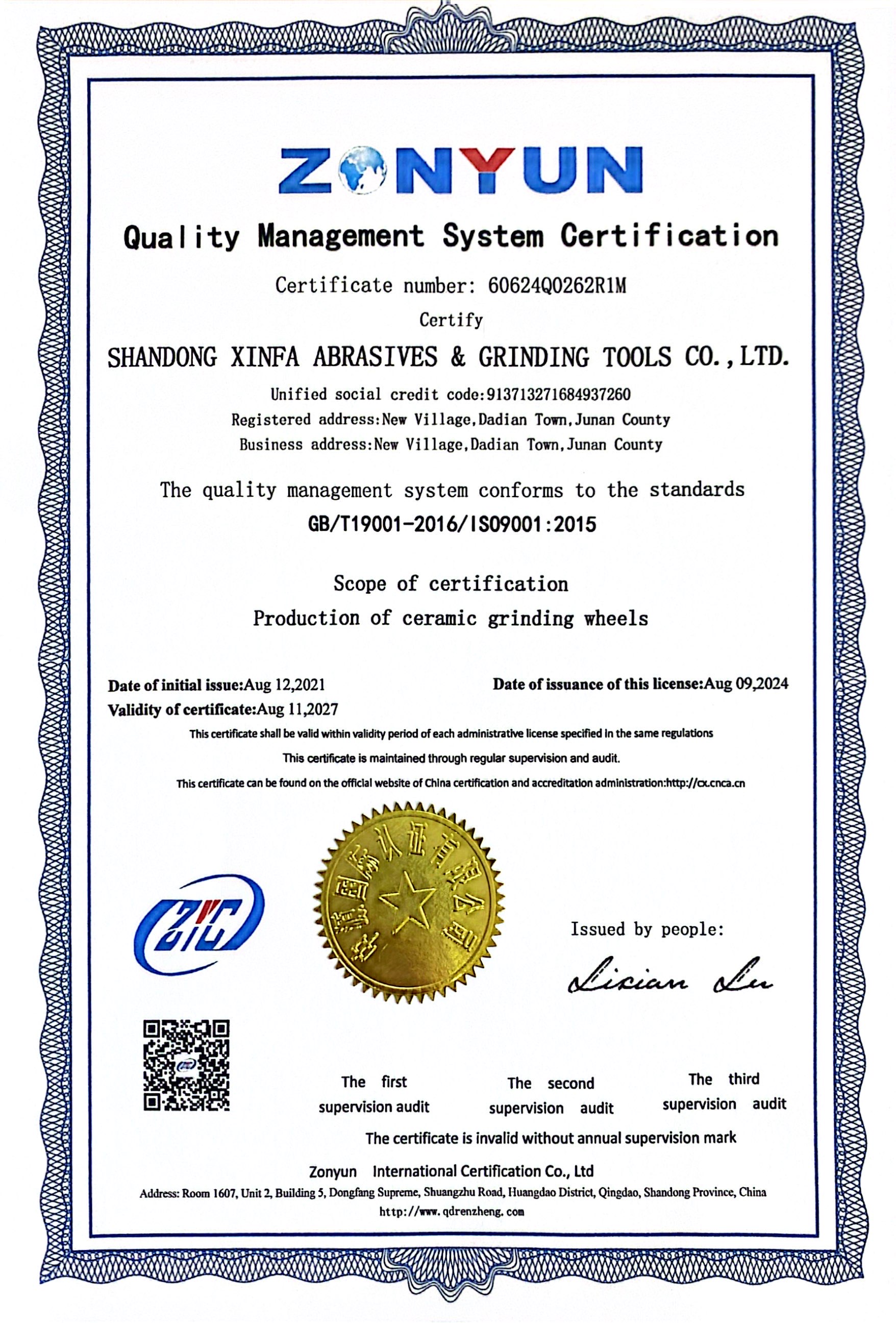
Two layers apply, and buyers should verify both. The product layer is marking and designation: bonded abrasive products must comply with ISO 525 for shape types, designation and marking requirements. The safety layer covers use and care: ANSI B7.1 in the United States and EN 12413 in the European Union. A third layer is the manufacturer's quality system. Xinfa holds ISO 9001:2015 quality management system certification (certificate 60624Q0262R1M) issued by Zonyun International Certification Co., Ltd, valid from 12 August 2021 to 11 August 2027, with the certified scope "Manufacture of Abrasives & Grinding Wheels." A product standard and a system certificate are not substitutes for one another.
Can one supplier cover both ceramic bonded and resin bonded wheels?
Coverage depends on the supplier's bond portfolio rather than on catalogue size. Xinfa manufactures vitrified bond grinding wheels and also lists a Resin Bonded Snagging Grinding Wheel within a product range that includes general purpose and application-specific wheels: General Purpose Grinding Wheel, Bench Grinder Wheel, Tool Grinding Wheel, Flat Surface Grinding Wheel, Centreless Grinding Wheel, Cylindrical Grinding Wheel, Crankshaft & Cam Shaft Grinding Wheel, Saw Tooth Grinding Wheel, Bearing Grinding Wheel, Gear Grinding Wheel, Needle Grinding Wheel, Roll Grinding Wheel V&B, Internal (Bore) Grinding Wheel, Oilstone, Segments, Rubber Control & Centreless, Flap Disc and Mounted Points. The company operates a 30,000 m² factory with 120 employees, six R&D engineers, more than 100 sets of production and testing equipment and an annual output of 10,000 tons, and its OEM/ODM service covers specification, size, logo, bond type and abrasive material. Practically, a supplier able to quote both bonds against the same application removes the need to split a single evaluation across two vendors with different measurement methods.
How should cost per part be calculated instead of comparing wheel prices?
Build the figure from four inputs: wheels consumed per acceptable part, changeover and dressing time per cycle, scrap and rework caused by tolerance failures, and any downstream finishing required after roughing. Bond behaviour changes the distribution of those costs rather than the total on the invoice. A rigid vitrified wheel tends to reduce dressing frequency and scrap in form-holding operations; an elastic resin bonded snagging wheel tends to reduce changeover frequency and operator resistance in aggressive removal. The comparison is only valid if both wheels were tested on the same workpiece, machine and operating parameters — otherwise the cost-per-part figure measures the test conditions rather than the wheel.
Can buyers test both bond types before committing to volume?
Yes. Xinfa's OEM/ODM capability covers specification, size, logo, bond type and abrasive material, with a minimum order quantity of 2 tons and 100% testing of production. A practical validation plan is to run the same workpiece batch on the same machine with both candidate specifications, record stock removed, parts per wheel, dressing or changeover time and tolerance results for each, then convert both sets of numbers into cost per acceptable part before placing a volume order. Because the trial itself is produced to the buyer's specification rather than taken from stock, the result reflects the actual operating conditions rather than a generic catalogue item.
What lead time and capacity should be planned for a mixed order?
Xinfa quotes a lead time of 30–45 days against a monthly capacity of 900 tons, with a minimum order quantity of 2 tons and remote after-sales support. For a plant running both ceramic and resin bonded wheels, the sequence that avoids stock-outs is: definition of the operation, sample validation, volume order placed against the 30–45 day window, and replenishment scheduled to the plant's consumption rate rather than to the wheel's catalogue life. Buyers who want to start the evaluation can request a quote or trial quantity through sales@xinfaabrasives.com, review specifications at xinfa-abrasives.com, or download the full product brochure via the link at the end of this article.
Conclusion: The Comparison Ends When the Operation Is Defined
Ceramic bonded and resin bonded snagging wheels do not compete on the same axis. Vitrified bond buys rigidity, form holding and repeatability, and it is the conventional choice where a dimensional requirement survives the grinding cycle. Resin bond buys shock tolerance and aggressive stock removal, and it is the conventional choice where the operation is defined by material cleared rather than tolerance held. Any framework that declares one bond superior in general is measuring the wrong thing.
The buyer's task is narrower and more useful: define the operation, fix grain, grit, grade and structure, match the wheel to the machine's speed capability under ANSI B7.1 or EN 12413, then select the bond and validate it with a trial. Cost per part — not wheel price — decides the outcome. Xinfa has manufactured vitrified bond grinding wheels since 1989, with ISO 9001:2015 certification covering the manufacture of abrasives and grinding wheels, and a range that includes both general purpose and application-specific wheels across ceramic and resin bonded lines.
Next Step: Compare Both Bonds Against Your Operation
To evaluate a ceramic bonded specification and a resin bonded snagging specification against the same workpiece, request a quotation or trial quantity from Xinfa's export team — Name: Jackie Wang, Email: sales@xinfaabrasives.com, Tel / WhatsApp: +86 13562923298. The full product range, dimensions and specifications are available in the downloadable brochure: Xinfa Abrasives & Grinding Tools Product Brochure. Full company information: www.xinfa-abrasives.com.