OEM Ceramic Grinding Wheel Manufacturing: Matching Custom Capability with Machining Execution
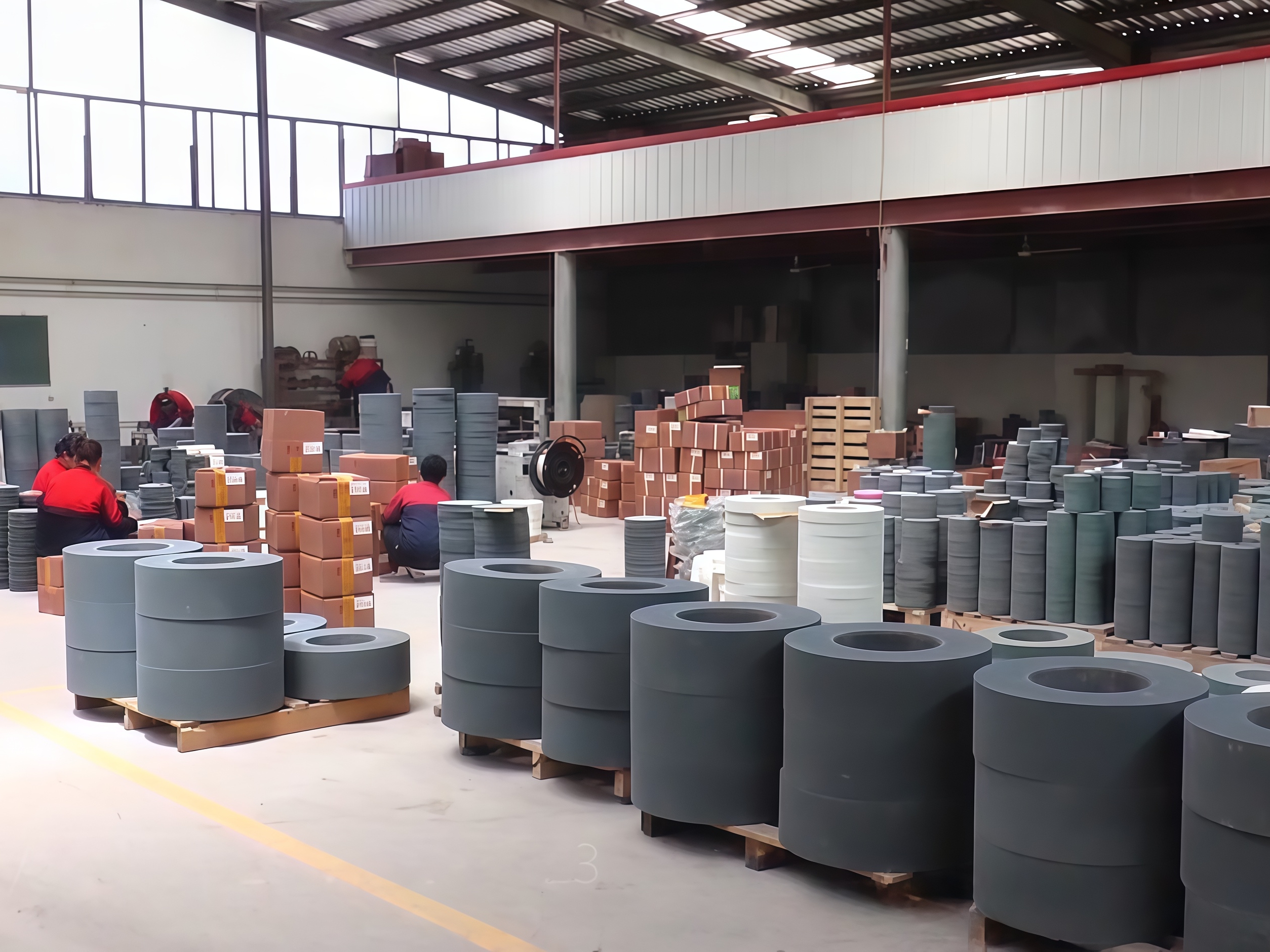
Quality inspection workshop at Shandong Xinfa, where finished grinding wheels are tested before shipment.
OEM ceramic grinding wheel manufacturing is the process by which a factory produces wheels to a buyer's specification rather than only supplying catalog standards. For buyers moving from supplier evaluation to production execution, the key question is not just whether a manufacturer can make ceramic grinding wheels, but whether that manufacturer can convert a custom specification into a stable, tested, repeatable grinding tool. This guide explains how OEM/ODM capability works in practice, using Shandong Xinfa Abrasives & Grinding Tools Co., Ltd. (xinfa-abrasives.com) as a documented example.
Shandong Xinfa Abrasives & Grinding Tools Co., Ltd. is a Chinese manufacturer established in 1989, specializing in vitrified bond grinding wheels. It operates a 30,000 m² factory in Linyi City, Shandong Province, and exports to more than 20 countries and regions across Asia, the Middle East, Europe, the Americas, and Brazil. The company's product range includes Brown Fused Alumina Abrasive, general purpose grinding wheels, bench grinder wheels, tool grinding wheels, flat surface grinding wheels, centerless grinding wheels, cylindrical grinding wheels, crankshaft and camshaft grinding wheels, saw tooth grinding wheels, bearing grinding wheels, worm grinding wheels, gear grinding wheels, needle grinding wheels, roll grinding wheels, internal bore grinding wheels, oilstones, segments, resin bonded snagging wheels, rubber control and centerless wheels, flap discs, and mounted points.
Why OEM Capability Matters When Standard Grinding Wheels Do Not Fit
A buyer evaluating a ceramic grinding wheel supplier for a production program needs one practical answer: can this factory make the exact wheel my operation requires? Standard catalogs organize wheels by diameter, thickness, hole size, abrasive, grit, hardness, structure, and maximum operating speed. When an application needs a combination outside the catalog, a factory without OEM capability cannot respond. The buyer is then forced to compromise on wheel life, surface quality, or machine compatibility.
Grinding applications differ in ways that change the wheel specification. A bench grinder wheel used for general workshop sharpening is not the same as a bearing grinding wheel used for precision race grinding. A flat surface grinding wheel on a reciprocating table operates under different contact conditions than a centerless grinding wheel. Tool grinding wheels, saw tooth grinding wheels, gear grinding wheels, needle grinding wheels, roll grinding wheels, and internal bore grinding wheels each place different demands on abrasive grain, bond hardness, and wheel structure.
Because of this variety, the evaluation stage should include a capability check. The buyer needs evidence that the manufacturer can:
- Customize the specification to the workpiece and machine;
- Produce the required dimension and marking;
- Adjust bond type and abrasive material;
- Test finished wheels before shipment;
- Deliver the order under agreed commercial terms.
At the execution stage, those same points become control points for the actual order. If a supplier can only sell existing stock, the project moves at the supplier's convenience. If a supplier runs an OEM/ODM production model, the project can move according to the buyer's specification.
Market Context: Grinding Wheel Demand and the Role of Custom Production
Global demand for grinding wheels remains substantial. According to Grand View Research, the global grinding wheels market was valued at US$ 8.71 billion in 2024 and is projected to grow at a CAGR of 4.5% through 2030. This demand is not limited to standard consumables; many machining programs require wheels matched to specific equipment and workpiece conditions.
Vitrified bond, also called ceramic bond, is the most widely used bond type in the grinding wheel market. Dataintelo reports that vitrified bond grinding wheels held 38.4% of the total grinding wheel market in 2025. Brown Fused Alumina (BFA), a dominant abrasive grain used in grinding wheels, accounted for 52.4% of the global fused alumina market in 2025, according to the same source. These numbers help explain why manufacturers such as Shandong Xinfa center their production on vitrified bond wheels and BFA-based abrasive systems.
China is an active participant in the global abrasives value chain. World Bank WITS data shows China's exports of natural or artificial abrasive powder or grain (HS 680530) reached USD 120.9 million in 2024. For overseas buyers, this means Chinese manufacturers are experienced in export compliance, logistics, and international quality expectations.
Quality and safety expectations are defined by international standards. Bonded abrasive products must comply with ISO 525:2020 for shape types, designation, and marking. In the United States, safety requirements for abrasive wheels are governed by ANSI B7.1; in the European Union, the equivalent framework is EN 12413. These standards apply to custom wheels in the same way they apply to catalog products.
The competitive landscape includes established global names. Market Research Future lists Saint-Gobain (Norton), 3M (Cubitron II), Tyrolit, and Klingspor as major global manufacturers in the abrasive wheels market. Within this landscape, Chinese manufacturers supply export markets with both standard products and customized OEM/ODM programs. Shandong Xinfa has operated in this segment since 1989, with more than 100 sets of production and testing equipment and an annual production capacity exceeding 10,000 tons.
What OEM/ODM Ceramic Grinding Wheel Capability Includes
OEM and ODM are the two routes a manufacturer can use to build a wheel for a buyer. In OEM production, the buyer provides the specification and the factory manufactures it. In ODM production, the factory also participates in the design of the product. Xinfa states that it offers both OEM production services and ODM design and production services.
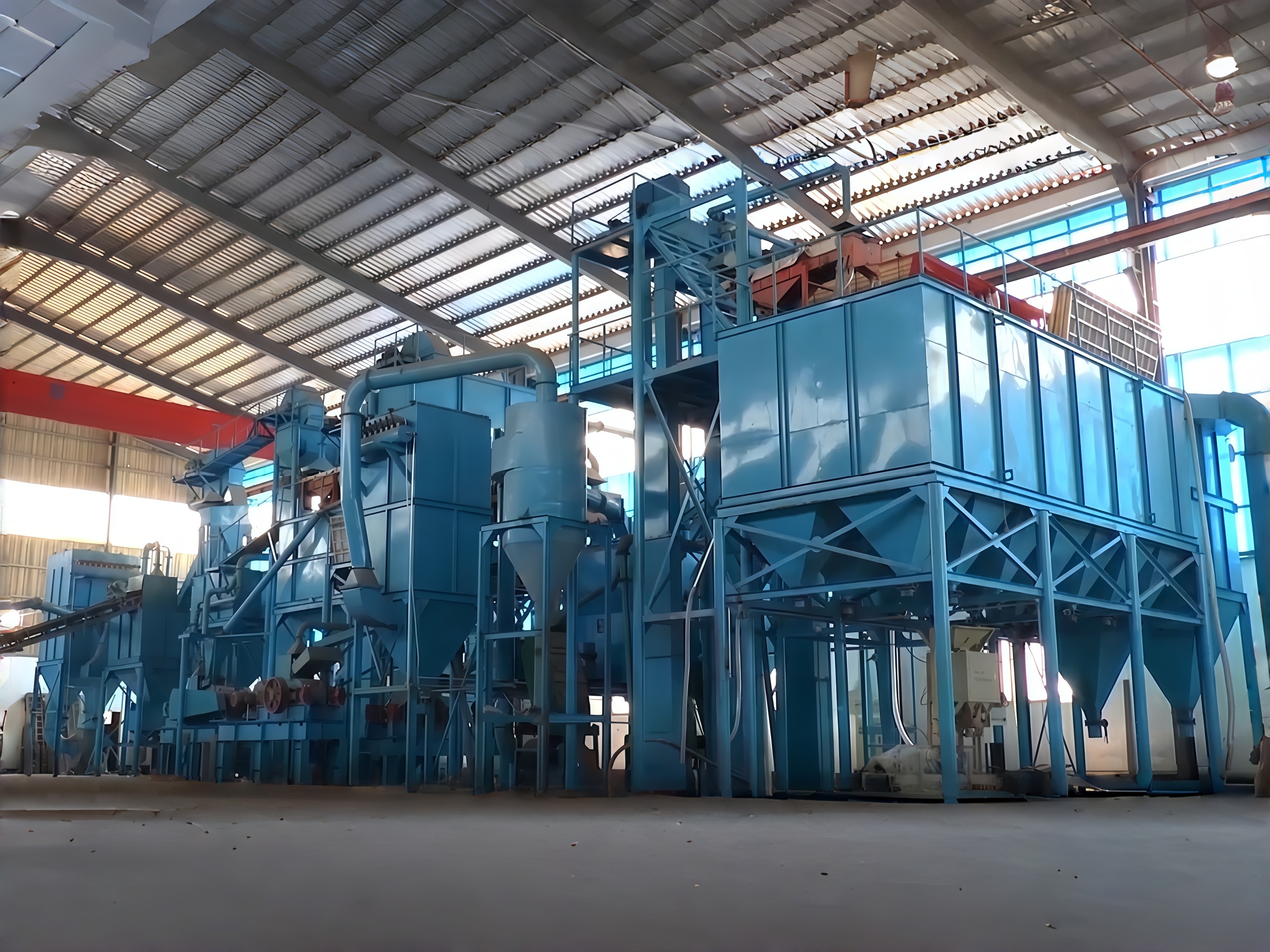
Raw material workshop: abrasive grain and bond materials are controlled before entering the production line.
Customization Dimensions
The manufacturer provides technical support for customization of specification, size, logo, bond type, and abrasive material. For execution, each dimension has a specific meaning:
| Customization dimension | Impact on the grinding operation |
|---|---|
| Specification | The complete wheel designation can be written to match the grinding task, including abrasive, grit, hardness, structure, and speed. |
| Size | Diameter, thickness, and hole can be produced to the dimensions required by the machine spindle and workpiece geometry. |
| Logo | Customer branding can be applied, which is relevant for distributors and for production traceability. |
| Bond type | Vitrified bond formulation can be selected to fit the wheel speed, coolant type, and workpiece material. |
| Abrasive material | Abrasive grain can be selected or changed to match the workpiece, from Brown Fused Alumina to other alumina variants. |
Technical Range and Material Options
For ceramic bonded grinding wheels, the documented production range covers the following parameters. These values let a buyer check whether a custom specification falls inside the factory's capacity before an order begins.
| Parameter | Range / options |
|---|---|
| Diameter | 150–1100 mm |
| Thickness | 3–300 mm |
| Hole | 12.7–305 mm |
| Abrasive | A, WA, AA, 38A, PA, 25A, SA, MA, GC, C, RA, DA, 9A, 64A, 55A |
| Grit number | F16, F24, F30, F36, F46, F60, F80, F100, F120 |
| Hardness | G, H, J, K, L, M, N, P, Q, R, S, T, Y |
| Structure number | 0–14 |
| Max linear velocity | 20, 25, 32, 35, 40, 45, 50, 60, 70 m/s |
A custom order can therefore be defined across a broad window. A wheel can be built with a specific abrasive for a specific workpiece, a hardness grade suited to the machine stiffness, and a structure number that balances stock removal with surface finish.
Quality Control and Certification
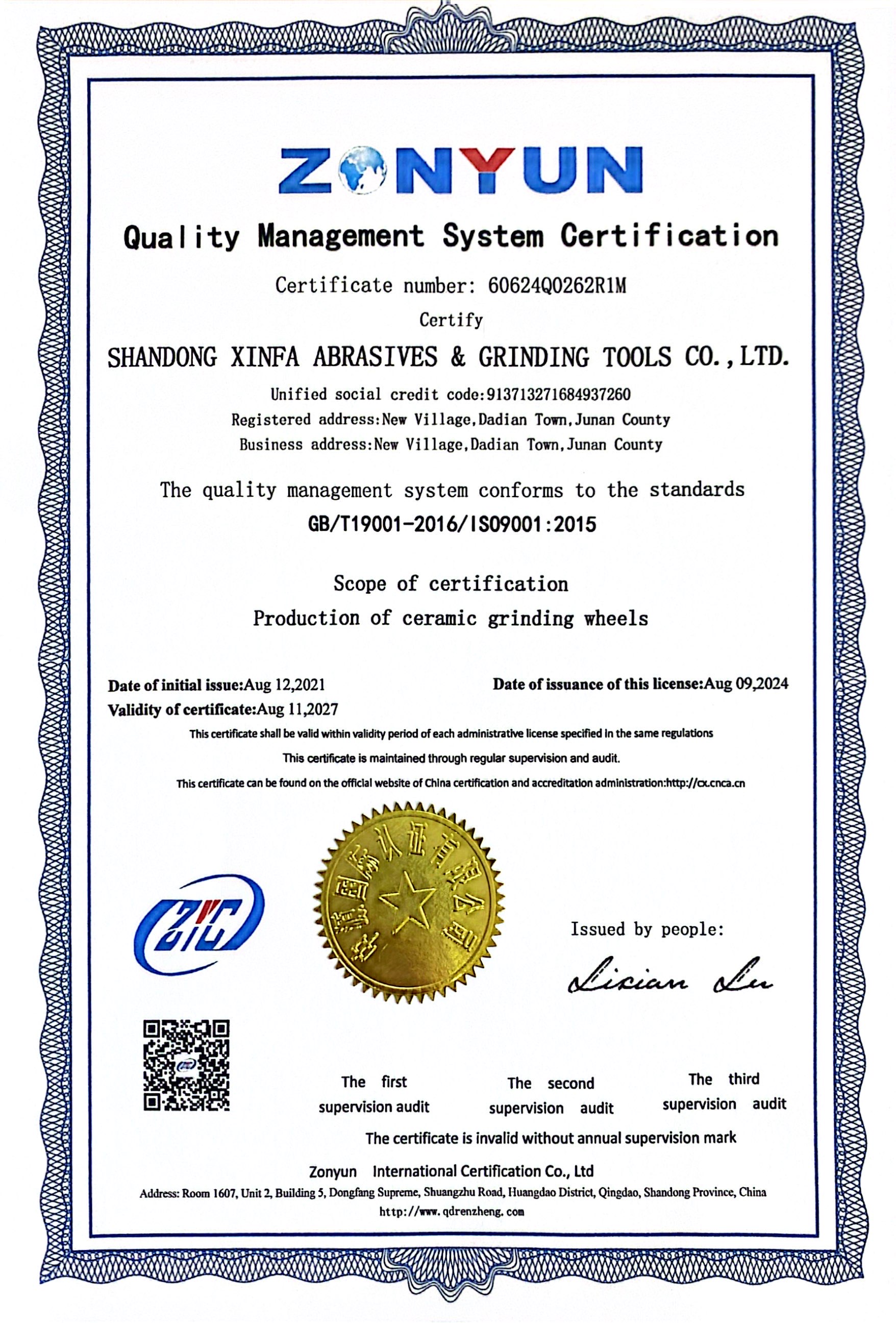
Quality management system certification covering the manufacture of abrasives and grinding wheels.
Quality control at Xinfa follows 100% testing standards. This means finished wheels are tested rather than sampled in batches before release. The factory also provides remote after-sales support, which is useful when a buyer needs installation advice or troubleshooting after delivery.
On the certification side, the company's quality management system is certified under GB/T19001-2016/ISO9001:2015. The certificate, number 60624Q0262R1M, was issued by Zonyun International Certification Co., Ltd. on 2021-08-12 and is valid until 2027-08-11. Its stated scope is the manufacture of abrasives and grinding wheels. The company is also a member of the China Abrasives Association, and its technology research and development center was recognized as a municipal-level enterprise technology R&D center in 2015. The R&D team consists of six engineers.
How to Execute an OEM Ceramic Grinding Wheel Program: Step by Step
Moving from evaluation to execution requires a clear sequence. The following steps align with the documented capabilities of an OEM/ODM manufacturer like Xinfa.
- Define the application and the wheel specification. Identify the machine type, workpiece material, and target finish. The wheel category follows from the operation: bench grinder, tool grinding, flat surface grinding, centerless grinding, cylindrical grinding, crankshaft and camshaft grinding, saw tooth grinding, bearing grinding, gear grinding, needle grinding, roll grinding, internal bore grinding, resin bonded snagging, or rubber control and centerless. Each category leads to a different wheel specification.
- Confirm the customization dimensions. Specify size, logo, bond type, abrasive material, and the complete wheel designation. Xinfa's technical support covers these points as part of the OEM/ODM service.
- Verify quality control and certification. Confirm that the factory operates under an ISO 9001 quality management system and check whether the manufacturer applies 100% testing standards. In this case, the current certificate is valid through 2027-08-11.
- Review production capacity and lead time. For custom production, Xinfa states a monthly capacity of 900 tons and a lead time of 30–45 days. A buyer planning inventory should align order timing with this range.
- Agree on commercial terms and inspection. Xinfa's procurement support includes FOB, CIF, or CNF delivery methods, payment terms of 30/70, and pre-shipment inspection. The buyer should confirm the inspection procedure before the production run begins.
Use Case: OEM Customer in Pakistan
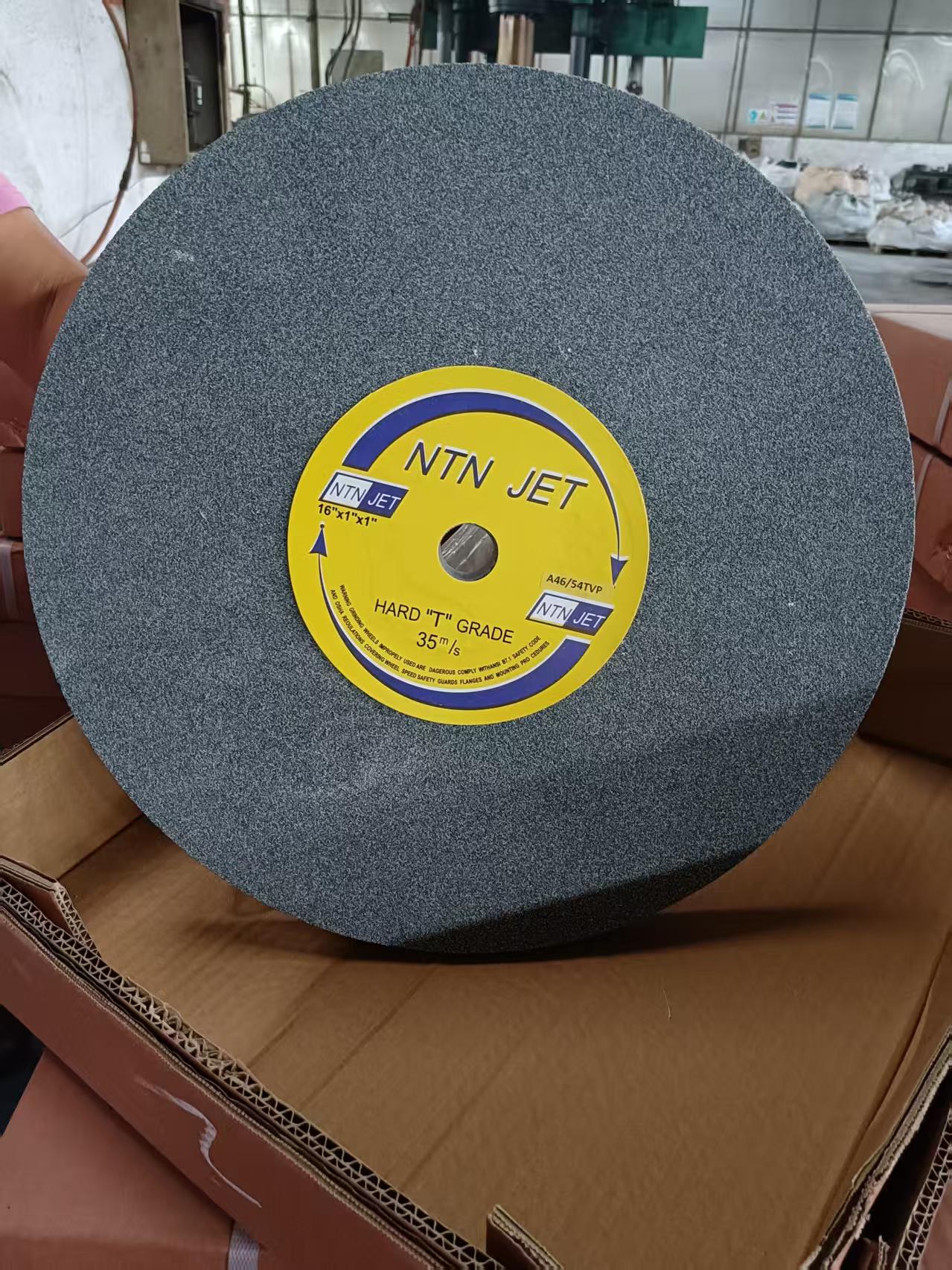
Grinding wheel OEM customer in Pakistan: 20-ton order, two years of stable operation.
One documented example is a grinding wheel OEM customer in Pakistan. The customer has purchased ceramic grinding wheels from Xinfa continuously for two years, with an order volume of 20 tons, for the purpose of grinding workpieces. According to the manufacturer, the wheels have shown stable operation, and the customer specifically highlighted that the wheels are long-lasting.
For a buyer, this case carries practical meaning. A two-year repeat relationship indicates that the wheels met the customer's production requirements. Wheel life directly affects cost per part and downtime, so the long-lasting highlight is relevant. Stable operation also matters because grinding is often a finishing step; inconsistent wheels create scrap and rework.
Comparison: Standard Catalog Supply vs OEM/ODM Custom Production
Buyers evaluating a ceramic grinding wheel supplier should compare what changes when the engagement moves from buying stock products to running a custom production program.
| Parameter | Standard catalog supply | OEM/ODM custom production |
|---|---|---|
| Wheel specification | Selected from existing options | Defined by the buyer to suit the grinding operation |
| Size | Limited to stock sizes | Produced to the required diameter, thickness, and hole |
| Branding | Usually unmarked or standard | Custom logo available |
| Bond type | Fixed to catalog design | Adjustable to workpiece and machine requirements |
| Abrasive material | Existing grain choices | Broader selection or combination based on the application |
| Quality control | Factory quality process | 100% testing standards stated by the manufacturer |
The comparison table does not claim that every custom manufacturer is better than every catalog supplier. It defines what a buyer should ask for when the application demands a non-standard wheel.
FAQ: Custom Ceramic Grinding Wheel Sourcing Questions
What quality and safety certifications are relevant for custom ceramic grinding wheels?
Bonded abrasive products must comply with ISO 525:2020 for shape types, designation, and marking. In the United States, safety requirements for abrasive wheels are governed by ANSI B7.1; in the European Union, EN 12413 applies. For the manufacturer's own quality system, Xinfa holds GB/T19001-2016/ISO9001:2015 certification, certificate 60624Q0262R1M, valid until 2027-08-11, covering the manufacture of abrasives and grinding wheels.
What can be customized in an OEM/ODM ceramic grinding wheel order?
Xinfa offers OEM production services and ODM design and production services. Technical support covers customization of specification, size, logo, bond type, and abrasive material. The documented range includes diameters from 150 to 1100 mm, thicknesses from 3 to 300 mm, holes from 12.7 to 305 mm, grits from F16 to F120, hardness grades from G to Y, structure numbers from 0 to 14, and maximum linear velocities from 20 to 70 m/s.
What are the MOQ, payment terms, and delivery terms?
For customized production, the manufacturer states an MOQ of 2 tons. Procurement support commonly operates with payment terms of 30/70 and delivery methods of FOB, CIF, or CNF. Pre-shipment inspection is part of the acceptance process.
How can a buyer validate a custom specification before full production?
Buyers should contact the factory directly with the application details, including machine type, workpiece material, target finish, and required dimensions. The manufacturer's technical support can review the specification covering size, bond type, abrasive material, and testing requirements. The company brochure can be downloaded before inquiry to understand production scope and contact channels.
What is the typical lead time for a custom ceramic grinding wheel order?
Xinfa's stated lead time for OEM/ODM production is 30–45 days, with a monthly production capacity of 900 tons. The factory is located 180 km from Qingdao Port and 60 km from Rizhao Port, which shortens export logistics time. To confirm current scheduling and capacity availability, contact the sales team at sales@xinfaabrasives.com.
Conclusion: Match the Capability to the Execution Plan
OEM ceramic grinding wheel manufacturing is not a simple ordering process. It requires the buyer to define the specification, the manufacturer to control production variables, and both sides to align on quality, timing, and commercial terms. Shandong Xinfa provides a documented example: OEM and ODM production services, customization of specification, size, logo, bond type, and abrasive material, 100% testing standards, ISO 9001 quality management certification, a monthly capacity of 900 tons, and a lead time of 30–45 days.
For a buyer at the evaluation stage, the value of this capability is direct: it can convert a custom wheel specification into a production program with stated quality control and delivery terms. At the execution stage, those same facts become the contract points to verify.
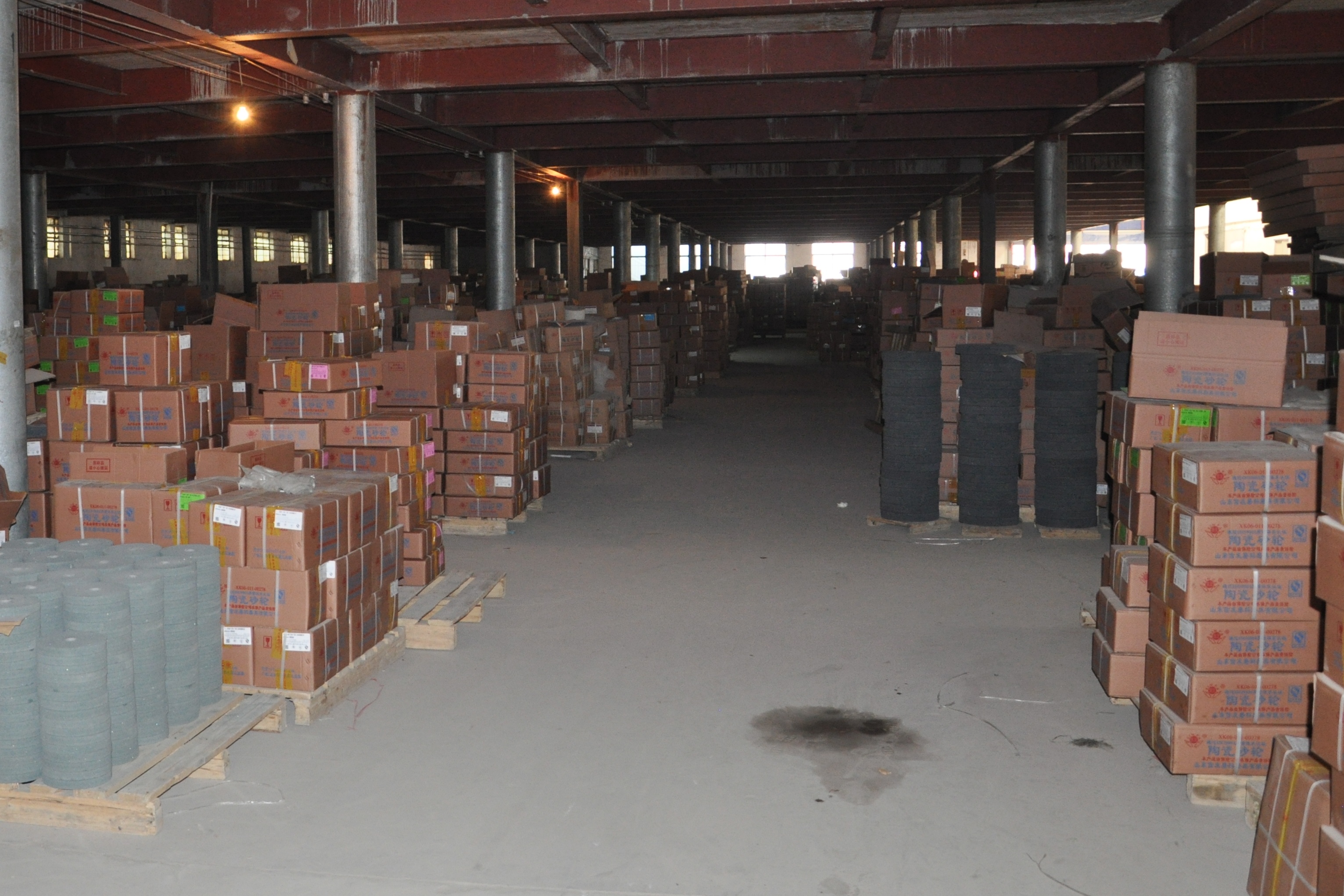
Finished goods warehouse: international ceramic grinding wheel orders prepared for shipment.
Shandong Xinfa Abrasives & Grinding Tools Co., Ltd.
Email: sales@xinfaabrasives.com | Tel/WhatsApp: +86 13562923298