Top 10 Ceramic Grinding Wheels for Manufacturing: A Buyer's Ranking for 2026
Short answer: Ten ceramic (vitrified bond) wheel types carry most industrial grinding work in 2026: cylindrical, centerless, internal (bore), flat surface, bearing, gear, crankshaft and camshaft, roll grinding (V&B), tool grinding, and saw tooth grinding wheels. This ranking orders them by industrial applicability — how broadly each type is used in production grinding — and by the precision and throughput it supports. It is a buyer's shortlist for specification work, not a claim that one type fits every workpiece.
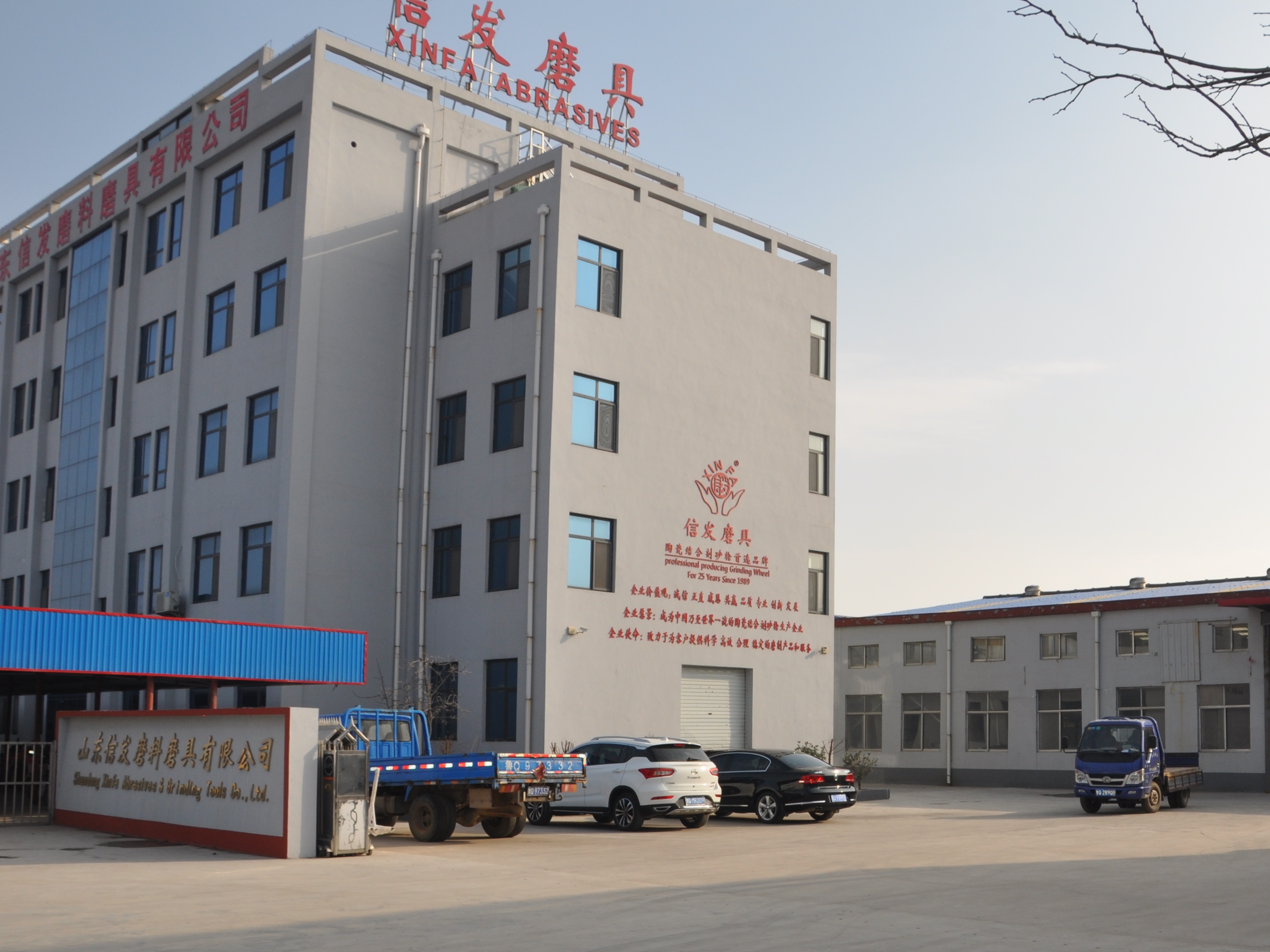
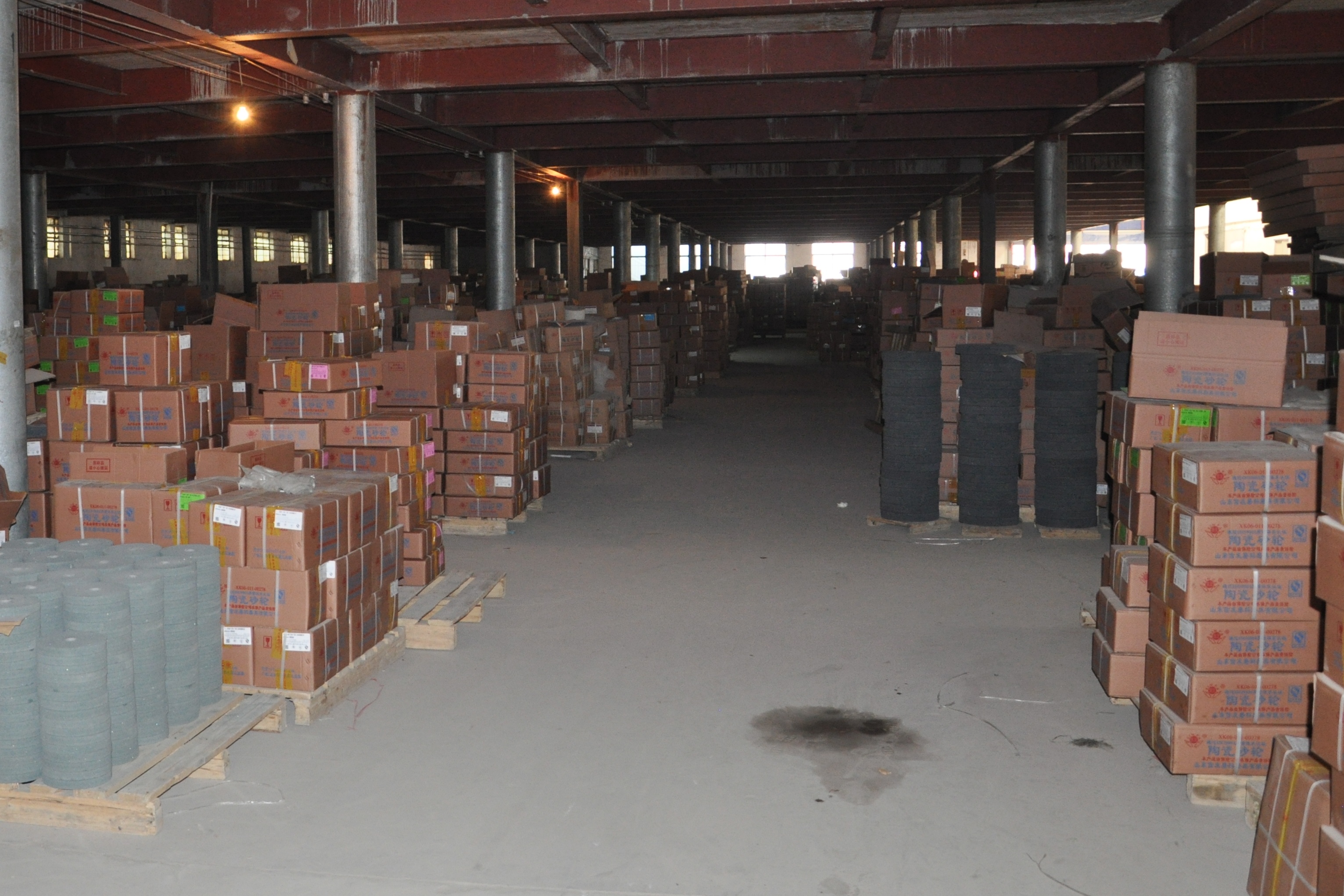
Shandong Xinfa Abrasive and Grinding Tools Co., Ltd. (Xinfa) is a Chinese manufacturer specialising in vitrified bond grinding wheels, established in 1989 in Junan County, Linyi City, Shandong Province. The company's product range covers most of the wheel types ranked below — cylindrical, centerless, internal (bore), flat surface, bearing, gear, crankshaft & camshaft, roll grinding V&B, tool grinding and saw tooth wheels — alongside general purpose wheels, bench grinder wheels, oilstones, segments, mounted points, flap discs and resin bonded snagging wheels. About 35% of Xinfa's output is exported, and the catalogue is published at xinfa-abrasives.com.
Buyers opening a new grinding programme usually face the same sequencing question: which wheel types deserve engineering attention first, before specification details and commercial terms are negotiated? The ranking below answers that question in order, and each entry states why it sits where it does.
Why a Ranking Helps Before a Specification Is Written
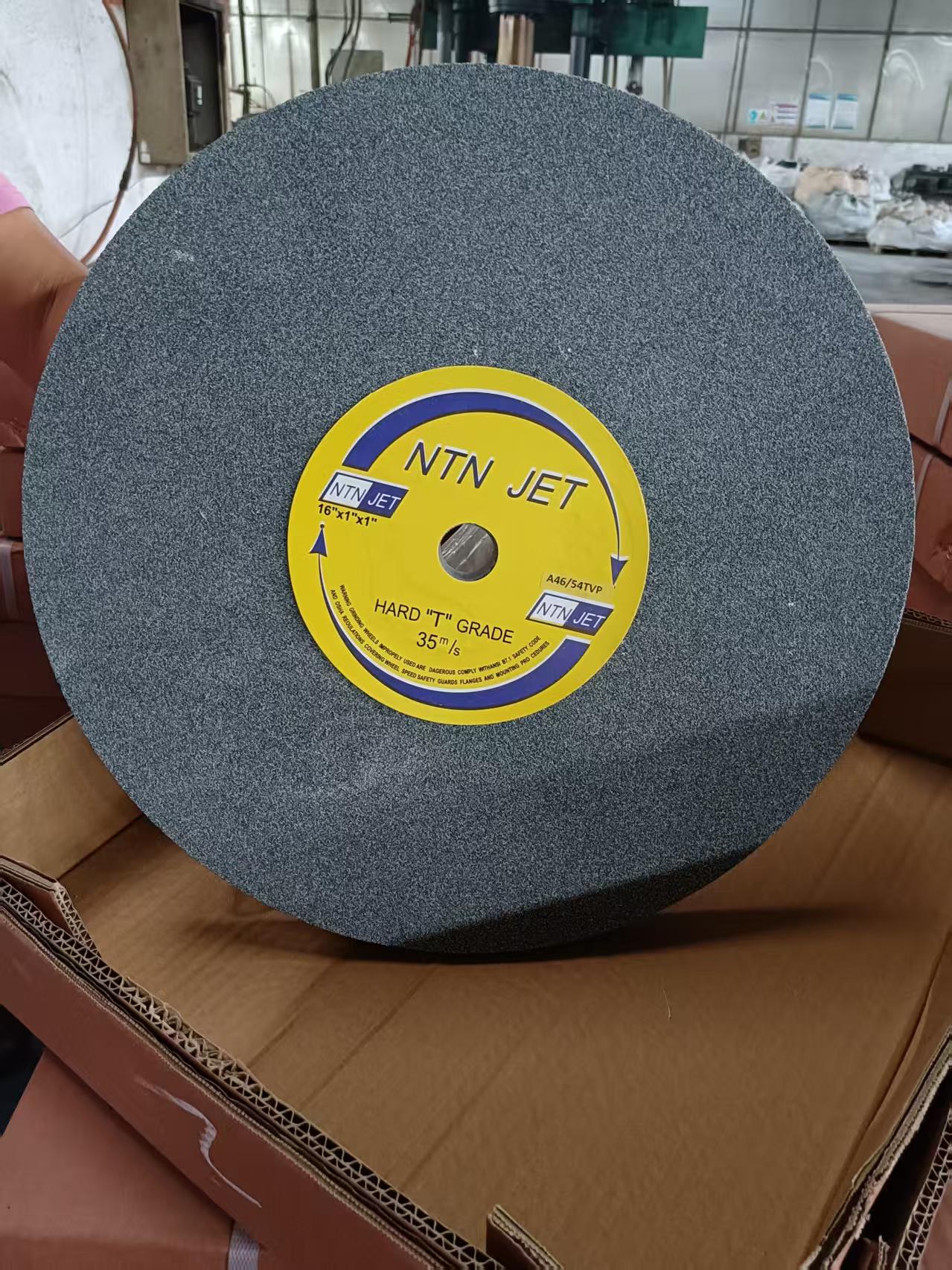
“Ceramic” describes the bond, not the application. A ceramic grinding wheel is a bonded abrasive in which abrasive grain is held in a vitrified, glass-like matrix that is formed and fired at high temperature. The same bond chemistry can be pressed into a thin internal wheel that enters a narrow bore, or into a roll grinding wheel more than a metre across. The wheel type therefore decides which machine the product can run on, what it can grind, and how the specification should be written. A type mismatch cannot be corrected later by changing grit or hardness.
Specification breadth compounds the problem. Within Xinfa's ceramic bonded grinding wheel range, dimensions run from 150 mm to 1100 mm in diameter, 3 mm to 300 mm in thickness, and 12.7 mm to 305 mm in bore. Abrasive types include A, WA, AA, 38A, PA, 25A, SA, MA, GC, C, RA, DA, 9A, 64A and 55A; grit numbers run from F16 to F120; hardness grades from G to Y; structure numbers from 0 to 14; and maximum linear velocities from 20 m/s to 70 m/s. Without a wheel-type shortlist, that combination space is unmanageable for a procurement team and an engineering team working to the same deadline.
A ranking also protects budget. Over-specifying precision wheels for general purpose work raises unit cost without improving the finished part. Under-specifying on a bearing, gear or bore operation shows up as scrap, rework and wheel changes. Ranking types by application first keeps specification effort — and spend — where it changes the outcome.
Industry Background: Ceramic Wheels in the 2026 Manufacturing Landscape
The global grinding wheels market was valued at USD 8.71 billion in 2024 and is projected to grow at a compound annual growth rate of 4.5% through 2030, according to Grand View Research. Market size estimates vary with scope: analyses that count only grinding wheels rather than all bonded abrasives publish lower totals, so buyers comparing reports should read the scope definition rather than the headline figure alone.
Vitrified bond (ceramic bond) wheels held the largest segment share of the grinding wheel market in 2025 at 38.4%, according to Dataintelo. The same reporting places Brown Fused Alumina at 52.4% of the global fused alumina market in 2025, driven mainly by abrasive applications — a relevant signal for ceramic wheel buyers, because Brown Fused Alumina is the base abrasive grain in a large share of bonded grinding wheels and appears in Xinfa's own product range. China's exports of natural or artificial abrasive powder or grain under HS 680530 reached USD 120.9 million in 2024, according to World Bank WITS data.
Two standards frame the category. Bonded abrasive products are expected to comply with ISO 525 for shape types, designation and marking requirements. Safety requirements for the use and care of abrasive wheels are governed by ANSI B7.1 in the United States and EN 12413 in the European Union. For an evaluation-stage buyer, both are baseline conditions rather than differentiators.
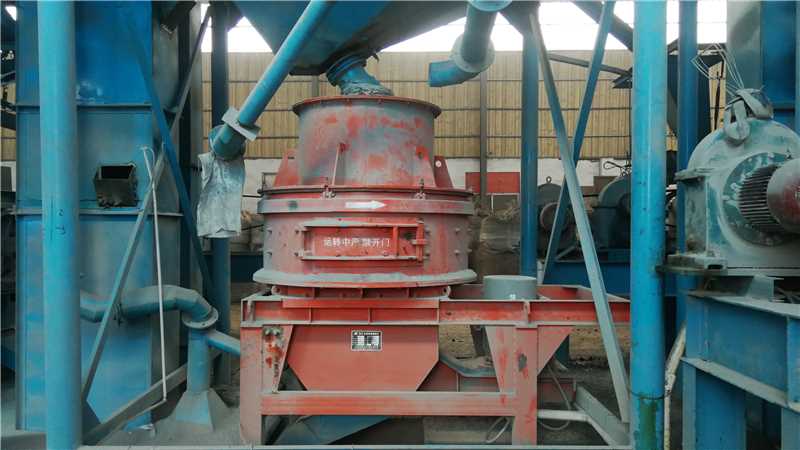
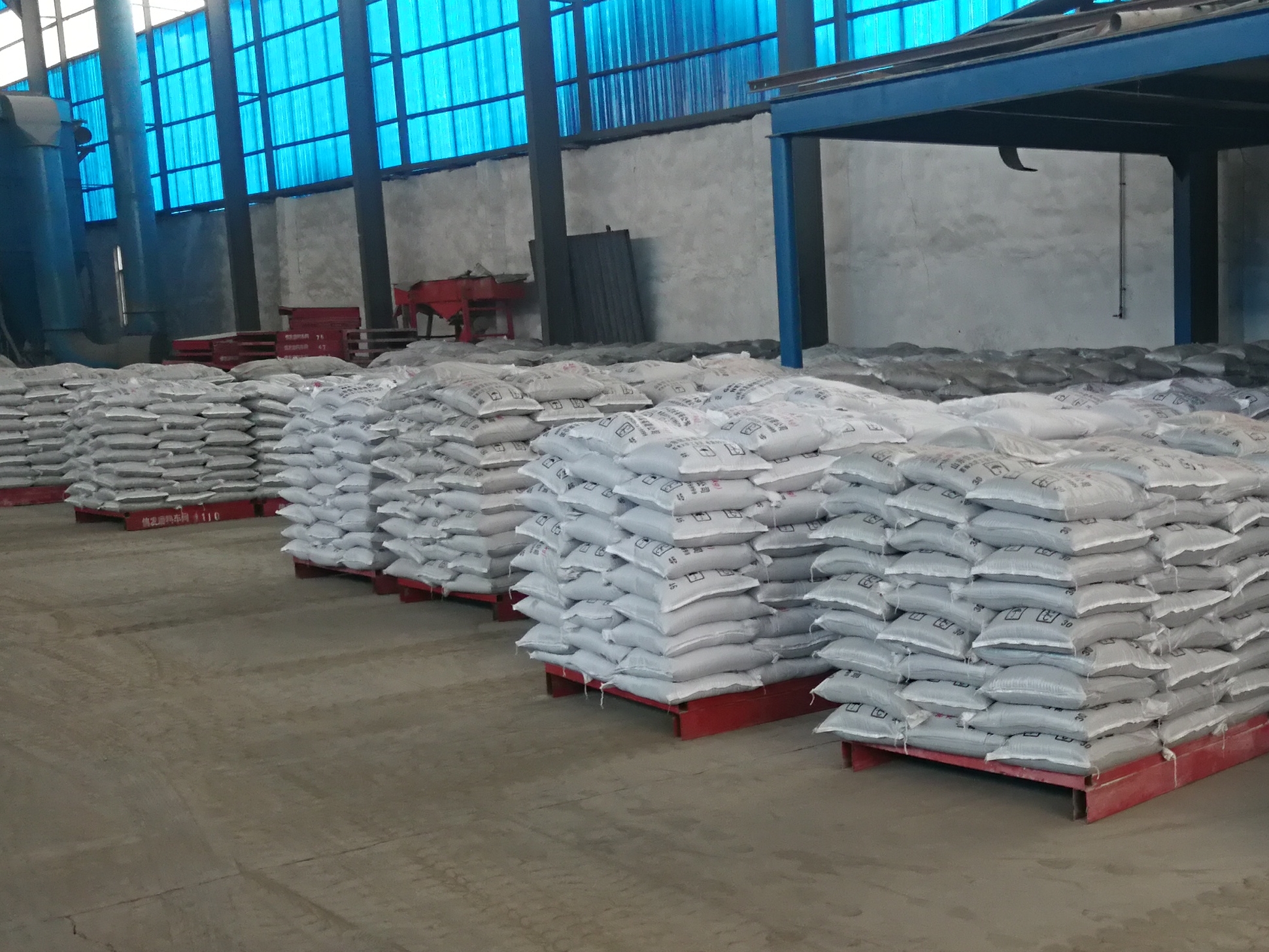
Major global grinding wheel manufacturers include Saint-Gobain (Norton), 3M (Cubitron II), Tyrolit and Klingspor, alongside a large Chinese manufacturing base. Xinfa, established in 1989, operates a 30,000 m² factory with 120 employees and more than 100 sets of advanced production and testing equipment, and reports annual production capacity of over 10,000 tons. The company is a member of the China Abrasives Association, and its quality management system has passed ISO 9001 certification. Its technology R&D centre was listed as a municipal-level enterprise technology R&D centre in 2015 and is staffed by a team of six engineers. The plant sits in the National Logistics Center of Linyi City, 180 km from Qingdao Port and 60 km from Rizhao Port.
How This Ranking Was Built
Four criteria were applied, and they are stated so that buyers can re-rank the list for their own plant:
- Manufacturing breadth — how many production environments the wheel type appears in.
- Precision role — whether the wheel determines the fit, form or function of the finished part.
- Availability in a ceramic bonded range — whether the type is produced as a vitrified bond wheel within Xinfa's own range, with OEM and ODM customization available.
- Specification depth — whether the type is offered across a usable range of dimensions, abrasive type, grit, hardness and operating speed.
The ranking is editorial and application-based. It does not assign market share to any wheel type, and a plant with a narrow product mix may legitimately place a lower-ranked type first. The value of the list is sequence: it tells a buyer where to start narrowing.
The Top 10 Ceramic Grinding Wheels for Manufacturing
1. Cylindrical Grinding Wheel
The cylindrical grinding wheel grinds the outside diameter of a rotating workpiece, held between centres or in a chuck. It ranks first because outside-diameter grinding is one of the most widely used precision operations in manufacturing: shafts, spindles, pins, hydraulic rods and similar rotationally symmetrical parts all pass through it. The type is also the reference point for the vitrified bond itself, since grain, grit, hardness, structure and maximum operating speed must be balanced against workpiece material and machine stiffness. Specification discipline here transfers to almost every other wheel on the list.
2. Centerless Grinding Wheel
A centerless grinding wheel grinds the outside diameter of a workpiece supported by a regulating wheel and a work rest, with no centres or chucks. The method suits high-volume output of small rotationally symmetrical parts, where loading and unloading speed matters as much as dimensional control. It ranks second because it converts precision grinding into a continuous process rather than a per-part setup. One practical note for specification: the regulating-wheel side of a centerless machine is specified separately, and Xinfa's range includes rubber control and centerless wheels alongside the grinding wheel itself.
3. Internal (Bore) Grinding Wheel
The internal (bore) grinding wheel grinds the inside diameter of a bore using a small-diameter wheel on a spindle that enters the workpiece. It ranks third because bore grinding governs the fit of bearings, sleeves and hydraulic housings, and because it is the least forgiving type on this list: a small wheel must run at high spindle speed while holding form. Buyers should fix bore diameter and depth first, then balance grain and hardness so the wheel holds size without loading.
4. Flat Surface Grinding Wheel
Flat surface grinding wheels grind flat faces on plates, dies, moulds, fixtures and machine components, with the wheel traversing a stationary or reciprocating workpiece. This type ranks fourth for breadth rather than for its precision ceiling: surface grinding appears in almost every metalworking plant, from maintenance and tool room work to production finishing. For large flat areas, suppliers may combine surface wheels with segments, which cover wide contact areas in a single pass.
5. Bearing Grinding Wheel
Bearing grinding wheels are specified for bearing rings and raceways, where form and dimensional tolerances are tight and volumes are high. The type ranks fifth because it is narrower in application than the four above it, yet indispensable in the plants that run it. A bearing line typically combines several ranked types at once: centerless or cylindrical wheels for ring outside diameters and internal wheels for bores, which is why bearing producers tend to build multi-type wheel programmes rather than single-type orders.
6. Gear Grinding Wheel
Gear grinding wheels finish gear tooth flanks after heat treatment, correcting distortion and setting final tooth form and surface condition. The type ranks sixth because it sits at the precision end of the ranking: volumes are lower than shaft or ring grinding, but an inconsistent wheel shows up as tooth form error that is difficult to correct downstream. Buyers in this segment should treat wheel-to-wheel consistency as a specification requirement, not a quality preference.
7. Crankshaft & Camshaft Grinding Wheel
Crankshaft and camshaft grinding wheels grind the offset journals, pins and lobes of engine shafts, where the wheel follows interrupted rotating geometry at production rates. The type ranks seventh because it is a specialised, high-value application concentrated in engine and compressor component manufacturing. Specification work here centres on wheel diameter relative to the journal, and on hardness and structure that hold form through interrupted cuts.
8. Roll Grinding Wheel V&B
Roll grinding wheels, listed in Xinfa's range as Roll Grinding Wheel V&B, are used to grind and re-grind large cylindrical rolls. The type ranks eighth because the application is concentrated in a smaller number of plants, but those plants depend on it continuously for maintenance and reconditioning. Scale matters more here than anywhere else on the list: Xinfa's ceramic bonded range reaches up to 1100 mm in diameter, 300 mm in thickness and 305 mm in bore, which is the dimensional envelope roll grinding buyers need to check first.
9. Tool Grinding Wheel
Tool grinding wheels sharpen and re-form cutting tools such as drills and milling cutters in tool rooms and reconditioning shops. The type ranks ninth because its demand is service-driven rather than production-driven, yet it feeds every machining cell in a plant. Because tool grinding covers many small, varied geometries, buyers in this segment often order tool wheels together with mounted points for detail work in hard-to-reach areas.
10. Saw Tooth Grinding Wheel
Saw tooth grinding wheels grind the teeth of circular saw blades and similar toothed tooling, restoring tooth geometry and cutting edge condition. The type ranks tenth on manufacturing breadth, but it is the entry point for a distinct buyer group — saw service shops and cutting tool reconditioners — and it shares the same vitrified bond platform as the higher-ranked types, which keeps specification logic consistent across a mixed order.
Step-by-Step: From This Ranking to an Order-Ready Specification
The ranking narrows the wheel type. The following sequence turns that shortlist into a specification that can be quoted, sampled and shipped.
- Fix the workpiece variables. Material, condition after heat treatment, stock allowance, diameter or bore to be ground, tolerance and surface requirement.
- Match the wheel type to the machine. Cylindrical, centerless, internal, surface, bearing, gear, crankshaft and camshaft, roll, tool or saw tooth. The machine configuration usually decides the type before any other specification discussion begins.
- Select the abrasive type. Xinfa's ceramic bonded range covers A, WA, AA, 38A, PA, 25A, SA, MA, GC, C, RA, DA, 9A, 64A and 55A. Grain choice follows workpiece hardness and the cutting behaviour required.
- Set the grit number. Available grit numbers run from F16 to F120; coarser grits favour stock removal and finer grits favour finish and form.
- Set hardness and structure. Hardness grades run from G to Y and structure numbers from 0 to 14. These two values, more than any other, control whether the wheel stays free-cutting or glazes in service.
- Confirm the maximum operating speed. The range covers 20 m/s to 70 m/s. The wheel's rated speed must match or exceed the machine's operating condition, so this value has to be agreed before pressing.
- State customization requirements. Xinfa offers OEM production and ODM design and production, with technical support covering customization of specification, size, logo, bond type and abrasive material.
- Agree validation and commercial terms. Quality control follows 100% testing standards, pre-shipment inspection is accepted, lead time is 30–45 days, and delivery is quoted on FOB, CIF or CNF terms.
Use Cases: How Buyers Apply the Ranking
Precision component plant. A plant producing rings, sleeves and bushes typically orders three or four ranked types together: centerless or cylindrical wheels for outside diameters, internal (bore) wheels for bores, and bearing wheels where raceway quality determines the fit. The ranking keeps the order structure clear and prevents the procurement team from buying one premium type and under-specifying the rest.
General machining job shop or tool room. Here the practical shortlist is usually flat surface wheels, tool grinding wheels and mounted points, with a general purpose wheel covering maintenance work. Because these buyers run many small jobs, they benefit most from a supplier that can produce mixed orders with customized specification, size and logo options.
OEM wheel programme. A documented example in Xinfa's case records is a grinding wheel OEM customer in Pakistan that has used 20 tons of product over two years for grinding workpieces, reporting stable operation and long-lasting performance. That pattern — a defined wheel type, a fixed specification and repeat orders — is what a well-sequenced ranking is designed to produce.
Comparison Table: Ranking Summary
| Rank | Wheel type | Primary grinding role | Manufacturing fit | Supply note |
|---|---|---|---|---|
| 1 | Cylindrical | Outside diameter of rotating parts | General precision machining, shafts, spindles, pins | Produced in Xinfa's vitrified bond range |
| 2 | Centerless | Outside diameter without centres | High-volume small round parts | Ground and control wheel sides specified together |
| 3 | Internal (Bore) | Inside diameter of bores | Bearings, sleeves, hydraulic housings | Specified by bore diameter and depth |
| 4 | Flat Surface | Flat faces and plate work | Tool rooms, dies, moulds, fixtures, maintenance | Often combined with segments for wide areas |
| 5 | Bearing | Rings and raceways | Rolling bearing production | Used with centerless and internal wheels on one line |
| 6 | Gear | Gear tooth flanks after heat treatment | Transmission and gear manufacturing | Consistency between wheels is the key requirement |
| 7 | Crankshaft & Camshaft | Journals, pins and lobes | Engine and compressor components | Form holding through interrupted cuts |
| 8 | Roll Grinding V&B | Large cylindrical rolls | Roll maintenance and reconditioning | Largest dimension envelope: up to 1100 mm diameter |
| 9 | Tool Grinding | Sharpening and re-forming cutting tools | Tool rooms, reconditioning services | Ordered with mounted points for detail work |
| 10 | Saw Tooth | Saw blade teeth and toothed tooling | Saw service and cutting tool shops | Shares the same vitrified bond platform |
Specification envelope for the ranked types (Xinfa ceramic bonded grinding wheel range): diameter 150–1100 mm; thickness 3–300 mm; bore 12.7–305 mm; abrasive types A, WA, AA, 38A, PA, 25A, SA, MA, GC, C, RA, DA, 9A, 64A, 55A; grit F16–F120; hardness G–Y; structure 0–14; maximum linear velocity 20–70 m/s.
FAQ: Certification, Capability, MOQ, Validation and Lead Time
Which certifications and standards apply to Xinfa ceramic grinding wheels?
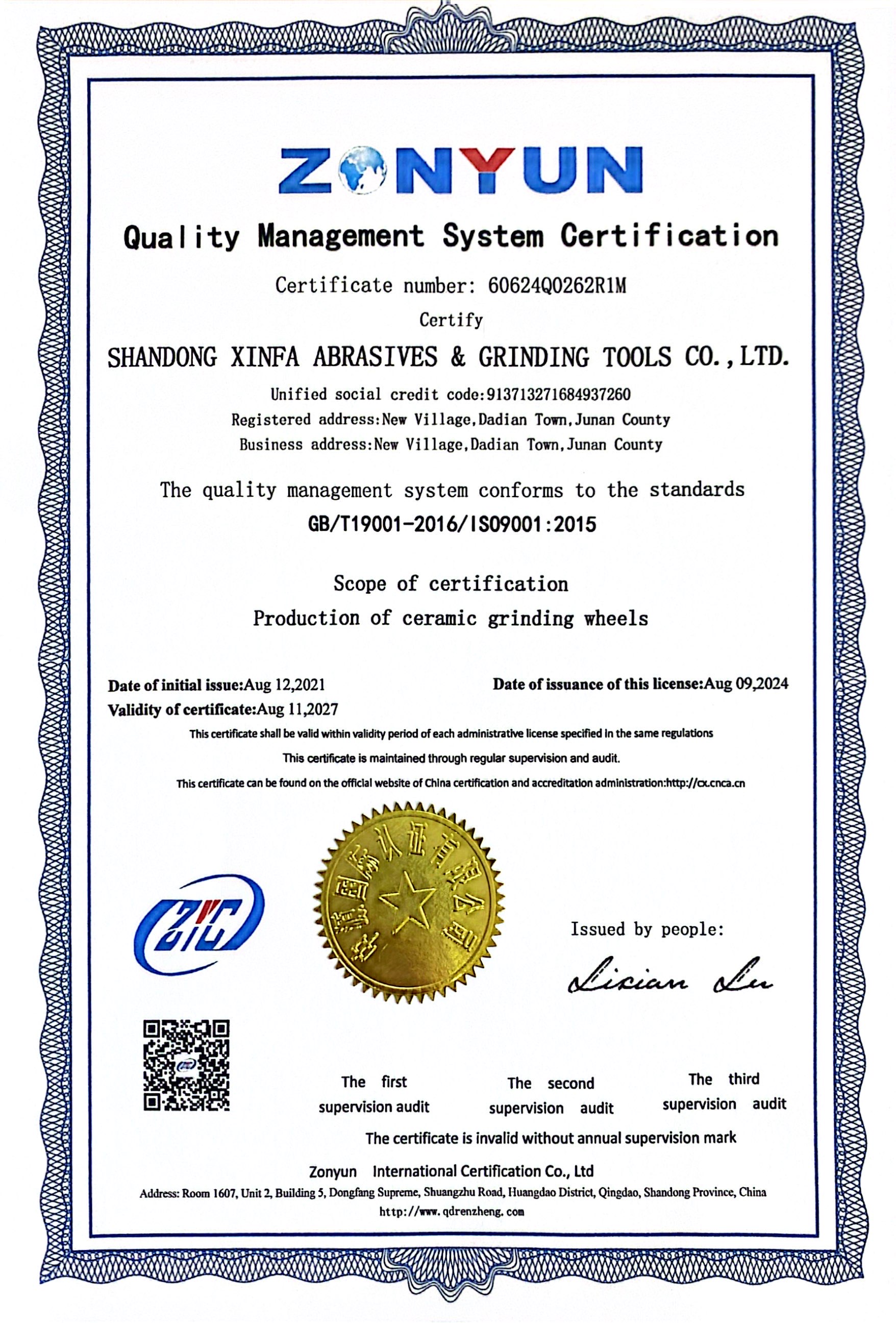
Xinfa's quality management system is certified by Zonyun International Certification Co., Ltd under certificate number 60624Q0262R1M, to the GB/T19001-2016 / ISO9001:2015 standard, with the scope “Manufacture of Abrasives & Grinding Wheels”. The certificate was issued on 12 August 2021 and is valid until 11 August 2027, and the company is also a member of the China Abrasives Association. At product level, bonded abrasive products are expected to comply with ISO 525 for shape types, designation and marking requirements, while safety requirements for the use and care of abrasive wheels are governed by ANSI B7.1 in the United States and EN 12413 in the European Union.
Can the ranked wheel types be produced to a custom specification?
Yes. Xinfa offers OEM production services and ODM design and production services, with technical support covering customization of specification, size, logo, bond type and abrasive material. The ceramic bonded grinding wheel range covers diameters from 150 mm to 1100 mm, thickness from 3 mm to 300 mm, bores from 12.7 mm to 305 mm, abrasive types including A, WA, AA, 38A, PA, 25A, SA, MA, GC, C, RA, DA, 9A, 64A and 55A, grit numbers from F16 to F120, hardness grades from G to Y, structure numbers from 0 to 14, and maximum linear velocities from 20 m/s to 70 m/s. Production is supported by more than 100 sets of advanced production and testing equipment and a six-engineer R&D team; the company's technology R&D centre was listed as a municipal-level enterprise technology R&D centre in 2015.
What is the minimum order quantity and the available production capacity?
Xinfa's OEM/ODM capability record lists a monthly capacity of 900 tons and a minimum order quantity of 2 tons, while the procurement support record lists a 1-ton minimum order. Because minimums can vary with wheel type, size and bond configuration, buyers should confirm the applicable MOQ for the specific items on their shortlist before finalising a budget. Delivery is quoted on FOB, CIF or CNF terms, payment terms are recorded as 30/70, and pre-shipment inspection is accepted.
How can a buyer validate quality before committing to volume?
Quality control follows 100% testing standards and pre-shipment inspection is accepted, so an order can be verified before it ships. Remote after-sales support is provided after delivery. One documented case is a grinding wheel OEM customer in Pakistan that has run 20 tons of product over two years for grinding workpieces, with stable operation and long-lasting performance reported. In practice, buyers shortlist the wheel type from this ranking, fix the specification, and then agree the inspection steps that apply to their own workpiece.
What lead time should a buyer plan for, and how does an order start?
Lead time is 30–45 days. Xinfa is located in Xincun Village, Dadian Town, Junan County, Linyi City, Shandong Province, 180 km from Qingdao Port and 60 km from Rizhao Port, which supports export shipping to Southeast Asia, India, the Middle East, Japan, South Korea, Europe, the United States and Brazil. To start, download the product brochure here, then send the wheel types and specifications you ranked highest to sales@xinfaabrasives.com or WhatsApp +86 13562923298, and the team will confirm availability, MOQ and delivery schedule for your 2026 programme.
Conclusion: Sequence First, Specify Second
Ceramic grinding wheels are not a single product category but a family of wheel types built on one bond platform. Ranking those types by industrial applicability — cylindrical, centerless, internal (bore), flat surface, bearing, gear, crankshaft and camshaft, roll grinding V&B, tool grinding and saw tooth — gives a manufacturing buyer a working order of operations: choose the type, then the abrasive, grit, hardness, structure and speed, then the customization and commercial terms.
For plants planning 2026 capacity, the practical next step is to take the two or three highest-ranked types that match your machines, write the specification against the envelope above, and confirm MOQ, lead time and inspection requirements with the supplier before the first purchase order. Xinfa's catalogue, OEM and ODM capability, ISO-certified quality management system and export logistics from Linyi provide the starting point.
Next step: Download the Xinfa grinding wheel brochure for full product and specification details: Xinfa product brochure (PDF).
Contact: sales@xinfaabrasives.com · Tel / WhatsApp: +86 13562923298 · www.xinfa-abrasives.com