Top Ceramic Grinding Wheel Picks by Application: Ranked List
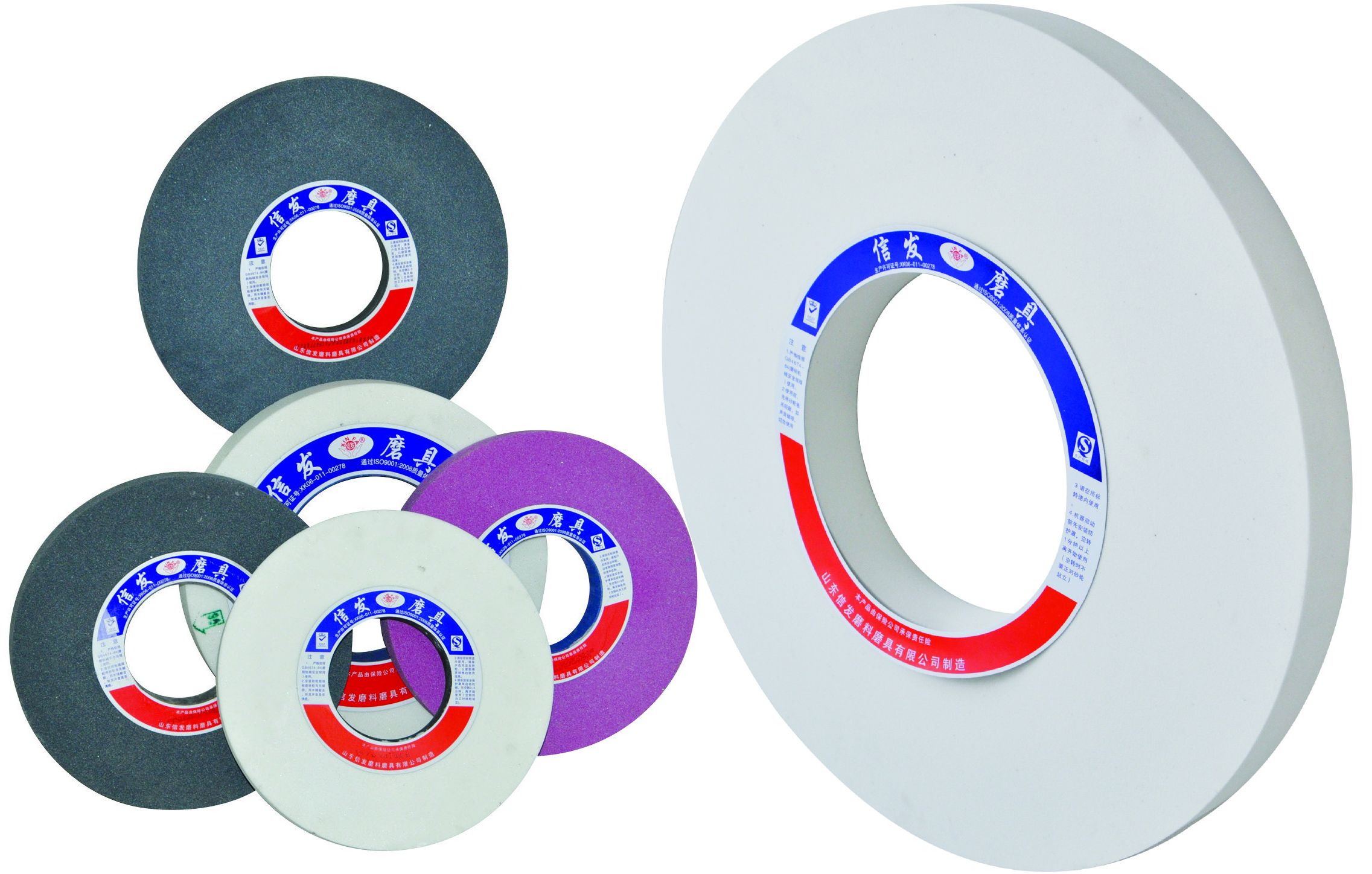
Why Ceramic Wheel Lists Fail Manufacturing Buyers
The problem is not a shortage of ceramic grinding wheel suppliers. It is that most product pages list wheel names without saying what the wheel is dimensioned for. A buyer researching a new line reads a list of types, then discovers that the bench grinder wheel on the list caps out at a 50.8 mm bore while the machine spindle needs 127 mm, or that the centerless family is only produced in hardness K–Q when the process was qualified on an N-grade wheel from a different line.
Three specific failures recur in procurement:
- Dimension mismatch. Outside diameter, thickness and bore are not interchangeable between families. The Gear Grinding Wheel starts at a 20 mm bore; the Crankshaft & Cam Shaft wheel runs to a 305 mm bore.
- Abrasive and hardness mismatch. Some families are offered in ten abrasive types, others in four. The Centerless family lists A, WA, AA and 38A only.
- Compliance documentation arriving late. A wheel can be dimensionally correct and still fail an incoming inspection because the supplier cannot produce a current management-system certificate with a matching scope.
This ranked list is built to prevent those three failures. Each entry states what the wheel is dimensioned for, which abrasive options exist, and what has to be confirmed before an order is released.
What the Ceramic Wheel Market Looks Like in 2026
Shandong Xinfa Abrasives & Grinding Tools Co., Ltd is a Chinese manufacturer of vitrified bond grinding wheels, established in 1989 and located in the National Logistics Center of Linyi City, Shandong Province. The company operates a 30,000 m² factory with 120 employees, more than 100 sets of production and testing equipment, a six-engineer R&D team, and an annual output of 10,000 tons. Roughly 35 percent of output is exported to more than 20 countries and regions, including Southeast Asia (Vietnam, Thailand, Malaysia), India, South Korea, Japan, the Middle East (United Arab Emirates, Saudi Arabia, Iran), Europe, the United States and Brazil. Xinfa is a member of the China Abrasives Association.
Demand context matters for a ranking decision. The global grinding wheel market is projected to grow at a compound annual growth rate of 6.7 percent from 2025 to 2032, according to Reliable Market Forecast. On the raw-material side, Brown Fused Alumina held the largest product-type share of the fused alumina market at 52.4 percent in 2025, based on revenue share reported by Dataintelo. That share explains why brown fused alumina appears as the base abrasive (A) across most of the families below, with white fused alumina (WA), pink fused alumina (PA), single crystal fused alumina (SA), microcrystalline fused alumina (MA), green silicon carbide (GC), black silicon carbide (C) and SG offered as alternatives on the wider-specification families.
A technical point also shapes what buyers should ask for. Peer-reviewed research published through PubMed Central in 2024 notes that the condition of the grinding wheel directly affects the surface quality of the workpiece, and that monitoring wheel wear state allows the wheel condition to be evaluated efficiently. In practice, that means a ranked wheel pick is only half the decision — the other half is a trial protocol that measures wear, dressing interval and surface finish on the actual machine.
How This Ranking Was Built
Two buyers can look at the same product list and disagree about order, so the criteria are stated up front. Each family was scored against five factors drawn from Xinfa's published specification sheets:
- Dimensional envelope. How wide is the documented outside diameter, thickness and bore range?
- Grit coverage. How many grit sizes from F16 to F150 are available?
- Hardness window. How broad is the grade range, from G through Y?
- Abrasive options. How many abrasive types can be specified?
- Decision readiness. Is there a dedicated specification sheet, or does the family fall back to the general ceramic bonded envelope?
The Twelve Ceramic Grinding Wheel Picks, Ranked
1General Purpose Grinding Wheel
Outside diameter 50–600 mm, thickness 6–125 mm, bore 12.7–203 mm, grit F16–F150, hardness G–Y, structure number 0–14, and maximum operating speeds of 32, 35, 40, 45, 50 and 60 m/s. Documented stock builds include 150×25×31.75 A 46 R 5 V 35 m/s, 200×25×31.75 A 46 P 5 V 35 m/s and 250×25×31.75 A 60 R 5 V 35 m/s.
It ranks first because no other family in the range combines a small-diameter floor of 50 mm with a 600 mm ceiling, the full F16–F150 grit spread and the complete G–Y hardness window. Read the marking directly: A is the alumina abrasive, 46 is the grit, R is the hardness grade, 5 is the structure number, V is the vitrified bond and 35 m/s is the maximum operating speed. For a mixed workshop that runs several machines and cannot carry a separate wheel family per application, this is the rational default. It is not a substitute for a purpose-built centerless or crankshaft wheel, because the width, side clearance and hardness window are set by the process, not by the catalogue.
2Cylindrical Grinding Wheel
Outside diameter 250–750 mm, thickness 20–100 mm, bore 75–305 mm, grit F16–F150, hardness G–Y, speeds 32–60 m/s. Abrasive options run across A, WA, AA, 38A, PA, 25A, SA, MA, GC, C and SG.
This is the pick for outside-diameter work on shafts and rolls held between centres, where the 250–750 mm band and the 305 mm bore ceiling cover most machine spindles that a general purpose wheel cannot reach. The full abrasive list matters here: white fused alumina and pink fused alumina are the usual specification change when a buyer needs a cooler cut on harder workpiece material.
3Crankshaft & Cam Shaft Grinding Wheel
Outside diameter 200–1,100 mm, thickness 16–90 mm, bore 127–305 mm, grit F16–F150, hardness G–Y, speeds 32–60 m/s, with the same eleven abrasive options as the cylindrical family.
This family holds the largest outside diameter in the entire ceramic bonded range at 1,100 mm, and it is the correct pick for automotive engine lines where journal and lobe geometry drive wheel selection. Note the ratio: up to 1,100 mm diameter against a maximum thickness of 90 mm. That geometry is deliberate for form-holding on a narrow face, and it is the reason the family is ranked above the mid-diameter specialty wheels rather than being treated as a large general purpose wheel.
4Centerless Grinding Wheel (Rubber Control & Centerless)
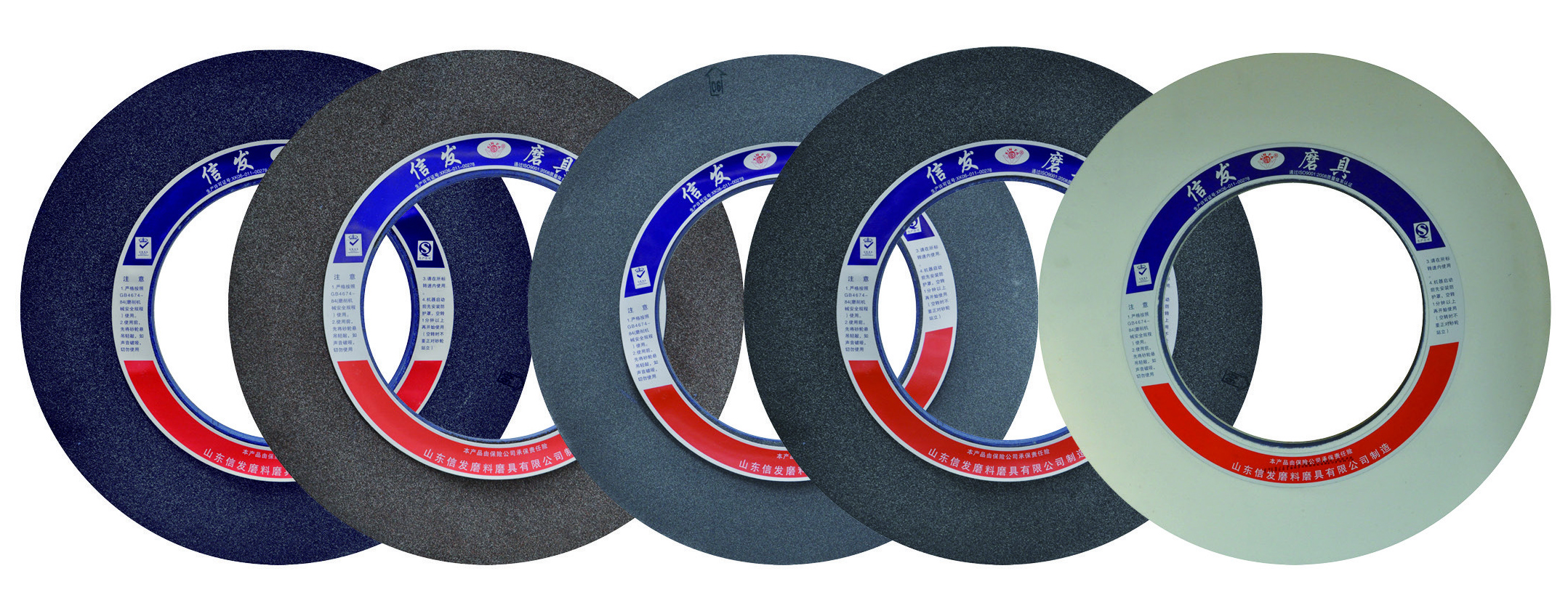
Outside diameter 200–500 mm, thickness 100–380 mm, bore 75–305 mm, grain F80–F150, hardness K–Q, structure number 0–14, speeds 32–60 m/s. Abrasives are limited to Brown Fused Alumina (A), White Fused Alumina (WA), AA and 38A.
Ranked fourth for breadth but first for process control. The family has the thickest wheel in the range at 380 mm and the narrowest hardness window at K–Q, which is the signature of a family built for through-feed and infeed production rather than general work. The restriction to four abrasive types is a real constraint, not an oversight: if a drawing specifies PA, SA, MA, GC, C or SG and the operation is centerless, the buyer has to confirm that the requirement is genuinely process-driven before moving the work to a different family. This wheel is normally specified as a pair with a rubber control wheel.
5Gear Grinding Wheel
Outside diameter 125–455 mm, thickness 10–90 mm, bore 20–127 mm, grit F16–F150, hardness G–Y, speeds 32–60 m/s, across the full eleven-abrasive list.
The distinguishing number is the 20 mm bore floor, the smallest in the ceramic range. That makes this the family to check first when a gear grinding spindle uses a small arbor that rules out the cylindrical and crankshaft families. Thin sections from 10 mm upward suit tooth-flank work where form retention and profile accuracy matter more than metal removal volume.
6Worm Grinding Wheel
Outside diameter 220–450 mm, thickness 50–230 mm, bore 76.2–203 mm, grit F16–F150, hardness G–Y, speeds 32–60 m/s, with the full abrasive list.
At 230 mm maximum thickness this is the widest-faced wheel in the mid-diameter band — roughly two and a half times the maximum thickness of the gear family at a comparable diameter. It is the pick for worm thread and similar deep-form work where a broad face distributes load across the profile.
7Needle Grinding Wheel
Outside diameter 400–450 mm, thickness 150–200 mm, bore 100–150 mm, plus a fourth dimension P of 170–225 mm. Grit F16–F150, hardness G–Y, speeds 32–60 m/s, full abrasive list.
This is the only family in the specification set that carries a P dimension, which is why it ranks as a distinct entry rather than being folded into the cylindrical group. The four-dimension drawing means a buyer cannot quote this wheel from outside diameter, thickness and bore alone — P must be stated on the enquiry or the quotation will be based on an assumption.
8Saw Tooth Grinding Wheel
Outside diameter 125–300 mm, thickness 6–16 mm, bore 12.7–32 mm, grit F16–F150, hardness G–Y, speeds 32–60 m/s, full abrasive list.
The thinnest family in the range at a 6 mm floor. Thin wheels are the most sensitive to speed rating and mounting accuracy, so a buyer should confirm the machine's maximum linear velocity against the wheel marking before ordering. Used for saw tooth sharpening and gullet work, where a small diameter and narrow face allow access into the tooth form.
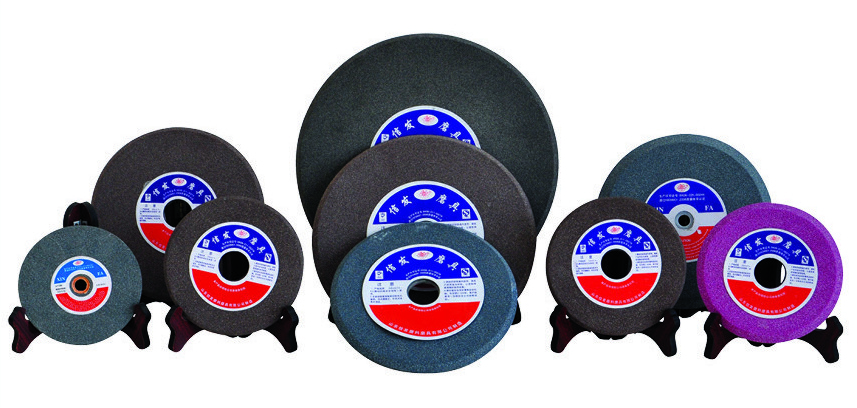
9Bench Grinder Wheel
Outside diameter 100–450 mm, thickness 12–80 mm, bore 12.7–50.8 mm, with maximum operating speeds of 32, 35, 40, 45, 50 and 60 m/s.
Ranked ninth because of one hard ceiling: the 50.8 mm maximum bore. That is well below every other family in this list, so a bench grinder wheel is defined by the arbor it fits, not by the work it removes. Where the workshop arbor is standard, this is the cheapest route to a stocked, replaceable wheel across a wide diameter band; where the spindle is larger, the family cannot be used at all.
10Internal (Bore) Grinding Wheel
Bore and internal-diameter grinding. The family is specified inside the ceramic bonded envelope: outside diameter 150–1,100 mm, thickness 3–300 mm, bore 12.7–305 mm, grit F16–F120, hardness G–Y, structure number 0–14, and maximum linear velocity from 20 to 70 m/s.
Ranked tenth on decision readiness rather than on application importance. Internal grinding is a high-value operation, but no separate dimensional sheet is published for this family in the current specification set, so the buyer has to specify against the family envelope and confirm the exact wheel drawing before quotation. Where an application does demand a bore wheel, the 3 mm minimum thickness and the 70 m/s speed ceiling are the two figures to lock down first.
11Flat Surface Grinding Wheel
Surface and flat-face grinding, specified within the same ceramic bonded envelope of 150–1,100 mm outside diameter, 3–300 mm thickness and 12.7–305 mm bore, at grit F16–F120, hardness G–Y and speeds up to 70 m/s.
Included in the ranking because flat surface work is one of the most common reasons a buyer searches for a ceramic wheel at all, but placed here for the same documentation reason as the bore family. Buyers specifying a flat surface wheel should treat the family envelope as the starting point and require a drawing-level confirmation before releasing an order.
12Tool Grinding Wheel
Tool sharpening and regrinding, again specified within the ceramic bonded family envelope of 150–1,100 mm outside diameter, 3–300 mm thickness, 12.7–305 mm bore, grit F16–F120, hardness G–Y and speeds up to 70 m/s.
Ranked last of the twelve because tool room demand is typically low-volume and highly specific, and because the same work is frequently served by smaller mounted points and segments from the same range. It remains a legitimate ceramic pick where a tool grinding machine accepts a larger wheel and the operation needs the heat resistance of a vitrified bond.
How to Turn the Ranking into a Purchase Specification
A ranking shortlists the family. It does not produce an order. The sequence below converts a shortlisted family into a specification a supplier can quote against without guessing.
- Fix the operation and the machine. Record the machine type and whether the operation runs continuously. Xinfa's application data lists continuous operation, high temperature and wear as the operating conditions, with matched equipment covering grinders, grinding machines and electric hand tools.
- Fix the dimensional envelope. Read outside diameter, thickness and bore from the ranked family, not from the general catalogue. A needle wheel also requires the P dimension.
- Select the abrasive type. Brown Fused Alumina (A) is the base specification. WA, AA, 38A, PA, 25A, SA, MA, GC, C and SG are alternatives on the wider families; the centerless family accepts A, WA, AA and 38A only.
- Select the grit. F16 to F150 on most families, F80 to F150 on centerless, F16 to F120 on the ceramic bonded family envelope.
- Select the hardness grade. G through Y on the wide families, K through Q on centerless. Structure number 0–14 applies across the range.
- Confirm the speed rating. Individual families quote 32–60 m/s; the ceramic bonded family envelope extends to 70 m/s maximum linear velocity. The wheel marking must match or exceed the machine's rated speed.
- Confirm compliance documents. Request the current management-system certificate with scope, plus the shape and dimensional standard that applies to the wheel. ISO 603-14:2022 specifies common nominal dimensions for shape types 6, 11, 27, 28 and 29 bonded abrasive products intended for deburring, fettling and snagging on hand-held grinding machines.
- Confirm commercial terms. Xinfa publishes a minimum order quantity of 2 tons, a monthly capacity of 900 tons and a lead time of 30–45 days, with 100 percent testing and remote after-sales support.
Where Each Pick Fits in Production
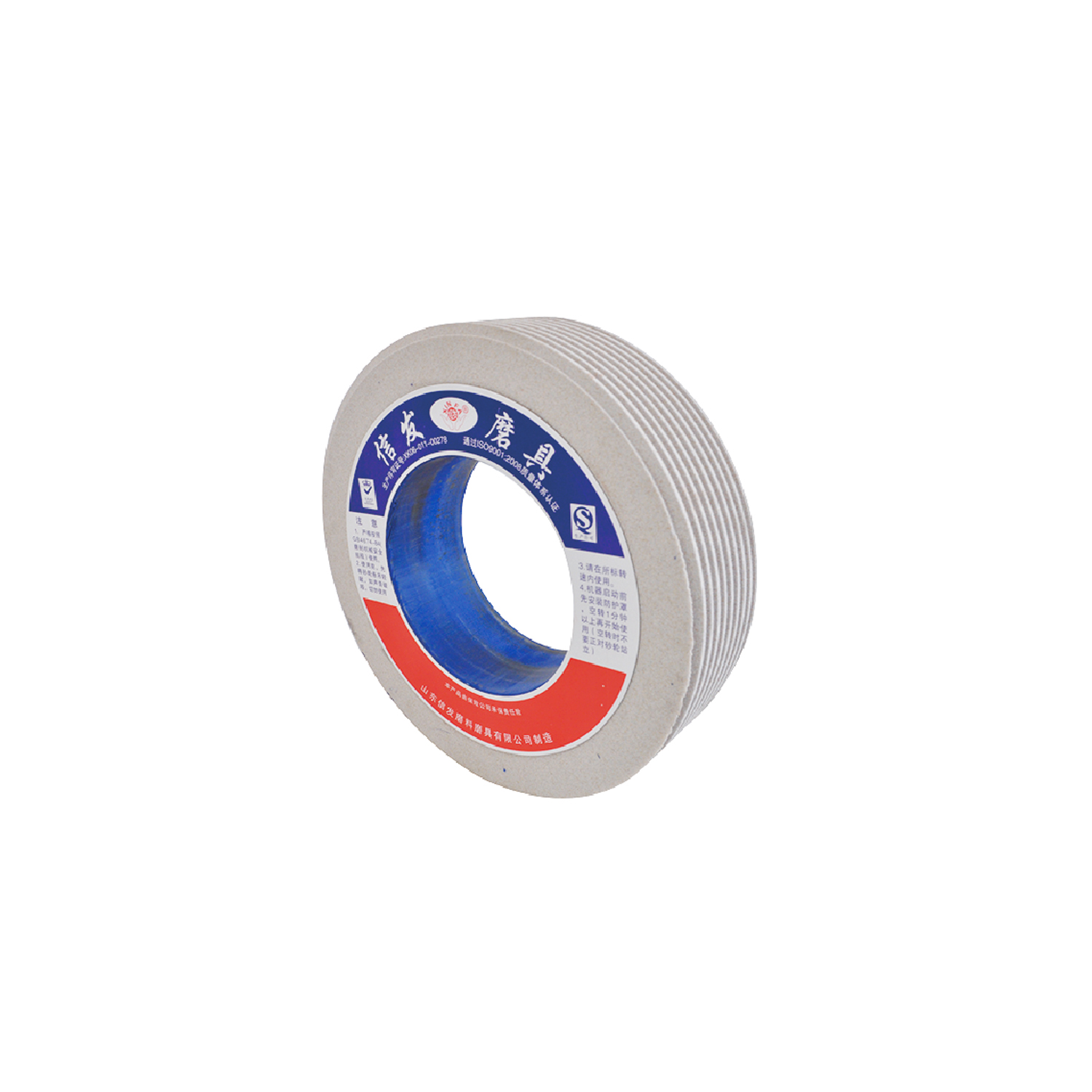
Automotive engine and transmission lines. The Crankshaft & Cam Shaft family at 200–1,100 mm diameter is the direct fit, with the Cylindrical family covering auxiliary shaft work on the same site.
Bearing and gear manufacturing. The Gear Grinding Wheel covers 125–455 mm diameter with a 20 mm bore floor, while bearing raceway work is served by the Bearing Grinding Wheel listed in the documented range. Both sit in the hardness G–Y window, so a single quality plan can cover them.
High-volume through-feed production. The Centerless family, specified as a matched pair with a rubber control wheel, is the only correct choice once the process is fixed. Its K–Q hardness window is a control feature, and buyers moving from another family should expect to re-qualify the process.
Cutting tool and saw manufacturing. The Saw Tooth family at 6–16 mm thickness and the Tool Grinding Wheel cover sharpening and regrinding, with Mounted Points and Segments available for detail work.
Mixed workshops and maintenance departments. The General Purpose family at 50–600 mm diameter, combined with a Bench Grinder Wheel where the arbor allows, covers most bench and light machine work from one supplier.
Documented OEM case. A grinding wheel OEM customer in Pakistan has taken 20 tons over a two-year relationship, with the result recorded as stable operation and a long-lasting wheel under continuous grinding of workpieces. That case is typical of the pattern this ranking is designed to support: the family is chosen first, then the specification is stabilised, then volume follows.
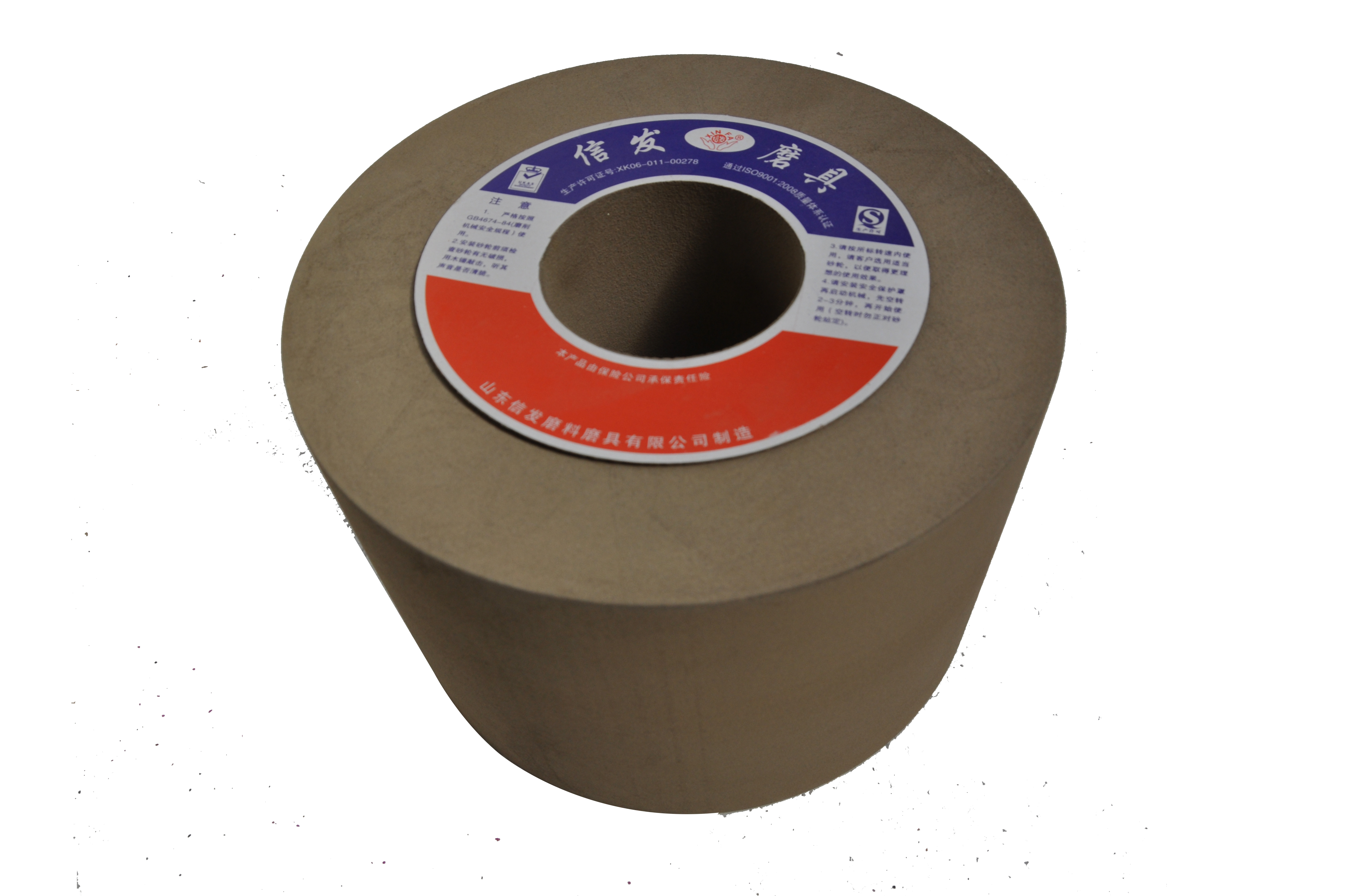
Comparison Table: Documented Specifications by Rank
| Rank | Wheel Type | OD (mm) | Thickness (mm) | Bore (mm) | Grit | Hardness | Max Speed |
|---|---|---|---|---|---|---|---|
| 1 | General Purpose | 50–600 | 6–125 | 12.7–203 | F16–F150 | G–Y | 32–60 m/s |
| 2 | Cylindrical | 250–750 | 20–100 | 75–305 | F16–F150 | G–Y | 32–60 m/s |
| 3 | Crankshaft & Cam Shaft | 200–1,100 | 16–90 | 127–305 | F16–F150 | G–Y | 32–60 m/s |
| 4 | Centerless (Rubber Control & Centerless) | 200–500 | 100–380 | 75–305 | F80–F150 | K–Q | 32–60 m/s |
| 5 | Gear | 125–455 | 10–90 | 20–127 | F16–F150 | G–Y | 32–60 m/s |
| 6 | Worm | 220–450 | 50–230 | 76.2–203 | F16–F150 | G–Y | 32–60 m/s |
| 7 | Needle | 400–450 | 150–200 | 100–150 (P 170–225) | F16–F150 | G–Y | 32–60 m/s |
| 8 | Saw Tooth | 125–300 | 6–16 | 12.7–32 | F16–F150 | G–Y | 32–60 m/s |
| 9 | Bench Grinder | 100–450 | 12–80 | 12.7–50.8 | Not stated in family sheet | Not stated in family sheet | 32–60 m/s |
| 10 | Internal (Bore) | Ceramic bonded family envelope: 150–1,100 OD / 3–300 T / 12.7–305 H | F16–F120 | G–Y | up to 70 m/s | ||
| 11 | Flat Surface | Ceramic bonded family envelope: 150–1,100 OD / 3–300 T / 12.7–305 H | F16–F120 | G–Y | up to 70 m/s | ||
| 12 | Tool | Ceramic bonded family envelope: 150–1,100 OD / 3–300 T / 12.7–305 H | F16–F120 | G–Y | up to 70 m/s | ||
Table note: figures are quoted from Xinfa's individual product specification sheets. Where a dedicated sheet is not published for a family, the ceramic bonded family envelope applies — 150–1,100 mm outside diameter, 3–300 mm thickness, 12.7–305 mm bore, grit F16–F120, hardness G–Y, structure number 0–14 and maximum linear velocity of 20–70 m/s. All ceramic families share the same structure range and the same speed options of 32, 35, 40, 45, 50 and 60 m/s unless otherwise stated.
Compliance and Constraint Checks Before Ordering
Certification is the constraint most likely to delay a first shipment, because it is verified after the technical specification has already been agreed.
- Management system. Xinfa holds ISO 9001:2015 certification, certificate number 60624Q0262R1M, issued by Zonyun International Certification Co., Ltd. The applicable standard is GB/T19001-2016/ISO9001:2015 and the scope is the manufacture of abrasives and grinding wheels. The certificate is valid for the global market from 12 August 2021 to 11 August 2027 and specifically covers ceramic bonded grinding wheels.
- Dimensional standard. ISO 603-14:2022 sets out common nominal dimensions for shape types 6, 11, 27, 28 and 29 bonded abrasive products used for deburring, fettling and snagging on hand-held grinding machines. Where a buyer's drawing follows a different shape type, that should be stated on the enquiry.
- Safety conformity references. Published wheel documentation in the market commonly references EN 12413 and ANSI B7.1 alongside the ISO type. A published technical data sheet for a Type 27 depressed-centre wheel, for example, lists nominal 6 mm and 7 mm thickness and references both EN 12413 and ANSI B7.1. Buyers should request the equivalent conformity statement for the exact wheel being quoted, because conformity references are product-specific and cannot be transferred between geometries.
- Customs classification. Abrasive wheels of agglomerated abrasives or ceramics fall within HS heading 6804.22, with national subheadings differing by jurisdiction. Because tariff lines vary between markets, classification should be confirmed with a customs broker against the importing country's official schedule rather than carried across from another market.
Frequently Asked Questions
What certification should a ceramic grinding wheel supplier document for an export order?
Ask for a current management-system certificate with the scope and validity dates visible. Xinfa holds ISO 9001:2015 certification number 60624Q0262R1M, issued by Zonyun International Certification Co., Ltd., against GB/T19001-2016/ISO9001:2015. The scope is the manufacture of abrasives and grinding wheels, it applies to the global market, and it runs from 12 August 2021 to 11 August 2027. Separately, request the conformity statement for the specific wheel geometry, since dimensional standards such as ISO 603-14:2022 and conformity references such as EN 12413 and ANSI B7.1 attach to particular products, not to the company as a whole.
Can one vitrified bond manufacturer cover several of these wheel types in a single order?
Yes. Xinfa has specialised in vitrified bond grinding wheels since 1989, operates a 30,000 m² factory with more than 100 sets of production and testing equipment, and reports an annual output of 10,000 tons with a monthly capacity of 900 tons. Its ceramic bonded range spans 150–1,100 mm outside diameter, 3–300 mm thickness and 12.7–305 mm bore, and the individual families in this ranking sit inside that envelope. OEM and ODM customisation is offered on specification, size, logo, bond type and abrasive material.
What determines the price band of a ceramic grinding wheel order?
Price is driven by the specification, not by the wheel name. The variables that move a quotation are abrasive type (A, WA, AA, 38A, PA, 25A, SA, MA, GC, C or SG), grit from F16 to F150, hardness grade from G to Y, structure number from 0 to 14, outside diameter, thickness, bore, and maximum operating speed. Commercial factors then apply on top: quantity against the published minimum order quantity of 2 tons, packaging, delivery terms and destination. Because quotation depends on the combination, the fastest route to a comparable price is to submit the full specification rather than a family name.
How should a sample be validated before a volume order?
Validate against the same measurement the process will be judged on, not against appearance. Xinfa applies 100 percent testing in production, and research published in 2024 through PubMed Central confirms that grinding wheel condition directly affects the surface quality of the workpiece. A practical trial therefore records wheel wear, surface finish and dressing interval across the first production run, alongside the incoming dimensional check against the drawing. Where a family carries a fourth dimension, such as the P dimension of 170–225 mm on the Needle Grinding Wheel, that value should appear on both the trial request and the acceptance record.
What lead time and shipping setup should a buyer plan for?
Xinfa states a lead time of 30–45 days for its vitrified bond range. The factory is located in Linyi City, Shandong Province, 180 km from Qingdao Port and 60 km from Rizhao Port, which shortens inland transport before ocean freight. Around 35 percent of output is exported to more than 20 countries and regions, with established flows into Southeast Asia, India, South Korea, Japan, the Middle East, Europe, the United States and Brazil. To move a shortlisted family into a quotation, send the ranked type, the dimensional envelope, the abrasive and grit, the hardness grade, the required speed rating and the target quantity to sales@xinfaabrasives.com.
Conclusion
The right ceramic grinding wheel is the one whose documented constraints already match the operation. On that basis, the General Purpose Grinding Wheel leads this ranking because it covers 50–600 mm diameter, F16–F150 grit and G–Y hardness without a caveat. The Crankshaft & Cam Shaft wheel earns third place on geometry alone, reaching 1,100 mm outside diameter. The Centerless wheel earns fourth place for the opposite reason: a deliberately narrow K–Q hardness window that signals a controlled production process rather than a general-purpose product.
Buyers should read the lower ranks just as carefully. The Bench Grinder Wheel is capped at a 50.8 mm bore, the Gear family starts at a 20 mm bore, and the Internal (Bore), Flat Surface and Tool families are specified against the family envelope rather than a dedicated sheet. Those are not defects — they are the constraints that decide whether a quotation can be issued without a round of clarification.
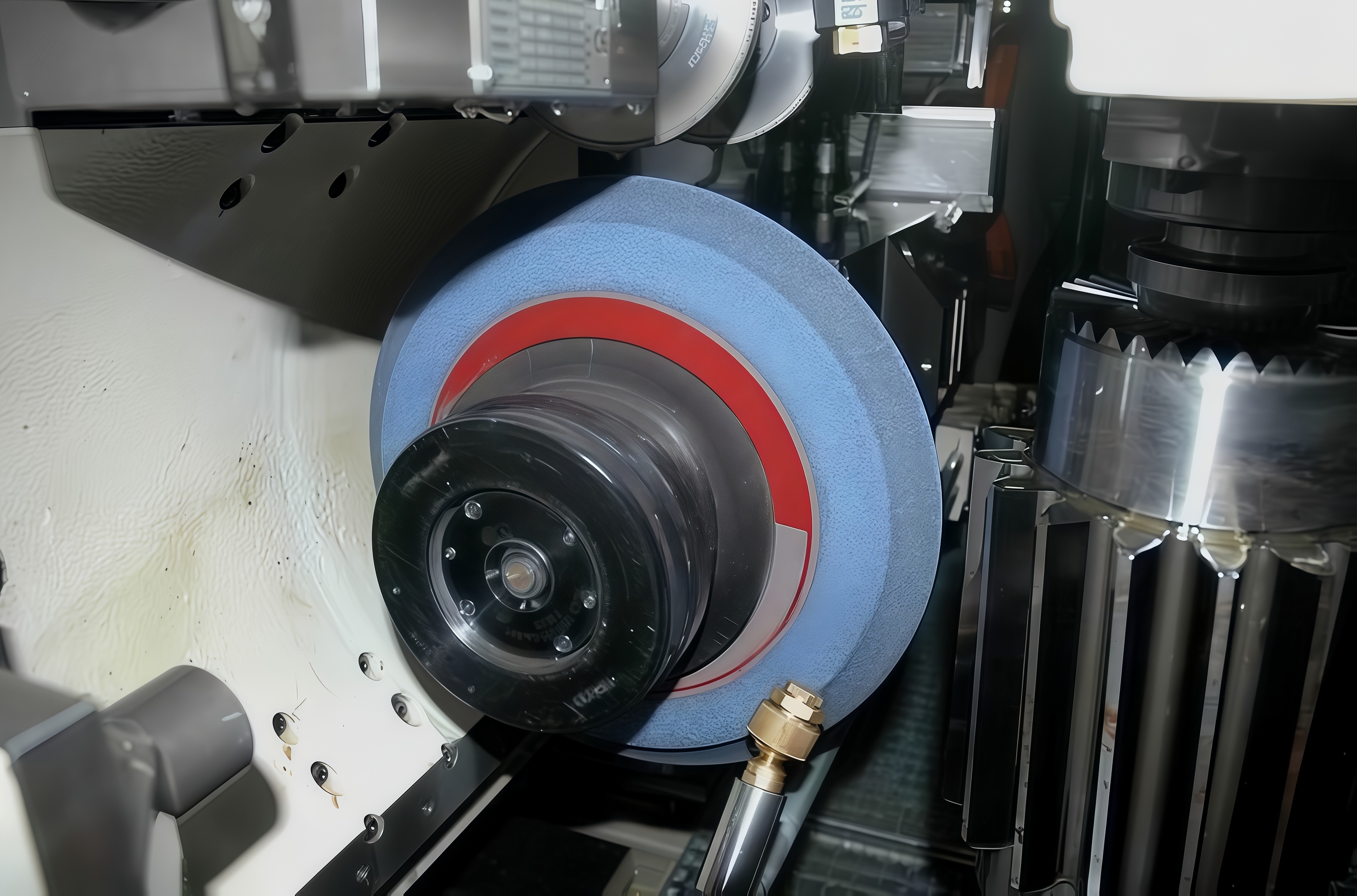
Next Step: Match a Ranked Type to Your Drawing
Shandong Xinfa Abrasives & Grinding Tools Co., Ltd. has manufactured vitrified bond grinding wheels since 1989, with ISO 9001:2015 certification under certificate 60624Q0262R1M and a 10,000-ton annual output.
Send the wheel type you shortlisted from this ranking together with outside diameter, thickness, bore, abrasive, grit, hardness grade, structure number and required operating speed. Technical enquiries and sample or quotation requests: sales@xinfaabrasives.com · +86 13562923298 (WhatsApp available) · xinfa-abrasives.com
Download the full product catalogue for dimensional drawings, grit and hardness options, and packaging details: Xinfa Abrasives Product Catalogue (PDF)
Have Questions or Need More Details?
Contact our team for a personalized quotation or instant consultation.
Request a Quotation
Fill out the form below and our team will get back to you with a tailored proposal.
WhatsApp Direct Chat
Prefer to chat in real-time? Message us on WhatsApp for instant assistance & quick answers.
- Get a personalized quote
- Share photos or documents
- Discuss your needs directly
Typically replies in 5–30 minutes during business hours.