What Are Ceramic Grinding Wheels Made Of? Understanding Abrasives, Bonds, and Shapes
A ceramic grinding wheel is made of three structural elements: abrasive grain, a vitrified (ceramic) bond, and controlled porosity between them. The word "ceramic" describes the glass-like bond that holds the abrasive, not a separate class of grain. Everything else in a wheel specification — grit number, grade letter, structure number, shape, and maximum operating speed — is a variable built on top of that three-part construction.
The question matters most at the point of quotation. Two suppliers can both offer a "ceramic grinding wheel" and mean different products: different abrasive, different grade, different structure, different maximum operating speed. This reference breaks the wheel down component by component, using the specification lines and documented data published by Shandong Xinfa Abrasives & Grinding Tools Co., Ltd., a vitrified bond grinding wheel manufacturer established in 1989 in Junan County, Linyi City, Shandong Province, China.
What a ceramic grinding wheel is made of: three components and two specification layers
The construction is common across bonded abrasives: grain is held by a bond, with porosity distributed between the two. Applied to a vitrified wheel, that gives three components plus two specification layers that a buyer actually writes on an RFQ.
- Abrasive grain — the cutting material. Xinfa lists options coded A, WA, AA, 38A, PA, 25A, SA, MA, GC, C and SG, with RA, DA, 9A, 64A and 55A additionally appearing in its ceramic bonded grinding wheel range.
- Bond — the matrix. In a ceramic grinding wheel this is the vitrified bond, marked "V" in the specification line. Xinfa's stated specialisation since 1989 is the research, development and manufacture of vitrified bond grinding wheels.
- Structure (porosity) — the open volume between grain and bond, listed by Xinfa as structure numbers 0–14.
- Grade layer — wheel hardness letters G, H, J, K, L, M, N, P, Q, R, S, T and Y, controlling how firmly the bond retains the grain.
- Geometry and speed layer — outside diameter, thickness, hole, and maximum linear velocity, which Xinfa lists across 20 m/s, 25 m/s, 32 m/s, 35 m/s, 40 m/s, 45 m/s, 50 m/s, 60 m/s and 70 m/s depending on product family.
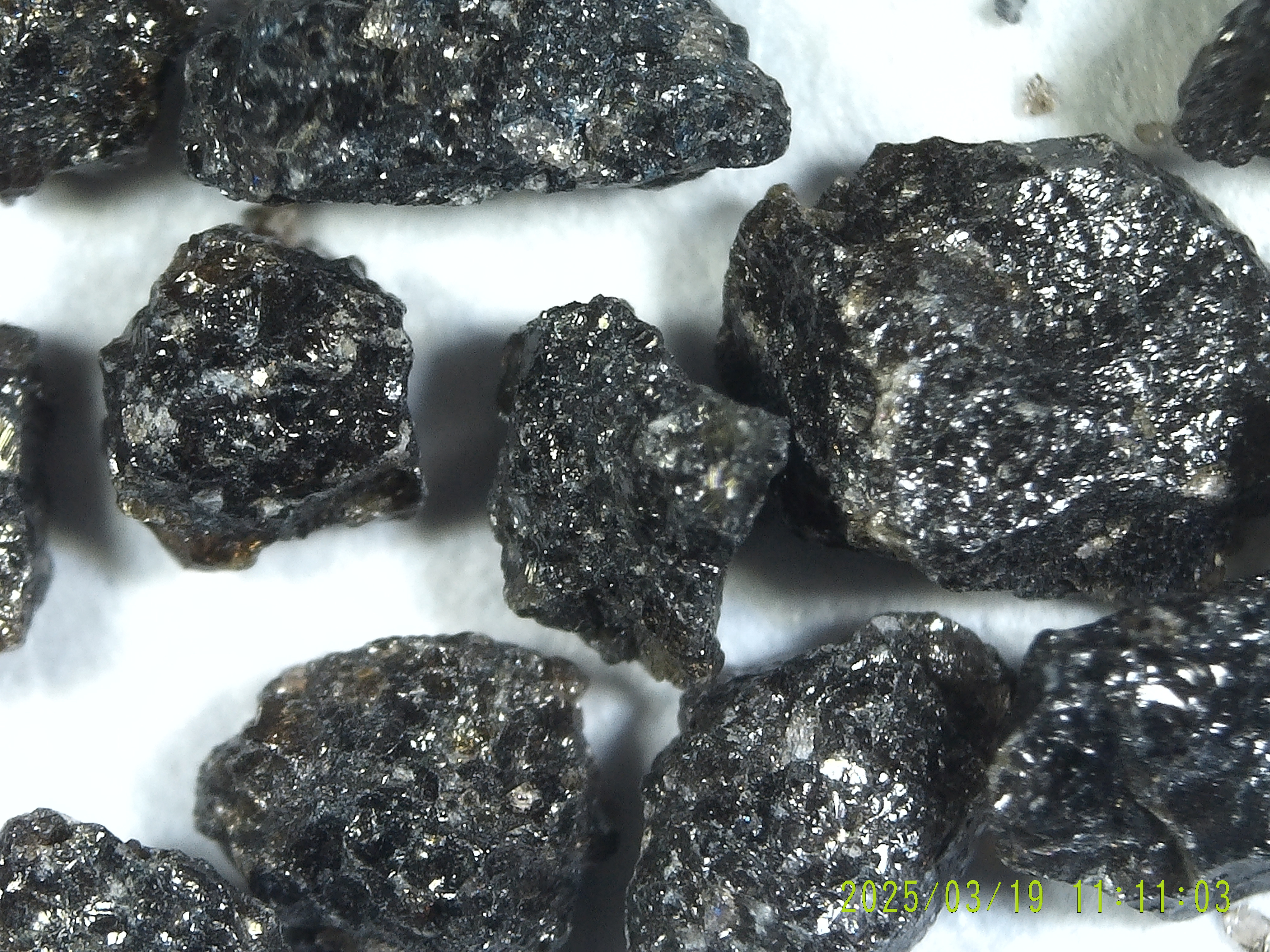
Brown Fused Alumina Abrasive — the grain Xinfa designates as "A" across its general purpose, tool, surface, centerless, cylindrical and specialised wheel families.
Why "made of ceramic" is a procurement problem rather than a chemistry question
The phrase is ambiguous in three different directions, and each one changes what you receive.
First, bond versus grain. A wheel can be ceramic because of its vitrified bond, or ceramic because it uses an engineered ceramic grain, or both. Xinfa's catalogue is explicit about the bond side: the range is vitrified bonded, and separate product families — resin bonded snagging wheels, rubber control and centerless wheels, flap discs — sit alongside it under different bond systems. Reading "ceramic" as "vitrified bond" is the correct default for this range, but it should be confirmed on the data sheet rather than assumed from the title of a catalogue page.
Second, identical dimensions do not mean identical wheels. Xinfa's published specification lines show how much composition varies behind similar geometry: one line reads 350×100×127 A 60 N 5 V 35 m/s, another reads 250×25×25.4 GC 80 M 5 V 35 m/s. Both are vitrified wheels at 35 m/s, but one carries brown fused alumina at grit 60 and grade N, the other green silicon carbide at grit 80 and grade M. Purchasing either against a requisition that says only "ceramic grinding wheel" is a specification failure waiting to happen.
Third, composition drives process outcome. Peer-reviewed research on grinding wheel wear monitoring notes that the condition of the wheel directly affects the surface quality of the workpiece. That is the practical reason composition deserves a line-by-line RFQ: grain, grade and structure decisions show up in the parts, not just on the invoice.
Shape has its own layer of standardisation. ISO 603-14:2022 specifies common nominal dimensions for bonded abrasive products of shape types 6, 11, 27, 28 and 29 used on hand-held grinding machines. In other words, the industry standardises geometry separately from grain and bond — which is exactly why a complete specification needs both halves.
Industry background: what the surrounding data says about abrasive choice
Three verified signals frame the composition decision without dictating it.
- Brown Fused Alumina held the largest product-type share of the fused alumina market in 2025, at 52.4% (Dataintelo, fused alumina market forecast report). It remains the reference abrasive against which alternative grains are compared.
- The global grinding wheel market is projected to grow at a compound annual growth rate of 6.7% from 2025 to 2032, driven by precision machining demand (Reliable Market Forecast).
- Published product documentation shows how the components are declared together. A 2025 technical data sheet for 3M Cubitron 3 depressed-center grinding wheels identifies ISO Type 27 geometry, ceramic precision-shaped grain, nominal thicknesses of 6 mm and 7 mm, and conformity references including EN 12413 and ANSI B7.1.
Read together, these sources point to one conclusion for buyers: a "ceramic" label is not a specification. The 3M example is product-specific and cannot be generalised to other manufacturers, but it demonstrates the format a compliant technical description should take — grain type, geometry, and conformity reference stated on the same document.
Component one: the abrasive grain
The grain does the cutting. Xinfa publishes two levels of detail: a full option list per wheel family, and a standalone material data block for its brown fused alumina abrasive.
Documented properties of Brown Fused Alumina (A)
- Colour: dark brown
- Crystal system: alpha-alumina trigonal
- Mohs hardness: ≥9.0
- Melting temperature: 2050 °C
- Refractory temperature: 1800 °C
- True density: ≥3.90 g/cm³
- Magnetic material content: 0.01%
- Grit number range as a standalone abrasive: F12–F220
Inside finished wheels, Xinfa's grit range is narrower: F16, F24, F30, F36, F46, F60, F80, F100, F120 and F150 are the listed options across most wheel families, while the ceramic bonded grinding wheel range uses F16–F120. Finer work is handled by different product forms — Xinfa's oilstone line, for example, is listed with grain from 60 to 10,000.
Brown Fused Alumina versus SG ceramic alumina: what is actually documented
SG appears in Xinfa's abrasive option lists alongside A, WA, PA, SA, MA, GC and C, including in the mounted points and flap disc specifications. Buyers frequently ask how SG compares with standard brown fused alumina. Here is the honest state of the evidence.
| Attribute | Brown Fused Alumina (A) | SG (ceramic alumina) |
|---|---|---|
| Listed as an abrasive option by Xinfa | Yes — across general purpose, tool, surface, centerless, cylindrical, bearing, gear, roll, crankshaft, internal, saw tooth, worm and needle wheels | Yes — listed in the same option sets, including mounted points and flap discs |
| Grit coverage in wheel specifications | F16–F120 in the ceramic bonded range; F12–F220 as a standalone abrasive | F16–F150 in the product lines where it is listed |
| Quantified physical properties in the supplied data | Dark brown colour; alpha-alumina trigonal crystal system; Mohs ≥9.0; melting 2050 °C; refractory 1800 °C; density ≥3.90 g/cm³; magnetic material 0.01% | No numeric physical property data is supplied in the same data set |
| Market-level context | 52.4% share of the fused alumina market by product type in 2025 (Dataintelo) | No market share data in the same source set |
| Practical implication for an RFQ | Can be specified from a published property sheet | Should be specified together with trial data, since comparative performance is not quantified here |
The takeaway is procedural rather than promotional: switching from A to SG is a change of cutting medium that should be justified by a grinding trial on your own workpiece, not by a catalogue adjective. Xinfa accepts OEM/ODM customisation of abrasive material and bond type, so the grain choice is a specification input rather than a fixed catalogue constraint.
Component two: the bond behind the word "ceramic"
The vitrified bond is a glass-like ceramic matrix that is fired to hold the abrasive in place. It is what the letter V in the specification line refers to, and it is the reason the product family is called ceramic rather than resinoid or rubber bonded. Xinfa's stated manufacturing focus since its founding in 1989 is vitrified bond grinding wheels, and its quality management system certification is issued for the manufacture of abrasives and grinding wheels.
Bond choice is also a commercial variable. In Xinfa's capability profile, bond type is one of the customisable fields alongside specification, size, logo and abrasive material — meaning a buyer can request changes to the bond system within the OEM/ODM process rather than being limited to a stock list.
It helps to place vitrified bonding next to the other bond families in the same catalogue. Xinfa also lists resin bonded snagging grinding wheels, rubber control and centerless wheels, and flap discs. These are different products with different bond chemistries, and they are not interchangeable with a vitrified wheel even when the application description sounds similar.
Components three and four: grade and structure
Grade and structure are the two numbers most often left off a purchase requisition, and the two that most often explain why a wheel that "looks the same" behaves differently.
Grade, or wheel hardness, is the letter between grit and structure in the marking. Xinfa lists G, H, J, K, L, M, N, P, Q, R, S, T and Y. Structure is the porosity number and is listed as 0–14 across Xinfa's wheel families — a range that spans dense wheels for form holding through to open wheels for freer cutting and cooler grinding.
Shape and dimensions: where the wheel meets the machine
Shape is the most concrete part of the specification, because it is constrained by the machine. ISO 603-14:2022 addresses nominal dimensions for shape types 6, 11, 27, 28 and 29 bonded abrasive products intended for deburring, fettling and snagging with hand-held grinding machines — a reminder that shape standards are published separately from grain and bond standards.
For machine-mounted wheels, Xinfa publishes dimension ranges by wheel family rather than a single shape list. The table below reproduces those ranges. They are catalogue limits, not recommendations for a specific job.
| Wheel family | Outside diameter (mm) | Thickness (mm) | Hole (mm) | Maximum speed listed |
|---|---|---|---|---|
| Bearing Grinding Wheel | 500–600 | 14–50 | 305 | 32–60 m/s |
| Gear Grinding Wheel | 125–455 | 10–90 | 20–127 | 32–60 m/s |
| Roll Grinding Wheel V&B | 450–1066 | 50–150 | 203–508 | 32–60 m/s |
| Crankshaft & Cam Shaft Grinding Wheel | 200–1100 | 16–90 | 127–305 | 32–60 m/s |
| Cylindrical Grinding Wheel | 250–750 | 20–100 | 75–305 | 32–60 m/s |
| Centerless Grinding Wheel | 300–750 | 100–400 | 127–305 | 32–60 m/s |
| Internal (Bore) Grinding Wheel | 50–150 | 6–120 | 16–32 | 32–60 m/s |
| Flat Surface Grinding Wheel | 90–900 | 13–100 | 5–305 | 20–70 m/s |
| Tool Grinding Wheel | 100–600 | 3–150 | 12.7–203 | 32–60 m/s |
| Bench Grinder Wheel | 100–450 | 12–80 | 12.7–50.8 | 32–60 m/s |
Read the table as a screening tool. A bearing grinding wheel at 500–600 mm outside diameter and 305 mm hole sits in a different machine class from a 50–150 mm internal grinding wheel. Specifying grain and bond without first fixing the dimensional envelope produces quotes that cannot be compared.
Step by step: how the components become a finished wheel
Composition only becomes a product through a manufacturing sequence. Xinfa's documented facility data — a 30,000 m² plant, more than 100 sets of advanced production and testing equipment, 120 employees, six R&D engineers and annual capacity of 10,000 tons — describes the environment in which that sequence runs. The published workshop images map the stages.
- Raw material intake and storage. Abrasive grain and bond raw materials are held before batching. Xinfa publishes raw material workshop and raw material warehouse images as part of its facility record.
- Batching, mixing and forming. Grain, bond and the temporary processing aids are combined and pressed or formed into the green wheel shape. Xinfa's forming workshop images document this stage.
- Firing. The formed wheel is fired in a kiln so the vitrified bond matures and locks the grain in place. Xinfa publishes kiln furnace and kiln car images from this stage.
- Inspection. Dimensions, speed rating, hardness and appearance are checked. Xinfa states 100% test as its quality control approach and publishes quality inspection workshop images.
- Finishing and warehousing. Bushes, markings and packing are completed before the wheel moves to finished goods storage, which Xinfa also documents photographically.
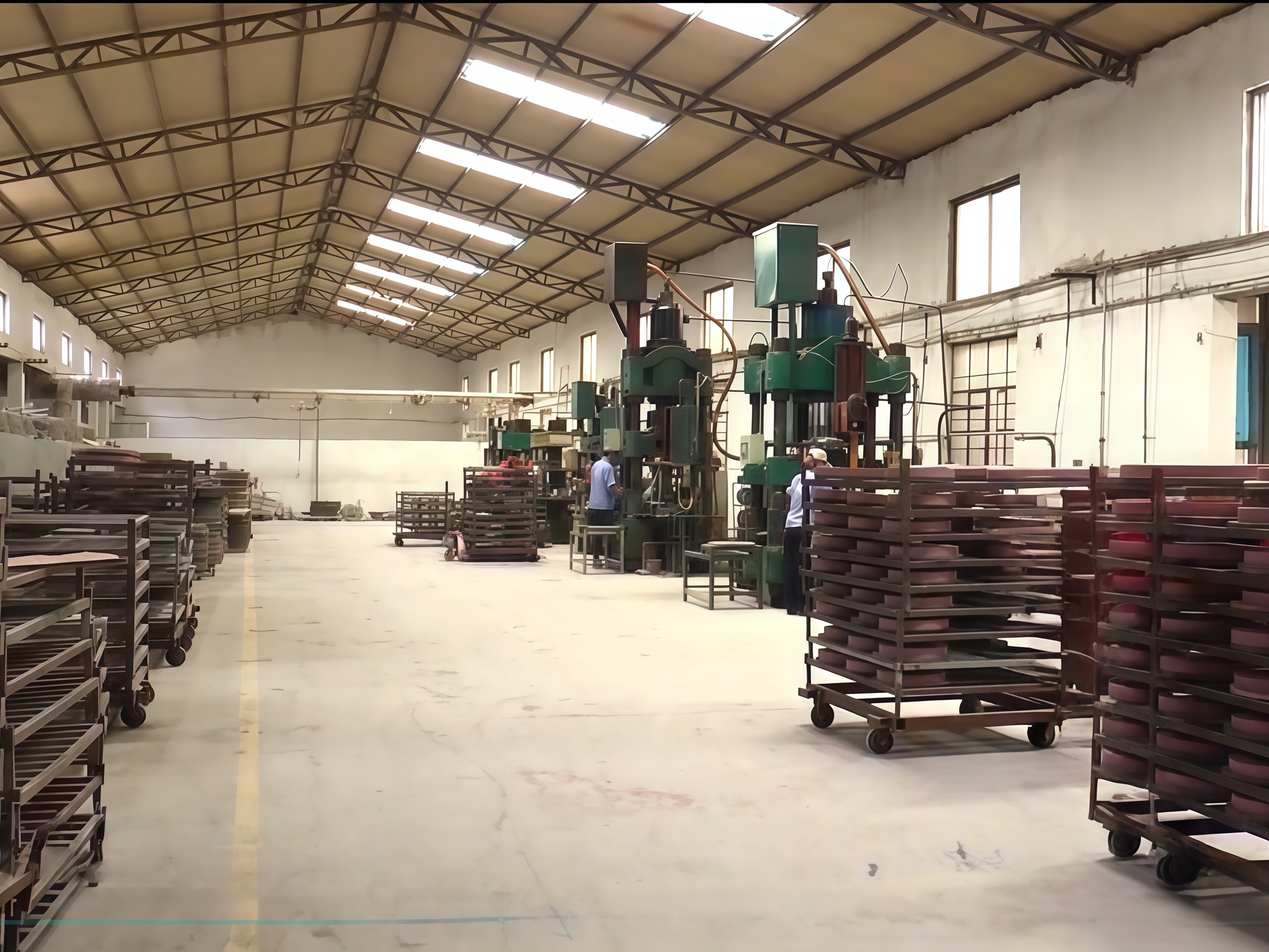
Forming workshop: grain and vitrified bond are combined and formed before the wheel enters the kiln.
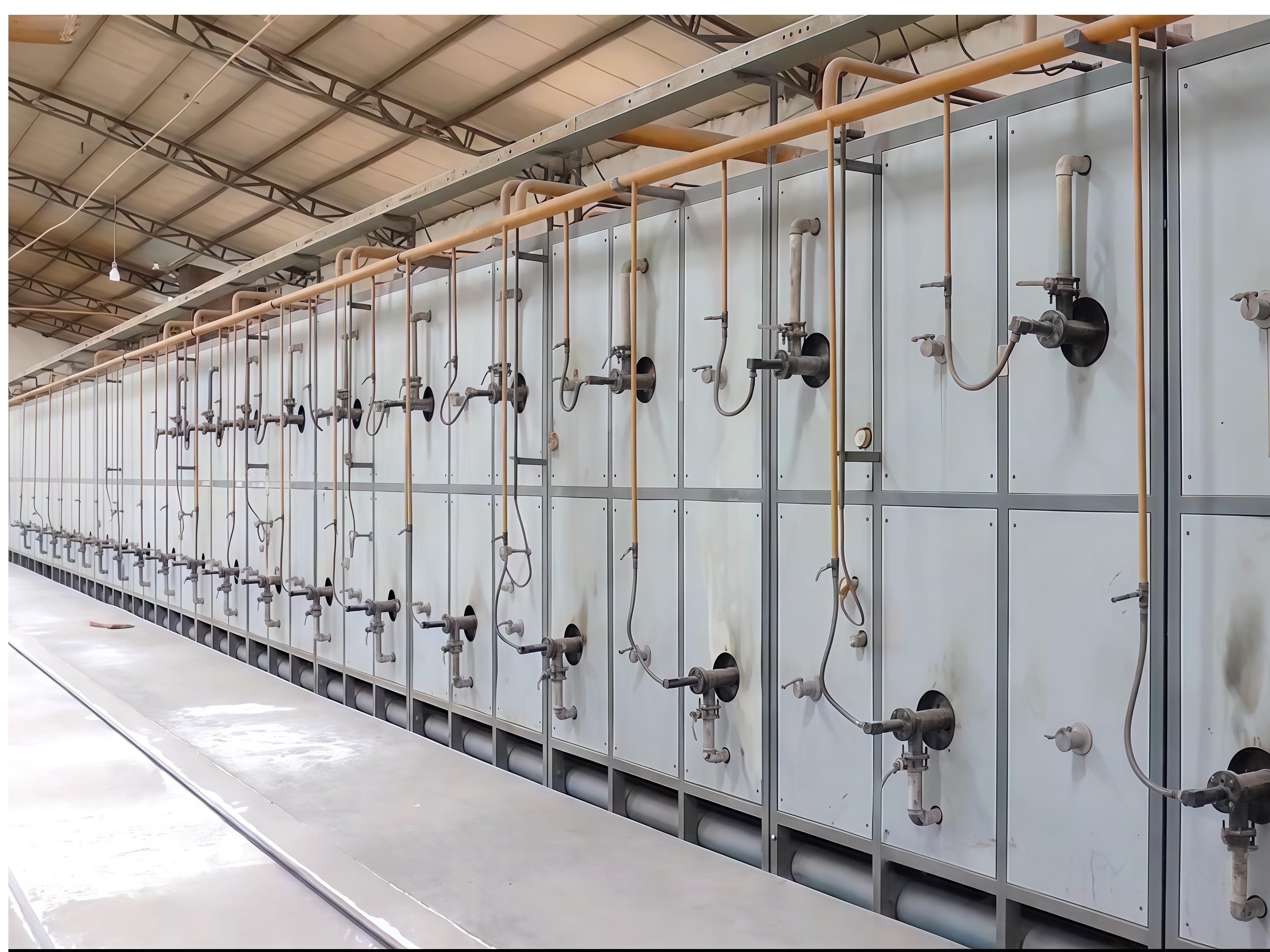
Kiln furnace: the firing stage in which the ceramic bond matures and fixes the abrasive grain.
Use cases: bearings, gears and rolls
The composition discussion becomes concrete when it is tied to a workpiece family. Three examples from Xinfa's own product documentation show how geometry, grain and bond are combined for different precision components.
Bearing grinding
Xinfa's bearing grinding wheel is listed at 500–600 mm outside diameter, 14–50 mm thickness and a 305 mm hole, with the full abrasive option set including A, WA, PA, SA, MA, GC, C and SG, grade G–Y and structure 0–14. The wide grade and structure range matters here because bearing raceways demand consistent surface finish, and the research evidence is clear that wheel condition feeds directly into workpiece surface quality.
Gear grinding
The gear grinding wheel range is 125–455 mm outside diameter, 10–90 mm thickness and 20–127 mm hole, again with the same grain, grade and structure options. Smaller diameters and thinner sections suit profile and form grinding where the wheel shape has to hold its geometry through the cycle — a requirement that points back to grade and structure selection rather than to the abrasive alone.
Roll grinding
Roll grinding wheels are the largest in the published range: 450–1066 mm outside diameter, 50–150 mm thickness and 203–508 mm hole. At this scale, the dimensional and speed fields dominate the specification, and maximum operating speed values of 32–60 m/s must be matched to the machine and the wheel's marked limit.
Adjacent families follow the same logic. Crankshaft and camshaft wheels run from 200 to 1100 mm outside diameter; centerless wheels from 300 to 750 mm with thickness up to 400 mm; internal (bore) wheels from 50 to 150 mm outside diameter with thickness up to 120 mm. A field record reported by Xinfa illustrates continuity in practice: a grinding wheel OEM customer in Pakistan has taken 20 tons over a two-year relationship, with stable operation and long wheel life reported as the outcome.
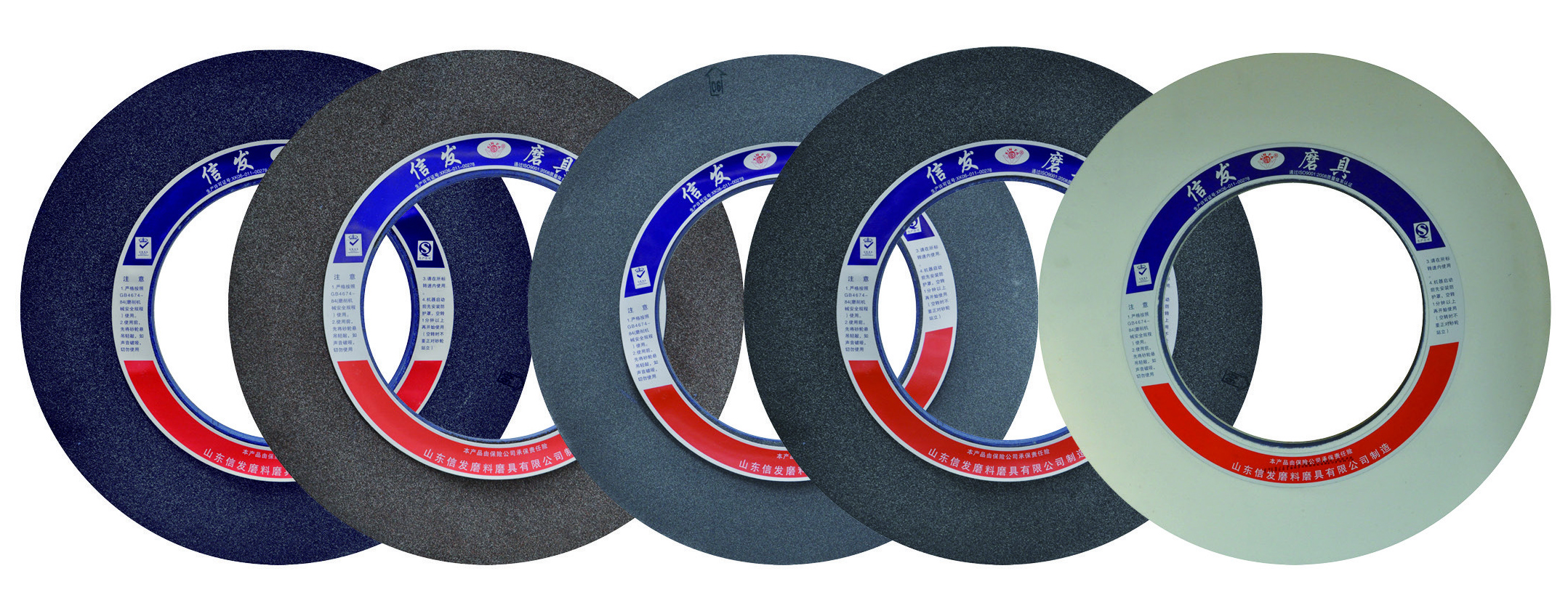
Bearing Grinding Wheel — one of the application-specific families in Xinfa's vitrified bonded range.
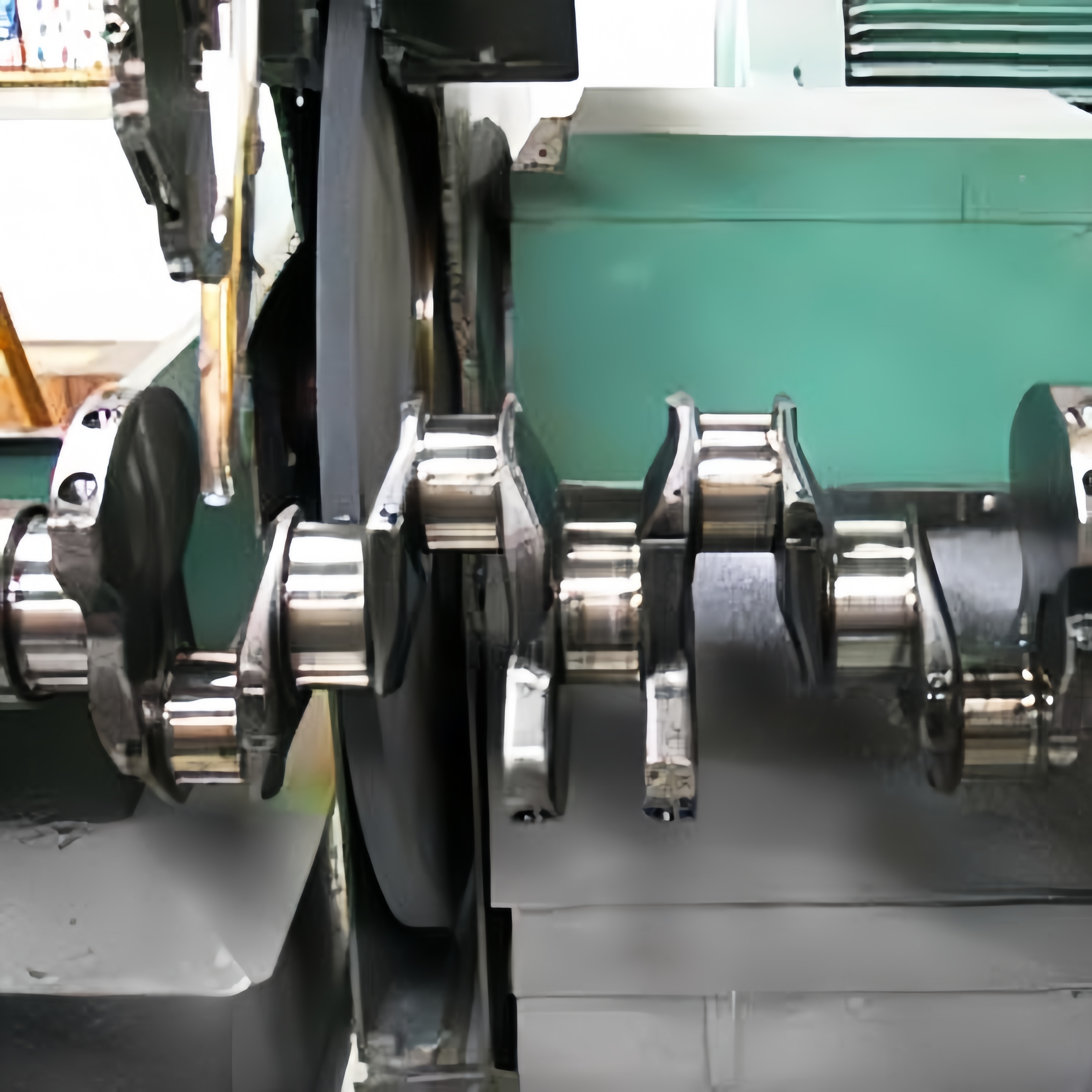
In-process: the wheel specification has to match the machine envelope, the workpiece and the required surface finish.
Compliance checkpoints before you place an order
Composition claims are only useful if the supplier documentation supports them. Four checkpoints cover most of what a research-stage buyer needs.
- Management system certification. Xinfa holds ISO 9001:2015 certification for the manufacture of abrasives and grinding wheels, certificate number 60624Q0262R1M, issued by Zonyun International Certification Co., Ltd. The applicable standard is GB/T19001-2016/ISO 9001:2015, the certification is valid globally and applies to ceramic bonded grinding wheels, with an issue date of 12 August 2021 and an expiry date of 11 August 2027.
- Dimensional standard. Confirm which shape type your drawing follows. ISO 603-14:2022 covers nominal dimensions for shape types 6, 11, 27, 28 and 29 used on hand-held grinding machines.
- Safety and conformity references. Published manufacturer documentation in this category commonly declares conformity to EN 12413 and ANSI B7.1, as seen in a 2025 3M Cubitron 3 technical data sheet for a named product. Ask your supplier which references apply to the specific wheel you are buying, since conformity is declared per product, not per category.
- Maximum operating speed. The speed field in the specification line is a limit, not a target. Xinfa lists options from 20 m/s up to 70 m/s depending on wheel family; the marked value must be at least equal to the machine's operating speed.
A practical RFQ checklist drawn from the same data set: abrasive code, grit number, grade letter, structure number, bond letter, outside diameter × thickness × hole, maximum operating speed, quantity, and the documentation you require with the shipment.
Frequently asked questions
Which certifications and standards apply to a ceramic grinding wheel?
Xinfa holds ISO 9001:2015 certification for the manufacture of abrasives and grinding wheels, certificate number 60624Q0262R1M, issued by Zonyun International Certification Co., Ltd. under the standard GB/T19001-2016/ISO 9001:2015, valid globally and covering ceramic bonded grinding wheels until 11 August 2027. On the dimensional side, ISO 603-14:2022 specifies nominal dimensions for shape types 6, 11, 27, 28 and 29 bonded abrasive products used on hand-held grinding machines. Safety conformity references such as EN 12413 and ANSI B7.1 are declared per product by the manufacturer, so they should be requested for the exact wheel specification you are ordering.
What abrasive grains and bond types can be specified in a ceramic grinding wheel?
Xinfa lists abrasive options A, WA, AA, 38A, PA, 25A, SA, MA, GC, C and SG, with RA, DA, 9A, 64A and 55A additionally available in the ceramic bonded grinding wheel range. Grit options in finished wheels are F16 to F150 depending on family, with F16–F120 in the ceramic bonded range. Grade letters run G, H, J, K, L, M, N, P, Q, R, S, T and Y, and structure numbers run 0–14. Bond type is one of the fields Xinfa customises under OEM/ODM, together with specification, size, logo and abrasive material.
How is a ceramic grinding wheel priced, and what is the minimum order?
There is no published price band for this category in the available documentation, so price has to be quoted against a defined specification. What is documented is the commercial frame around it: Xinfa's minimum order quantity is 2 tons, monthly capacity is 900 tons, and production is organised on an OEM/ODM basis with 100% test quality control. Because cost follows grain type, grit, grade, structure, dimensions and quantity, the fastest route to a comparable price is a completed specification line rather than a product name.
Can I evaluate a sample before committing to a production order?
Yes. Xinfa accepts OEM/ODM orders against a defined specification and applies 100% test as its quality control approach, so evaluation is a specification exercise: state the abrasive, grit, grade, structure, bond, dimensions and maximum operating speed, and request the corresponding wheels for trial on your own workpiece. Because wheel condition affects workpiece surface quality, the trial should measure surface finish and wheel life on the actual machine rather than relying on a catalogue description.
What is the lead time for a custom vitrified bond grinding wheel?
Xinfa's stated lead time is 30–45 days, against a monthly capacity of 900 tons and a minimum order quantity of 2 tons. Lead time is measured from a confirmed specification, so the practical next step is to send the specification line — for example a 350×100×127 A 60 N 5 V 35 m/s requirement — together with quantity and destination. You can send it to sales@xinfaabrasives.com or start a conversation on WhatsApp at +86 13562923298 to confirm feasibility and timing.
Conclusion: describe the wheel, not the category
A ceramic grinding wheel is made of abrasive grain, a vitrified bond and controlled porosity, described by grit, grade, structure, shape and maximum operating speed. The composition question is answered by the specification line, not by the catalogue heading. Brown fused alumina remains the most widely used grain in this family — it held 52.4% of the fused alumina market by product type in 2025 — while options such as SG, white alumina, single crystal and microcrystalline grains, and silicon carbides, exist to match different workpiece requirements.
For buyers in the research and evaluation stages, the useful discipline is to fix geometry first, then grain, then grade and structure, then documentation. That sequence produces quotations that can be compared, trials that can be measured, and orders that arrive as specified.
Specify your next vitrified wheel with Xinfa
Send your abrasive code, grit, grade, structure, bond, dimensions and maximum operating speed, and Xinfa will confirm the build against its vitrified bond range. Minimum order quantity is 2 tons, monthly capacity is 900 tons, and lead time is 30–45 days.
Email: sales@xinfaabrasives.com | Tel / WhatsApp: +86 13562923298 | Website: xinfa-abrasives.com
Download the full product catalogue: Xinfa Abrasives product brochure (PDF)
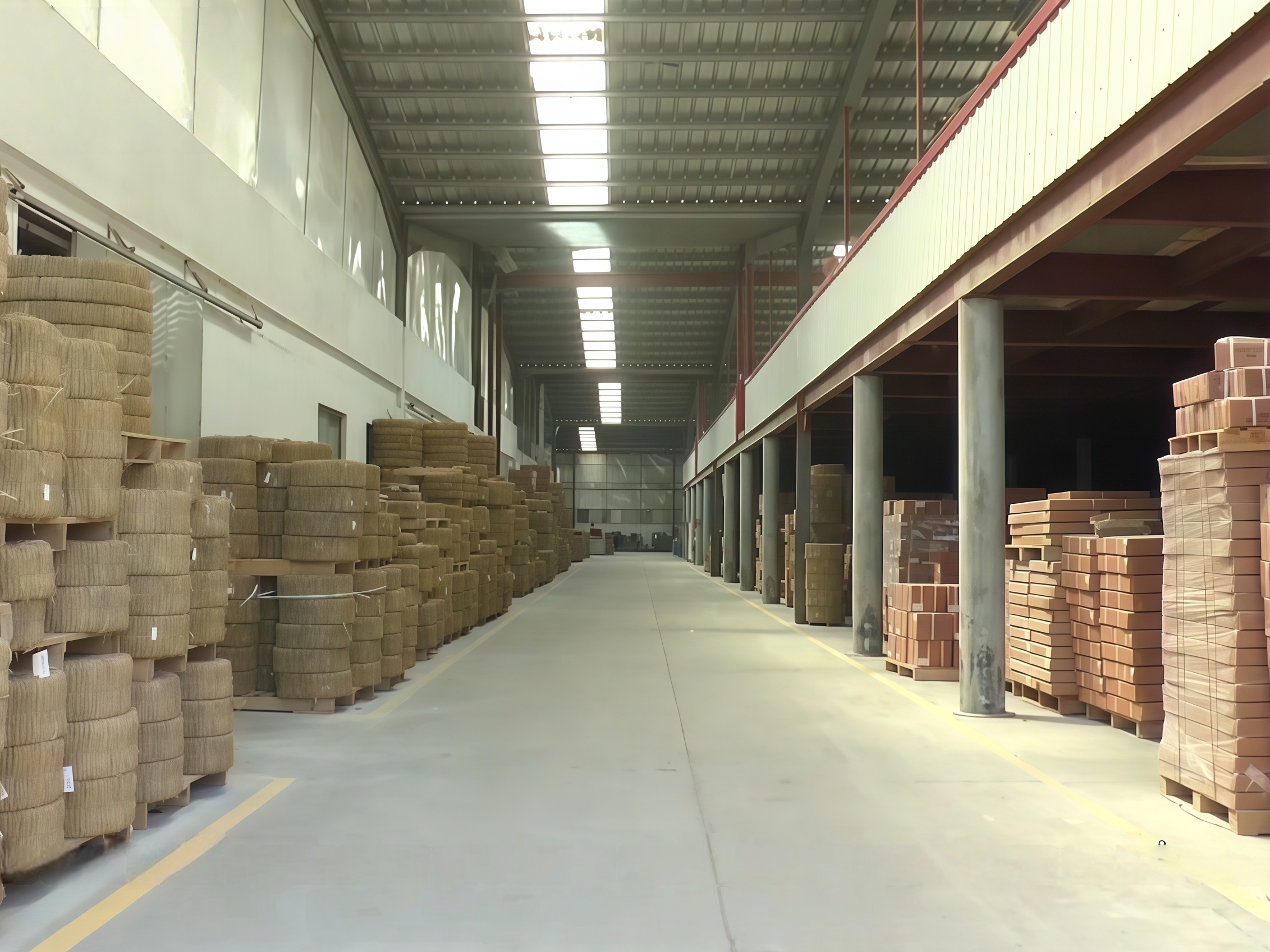
Finished goods warehouse — vitrified bonded wheels packed for export to more than 20 countries and regions.
Have Questions or Need More Details?
Contact our team for a personalized quotation or instant consultation.
Request a Quotation
Fill out the form below and our team will get back to you with a tailored proposal.
WhatsApp Direct Chat
Prefer to chat in real-time? Message us on WhatsApp for instant assistance & quick answers.
- Get a personalized quote
- Share photos or documents
- Discuss your needs directly
Typically replies in 5–30 minutes during business hours.