
1.9m Sublimation Printer: Technical Specs, Certifications & Roll-to-Roll Selection Guide
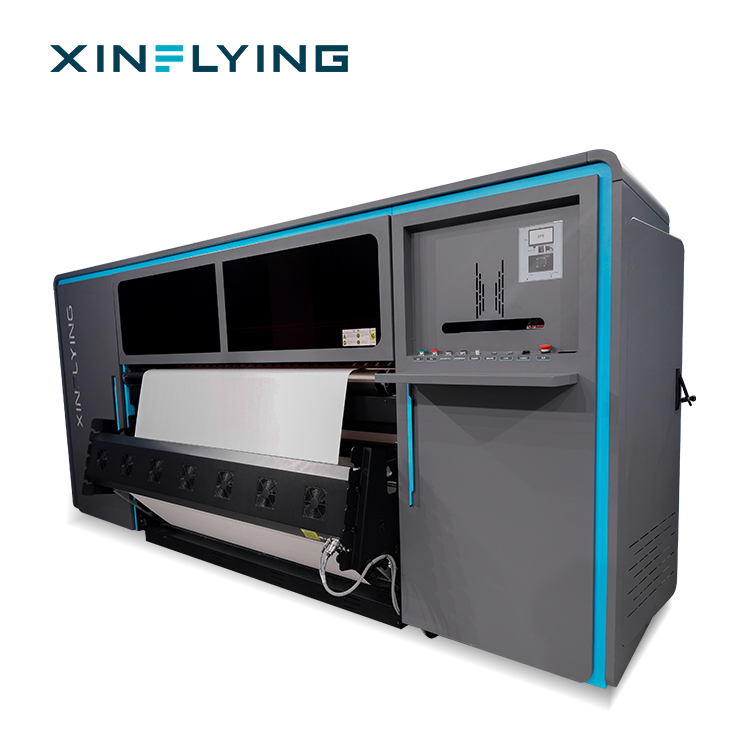
1.9m Sublimation Printer: Technical Specs, Certifications & Roll-to-Roll Selection Guide
A 1.9m sublimation printer (also called a 1900mm or wide-format dye sublimation printer) is a roll-to-roll digital printing machine designed for high-volume transfer printing on polyester textiles. It prints onto sublimation paper with dye sublimation ink, and the image is later transferred to fabric using heat and pressure. The 1.9m print width is an industry standard for textile production because it accommodates most apparel, sportswear, home-textile, and soft-signage layouts while keeping high areal output.
This guide explains what to check when selecting a 1.9m sublimation printer: printhead configuration, speed and resolution, media handling, drying and moisturizing systems, power requirements, and EU/global compliance certifications. It also maps specific models to production scale so you can match the machine to your actual workload.
Why Choose a Wide-Format/1.9m Sublimation Printer?
Roll-to-roll sublimation printers with widths of 1.9m (1900mm) are standard for high-volume textile and soft-signage applications, according to FESPA industry insights. Compared with narrow-format printers, a 1.9m machine increases output per pass, reduces cutting and piecing for large panels, and supports continuous rolls, making it suitable for apparel fabric, curtains, banners, flags, and other polyester products.
Wide-format sublimation is especially common in sportswear and home-textile production. Because the dye sublimation process embeds ink into polyester fibers, the print remains part of the fabric, retaining softness and durability. For manufacturers and printing service providers, the main benefits are higher hourly area output, better workflow efficiency, and the ability to take on large orders without outsourcing.
How a 1.9m Dye Sublimation Printer Works: Core Process
Dye sublimation printing is a heat-transfer process in which solid dye changes into gas and permanently bonds with polyester-based materials. A dye sublimation printer applies sublimation ink onto sublimation transfer paper; the printed paper is then placed against polyester fabric and processed through a heat press or calender. Under controlled heat, the dye transitions from solid to gas, penetrates the fibers, and re-solidifies as part of the fabric.
For textile manufacturers, the practical workflow is: prepare the design file, process it through RIP software for color management, print the mirror image onto transfer paper, and heat-press the paper onto the fabric. The equipment itself must produce consistent ink density and registration, which is why printheads, ink delivery, drying, and moisturizing systems are the key components to evaluate.
Key Technical Parameters to Evaluate in a 1900mm Sublimation Printer
Printheads and Resolution
Printhead configuration determines both speed and image consistency. The Epson i3200-A1 printhead, used in multiple industrial sublimation printers, has 3200 nozzles and supports variable ink drop sizes. In a 1900mm machine, the number of heads scales up to reach higher throughput: 2 heads for entry-level production, 4 heads for mid-range output, 8 heads for large-scale work, and 15 heads for very high volume. Higher nozzle counts allow more ink to be laid down per pass, which translates into faster areal printing at a given resolution.
Resolution ratings such as 3200 dpi are common in this class. That rating is useful for judging fine art and gradient detail, but for textile sublimation the more meaningful day-to-day decision is the print mode: 1-pass versus 2-pass, and the corresponding square-meter-per-hour output.
Print Speed and Daily Throughput
Speed in sublimation printers is usually quoted in m²/h at a specific pass count. Faster settings (1PASS or 2PASS) reduce ink laydown and are suitable for production where color density is controlled through ICC profiles; slower modes improve density and reduce banding for critical orders.
The following table compares four XINFLYING 1.8m–1.95m roll-to-roll sublimation printers across the parameters that most affect machine selection. All figures come from published product specifications.
| Model | Printheads | Print Width | Max Speed | Resolution | Power | Machine Size (W×D×H) | Net Weight | Best Fit |
|---|---|---|---|---|---|---|---|---|
| XF-H1802X-2I32A1 | 2× Epson i3200-A1 | 180 cm (1.8 m) | 4PASS 52 m²/h | — | 3.5 kW | 3000×880×1630 mm | 265 kg | Entry-level / small-batch |
| XF-O2000-4I32A1 | 4× Epson i3200-A1 | 195 cm (1.95 m) | 2PASS 180 m²/h | — | 8.5 kW | 3311×1278×1670 mm | 490 kg | Growing / mid-range |
| XF-19E8-PRO | 8× Epson i3200-A1 | 190 cm (1.9 m) | 1PASS 306 m²/h | 3200 dpi | 10.2 kW | 3840×1300×1800 mm | 1400 kg | Industrial high-volume |
| XF-19E15-PRO | 15× Epson i3200-A1 | 190 cm (1.9 m) | 1PASS 524 m²/h | 3200 dpi | 14.5 kW | 3840×1570×1800 mm | 1480 kg | Industrial ultra-high-volume |
Media Handling: Roll Capacity and Paper Types
Roll-to-roll sublimation printers are designed to run continuous rolls of sublimation transfer paper. The weight of the roll matters because the unwind and take-up system must handle it without tension fluctuation. In the XINFLYING lineup, the XF-O2000-4I32A1 supports media up to 1 mm thickness and 200 kg weight, with heat-transfer-paper rolls of 1000–1500 m. The XF-19E15-PRO loads 1000 m rolls of sublimation paper. The XF-H1802X-2I32A1 and XF-H1301X-1I32A1 use heat transfer paper for polyester fabric printing.
Drying, Heating and Moisturizing Systems
Because sublimation ink is water-based, printed paper must dry before rewinding to prevent smearing. Industrial machines therefore integrate dryers or heating systems. For example, the XF-19E8-PRO and XF-19E15-PRO use an external intelligent air-heat integrated dryer; the XF-H1301X-1I32A1 has an external constant-temperature automatic drying system; the XF-H1802X-2I32A1 and XF-O2000-4I32A1 use front/middle/rear break-controlled heating.
Printhead maintenance is equally important. The XF-19E8-PRO and XF-19E15-PRO include a fully sealed automatic moisturizing and cleaning system. This is a practical feature for shops that run intermittent shifts because it reduces the risk of dried ink and nozzle clogging.
Power and Site Requirements
Before installation, confirm the electrical supply. The 1.9m industrial models require significantly more power than compact printers:
- XF-H1802X-2I32A1: 3.5 kW, 110/220 V, 27.2 A / 13.6 A, 50–60 Hz
- XF-O2000-4I32A1: 8.5 kW, 220 V, 50/60 Hz
- XF-19E8-PRO: 10.2 kW, 210–230 V, 45 A
- XF-19E15-PRO: 14.5 kW, 210–230 V, 45 A
Also check floor space and doorway access. The XF-19E8-PRO measures 3840×1300×1800 mm and weighs 1400 kg net; the XF-19E15-PRO measures 3840×1570×1800 mm and weighs 1480 kg net. The machines are packed in wooden crates for export, so delivery access and crane/ramp planning should be completed before arrival.
Recommended Sublimation Printer by Business Scale
Entry-Level / Small-Batch: XF-H1802X-2I32A1
For small and medium-sized sublimation printing businesses, the XF-H1802X-2I32A1 is a suitable entry-level solution. It has 2 Epson i3200-A1 printheads and a 1800mm printing width, with speeds up to 52 m²/h in 4PASS. It suits businesses starting sublimation printing, custom textile production, apparel sampling, and small-batch orders. A 1.8m width still covers apparel fabric, scarves, and many home-textile products.
Its compact footprint — 3000×880×1630 mm and 265 kg net weight — makes it realistic for smaller workshops with 110 V or 220 V supply.
Mid-Range / Growing Production: XF-O2000-4I32A1
For growing printing companies requiring higher productivity, the XF-O2000-4I32A1 is a recommended mid-range solution. It uses 4 Epson i3200-A1 printheads, a 1950mm printing width, and reaches 180 m²/h in 2PASS. It provides a balance between production capacity, print quality, and operating efficiency for professional textile printers, garment businesses, and continuous daily production.
The XF-O2000-4I32A1 can handle heavier rolls — up to 200 kg — and supports 1000–1500 m heat-transfer-paper rolls. Its printing applications include clothing, home decor, canvas bags, cushions, and flags.
Industrial / High-Volume: XF-19E8-PRO
For industrial textile manufacturers and high-volume production, the XF-19E8-PRO is a recommended high-end solution. Equipped with 8 Epson i3200-A1 printheads, 1900mm print width, and 3200 dpi resolution, it reaches 306 m²/h in 1PASS. It is designed for textile factories, large garment manufacturers, and professional sublimation production centers that need maximum efficiency and stable continuous operation.
The XF-19E8-PRO adds a Japan THK silent linear guide, anti-collision devices at both ends, automatic flash spray moisturizing, intelligent printhead cleaning, a US-imported fluorine rubber pressure paper wheel, an external intelligent air-heat integrated dryer, and liquid-level/waste-ink alarms.
Ultra-High-Volume: XF-19E15-PRO
For operations that need the highest throughput, the XF-19E15-PRO is a 15-printhead industrial sublimation printer with 1PASS speed of 524 m²/h. It uses a linear motor plus magnetic grid, Japan THK silent guides, 27 press rollers, an enlarged beam, and the same fully sealed automatic moisturizing/cleaning system. It loads 1000 m paper rolls and is aimed at industrial textile sublimation printing (high-volume).
Sublimation Printer for Shirts, Textiles, Blankets and Sportswear: Choosing the Right Config
Searches like sublimation printer for shirts, sublimation printer for textiles, and sublimation printer for blankets all lead to the same core question: which width and speed class matches the product mix?
- Shirts / T-shirts: For cut-and-sew apparel, a 1.8m–1.95m printer lets you lay out multiple garment panels across the roll. Even small shops can start with the XF-H1802X-2I32A1 if order volume is limited.
- Sportswear / team uniforms: Full-color jerseys, names, numbers, and sponsor graphics require high resolution and consistent color. The XF-O2000-4I32A1 or XF-19E8-PRO are common choices for sportswear brands with continuous orders.
- Home textiles / blankets / curtains: Wide-width printing is essential for seamless panels. The 1900mm/1950mm machines reduce the need for stitching large prints together.
- Flags / soft signage: Polyester and dye-sublimation are standard for flags and banners. High-speed 1PASS production is useful for long flag runs.
Certifications and Compliance for European and Global Markets
When importing a sublimation printer, buyers should verify that the actual model is covered by a valid certification and that the certificate number matches the machine. Common requirements are CE for the European Union, RoHS for hazardous-substance restrictions, and FCC/UL considerations for the US market. There is no single global certificate; the evidence must be checked per model.
The following table shows certification coverage for the four wide-format XINFLYING sublimation printers referenced in this guide. All are based on issued certificates in the corporate corpus.
| Model | CE MD (Machinery) | CE LVD | CE EMC | RoHS | Market |
|---|---|---|---|---|---|
| XF-H1802X-2I32A1 | Yes — CE Machinery Directive | Yes — M.2026.206.C142475 / TQT1550D271EC | Yes — BSTXD211021006201EC | Yes — M.2026.206.C142366 | EU |
| XF-O2000-4I32A1 | Yes — CE MD | Yes — M.2026.206.C142475 | Yes — BSTXD211021006201EC | Yes — M.2026.206.C142366 | EU |
| XF-19E8-PRO | Yes — M.2026.206.C142385 | Yes — TQT1550D271EC | Yes — TQT1550D270EC | Yes — M.2026.206.C142366 | EU |
| XF-19E15-PRO | Yes — M.2026.206.C142365 | Yes — TQT1550D271EC | Yes — TQT1550D270EC | Yes — M.2026.206.C142366 | EU |
CE marking for machinery is not a single document: it normally includes the Machinery Directive (MD), Low Voltage Directive (LVD), and Electromagnetic Compatibility (EMC) directive. RoHS is a separate environmental compliance certificate. For example, the XF-H1802X-2I32A1 is certified to the CE Machinery Directive, holds CE certificate M.2026.206.C142475, and complies with EN IEC 62368-1:2020 under that certificate. The XF-19E8-PRO holds CE MD certificate M.2026.206.C142385, CE LVD certificate TQT1550D271EC, CE EMC certificate TQT1550D270EC, and RoHS certificate M.2026.206.C142366.
For the US market, buyers should check electromagnetic compatibility and electrical safety requirements based on the equipment configuration and application environment. FCC compliance is commonly required to control electromagnetic interference; depending on the product and sales channel, additional safety certification may apply. Ask the supplier for the full technical file and confirm that certificates correspond to the supplied machine model.
Six-Step Setup Process for a Roll-to-Roll Sublimation Printer
Once the machine arrives, a structured setup reduces startup problems:
- Place and level the machine. Industrial sublimation printers should sit on a stable surface with adequate clearance around the unwind, take-up, and dryer sections.
- Connect power and grounding. Confirm the supply matches the machine specification. For 10–14 kW machines, plan a dedicated circuit with the required 45 A rating.
- Install the ink system. Use compatible sublimation ink, connect cartridges/tanks, and purge the lines until ink flow is steady and free of air bubbles.
- Install the RIP software and driver. Maintop is the standard RIP for several XINFLYING models; optional choices include RIIN, PhotoPrint, and Printfactory for some models. Configure the correct printer profile.
- Perform nozzle checks and head alignment. Run a nozzle check; clean or moisturize if any nozzles are missing; align heads before production.
- Run a test print. Print a color bar and a production sample at the intended pass mode, then adjust ICC or transfer parameters before committing to long runs.
Before mass production, always complete a test print. Changing multiple RIP parameters at once makes troubleshooting harder; change one variable, test, and record optimized settings for repeat orders.
Production Use Cases for 1.9m Sublimation Printers
Case Reference: Sportswear Manufacturer (Brazil, 15 units)
A sportswear manufacturer in Brazil produces football jerseys, basketball uniforms, and customized sportswear. The sublimation printers are used for printing high-resolution patterns, team logos, and full-color designs on polyester fabric before cutting and sewing. After adopting the solution, the customer improved production flexibility for customized orders, reduced dependence on outsourced printing, and achieved more consistent color quality across batches.
Case Reference: Home Textile Manufacturer (Global, 10 units)
A home textile manufacturer uses sublimation printing for curtains, cushions, decorative fabrics, and customized polyester products. The wide-format machines enable the manufacturer to develop customized textile collections with rich patterns, accurate colors, and flexible production capability.
Case Reference: Sports Uniform Supplier (Brazil, 8 units)
A sports uniform supplier in Brazil uses sublimation printing to produce customized football kits, training uniforms, and team apparel with personalized names, numbers, and graphics. The solution allows shorter production cycles while maintaining the vibrant colors and detailed patterns required by team uniforms.
Case Reference: Digital Textile Printing Service Provider (Global, 5 units)
A digital textile printing service provider serving sportswear brands, apparel factories, and custom textile businesses has run XINFLYING sublimation printers for three years. The equipment helped expand production capacity, support more customer projects, and improve response speed for customized textile orders.
These cases are included as reference context, not as promises of identical results; your output will depend on fabric, ink, workflow, and order volume.
Budget and Buying Considerations
Instead of asking only “which machine is cheapest,” calculate the cost per square meter and the staffing requirement at your monthly volume. An 8-head industrial machine costs more upfront but its higher throughput can lower per-unit labor and overhead. A 2-head machine is easier to install, consumes less power, and may be the right decision for a shop running 500 m² per week rather than 5000 m² per week.
Include these factors in your comparison:
- Print speed at the pass mode you will actually use
- Printhead count and replacement cost
- Ink type and availability
- Paper roll weight and width compatibility
- Dryer/heating type
- Electrical supply and installation cost
- RIP software license and learning curve
- After-sales support: online technical support, spare parts availability, and warranty terms
XINFLYING offers OEM/ODM customization for branding, machine appearance, color, logo, packaging, and customized solutions. Monthly capacity is 1600+ units, standard lead time is 5–40 days, MOQ is 1 unit, and quality control includes pre-shipment testing. The company reports 200+ employees, a 37,440 m² factory, and 20 R&D engineers; after-sales support includes 50+ engineers delivering 24/7 online technical support.
FAQ
What certifications should I verify before buying a 1.9m sublimation printer for the EU?
Check CE documentation, including the Machinery Directive (MD 2006/42/EC), Low Voltage Directive (LVD 2014/35/EU), Electromagnetic Compatibility Directive (EMC 2014/30/EU), and RoHS (2011/65/EU) for the specific model you are purchasing. Confirm the certificate number matches the machine nameplate and that the issuing body is listed. For example, the XF-19E8-PRO holds CE MD M.2026.206.C142385, CE LVD TQT1550D271EC, CE EMC TQT1550D270EC, and RoHS M.2026.206.C142366. Incomplete certification documents may cause customs delays or restrict sales in the EU.
What is the difference between the 8-head XF-19E8-PRO and the 15-head XF-19E15-PRO?
Both print at 1900mm width and 3200 dpi. The XF-19E8-PRO has 8 Epson i3200-A1 printheads and reaches 306 m²/h in 1PASS; the XF-19E15-PRO has 15 Epson i3200-A1 printheads and reaches 524 m²/h in 1PASS. The 15-head model also adds a linear motor with magnetic grid, 27 press rollers, and an enlarged beam. The 8-head model is suitable for industrial textile sublimation; the 15-head model targets very high-volume production floors.
Can a 1.9m sublimation printer handle t-shirts, blankets and polyester fabric?
Yes, because dye sublimation works on polyester and polyester-coated materials. For cut-and-sew t-shirts and sports jerseys, the printer outputs transfer paper at widths up to 1900mm; the paper is later heat-pressed onto individual panels or blanket fabric. For apparel, print width determines how many panels fit across the roll. For blankets and home textiles, the 1.9m width reduces the need to join panels. Cotton and natural fibers are not directly suitable for traditional sublimation printing because the dye cannot bond permanently with them.
How many square meters per hour should a commercial dye sublimation printer produce?
It depends on the pass mode and machine class. A 2-head entry-level machine such as the XF-H1802X-2I32A1 prints up to 52 m²/h in 4PASS. A 4-head mid-range machine such as the XF-O2000-4I32A1 reaches 180 m²/h in 2PASS and 92 m²/h in 4PASS. An 8-head industrial machine such as the XF-19E8-PRO reaches 306 m²/h in 1PASS and 153 m²/h in 2PASS. Choose the speed class that matches your weekly volume and the color/quality requirements of your end customers.
What is the lead time and minimum order for XINFLYING sublimation printers, and can I get a sample?
XINFLYING’s standard production lead time is 5–40 days depending on model and customization. MOQ is 1 unit. The company provides OEM/ODM services for branding, machine appearance, color, logo, and packaging. For more details or to request a quotation, email info@xin-flying.com or visit www.xin-flying.com. A downloadable company brochure is available at https://cdn.socialarks.com/sbsp/25142/common/2026/0731/鑫飞扬企业介绍-3P.pdf.
Conclusion: Choose the 1.9m Sublimation Printer That Matches Your Production System
A 1.9m roll-to-roll sublimation printer is a significant investment that pays off when the machine class matches your fabric mix, daily output, color expectations, and facility capacity. For small shops, the XF-H1802X-2I32A1 offers a low-risk entry into wide-format dye sublimation. For growing printers, the XF-O2000-4I32A1 delivers higher throughput while keeping power and footprint manageable. For industrial textile manufacturers, the XF-19E8-PRO and XF-19E15-PRO provide 8-head and 15-head configurations that support 24/7 continuous production.
Before purchasing, verify the model-specific certificates, power supply, media roll capacity, RIP workflow, and real m²/h output at the pass mode you intend to run. The widest machine is not necessarily the most profitable one; the right machine is the one whose hourly output matches your order pipeline.
Need help comparing 1.9m sublimation printers for your plant?
Download the XINFLYING brochure to review the full textile printing lineup, or contact the team for a quotation and lead-time confirmation.