1900mm vs 1800mm Sublimation Printers: The Print Width Decision
1900mm vs 1800mm Sublimation Printers: The Print Width Decision
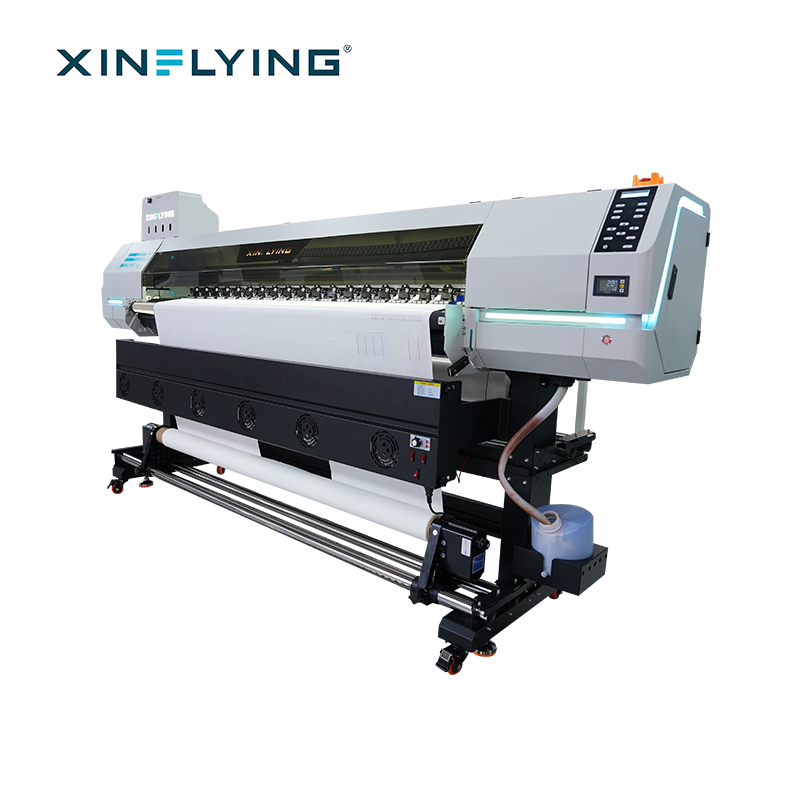
Two roll-to-roll sublimation printers that differ by only 100 mm of maximum print width can still deliver different monthly output, different utility requirements and different installation cost. That is what separates the XF-19E8-PRO, a 190 cm (75") sublimation printer, from the XF-H1802X-2I32A1, an 180 cm (1.8 m) model, inside Xinflying's digital textile printer range.
The short answer for buyers at the evaluation stage: the 1900 mm platform is built for continuous industrial textile production where 1.9 m roll-to-roll widths are the working convention, while the 1800 mm platform is positioned for businesses that need stable polyester fabric output, apparel sampling and small-batch orders without a 10.2 kW power and heavy-rigging commitment. The rest of this article explains how to confirm that answer against your own media, artwork and floor.
Problem Definition: What the 100 mm Width Gap Actually Controls
Print width is the maximum width of a single printed pass, measured from the outer edge of the printable area on one side to the outer edge on the other. It is not the same variable as print speed, resolution, or printhead count, and confusing the four is the most common source of mis-buying in wide-format sublimation equipment.
Three things follow directly from print width:
- Usable width is capped by media, not by the machine. A printer can only print as wide as the transfer paper or sublimation paper that is loaded into it. If the roll is narrower than the machine's maximum print width, the surplus width cannot be monetised on that job.
- Width governs nesting, not chemical performance. How many garment panels, banner drops or cushion faces can be arranged side by side in one pass is a width question. Colour bonding, hand feel and wash durability are ink, paper and heat-transfer questions.
- Width is a fixed commitment. Unlike a RIP profile or a pass setting, print width cannot be upgraded later by configuration. It is decided at the point of purchase and stays with the machine for its service life.
The 1900 mm class sits on a recognised production convention. Industry body FESPA describes roll-to-roll sublimation printers with widths of 1.9 m (1900 mm) as standard for high-volume textile and soft-signage applications. The 1800 mm class sits below that convention, which is exactly why the two machines in this comparison serve different production models rather than simply representing a "smaller" and a "larger" version of the same product.
Industry Background: Why Print Width Became a First-Order Buying Question
The width decision matters more today than it did a decade ago because the dye sublimation equipment category itself keeps expanding. Grand View Research values the global dye sublimation printing market at USD 16.4 billion in 2025, with a projected value of USD 39.0 billion by 2033. The same source projects a CAGR of 11.5% from 2026 to 2033.
Narrowing to equipment only, Mordor Intelligence sizes the dye sublimation printers segment at USD 1.88 billion in 2025, expected to reach USD 2.53 billion by 2030. Inkjet technology dominates that equipment pool: Grand View Research reports that inkjet production printers accounted for 87.3% of the production printer market share by type in 2024.
The demand is geographically concentrated. Asia Pacific held a 36.5% revenue share of the dye sublimation printing market in 2025, led by China as the largest country market, according to Grand View Research. That concentration matters to equipment buyers because it shapes supply of media, inks and consumables that must match the machine's width.
The demand driver behind all of this is personalisation. Grand View Research links demand for personalised apparel and home decor to a 13.1% CAGR in the digital textile sublimation market through 2030. Personalised production is short-run and design-heavy, which pushes printers toward either high flexibility at moderate width or high width utilisation at industrial speed — the two sides of this comparison.
Detailed Solution: The Two Platforms Behind the Decision
Both machines are dye sublimation printers in the same production family from Guangzhou Xin Flying Digital Technology Co., Ltd., a digital printing equipment manufacturer founded in 2010 that operates a 37,440 m² facility and exports to North America, South America, Europe, Asia, the Middle East and Africa. They are, however, engineered for different rungs of the production ladder.
XF-19E8-PRO — the 1900 mm industrial platform
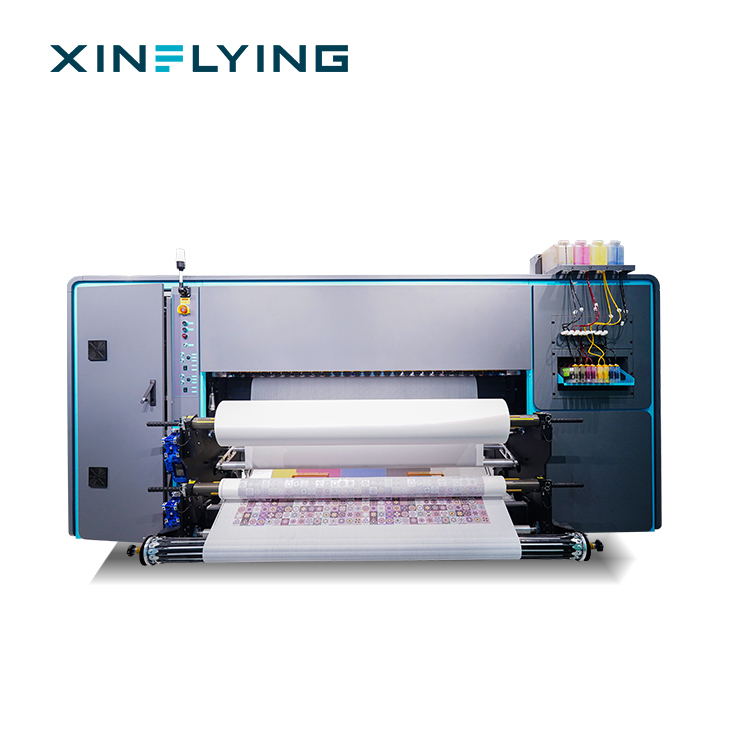
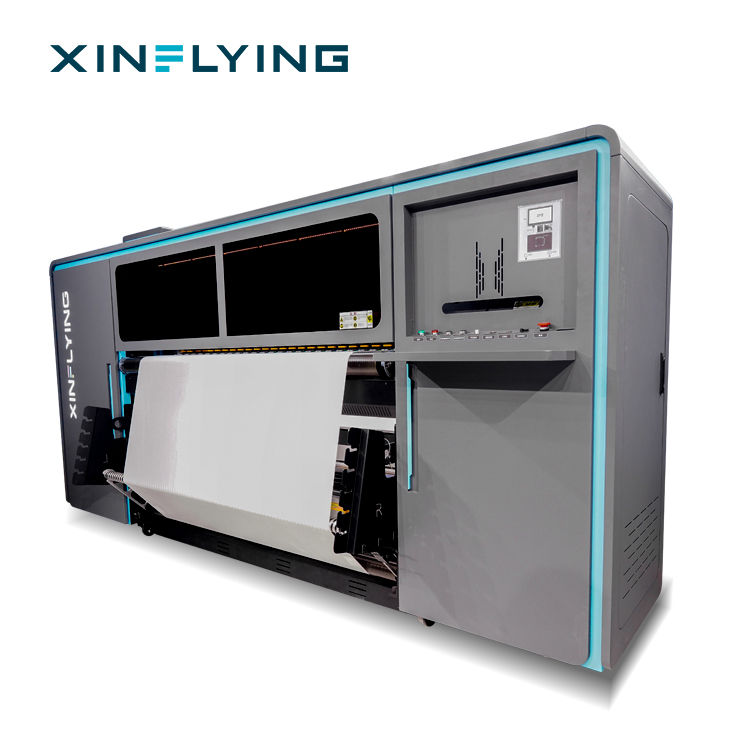
The XF-19E8-PRO is a 190 cm (75") roll-to-roll sublimation printer driven by 8 × Epson i3200-A1 printheads in CMYK. Its published speeds are 1PASS 306 m²/h and 2PASS 153 m²/h at fastest setting, and 1PASS 210 m²/h and 2PASS 109 m²/h at standard setting, at a stated resolution of 3200 dpi. It runs on 210–230V, 45A with 10.2 kW power draw, uses sublimation paper, and lists an external intelligent air-heat integrated dryer plus fully sealed automatic moisturizing and cleaning. Maintop is the standard RIP, with RIIN (Hoson only), PhotoPrint and Printfactory available as options. The machine measures 3840×1300×1800 mm and weighs 1400 kg net / 1500 kg gross. Its stated applicable industry is industrial textile sublimation printing.
XF-H1802X-2I32A1 — the 1800 mm production platform
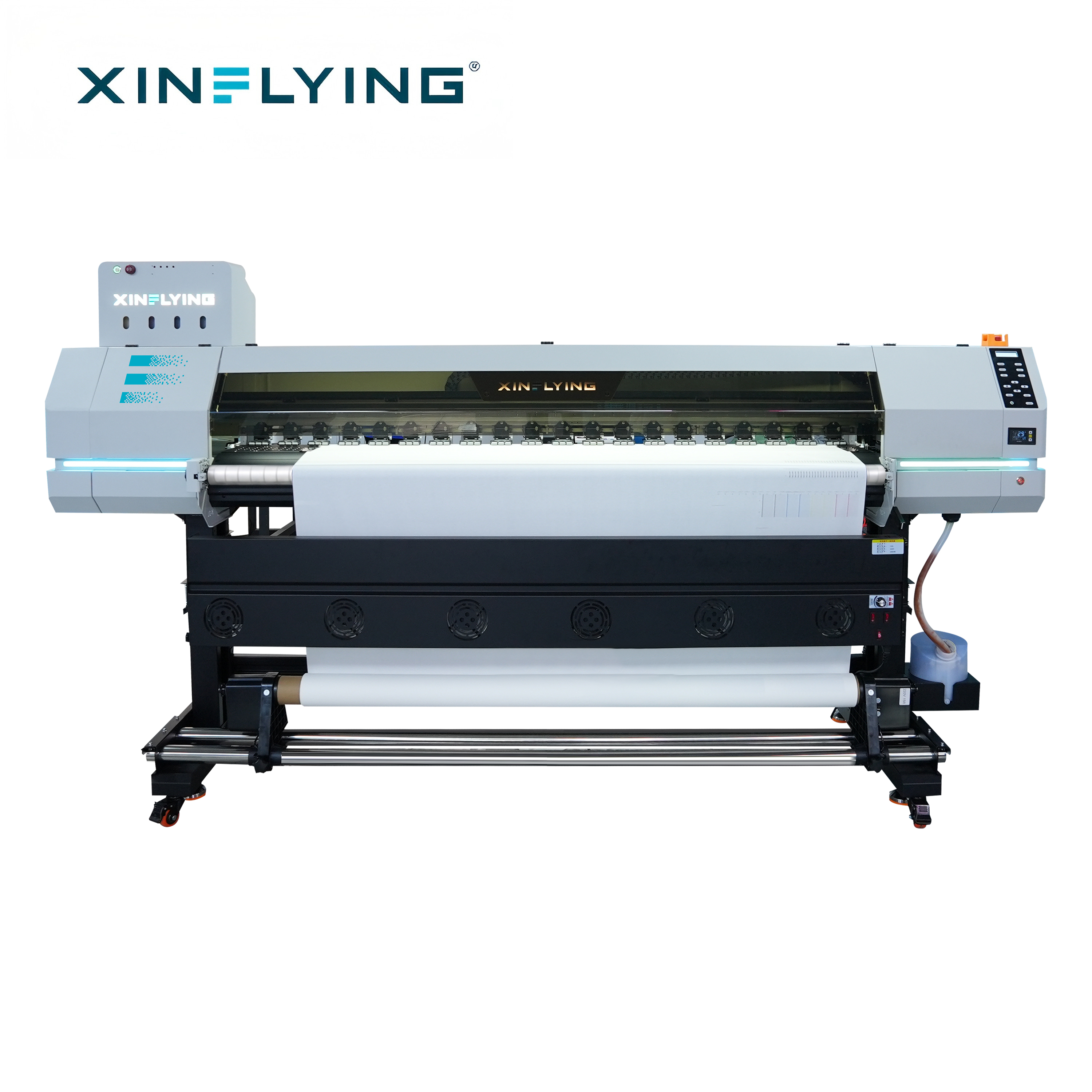
The XF-H1802X-2I32A1 is a 180 cm (1.8 m) sublimation printer with 2 × Epson i3200-A1 printheads and CMYK+CMYK ink channels. Its published speeds are 4PASS 52 m²/h at fastest setting and 4PASS 42 m²/h at standard setting. It runs on 110/220V, 27.2A/13.6A, 50–60Hz with 3.5 kW power draw, uses heat-transfer paper, and specifies front/middle/rear break-controlled heating. Maintop is the standard RIP. The machine measures 3000×880×1630 mm and weighs 265 kg net / 325 kg gross. Its stated applicable industry is textile sublimation printing on polyester fabrics.
The relevant asymmetry is visible immediately: in this pair, the wider machine is also the far faster machine, but the two properties come from different components. Width comes from the chassis and the media path. Speed comes from having eight printheads running 1PASS instead of two printheads running 4PASS.
Certification Profile: Where 1900 mm and 1800 mm Are Equal
Buyers often assume that a larger industrial machine carries a heavier or different compliance file. In this specific pair, that assumption is wrong, and understanding why saves evaluation time.
Both the XF-19E8-PRO and the XF-H1802X-2I32A1 appear in the scope of the same certificate set held for Xinflying digital textile printers:
- CE EMC certificate TQT1550D270EC, issued by TQT on 19 May 2026, covering EMC Directive 2014/30/EU against EN 55032:2015/A11:2020, EN 55035:2017/A11:2020, EN IEC 61000-3-2:2019+A1:2021 and EN 61000-3-3:2013/A2:2021.
- CE LVD certificate TQT1550D271EC, issued by TQT on 19 May 2026, covering LVD 2014/35/EU against EN IEC 62368-1:2020/A11:2020.
- CE MD certificate of conformity M.2026.206.C142365 and M.2026.206.C142385, issued by UDEM on 10 June 2026 under MD 2006/42/EC against EN ISO 12100:2010, EN 60204-1:2018/A1:2025 and EN ISO 12643-1:2023.
- RoHS certificate M.2026.206.C142366, issued by UDEM on 10 June 2026, valid to 9 June 2031, covering Directive 2011/65/EU against EN IEC 63000:2018 and the EN IEC 62321 series.
One certificate in the file does not cover the machine itself. The OEKO-TEX® ECO PASSPORT certificate SH150194016, issued by TESTEX AG and valid to 31 December 2026, covers textile printing inks and printing pastes. It is a consumables credential relevant to the printed output, not a statement about the printer chassis.
Where standards do touch the workflow rather than the machine, they tend to concern colour. ISO 12647-8:2021, the standard for validating print processes working directly from digital data, is the reference point many buyers cite when they need reproducible colour between batches. Judging how well a printer serves that aim is a RIP and colour-management exercise, not a print width exercise.
Workflow Implications: Power, Drying, Footprint and Media
Print width is the headline difference, but the utility consequences of choosing one width over the other are what determine whether the machine actually fits your building.
Electrical supply
The XF-19E8-PRO draws 10.2 kW at 210–230V and 45A. That is an industrial supply requirement and usually implies a dedicated circuit, appropriate cabling and a site electrician's sign-off before delivery. The XF-H1802X-2I32A1 draws 3.5 kW at 110/220V, 27.2A/13.6A, 50–60Hz, which is within reach of many smaller production units that are not wired for heavy industrial loads.
Drying and ink handling
The 1900 mm machine lists an external intelligent air-heat integrated dryer as well as fully sealed automatic moisturizing and cleaning. The 1800 mm machine specifies front/middle/rear break-controlled heating. Both approaches aim at the same outcome — keeping the printed transfer stable before heat transfer — but they impose different space and maintenance routines, and the integrated dryer on the industrial model has to be planned into the line layout.
Footprint and installation
The XF-19E8-PRO occupies 3840×1300×1800 mm at 1400 kg net and 1500 kg gross. The XF-H1802X-2I32A1 occupies 3000×880×1630 mm at 265 kg net and 325 kg gross. That is roughly 840 mm of additional machine length, about 420 mm of additional depth and more than five times the weight to move, level and support. Floor loading, doorway clearance, forklift access and packing disposal all scale with those numbers, and they are frequently the reason a buyer who wanted 1900 mm ends up with 1800 mm.
Environment and media
Operating envelopes differ slightly: the XF-19E8-PRO states 18–30°C and 35–65% RH, the XF-H1802X-2I32A1 states 20–35°C and 45–65% RH. The industrial model specifies sublimation paper as its media and the 1800 mm model specifies heat-transfer paper. In practice both consume transfer media, but you should confirm the exact roll width and grammage you intend to run with your supplier before ordering, because media availability at the width you need is what converts machine capability into usable output.
Step-by-Step: How to Choose Between 1900 mm and 1800 mm
The following sequence works for any width comparison and is written here against the two Xinflying models.
Step 1 — Start from the media you can actually buy and store. List the transfer paper or sublimation paper roll widths your current suppliers deliver, then eliminate any printer whose maximum print width exceeds the widest roll you can source reliably. A 1900 mm machine fed with narrower rolls loses its advantage on every job.
Step 2 — Nest your real product mix. Take three or four representative jobs — a sportswear panel, a banner drop, a cushion face — and work out how many fit side by side at 1900 mm versus 1800 mm. The 100 mm difference rarely doubles your nest, but on some layouts it changes the number of passes required to cover the same fabric area.
Step 3 — Match throughput to your order book. Compare the fast and standard figures directly: 1PASS 306 m²/h and 1PASS 210 m²/h on the XF-19E8-PRO against 4PASS 52 m²/h and 4PASS 42 m²/h on the XF-H1802X-2I32A1. If your monthly volume never approaches the lower figure, the industrial platform's speed is capacity you pay for and do not use.
Step 4 — Audit the electrical supply. Confirm with a qualified electrician whether your site can deliver 45A at 210–230V for a 10.2 kW machine, or whether a 3.5 kW machine on a 110/220V supply is the practical ceiling. This single check eliminates one option in many workshops.
Step 5 — Plan the floor, not just the machine. Add clearance for the integrated dryer on the industrial model, and for the operator side of the 1800 mm unit. Check door widths and lift capacity against the 1500 kg gross and 325 kg gross handling weights respectively.
Step 6 — Verify compliance documents against the exact model. Because both widths share the same certificate scope in this pair, use this step only to confirm model-to-document mapping, not to differentiate between them.
Step 7 — Validate before you commit. Xinflying performs pre-shipment testing as part of its quality control process, supports OEM/ODM customisation of branding, machine appearance, colour, logo and packaging, and works from a minimum order quantity of 1 unit. Use that structure to test the width you are considering with your own artwork, media and colour targets.
Use Cases: Matching Width to Production Model
The two platforms map onto clearly different operating profiles.
Small and medium-sized sublimation operations, sampling and small batches. The XF-H1802X-2I32A1 is positioned as an entry-level solution with 2 × Epson i3200-A1 printheads and a 1800 mm print width, with speeds up to 52 m²/h. It suits businesses starting sublimation printing, custom textile production, apparel sampling and small-batch orders, where flexibility and manageable installation matter more than raw output.
Industrial textile manufacturers and high-volume production centres. The XF-19E8-PRO is positioned as a high-end sublimation solution with 8 × Epson i3200-A1 printheads and speeds up to 306 m²/h at 3200 dpi, intended for textile factories, large garment manufacturers and professional sublimation production centres running continuous shifts.
Evidence from installed production. Xinflying sublimation printing solutions have been deployed across several production models. A sportswear manufacturer in Brazil installed 15 units and has used the solution for 4 years to print football jerseys, basketball uniforms and custom sportswear on polyester fabric before cutting and sewing, reporting more consistent colour quality across batches and reduced dependence on outsourced printing. A sports uniform supplier, also in Brazil, installed 8 units and has used the solution for 5 years for personalised names, numbers and graphics on team apparel. A home textile manufacturer installed 10 units and has used them for 4 years for curtains, cushions and decorative fabrics. A digital textile printing service provider serving a global customer base installed 5 units and has operated the solution for 3 years, expanding capacity and improving response speed for custom textile orders.
These cases share one characteristic that should inform the width decision: in each of them the machine was sized against a defined product mix, not against the largest available width.
Comparison Table: XF-19E8-PRO vs XF-H1802X-2I32A1
| Specification | XF-19E8-PRO (1900 mm class) | XF-H1802X-2I32A1 (1800 mm class) |
|---|---|---|
| Print width | 190 cm (75") | 180 cm (1.8 m) |
| Printheads | 8 × Epson i3200-A1 | 2 × Epson i3200-A1 |
| Ink colours | CMYK | CMYK+CMYK |
| Print speed (fastest) | 1PASS 306 m²/h; 2PASS 153 m²/h | 4PASS 52 m²/h |
| Print speed (standard) | 1PASS 210 m²/h; 2PASS 109 m²/h | 4PASS 42 m²/h |
| Resolution | 3200 dpi | — |
| Media | Sublimation paper | Heat transfer paper |
| Drying / heating | External intelligent air-heat integrated dryer | Front/middle/rear break-controlled heating |
| Moisturizing system | Fully sealed automatic moisturizing and cleaning | — |
| RIP | Maintop (standard); RIIN (Hoson only), PhotoPrint, Printfactory (optional) | Maintop (standard) |
| Power | 10.2 kW | 3.5 kW |
| Power supply | 210–230V, 45A | 110/220V, 27.2A/13.6A, 50–60Hz |
| Operating environment | 18–30°C, 35–65% RH | 20–35°C, 45–65% RH |
| Machine size | 3840×1300×1800 mm | 3000×880×1630 mm |
| Net / gross weight | 1400 kg / 1500 kg | 265 kg / 325 kg |
| Stated applicable industry | Industrial textile sublimation printing | Textile sublimation printing (polyester fabrics) |
| Certificate scope (as listed) | Both models are listed under CE EMC TQT1550D270EC, CE LVD TQT1550D271EC, CE MD M.2026.206.C142365 / M.2026.206.C142385 and RoHS M.2026.206.C142366 | |
Entries marked "—" are not stated in the supplied specification for that model.
FAQ
Do the XF-19E8-PRO and the XF-H1802X-2I32A1 carry the same EU compliance coverage?
Yes. Both models are listed within the same certificate set held for Xinflying digital textile printers: CE EMC certificate TQT1550D270EC issued by TQT against EN 55032:2015/A11:2020, EN 55035:2017/A11:2020, EN IEC 61000-3-2:2019+A1:2021 and EN 61000-3-3:2013/A2:2021; CE LVD certificate TQT1550D271EC issued by TQT against EN IEC 62368-1:2020/A11:2020; CE MD certificates of conformity M.2026.206.C142365 and M.2026.206.C142385 issued by UDEM against EN ISO 12100:2010, EN 60204-1:2018/A1:2025 and EN ISO 12643-1:2023; and RoHS certificate M.2026.206.C142366 issued by UDEM against EN IEC 63000:2018 and the EN IEC 62321 series, valid to 9 June 2031. The OEKO-TEX® ECO PASSPORT certificate SH150194016 issued by TESTEX AG covers textile printing inks and printing pastes rather than the printers themselves. Because coverage is equivalent, print width should not be treated as a compliance variable in this pair; verify that the documents match the exact model and serial number you order.
Does the 1900 mm printer automatically produce more than the 1800 mm printer?
Width and throughput are separate variables, and in this pair they happen to move together for a specific reason. The XF-19E8-PRO combines a 190 cm print width with 8 × Epson i3200-A1 printheads, giving 1PASS 306 m²/h and 2PASS 153 m²/h at the fastest setting, and 1PASS 210 m²/h and 2PASS 109 m²/h at standard, at 3200 dpi. The XF-H1802X-2I32A1 combines a 180 cm print width with 2 × Epson i3200-A1 printheads, giving 4PASS 52 m²/h at the fastest setting and 4PASS 42 m²/h at standard. The output gap comes from printhead count and pass mode, not from the 100 mm of width. The wider chassis only converts into usable output when your transfer paper roll and your artwork can occupy the full printable area.
What drives the cost difference between the two platforms?
Equipment pricing is not part of the published specification, so the honest answer is that the two machines should be compared on installed cost drivers that are documented. Those drivers are power draw (10.2 kW versus 3.5 kW), electrical supply (210–230V, 45A versus 110/220V, 27.2A/13.6A, 50–60Hz), drying architecture (external intelligent air-heat integrated dryer versus front/middle/rear break-controlled heating), and physical handling (3840×1300×1800 mm at 1400 kg net versus 3000×880×1630 mm at 265 kg net), which affects freight, rigging, floor preparation and packing disposal. Media consumption per finished unit, driven by how well your artwork nests into the available width, is the other recurring cost that varies between the two.
Can I validate the print width with a sample order before committing?
Xinflying performs pre-shipment testing as part of its quality control process and operates a minimum order quantity of 1 unit, with OEM/ODM customisation available for product branding, machine appearance, colour, logo and packaging. That structure allows a buyer to validate on real material rather than on a specification sheet. A practical validation covers three checks: run your own artwork at the width under consideration and measure usable nesting area, reprint the same file across two runs and compare colour consistency for batch repeatability, and confirm that the transfer paper width you intend to buy matches the machine's printable area.
What lead time and support can I expect after ordering?
Published lead time for Xinflying digital printing equipment is 5–40 days, against a monthly production capacity of 1600+ units. After-sales is handled by a team of more than 50 engineers providing 24/7 online technical support, which matters most in the first weeks after installation when RIP settings, colour profiles and media handling are being tuned to your production. To move forward, request a quotation or a sample discussion at info@xin-flying.com, by WhatsApp on +86 188-1322-1357, or through www.xin-flying.com.
Conclusion
The 1900 mm versus 1800 mm decision is not a question of which printer is better. It is a question of which width your media supply, artwork nesting, electrical supply and floor can actually support profitably. The XF-19E8-PRO pairs a 190 cm print width with eight Epson i3200-A1 printheads, 1PASS 306 m²/h output and industrial textile positioning. The XF-H1802X-2I32A1 pairs a 180 cm print width with two printheads, 4PASS 52 m²/h output, a 3.5 kW power envelope and a 265 kg footprint, and is positioned for small and medium-sized operations, custom textile production and sampling.
Both models sit inside the same EU-facing certificate set, so compliance will not separate them for you. Power, floor space, media width and throughput will. Measure those four against your own site first, then choose the width that fits — not the widest machine your budget can reach.
For the complete specification set across the sublimation and DTF ranges, download the Xinflying product catalogue, or contact the team directly for a width-specific recommendation.