
1900mm vs 1950mm Sublimation Printer: Certification Proof
1900mm vs 1950mm Sublimation Printer: Certification Proof
Two roll-to-roll sublimation printers that sit 50 mm apart on a specification sheet can still force a full re-evaluation of a textile production plan. The XF-19E8-PRO prints at 190 cm (75"). The XF-O2000-4I32A1 prints at 195 cm (1.95 m). Both are dye sublimation platforms manufactured by Xinflying — Guangzhou Xin Flying Digital Technology Co., Ltd., a digital printing equipment manufacturer founded in 2010 in Panyu, Guangzhou — and both carry European Union conformity documentation.
Short answer: the 1900 mm versus 1950 mm decision is not a choice between a certified machine and a less certified one. Both platforms sit inside a demonstrated CE EMC, CE LVD, CE MD and RoHS envelope, so neither width requires an out-of-envelope configuration to reach its printed width. The decision is settled by four measurable items — roll arithmetic, the electrical supply your building can carry, the pass mode your quality standard allows, and physical footprint — with certification checked as a gate that both machines already pass.
This guide works through that reasoning using the certificate numbers, standard editions and declared specifications published for these two models. It is written for buyers in the Research and Evaluation stages who are comparing a 1.9 m class platform against a 1950 mm platform and need to know what the paperwork actually proves.
Why a 50 mm Width Difference Turns Into a Certification Question
190 cm and 195 cm belong to the same production class of wide-format textile printing, but on a factory floor the two numbers trigger three separate evaluations.
- Roll utilisation. A wider print width changes how panels, strips and nested layouts fit across the roll, and therefore how much transfer paper and ink each order consumes.
- Electrical capacity. Width correlates with head count and heater load, and those determine the current the machine draws. The XF-19E8-PRO is rated 10.2 kW on a 210–230V, 45A supply. The XF-O2000-4I32A1 is rated 8.5 kW on a 220V, 50/60Hz supply.
- Certificate coverage. EU market access depends on documents that name the specific model — not on a general claim that a manufacturer's machines are "CE certified".
The third item is where most borderline-width evaluations stall, because it forces a question that has nothing to do with width: which electrical and electromagnetic envelope has this exact machine been demonstrated to operate inside?
Industry Background: Why 1900 mm Became the Reference Width
Roll-to-roll sublimation printers at 1.9 m (1900 mm) width are treated as standard for high-volume textile and soft signage applications, according to FESPA industry insights. That is why so much existing production tooling — transfer paper stock, calenders, cutting tables — is dimensioned around 190 cm output, and why a 1950 mm platform reads as an incremental step rather than a new category.
The equipment market underneath that standard is expanding. Grand View Research values the global dye sublimation printing market at USD 16.4 billion in 2025, projecting USD 39.0 billion by 2033 at a CAGR of 11.5% from 2026 to 2033. Within the equipment segment, Mordor Intelligence values dye sublimation printers at USD 1.88 billion in 2025, moving toward USD 2.53 billion by 2030. Asia Pacific held a 36.5% revenue share in 2025, with China the largest single country market (Grand View Research).
Two further structural facts shape how buyers evaluate machines here:
- Inkjet production printers accounted for 87.3% of the production printer market by type in 2024 (Grand View Research), which is the technology base both platforms in this comparison are built on.
- ISO 12647-8:2021 defines the standard for validation print processes working directly from digital data — the colour-accuracy framework professional sublimation workflows are measured against.
The market has therefore settled on a width class, standardised the way colour output is validated, and concentrated manufacturing capacity in Asia. What remains uneven is documentation discipline: proving that the machine on the purchase order is the machine that was tested, and that the configuration being ordered sits inside the tested envelope.
Why EMC — Not Width — Caps the Configuration
Electromagnetic compatibility usually gets filed under paperwork. Functionally, it is the constraint that determines how far a printer platform can be configured before it must be re-submitted for testing.
For a CE-marked machine, EMC conformity is demonstrated against a defined set of emission and immunity standards. The certificates covering this product family cite four:
- EN 55032 — electromagnetic emissions from multimedia equipment.
- EN 55035 — immunity requirements for multimedia equipment.
- EN IEC 61000-3-2 — limits for harmonic current emissions.
- EN 61000-3-3 — limitation of voltage changes, fluctuations and flicker.
Each of those standards responds to the design parameters that scale with a larger machine: the number of printheads switching at high frequency, the drive electronics controlling them, the heater load in the drying and transfer path, and the power supply feeding the whole system.
What "capped by EMC" means in a print-width decision. A wider chassis does not by itself unlock more printheads, a heavier heater load or a faster switching drive. Any of those changes alters the machine's emission profile and its behaviour under external interference, so the configuration must remain inside the envelope the platform's EMC submission has already demonstrated. Print width is a mechanical variable; head count, drive electronics and heater make-up are electrical variables bound together by that submission.
The consequence for this comparison is direct: neither platform needs a non-compliant configuration to reach its printed width. Eight printheads at 190 cm and four printheads at 195 cm are both inside documented EMC coverage. A buyer is not choosing between efficiency and compliance — the choice is between two output profiles that already sit inside the same regulatory gate.
Certificate Proof: TQT1550D270EC and BSTXD211021006201EC in the Same Frame
The certification record for these two models is worth reading line by line, because the certificate families differ — and reconciling that difference is exactly what an importer's technical file has to do.
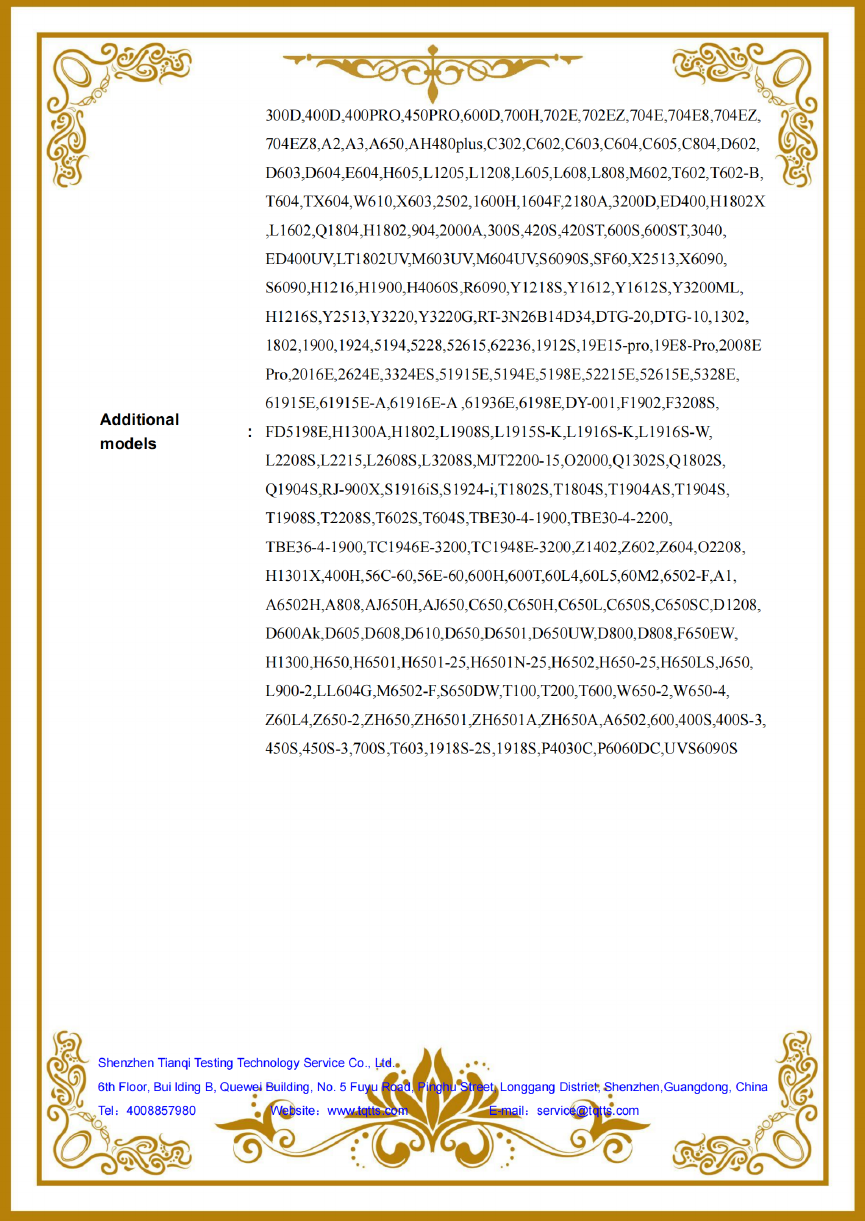
The 1900 mm platform: XF-19E8-PRO
- CE Machinery Directive: Certificate of Conformity number M.2026.206.C142385, issued by UDEM International Certification Auditing Training Centre Industry and Trade Inc. Co., against EN ISO 12100:2010, EN 60204-1:2018/A1:2025 and EN ISO 12643-1:2023.
- CE Low Voltage Directive: certificate TQT1550D271EC, issued by Shenzhen Tianqi Testing Technology Service Co., Ltd. (TQT), against EN IEC 62368-1:2020/A11:2020.
- CE EMC: certificate TQT1550D270EC, issued by TQT, against EN 55032:2015/A11:2020, EN 55035:2017/A11:2020, EN IEC 61000-3-2:2019+A1:2021 and EN 61000-3-3:2013/A2:2021.
- RoHS: certificate M.2026.206.C142366, issued by UDEM, against EN IEC 63000:2018 and the EN IEC 62321 series.
- The model is additionally listed as covered by CE certification issued by CTIC Testing Group (Guangdong) Co., Ltd. under number CTICAIQ415250900815313DC, and by BST Testing (Shenzhen) Co., Ltd.
The 1950 mm platform: XF-O2000-4I32A1
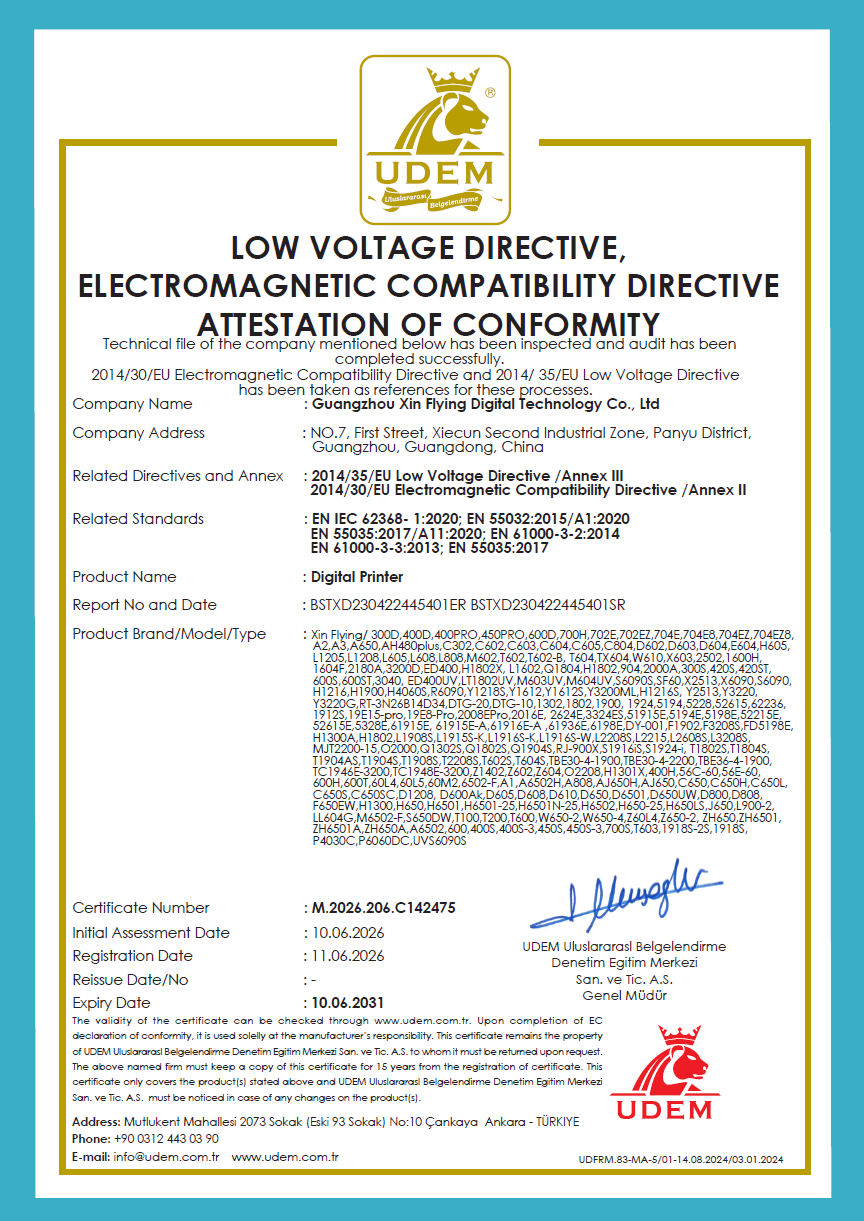
- CE Machinery Directive: applicable standard EN ISO 12100:2010, with the CE MD certificate issued by UDEM.
- CE LVD & EMC: certificate M.2026.206.C142475, issued by UDEM for LVD 2014/35/EU and EMC 2014/30/EU.
- CE LVD: additionally holds the TQT-issued certificate TQT1550D271EC.
- CE EMC: additionally holds the TQT-issued certificate TQT1550D270EC.
- CE Certificate of Compliance: BSTXD211021006201EC, issued by BST Testing (Shenzhen) Co., Ltd. on 2021-10-18, against EN 55032:2015+A11:2020, EN IEC 61000-3-2:2019, EN 61000-3-3:2013+A1:2019 and EN 55035:2017+A11:2020.
- RoHS: certificate M.2026.206.C142366.
How to Compare the Two Certificate Families
| Check point | TQT family (TQT1550D270EC / TQT1550D271EC) | BST family (BSTXD211021006201EC) |
|---|---|---|
| Issuing test house | Shenzhen Tianqi Testing Technology Service Co., Ltd. | BST Testing (Shenzhen) Co., Ltd. |
| Issue date in the certificate record | 2026-05-19 | 2021-10-18 |
| EMC standards cited | EN 55032:2015/A11:2020; EN 55035:2017/A11:2020; EN IEC 61000-3-2:2019+A1:2021; EN 61000-3-3:2013/A2:2021 | EN 55032:2015+A11:2020; EN IEC 61000-3-2:2019; EN 61000-3-3:2013+A1:2019; EN 55035:2017+A11:2020 |
| Declared scope wording in the record | Electrical safety (LVD) and EMC compliance for digital printer products | Recorded scope reads "DTF Printer"; the same record states the certificate applies to the EU market for the XF-O2000-4I32A1 sublimation printer |
Two conclusions follow, and both matter more than the width figure.
First, neither platform depends on a single certificate house. The 1900 mm model is covered by UDEM (MD, RoHS), TQT (LVD, EMC) and is listed under CTIC and BST certifications as well. The 1950 mm model is covered by UDEM (MD, combined LVD & EMC, RoHS), TQT (LVD, EMC) and BST. For an import file, that redundancy is practical: if a reviewer questions one document, a second, independently issued document covers the same conformity area.
Second, declared scope wording is a field worth checking. The BST record for BSTXD211021006201EC describes its scope as "DTF Printer", while the same certificate record states that it applies to the EU market for the XF-O2000-4I32A1 sublimation printer. An older certificate of this type also cites earlier editions of the same standards than the 2026 TQT documents. Neither observation makes a certificate unusable — but reconciling scope wording and standard editions against the specific machine on the order is exactly the work an EU importer's technical file performs, and it is cheaper to do before the container ships than after.
The instruction for a buyer comparing 1900 mm and 1950 mm machines is identical in both cases: request the certificate that names your exact model, request a declaration of conformity that references it, and confirm the standard editions cited are ones your market surveillance authority currently accepts.
What the Two Platforms Actually Do
With compliance treated as a gate both machines already pass, the comparison moves to configuration.
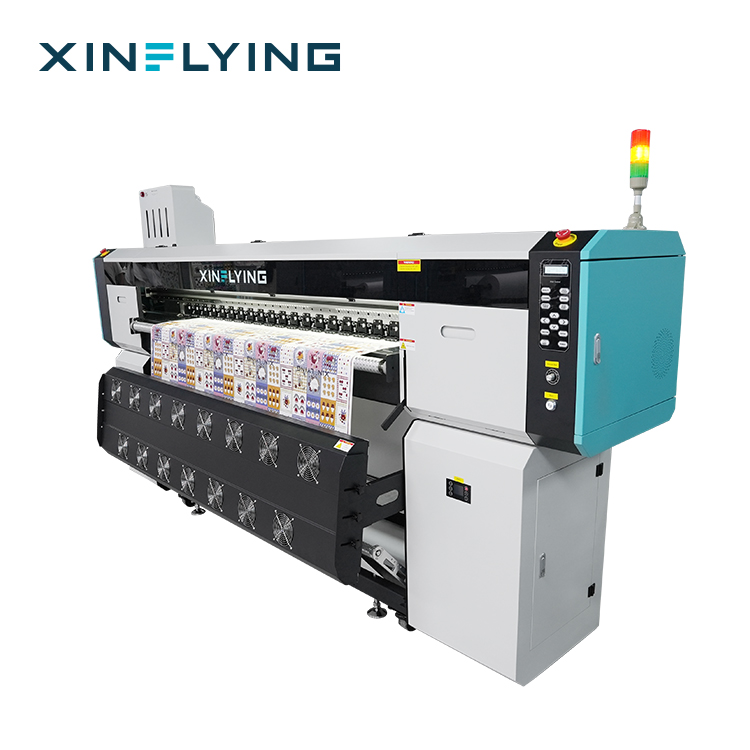
The XF-O2000-4I32A1 uses 4 Epson i3200-A1 printheads in a four-bank CMYK configuration (CMYK+CMYK+CMYK+CMYK) on a 195 cm (1.95 m) width. Declared speed is 2PASS 180 m²/h and 4PASS 92 m²/h. It runs on 220V, 50/60Hz at 8.5 kW, supports heat transfer paper rolls of 1000–1500 m, and uses sublimation ink from a 220 ml cartridge with a 3 L ink tank. RIP options are RIIN Print and Maintop. Net weight is approximately 490 kg.
The XF-19E8-PRO uses 8 Epson i3200-A1 printheads on a 190 cm (75") width at 3200 dpi. Declared speed is 1PASS 306 m²/h and 2PASS 153 m²/h in fastest mode, or 1PASS 210 m²/h and 2PASS 109 m²/h in standard mode. It runs on 210–230V, 45A at 10.2 kW, with Maintop as standard RIP (RIIN for Hoson configurations, PhotoPrint and Printfactory optional). Hardware includes a Japan THK silent linear guide, anti-collision devices at both ends, fully sealed automatic moisturizing and cleaning, an external intelligent air-heat integrated dryer, and a liquid level and waste ink alarm. Net weight is 1400 kg.
The performance gap is less obvious than the width gap. At 2PASS, the 4-head 1950 mm platform is specified at 180 m²/h, above the 8-head 1900 mm platform's 153 m²/h at the same pass count — while the 8-head machine adds a 1PASS mode specified up to 306 m²/h that the 4-head platform does not list. Choosing on head count alone, or on width alone, misses that structure entirely.
1900 mm vs 1950 mm: Side-by-Side Specification and Certificate Table
| Comparison item | XF-19E8-PRO (1900 mm) | XF-O2000-4I32A1 (1950 mm) |
|---|---|---|
| Print width | 190 cm (75") | 195 cm (1.95 m) |
| Printheads | 8 × Epson i3200-A1 | 4 × Epson i3200-A1 |
| Ink colours | CMYK | CMYK+CMYK+CMYK+CMYK |
| Fastest declared speed | 1PASS 306 m²/h; 2PASS 153 m²/h | 2PASS 180 m²/h; 4PASS 92 m²/h |
| Standard declared speed | 1PASS 210 m²/h; 2PASS 109 m²/h | Not separately listed in the published specification |
| Resolution | 3200 dpi | Not stated in the published specification |
| Media | Sublimation paper | Heat transfer paper, 1000–1500 m rolls |
| Ink supply | Sublimation ink | Sublimation ink, 220 ml cartridge + 3 L ink tank |
| RIP | Maintop standard; RIIN (Hoson only), PhotoPrint, Printfactory optional | RIIN Print; Maintop |
| Power / supply | 10.2 kW; 210–230V, 45A | 8.5 kW; 220V, 50/60Hz |
| Machine size | 3840×1300×1800 mm | 3311×1278×1670 mm |
| Packing size | 4010×1180×2160 mm | 3640×760×1740 mm |
| Net / gross weight | 1400 kg / 1500 kg | ≈490 kg / ≈675 kg |
| CE Machinery Directive | M.2026.206.C142385 (UDEM); EN ISO 12100:2010, EN 60204-1:2018/A1:2025, EN ISO 12643-1:2023 | EN ISO 12100:2010; certificate issued by UDEM |
| CE LVD | TQT1550D271EC (TQT); EN IEC 62368-1:2020/A11:2020 | TQT1550D271EC (TQT); also covered by M.2026.206.C142475 (UDEM) |
| CE EMC | TQT1550D270EC (TQT); EN 55032, EN 55035, EN IEC 61000-3-2, EN 61000-3-3 | TQT1550D270EC (TQT); M.2026.206.C142475 (UDEM); BSTXD211021006201EC (BST Testing) |
| RoHS | M.2026.206.C142366 (UDEM); EN IEC 63000:2018 | M.2026.206.C142366 (UDEM) |
Step-by-Step: Making the 1900 / 1950 Decision
- Do the roll arithmetic first. List your three widest recurring layouts and check whether each fits inside 190 cm. If nothing in your order book needs the extra 5 cm, the wider platform has to be justified on throughput and media handling instead.
- Verify the electrical envelope against your building. The 1900 mm platform is specified at 10.2 kW on 210–230V with a 45A rating. The 1950 mm platform is specified at 8.5 kW on 220V, 50/60Hz. Note that the published specification for the 1950 mm model does not state an amperage figure alongside the voltage and frequency, so request the current rating from the supplier before your electricians size the circuit.
- Match the machine to the pass mode you will actually run. If your quality standard allows 2PASS production, the 4-head 1950 mm platform is specified at 180 m²/h against 153 m²/h for the 8-head 1900 mm platform at the same pass count. If you need a 1PASS production mode, that mode is specified only on the 8-head 1900 mm platform, up to 306 m²/h.
- Audit the certificate that names your model. Confirm the model appears on the CE MD, CE LVD, CE EMC and RoHS documents you receive, and that the standard editions cited are current for your market. Ask for the declaration of conformity that references the same certificate numbers.
- Check floor and logistics limits. The two machines differ substantially in mass and footprint: 1400 kg versus approximately 490 kg net weight, 3840×1300×1800 mm versus 3311×1278×1670 mm, and packing volumes of 4010×1180×2160 mm versus 3640×760×1740 mm. Floor loading, doorway widths and container planning should be checked against those numbers, not against a brochure image.
- Confirm media and consumable handling. The 1950 mm platform is specified for heat transfer paper rolls of 1000–1500 m and uses a 220 ml cartridge plus a 3 L ink tank. Confirm your transfer paper supply and ink logistics match the machine you select.
- Validate before you commit. Xinflying operates a one-unit minimum order quantity with pre-shipment testing, so a single machine can be used for validation. Print your own artwork on your own polyester before scaling the decision to a full line.
Where Each Width Fits in Real Production
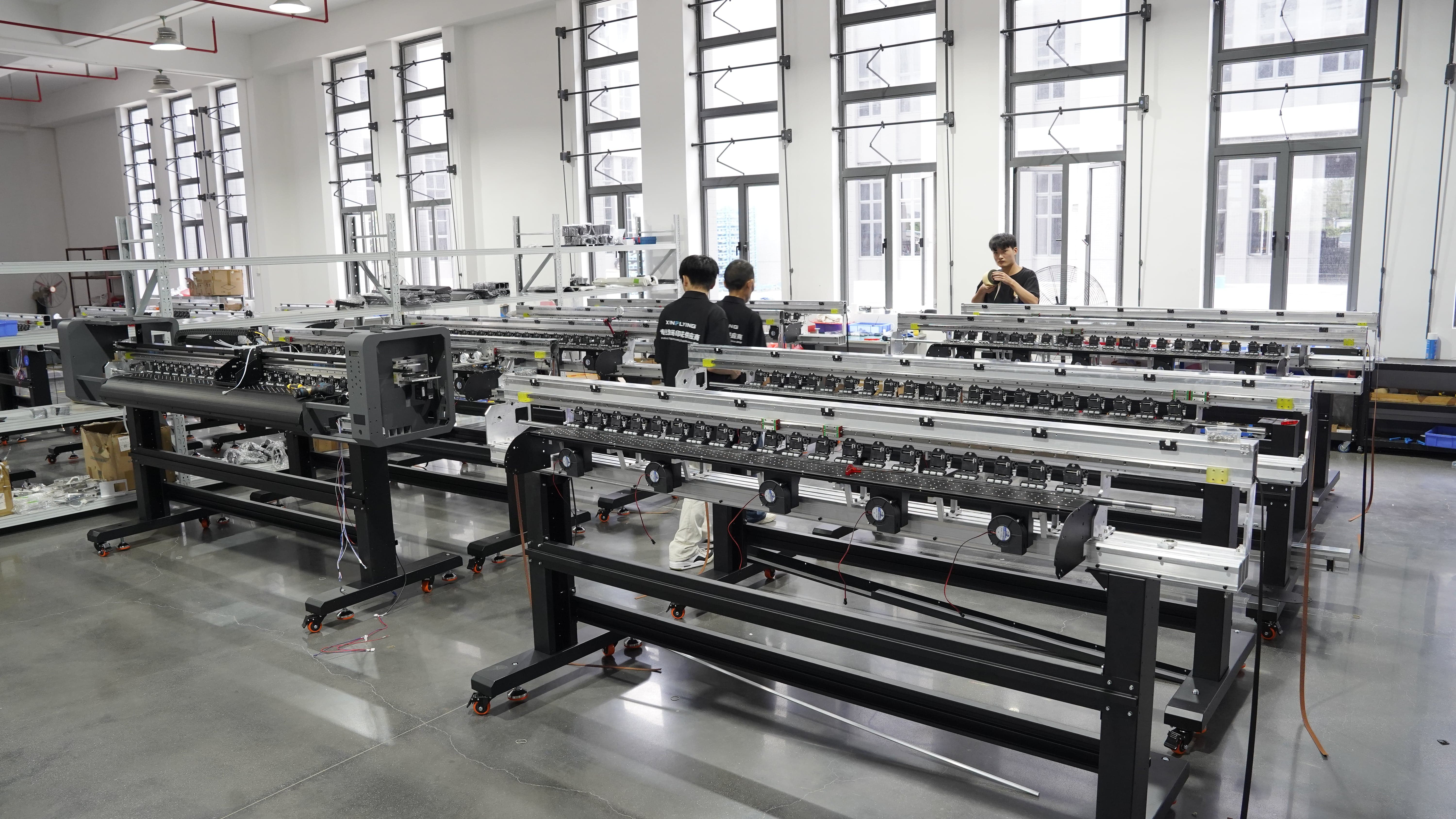
Documented sublimation deployments in Xinflying's project record show how the width decision tends to be resolved in practice.
- Sportswear manufacturing (Brazil, 15 units, 4 years). A manufacturer producing football jerseys, basketball uniforms and custom sportswear uses roll-to-roll sublimation for high-resolution patterns, team logos and full-colour designs on polyester before cutting and sewing. Reported outcome: greater flexibility on customised orders, reduced dependence on outsourced printing, and more consistent colour across batches. Panel-heavy sportswear layouts benefit from checking nesting at both 190 cm and 195 cm before choosing.
- Sports uniform supply (Brazil, 8 units, 5 years). A supplier producing customised football kits, training uniforms and team apparel with personalised names, numbers and graphics reports shorter production cycles while maintaining the colour vibrancy and pattern detail team uniforms require. Mixed short-run work is where roll utilisation, not maximum width, usually decides the numbers.
- Home textile manufacturing (10 units, 4 years). Curtains, cushions and decorative fabrics favour wider, continuous runs and consistent pattern reproduction — the case type where the extra 5 cm of the 1950 mm platform is most likely to change material usage.
- Digital textile printing service provider (5 units, 3 years). A service provider supplying sportswear brands and apparel factories reports expanded capacity, support for more concurrent customer projects, and faster response on customised orders — a workload where two width classes are often more useful than standardising on one.
FAQ: 1900 mm vs 1950 mm Sublimation Printer Certification and Selection
1. Which certificates should I verify before importing a 1900 mm or 1950 mm sublimation printer into the EU?
Verify four coverage areas and match each one to your exact model. For the 1900 mm XF-19E8-PRO, the record includes CE MD Certificate of Conformity M.2026.206.C142385 issued by UDEM, CE LVD certificate TQT1550D271EC under EN IEC 62368-1:2020/A11:2020, CE EMC certificate TQT1550D270EC covering EN 55032, EN 55035, EN IEC 61000-3-2 and EN 61000-3-3, and RoHS certificate M.2026.206.C142366. For the 1950 mm XF-O2000-4I32A1, the record includes CE MD with EN ISO 12100:2010 issued by UDEM, combined CE LVD & EMC certificate M.2026.206.C142475, the TQT-issued LVD and EMC certificates, CE Certificate of Compliance BSTXD211021006201EC from BST Testing, and RoHS certificate M.2026.206.C142366. Check that the model name and the cited standard editions match what your importer will file.
2. Does a 1950 mm sublimation printer print faster than a 1900 mm model?
Not as a category — it depends on the pass mode and head count. The 1950 mm XF-O2000-4I32A1 runs 4 Epson i3200-A1 printheads and is specified at 2PASS 180 m²/h and 4PASS 92 m²/h. The 1900 mm XF-19E8-PRO runs 8 Epson i3200-A1 printheads and is specified at 1PASS 306 m²/h and 2PASS 153 m²/h in fastest mode, or 1PASS 210 m²/h and 2PASS 109 m²/h in standard mode. At 2PASS the 4-head 1950 mm platform carries the higher figure; the 8-head 1900 mm platform adds a 1PASS mode the 4-head platform does not list.
3. What drives the cost and running-cost difference between the two widths?
Four measurable drivers separate the platforms. Power: 10.2 kW on a 210–230V, 45A supply for the 1900 mm model versus 8.5 kW on 220V, 50/60Hz for the 1950 mm model. Mass and freight: 1400 kg net for the 1900 mm model versus approximately 490 kg for the 1950 mm model, with correspondingly different packing volumes. Media handling: the 1950 mm model is specified for 1000–1500 m transfer paper rolls and a 220 ml cartridge plus 3 L ink tank. Head count: 8 versus 4 Epson i3200-A1 printheads. Equipment pricing itself is quoted per configuration and per project, so ask for a quotation that reflects your actual width, pass mode and volume rather than comparing list figures.
4. How can I validate a borderline width choice before committing to a full line?
Use the sample route. Xinflying operates a one-unit minimum order quantity with pre-shipment testing, which allows a single machine to be validated against real work before a multi-unit decision. Validate with your own polyester and your own artwork, and compare roll utilisation at 190 cm and 195 cm using your three widest recurring layouts. The project record includes a digital textile printing service provider that ran five units over three years and a sportswear manufacturer running fifteen units over four years — both started from a single configuration decision.
5. What lead time and after-sales support apply to these machines?
Declared lead time for Xinflying digital printing equipment is 5–40 days, with a one-unit minimum order quantity and monthly production capacity of 1600+ units. OEM and ODM customisation is available, covering product branding, machine appearance, colour, logo and packaging, plus customised solutions based on customer requirements. After-sales support is delivered by over 50 engineers providing 24/7 online technical support, and the company maintains local warehouses and technical support in key markets. Xinflying was founded in 2010 and operates a 37,440 m² facility in Panyu, Guangzhou, exporting to North America, South America, Europe, Asia, the Middle East and Africa at an export ratio of 80%. To move from certification to configuration, request the product and compliance documentation set by email at info@xin-flying.com or by phone and WhatsApp at +86 188-1322-1357.
Conclusion: Two Widths, One Compliance Gate
The 1900 mm versus 1950 mm question looks like a width question and behaves like a configuration question. Both the XF-19E8-PRO and the XF-O2000-4I32A1 clear the same EU compliance gate: CE Machinery Directive, Low Voltage Directive, EMC and RoHS coverage, issued across the two platforms by UDEM, TQT and BST Testing. Neither platform requires an out-of-envelope configuration to reach its printed width, so neither introduces a compliance inefficiency that the other avoids.
The decision therefore settles on four measurable items: whether your widest recurring layouts need the extra 5 cm; whether your building can carry 10.2 kW at a 45A rating or 8.5 kW at 220V, 50/60Hz; which pass mode your quality standard actually allows; and whether a 1400 kg machine or a roughly 490 kg machine fits your floor, your doorway and your freight plan. Certification is the gate you check before all four — not the tie-breaker between them.
Xinflying (Guangzhou Xin Flying Digital Technology Co., Ltd.) has manufactured dye sublimation, DTF, DTG and UV printing equipment since 2010, with a 37,440 m² facility, 200+ employees, 20 R&D engineers and an 80% export ratio across North America, South America, Europe, Asia, the Middle East and Africa.
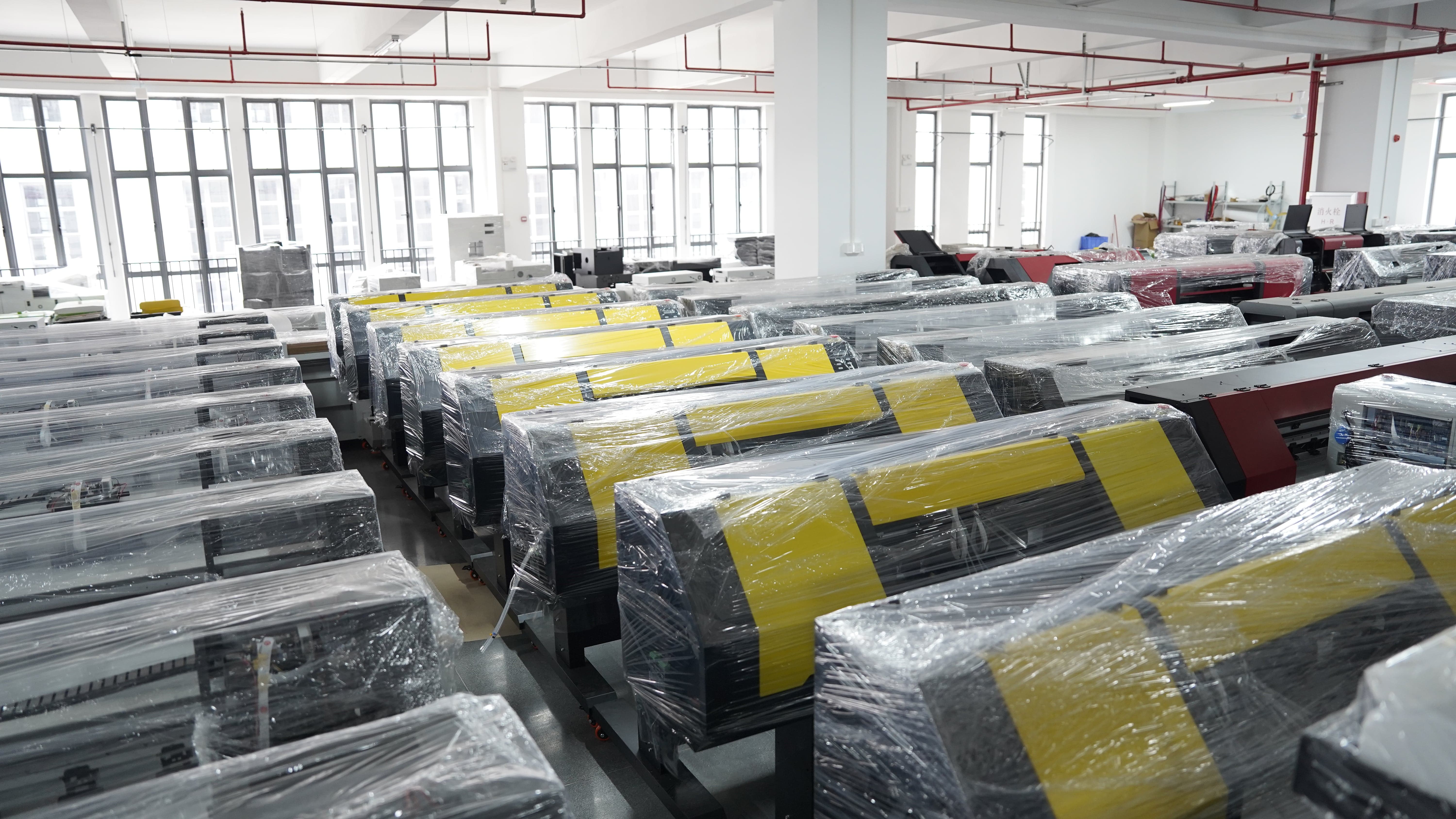
Next step: request the compliance document set for XF-19E8-PRO or XF-O2000-4I32A1, or a configuration quotation based on your width, pass mode and volume. Download the Xinflying company brochure (PDF), email info@xin-flying.com, call or WhatsApp +86 188-1322-1357, or visit www.xin-flying.com.