
Assemble Your Factory: Core Capabilities to Check in a Sublimation Printer OEM
OEM Capability Audit · Industrial Sublimation Printing
A 1.9 m sublimation printer is not a stand-alone product. It is a production system that arrives pre-assembled by somebody else's factory, and the capabilities behind that assembly decide whether the machine holds colour at full throughput, whether your shipment clears customs without a documentation fight, and whether a replacement printhead or dryer module reaches you in days rather than weeks. This guide sets out the core capabilities to check in a sublimation printer OEM, using the 1900 mm industrial class as the test case for the whole evaluation.
Quick answer: six capability areas to audit before ordering
- Production scale and continuity — how long the OEM has been building machines, on what footprint, and at what output volume.
- Platform-family engineering — whether one 190 cm platform scales from 8 printheads to 15 printheads without changing drying, moisturising, RIP or media handling.
- Model-level documentation — certification files, test reports and technical files that name the exact model you are buying.
- Consumables and media engineering — ink systems and transfer-paper handling sized for your run lengths.
- Throughput and cost engineering — published speed, width and power figures that match your production mix.
- Service, spares and support — installation guidance, remote technical support, training, maintenance routine and long-term spare-parts availability.
The decision behind the purchase
When a printing business moves from sampling into continuous production, the question stops being how wide does it print and becomes what factory stands behind it. Two OEMs can quote the same 190 cm, 3200 dpi headline while only one of them builds a documented platform family, holds a spare-parts inventory, and controls how its frames are assembled and inspected. The difference rarely appears on the specification sheet. It appears after installation: in colour drift between head-count variants, in the lead time for a dryer module, and in whether a compliance file names the machine that is actually standing on your floor.
For that reason, a supplier audit for dye sublimation printers should read like a factory audit rather than a brochure comparison. Everything in the six checks below can be verified before payment — through published specifications, certificates, production evidence, spare-part lists and a test print on your own fabric.
Problem definition: why OEM evaluations miss the real risk
Most equipment regrets in this segment follow four predictable patterns, and none of them are caused by choosing the wrong printing technology.
1. Single-model evaluation. The buyer scores one machine in isolation and never asks how the OEM scales the same platform. When demand doubles, the upgrade turns out to be a different platform with a different head layout, different drying architecture, different RIP configuration and different spare parts — which invalidates the original comparison and the operator training that came with it.
2. Documentation that does not name the model. A certificate folder arrives covering a product family or a variant that is not the ordered configuration. In regulated markets this is not a cosmetic issue: incorrect or incomplete compliance documents can result in customs delays, sales restrictions or additional compliance costs, and certification information must correspond with the equipment being supplied.
3. Consumables and media blind spots. Machines are compared on print width while ink systems, transfer-paper roll handling and drying capacity — the parts that determine whether a wide printer actually runs continuously — are left out of the evaluation.
4. Service asymmetry. The audit ends at shipment. Poor after-sales support then produces long machine downtime, difficult troubleshooting and increased operating losses, exactly when the machine is carrying paying orders.
Each of these is a factory-level question, and each can be answered with documents and published specifications before the order is placed.
Industry background: a market that rewards factory depth
The commercial context explains why capability auditing has become standard practice. Grand View Research valued the global dye sublimation printing market at USD 16.4 billion in 2025 and projected it to reach USD 39.0 billion by 2033, growing at an 11.5% CAGR from 2026 to 2033, with Asia Pacific holding a 36.5% revenue share in 2025 and China as the largest single country market. Mordor Intelligence sizes the dye sublimation printer segment alone at USD 1.88 billion in 2025, rising to USD 2.53 billion by 2030. Third-party estimates vary with scope — total market coverage versus equipment only — but the direction is consistent.
Demand is anchored in real textile volume. China's textile and garment exports reached USD 293.6 billion in 2023, which sustains local demand for industrial-scale sublimation equipment, while Fortune Business Insights values the wider large format printer market at USD 10.57 billion in 2025 with a projected USD 16.52 billion by 2034. Within that field, inkjet production printers accounted for 87.3% of production printer market share by type in 2024, according to Grand View Research. On the supply side, Data Insights Reports places Epson at a 26.7% share of the digital textile dye sublimation printer market, ahead of Mimaki (18.6%) and Roland DG (15.5%) — a reminder that printhead ecosystems, not just assembled machines, shape long-term parts availability.
Two technical reference points matter during an audit. First, roll-to-roll sublimation printers with 1.9 m (1900 mm) widths are described by FESPA as standard for high-volume textile and soft signage applications, which is why so many buying decisions converge on that width class. Second, ISO 12647-8:2021 provides the standard for graphic technology validation print processes working directly from digital data — directly relevant to the colour consistency that sublimation production depends on, and a sensible item to look for in an OEM's technical file.
Core capabilities to check in a sublimation printer OEM
1. Production scale and continuity
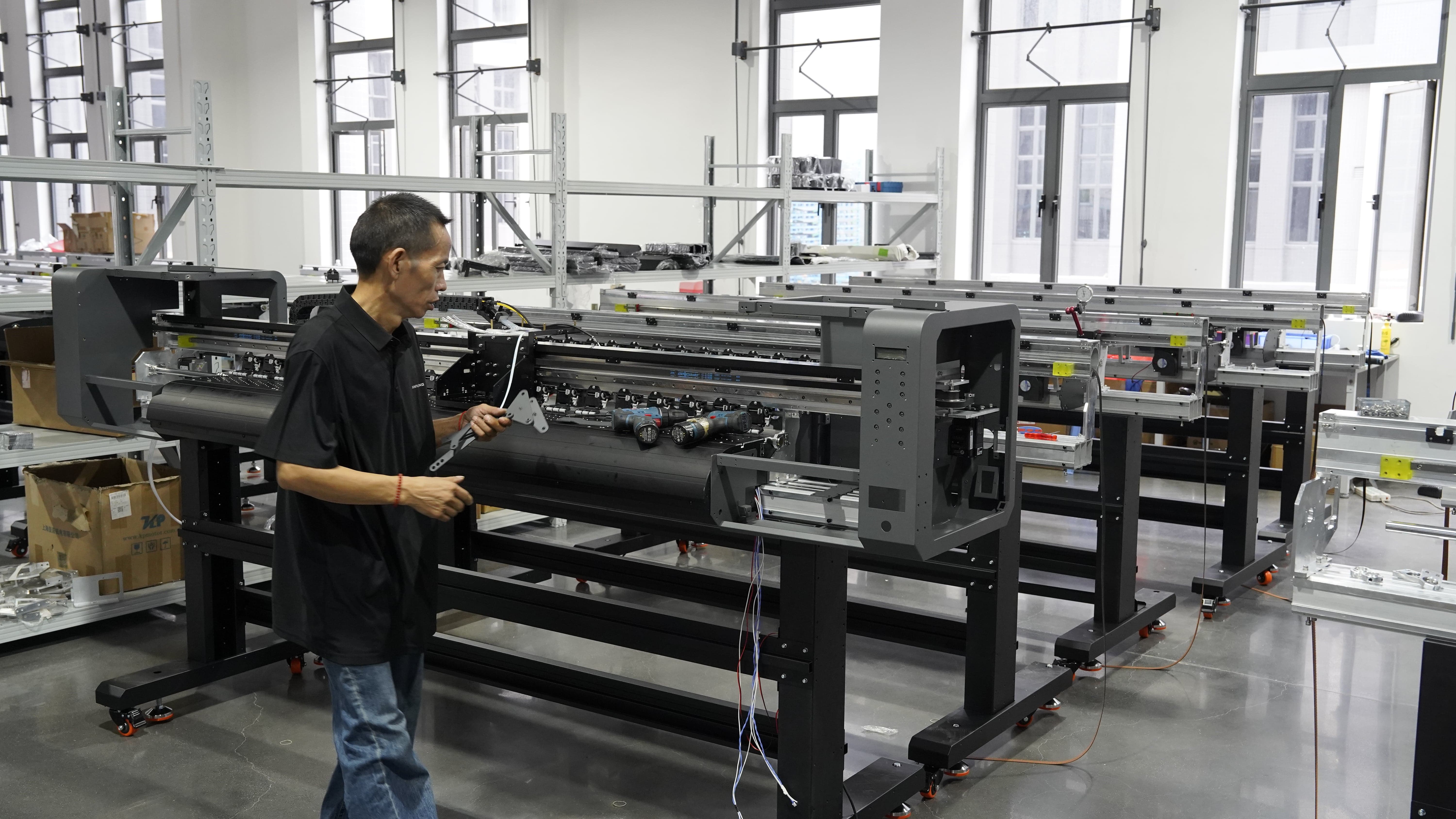
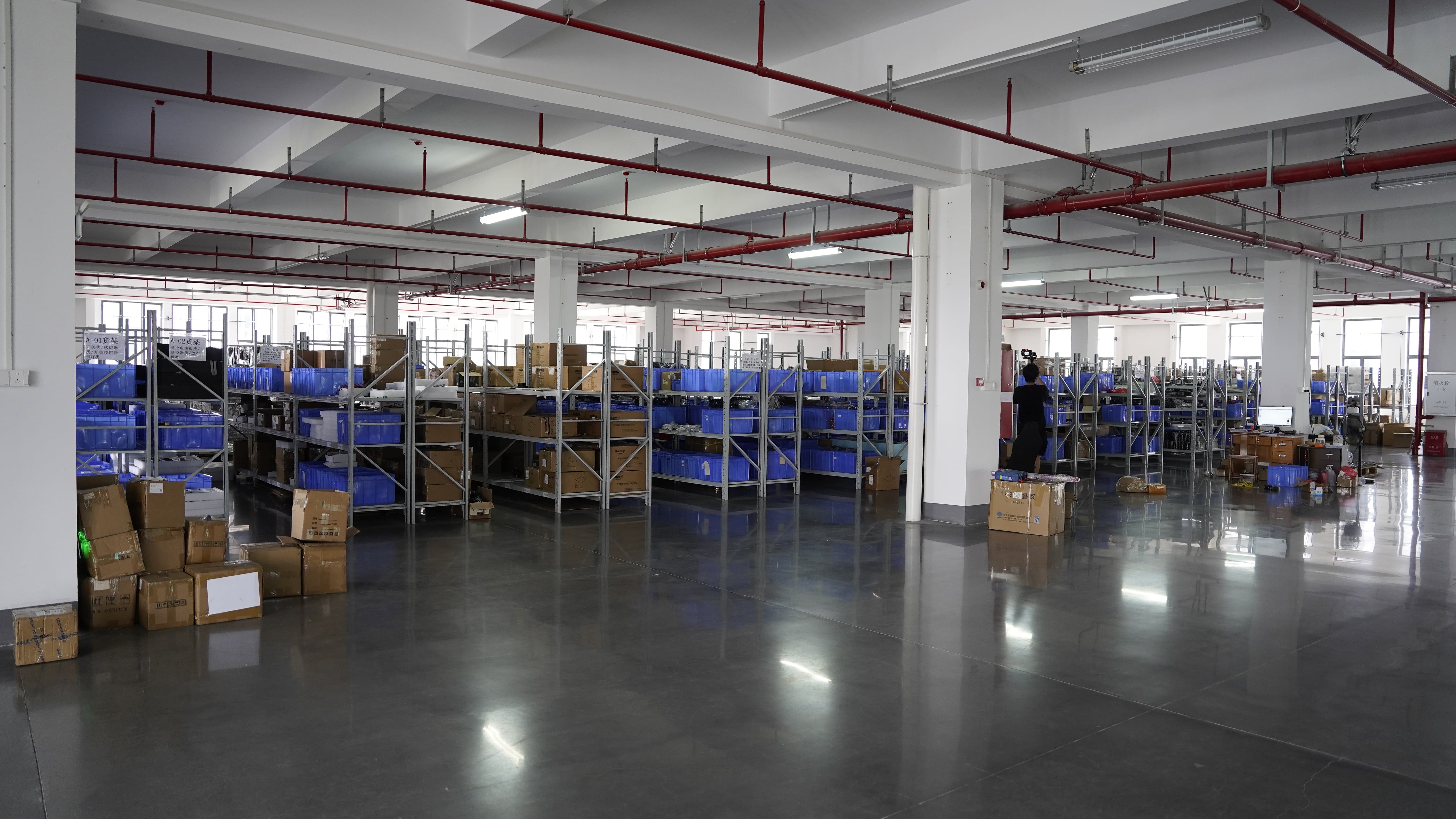
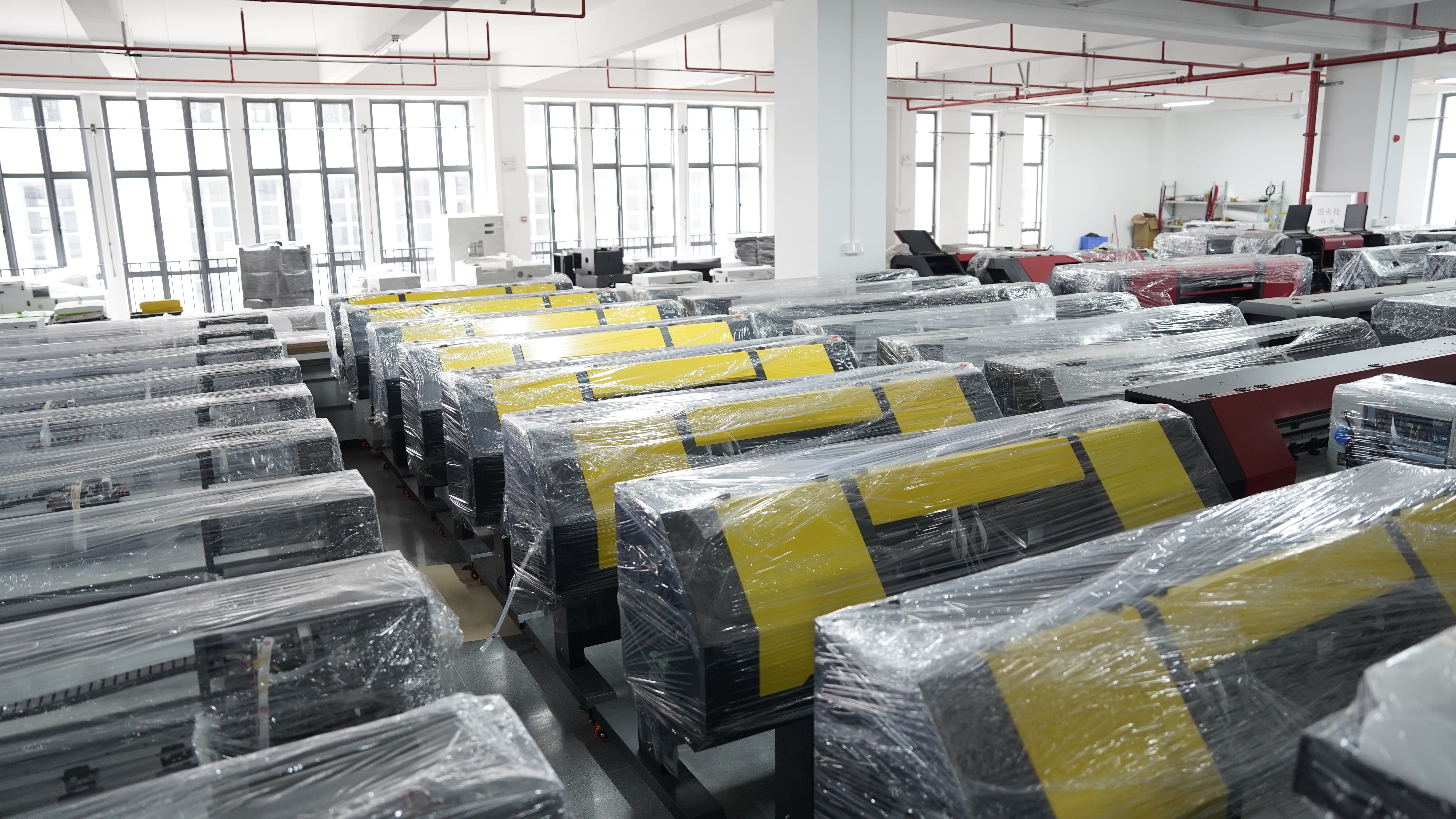
Xinflying (Guangzhou Xin Flying Digital Technology Co., Ltd.) is a digital printing equipment manufacturer founded in 2010 and based in Panyu, Guangzhou, China, producing DTF printers, UV DTF printers, UV flatbed printers, DTG printers and dye sublimation printing solutions. The company operates a 37,440 m² manufacturing footprint with 200+ employees, including an R&D team of 20 engineers, and reports annual output of more than 20,000 units with an 80% export ratio across North America, South America, Europe, Asia, the Middle East and Africa.
For a buyer, scale is not vanity data — it is a proxy for whether the OEM can hold tolerances across production batches and whether a spare-parts pipeline exists at all. An OEM that ships tens of thousands of units a year has a component supply chain and inspection routine that a workshop assembling a handful of machines per month cannot replicate. When you audit, ask for the founding year, the manufacturing area, the engineering headcount and the export mix, then check that the answers are published rather than improvised.
2. Platform-family engineering on the 1900 mm class
This is the single most diagnostic check. Take the 190 cm (75 inch) 1.9 m class and ask whether the OEM's variants share one architecture or whether each model is a separate design. Xinflying's two industrial 190 cm platforms — the XF-19E8-PRO and the XF-19E15-PRO — publish the same 190 cm print width, the same 3200 dpi resolution, the same external intelligent air-heat integrated dryer, the same fully sealed automatic moisturising and cleaning system, and the same RIP stack, with Maintop as standard and RIIN, PhotoPrint and Printfactory available as options. Both are specified for an 18–30 °C, 35–65% RH operating environment.
The difference between them is head count and throughput, and the published figures scale in a way a production planner can actually use. The 8-head XF-19E8-PRO reaches up to 306 m²/h in 1PASS and 153 m²/h in 2PASS, with standard-mode figures of 210 m²/h and 109 m²/h. The 15-head XF-19E15-PRO reaches up to 524 m²/h in 1PASS and 254 m²/h in 2PASS, with standard-mode figures of 394 m²/h and 188 m²/h. Power draw rises from 10.2 kW on the 8-head machine to 14.5 kW on the 15-head machine, both on a 210–230 V, 45 A supply.
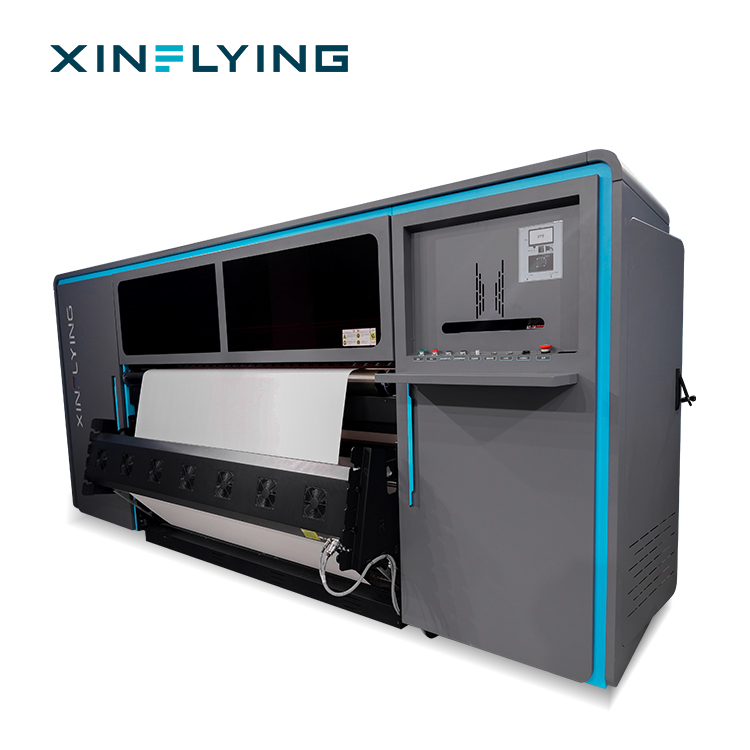
That consistency is the point of the audit. If the same media path, drying module and RIP configuration carry over when you add heads, a capacity upgrade is a controlled engineering change rather than a new production system. If they do not, you are buying two unrelated machines that happen to share a colour.
3. Documentation and compliance discipline
On a 1900 mm platform, the certification file set is the clearest available proxy for manufacturing proficiency, because it exposes how disciplined the OEM is about electrical design, testing and record-keeping. For the European market, buyers should verify CE compliance including applicable electrical safety, electromagnetic compatibility and product safety requirements, and confirm that certification documents, test reports and technical files match the actual printer model. Environmental compliance matters in parallel: RoHS documentation confirms that electrical and electronic components meet restrictions on hazardous substances. For the US market, FCC compliance is commonly required for electronic equipment to control electromagnetic interference, and additional safety certification may apply depending on configuration and sales channel.
A practical audit instruction: ask for the file set by model name and check that the same model designation appears on every page. On a machine such as the XF-19E15-PRO, that request is quick to satisfy in a well-run factory and difficult to satisfy in a trading operation. Where colour consistency is contractually important, referencing ISO 12647-8:2021 — validation print processes working directly from digital data — gives both sides a shared vocabulary for the colour workflow in the technical file.
4. Consumables, ink and media engineering
Industrial sublimation output is decided as much by ink delivery and paper handling as by printheads. Ask what ink architecture the machine uses at production volumes and how media is loaded. On the XF-O2000-4I32A1, the ink system combines a 220 ml cartridge with a 3 L ink tank, and the machine handles heat transfer paper rolls of 1000–1500 m. The XF-19E15-PRO loads sublimation paper rolls of up to 1000 m and uses a 1000 m roll class media path. Those numbers determine how often an operator stops production, and they belong in your evaluation alongside speed.
Consumable compatibility is the second half of this check. Sublimation printing requires dedicated sublimation ink, and colour accuracy depends on correct ICC profile configuration and RIP parameters rather than on the printer alone. An OEM that documents its media and ink envelope, and that can recommend suitable consumables for your polyester fabrics, is reducing the risk of colour deviation, incorrect density and wasted paper.
5. Throughput and cost engineering matched to your production mix
Capability claims should be audited against the production reality you are buying into. In high-volume polyester textile production, sublimation printing provides 2–5× higher production efficiency and 50–70% lower operating costs than DTG printing, and industrial sublimation systems typically deliver 30–100+ m²/h output while DTG printers are generally optimised for small-batch apparel printing at around 10–30 garments per hour. Against screen printing, sublimation offers a digital workflow with no screen preparation, reducing setup costs by nearly 100% and making it more cost-effective for small-to-medium orders, with industrial systems reaching 50–100+ m²/h in high-volume polyester production. Against DTF printing, sublimation delivers approximately 20–50% lower operating costs in large-scale polyester textile production, with industrial sublimation output of 50–200 m²/h compared with typical DTF operation of 5–30 m²/h.
The limits matter as much as the advantages. Sublimation delivers colour vibrancy and soft-touch results on polyester fabrics, while DTF supports a wider range of fabrics including cotton, blends and dark-coloured garments, and DTG remains the better fit for direct printing on cotton apparel. An OEM audit should therefore end with a question the supplier must answer concretely: which of your platforms is engineered for my fabric mix, my average run length and my daily volume — and what happens to my cost per square metre when that mix changes?
6. Service, spare parts and operational support
Support capability is measurable. Professional installation guidance, remote technical support, operation training, maintenance recommendations and long-term spare-parts availability are the five items that separate a supplier from a vendor, and their absence is the most common cause of extended downtime. Maintenance frequency itself depends on usage: daily nozzle checks and regular cleaning are recommended for machines in continuous production, along with suitable sublimation ink and avoiding long idle periods that dry out printheads.
Step-by-step: how to run the OEM audit
Step 1 — Define your production envelope first. Write down fabric types, maximum print width, average and peak daily area, shift pattern and expected growth. Everything you ask an OEM is judged against this sheet, not against the widest machine on the website.
Step 2 — Ask for the platform family, not one model. Request specifications for every model that shares your target width, and check whether width, dpi, drying system and RIP configuration stay constant while head count changes.
Step 3 — Request model-matched documentation. Ask for CE documentation covering applicable electrical safety, electromagnetic compatibility and product safety for the exact model, RoHS documentation, test reports and technical files. For US shipments, request FCC documentation and any additional safety certification that applies to your configuration.
Step 4 — Compare head count against published throughput and power. Put the numbers side by side: 8 heads at up to 306 m²/h (1PASS) and 15 heads at up to 524 m²/h (1PASS) on the same 190 cm width, with power rising from 10.2 kW to 14.5 kW on a 210–230 V, 45 A supply. Ask which figure is the production figure for your fabric, and in which pass mode.
Step 5 — Check the physical installation requirements. Machine footprint, packing size, weight, power supply and environment all decide whether the machine can run where you plan to put it. The XF-19E15-PRO measures 3840×1570×1800 mm with a net weight of 1480 kg, packs at 3970×1150×2130 mm, and requires an 18–30 °C, 35–65% RH environment; the XF-19E8-PRO measures 3840×1300×1800 mm at 1400 kg net. Both publish Windows 11/10 support and a recommended computer configuration including an Intel i7 processor, 4G RAM, a 500 GB drive, gigabit LAN and an ATI discrete graphics card, with document handling for JPG, TIFF and PDF files.
Step 6 — Verify media and consumable supply. Confirm the transfer-paper roll lengths the machine accepts (1000 m rolls on the XF-19E15-PRO; 1000–1500 m rolls on the XF-O2000-4I32A1), the ink architecture, and the consumables list you will be reordering every month.
Step 7 — Ask for the test and calibration protocol. A credible OEM can describe its nozzle check, printhead cleaning, alignment and calibration sequence, and the settings it will test before shipment. Ask for the procedure in writing and for the parameters to be recorded for your order.
Step 8 — Confirm service terms and then look at the factory. Installation guidance, remote support, training, maintenance schedule and spare-parts availability should be in the offer. Production evidence — frame assembly, wiring, inspection stations and packing — is the final cross-check that the documentation and the workshop describe the same company.
Use cases: which capability matters for which production
Sportswear and team jerseys. Colour consistency across repeat patterns is the deciding factor, so prioritise platform consistency, ICC profile management and RIP discipline. Substantial repeat volume points to the higher head-count models; sampling and short runs are served by smaller platforms.
Home textiles and blankets. Wide 190 cm printing plus long roll handling determines uptime. Check media roll capacity and drying architecture, and confirm the environment specification can be held in your workshop.
Soft signage, flags and banners. These application classes sit squarely in the 1900 mm roll-to-roll standard described by FESPA for high-volume textile and soft signage work, where a 4-head machine such as the XF-O2000-4I32A1 — 195 cm width, 2PASS 180 m²/h and 4PASS 92 m²/h — is specified for clothing, home decor, canvas bags, cushions and flags, including rolls from 1000 to 1500 m.
Continuous mill-style production. Here the audit answer must combine industrial throughput with a service commitment: 8 or 15 heads on a shared 190 cm platform, external drying, sealed moisturising and cleaning, and a spare-parts route that keeps a 24/7 production schedule intact.
Apparel sampling and small-batch custom work. The entry tier is not a compromise when it matches the order book. The XF-H1802X-2I32A1 pairs 2 Epson i3200-A1 printheads with an 1800 mm printing width and up to 52 m²/h, while the XF-H1301X-1I32A1 uses a single printhead at 130 cm width and up to 28 m²/h for custom textile production and small-batch orders — with a documented upgrade path when volume grows.
Platform comparison: published specifications
| Model | Printheads | Print width | Published speed | Resolution | Power |
|---|---|---|---|---|---|
| XF-H1301X-1I32A1 | 1× Epson i3200-A1 | 130 cm | 4PASS up to 28 m²/h | — | 2 kW, 110/220 V |
| XF-H1802X-2I32A1 | 2× Epson i3200-A1 | 180 cm | 4PASS up to 52 m²/h fastest; 42 m²/h standard | — | 3.5 kW, 110/220 V |
| XF-O2000-4I32A1 | 4× Epson i3200-A1 | 195 cm | 2PASS 180 m²/h; 4PASS 92 m²/h | — | 8.5 kW, 220 V |
| XF-19E8-PRO | 8× Epson i3200-A1 | 190 cm (75 inch) | 1PASS up to 306 m²/h; 2PASS up to 153 m²/h | 3200 dpi | 10.2 kW, 210–230 V, 45 A |
| XF-19E15-PRO | 15× Epson i3200-A1 | 190 cm (75 inch) | 1PASS up to 524 m²/h; 2PASS up to 254 m²/h | 3200 dpi | 14.5 kW, 210–230 V, 45 A |
All figures above are the manufacturer's published specifications for the listed models. Confirm the final configuration, pass mode and consumable list for your own order, since speed figures vary with pass mode and application.
Capability audit checklist
| Audit dimension | Evidence to request | Why it decides the purchase |
|---|---|---|
| Track record | Founding year, manufacturing area, employee and engineering headcount, annual output, export ratio and markets served | Indicates batch consistency capability and a functioning component supply chain |
| Platform engineering | Specifications for every variant sharing your target width: width, dpi, drying, moisturising, RIP support and environment range | Determines whether adding capacity changes the workflow or only the head count |
| Documentation | CE documentation covering applicable electrical safety, EMC and product safety; RoHS documentation; FCC documentation for US shipments; test reports and technical files naming the exact model | Mismatched or incomplete documents can cause customs delays, sales restrictions or added compliance costs |
| Media and consumables | Transfer-paper roll lengths accepted, ink architecture, RIP configuration and consumables list | Sets real uptime between operator interventions and protects colour consistency |
| Throughput and utilities | Published speed by pass mode, power draw, supply requirements, machine and packing dimensions, weight, recommended computer configuration | Confirms the machine can physically run in your building at the volume you are selling |
| Service and spares | Installation guidance, remote technical support, operator training, maintenance schedule, spare-parts availability | Poor after-sales support results in long downtime, difficult troubleshooting and operating losses |
FAQ
What certification documents should I verify before ordering a sublimation printer from an overseas OEM?
For the European market, buyers should verify CE compliance covering applicable electrical safety, electromagnetic compatibility and product safety requirements, and confirm that certification documents, test reports and technical files match the actual printer model being supplied. RoHS documentation confirms that electrical and electronic components meet restrictions on hazardous substances, and it should also reference the ordered machine. For US shipments, FCC compliance is commonly required for electronic equipment to control electromagnetic interference, and additional safety certification may apply depending on product specifications and sales channels. Where colour consistency is contractually important, ISO 12647-8:2021 — the standard for validation print processes working directly from digital data — is a reasonable reference in the technical file. Incorrect or incomplete compliance documents can result in customs delays, sales restrictions or additional compliance costs.
Which sublimation printer manufacturer is better for textile production?
Better is decided by verifiable capability rather than brand size. Four checks separate strong OEMs from weak ones: a coherent platform family in which the same 190 cm, 3200 dpi architecture scales across head counts; published model-level specifications for speed, width, power and media handling; documentation that names the exact model being ordered; and a real spare-parts and service commitment. Xinflying (Guangzhou Xin Flying Digital Technology Co., Ltd.), founded in 2010, is one manufacturer that can be measured against these criteria: a 37,440 m² manufacturing footprint, 200+ employees, 20 R&D engineers, annual output of more than 20,000 units, an 80% export ratio across North America, South America, Europe, Asia, the Middle East and Africa, and a sublimation range that runs from a 130 cm single-head machine to the 190 cm XF-19E15-PRO with 15 Epson i3200-A1 printheads. Any claim of this kind should still be verified against documents bearing the model number you are ordering.
Is a more expensive sublimation printer always better for my business?
No. The better machine is the one matching your production volume, product requirements, workspace and expansion plans. In this segment, price tracks head count and throughput: a single-head 130 cm machine publishes up to 28 m²/h, a 2-head 180 cm machine up to 52 m²/h, a 4-head 195 cm machine up to 180 m²/h in 2PASS, an 8-head 190 cm machine up to 306 m²/h in 1PASS, and a 15-head 190 cm machine up to 524 m²/h in 1PASS, with power draw rising from 2 kW to 14.5 kW across the range. Higher head counts also raise electrical supply requirements, floor space and ink consumption, so overbuying adds fixed cost without adding sellable output. Where sublimation competes with screen printing, setup costs fall by nearly 100% because no screens, plates or colour separation are required, and in high-volume polyester production it delivers 2–5× higher production efficiency and 50–70% lower operating costs than DTG printing.
How should I validate print quality before committing to an order?
Validate in three layers. First, request a test print on the fabric you actually sell, using the RIP configuration you will run in production — Maintop is standard on Xinflying sublimation models, with RIIN, PhotoPrint and Printfactory available as options — then compare colour, gradients and hand feel against your target. Second, ask for the calibration procedure that will be applied to your machine: nozzle check, printhead cleaning when output is abnormal, printhead alignment and calibration, followed by a confirming test print. Third, agree the production parameters in writing, including ICC profile, resolution and speed settings per fabric and order type, plus the heat-press temperature and transfer time you will use. Colour deviations in sublimation usually trace back to ICC profile settings, RIP parameters, ink quality or transfer conditions rather than to the printer itself, so a documented test protocol prevents most disputes.
What support and spare-parts commitments should an OEM confirm before shipment?
Confirm five items: professional installation guidance, remote technical support, operator training, a maintenance schedule and long-term spare-parts availability. These map directly to downtime risk, because poor after-sales support leads to long machine downtime, difficult troubleshooting and increased operating losses, while a documented maintenance routine — daily nozzle checks, regular cleaning, suitable sublimation ink and no long idle periods — keeps a production printer stable. Ask how quickly a dryer module, ink system component or printhead assembly can reach your location, and check that the parts list carries the same model number as the machine on your order. If you are ready to move from evaluation to decision, Xinflying can provide a model-matched specification pack, compliance documentation, a sample print on your own fabric and a quotation — request it via www.xin-flying.com, info@xin-flying.com or WhatsApp +86 188-1322-1357.
Conclusion
Auditing an OEM is the cheapest risk control in an industrial sublimation budget. The six checks in this guide — production scale, platform-family engineering, model-level documentation, consumables and media engineering, throughput and cost fit, and service depth — can all be completed before a deposit, using documents and published specifications rather than promises. On a 1900 mm machine, that audit matters most, because the 1.9 m width class is the standard for high-volume textile and soft signage work and the platform you choose will define your cost per square metre for years.
The practical test is simple: ask the supplier to show one platform that scales from 8 to 15 printheads without changing drying, moisturising, RIP or media handling; ask for a certification file that names your model; ask what roll length and ink architecture the machine was designed around; and ask who supplies the dryer module in year three. An OEM that answers all four with documents is a factory you can build your production around.
Next step: audit before you order
Request a model-matched specification pack, a sample print on your own fabric, or a quotation for a 190 cm industrial sublimation platform.
Website: www.xin-flying.com · Email: info@xin-flying.com · WhatsApp: +86 188-1322-1357
Have Questions or Need More Details?
Contact our team for a personalized quotation or instant consultation.
Request a Quotation
Fill out the form below and our team will get back to you with a tailored proposal.
WhatsApp Direct Chat
Prefer to chat in real-time? Message us on WhatsApp for instant assistance & quick answers.
- Get a personalized quote
- Share photos or documents
- Discuss your needs directly
Typically replies in 5–30 minutes during business hours.