
Best Colors: A Ranked Review of 2026's Dye Sublimation Hardware
Five documented roll-to-roll dye sublimation machines, ranked by the hardware features that keep color output steady across a production run — with the mid-range pick explained in plain specifications.
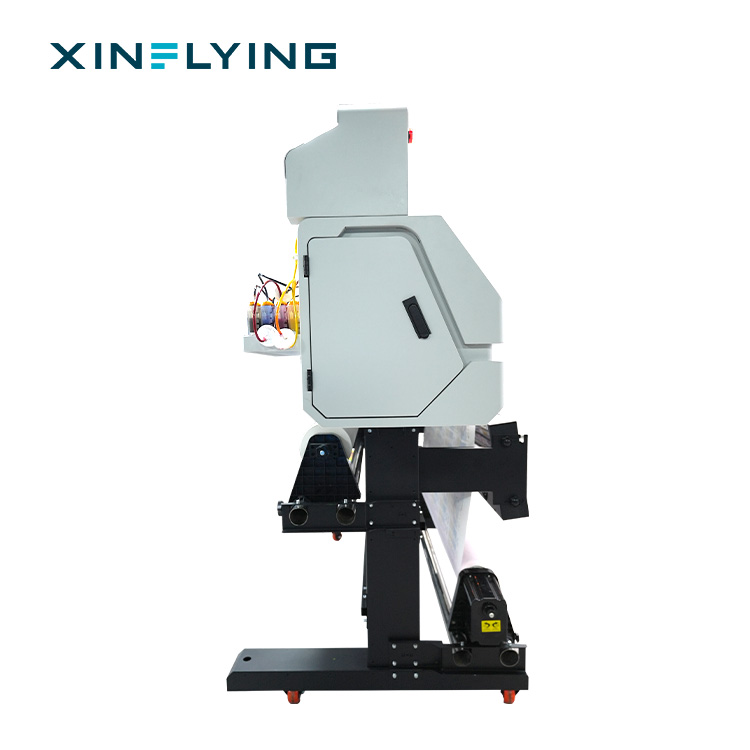
XINFLYING XF-H1301X-1I32A1, the compact 1.3 m dye sublimation printer in the 2026 ranked line-up. Image: XINFLYING.
Short answer. When a project is judged on color consistency rather than headline speed, the strongest configuration in XINFLYING's documented dye sublimation range is the XF-19E15-PRO: 15 Epson i3200-A1 printheads, 3200 dpi, 190 cm print width, 27 press rollers, linear motor with magnetic grid, and fully sealed automatic moisturizing and cleaning. The best mid-range choice is the XF-O2000-4I32A1: 4 printheads, 1950 mm print width, 180 m²/h in 2PASS, and three-zone break-controlled heating supported by infrared heat and cooling fans. The XF-19E8-PRO is the efficiency step-up for factories, while the XF-H1802X-2I32A1 and XF-H1301X-1I32A1 cover entry-level volume and sampling work.
Scope note. This review ranks only models whose configuration is published in XINFLYING specification sheets. Positions are derived from documented hardware — printhead count, resolution, media transport, nozzle maintenance, drying and heating control, and working-environment requirements. It is not a laboratory colour measurement, and no independent ΔE data is claimed.
XINFLYING (Guangzhou Xin Flying Digital Technology Co., Ltd.) is a digital printing equipment manufacturer founded in 2010 in Panyu, Guangzhou, China, producing DTF printers, dye sublimation printers, DTG printers, UV DTF printers, UV flatbed printers and printing consumables. The dye sublimation range reviewed here is used in polyester apparel, sportswear, team kit, home textiles, flags, banners and soft signage production.
Why Color Drift, Not Print Speed, Decides Project Fit
In dye sublimation, the printer does not put the final colour on the fabric. It puts dye onto transfer paper, and the colour appears only after the paper meets polyester under heat and pressure. That single fact changes how hardware should be judged: a machine is only as consistent as the weakest link between printhead condition, ink delivery, paper transport, drying, and transfer settings.
The failure modes are well documented. Banding — horizontal lines, uneven colour areas, visible gaps — is typically traced to partial nozzle blockage, incorrect resolution or speed settings, unstable ink supply, incorrect printhead alignment, or a machine that needs calibration. Colour deviation — output that is too dark, too light, or drifting from the original artwork — is typically traced to an incorrect ICC profile, misconfigured RIP parameters, ink quality or ink compatibility, wrong temperature or transfer time during heat pressing, or differences between materials.
Notice what is missing from both lists: print width and top speed. Those are capacity decisions. Consistency is a mechanical and process decision, and it is the one that determines whether a sportswear programme holds team colours across repeat orders, or whether a home textile collection can be re-run months later without re-profiling.
For a buyer in the research and evaluation stage, the practical question is therefore not "which machine is fastest" but "which machine removes the most opportunities for drift, at the volume I actually run". The ranking below answers that question in that order.
Industry Background: Where 2026 Sublimation Volume Sits
Dye sublimation production in 2026 concentrates in polyester-based work: sportswear and team jerseys, activewear, custom apparel, fashion fabric, home textiles and decorative fabric, soft signage, flags, banners and personalised textile products. These are applications where the dye bonds into the fibre rather than sitting on top of it, which is why the process is chosen for wash durability and hand feel.
The operating profile of that work is demanding. Production lines are commonly specified for 24/7 operation with an expectation of high printing accuracy, stable colour reproduction, vibrant colour output, continuous production stability, wide polyester fabric compatibility and reliable long-term performance. A sublimation line is also only one part of a chain: matched equipment typically includes RIP software, a heat press calender, dye sublimation paper, dye sublimation ink, a laser cutting machine and suitable substrates.
Environment is part of the specification, not an afterthought. Controlled indoor production is generally recommended at 18–30 °C and 35–65% RH to maintain consistent ink performance, colour accuracy and print quality. Individual models narrow that window further, which matters when a workshop is shared with other heat-generating equipment.
On the supply side, XINFLYING operates a 37,440 m² facility with 200+ employees, a 20-engineer R&D team, annual output of 20,000+ units and monthly capacity of 1,600+ units, exporting about 80% of production to North America, South America, Europe, Asia, the Middle East and Africa. That scale explains why the range spans 1.3 m to 1.95 m widths rather than a single platform.
How This Ranking Was Built
Six criteria were applied, all of them readable from published specifications rather than from marketing copy. They are weighted in the order below because that is the order in which they influence colour stability on a running line.
- 1. Printhead count and resolution headroom. More i3200-A1 heads at a published 3200 dpi allow a given output density to be reached at a lower pass count, which reduces the time in which drift can occur.
- 2. Nozzle maintenance architecture. Sealed automatic moisturizing and cleaning, flash-spray moisturizing, intelligent printhead cleaning, and liquid-level and waste-ink alarms all reduce the probability of a partial blockage reaching production.
- 3. Media transport stability. Press roller count, guide-rail quality, and pressure-wheel material determine whether paper advances identically metre after metre.
- 4. Drying and heating control. External air-heat integrated dryers, multi-zone break-controlled heating, and infrared heating with cooling fans decide whether ink is fixed consistently across the web width.
- 5. Throughput at a usable quality setting. Published speeds are compared at comparable pass counts, not at the fastest headline figure alone.
- 6. Fit to the production environment. Power draw, machine weight, working temperature and humidity window, and print width against the actual product mix.
What the ranking deliberately does not do is compare brands. No third-party colour measurements or competitor specifications are used, so no cross-brand claim is made here.
The 2026 Ranked Review
Rank 1 — XF-19E15-PRO: The Consistency Flagship for High-Volume Roll-to-Roll
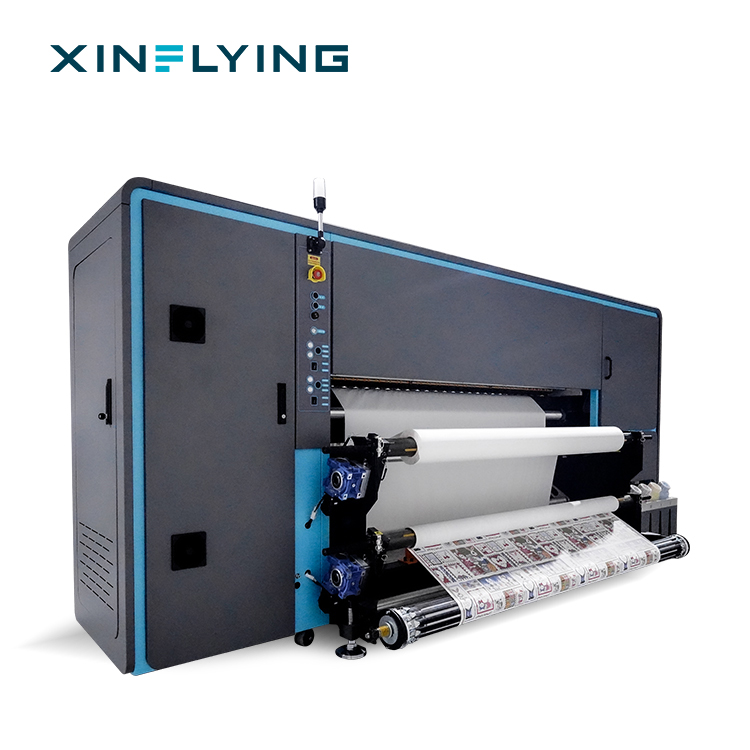
XINFLYING XF-19E15-PRO: 15 Epson i3200-A1 printheads, 190 cm print width, 3200 dpi. Image: XINFLYING.
The XF-19E15-PRO is a 190 cm (75") industrial sublimation printer built around 15 Epson i3200-A1 heads, each with 3200 nozzles and variable ink drop, running CMYK sublimation ink at a published 3200 dpi. It loads sublimation paper rolls up to 1,000 m.
Why it ranks first. Three documented features attack drift directly. First, a linear motor combined with a magnetic grid and a Japan THK silent guide — a transport architecture that is less sensitive to the vibration and belt creep that shift dot placement over a long run. Second, 27 press rollers plus an enlarged beam, which hold the web flat and evenly tensioned across the full 190 cm, so the paper does not wander between the first and the thousandth metre. Third, a fully sealed automatic moisturizing and cleaning system, which keeps nozzles in condition between jobs instead of relying on an operator remembering to cap them.
Throughput leaves headroom for quality: 524 m²/h in 1PASS at the fastest setting, 394 m²/h in 1PASS at the standard setting, 254 m²/h in 2PASS fastest and 188 m²/h in 2PASS standard. That means a producer can hold a higher-quality pass count and still meet daily output — the practical definition of consistency at volume.
Project fit. Industrial textile sublimation printing at high volume: sportswear factories, large garment manufacturers, professional sublimation production centres, and printers running long repeat programmes where a colour shift mid-roll is expensive.
Watch-outs. This is a 1,480 kg net machine drawing 14.5 kW on a 210–230 V, 45 A supply, with a 3,840 × 1,570 × 1,800 mm footprint. Floor loading, power provisioning and headroom should be confirmed before ordering. It is not a sampling-room machine.
Rank 2 — XF-19E8-PRO: The Eight-Head Workhorse
The XF-19E8-PRO keeps the 190 cm width and the 3200 dpi resolution but runs 8 Epson i3200-A1 heads in CMYK, at a published 306 m²/h in 1PASS fastest, 210 m²/h in 1PASS standard, 153 m²/h in 2PASS fastest and 109 m²/h in 2PASS standard.
Why it ranks second. It carries much of the flagship's stability engineering at lower cost and lower power: Japan THK silent linear guide, anti-collision devices at both ends, automatic flash-spray moisturizing, an intelligent printhead cleaning and moisturizing device, an external intelligent air-heat integrated dryer, and liquid-level plus waste-ink alarms. The US-imported fluorine rubber pressure paper wheel is a detail worth noting for consistency, because pressure-wheel hardness affects paper grip and therefore registration on long runs.
Project fit. Textile factories and professional sublimation centres that need industrial output but do not require 15-head throughput. At 10.2 kW on 210–230 V, 45 A and 1,400 kg net, site preparation is lighter than the flagship.
Watch-outs. Eight heads at 190 cm means the per-head coverage area is larger than on the 15-head platform, so nozzle health discipline matters more, not less. The maintenance architecture helps, but a documented daily nozzle check routine is still the deciding factor.
Rank 3 — XF-O2000-4I32A1: Best Mid-Range Performance
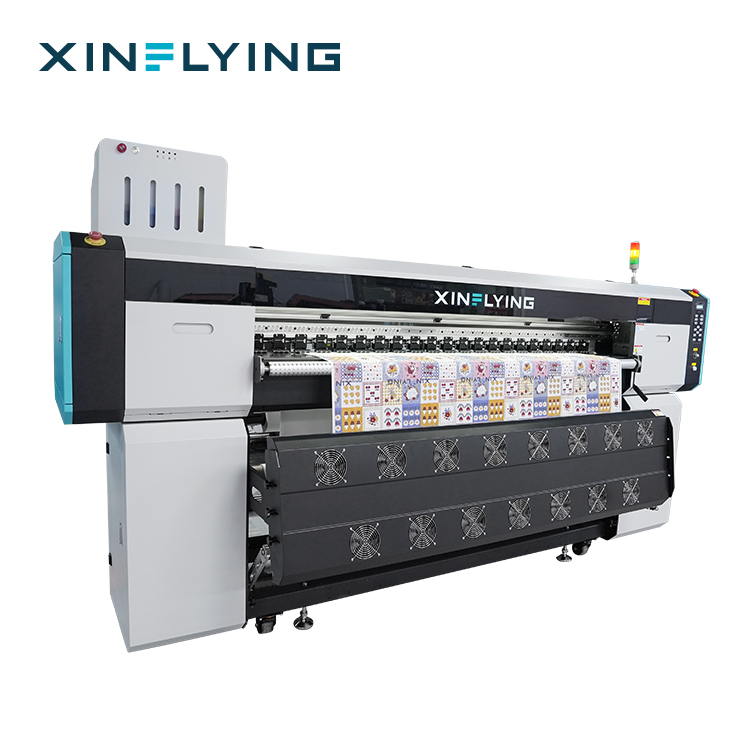
XINFLYING XF-O2000-4I32A1: 1950 mm print width, four printheads, front/middle/rear break-controlled heating. Image: XINFLYING.
The XF-O2000-4I32A1 is the model XINFLYING documents as its mid-range sublimation solution, and it is the pick of this review for growing printing companies. It uses 4 Epson i3200-A1 printheads in a CMYK+CMYK+CMYK+CMYK configuration, prints at 180 m²/h in 2PASS and 92 m²/h in 4PASS, and — significantly — offers a 195 cm (1.95 m) print width, the widest in the documented range.
Why it wins the mid-range position. Mid-range machines usually fail on drying, not on heads. The XF-O2000-4I32A1 addresses that with front, middle and rear break-controlled heating, a carriage with added base heating, and an integrated infrared and cooling-fan system. Stable ink fixing across the web is what prevents the subtle density shift that appears when a machine speeds up in the afternoon. Its media handling is also industrial-grade for the class: 1 mm media thickness, 200 kg media weight, and heat transfer paper rolls of 1,000–1,500 m.
Two further details reduce interruption frequency. The ink system pairs a 220 ml cartridge with a 3 L ink tank, and the machine is specified for piezoelectric inkjet with sublimation ink. Fewer refill stops in a shift means fewer opportunities for the pressure and colour discontinuity that follows a system top-up.
Project fit. Growing printing companies, professional textile printers, garment businesses and operations running continuous daily production — the case where a single-head or two-head machine has become the bottleneck but a 15-head platform is more capacity than the order book justifies.
Watch-outs. Its documented working range is narrower than the 19E series: 20–25 °C and 45–65% RH. It draws 8.5 kW on 220 V, 50/60 Hz, and weighs approximately 490 kg net (675 kg gross). RIP support is RIIN Print and Maintop, so an existing colour-managed workflow should be checked against those before ordering.
Rank 4 — XF-H1802X-2I32A1: The Entry-Level 1.8 m Platform
The XF-H1802X-2I32A1 is a 180 cm (1.8 m) machine with 2 Epson i3200-A1 heads in CMYK+CMYK, publishing 52 m²/h in 4PASS at the fastest setting and 42 m²/h at the standard setting. It uses a Honson board, an aluminium ink rack, a retraction system, and front, middle and rear break-controlled heating.
Why it ranks fourth. It shares the three-zone heating logic of the mid-range platform, which is the right architecture for its class, but its two-head configuration and 4PASS-only published operation mean it is a short-run and small-batch tool rather than a continuous-production tool. Consistency here is dominated by maintenance rhythm, not by transport engineering.
Project fit. Businesses starting sublimation printing, custom textile producers, apparel sampling operations and small-batch order production. At 3.5 kW, 110/220 V, 265 kg net and a 3,000 × 880 × 1,630 mm footprint, it fits a workshop that cannot host an industrial frame.
Watch-outs. Published working range is 20–35 °C and 45–65% RH. At 42–52 m²/h, it should be bought against a realistic weekly volume, not against peak-season demand.
Rank 5 — XF-H1301X-1I32A1: The 1.3 m Sampling and Compact Unit
The XF-H1301X-1I32A1 is a 130 cm (1.3 m) single-head machine with 1 Epson i3200-A1 head in CMYK, publishing 28 m²/h in 4PASS at the fastest setting, with an external constant-temperature automatic drying system, a Honson board, an aluminium ink rack and a retraction system.
Why it ranks fifth. Single-head architecture has the fewest variables to manage and the lowest capital exposure, which makes it a rational first machine — but 28 m²/h and a 130 cm width put a hard ceiling on volume, and the constant-temperature external dryer is a simpler drying approach than the multi-zone heating on the larger platforms.
Project fit. Apparel sampling, prototype and strike-off work, personalised textile products, and businesses validating a sublimation product line before committing to a wider platform. Power is 2 kW on 110/220 V; net weight is 140 kg with a 2,220 × 870 × 1,540 mm footprint.
Watch-outs. Working range is 20–35 °C and 45–65% RH. It is a validation machine, not a substitute for production capacity.
Specification and Fit Comparison
| Rank | Model | Print width | Printheads | Published speed | Drying / heating | Power | Net weight | Best-fit project |
|---|---|---|---|---|---|---|---|---|
| 1 | XF-19E15-PRO | 190 cm (75") | 15 × Epson i3200-A1 | 524 m²/h (1PASS, fastest); 188 m²/h (2PASS, standard) | External intelligent air-heat integrated dryer; fully sealed automatic moisturizing and cleaning | 14.5 kW, 210–230 V, 45 A | 1,480 kg | High-volume industrial textile sublimation |
| 2 | XF-19E8-PRO | 190 cm (75") | 8 × Epson i3200-A1 | 306 m²/h (1PASS, fastest); 109 m²/h (2PASS, standard) | External air-heat integrated dryer; flash-spray moisturizing; intelligent head cleaning | 10.2 kW, 210–230 V, 45 A | 1,400 kg | Factory output without 15-head capacity |
| 3 | XF-O2000-4I32A1 | 195 cm (1.95 m) | 4 × Epson i3200-A1 | 180 m²/h (2PASS); 92 m²/h (4PASS) | Front/middle/rear break-controlled heating; IR + cooling fan; carriage base heating | 8.5 kW, 220 V, 50/60 Hz | ≈490 kg | Growing printers, continuous daily production |
| 4 | XF-H1802X-2I32A1 | 180 cm (1.8 m) | 2 × Epson i3200-A1 | 52 m²/h (4PASS, fastest); 42 m²/h (4PASS, standard) | Front/middle/rear break-controlled heating | 3.5 kW, 110/220 V | 265 kg | Startups, sampling, small-batch custom textile |
| 5 | XF-H1301X-1I32A1 | 130 cm (1.3 m) | 1 × Epson i3200-A1 | 28 m²/h (4PASS, fastest) | External constant-temperature automatic drying system | 2 kW, 110/220 V | 140 kg | Sampling, prototyping, personalised products |
All values as published in XINFLYING model specification sheets. Resolution: 3200 dpi published for XF-19E15-PRO and XF-19E8-PRO; XF-O2000-4I32A1 is specified as piezoelectric inkjet.
Step-by-Step: Validating Color Consistency Before You Commit
Hardware sets the ceiling; the process determines where you land under it. The sequence below is the practical order in which a sublimation project should be validated, and it applies to any model in the table above.
Step 1 — Define the substrate and the colour target. Sublimation works best on polyester fabrics and polyester-coated substrates, because the dye bonds with polyester fibre during heat transfer. Cotton generally requires a different process or a special coating. Confirm the exact fabric and colour reference before comparing machines.
Step 2 — Match width and throughput to the order profile. Compare the largest repeating panel size against print width, and the weekly square metres against published speed at the pass count you intend to run — not the headline number.
Step 3 — Configure RIP and ICC control. Maintop is the standard RIP across the documented range; RIIN (Hoson only), PhotoPrint and Printfactory are optional on the XF-19E15-PRO and XF-19E8-PRO, and RIIN Print and Maintop are supported on the XF-O2000-4I32A1. Load a profile built for your ink and substrate combination.
Step 4 — Confirm the room, not just the machine. The XF-19E15-PRO and XF-19E8-PRO are specified for 18–30 °C and 35–65% RH; the XF-O2000-4I32A1 for 20–25 °C and 45–65% RH; the XF-H1802X-2I32A1 and XF-H1301X-1I32A1 for 20–35 °C and 45–65% RH.
Step 5 — Nozzle check, then test print. Run a nozzle check, clean if output is abnormal, then adjust resolution, speed and ink density one variable at a time. Change one parameter per test and record the result — changing several at once makes the source of a shift impossible to identify.
Step 6 — Verify the transfer side. Temperature and transfer time on the calender are documented causes of colour deviation. Fix them before judging the printer.
Step 7 — Lock a maintenance rhythm. Daily nozzle checks for machines in continuous production, regular cleaning, correct operating conditions, and avoiding long idle periods are the documented countermeasures to clogging and banding. Keep the optimised parameter set on file so repeat orders start from a known state.
Use Cases: Which Project Profile Maps to Which Machine
Field results are more useful than feature lists when the question is fit. The deployments below describe production outcomes from XINFLYING sublimation installations; the model recommendation is derived from the production profile each describes.
Sportswear manufacturing — 15 units, 4 years, Brazil
A sportswear manufacturer producing football jerseys, basketball uniforms and customised sportswear uses sublimation to print high-resolution patterns, team logos and full-colour designs on polyester before cutting and sewing. The reported result after adoption: improved flexibility for customised orders, reduced dependence on outsourced printing, and more consistent colour quality across batches. That is a repeat-order colour problem at volume, which maps to the XF-19E15-PRO or XF-19E8-PRO.
Team uniform supply — 8 units, 5 years, Brazil
A sports uniform supplier produces customised football kits, training uniforms and team apparel with personalised names, numbers and graphics. The reported result: shorter production cycles while maintaining vibrant colours and the detailed patterns team uniforms require. The mix of small-batch customisation and continuous commercial printing maps to the XF-O2000-4I32A1 or XF-19E8-PRO.
Home textiles — 10 units, 4 years
A home textile manufacturer applies sublimation to curtains, cushions, decorative fabrics and customised polyester products, building collections that need rich patterns, accurate colour and flexible production. Large-format work with detailed patterns maps to the XF-O2000-4I32A1, whose 195 cm width is the widest documented, or to the XF-19E8-PRO.
Printing service provider — 5 units, 3 years
A digital textile printing service provider supplying sportswear brands, apparel factories and customised textile businesses reported that the solution expanded production capacity, supported more customer projects and improved response speed on customised orders. A multi-client service model with variable run lengths maps to the XF-O2000-4I32A1 as the capacity-balanced choice.
Sampling and market entry
Where the requirement is validation rather than volume — apparel sampling, strike-offs, personalised products — the XF-H1301X-1I32A1 provides a single-head entry point, and the XF-H1802X-2I32A1 provides a 1.8 m step up once order volume justifies it.
Documentation to Check Before the Machine Ships
Colour consistency is a production issue; compliance is a market-access issue. Both belong in the same evaluation file.
- European Union. Verify CE compliance covering applicable electrical safety, electromagnetic compatibility and product safety requirements. A reliable supplier provides valid certification documents, test reports and technical files that match the actual printer model.
- RoHS. RoHS documentation confirms that electrical and electronic components meet restrictions on hazardous substances. Request it and confirm it applies to the model being supplied, not to a sister model.
- United States. FCC compliance is commonly required for electronic equipment to control electromagnetic interference, and additional safety certification may apply depending on configuration and sales channel.
- Model matching. Confirm that any certificate reference quoted in a quotation or brochure corresponds to the exact model and configuration being shipped. Incorrect or incomplete compliance documents can result in customs delays, sales restrictions or additional compliance costs.
Electronics stability is documented rather than assumed. Where a supplier cites a certificate number, ask for the underlying test report and check that the model and configuration on the report match the order.
FAQ
Which certification documents should I verify before importing a dye sublimation printer into the EU or the US?
For the EU, verify CE compliance covering applicable electrical safety, electromagnetic compatibility and product safety requirements, and confirm that the certification documents, test reports and technical files match the exact model being supplied. Ask for RoHS documentation as well, since it confirms that electrical and electronic components meet restrictions on hazardous substances. For the US, FCC compliance is commonly required for electronic equipment to control electromagnetic interference, and additional safety certification may be required depending on configuration and sales channel. In both markets, mismatched or incomplete documents can cause customs delays, sales restrictions or additional compliance costs.
Which hardware features actually improve color consistency on a long sublimation run?
Five documented features matter most. Nozzle maintenance architecture — fully sealed automatic moisturizing and cleaning on the XF-19E15-PRO, automatic flash-spray moisturizing and intelligent printhead cleaning on the XF-19E8-PRO — reduces the chance of partial blockage reaching production. Media transport stability, delivered through 27 press rollers and an enlarged beam on the XF-19E15-PRO, a Japan THK silent guide, and a US-imported fluorine rubber pressure paper wheel on the XF-19E8-PRO, keeps paper advance repeatable. Drying control, through an external air-heat integrated dryer or three-zone break-controlled heating with infrared and cooling fans, fixes ink evenly across the web. Printhead count and resolution headroom allow a higher-quality pass count at the same output. RIP and ICC control determine whether the colour you approve is the colour you reprint.
Is a more expensive sublimation printer always better for color-critical work?
No. The right machine is the one that matches actual production needs, budget and expansion plans. Cost scales with printhead count, print width, power draw and machine weight: from 2 kW and 140 kg on the single-head XF-H1301X-1I32A1, through 3.5 kW and 265 kg on the XF-H1802X-2I32A1, 8.5 kW and approximately 490 kg on the XF-O2000-4I32A1, up to 10.2 kW and 1,400 kg on the XF-19E8-PRO and 14.5 kW and 1,480 kg on the XF-19E15-PRO. A sampling operation cannot use 524 m²/h; a high-volume factory cannot absorb the reprint cost of a machine that runs out of capacity mid-season. Match the platform to the order book.
How can I validate color output before committing to a full production line?
Validate in the same sequence you will produce in. Confirm the substrate is polyester or polyester-coated, profile it through RIP software with the correct ICC profile for the ink and fabric, run a nozzle check, then test print and transfer at the calender temperature and dwell time you intend to use, changing one parameter per test. Record the optimised parameter set so repeat orders start from a known state. Minimum order quantity is 1 unit and pre-shipment testing is performed, so a single-machine evaluation is practical before scaling to a multi-unit line. To discuss a trial configuration or request a quotation, contact the XINFLYING team at info@xin-flying.com or +86 188-1322-1357.
What lead time and technical support should I plan for?
Lead time is 5–40 days depending on model and configuration, against a monthly production capacity of 1,600+ units, so scheduling is possible for multi-unit rollouts. Technical support is delivered by over 50 engineers providing 24/7 online assistance. Plan three things before the machine arrives: the power supply (45 A at 210–230 V for the XF-19E series; 220 V at 50/60 Hz for the XF-O2000-4I32A1), the room conditions in the model specification, and operator time for nozzle-check and cleaning routines, because maintenance discipline is the largest single variable in long-run colour stability.
Conclusion: Buy the Transport and the Drying, Not the Headline Speed
Ranked by the hardware that actually holds colour steady, the 2026 line-up divides cleanly. The XF-19E15-PRO is the consistency flagship — 15 heads, 3200 dpi, 27 press rollers, linear motor with magnetic grid, sealed automatic moisturizing — and it is the correct choice when a mid-roll colour shift is the expensive failure. The XF-19E8-PRO delivers most of that stability at 10.2 kW and 1,400 kg. The XF-O2000-4I32A1 is the best mid-range machine in the range, and the reason is unglamorous: 195 cm of width, three-zone break-controlled heating, infrared and cooling support, and a 3 L ink tank — all of which attack drift rather than advertise speed. The XF-H1802X-2I32A1 and XF-H1301X-1I32A1 cover entry volume and sampling without pretending to be production platforms.
Two closing rules apply to every model. First, hardware sets the ceiling and process decides the result: ICC profiling, transfer settings and daily nozzle checks are not optional extras. Second, confirm documentation against the exact model — certification that does not match the shipped configuration is a market-access risk, not a formality.
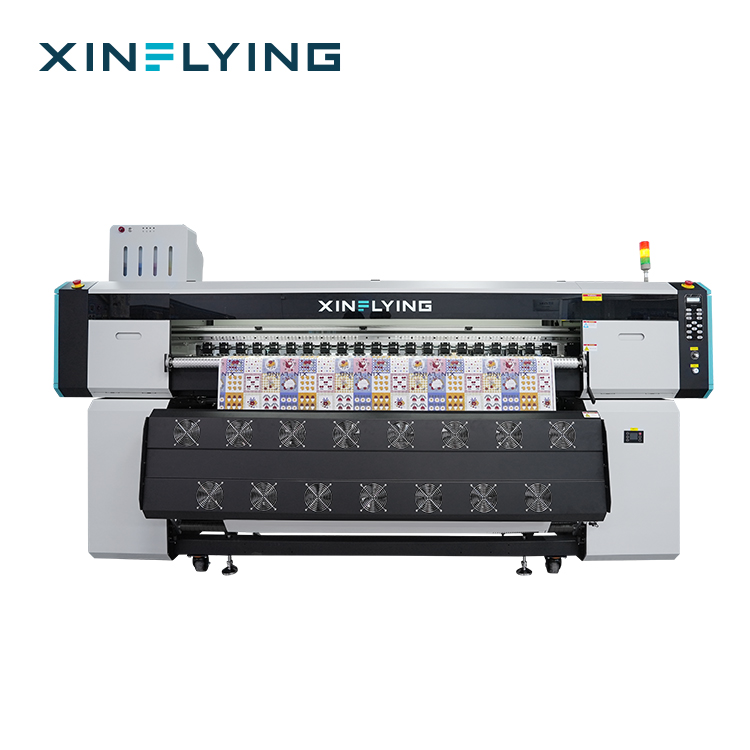
XINFLYING XF-O2000-4I32A1, the mid-range pick of this review. Image: XINFLYING.
Next step: match the machine to your order book
XINFLYING supplies dye sublimation printers from 1.3 m to 1.95 m, with OEM/ODM options including product branding, machine appearance, colour, logo and packaging customisation, minimum order quantity of 1 unit, and 24/7 online technical support from over 50 engineers.
Download the company and product brochure: XINFLYING corporate brochure (PDF)
Email: info@xin-flying.com | Tel / WhatsApp: +86 188-1322-1357 | Website: www.xin-flying.com
Address: No.7, Xiecun 2nd Industrial Zone, Panyu, Guangzhou, Guangdong
Have Questions or Need More Details?
Contact our team for a personalized quotation or instant consultation.
Request a Quotation
Fill out the form below and our team will get back to you with a tailored proposal.
WhatsApp Direct Chat
Prefer to chat in real-time? Message us on WhatsApp for instant assistance & quick answers.
- Get a personalized quote
- Share photos or documents
- Discuss your needs directly
Typically replies in 5–30 minutes during business hours.