
CE Certification Requirements for DTF Printers Imported Into the EU
A DTF printer placed on the EU market needs a CE conformity file built on three separate legal bases: the Low Voltage Directive 2014/35/EU for electrical safety, the EMC Directive 2014/30/EU for electromagnetic compatibility, and the Machinery Directive 2006/42/EC for machine safety — with RoHS 2011/65/EU covering restricted substances on top of them. One certificate headed “CE” is not a complete file. Buyers should be able to name the certificate number, the issuing body, the directive and the harmonised standard behind each document.
This guide is written for importers, distributors, brand owners and OEM buyers evaluating a direct-to-film printing line for the European Union. It explains what each directive actually covers, converts the paperwork into a practical request list, and uses the certificate references held by XINFLYING (Guangzhou Xin Flying Digital Technology Co., Ltd.) — a digital printing equipment manufacturer founded in 2010 in Panyu, Guangzhou — so readers can compare a complete compliance file against whatever a supplier has sent them.
Problem Definition: Compliance Files Usually Fail on Paper Before They Fail in Production
A DTF printer that runs cleanly in a factory in Guangzhou can still create problems in Rotterdam or Hamburg — not because of print quality, but because the conformity documentation does not survive a routine check. The failure is almost always administrative rather than technical:
- A supplier sends a single EMC certificate and presents it as “CE certification”, while the electrical safety and machinery documentation is missing.
- The certificate exists, but the model code on it does not match the model on the invoice, packing list or machine nameplate.
- The Declaration of Conformity is unsigned, or names a trading company rather than the legal manufacturer.
- The listed standards are superseded versions, or the certificate never states which directives it covers.
- Restricted-substance (RoHS) evidence is missing even though the buyer’s own retail customer requires it.
The commercial consequences follow quickly. Customs and market surveillance checks focus on whether the equipment is supported by correct documentation for the exact model being placed on the market. When the file is incomplete, the shipment can be held while paperwork is requested retroactively, resale into organised retail becomes harder, and service and spare-part discussions stall because nobody can confirm which configuration was assessed.
Because the importer is normally the party responsible for the product once it enters the EU, any gap in the supplier’s file becomes the importer’s exposure. The practical conclusion is that CE compliance belongs in supplier evaluation, not in the week the container is booked.
Industry Background: Why the EU Is a Compliance-Driven DTF Market
Europe is not a marginal territory for direct-to-film printing. Grand View Research reported that Europe was the leading regional market for DTF printing in 2024 with a 36.0% revenue share, inside a global DTF printing market valued at USD 2.7 billion that year. T-shirts remain the dominant end product, accounting for 41% of DTF printing revenue in 2024 according to KBV Research.
Supply, by contrast, is concentrated. Dataintelo estimates that China accounts for more than 45% of global DTF printer manufacturing capacity. For EU buyers this creates a structural situation: most machines are built outside the EU, while the obligation to demonstrate conformity rests with the party placing them on the EU market.
Growth projections reinforce the direction but should be read with care. Dataintelo projects the DTF printer market reaching USD 5.2 billion by 2034, while other research houses publish noticeably different growth rates for the same period. The trend that matters operationally — more DTF capacity, more cross-border purchasing, more documentation scrutiny — is consistent across all of them.
What has changed for buyers is status: compliance has moved from a formality to a selection criterion. Distributors reselling into EU retail chains increasingly ask their equipment supplier for certificate numbers before they ask for a price list.
Detailed Solution: The Four EU Legal Bases Behind a DTF Printer’s CE Mark
CE marking is not one approval. It is the visible result of a manufacturer demonstrating conformity with every EU directive applicable to the product. For a direct-to-film printer, four legal instruments apply in practice, and a complete file addresses each of them separately.
1. Low Voltage Directive 2014/35/EU — Electrical Safety
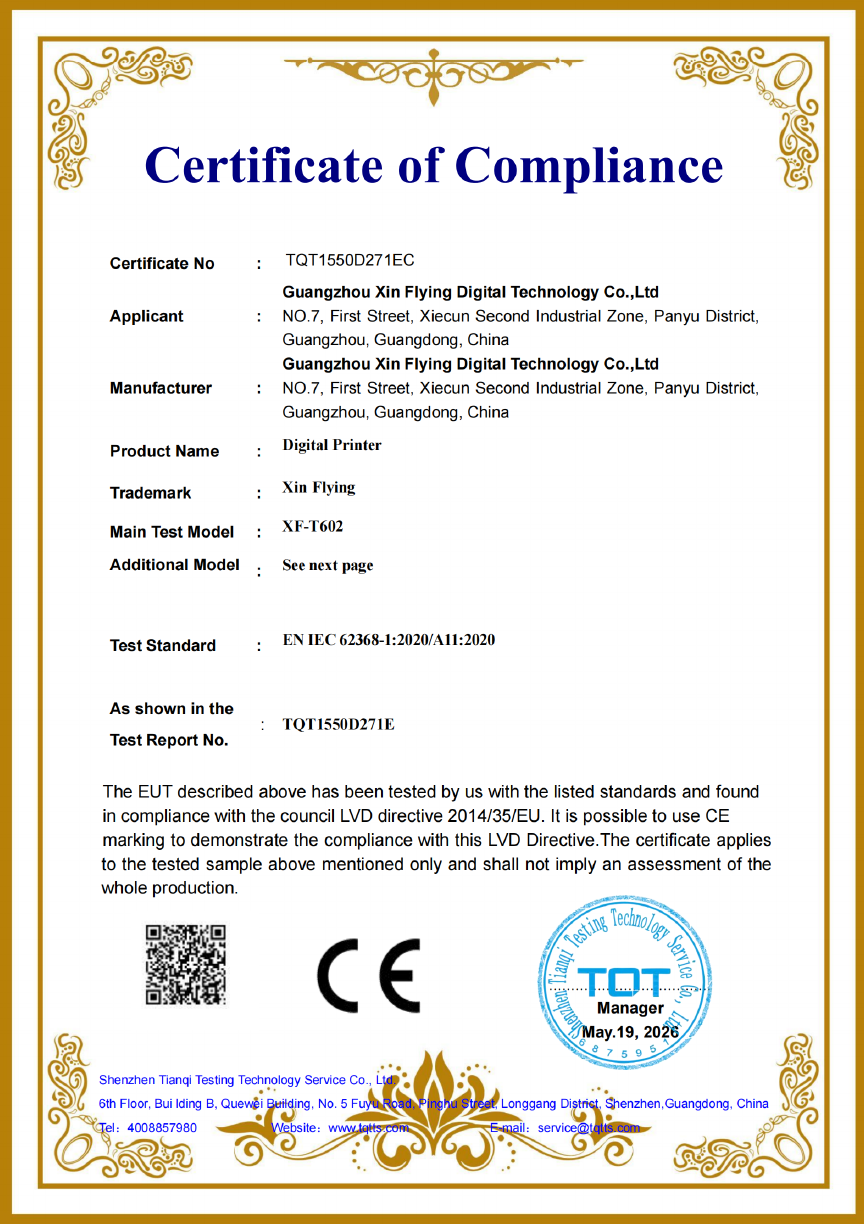
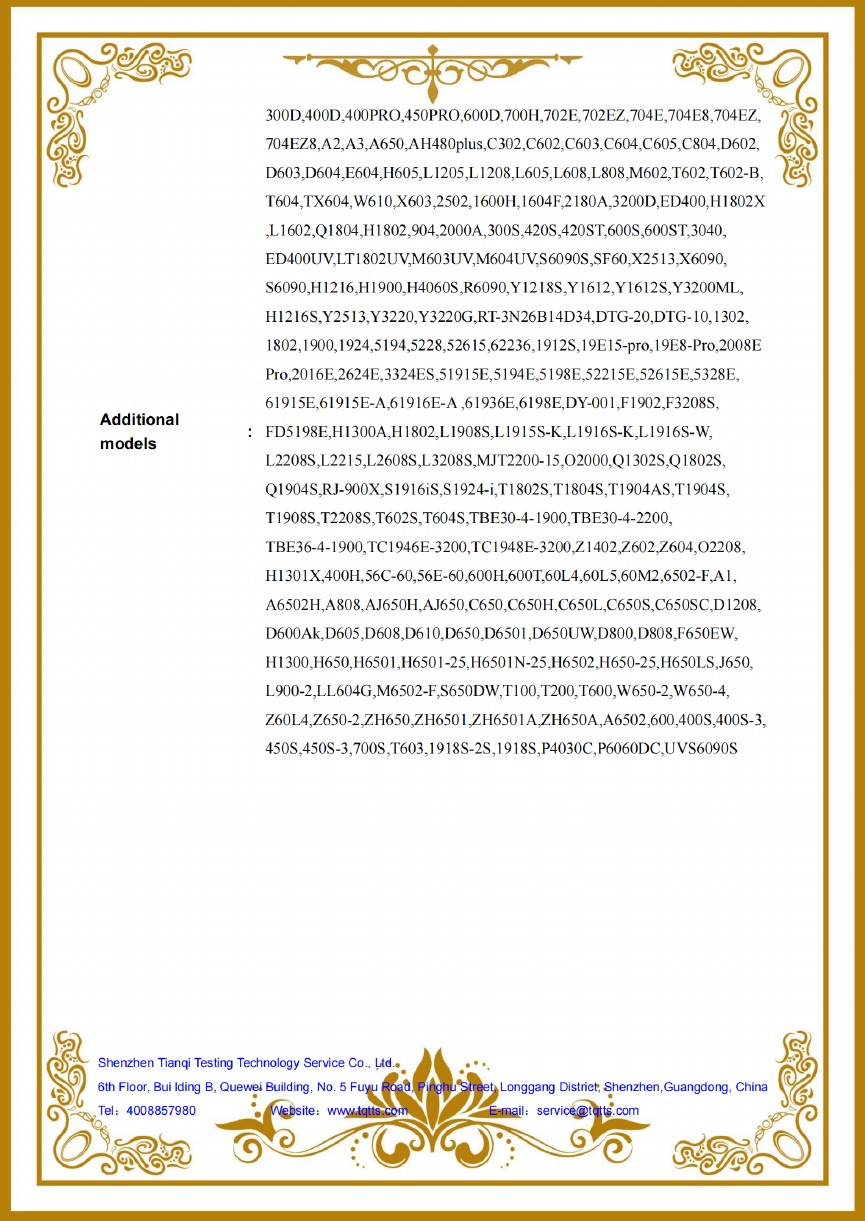
The LVD covers electrical safety for equipment operating within defined voltage ranges, which includes the power supply, control electronics and heating elements of a DTF printer. The harmonised standard used in the current XINFLYING file is EN IEC 62368-1:2020/A11:2020, the safety standard for audio/video, information and communication technology equipment.
The corresponding document is a Certificate of Compliance numbered TQT1550D271EC, issued by TQT (Shenzhen Tianqi Testing Technology Service Co., Ltd.) on 19 May 2026 for digital printer products placed on the EU market under LVD 2014/35/EU.
Buyers should connect this certificate to the nameplate. XINFLYING DTF models such as the XF-702E are rated for 110–220V, 50/60 Hz input at 0.8 kW, and the tested voltage and current ratings need to match the rating plate on the delivered unit.
2. EMC Directive 2014/30/EU — Electromagnetic Compatibility
EMC compliance addresses two different risks: the printer emitting interference that disturbs other equipment, and the printer continuing to operate correctly in an environment where other equipment emits interference. The harmonised standards referenced in the XINFLYING EMC file are:
- EN 55032:2015/A11:2020 — emission requirements
- EN 55035:2017/A11:2020 — immunity requirements
- EN IEC 61000-3-2:2019+A1:2021 — harmonic current emissions
- EN 61000-3-3:2013/A2:2021 — voltage changes, fluctuations and flicker
The corresponding Certificate of Compliance is numbered TQT1550D270EC, also issued by TQT on 19 May 2026, covering EMC compliance under Directive 2014/30/EU.
3. Machinery Directive 2006/42/EC — Machine Safety
A DTF printer is machinery: it has a moving carriage, heated components, an ink and powder workflow, and an operator interface. The Machinery Directive file therefore addresses risk assessment and machine safety rather than electricity alone. The standards referenced in the XINFLYING documentation are:
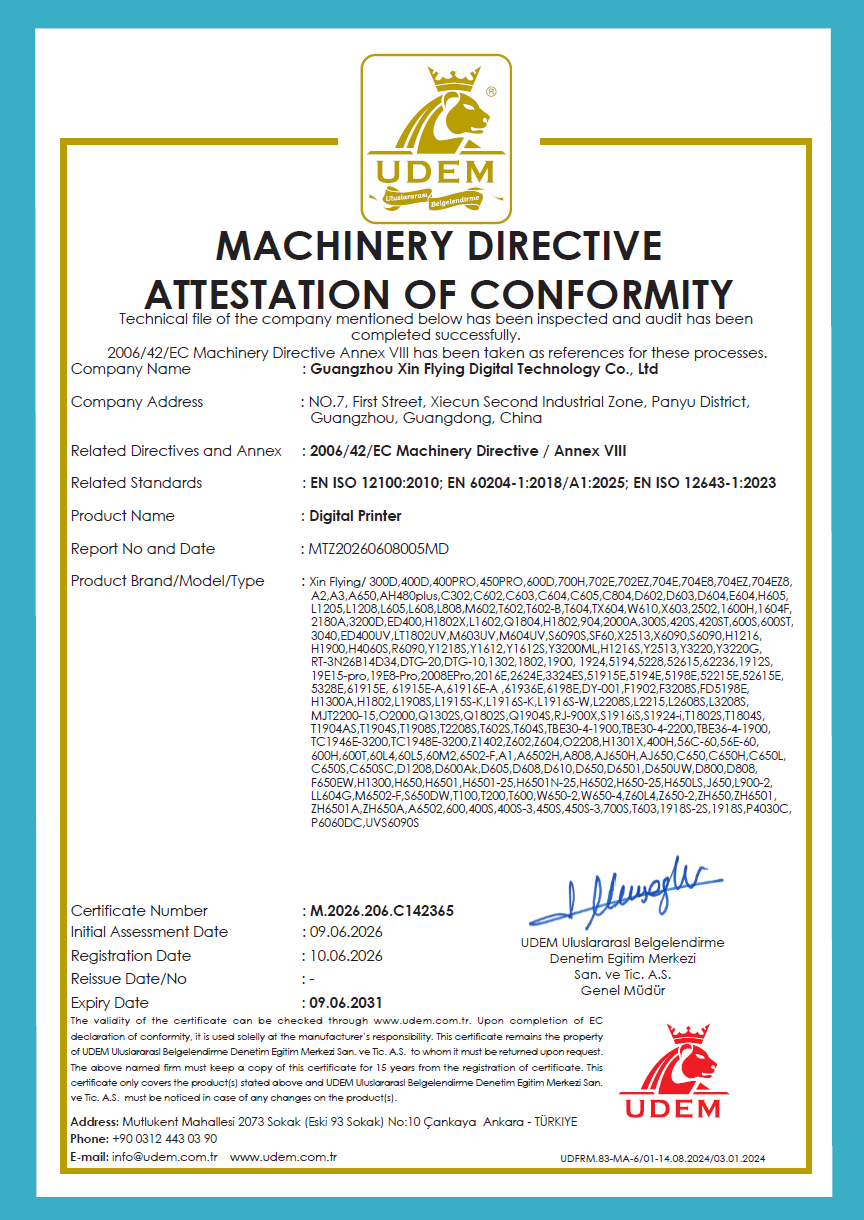
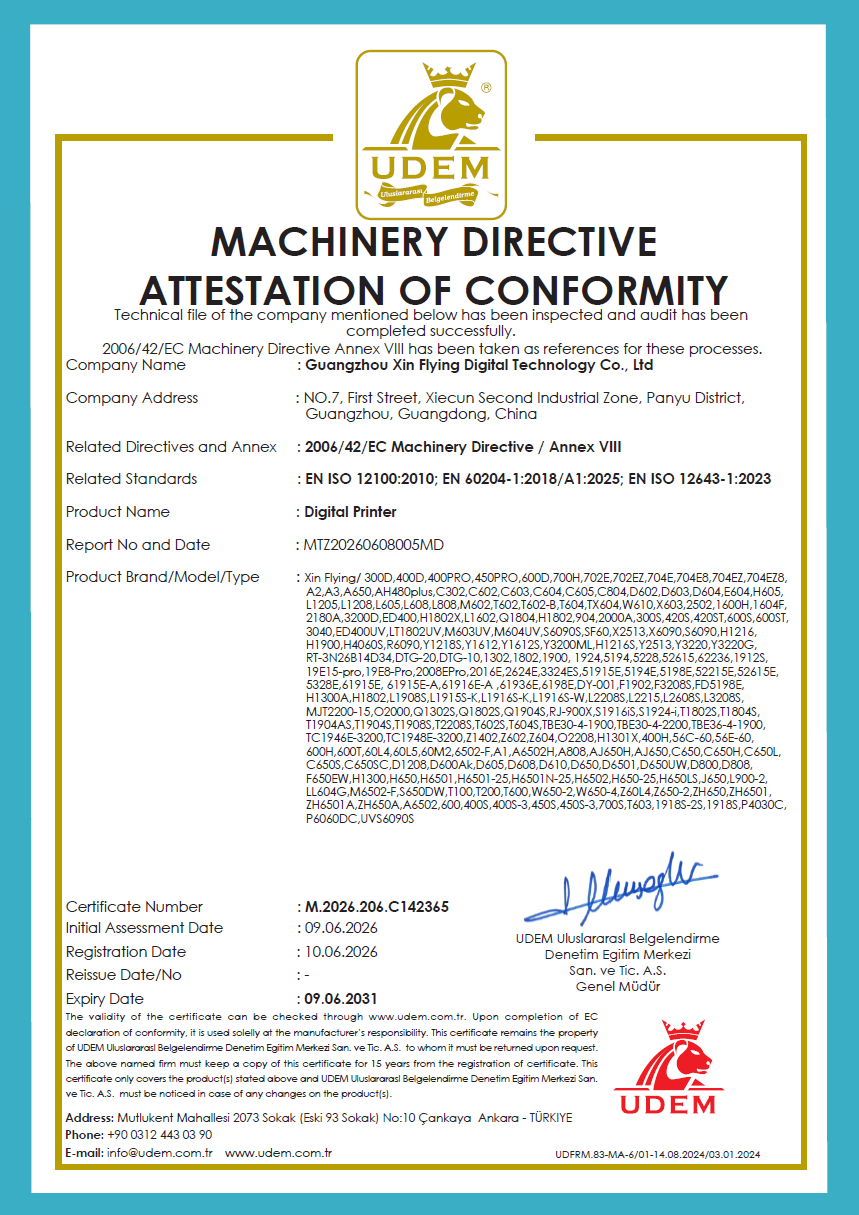
- EN ISO 12100:2010 — risk assessment and risk reduction methodology
- EN 60204-1:2018/A1:2025 — electrical equipment of machines
- EN ISO 12643-1:2023 — safety requirements for graphic technology equipment
The Certificate of Conformity is numbered M.2026.206.C142365, issued by UDEM on 10 June 2026 and valid until 9 June 2031. A second machinery certificate, M.2026.206.C142385, is held under the same scheme.
4. RoHS Directive 2011/65/EU — Restricted Substances
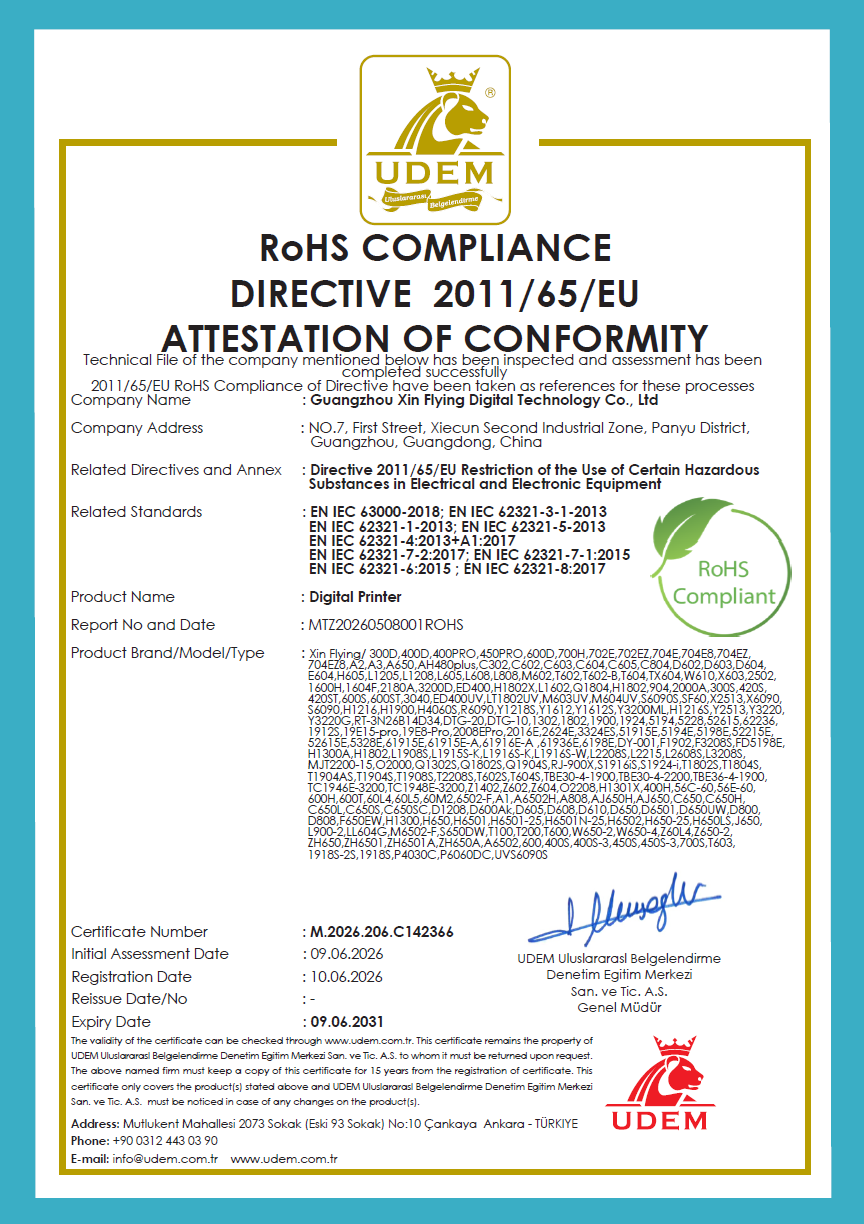
RoHS limits the use of specified hazardous substances in electrical and electronic equipment. The XINFLYING attestation is numbered M.2026.206.C142366, issued by UDEM on 10 June 2026 and valid until 9 June 2031, assessed against EN IEC 63000:2018 and the EN IEC 62321 test series.
A single attestation can also cover more than one directive, and buyers should expect to see this in a mature file. XINFLYING holds a combined LVD and EMC Attestation of Conformity numbered M.2026.206.C142475, issued by UDEM on 11 June 2026 and valid until 10 June 2031, referencing EN IEC 62368-1:2020/A11:2020, EN 55032:2015/A1:2020, EN 55035:2017, EN 61000-3-2:2014 and EN 61000-3-3:2013. Earlier CE documentation supports continuity: certificate BSTXD211021006201EC was issued by BST Testing (Shenzhen) Co., Ltd. on 18 October 2021, and certificate CTICAIQ415250900815313DC by CTIC Testing Group (Guangdong) Co., Ltd. on 12 August 2025.
What CE Documentation Does Not Cover
- Print quality or productivity. CE says nothing about resolution, output speed, colour consistency or uptime.
- Ink chemistry. Printing inks and printing pastes can require separate textile-safety documentation. XINFLYING holds OEKO-TEX® ECO PASSPORT certificate SH150194016 from TESTEX AG, valid until 31 December 2026, covering textile printing inks and printing pastes.
- Private-label changes. Certification relates to a specific configuration. If branding, packaging, appearance or colour change as part of an OEM or ODM project, the buyer should confirm in writing which certificate applies to the delivered model.
- The importer’s own obligations. Resale, leasing or workplace installation can trigger duties that the manufacturer’s file does not discharge on the importer’s behalf.
Step-by-Step Breakdown: How to Verify CE Compliance Before You Pay a Deposit
The sequence below takes less time than resolving a documentation problem after the container has sailed.
- Fix the configuration first. Decide print width, printhead count and power rating before requesting certificates. A 60 cm model with two printheads and a 60 cm model with five printheads are different products with potentially different certificate scopes.
- Ask for certificate numbers with the quotation. A supplier that can send certificate numbers, issuing bodies and standards together with a price is a supplier that holds the file. Vague references to “CE available” should be treated as an open item.
- Verify each certificate individually. For every number, check the issuing body, the directive covered, the harmonised standard, the issue date, the expiry date and the stated product scope.
- Cross-check the model code. Match the certificate scope against the quotation, proforma invoice, packing list and the nameplate on the machine itself. The four documents should name the same model.
- Request the EU Declaration of Conformity. Confirm it is signed, names the legal manufacturer — for this supplier, Guangzhou Xin Flying Digital Technology Co., Ltd. — and lists the directives and standards relied upon.
- Confirm the acceptance procedure. XINFLYING product acceptance is based on passing pre-shipment test procedures. Ask for the test record for your specific unit and keep it with the certificate file.
- Agree commercial terms and lead time. The minimum order quantity is 1 unit and production lead time is 5–40 days. Delivery terms are EXW/FOB/CIF/DDP; payment terms are T/T, Western Union and PayPal.
- Archive the file after delivery. Store the Declaration of Conformity, certificates and test record against the machine serial number so that resale, service or inspection queries can be answered without reopening the purchase.
Use Cases: How Different EU Buyers Use the Same Compliance File
EU distributor building a private label. A distributor selling under its own brand needs the certificate to survive the rebrand. XINFLYING provides OEM services covering product branding, logo and packaging customization, and ODM services covering machine appearance customization, colour customization and customized solutions based on customer requirements. In a private-label project, the compliance question is whether the chosen certificate scope lists the delivered model, so ask for that mapping in writing before the packaging artwork is approved.
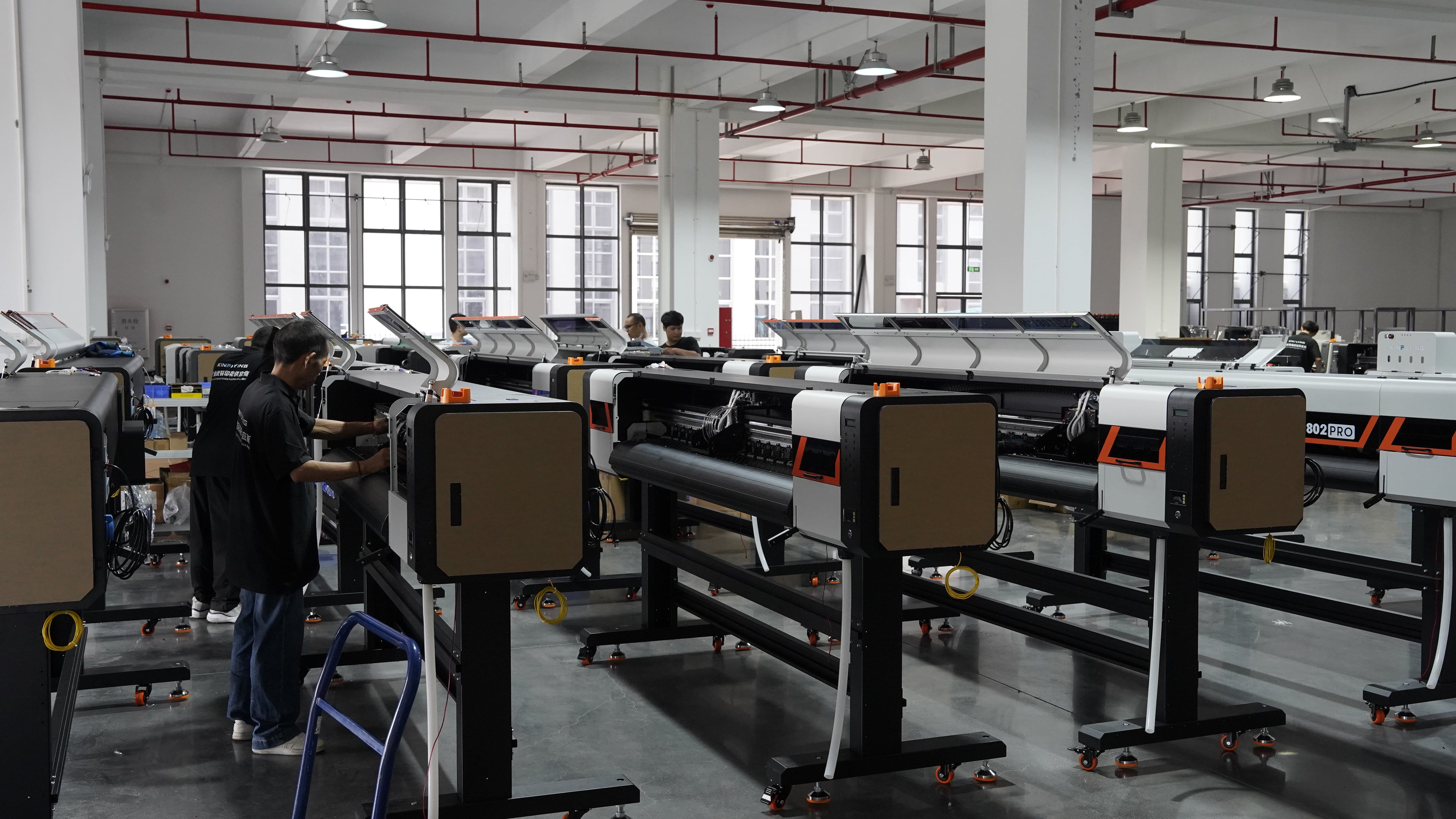
Garment factory bringing decoration in-house. A factory that previously outsourced transfers needs production capacity and a documentation trail. XINFLYING operates a 37,440 m² facility with more than 200 employees, a 20-engineer R&D team and monthly capacity of 1600+ units, producing DTF, UV DTF, DTG and dye sublimation equipment. A garment manufacturing customer with 20 units applied DTF printing to add logos and graphics to finished garments, using it for sampling and short-run projects alongside larger orders.
Print-on-demand and custom apparel businesses. These buyers start small and scale, which makes model-level documentation important: the entry machine ordered today and the production machine ordered in two years may sit under different certificate parts. XINFLYING has supplied a print-on-demand business owner running 5 units over 5 years and a custom apparel printing business running 2 units over 3 years.
DTF transfer suppliers. A transfer supplier running 30 units reported improvements in transfer production capacity and print stability. For this buyer type the compliance file matters twice — once for the printing equipment and once for the inks and consumables supplied downstream, where OEKO-TEX® ECO PASSPORT documentation for printing inks and printing pastes becomes relevant.
After-sales continuity. Documentation is only useful if technical support follows it. XINFLYING maintains over 50 engineers delivering 24/7 online technical support, which matters when a buyer needs to confirm which configuration was certified for a specific model.
Comparison Table: Directives, Standards and Verified Certificate References
The table below maps each EU legal basis to the harmonised standards and the certificate references held in the XINFLYING compliance file. Certificate numbers, issuing bodies and dates are stated exactly as issued.
| Directive | Harmonised standard | Certificate number | Issuing body | Issue date |
|---|---|---|---|---|
| LVD 2014/35/EU | EN IEC 62368-1:2020/A11:2020 | TQT1550D271EC | TQT (Shenzhen Tianqi Testing Technology Service Co., Ltd.) | 19 May 2026 |
| EMC 2014/30/EU | EN 55032:2015/A11:2020; EN 55035:2017/A11:2020; EN IEC 61000-3-2:2019+A1:2021; EN 61000-3-3:2013/A2:2021 | TQT1550D270EC | TQT | 19 May 2026 |
| LVD 2014/35/EU + EMC 2014/30/EU | EN IEC 62368-1:2020/A11:2020; EN 55032:2015/A1:2020; EN 55035:2017; EN 61000-3-2:2014; EN 61000-3-3:2013 | M.2026.206.C142475 | UDEM | 11 June 2026 |
| MG 2006/42/EC | EN ISO 12100:2010; EN 60204-1:2018/A1:2025; EN ISO 12643-1:2023 | M.2026.206.C142365 | UDEM | 10 June 2026 |
| MG 2006/42/EC | EN ISO 12100:2010; EN 60204-1:2018/A1:2025; EN ISO 12643-1:2023 | M.2026.206.C142385 | UDEM | 10 June 2026 |
| RoHS 2011/65/EU | EN IEC 63000:2018; EN IEC 62321 series | M.2026.206.C142366 | UDEM | 10 June 2026 |
| Textile printing inks and pastes | OEKO-TEX® ECO PASSPORT; EN ISO 17050-1 | SH150194016 | TESTEX AG | 11 December 2025 |
The CE documentation above covers DTF models including the XF-450PRO, XF-400D, XF-702E, XF-C602, XF-704E, XF-C604, XF-C605, XF-F606, XF-L608 and XF-F808, together with dye sublimation models such as the XF-H1301X-1I32A1, XF-H1802X-2I32A1, XF-O2000-4I32A1, XF-19E8-PRO and XF-19E15-PRO. Buyers should still confirm that the exact model and configuration on their order appears in the certificate scope.
| Document | What it demonstrates | Verification point |
|---|---|---|
| EU Declaration of Conformity | The manufacturer’s formal conformity statement | Signed, with directives, standards and legal manufacturer name |
| LVD Certificate of Compliance | Electrical safety under 2014/35/EU | Standard version, model scope, issue and expiry date |
| EMC Certificate of Compliance | Emission and immunity compliance under 2014/30/EU | All four referenced standards listed |
| Machinery Certificate of Conformity | Machine safety under 2006/42/EC | Risk assessment and machine electrical standards cited |
| RoHS attestation | Restricted substance compliance under 2011/65/EU | Assessment standard and validity period |
| Pre-shipment test record | Acceptance of the delivered unit | Matches the serial number of the shipped machine |
Frequently Asked Questions
Which CE documents should an EU buyer request from a DTF printer supplier before ordering?
Request four document groups and check each one separately. First, the EU Declaration of Conformity, signed by the legal manufacturer. Second, the Certificates of Compliance for the Low Voltage Directive 2014/35/EU, the EMC Directive 2014/30/EU and the Machinery Directive 2006/42/EC, plus the RoHS 2011/65/EU attestation. XINFLYING holds CE LVD certificate TQT1550D271EC issued by TQT on 19 May 2026 under EN IEC 62368-1:2020/A11:2020, CE EMC certificate TQT1550D270EC issued by TQT on 19 May 2026, CE Machinery certificate M.2026.206.C142365 issued by UDEM on 10 June 2026 and valid until 9 June 2031, and RoHS certificate M.2026.206.C142366 issued by UDEM on 10 June 2026. Third, the certificate scope or model list showing the exact model being purchased. Fourth, the pre-shipment test record for the unit shipped.
Does one CE certificate cover every DTF printer model a manufacturer sells?
No. Certificates are issued with a defined product scope and normally name the models they cover, so a certificate held for one machine does not automatically support a different model or a different configuration. The XINFLYING CE documentation lists DTF models including the XF-450PRO, XF-400D, XF-702E, XF-C602, XF-704E, XF-C604, XF-C605, XF-F606, XF-L608 and XF-F808, alongside dye sublimation models. Buyers should confirm that their exact model code appears in the scope of the certificates supplied with the order.
Can a 60cm DTF printer be customized for OEM production while remaining covered by CE documentation?
Yes, and customization is normally handled in two layers. OEM services for DTF printers cover product branding, logo and packaging customization. ODM services cover machine appearance customization, colour customization and customized solutions based on customer requirements. Because certification refers to a specific configuration, a buyer placing a private-label order should ask the supplier to confirm in writing which certificate applies to the delivered model and to include that confirmation with the shipping documents. The minimum order quantity for such orders is 1 unit, with a production lead time of 5–40 days.
What does pre-shipment acceptance involve for a DTF printer order?
Acceptance is based on passing pre-shipment test procedures before the machine leaves the factory. In practice, buyers should request the test record for their specific unit and keep it together with the Declaration of Conformity and the certificates, indexed by machine serial number. This record is what allows an importer to answer questions about the condition and configuration of the delivered equipment long after the purchase.
What is the minimum order quantity, lead time and payment terms for a CE-certified DTF printer?
The minimum order quantity is 1 unit and production lead time is 5–40 days. Delivery terms are EXW/FOB/CIF/DDP, and payment terms are T/T, Western Union and PayPal. If you are finalising a purchase and need the certificate set, technical documentation and product specifications for a specific model first, you can download the XINFLYING company and product brochure or send your model list and destination market to info@xin-flying.com for a document pack and quotation.
Conclusion: Compliance Is a Purchasing Criterion, Not an Afterthought
For a DTF printer entering the EU, the CE file is the product of four separate legal bases — LVD 2014/35/EU, EMC 2014/30/EU, Machinery Directive 2006/42/EC and RoHS 2011/65/EU — each supported by harmonised standards and named certificates. Buyers who evaluate suppliers on the completeness of that file, rather than on the presence of a single document, avoid the customs delays, resale friction and support problems that incomplete paperwork creates.
The verification routine is short: fix the configuration, request certificate numbers with the quotation, check each certificate against the directive and standard, confirm the model code on the certificate matches the model on the packing list and the nameplate, and keep the file with the machine serial number. XINFLYING maintains this documentation across its DTF and dye sublimation ranges, supported by a 37,440 m² production facility, monthly capacity of 1600+ units, and over 50 engineers providing 24/7 online technical support.
Need the Certificate Set for Your Model?
Send your target model, destination EU market and customization requirements to info@xin-flying.com, and request the matching CE certificates, Declaration of Conformity and product specifications before you confirm the order.
Brochure: XINFLYING Company & Product Brochure (PDF)
Website: www.xin-flying.com
Tel / WhatsApp: +86 188-1322-1357
Have Questions or Need More Details?
Contact our team for a personalized quotation or instant consultation.
Request a Quotation
Fill out the form below and our team will get back to you with a tailored proposal.
WhatsApp Direct Chat
Prefer to chat in real-time? Message us on WhatsApp for instant assistance & quick answers.
- Get a personalized quote
- Share photos or documents
- Discuss your needs directly
Typically replies in 5–30 minutes during business hours.