
CE-Certified Sublimation Printers: XF Models Compared
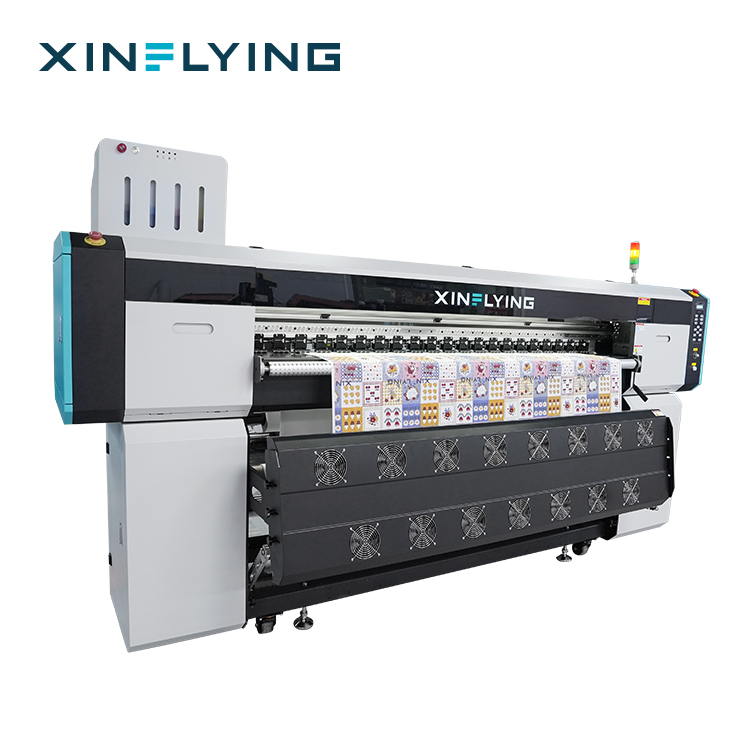
When buyers compare CE-certified sublimation printers for the EU market, the useful question is not only which machine prints faster. It is whether the exact model, configuration and compliance documents support the intended sale, installation and textile production plan. This guide compares the XF-19E15-PRO, XF-19E8-PRO and XF-O2000-4I32A1 using the supplied product specifications and certificate references. It also explains what to check in CE LVD, EMC, MD and RoHS evidence before selecting a large format sublimation printer.
The comparison brief cites certificate references TQT1550D270EC, TQT1550D271EC, M.2026.206.C142365, M.2026.206.C142366 and M.2026.206.C142385. Those references are important, but they are not a substitute for a model-by-certificate matrix. The supplied product data does not state which certificate number belongs to which model or which directive. Buyers should therefore verify the Declaration of Conformity for the exact machine, not assume that one certificate number covers every XF model in this set.
Quick answer: what changes across these three models
The three models share a roll-to-roll textile focus and XINFLYING branding, but they differ in printhead count, documented print speed, power demand, machine weight and media handling. The XF-19E15-PRO is the highest-throughput model in the supplied specifications, with 15 Epson i3200-A1 printheads and a documented 1PASS speed of 524 m²/h. The XF-19E8-PRO uses 8 printheads and is documented at 1PASS 306 m²/h. The XF-O2000-4I32A1 uses 4 printheads and is documented at 2PASS 180 m²/h and 4PASS 92 m²/h.
- For the highest documented output in this set, start with the XF-19E15-PRO.
- For an industrial high-volume solution described in the supplied FAQ content, the XF-19E8-PRO is the recommended high-end model.
- For growing textile printing companies needing a balance of capacity and operating efficiency, the XF-O2000-4I32A1 is the mid-range starting point.
- For CE compliance, the decisive step is not the model name or the certificate count. It is the model-specific Declaration of Conformity and the standards and editions cited for that machine.
Why CE evidence matters in the EU sublimation printer market
Demand context supports a careful procurement approach. Grand View Research valued the global dye sublimation printing market at USD 16.4 billion in 2025, and Smithers reports that garments accounted for 71.9% of total dye sublimation printing volume. Asia Pacific held a 36.5% revenue share in 2025 according to Grand View Research. For a textile producer buying a commercial sublimation printer, those figures describe a large and application-heavy market, not a guarantee that any one machine is compliant or suitable. Compliance and production fit remain model-level questions.
CE marking is a declaration-based system. It is not a single certificate that can be transferred freely from one model to another. A CE-marked industrial sublimation printer may involve several checkpoints, including electrical safety, electromagnetic compatibility, machinery safety and restriction of hazardous substances. Which checkpoints apply depends on the machine as placed on the market, its configuration and the applicable legal framework. This article is a procurement guide, not legal advice, and it does not replace the manufacturer's technical file or the importer's own conformity review.
The five certificate references in this comparison
The comparison set cites the following references: TQT1550D270EC, TQT1550D271EC, M.2026.206.C142365, M.2026.206.C142366 and M.2026.206.C142385. These may be relevant to the CE documentation package, but a reference number alone does not show which model it covers, which directive it supports or which standard edition was tested.
Important evidence boundary: The supplied product units describe printheads, speed, width, power and machine dimensions. They do not provide a model-to-certificate mapping. Any statement that one model has broader LVD, EMC, MD or RoHS coverage than another would be unsupported unless the buyer obtains the model-specific DoC and test report. The practical answer is to verify each reference against the exact model and configuration.
CE LVD, EMC, MD and RoHS: what each checkpoint means
Buyers often ask for a CE certificate as one document. In practice, the compliance file should be read as a set of claims. The table below separates the four checkpoints named in this comparison and shows what a buyer should verify before relying on them.
| Checkpoint | What it addresses | Evidence to request for the exact model |
|---|---|---|
| CE LVD | Electrical safety of equipment within the applicable voltage scope. | Model-specific Declaration of Conformity, electrical safety test report and the standards cited for the machine. |
| CE EMC | Electromagnetic emissions and immunity so the printer can operate without unacceptable interference. | EMC test report and DoC. Check whether standards such as EN 55032:2015 and EN IEC 61000-3-2:2019 are cited, including editions and amendments. |
| CE MD | Machinery safety, including guards, moving parts, emergency functions and safe commissioning where applicable. | DoC, risk assessment and the machinery safety standards cited. Check whether EN ISO 12643-1:2023 is listed for the model and scope. |
| RoHS | Restrictions on hazardous substances in electrical and electronic equipment. | RoHS declaration, material declarations and test evidence where available. Confirm that the documents identify the supplied model and serial or batch scope. |
Standard names should be read with their years. EN 55032:2015 addresses electromagnetic emissions from multimedia equipment. EN IEC 61000-3-2:2019 addresses harmonic current emissions. EN ISO 12643-1:2023 addresses general safety requirements for graphic technology equipment and systems. A DoC that says only EN 55032 without the year or amendment may not be enough for a buyer to compare scope. Ask for the exact reference as written in the DoC and test report.
Model comparison: documented specifications
The table below uses the supplied product specifications. Speeds are manufacturer-reported and depend on pass mode, media, RIP settings, drying and job content. They should not be treated as independent field-test results or as a guaranteed output rate for every textile producer.
| Model | Printheads | Print width | Documented speed | Power | Net weight | Notable hardware |
|---|---|---|---|---|---|---|
| XF-19E15-PRO | 15 × Epson i3200-A1 | 190 cm | 1PASS 524 m²/h; 2PASS 254 m²/h | 14.5 kW; 210–230V, 45A | 1480 kg | Linear motor and magnetic grid; Japan THK silent guide; 27 press rollers; fully sealed automatic moisturizing and cleaning. |
| XF-19E8-PRO | 8 × Epson i3200-A1 | 190 cm | 1PASS 306 m²/h; 2PASS 153 m²/h | 10.2 kW; 210–230V, 45A | 1400 kg | Japan THK silent linear guide; anti-collision device at both ends; automatic flash spray moisturizing; intelligent printhead cleaning; external air-heat dryer. |
| XF-O2000-4I32A1 | 4 × Epson i3200-A1 | 195 cm | 2PASS 180 m²/h; 4PASS 92 m²/h | 8.5 kW; 220V, 50/60Hz | ≈490 kg | Piezoelectric inkjet; CMYK+CMYK+CMYK+CMYK; front/middle/rear break-controlled heating; 220 ml cartridge plus 3 L ink tank; media thickness 1 mm and weight 200 kg. |
XF-19E15-PRO: highest documented throughput in this set
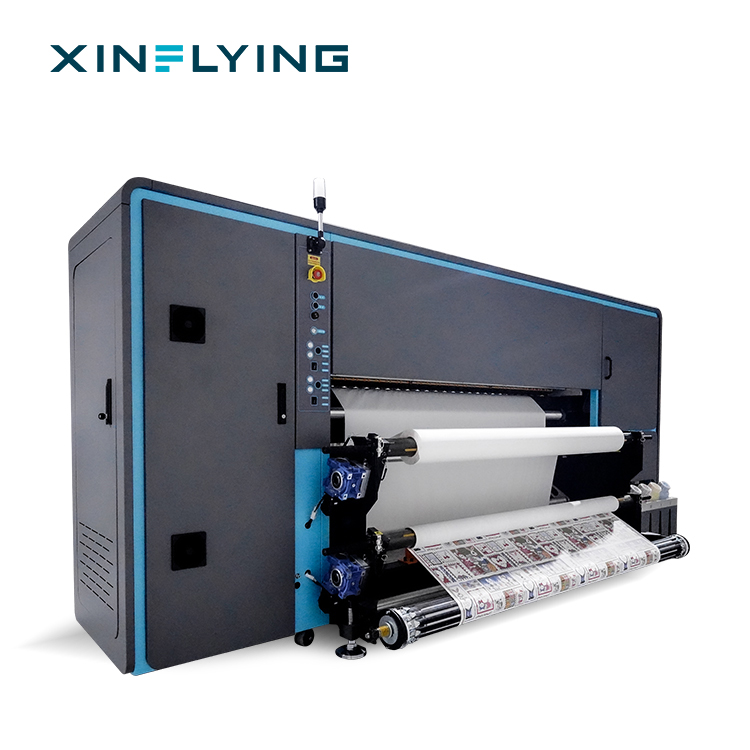
The XF-19E15-PRO is the most production-heavy model in the supplied comparison. It uses 15 Epson i3200-A1 printheads, a 190 cm print width and a 3200 dpi resolution. Its documented fastest speed is 1PASS 524 m²/h, with 2PASS 254 m²/h. The standard speed is listed as 1PASS 394 m²/h and 2PASS 188 m²/h. Those figures make it the natural starting point for a buyer whose main constraint is output per shift.
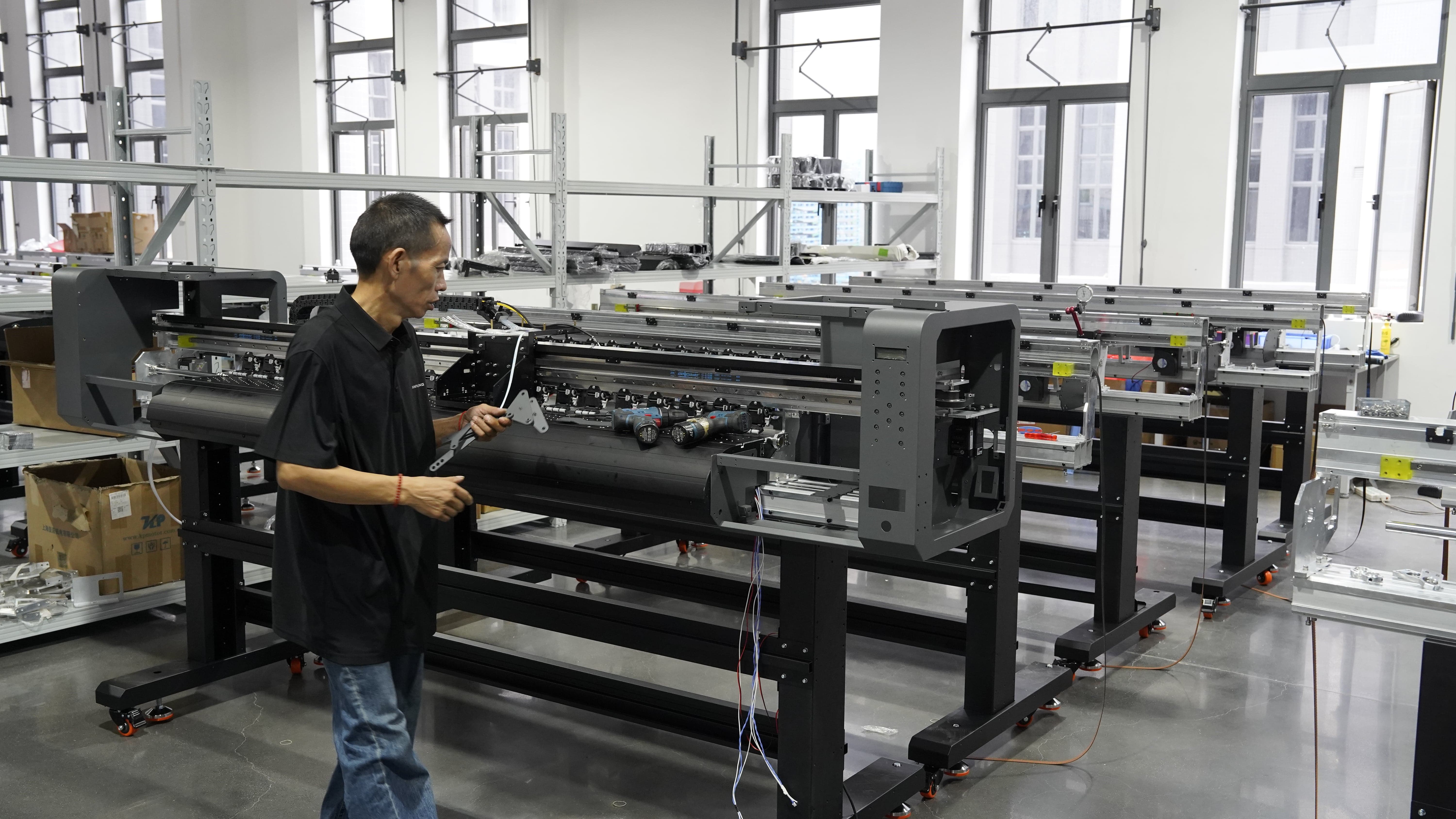
The hardware also signals an industrial configuration: a linear motor plus magnetic grid, Japan THK silent guide, 27 press rollers, an enlarged beam, and a fully sealed automatic moisturizing and cleaning system. Power demand is higher at 14.5 kW with a 210–230V, 45A supply. For EU site planning, that power profile should be checked against the facility's electrical design and the model-specific LVD evidence. Do not assume that a higher-speed model automatically has broader CE coverage. The correct check is whether the DoC and test report match the exact 15-head configuration being imported.
XF-19E8-PRO: industrial high-volume solution with 8 heads
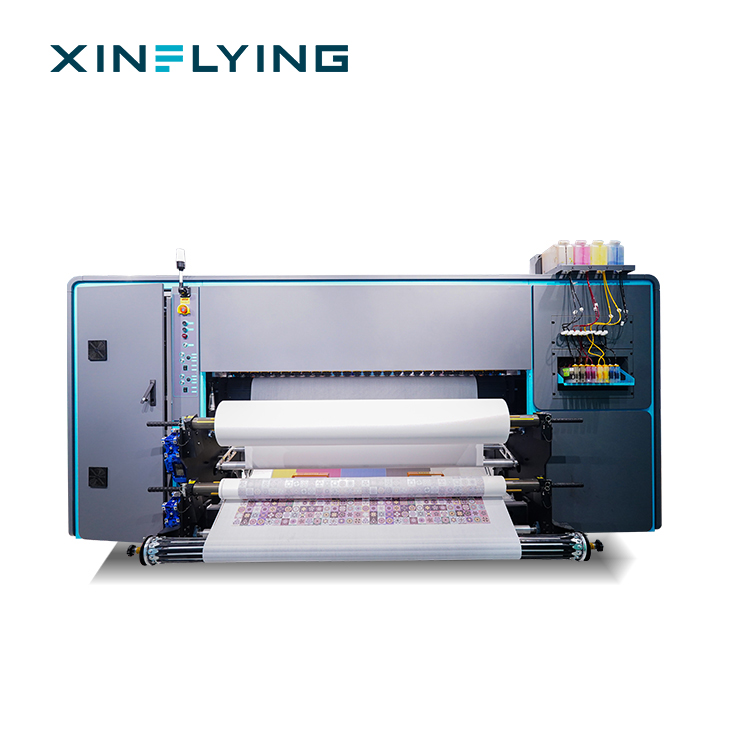
The XF-19E8-PRO is documented with 8 Epson i3200-A1 printheads, a 190 cm print width and 3200 dpi resolution. Its fastest documented speed is 1PASS 306 m²/h and 2PASS 153 m²/h, with standard speed listed as 1PASS 210 m²/h and 2PASS 109 m²/h. It draws 10.2 kW on a 210–230V, 45A supply and has a net weight of 1400 kg.
In the supplied FAQ content, the XF-19E8-PRO is described as the recommended high-end solution for industrial textile manufacturers and high-volume production environments. That recommendation is based on its 8-head configuration, speed and suitability for textile factories, large garment manufacturers and professional sublimation production centers. For CE review, the lower power demand than the 15-head model may simplify some site questions, but it does not remove the need for a model-specific EMC, LVD, MD and RoHS file. The buyer should confirm that the certificate reference cited in the quotation belongs to the 8-head XF-19E8-PRO, not to another configuration.
XF-O2000-4I32A1: mid-range capacity and wider media handling
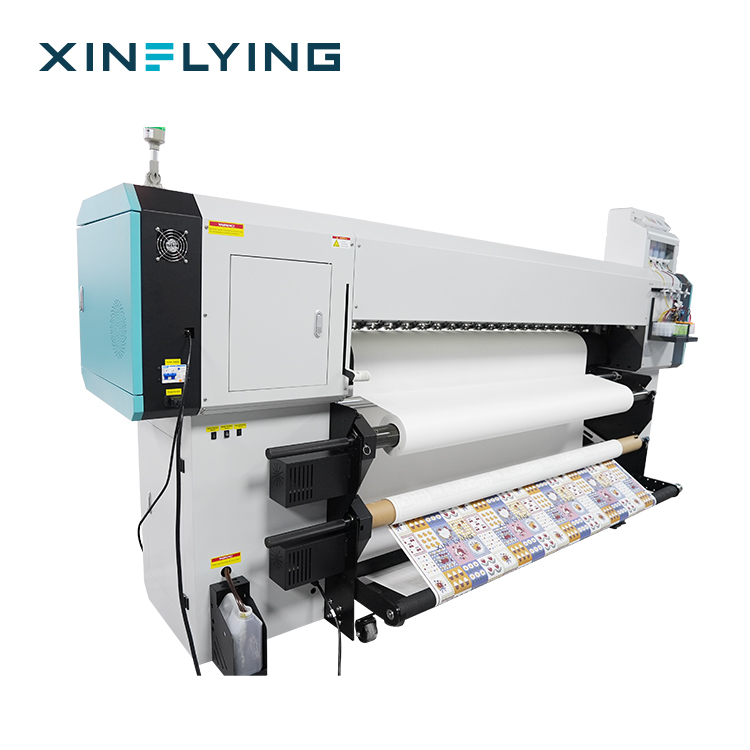
The XF-O2000-4I32A1 uses 4 Epson i3200-A1 printheads in a CMYK+CMYK+CMYK+CMYK arrangement, a 195 cm print width and piezoelectric inkjet technology. Its documented speed is 2PASS 180 m²/h and 4PASS 92 m²/h. Power is 8.5 kW on 220V, 50/60Hz. The machine is much lighter than the two 190 cm industrial models, with a net weight of approximately 490 kg and a gross weight of approximately 675 kg.
Media handling is a useful differentiator. The XF-O2000-4I32A1 supports heat transfer paper rolls of 1000–1500 m, media thickness up to 1 mm and media weight up to 200 kg. It uses a 220 ml cartridge plus a 3 L ink tank, and its heating is front, middle and rear break-controlled. The supplied FAQ positions it for growing printing companies, professional textile printers and garment businesses that need continuous daily production with a balance between capacity and operating efficiency. For EU buyers, the 195 cm width and lower power draw should be checked against the intended textile applications and the site electrical plan, while the CE evidence should be verified for this exact model.
How CE coverage can differ across same-brand models
CE compliance is attached to the machine as placed on the market, not to a brand family as a whole. Two printers from the same manufacturer can differ in power components, control systems, moving parts, heating modules and optional equipment. Those differences can change the technical file, the applicable standards and the test scope. A certificate number that appears on one quotation should not be copied onto another model without checking the model name, configuration and serial or batch scope.
The five references in this comparison should therefore be handled as verification leads. For each reference, ask four questions. First, which exact model and configuration does it cover? Second, which CE checkpoint does it support: LVD, EMC, MD, RoHS or a combination? Third, which standards and editions are cited? Fourth, is the reference supported by a current DoC and test report that the importer can review? If the supplier cannot answer those questions, the buyer does not yet have enough evidence to compare coverage across the XF-19E15-PRO, XF-19E8-PRO and XF-O2000-4I32A1.
Buyer checklist before selecting a CE-certified sublimation printer
- Lock the exact model and configuration. Record printhead count, print width, power supply, dryer, ink system and any optional equipment. Certificate scope should match that configuration.
- Request the model-specific Declaration of Conformity. Check the manufacturer or importer name, model designation, applicable CE checkpoints and the standards cited.
- Match every certificate reference to the model. The supplied references are TQT1550D270EC, TQT1550D271EC, M.2026.206.C142365, M.2026.206.C142366 and M.2026.206.C142385. Do not accept a reference without a model match.
- Check the standards and editions. For EMC, look for EN 55032:2015 and EN IEC 61000-3-2:2019 where applicable. For machinery safety, check whether EN ISO 12643-1:2023 is cited for the relevant scope.
- Review the test report scope. A DoC summary is not the same as the test report. Check the tested configuration, operating mode and any deviations.
- Check electrical site fit. The XF-19E15-PRO and XF-19E8-PRO are listed at 210–230V, 45A with 14.5 kW and 10.2 kW respectively. The XF-O2000-4I32A1 is listed at 220V, 50/60Hz and 8.5 kW. Confirm the facility supply before delivery.
- Check machinery safety and commissioning. Moving parts, guards, emergency functions and safe installation should be covered by the technical file and commissioning plan.
- Check RoHS documents. Ask for a declaration that identifies the supplied model and the electrical and electronic components in scope.
- Confirm importer responsibilities. The EU importer or distributor should be able to explain how the declaration, technical file and marking requirements are maintained for the supplied machine.
- Keep the compliance file with the purchase order. Store the DoC, certificate references, test reports and correspondence with the serial number of each delivered printer.
Which model fits which textile production scenario
For high-volume industrial textile production, the XF-19E15-PRO is the highest-output option in the supplied data, while the XF-19E8-PRO is the model described in the supplied FAQ as the recommended high-end solution for industrial textile manufacturers. The difference is not a ranking of compliance. It is a production-fit choice that should be made after the buyer confirms the exact CE file for the selected model.
For growing printing companies, the XF-O2000-4I32A1 offers a 195 cm width, 4 printheads and a lower documented power draw. It is positioned for continuous daily production and for businesses that need more capability than an entry-level machine without moving to the highest-output industrial configuration. Across all three models, the application logic remains the same: sublimation printing is associated with polyester-based textiles and polyester-coated materials, and it is commonly used for sportswear, apparel, home textiles, soft signage, flags and banners. Buyers should screen the fabric composition and downstream heat-transfer process before selecting the printer.
FAQ
What is a CE-certified sublimation printer?
A CE-certified sublimation printer is a machine for which the manufacturer or importer has issued a Declaration of Conformity covering the applicable CE requirements for the exact model and configuration. The certificate number is evidence to verify, not a substitute for the declaration.
Which models are compared in this guide?
This comparison covers the XF-19E15-PRO, XF-19E8-PRO and XF-O2000-4I32A1. Their documented widths are 190 cm, 190 cm and 195 cm; their printhead counts are 15, 8 and 4.
Do the five certificate numbers show which model has broader CE coverage?
No. The five references are TQT1550D270EC, TQT1550D271EC, M.2026.206.C142365, M.2026.206.C142366 and M.2026.206.C142385. The supplied product data does not map each number to a model or to LVD, EMC, MD or RoHS. Ask for the model-specific DoC before treating any number as coverage.
What do EN 55032:2015, EN IEC 61000-3-2:2019 and EN ISO 12643-1:2023 cover?
EN 55032:2015 addresses electromagnetic emissions from multimedia equipment. EN IEC 61000-3-2:2019 addresses harmonic current emissions. EN ISO 12643-1:2023 addresses general safety requirements for graphic technology equipment and systems. Buyers should confirm the exact edition, amendment and model scope in the DoC and test report.
How do the three models differ in speed, printheads and power?
The XF-19E15-PRO is documented at 1PASS 524 m²/h and 2PASS 254 m²/h with 15 heads and 14.5 kW. The XF-19E8-PRO is documented at 1PASS 306 m²/h and 2PASS 153 m²/h with 8 heads and 10.2 kW. The XF-O2000-4I32A1 is documented at 2PASS 180 m²/h and 4PASS 92 m²/h with 4 heads and 8.5 kW. These are manufacturer-reported figures and depend on pass mode, media and job.
Which XF model is suitable for high-volume textile production?
For the highest documented throughput in this set, the XF-19E15-PRO is the starting point. For an industrial high-volume solution described in the supplied FAQ content, the XF-19E8-PRO is the recommended high-end model with 8 heads and up to 306 m²/h. The XF-O2000-4I32A1 is positioned for growing companies needing a balance of capacity and efficiency. Match the machine to your production profile and verify CE evidence for the exact model.
What should I ask a sublimation printer manufacturer before ordering?
Ask for the model-specific Declaration of Conformity, the certificate or test report, the standards and editions cited, the technical file, the importer details and the serial or batch scope. Also request the current brochure and model datasheet. XINFLYING provides a downloadable company brochure at the link below; use it with the model-specific compliance documents, not instead of them.
Conclusion: compare the certificate file, not just the model name
The XF-19E15-PRO, XF-19E8-PRO and XF-O2000-4I32A1 differ in documented speed, printhead count, power demand and media handling. Those differences matter for production planning. They do not prove that one model has broader CE coverage than another. The five certificate references cited in this comparison are a starting point for verification, not a coverage matrix.
For EU market fit, the buyer should connect three decisions: the textile application and required output, the site electrical and mechanical installation, and the model-specific CE documentation. XINFLYING (Guangzhou Xin Flying Digital Technology Co., Ltd.) is a digital printing equipment manufacturer founded in 2010 with a portfolio that includes DTF, UV DTF, DTG, UV flatbed, dye sublimation printers and printing consumables. Its official website is www.xin-flying.com.
Next step: request the current XINFLYING company brochure and the model-specific compliance file for the printer you are evaluating. Use the brochure for portfolio and application context, and use the DoC, certificate references and test reports for the compliance decision.
Have Questions or Need More Details?
Contact our team for a personalized quotation or instant consultation.
Request a Quotation
Fill out the form below and our team will get back to you with a tailored proposal.
WhatsApp Direct Chat
Prefer to chat in real-time? Message us on WhatsApp for instant assistance & quick answers.
- Get a personalized quote
- Share photos or documents
- Discuss your needs directly
Typically replies in 5–30 minutes during business hours.