
Choosing Single-Head or Multi-Head: Optimizing Sublimation Printer Workflow Configurations
A configuration comparison for textile printers, importers and production managers · XINFLYING (Guangzhou Xin Flying Digital Technology Co., Ltd.)
A sublimation printer configuration is two decisions in one. The first is a production decision: how many Epson i3200-A1 printheads the machine carries, how wide it prints, and how many square metres per hour it produces. The second is an operational decision: what the plant must supply in power, floor space, drying, colour control and daily maintenance attention to keep that output consistent week after week.
Short answer: where reliability, colour consistency and uptime matter more than peak throughput — sampling, short runs, mixed order books and businesses still building an order pipeline — the single-head XF-H1301X-1I32A1 is the recommended configuration. Where production is continuous and volume-driven, the multi-head ladder from XF-H1802X-2I32A1 (2 printheads) through XF-O2000-4I32A1 (4 printheads), XF-19E8-PRO (8 printheads) and XF-19E15-PRO (15 printheads) supplies the throughput. Both families are manufactured by XINFLYING, a digital printing equipment manufacturer founded in 2010 in Guangzhou, China, exporting to North America, South America, Europe, Asia, the Middle East and Africa.
Whichever configuration is selected, European importers must confirm that CE documentation covering low-voltage electrical safety (LVD) and electromagnetic compatibility (EMC) applies to the exact model being shipped — a routine check that is explained later in this guide.
Why Configuration, Not Speed, Decides the Workflow
Configuration problems rarely surface as a machine failure. They surface as a workflow that stalls in a predictable place: the printer finishes a job faster than the calender can transfer it, or the print width forces fabric to be seamed where a single piece was expected, or the site cannot deliver the supply current the machine was specified for.
- Throughput bought, finishing ignored. A 15-printhead machine running at 524 m²/h at 1PASS only pays back if the heat press calender, paper handling and cutting capacity behind it can absorb the same volume.
- Width mismatch. Print widths across the range differ: 130 cm (XF-H1301X-1I32A1), 180 cm (XF-H1802X-2I32A1), 190 cm / 75 in (XF-19E8-PRO and XF-19E15-PRO) and 195 cm (XF-O2000-4I32A1). Width decides whether a banner or a curtain panel prints in one pass or must be joined.
- Electrical infrastructure mismatch. The single-head machine draws 2 kW on 110/220 V (18 A / 9 A), the 2-head machine 3.5 kW on 110/220 V, the 4-head machine 8.5 kW on 220 V, and the 8-head and 15-head machines 10.2 kW and 14.5 kW on a 210–230 V, 45 A supply.
- Floor and logistics mismatch. Net machine weight ranges from 140 kg (XF-H1301X-1I32A1) to 1400–1480 kg (XF-19E8-PRO / XF-19E15-PRO), with gross weights of 200 kg up to 1580 kg.
- Colour control load. Each additional printhead adds nozzles to check, clean, align and keep moisturised before colour output stays repeatable across batches.
- Compliance file mismatch. A certificate or test report that does not name the shipped model creates the same delay as a missing document.
Industry Background: A Market Built Around 1.9 m Roll-to-Roll Production
Dye sublimation printing is no longer a niche decoration method. Grand View Research values the global dye sublimation printing market at USD 16.4 billion in 2025, projected to reach USD 39.0 billion by 2033, growing at a CAGR of 11.5% from 2026 to 2033. Within that market, the printer segment itself was valued at USD 1.88 billion in 2025 and is expected to reach USD 2.53 billion by 2030 (Mordor Intelligence).
Demand is concentrated where textile manufacturing already is. Asia Pacific held a 36.5% revenue share of the dye sublimation printing market in 2025, led by China as the largest country market (Grand View Research), supported by China's textile and garment exports of USD 293.6 billion in 2023. On the demand side, personalised apparel and home decor are the primary drivers behind the 13.1% CAGR projected for the digital textile sublimation market through 2030.
Equipment standards have followed. Roll-to-roll sublimation printers with a 1.9 m (1900 mm) print width are the standard for high-volume textile and soft signage applications (FESPA market insights), which is why four of the five XINFLYING models discussed here sit at 180–195 cm. Inkjet technology now dominates production printing, accounting for 87.3% of the production printer market by type in 2024 (Grand View Research). For colour verification, ISO 12647-8:2021 defines the standard for validating print processes working directly from digital data — the reference point for anyone building a repeatable sublimation colour workflow.
XINFLYING manufactures within this segment: a 37,440 m² production base, more than 200 employees, a 20-person R&D team, annual output of more than 20,000 units and a monthly capacity of 1,600+ units, with roughly 80% of production exported. That scale is what makes a 5–40 day lead time on a single unit possible.
Detailed Solution: What Each Configuration Actually Does
The single-head configuration: reliability as a production property
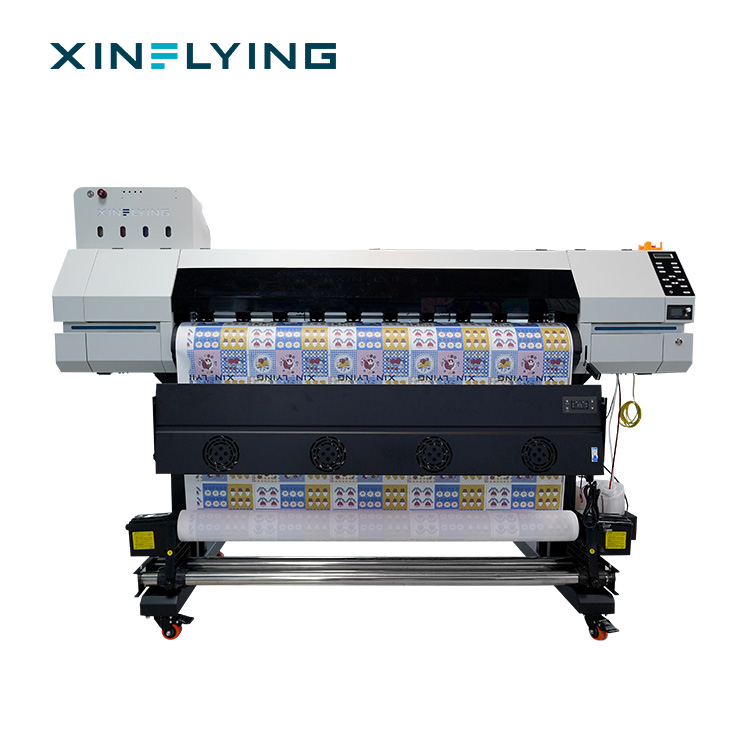
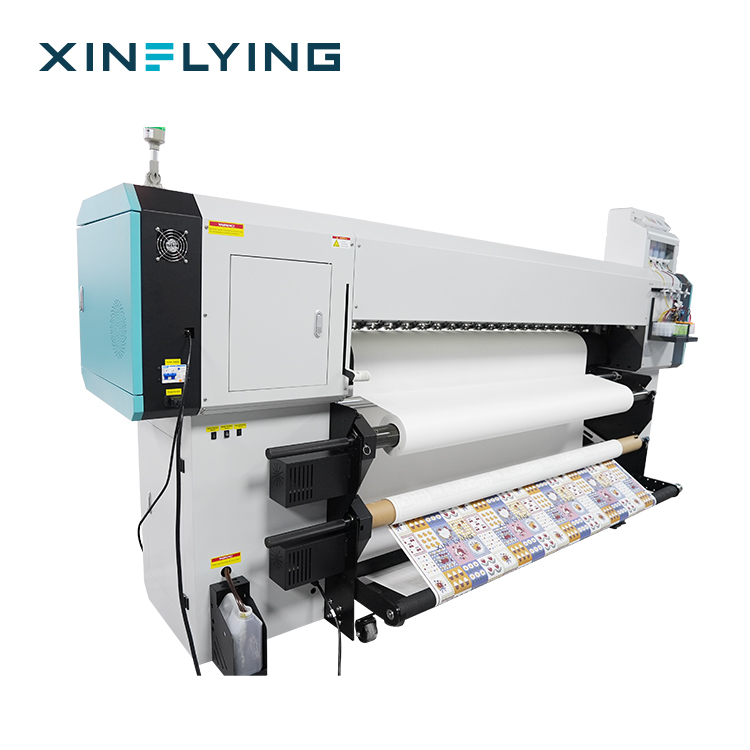
The XF-H1301X-1I32A1 is a digital textile sublimation printer built around one Epson i3200-A1 printhead, CMYK ink, a 130 cm (1.3 m) print width and a fastest 4PASS print speed of 28 m²/h. It uses heat transfer paper, ships with Maintop RIP as standard, and runs an external constant-temperature automatic drying system. Power demand is 2 kW on 110/220 V (18 A / 9 A, 50–60 Hz), machine size is 2220×870×1540 mm with a 2280×880×680 mm packing size, and net weight is 140 kg (200 kg gross). The frame and ink path use aluminium alloy, stainless steel and ABS plastic, with an aluminium ink rack, a Honson board and a retraction system.
From a workflow standpoint, the value of this configuration is concentration. Output depends on a single printhead, so nozzle checks, cleaning cycles and ink-delivery checks cover a smaller component set, and the machine's 2 kW draw and 140 kg footprint let it sit inside a normal workshop next to the calender rather than requiring a dedicated production hall. It is rated for 20–35°C and 45–65%RH; the broader textile application scenario it belongs to is specified at 18–30°C and 35–65%RH, so the practical operating envelope for both is 20–30°C and 45–65%RH.
The limitation is equally clear. At 130 cm wide and 28 m²/h at 4PASS, this machine is not the answer for a mill running continuous roll-to-roll fabric orders or 1.9 m soft signage work. It is suited to polyester fabric printing for sampling, small-batch customisation, personalised sportswear, promotional textiles and mixed order books where changeover speed matters more than square-metre volume.
Multi-head configurations: each step changes the workflow
Adding printheads is not a linear upgrade. Each step changes what the machine can be used for, what it consumes, and what it demands from the site.
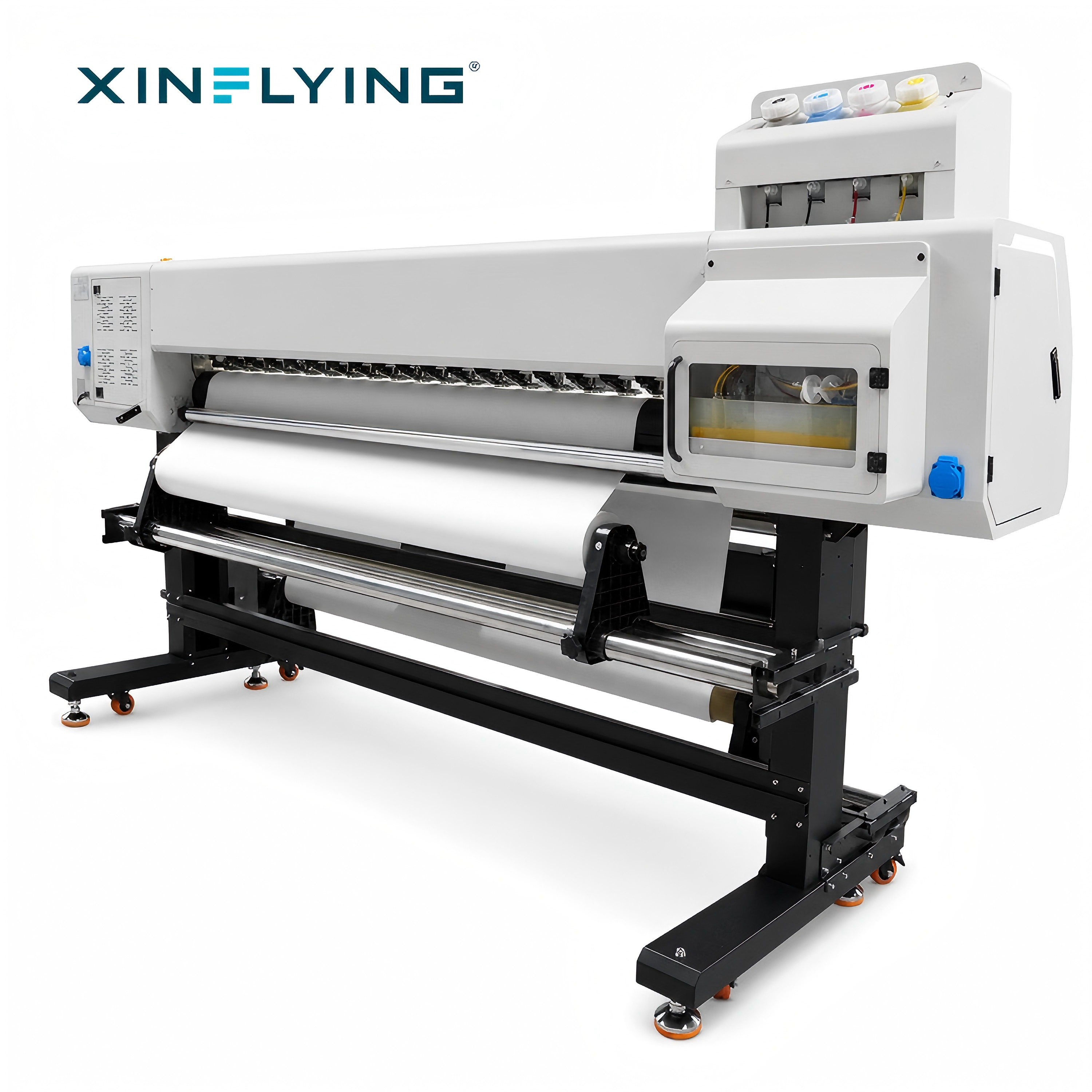
- XF-H1802X-2I32A1 (2 printheads). 2× Epson i3200-A1, CMYK+CMYK, 180 cm print width, fastest 4PASS 52 m²/h and standard 4PASS 42 m²/h, Maintop RIP, front/middle/rear break-controlled heating, 3.5 kW on 110/220 V (27.2 A / 13.6 A). A practical step for shops moving from sampling into daily short and medium runs.
- XF-O2000-4I32A1 (4 printheads). 4× Epson i3200-A1, CMYK×4, 195 cm print width, 2PASS 180 m²/h and 4PASS 92 m²/h, piezoelectric inkjet, 220 ml cartridges plus a 3 L ink tank, heat transfer paper rolls of 1000–1500 m, RIIN Print and Maintop RIP, break-controlled heating, 8.5 kW on 220 V. Used for personalised textile products and decorative fabric items in continuous daily production.
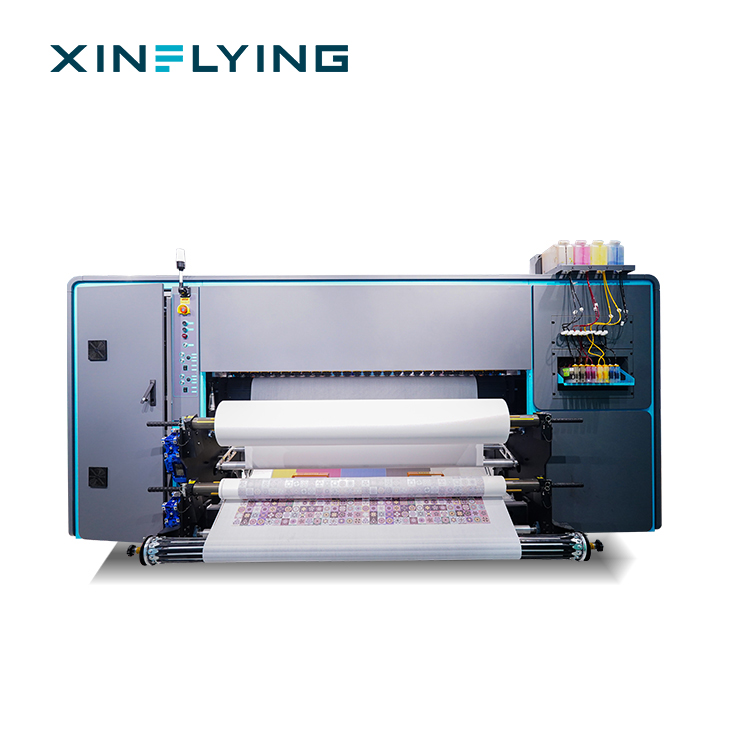
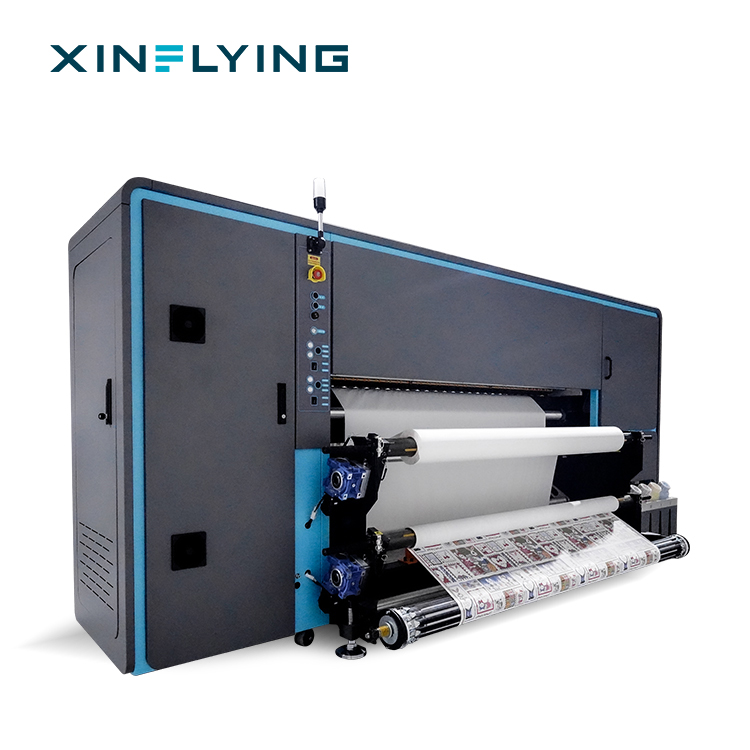
- XF-19E8-PRO (8 printheads). 8× Epson i3200-A1, 190 cm (75 in) width, 3200 dpi, 1PASS 306 m²/h and 2PASS 153 m²/h at fastest settings, Maintop standard with RIIN (Hoson only), PhotoPrint and Printfactory optional, 10.2 kW on 210–230 V, 45 A, 1400 kg net. It is built for continuous 24/7 operation in textile production facilities, with a Japan THK silent linear guide, anti-collision devices at both ends, automatic flash spray moisturising, an intelligent printhead cleaning and moisturising device, a US-imported fluorine rubber pressure paper wheel, an external intelligent air-heat integrated dryer and liquid level / waste ink alarms.
- XF-19E15-PRO (15 printheads). 15× Epson i3200-A1 with 3200 nozzles per head and variable ink drop, 190 cm (75 in) width, 3200 dpi, 1PASS 524 m²/h and 2PASS 254 m²/h at fastest settings, sublimation paper rolls up to 1000 m, 14.5 kW on 210–230 V, 45 A, 1480 kg net. A linear motor with magnetic grid, 27 press rollers, an enlarged beam and a fully sealed automatic moisturising and cleaning system define its workflow: fewer interruptions, longer runs.
Compliance: the electrical backbone behind the configuration
In the European Union, sublimation printers are imported against CE compliance that covers applicable electrical safety (Low Voltage Directive) and electromagnetic compatibility (EMC) requirements, supported by valid test reports and technical files. The essential check is not the existence of a certificate but its scope: the model named in the certificate and test report must match the exact configuration being shipped, because a mismatched compliance file can cause customs delays, sales restrictions or additional compliance costs.
For the United States, electromagnetic compatibility compliance (FCC) is commonly required for electronic equipment, and additional safety certification may apply depending on product specification and sales channel. Where hazardous-substance restrictions apply to electrical and electronic components, RoHS documentation should also be requested. In every case, buyers should ask the supplier for the certification documents, technical specifications and product test reports that correspond to the machine on order.
Verification rule: compare three items side by side — the model code on the purchase order, the model listed on the certificate, and the model printed in the test report. If any of the three differs, resolve it before the machine ships.
Step-by-Step: Configuring a Workflow Around Printhead Count
- Map the order mix first. List the products you actually sell — football jerseys and team uniforms, activewear, fashion fabric, curtains, cushions, decorative fabric, flags, banners or soft signage — and note the widest single piece in each. This defines whether 130 cm, 180 cm, 190 cm or 195 cm is required.
- Convert volume into square metres per hour. Compare like with like across the range: 28 m²/h (1 head, 4PASS fastest), 52 m²/h (2 heads, 4PASS fastest), 180 m²/h (4 heads, 2PASS), 306 m²/h (8 heads, 1PASS), 524 m²/h (15 heads, 1PASS). Then subtract realistic downtime for changeovers and maintenance.
- Check the site, not just the machine. Confirm supply current and voltage (2 kW at 110/220 V versus 8.5 kW at 220 V versus 10.2–14.5 kW at 210–230 V, 45 A), floor loading for 140 kg up to 1480 kg net weight, and packing clearance for crates up to 4010×1180×2160 mm.
- Fix the operating environment. The textile application scenario calls for a controlled indoor environment of 18–30°C and 35–65%RH to keep ink behaviour, colour accuracy and print quality stable. Note that the XF-O2000-4I32A1 is specified at 20–25°C and 45–65%RH, and the XF-H1301X-1I32A1 at 20–35°C and 45–65%RH.
- Configure RIP and colour management. Maintop is the standard RIP across the range; RIIN (Hoson only), PhotoPrint and Printfactory are optional on the 19E series, and RIIN Print is available on the XF-O2000-4I32A1. Build ICC profiles for each fabric and ink combination, and validate output against ISO 12647-8:2021 principles before signing off on a customer colour.
- Pair the finishing line. Each configuration must be matched with a heat press calender, dye sublimation paper, dye sublimation ink and downstream cutting. The XF-O2000-4I32A1 handles paper rolls of 1000–1500 m and the XF-19E15-PRO loads 1000 m rolls, so paper handling is part of the capacity calculation.
- Lock the compliance file and the service plan. Request model-matched CE (LVD / EMC) documentation, RoHS where applicable, and FCC-related documents for US shipments. Confirm pre-shipment testing, the 5–40 day lead time and the spare-parts route before the order is placed; XINFLYING supports installations with more than 50 engineers providing 24/7 online technical support.
Use Cases: How the Decision Plays Out in Production
Four documented customer profiles show where the configuration line falls in practice.
Sports uniform supplier (Brazil, 8 units, 5 years). The business produces customised football kits, training uniforms and team apparel with personalised names, numbers and graphics. Its workflow depends on short production cycles with vibrant colours and detailed patterns — a job profile built on personalised sportswear production, small-batch customisation and continuous commercial printing rather than single long runs.
Sportswear manufacturer (Brazil, 15 units, 4 years). Football jerseys, basketball uniforms and customised sportswear are printed on polyester fabric before cutting and sewing. After adopting the sublimation solution, the manufacturer increased flexibility for customised orders, reduced dependence on outsourced printing and achieved more consistent colour across batches — the outcome that multi-head configurations at 190 cm width are designed to deliver.
Digital textile printing service provider (global, 5 units, 3 years). This customer prints for sportswear brands, apparel factories and customised textile businesses. The value of the configuration is flexibility: capacity to take on more customer projects and faster response on customised textile orders.
Home textile manufacturer (10 units, 4 years). Curtains, cushions, decorative fabrics and customised polyester textile products require detailed patterns at consistent quality over large formats — a profile that pushes the decision toward wider print widths and 4-head or higher throughput.
Configuration Comparison Table
| Configuration | Model | Printheads | Print width | Fastest speed | Standard RIP | Power | Net weight | Typical workflow role |
|---|---|---|---|---|---|---|---|---|
| Single head | XF-H1301X-1I32A1 | 1× Epson i3200-A1 | 130 cm | 4PASS 28 m²/h | Maintop | 2 kW; 110/220 V | 140 kg | Sampling, small batches, mixed orders, reliability-first production |
| 2 heads | XF-H1802X-2I32A1 | 2× Epson i3200-A1 | 180 cm | 4PASS 52 m²/h | Maintop | 3.5 kW; 110/220 V | 265 kg | Daily short and medium runs for growing print shops |
| 4 heads | XF-O2000-4I32A1 | 4× Epson i3200-A1 | 195 cm | 2PASS 180 m²/h | RIIN Print / Maintop | 8.5 kW; 220 V | ≈490 kg | Continuous daily production; personalised textiles and decorative fabric |
| 8 heads | XF-19E8-PRO | 8× Epson i3200-A1 | 190 cm (75 in) | 1PASS 306 m²/h | Maintop | 10.2 kW; 210–230 V, 45 A | 1400 kg | Continuous 24/7 industrial textile production |
| 15 heads | XF-19E15-PRO | 15× Epson i3200-A1 | 190 cm (75 in) | 1PASS 524 m²/h | Maintop | 14.5 kW; 210–230 V, 45 A | 1480 kg | High-volume industrial roll-to-roll production |
FAQ: Compliance, Capability, Budget, Sample and Lead Time
1. What compliance documents should I verify before importing a sublimation printer into the European Union?
EU imports require CE compliance covering applicable electrical safety (LVD) and electromagnetic compatibility (EMC) requirements, together with valid test reports and technical files. The decisive check is scope: the model listed on the certificate and in the test report must correspond to the exact printer configuration being shipped, because an incomplete or mismatched file can cause customs delays, sales restrictions or additional compliance costs. For US shipments, FCC-related electromagnetic compatibility documentation is commonly required for electronic equipment, with additional safety certification possibly required depending on specification and sales channel. Where hazardous-substance restrictions apply to electrical and electronic components, RoHS documentation should also be requested.
2. Can a single-head sublimation printer cover sportswear, apparel and home textile work?
Within its width limit, yes. The XF-H1301X-1I32A1 uses one Epson i3200-A1 printhead with CMYK sublimation ink, prints to a 130 cm (1.3 m) width on heat transfer paper, and reaches a fastest 4PASS speed of 28 m²/h, with Maintop RIP and an external constant-temperature automatic drying system. Its application focus is polyester fabric — sportswear, apparel sampling, personalised products and small-batch customised textile orders. Work that needs 180–195 cm widths, roll-to-roll fabric runs or 1.9 m soft signage moves to the 2-head, 4-head, 8-head or 15-head models, which is a scope question rather than a capability gap.
3. What drives the cost difference between single-head and multi-head configurations?
The cost of a configuration is driven by five physical factors rather than by brand positioning. First, printhead count — from 1 Epson i3200-A1 up to 15. Second, electrical infrastructure: 2 kW on 110/220 V (18 A / 9 A), 3.5 kW on 110/220 V, 8.5 kW on 220 V, or 10.2–14.5 kW on a 210–230 V, 45 A supply. Third, machine and packing volume, from a 2220×870×1540 mm frame at 140 kg net to a 3840×1570×1800 mm frame at 1480 kg net with 1580 kg gross. Fourth, drying, moisturising and RIP configuration, including optional RIIN, PhotoPrint and Printfactory licences. Fifth, ongoing consumable volume, which scales with square metres printed. The practical rule is to size the machine to the order book; a configuration larger than the workload carries infrastructure and consumable costs that the workload never repays.
4. How can I validate print output before committing to a configuration?
Validation is a procedure, not a promise. Set up the machine on a stable surface with the power and cabling requirements checked, install the sublimation ink system and confirm continuous ink flow, install the drivers and configure the RIP (Maintop as standard, or RIIN Print / Maintop on the XF-O2000-4I32A1), run nozzle checks and printhead inspection, complete initial calibration, then produce test prints on your own fabric and artwork before any mass production begins. Confirm the supplier's pre-shipment testing and request test output on your own material and ICC profile; the minimum order quantity for XINFLYING machines is 1 unit, so a single-machine trial line can be ordered without committing to a fleet.
5. What is the lead time, and how do I start a configuration review?
Lead time for XINFLYING sublimation printers runs from 5 to 40 days depending on model and quantity, with a minimum order quantity of 1 unit, pre-shipment testing before dispatch, and monthly production capacity of 1,600+ units against annual output of more than 20,000 units. To move from comparison to a decision, send your order mix, target width, daily volume and destination market (for CE, FCC or RoHS documentation needs) so the configuration can be matched to the workflow before a quote is issued. Requests for samples, quotation or the full catalogue can be made through www.xin-flying.com, by email at info@xin-flying.com, or via WhatsApp at +86 188-1322-1357.
Conclusion: Match the Configuration to the Order Book
The single-head versus multi-head decision resolves into one question: does this workflow need control or volume? A single-head configuration such as the XF-H1301X-1I32A1 concentrates production on one Epson i3200-A1 printhead, a 130 cm width, a 2 kW draw and a 140 kg frame — a small, stable footprint for sampling, small-batch customisation and mixed order books where consistent daily output matters more than peak speed. A multi-head configuration from XF-H1802X-2I32A1 to XF-19E15-PRO scales throughput from 52 m²/h to 524 m²/h at 1PASS, and scales with it the power supply, floor loading, paper handling and finishing capacity the plant must provide.
Both sides of the decision are supported by the same compliance foundation: model-matched CE documentation covering LVD and EMC for Europe, FCC-related documentation for the United States, and RoHS material compliance where applicable. Verifying those documents against the exact model on the order is as much part of configuration as choosing the printhead count.
Next step: configure the machine around your workflow
Send your order mix, target print width and destination market, and XINFLYING will match a single-head or multi-head configuration to your production profile — including the compliance documentation set for your region, pre-shipment testing, and 24/7 online technical support from more than 50 engineers.
Email: info@xin-flying.com | Tel / WhatsApp: +86 188-1322-1357 | Website: www.xin-flying.com
Address: No.7, Xiecun 2nd Industrial Zone, Panyu, Guangzhou, Guangdong
Download the full product and capability brochure: XINFLYING Company & Product Brochure (PDF)
Have Questions or Need More Details?
Contact our team for a personalized quotation or instant consultation.
Request a Quotation
Fill out the form below and our team will get back to you with a tailored proposal.
WhatsApp Direct Chat
Prefer to chat in real-time? Message us on WhatsApp for instant assistance & quick answers.
- Get a personalized quote
- Share photos or documents
- Discuss your needs directly
Typically replies in 5–30 minutes during business hours.