
Cost Efficiency in Digital Textile: Debunking Sublimation Printer Operational Myths
Digital textile cost models usually rest on two numbers: the invoice price of the machine and the print speed on the specification sheet. Both are easy to quote and both hide the figure that decides whether a print shop actually makes money — the cost per accepted square metre. That figure is shaped less by head count than by whether the machine's electrical build, certificate scope and component chain can be verified.
An unverified machine is expensive in three concrete ways. It generates rejected output that has already consumed ink, transfer paper, labour and energy. It creates compliance exposure at the border and, further downstream, with the buyer's own customers. And it invites unauthorised spare parts that move the printer outside the configuration that was ever tested. XINFLYING — Guangzhou Xin Flying Digital Technology Co., Ltd., a digital printing equipment manufacturer founded in 2010 and based in Panyu, Guangzhou — answers this with documents rather than adjectives: model-specific certificates, a published model schedule, and a compact DTF platform, the XF-450PRO, that appears on that schedule.
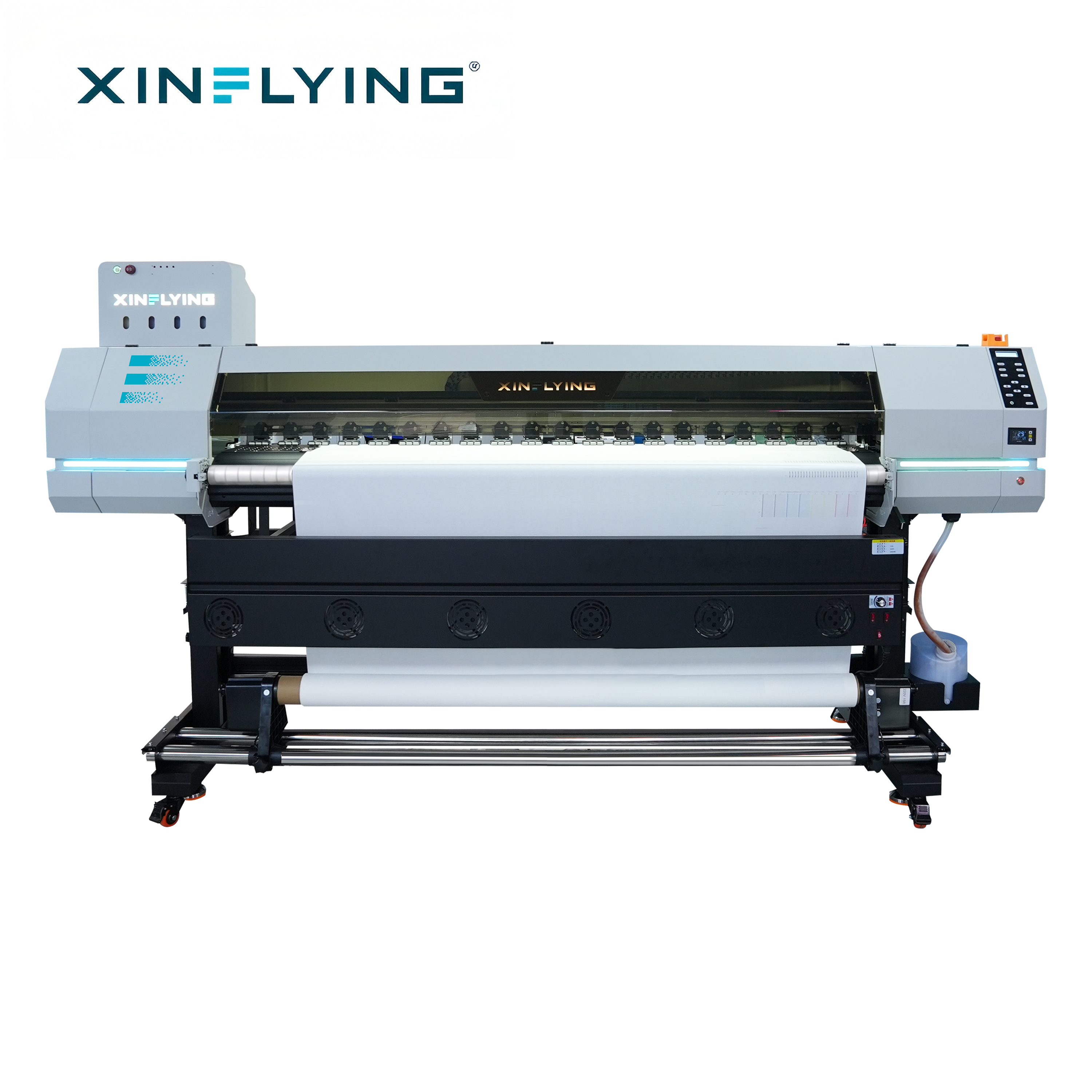
XINFLYING XF-H1802X-2I32A1: a 180 cm roll-to-roll sublimation printer with two Epson i3200-A1 printheads, listed on the CE MD, CE LVD, CE EMC and RoHS model schedules held by the manufacturer.
Problem Definition: Four Myths That Distort Digital Textile Cost Models
Most cost arguments in sublimation printing fail at the same point: they treat a machine as a mechanical object and ignore the fact that it is also an electrical object, a legal object and a spare-parts object. Four myths do most of the damage.
Myth 1 — Certification is paperwork, not production
Certification is often filed next to the warranty card and never read again. In practice, a conformity assessment is a description of how the machine was built: which risk assessment was performed, which electrical standard was applied, which bonding and guarding decisions were made. A CE Machinery Directive certificate naming EN 60204-1:2018/A1:2025 is not a decorative seal; it is a statement that the electrical equipment of the machine — including protective bonding — was assessed against a defined standard.
Myth 2 — Grounding is an installation detail
Earthing is usually discussed on site, by the electrician, after the machine has arrived. That is too late to influence the purchase decision. Protective bonding is a design and documentation question: either the manufacturer assessed it, or the buyer is being asked to trust an undocumented electrical build in a hall full of heat presses, calenders and high-current dryers.
Myth 3 — A compatible part is an equivalent part
A certificate describes a tested configuration. When a mainboard, driver board or printhead is replaced with an unauthorised component, the machine is no longer the object that was tested. The failure rarely appears as a dramatic breakdown; it appears as drift — colour that no longer matches the profile, nozzles that need cleaning more often, batches that no longer match each other.
Myth 4 — Throughput equals output
Print speed is the most quoted and least useful number on a specification sheet. A machine rated at high speed produces output; a machine that produces output which must be reprinted produces cost. The two are separated by reject rate, and reject rate is where electrical stability, calibration and consumable consistency converge.
Industry Background: Why Compliance Now Sits Inside the Cost Line
The commercial pressure behind this shift is measurable. Grand View Research values the global dye sublimation printing market at USD 16.4 billion in 2025, projected to reach USD 39.0 billion by 2033, with a CAGR of 11.5% from 2026 to 2033. Asia Pacific dominated that market in 2025 with a 36.5% revenue share, led by China as the largest country market — a position supported by China's textile and garment exports of USD 293.6 billion in 2023.
Equipment demand follows the same curve. Fortune Business Insights puts the large format printer market at USD 10.57 billion in 2025, rising to USD 16.52 billion by 2034, and Grand View Research records that inkjet production printers accounted for 87.3% of the production printer market by type in 2024. FESPA industry analysis notes that roll-to-roll sublimation printers at 1.9 m (1900 mm) width are the standard format for high-volume textile and soft signage work — which is why the XF-19E8-PRO and XF-19E15-PRO are built at 190 cm (75") print width.
What changed for buyers is not the growth rate but the entry ticket. European importers now routinely request the Machinery Directive, Low Voltage Directive, EMC and RoHS documentation before a purchase order is raised, and textile brands handling skin-contact products ask for ink-level evidence as well. A printer that cannot produce a model-matched certificate set is not a cheaper printer; it is a printer whose compliance cost has simply been deferred to the buyer.
Detailed Solution: What a Verified Electrical Build Actually Contains
The three standards that decide whether a printer is grounded in the legal sense
The CE Machinery Directive certificate held for the XINFLYING range — certificate number M.2026.206.C142365, issued by UDEM on 2026-06-10 and valid to 2031-06-09, under Directive 2006/42/EC — names three standards. Each answers a different question.
- EN ISO 12100:2010 — risk assessment and risk reduction methodology: were the hazards of the machine identified and addressed by design?
- EN 60204-1:2018/A1:2025 — electrical equipment of machines, including protective bonding: is the electrical build documented and is earthing treated as a design requirement rather than a site improvisation?
- EN ISO 12643-1:2023 — safety requirements for graphic technology equipment: does the machine meet the sector-specific safety framework for printing machinery?
A second Machinery Directive certificate, M.2026.206.C142385, was issued by UDEM on the same date against the same standard set, covering a separate model group. Two certificates, one standard framework — this is what makes a model-by-model check possible rather than a brand-level guess.
EMC and LVD: the two certificates buyers read least and need most
Electrical safety and electromagnetic behaviour are separate assessments, and both matter in a textile hall.
Low Voltage compliance is documented under certificate TQT1550D271EC, issued by TQT (Shenzhen Tianqi Testing Technology Service Co., Ltd.) on 2026-05-19 under Directive 2014/35/EU, against EN IEC 62368-1:2020/A11:2020. EMC compliance is documented under certificate TQT1550D270EC, also issued by TQT on 2026-05-19 under Directive 2014/30/EU, against EN 55032:2015/A11:2020, EN 55035:2017/A11:2020, EN IEC 61000-3-2:2019+A1:2021 and EN 61000-3-3:2013/A2:2021. A combined LVD and EMC attestation, M.2026.206.C142475, was issued by UDEM on 2026-06-11.
The EMC set is the one worth understanding. EN 55032 governs emissions; EN 55035 governs immunity — how the equipment behaves when it is exposed to electromagnetic disturbance. A printer that has never been assessed for immunity gives the buyer no information about how its control electronics will behave next to a bank of calenders and dryers on the same supply.
Why reject rates track the electrical build
Rejects in sublimation printing have well-documented causes. XINFLYING's own technical guidance lists partial nozzle blockage, incorrect resolution or speed settings, unstable ink supply, incorrect printhead alignment and a printer that requires calibration as the recurring sources of banding. Colour deviation is attributed to ICC profile settings, RIP parameters, ink quality and compatibility, heat press temperature and transfer time, and substrate differences.
Two of those causes — unstable ink delivery and printhead alignment — depend on control and motion electronics behaving predictably under load. That is the mechanism behind the claim being tested here: a machine whose protective bonding, control electronics and component provenance are undocumented is far more likely to deliver a higher share of rejected output, because the mechanisms that generate rejects are the same mechanisms that electrical instability disturbs first.
Counterfeit electronic parts and the tested configuration
Electronic parts counterfeiting is a supply-chain problem before it is a print-quality problem. A cloned mainboard, a re-marked driver board or a printhead of unknown origin changes the electrical behaviour of the machine, and it changes it silently. The certificate scope is the practical defence: the CE MD, CE LVD, CE EMC and RoHS certificates held by XINFLYING each carry a model schedule, and those schedules are what a buyer compares against the invoice.
The XF-450PRO is a useful example because it is a compact machine that buyers often assume sits outside industrial documentation. It does not. The XF-450PRO — a 42 cm (16.5") DTF platform with 2 × Epson i1600-A1 printheads, 3.5 kW power draw, 250 kg net weight and a 1950 × 1065 × 1350 mm footprint — appears on the model schedule of CE MD M.2026.206.C142365, RoHS M.2026.206.C142366, CE LVD TQT1550D271EC and CE EMC TQT1550D270EC, alongside the larger sublimation models. That is what makes the document checkable: the model number on the certificate should match the model number on the machine plate, the packing list and the invoice.
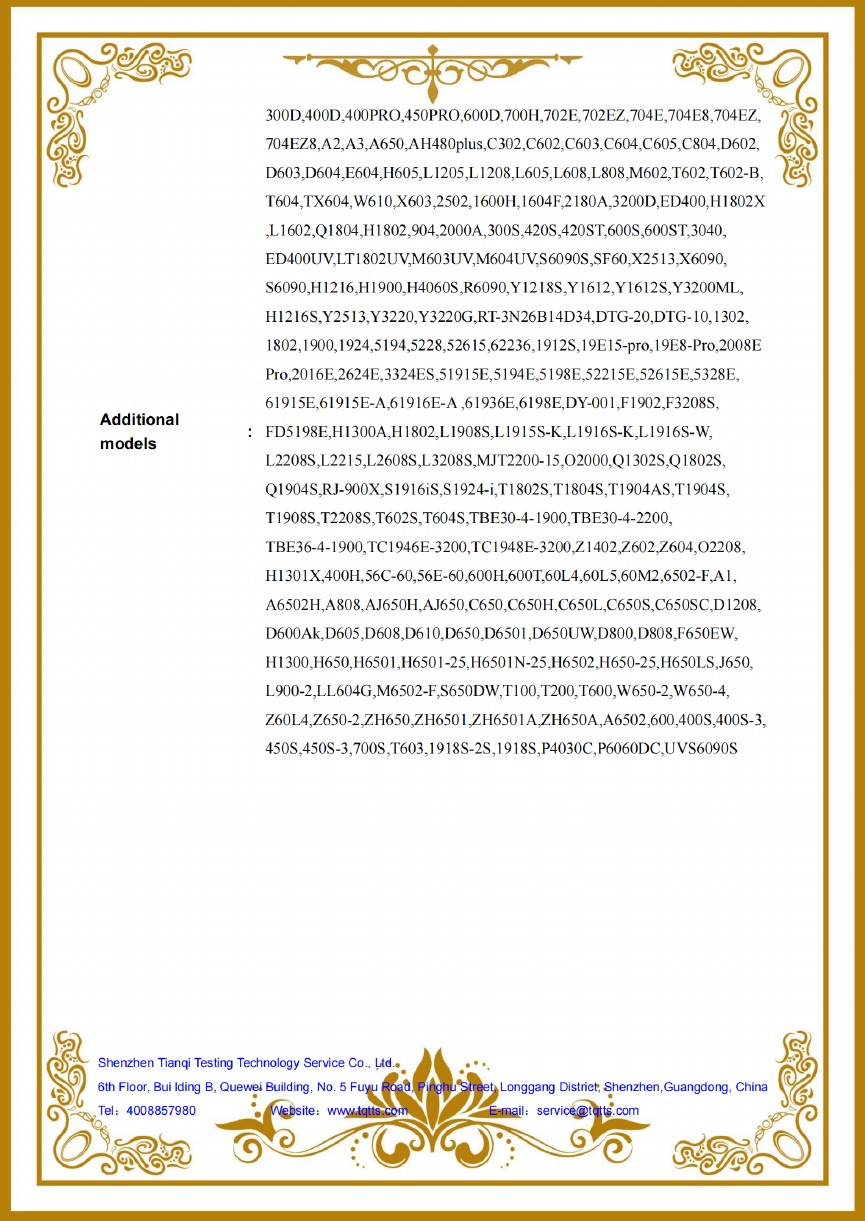
CE EMC Certificate of Compliance TQT1550D270EC, issued by TQT under Directive 2014/30/EU against EN 55032, EN 55035, EN 61000-3-2 and EN 61000-3-3 — the document that answers the immunity question.
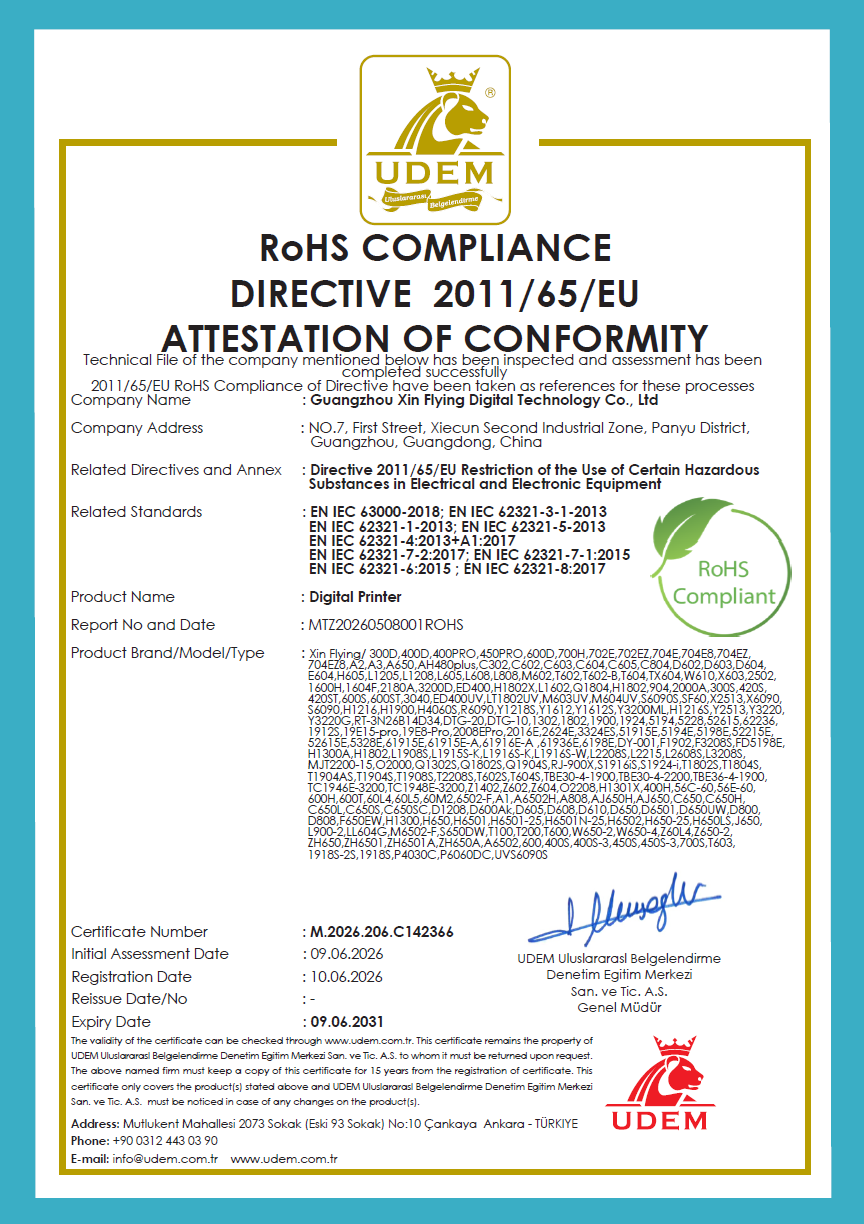
RoHS Compliance Certificate M.2026.206.C142366, issued by UDEM under Directive 2011/65/EU against EN IEC 63000:2018 and the EN IEC 62321 series.
Consumables compliance is a separate document — and it expires
Machine certificates do not cover ink. Ink compliance for skin-contact textiles is documented separately: OEKO-TEX® ECO PASSPORT certificate SH150194016, issued by TESTEX AG, covering textile printing inks and printing pastes, issued 2025-12-11 and valid to 2026-12-31. That expiry date is the point. A buyer auditing a supplier in late 2026 should be asking for the renewal, not for the 2025 file, and the same discipline applies to every document in the set.
The cost formula that replaces the invoice comparison
Once documentation is treated as a cost input, machine comparison becomes a division rather than a subtraction:
Cost per accepted m² = (ink + transfer paper + energy + labour + downtime + reprints + compliance losses) ÷ accepted m²
Energy is the term buyers most often skip, and the documented power figures make it visible. The XF-450PRO draws 3.5 kW; the XF-H1802X-2I32A1 draws 3.5 kW; the XF-O2000-4I32A1 draws 8.5 kW; the XF-19E8-PRO draws 10.2 kW; the XF-19E15-PRO draws 14.5 kW. A 14.5 kW machine running at 1PASS 524 m²/h and a 3.5 kW machine running at 4PASS 52 m²/h are not competitors — they are different business models, and the formula should be applied to each on its own duty cycle, not to a headline speed.
Step-by-Step Breakdown: A Seven-Step Verification Routine Before You Sign
This routine can be completed before a purchase order and repeated at acceptance. It uses documents the manufacturer already holds.
- Request the full certificate set for the specific model. Ask for the Machinery Directive certificate (M.2026.206.C142365 or M.2026.206.C142385 depending on the model group), the Low Voltage certificate (TQT1550D271EC) and the EMC certificate (TQT1550D270EC).
- Match the model number to the schedule. Every one of these certificates carries a model list. If your model is not on it, the certificate does not apply to your machine, whatever the brochure says.
- Read the standards column, not the certificate title. EN ISO 12100 plus EN 60204-1 plus EN ISO 12643-1 tells you the machine was assessed as machinery. A document that names none of these is not equivalent.
- Check issue and expiry dates against the delivery date. The Machinery Directive certificates run to 2031-06-09 and RoHS to 2031-06-09; the OEKO-TEX ECO PASSPORT for inks runs only to 2026-12-31 and requires renewal.
- Verify the issuing body is identifiable. UDEM, TQT and TESTEX AG are named on the documents, with certificate numbers that can be cross-checked.
- Inspect the physical build at acceptance. Confirm protective bonding points, emergency stop function and guarding against the machine you actually received — documentation and hardware should describe the same object.
- Run an acceptance print and keep the record. XINFLYING specifies pre-shipment testing as its acceptance criterion. Retain the test print, the nozzle check and the parameter set, because that record is the baseline against which every future drift is measured.
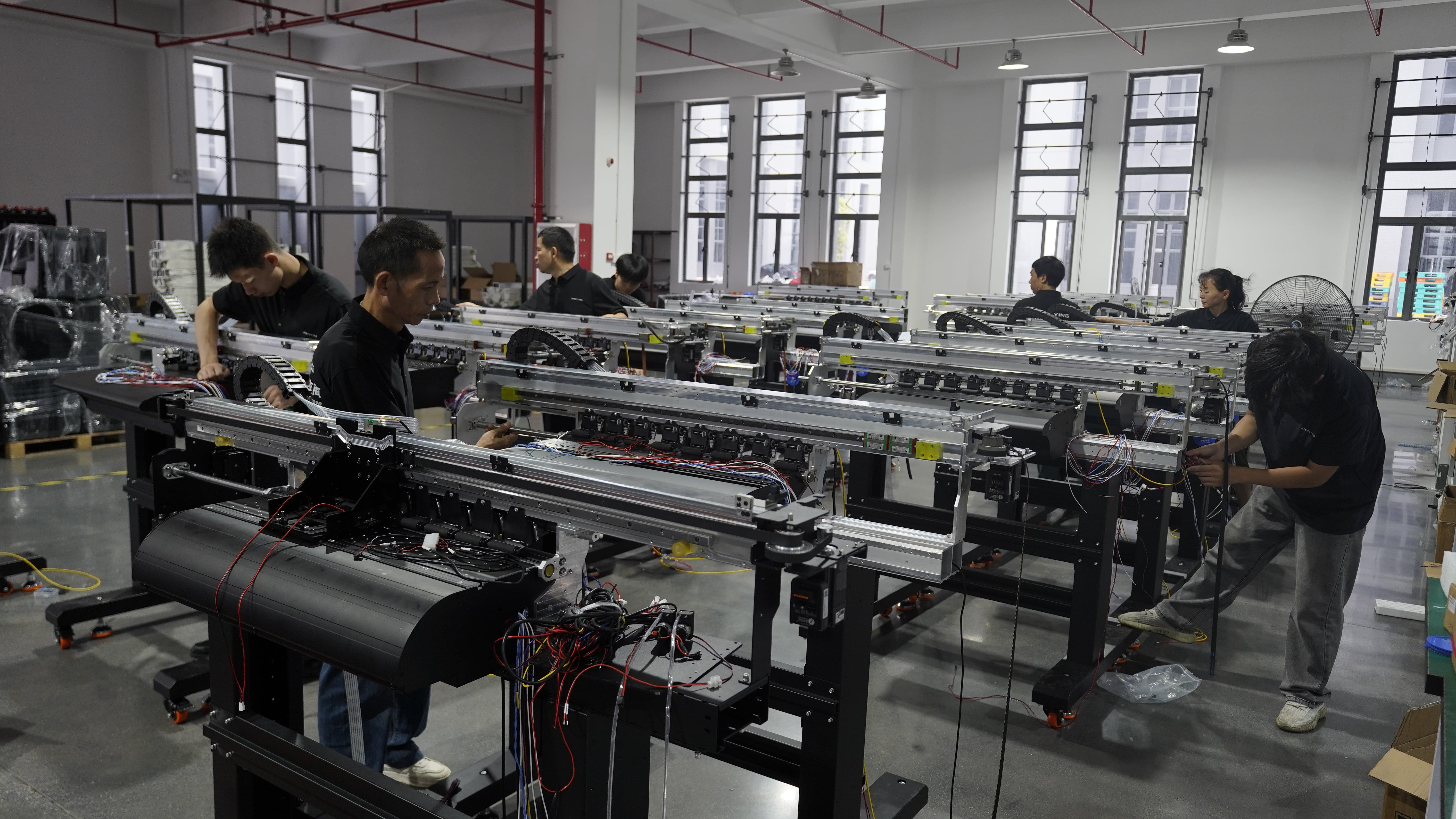
Assembly and wiring at the XINFLYING facility in Panyu, Guangzhou — the stage at which protective bonding and control wiring are either documented or lost.
Use Cases: Where Verification Pays Back
The manufacturer's recorded deployments show where documentation and reject control intersect with commercial outcomes. Client identities are not disclosed; the operating profiles are.
- Sportswear manufacturer, Brazil — 15 units, 4 years. Football jerseys, basketball uniforms and custom sportswear printed on polyester before cutting and sewing. The reported result after adoption was improved flexibility for customised orders, reduced dependence on outsourced printing, and more consistent colour across batches — the last point being precisely what undocumented electronics erode first.
- Sports uniform supplier, Brazil — 8 units, 5 years. Personalised kits with names, numbers and graphics. The reported gain was shorter production cycles for customised orders while holding colour vibrancy and pattern detail.
- Home textile manufacturer — 10 units, 4 years. Curtains, cushions and decorative polyester fabrics, where the 195 cm width of the XF-O2000-4I32A1 supports large-format pattern work and the front/middle/rear break-controlled heating supports dimensional stability.
- Digital textile printing service provider — 5 units, 3 years. A multi-client operation serving sportswear brands and apparel factories, where capacity expansion and response speed mattered more than any single machine specification.
- Compact DTF apparel customisation — XF-450PRO. At 42 cm print width and 6PASS 11 m²/h at fastest setting, this is the entry point for shops that need documented hardware at small format, including the CE and RoHS coverage described above.
Comparison Table: Documented Configurations Across the Range
The table below uses only manufacturer-published specifications. Every model listed appears on the CE MD, CE LVD, CE EMC and RoHS model schedules held by XINFLYING.
| Model | Type | Print width | Printheads | Max print speed | Power |
|---|---|---|---|---|---|
| XF-450PRO | DTF printer | 42 cm (16.5") | 2 × Epson i1600-A1 | 6PASS 11 m²/h | 3.5 kW |
| XF-H1802X-2I32A1 | Sublimation printer | 180 cm (1.8 m) | 2 × Epson i3200-A1 | 4PASS 52 m²/h | 3.5 kW |
| XF-O2000-4I32A1 | Sublimation printer | 195 cm (1.95 m) | 4 × Epson i3200-A1 | 2PASS 180 m²/h | 8.5 kW |
| XF-19E8-PRO | Sublimation printer | 190 cm (75") | 8 × Epson i3200-A1 | 1PASS 306 m²/h | 10.2 kW |
| XF-19E15-PRO | Sublimation printer | 190 cm (75") | 15 × Epson i3200-A1 | 1PASS 524 m²/h | 14.5 kW |
Speeds are manufacturer-published fastest-mode figures at the stated PASS setting. Resolution is 3200 dpi on the XF-19E8-PRO and XF-19E15-PRO.
The certificate register is the second half of the comparison, and it is the half that maps to legal risk rather than throughput.
| Document | Number | Authority | Standards named | Valid to |
|---|---|---|---|---|
| CE Machinery Directive Certificate of Conformity | M.2026.206.C142365 | UDEM | EN ISO 12100:2010; EN 60204-1:2018/A1:2025; EN ISO 12643-1:2023 | 2031-06-09 |
| CE Low Voltage Directive Certificate | TQT1550D271EC | TQT | EN IEC 62368-1:2020/A11:2020 | as recorded |
| CE EMC Certificate of Compliance | TQT1550D270EC | TQT | EN 55032:2015/A11:2020; EN 55035:2017/A11:2020; EN IEC 61000-3-2:2019+A1:2021; EN 61000-3-3:2013/A2:2021 | as recorded |
| RoHS Compliance Certificate | M.2026.206.C142366 | UDEM | EN IEC 63000:2018; EN IEC 62321 series | 2031-06-09 |
| OEKO-TEX® ECO PASSPORT (inks and pastes) | SH150194016 | TESTEX AG | OEKO-TEX® ECO PASSPORT; EN ISO 17050-1 | 2026-12-31 |
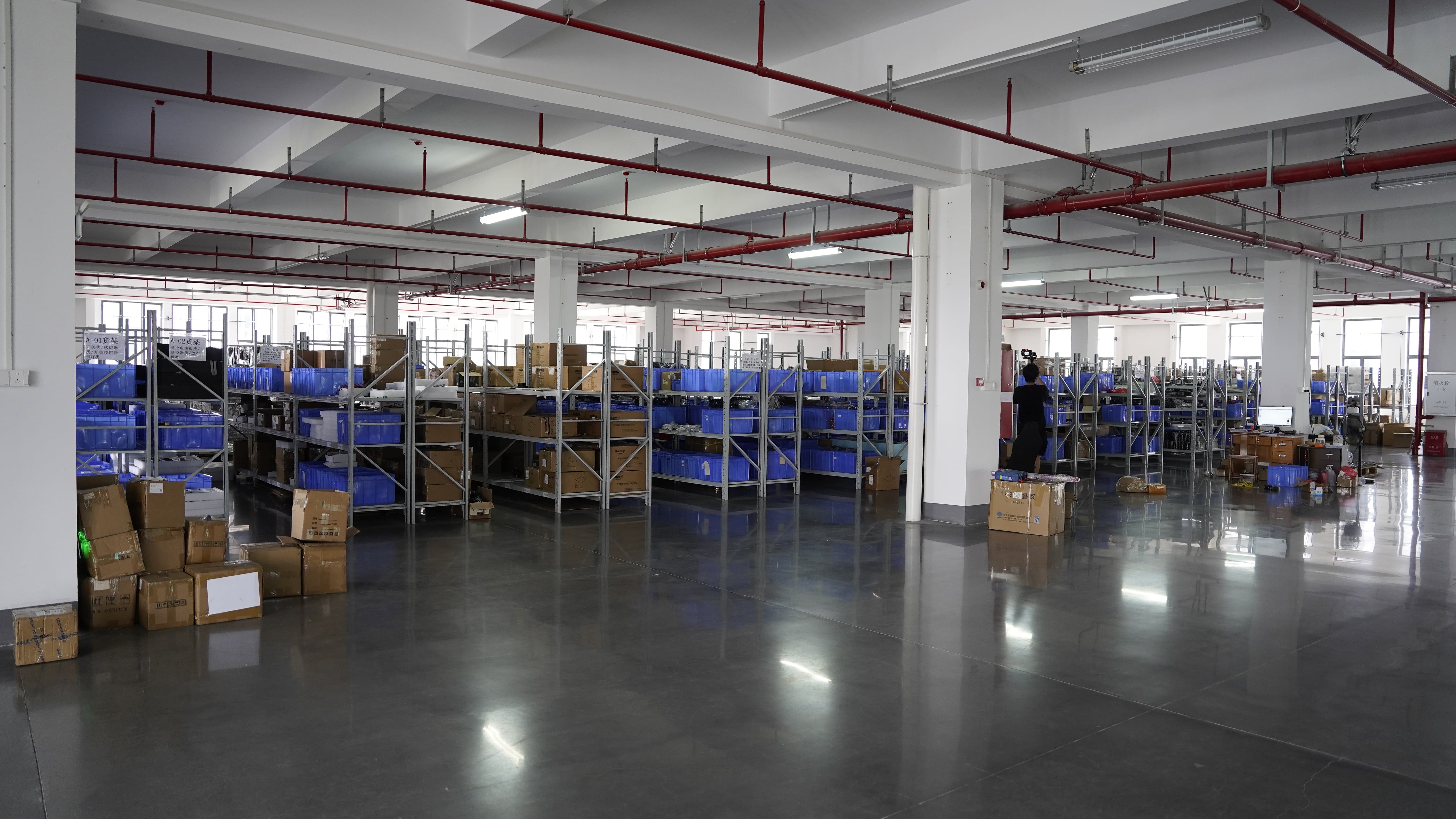
Component storage at the XINFLYING facility. Documented parts provenance is the practical answer to counterfeit electronic components — a certificate only protects the configuration it describes.
Frequently Asked Questions
Which certificates should I verify before accepting a digital textile printer?
Verify four machine documents and, where skin-contact textiles are involved, one consumable document. For the machine: CE Machinery Directive Certificate of Conformity M.2026.206.C142365 (UDEM, Directive 2006/42/EC, EN ISO 12100:2010, EN 60204-1:2018/A1:2025, EN ISO 12643-1:2023, valid to 2031-06-09); CE Low Voltage certificate TQT1550D271EC (TQT, Directive 2014/35/EU, EN IEC 62368-1:2020/A11:2020); CE EMC certificate TQT1550D270EC (TQT, Directive 2014/30/EU, EN 55032, EN 55035, EN IEC 61000-3-2, EN 61000-3-3); and RoHS certificate M.2026.206.C142366 (UDEM, Directive 2011/65/EU, EN IEC 63000:2018). For inks and printing pastes, OEKO-TEX® ECO PASSPORT SH150194016 (TESTEX AG) applies, valid to 2026-12-31. Each certificate carries a model schedule — the model number on the document must match the machine.
Can an OEM dye sublimation printer manufacturer customise the machine and the branding?
Yes. XINFLYING offers both OEM and ODM production services. Customisation covers product branding, machine appearance, colour, logo and packaging, plus customised solutions developed against stated customer requirements. Commercial terms support this model: minimum order quantity is 1 unit, monthly capacity is 1600+ units, and lead time runs from 5 to 40 days. Engineering capacity behind those terms includes a 20-engineer R&D team, a 37,440 m² facility, 200+ employees and annual output of 20,000+ units. Customisation changes appearance and configuration, not the compliance framework — the certificate schedule still has to match the delivered model.
How do I compare operating cost between two digital textile printers without price lists?
Compare cost per accepted square metre rather than purchase price: (ink + transfer paper + energy + labour + downtime + reprints + compliance losses) ÷ accepted m². Published power draw gives you the energy term directly — XF-450PRO 3.5 kW, XF-H1802X-2I32A1 3.5 kW, XF-O2000-4I32A1 8.5 kW, XF-19E8-PRO 10.2 kW, XF-19E15-PRO 14.5 kW. Then add the reject and compliance terms, which is where documentation changes the arithmetic: a machine without a model-matched certificate set carries a tail risk of customs delay, market rejection or customer claims that no speed advantage offsets. Note that XINFLYING publishes no reject-rate figures, so that term must be estimated from your own acceptance print and first production batch.
What acceptance evidence should arrive with the machine?
XINFLYING specifies pre-shipment testing as its quality control and acceptance criterion. In practice the evidence pack should contain the certificate set with the model schedule visible, an initial nozzle check, a test print produced on the machine with the parameter set recorded, and the consumable documentation where applicable. Keep all four. The test print is the reference that makes later colour drift measurable rather than arguable, and the nozzle check establishes the baseline for the maintenance routine — regular nozzle checks, printhead cleaning, ink supply inspection and correct operating conditions, which the manufacturer identifies as the practical route to avoiding banding and missing colour.
What are the lead time, MOQ and delivery terms?
Minimum order quantity is 1 unit. Lead time is 5 to 40 days depending on configuration and order volume. Standard delivery terms are EXW, FOB, CIF and DDP for global shipments, and payment terms are T/T, Western Union and PayPal. Because customisation is offered at single-unit MOQ, a buyer can validate one machine — certificate check, acceptance print, production trial — before committing to a multi-unit line. To start that process, request the certificate set for your target model and a quotation at xin-flying.com, or contact the team directly at info@xin-flying.com.
Conclusion: The Cheapest Machine Is the One You Can Verify
The myth that survives longest in digital textile purchasing is that compliance is a cost added on top of the machine. The evidence points the other way. Protective bonding under EN 60204-1, immunity under EN 55035, model-schedule matching under the CE and RoHS certificates, and ink documentation under OEKO-TEX® ECO PASSPORT are all inputs to the reject rate — and the reject rate is the largest controllable term in cost per accepted square metre.
That is why the XF-450PRO matters in this argument. A 42 cm DTF platform with 2 × Epson i1600-A1 printheads and 3.5 kW power draw is exactly the kind of machine buyers assume is exempt from industrial documentation. It is not: it sits on the same certificate schedules as the 190 cm, 15-head XF-19E15-PRO. Documented hardware does not make a small machine large; it makes a small machine accountable.
For a buyer at evaluation or execution stage, the practical sequence is short. Ask for the certificate set. Match the model number. Read the standards column. Check the expiry dates. Inspect the bonding at acceptance. Keep the first test print. Everything else — head count, print width, throughput — is a decision you can only make correctly after those six steps are done.
Next step. The full XINFLYING company and product overview, including the digital textile printer range and OEM/ODM capability, is available as a downloadable catalogue: XINFLYING company profile (PDF).
Website: www.xin-flying.com · Email: info@xin-flying.com · Tel / WhatsApp: +86 188-1322-1357 · Address: No.7, Xiecun 2nd Industrial Zone, Panyu, Guangzhou, Guangdong.
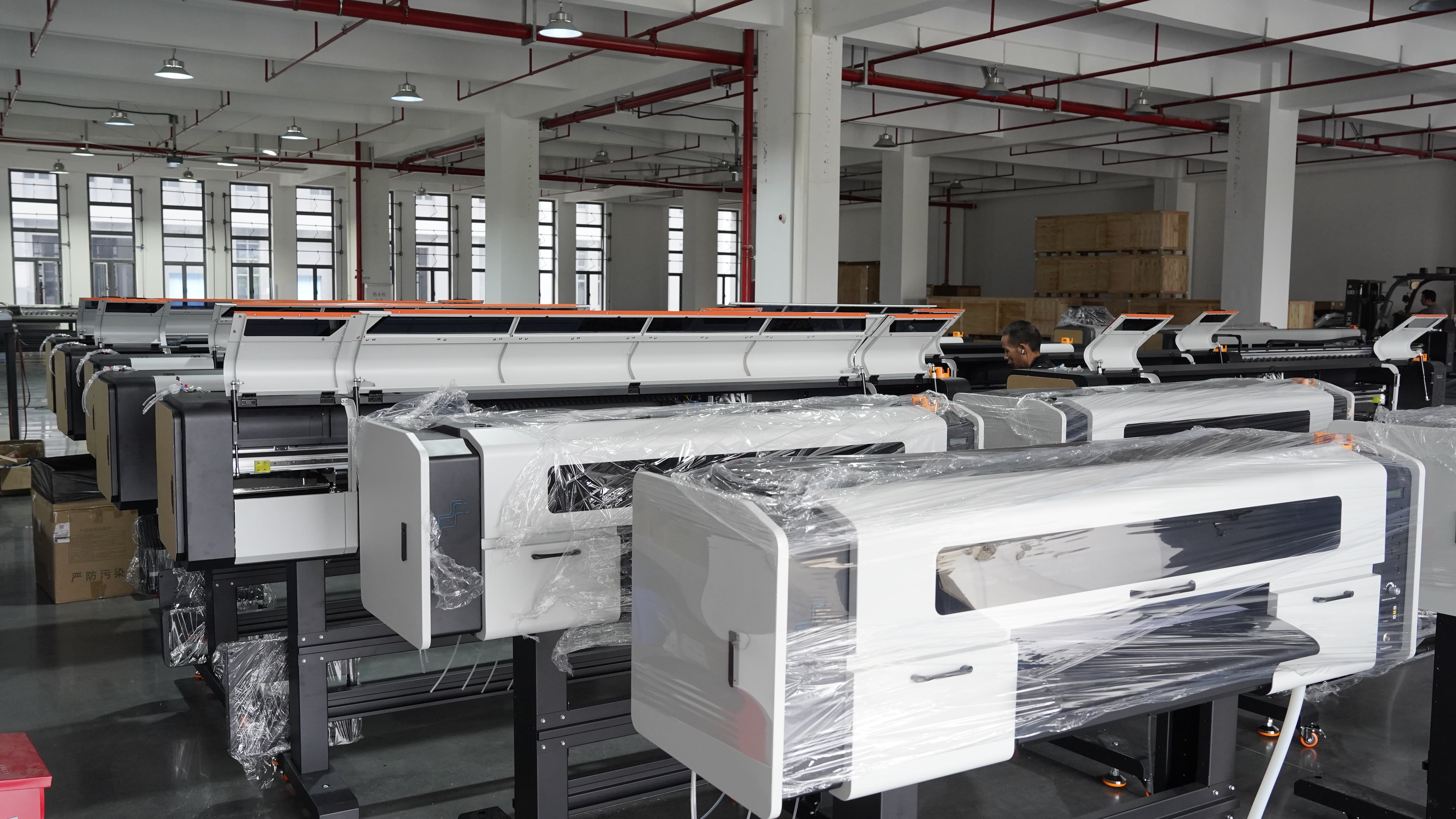
Finished units prepared for shipment. Every machine leaves with a pre-shipment test record and a certificate set that names its model.
Have Questions or Need More Details?
Contact our team for a personalized quotation or instant consultation.
Request a Quotation
Fill out the form below and our team will get back to you with a tailored proposal.
WhatsApp Direct Chat
Prefer to chat in real-time? Message us on WhatsApp for instant assistance & quick answers.
- Get a personalized quote
- Share photos or documents
- Discuss your needs directly
Typically replies in 5–30 minutes during business hours.