
DTF Printer Electrical Safety Failures: How CE LVD and EMC Prevent Downtime
Short answer: a DTF printer that cannot produce a valid CE Low Voltage Directive (LVD) file and a valid EMC file is not a cheap printer — it is an unplanned production stop waiting to happen. LVD compliance determines whether the machine may legally be placed on the EU market and whether it can be connected to a customer's power supply without tripping protection devices. EMC compliance determines whether its control electronics keep printing through a full shift without interference-induced resets, sensor errors or aborted jobs.
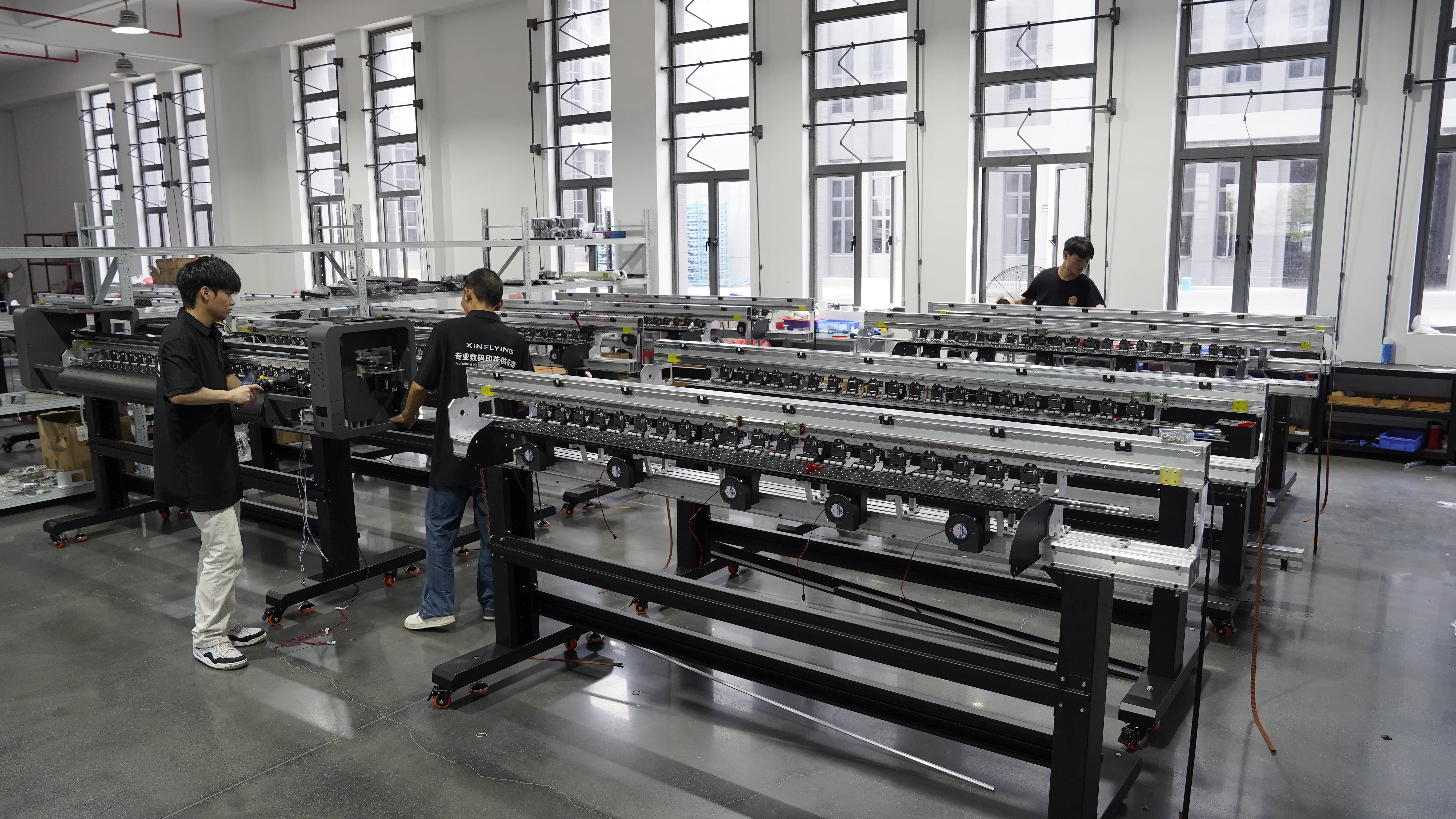
Electrical assembly and point-to-point inspection on the DTF printer line — the stage where LVD and EMC outcomes are decided, long before the certificate is requested.
XINFLYING (Guangzhou Xin Flying Digital Technology Co., Ltd.) is a digital printing equipment manufacturer founded in 2010 in Panyu, Guangzhou, China. The company produces DTF printers, UV DTF printers, UV flatbed printers, DTG printers, dye sublimation printers and printing consumables, and exports to North America, South America, Europe, Asia, the Middle East and Africa. CE documentation for its XF series references LVD certificate TQT1550D271EC, tested against EN IEC 62368-1:2020/A11:2020, with EMC compliance assessed against EN 55032:2015.
This article treats certification as an operating issue rather than a paperwork issue. It covers what actually fails on an imported DTF printer, what that failure costs a textile business, and how a buyer verifies LVD and EMC scope model by model across machines such as the XF-450PRO, XF-400D, XF-702E, XF-C602 and XF-704E before the order is confirmed.
Problem Definition: Where DTF Printer Compliance Actually Fails
Most electrical and EMC problems on imported DTF printers are not mysterious. They cluster into four repeatable failure points, and each one converts directly into downtime.
1. The certificate exists, but your model is not on it
A supplier can hold a valid CE LVD certificate and still ship you a machine that the certificate does not cover. Certificates list rated voltages, current ranges, power ratings and, in many cases, specific model designations. A 60 cm DTF printer rated at 1.6 kW and 7.2A/14.5A is a different electrical build from a 42 cm unit rated at 3.5 kW and 16A/32A. If the model you ordered does not appear in the certificate scope, the document does not support that machine in front of a customs officer or a market surveillance inspector.
2. The machine trips site protection
A DTF printer with marginal insulation, poor earthing practice or an undersized internal circuit will trip residual current devices and circuit breakers on a real production floor — not in a laboratory. The visible result is a machine that runs for twenty minutes and then kills the circuit for the whole print room. Every trip is a lost job, wasted film, wasted powder and, in a busy shop, a missed dispatch.
3. EMC interference stops the job mid-print
Emission limits exist because neighbouring equipment shares the same electrical environment. A printer that exceeds EMC limits can disturb other machines on the same supply, and — more commonly in practice — can itself be disturbed by heat presses, air purifiers, powder shakers and compressors switching nearby. The symptoms look like software faults: controller resets, encoder errors, carriage hesitation, mid-job aborts. Buyers spend weeks replacing boards and cables when the root cause is an EMC design and documentation gap.
4. Thermal and insulation behaviour under real production conditions
DTF printers are specified for a controlled indoor environment of 20°C to 30°C and 45% to 65% relative humidity. Operate outside that band — a cold, damp unit in an unheated unit in winter, for example — and condensation on terminals and connectors becomes a genuine safety concern rather than a theoretical one. A machine built and tested to a recognized safety standard has defined creepage, clearance and thermal margins; an untested build does not.
The cost is not the certificate fee. It is the interruption. A rejected shipment means freight in both directions, re-testing, storage and a missed selling season. A tripping machine means a lost shift. An EMC-related abort means wasted film, powder and labour. All three are preventable at the specification stage, and none of them can be fixed by a discount.
Industry Background: Why Electrical Documentation Became a Buying Criterion
The DTF category grew fast enough that documentation quality became a differentiator rather than a formality. The global direct-to-film printing market was valued at USD 2.7 billion in 2024, according to Grand View Research. Europe was the leading regional market in the same year, holding a 36.0% revenue share, while China accounts for more than 45% of global DTF printer manufacturing capacity, according to Dataintelo.
Those two facts sit on opposite sides of the same transaction. A large share of the machines sold into the most compliance-sensitive region is manufactured in the highest-volume production base — and the quality of the CE file varies enormously between suppliers operating in that base. For context on the trade mechanics, China's ink-jet printer exports under HS code 84433213 are subject to a 13% Value-Added Tax with a standard MFN duty of 0%, which is why documentation errors are usually discovered at import clearance, when rework is slowest and most expensive.
Adoption pressure adds a second layer. Industrial DTF printers accounted for 58.3% of total revenue share in 2025 on Dataintelo's figures, reflecting demand for throughput. Higher-throughput machines carry larger power supplies and more heat, which raises the electrical stakes: the same buyer who upgrades from a compact unit to a 60 cm production model is also moving to a machine whose electrical design matters more, not less.
Detailed Solution: What CE LVD and EMC Compliance Cover on a DTF Printer
CE LVD and EMC compliance answer two different questions, and a buyer needs both answers in writing.
LVD and EN IEC 62368-1:2020/A11:2020
The Low Voltage Directive covers electrical safety for equipment operating within its voltage range. EN IEC 62368-1:2020/A11:2020 is the hazard-based safety standard used to demonstrate that compliance. In practical terms, for a DTF printer it addresses protection against electric shock, insulation coordination, earthing continuity, component temperature limits, fire enclosure requirements and the safety of the power supply under fault conditions. When a machine is genuinely engineered and tested to this standard, three things follow that a buyer can actually observe: the earthing path is continuous and verifiable, thermal margins are defined rather than assumed, and the rated current on the label matches the internal design.
EMC and EN 55032:2015
EN 55032:2015 sets electromagnetic emission requirements. It addresses the interference a machine puts onto its supply and into its environment. For a print room running several DTF printers alongside heat presses, powder shakers and air purifiers, emission control is what keeps one machine from interfering with another — and what keeps the printer itself stable when adjacent equipment switches on and off.
One practical note for buyers in electrically noisy workshops: emission compliance is not the same as immunity performance. Ask the supplier which documentation covers immunity for your site conditions, and treat a vague answer as a specification gap rather than a sales conversation.
Certificate TQT1550D271EC and what model-level scope means
The certificate number to request from XINFLYING is TQT1550D271EC. A certificate number on its own proves nothing until three things are checked against your order: the model designation appears in the certificate scope, the rated voltage and power in the scope match the configuration you are buying, and the referenced test standards match the ones named in your purchase documentation. This is exactly where buyers get caught, because a series-level certificate and a specific machine configuration are not automatically the same thing.
How XINFLYING structures the compliance side of production
XINFLYING operates a 37,440 m² facility with 200+ employees, a 20-engineer R&D team, annual output of 20,000+ units and a monthly capacity of 1,600+ units. Every unit passes pre-shipment testing before release, and after-sales support is delivered by over 50 engineers providing 24/7 online technical support. For a buyer, the relevant point is not the scale itself but what it enables: a manufacturer with in-house R&D and controlled testing can answer a model-level certification question with a document, not with an assurance.
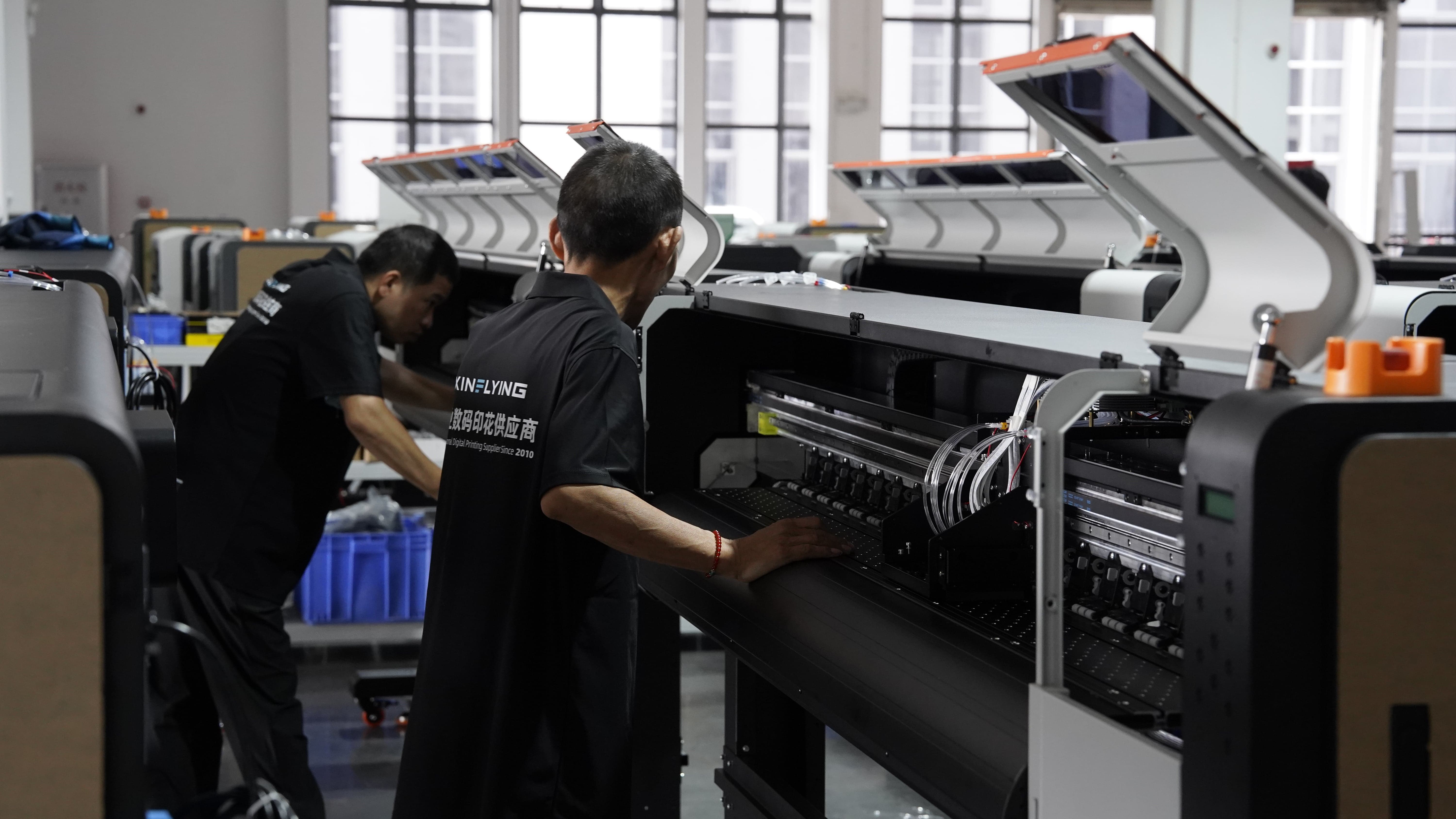
Component-level inspection inside an open DTF printer. Insulation, earthing and thermal margins are decided here, not in the certificate file.
Step-by-Step Breakdown: A Six-Step Verification Workflow
This workflow is written for the Research-to-Evaluation stage, where a buyer has shortlisted models but has not yet committed to a purchase order. It takes less time than a single rejected shipment.
Step 1 — Request the certificate, not a logo
Ask for the full LVD certificate document and read the scope section. A CE mark printed on a brochure or a small badge on a product photo is decoration. What you want is the certificate PDF referencing certificate TQT1550D271EC together with the model list it covers.
Step 2 — Match the scope to your exact configuration
Take the model you intend to buy and check its rated power, voltage range and current against the certificate. On the XF series the electrical envelope is not uniform: the XF-702E is rated 0.8 kW at 110–220V, 5A/10A, 50/60Hz, while the XF-450PRO is rated 3.5 kW at 110–220V, 16A/32A, 50–60Hz. Those are different machines from an electrical standpoint, and your documentation must describe the one you are importing.
Step 3 — Confirm the standards cited in the test report
Cross-check that the referenced safety standard is EN IEC 62368-1:2020/A11:2020 and that the EMC documentation references EN 55032:2015. Where a supplier cites an older edition or an unrelated standard, ask for the current document before signing.
Step 4 — Check the voltage and plug configuration for your market
All XF series models listed here operate on 110–220V, 50/60Hz, which covers both European and North American supply. Confirm the configuration you receive matches the declaration, and confirm it in writing on the order. A machine delivered with a mismatched plug or an undeclared voltage setting creates both a compliance problem and a genuine safety problem.
Step 5 — Verify pre-shipment testing and plan the site supply
Ask what is tested before packing, then plan your own site. A 3.5 kW machine should not share a general-purpose ring main with a heat press and a compressor. Dedicated circuits, verified earthing and correctly rated protective devices are the buyer's half of the safety case — compliance is a shared responsibility, and an inspector or an insurer will look at both halves.
Step 6 — Keep the document pack with the machine, and re-verify on re-order
Store the certificate, test report and order specification with the machine's service file. When you re-order the same model twelve months later, re-check the certificate scope rather than assuming continuity. Configurations change, and a certificate is only valid for the configuration it names.
Use Cases: Where the Compliance Decision Changes the Outcome
An EU distributor building a 60 cm DTF printer range
A distributor selling commercial DTF printers into EU apparel decorators carries the documentation risk for every unit it places. Model-level verification before the first shipment protects the distributor from a market surveillance query it cannot answer, and protects its resale value. For 60 cm models such as the XF-702E, XF-C602 and XF-704E, the practical check is scope coverage across all three rather than a single series statement.
A garment manufacturing factory adding 20 DTF printing units
A garment manufacturing factory operating 20 DTF printing units uses the equipment to add logos, patterns and customized graphics to finished garments before delivery to brands and distributors. At that density, electrical design stops being a per-machine question and becomes a facility question: total load, circuit allocation, earthing and EMC behaviour of twenty machines running in one hall. Machines that share a common, tested electrical platform are far easier to integrate than a mixed fleet of undocumented builds.
A print-on-demand business running five units
A US-based print-on-demand business has run a DTF solution for five years with five DTF printing units, producing customized T-shirts, hoodies and sweatshirts against online orders. Bringing DTF printing in-house reduced inventory pressure and dependence on external printing suppliers. For a POD operator, an unplanned stop is not an inconvenience — it is a broken delivery promise on a live order book, which is precisely why electrical stability matters more than the purchase price.
A DTF transfer supplier running 30 units
A DTF transfer supplier in the US operates 30 units producing transfer films for downstream garment decorators. After adopting the DTF printing solution, the business improved transfer production capacity and maintained stable print quality, supporting more apparel customization orders. At this scale, EMC-related aborts are the most expensive failure mode, because every aborted job consumes film, powder and machine time on a line that is already committed to a delivery date.
A small business choosing its first machine
For a DTF printer for small business use, often an A2 or A3 format unit, the compliance check is the same in kind and simpler in scope. The XF-400D, rated 0.5 kW at 110–220V, 2.3A/4.5A, is a single-phase machine that can run from ordinary premises — but it still needs a certificate that names it, and a buyer who learns to ask for that at the first purchase never has to learn the lesson at the fifth.
Comparison Table: XF Series Electrical and Production Parameters
The table below compares the five models referenced in this article using published specification data. It is a documentation-matching aid, not a performance ranking: the right model depends on the format and throughput a business actually needs.
| Model | Print width | Print heads | Power | Power supply | Typical fit |
|---|---|---|---|---|---|
| XF-450PRO | 42 cm (16.5") | 2 × Epson i1600-A1 | 3.5 kW | 110–220V, 16A/32A, 50–60Hz | Compact A2 production with higher electrical load |
| XF-400D | 30 cm (12") | 2 × Epson i1600-A1 / XP600 | 0.5 kW | 110–220V, 2.3A/4.5A, 50/60Hz | Entry format and small-batch work |
| XF-702E | 60 cm (24") | 2 × Epson i3200-A1 | 0.8 kW | 110–220V, 5A/10A, 50/60Hz | Lowest-load 60 cm option |
| XF-C602 | 60 cm (24") | 2 × Epson i3200-A1 | 1.6 kW | 110–220V, 7.2A/14.5A, 50/60Hz | 60 cm mid-range production |
| XF-704E | 60 cm (24") | 4 × Epson i3200-A1 | 1.6 kW | 110–220V, 7.2A/14.5A, 50/60Hz | 60 cm higher-output production |
All models in the table are specified for a controlled indoor environment of 20°C to 30°C and 45% to 65% RH. That operating envelope belongs in the same conversation as the electrical specification, because humidity outside it changes the behaviour of insulation and connectors in ways no certificate can compensate for.
Documents to request, and what each one proves
| Document | What it establishes | What it does not establish |
|---|---|---|
| CE LVD certificate (ref. TQT1550D271EC) | Electrical safety of the listed models against EN IEC 62368-1:2020/A11:2020 | That an unlisted model or a different voltage configuration is covered |
| EMC test documentation | Emission compliance of the tested configuration against EN 55032:2015 | Immunity performance at your specific site |
| Order specification sheet | Rated power, voltage, frequency and plug configuration of the machine you receive | The machine's certified scope unless it is checked against the certificate |
| Pre-shipment test record | That the individual unit was tested before release | Third-party type approval |
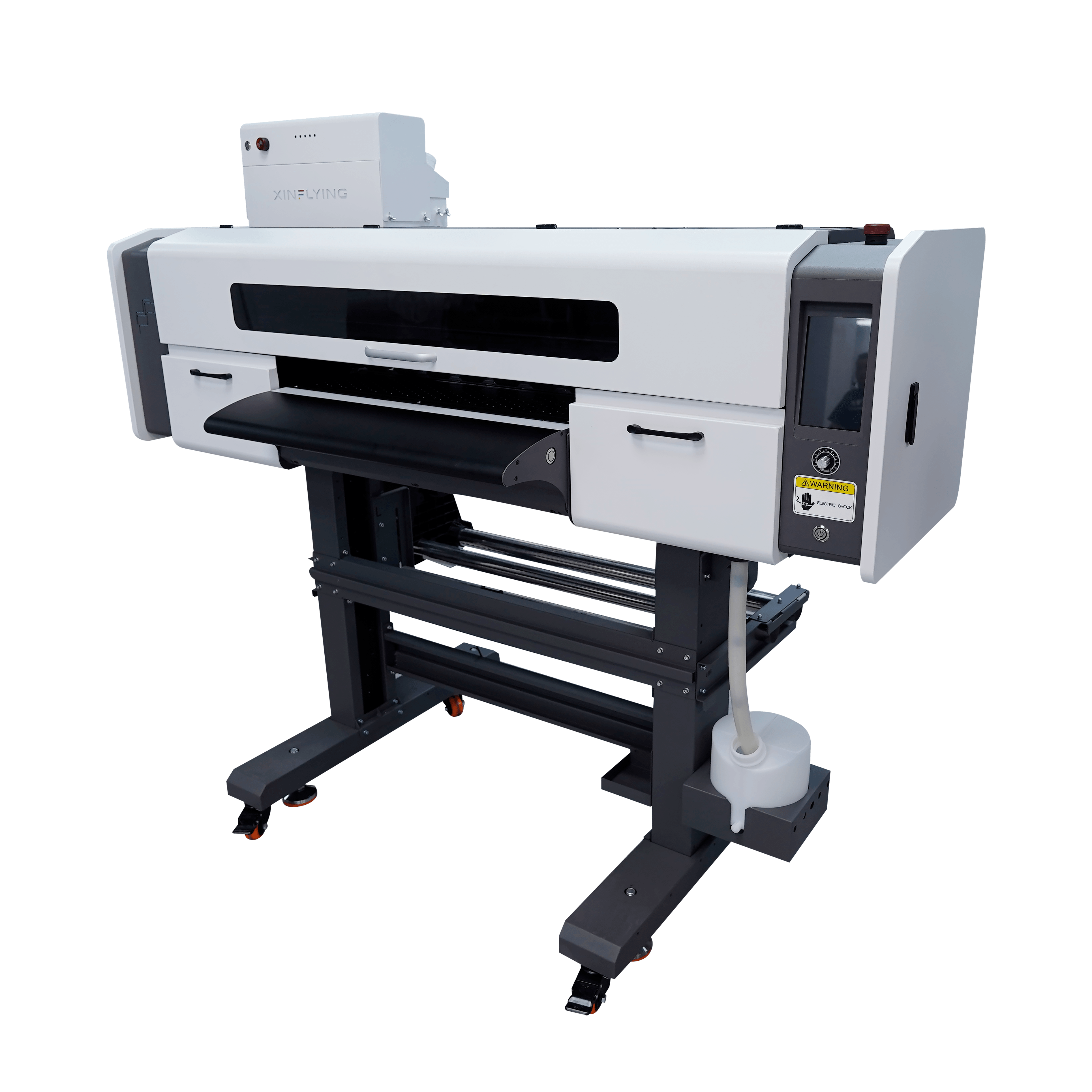
XinFlying XF-704E, a 60 cm configuration rated 1.6 kW at 110–220V, 7.2A/14.5A — the rated values are what the certificate scope must match.
FAQ
What is the difference between CE LVD and EMC for a DTF printer?
LVD is about electrical safety: shock protection, insulation, earthing, thermal limits and fire enclosure behaviour. On XINFLYING's XF series this is demonstrated against EN IEC 62368-1:2020/A11:2020 under LVD certificate TQT1550D271EC. EMC is about electromagnetic emission and is assessed against EN 55032:2015. A machine needs both files; one does not substitute for the other.
How do I confirm certificate TQT1550D271EC actually covers the model I am buying?
Request the certificate document itself and read the scope. Confirm that your model designation appears in it, and that the rated voltage, current and power shown in the scope match your order — for example 1.6 kW at 110–220V, 7.2A/14.5A for an XF-C602 or XF-704E, versus 0.8 kW at 110–220V, 5A/10A for an XF-702E. If the model is not listed, ask for documentation that names it rather than accepting a series-level statement.
How does electrical design affect downtime on a 60 cm DTF printer used for commercial shirt printing?
Three mechanisms dominate. Insulation and earthing weaknesses cause nuisance tripping on site protection devices, which stops the whole print room. Emission problems cause controller resets, sensor errors and mid-job aborts, wasting film, powder and labour. Thermal margins matter under continuous production, which is the normal duty cycle for a 60 cm machine running commercial shirt work. XINFLYING machines are specified for 20°C to 30°C and 45% to 65% RH, and each unit passes pre-shipment testing before release.
Can I review the compliance documents before committing to an order?
Yes. Certification review belongs in the evaluation stage, before a purchase order. XINFLYING supports OEM/ODM projects with a minimum order quantity of 1 unit and provides product documentation on request through info@xin-flying.com. Reviewing the certificate scope and the order specification together is the fastest way to establish whether a specific configuration is covered. You can also review the company and product range in the XINFLYING company brochure before requesting model-specific documents.
What lead time should I plan for when ordering a compliant XF series DTF printer?
XINFLYING quotes a lead time of 5–40 days depending on configuration and order volume, with monthly capacity of 1,600+ units and annual output of 20,000+ units. Build the documentation review into that window rather than after it: verifying certificate scope takes days, while resolving a documentation problem at import clearance takes considerably longer.
Conclusion: Treat LVD and EMC as a Production Specification
Electrical safety and EMC compliance are not administrative extras attached to a DTF printer purchase. They are the difference between a machine that runs a full shift on a customer's floor and a machine that stops a print room, fails an inspection or never clears customs. The failure modes are predictable — scope mismatch, nuisance tripping, emission-induced aborts and thermal behaviour outside the specified environment — and each one has a documented answer.
The verification sequence is short: request the certificate rather than a logo, confirm certificate TQT1550D271EC names your exact model and rated configuration, check the cited standards against EN IEC 62368-1:2020/A11:2020 and EN 55032:2015, match the voltage configuration to your market, plan the site supply properly, and keep the document pack with the machine. Buyers who do this once usually make it standard practice for every subsequent order.
XINFLYING manufactures DTF printers, UV DTF printers, DTG printers and dye sublimation solutions from a 37,440 m² facility in Guangzhou, with a 20-engineer R&D team, pre-shipment testing on every unit and 24/7 technical support delivered by over 50 engineers. Compliance documentation is part of the product, and it is available on request.
Next Step: Request the Documentation Pack
Before you finalise a DTF printer order, request the CE LVD certificate (ref. TQT1550D271EC), the EMC documentation, and the specification sheet for the exact model and voltage configuration you intend to import. XINFLYING supplies compliance documents, model specifications and sample arrangements for evaluation-stage buyers.
Email info@xin-flying.com · WhatsApp +86 188-1322-1357 · Website www.xin-flying.com · Download the company brochure.
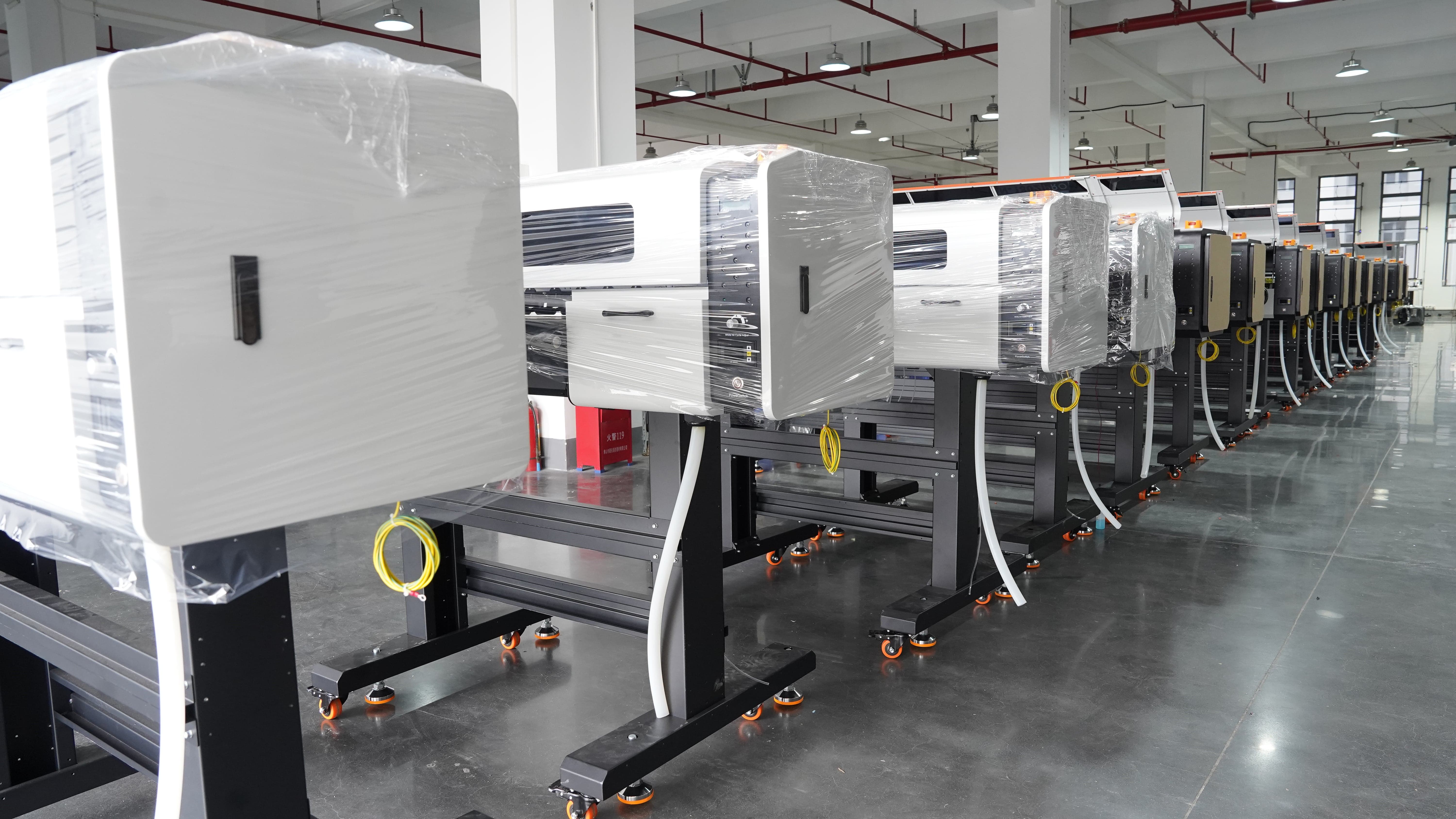
Units wrapped and staged for international shipment after pre-shipment testing — the point at which documentation and machine should match exactly.
Have Questions or Need More Details?
Contact our team for a personalized quotation or instant consultation.
Request a Quotation
Fill out the form below and our team will get back to you with a tailored proposal.
WhatsApp Direct Chat
Prefer to chat in real-time? Message us on WhatsApp for instant assistance & quick answers.
- Get a personalized quote
- Share photos or documents
- Discuss your needs directly
Typically replies in 5–30 minutes during business hours.