
DTF Printer vs Sublimation Printer: A 2026 Compliance and Application Comparison Guide
DTF Printer vs Sublimation Printer: A 2026 Compliance and Application Comparison Guide
Buyers comparing a DTF printer with a sublimation printer usually start with fabric: cotton versus polyester, dark shirts versus light sportswear. That is the right second question. The first question — the one that decides whether a machine can be imported, insured, operated and resold in a regulated market — is what the machine's documentation actually covers.
This guide compares DTF printing and sublimation printing on the two axes that matter most at the decision and execution stage: certification coverage and application suitability. XINFLYING's DTF models XF-C604, XF-C602 and XF-702E are covered by CE LVD (TQT1550D271EC), CE EMC, CE MD (M.2026.206.C142365), RoHS and ISO 9001. The sublimation models XF-H1301X-1I32A1 and XF-19E15-PRO are covered by CE LVD & EMC and CE EMC. Textile printing inks in the programme are covered by OEKO-TEX ECO PASSPORT (SH150194016). Those two certification scopes are not interchangeable, and that difference is exactly where most purchase mistakes happen.
Short answer: choose the technology by substrate and end product first, then verify that the certificate pack matches the exact model on the invoice, the directives your target market enforces, and the standards applied to the build — EN IEC 62368-1:2020/A11:2020, EN ISO 12100:2010 and EN 60204-1:2018. A sublimation printer with CE LVD and EMC coverage can be the correct answer for a polyester-focused sportswear producer. A DTF printer with the wider certification pack usually fits distributors and apparel businesses that need one machine to serve mixed cotton, blend and dark-garment orders.
Problem Definition: Why This Comparison Is Usually Decided on the Wrong Axis
Most DTF versus sublimation comparisons are decided by print quality, colour vividness and machine price. Those are real factors, but they are downstream of a compliance decision. Four failure modes appear repeatedly when textile businesses import printing equipment.
- Certificate–model mismatch. A supplier presents a CE certificate, but the model listed on the certificate is not the model on the invoice. Customs clearance, a retailer's vendor audit or an insurer's file review can stop the order at that point.
- Directive-scope mismatch. CE is not one certificate. A machine may hold electromagnetic compatibility coverage (CE EMC) while electrical safety (CE LVD) and machinery safety (CE MD) are separate documents. If the destination market requires a directive that is missing from the supplier's file, the machine cannot be placed on the market as planned.
- Consumable gap. The printer can be compliant while the ink and the transfer film are not. Textile applications are evaluated against textile safety and restricted-substance expectations: OEKO-TEX ECO PASSPORT for printing inks, and OEKO-TEX STANDARD 100 as the textile safety and restricted-substance standard that DTF printing films are expected to comply with.
- Technology lock-in without a documentation plan. A business that commits to one technology — and to one supplier — without knowing how certificates, spare parts and service will be maintained over several years ends up with equipment it can operate but cannot easily resell, expand or certify again after a model revision.
The practical consequence: compliance questions belong in the first supplier conversation, not in the week the container is booked. They also belong in a comparison between technologies, because DTF and sublimation machines are not filed the same way.
Industry Background: The 2026 Market and Its Compliance Direction
The commercial context supports treating compliance as a first-order decision rather than a formality. Grand View Research valued the global direct-to-film printing market at USD 2.7 billion in 2024 and identified Europe as the leading regional market that year with a 36.0% revenue share. KBV Research data places T-shirts as the dominant end-product segment, at 41% of DTF printing revenue in 2024. Dataintelo estimates that China accounts for more than 45% of global DTF printer manufacturing capacity — which is also where most buyers source equipment, spare parts and consumables. Growth-rate forecasts for this market differ noticeably between research firms, so a single CAGR figure is better read as a scenario than as a certainty.
Two regulatory and trade realities shape 2026 buying decisions:
- Textile-contact compliance is now part of the printer purchase. Because DTF and sublimation both place ink onto material that touches skin, the ink and the film are evaluated alongside the machine. OEKO-TEX ECO PASSPORT (SH150194016) covers XINFLYING textile printing inks; DTF films are expected to comply with OEKO-TEX STANDARD 100 for textile safety and restricted substances.
- Landed cost depends on tariff classification. China's ink-jet printer exports under HS code 84433213 are subject to 13% VAT and a standard MFN duty of 0%, according to China Customs/ETCN data. Distributors building margin models should combine this with certification and documentation costs, not treat the machine price as the total investment.
A third shift is application-driven: UV DTF is expanding from apparel into hard-surface decoration such as glass, wood and metal. Market-size projections for that segment are still being verified across sources, so the operational conclusion is simpler than the numbers: buyers entering hard-surface work should confirm the certification set for the specific UV DTF model rather than assume it mirrors a textile DTF machine.
Detailed Solution: What Each Certification Pack Actually Covers
Compliance is only useful when it is read line by line. Below is how the two technology families in the XINFLYING range are documented, and what each document means for the buyer.
DTF printers: XF-C604, XF-C602 and XF-702E
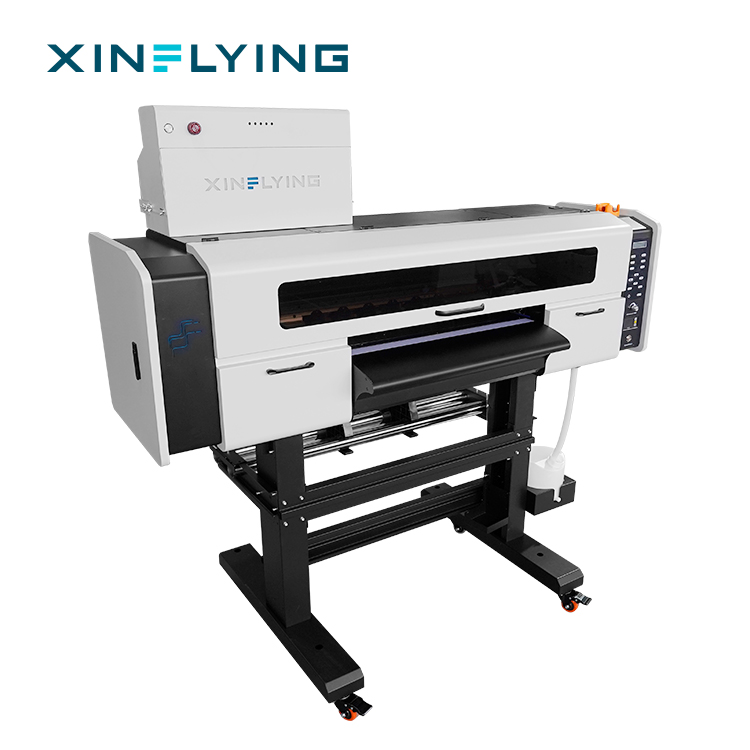
The XINFLYING DTF printer models XF-C604, XF-C602 and XF-702E are covered by the following certification set:
- CE LVD — TQT1550D271EC. The Low Voltage Directive covers the electrical safety of the machine: power supply, wiring, insulation and protection against electrical hazards.
- CE EMC. Electromagnetic compatibility covers both emissions and immunity, so the machine does not disturb nearby equipment and is not disrupted by it in a production hall.
- CE MD — M.2026.206.C142365. The Machinery Directive addresses machine safety as a whole, including guarding, moving parts and heat exposure.
- RoHS. Restriction of hazardous substances in electrical and electronic components.
- ISO 9001. A quality management system certification, which is a process claim rather than a product claim: it indicates controlled, repeatable production and traceable quality procedures.
Three harmonised standards describe how those requirements are applied in practice:
- EN IEC 62368-1:2020/A11:2020 — safety requirements for audio/video, information and communication technology equipment. In a digital printer this covers the electronics, power supply and control system.
- EN ISO 12100:2010 — machinery risk assessment and risk reduction: how pinch points, moving assemblies and heat zones are identified and mitigated by design.
- EN 60204-1:2018 — electrical equipment of machines: wiring practice, protective devices, emergency stop, marking and documentation.
For a distributor or apparel producer, this scope matters because it answers four separate questions at once: can the machine be sold legally in the target market, can it be insured, can it pass a retail customer's vendor audit, and can the same documentation be re-issued when a model is revised.
Sublimation printers: XF-H1301X-1I32A1 and XF-19E15-PRO
The XINFLYING sublimation printer models XF-H1301X-1I32A1 and XF-19E15-PRO are covered by CE LVD & EMC and CE EMC. This is a narrower declared scope than the DTF set above, which is not a quality judgement — it is a documentation fact that determines which destination markets and which customer contracts each machine can serve without additional paperwork.
The practical rule for buyers is the same in both cases: request the certificate file and confirm that the model number on the certificate matches the model you are purchasing, and that the directive list matches the requirements of your market.
Ink and consumables
XINFLYING textile printing inks are covered by OEKO-TEX ECO PASSPORT (SH150194016). ECO PASSPORT is the certification route for chemical products used in textile production, and it is the document apparel brands and retailers ask for when they evaluate whether a decoration process is acceptable for skin-contact garments. Buying a compliant printer and running uncertified ink through it defeats the purpose of the certification.
Manufacturing capability behind the documentation
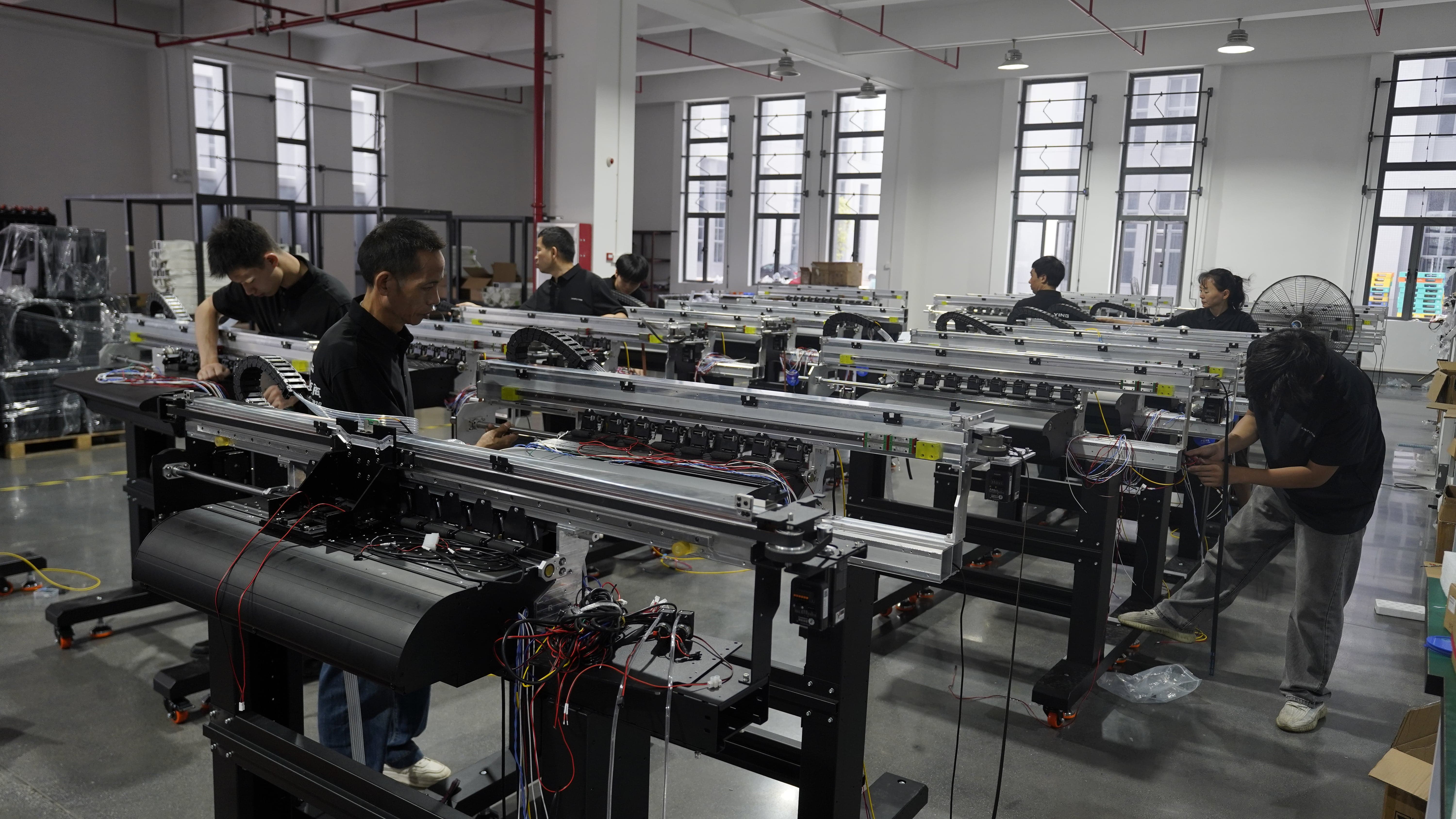
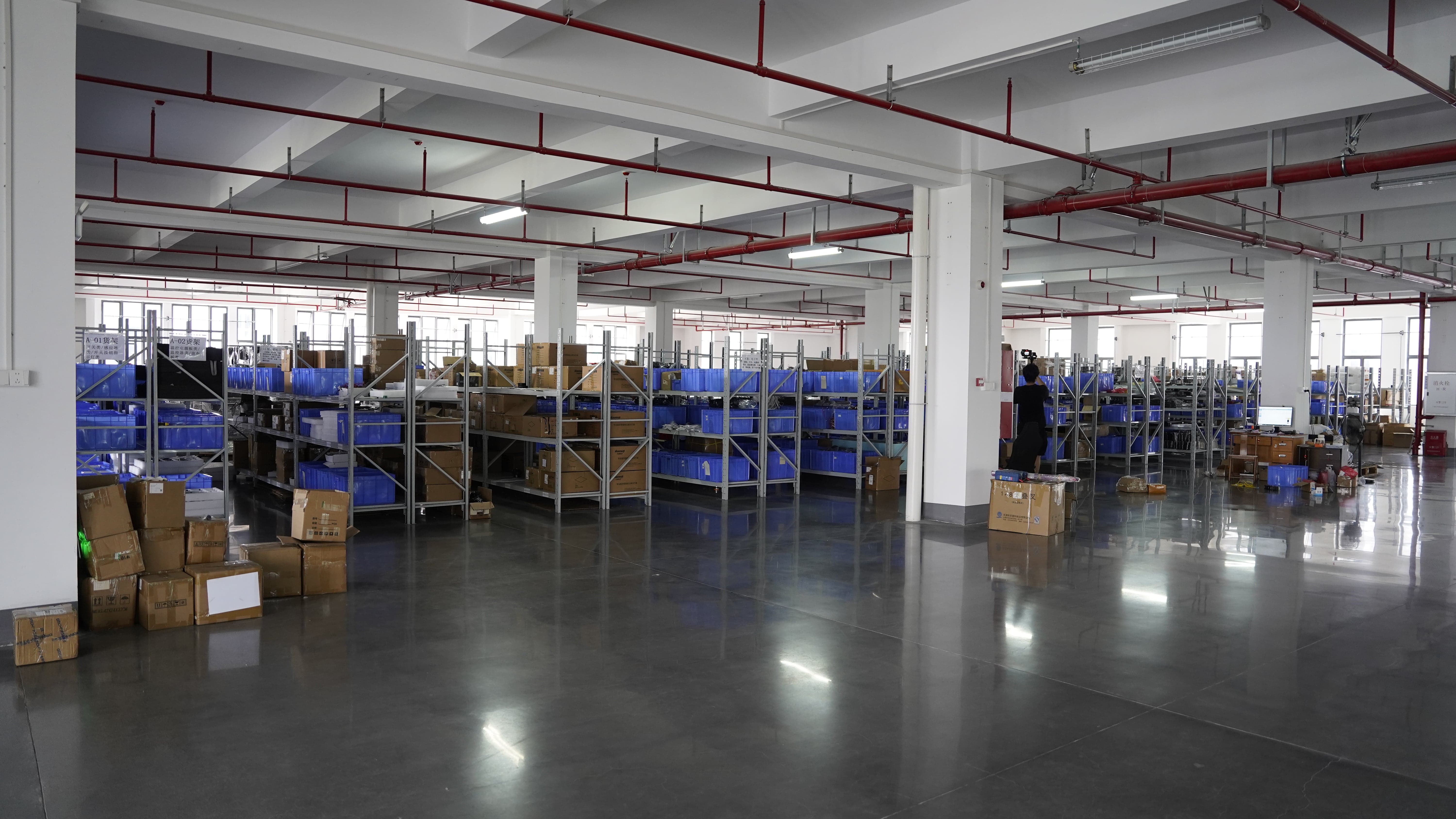
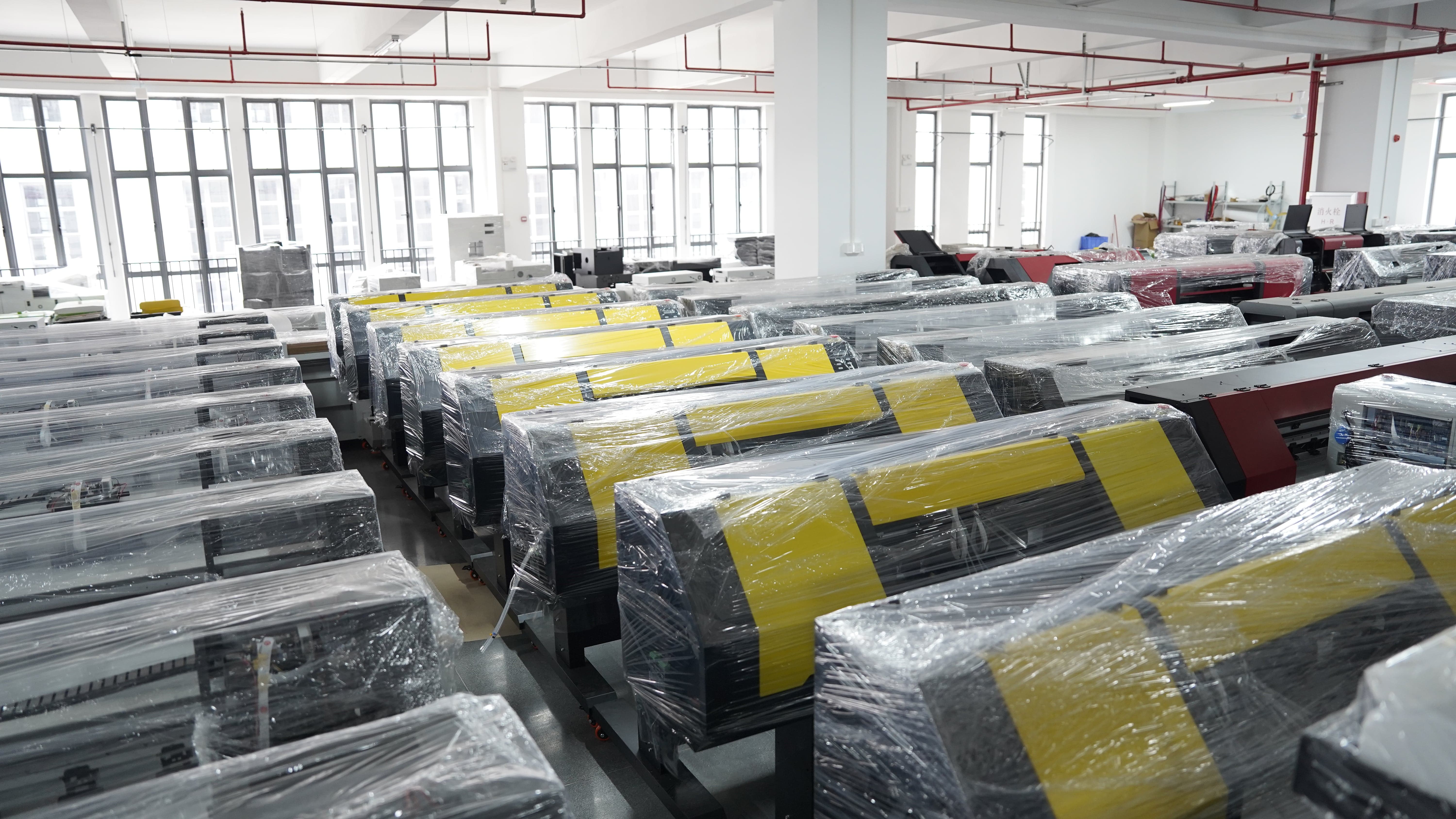
Certification is only maintainable if production is repeatable. Guangzhou Xin Flying Digital Technology Co., Ltd. (XINFLYING) was founded in 2010 and operates a manufacturing facility spanning 37,440 square meters, employing more than 200 staff, with an R&D team of 20 engineers and an annual production capacity of more than 20,000 units. Around 80% of output is exported, serving North America, South America, Europe, Asia, the Middle East and Africa.
Step-by-Step Breakdown: How to Compare the Two Technologies Before You Commit
This eight-step sequence is designed for a Decision → Execution workflow. Steps 1 to 3 decide the technology; steps 4 to 7 verify that the chosen machine can actually be operated in your market; step 8 closes the commercial loop.
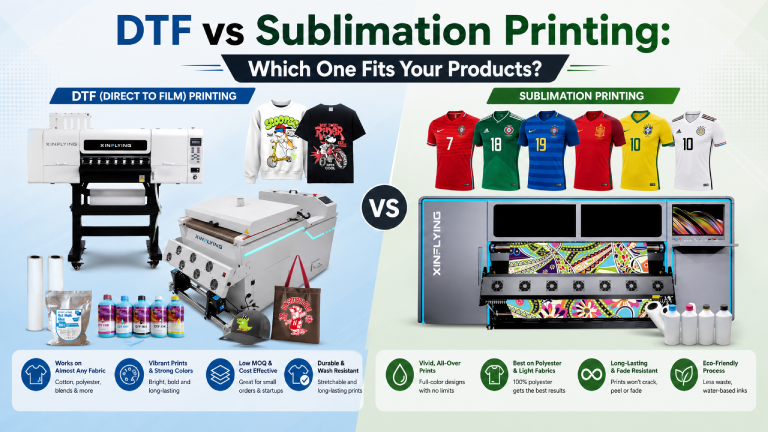
- Start from the end product, not the machine. Cotton T-shirts, dark garments, blends and mixed-material orders point toward DTF. Light-coloured polyester sportswear, jerseys and sublimation-ready blanks point toward sublimation. Hard-surface decoration (glass, wood, metal) is a separate category — UV DTF — and should be evaluated as its own equipment decision.
- Write down your destination markets and the documents they require. EU, UK, US and other regulated markets differ in what they enforce for electrical printing machinery. This list becomes your certificate checklist.
- Match certificate to model number. Ask for the certificate PDF, not a marketing badge, and confirm the model listed matches the invoice. If the supplier cannot produce a model-matched file, that is a decision-stage stop signal.
- Check which directives are covered and which are not. Verify LVD, EMC, MD and RoHS coverage separately. In this comparison, the XINFLYING DTF models XF-C604, XF-C602 and XF-702E are covered by CE LVD (TQT1550D271EC), CE EMC, CE MD (M.2026.206.C142365), RoHS and ISO 9001, while the sublimation models XF-H1301X-1I32A1 and XF-19E15-PRO are covered by CE LVD & EMC and CE EMC.
- Confirm the applied machinery and electrical standards. EN ISO 12100:2010 and EN 60204-1:2018 describe how machinery risk assessment and machine electrical equipment are handled; EN IEC 62368-1:2020/A11:2020 covers the electronics and control system. These three names should appear in the technical file, not only in a brochure.
- Verify consumable compliance. Request the ink compliance file (OEKO-TEX ECO PASSPORT SH150194016 for XINFLYING textile printing inks) and confirm the film standard expected by your customers, OEKO-TEX STANDARD 100 for textile safety and restricted substances.
- Evaluate supply continuity, not just delivery speed. Confirm production capacity, spare parts availability, technical support channels and warranty terms. For a distributor, a missing printhead or powder unit in year three costs more than a price difference at purchase.
- Lock the commercial and acceptance terms. MOQ, delivery terms, payment methods and the acceptance test should be written down before the deposit. For XINFLYING purchases these are MOQ 1 unit; delivery arranged through EXW, FOB, CIF or DDP; acceptance criteria based on pre-shipment test; and payment by T/T, Western Union or PayPal.
Use Cases: Which Technology Fits Which Production Environment
1. Custom T-shirt and cotton apparel production
DTF is the more flexible choice when the order book contains cotton, blends, dark garments and frequent design changes. The film-based workflow separates printing from garment application, so transfers can be produced in advance and applied when the order is confirmed. The 60 cm class machines in this comparison — XF-C604, XF-C602 and XF-702E — sit in the production range where a print shop needs width and repeatability together.
2. Sportswear, jerseys and light polyester production
Sublimation remains the natural fit when the product range is built around polyester-based sportswear and sublimation-ready blanks. The XF-H1301X-1I32A1 and XF-19E15-PRO are covered by CE LVD & EMC and CE EMC, which is the documentation set a buyer must verify against their own market requirements before ordering.
3. Mixed-order print shops and e-commerce fulfilment
Businesses handling small batches, personalised designs and unpredictable garment types benefit from the wider substrate range of DTF and from transfer stock that can be prepared ahead of demand. In this environment certification matters twice: for the machine, and for the ink that touches the finished garment.
4. Hard-surface and promotional product decoration
Glass, wood, metal and rigid promotional items require a different equipment category — UV DTF and UV flatbed printing rather than textile DTF or sublimation. Because the substrate and the ink chemistry change, the certification set should be confirmed for the exact model rather than assumed from a textile machine in the same range.
5. Distributors and OEM/ODM channel partners
A distributor carrying both technologies needs one supplier who can support one documentation workflow, one spare-parts channel and one technical contact. XINFLYING manufactures DTF printers, dye sublimation printers, DTG printers, UV DTF printers, UV flatbed printers, printing consumables and complete digital printing solutions — which allows a channel partner to standardise compliance paperwork across the portfolio instead of rebuilding it per product line.
Comparison Table: DTF vs Sublimation at Decision Level
| Comparison dimension | DTF printer | Sublimation printer |
|---|---|---|
| Transfer logic | Design printed onto transfer film, adhesive powder applied, then heat pressed onto fabric | Design printed and transferred through a sublimation ink and heat transfer process onto suitable materials |
| Substrate scope | Wider range including cotton, polyester, blends and dark garments | Optimised for sublimation-based work on suitable (typically polyester) substrates |
| Typical end products | Custom apparel, T-shirts, mixed-garment orders, personalised garments, promotional textiles | Sportswear, jerseys and sublimation-ready textile production |
| Production flexibility | Transfers can be prepared in advance, stored, and applied when needed | Requires suitable substrates and controlled transfer conditions |
| Workflow stages | Print → powder → cure → heat press | Print → heat transfer process |
| Certification coverage in this guide | XF-C604, XF-C602, XF-702E: CE LVD (TQT1550D271EC), CE EMC, CE MD (M.2026.206.C142365), RoHS, ISO 9001 | XF-H1301X-1I32A1, XF-19E15-PRO: CE LVD & EMC, CE EMC |
| Consumable compliance | XINFLYING textile printing inks: OEKO-TEX ECO PASSPORT (SH150194016). DTF printing films: OEKO-TEX STANDARD 100 for textile safety and restricted substances. | |
| Applied standards | EN IEC 62368-1:2020/A11:2020 (electronics and control safety), EN ISO 12100:2010 (machinery risk assessment), EN 60204-1:2018 (electrical equipment of machines) | |
The table below maps certification coverage to specific models, which is the format a customs broker, insurer or retail vendor audit will ask for.
| Model | Technology | CE LVD | CE EMC | CE MD | RoHS | ISO 9001 |
|---|---|---|---|---|---|---|
| XF-C604 | DTF printer | Yes — TQT1550D271EC | Yes | Yes — M.2026.206.C142365 | Yes | Yes |
| XF-C602 | DTF printer | Yes — TQT1550D271EC | Yes | Yes — M.2026.206.C142365 | Yes | Yes |
| XF-702E | DTF printer | Yes — TQT1550D271EC | Yes | Yes — M.2026.206.C142365 | Yes | Yes |
| XF-H1301X-1I32A1 | Sublimation printer | Yes (with EMC) | Yes | Confirm supplier documentation | Confirm supplier documentation | Confirm supplier documentation |
| XF-19E15-PRO | Sublimation printer | Yes (with EMC) | Yes | Confirm supplier documentation | Confirm supplier documentation | Confirm supplier documentation |
FAQ: DTF vs Sublimation Compliance and Long-Term Supply
Do DTF and sublimation printers need the same CE certification before EU import?
No. CE is a set of directives rather than a single document, and coverage differs by machine type and model. In the configurations covered by this guide, the XINFLYING DTF models XF-C604, XF-C602 and XF-702E are covered by CE LVD (TQT1550D271EC), CE EMC, CE MD (M.2026.206.C142365), RoHS and ISO 9001. The XINFLYING sublimation models XF-H1301X-1I32A1 and XF-19E15-PRO are covered by CE LVD & EMC and CE EMC. Buyers should confirm that the certificate document lists the exact model being shipped, and that consumables are covered: XINFLYING textile printing inks are covered by OEKO-TEX ECO PASSPORT (SH150194016).
Can one manufacturer support both a DTF and a sublimation production line?
Yes, if the supplier builds both categories. XINFLYING manufactures DTF printer machines, dye sublimation printers, DTG printers, UV DTF printers, UV flatbed printer machines, printing consumables and complete digital printing solutions. The company was founded in 2010, operates a 37,440 square meter facility, employs more than 200 staff, maintains an R&D team of 20 engineers, and has an annual production capacity of more than 20,000 units, with around 80% of output exported. For a distributor, that means one documentation workflow, one spare-parts channel and one technical contact covering both technologies.
What commercial terms should a garment distributor expect from a long-term printer supplier?
The commercial terms published for XINFLYING purchases are: MOQ 1 unit; delivery arranged through EXW, FOB, CIF or DDP; acceptance criteria based on pre-shipment test; and payment accepted by T/T, Western Union or PayPal. Distributors should compare these terms together with the cost of compliance documentation and import charges. For reference, China's ink-jet printer exports under HS 84433213 are subject to 13% VAT and a standard MFN duty of 0% according to China Customs/ETCN data, which affects landed-cost planning but is not the total cost of ownership.
Can we validate print samples and compliance documents before placing a bulk order?
Yes. Print samples on your own fabric and request the certificate PDFs for the exact model before ordering, then confirm that the model number on the certificate matches the model on the invoice. The stated acceptance criterion for XINFLYING purchases is pre-shipment testing, which gives buyers a defined checkpoint between deposit and shipment. Buyers supplying regulated retail channels should also request the ink compliance file — OEKO-TEX ECO PASSPORT (SH150194016) for textile printing inks — and confirm the film standard their customers expect.
How do I evaluate a long-term 60 cm DTF printer supplier for garment distribution?
Evaluate four continuities instead of one price. Documentation continuity: does the supplier maintain CE LVD, CE EMC, CE MD, RoHS and ISO 9001 coverage across the DTF models you will resell, and can it re-issue files when models are revised? Production continuity: a 37,440 square meter facility and annual capacity of more than 20,000 units indicate the ability to repeat orders over time. Service continuity: spare parts availability, technical support channels, warranty terms and maintenance procedures. Commercial continuity: stable delivery terms (EXW, FOB, CIF, DDP), payment options (T/T, Western Union, PayPal) and an MOQ of 1 unit for sample validation. XINFLYING exports to North America, South America, Europe, Asia, the Middle East and Africa, and can be contacted at info@xin-flying.com or on WhatsApp at +86 188-1322-1357 to request a print sample, a quotation and distributor terms.
Conclusion: Decide by Substrate, Validate by Certificate, Commit by Continuity
The DTF versus sublimation question resolves in a fixed order. Substrate and end product decide the technology: DTF for cotton, blends, dark garments and mixed-order flexibility; sublimation for polyester-based sportswear and sublimation-ready production. Certification scope decides the market: the XINFLYING DTF models XF-C604, XF-C602 and XF-702E carry CE LVD (TQT1550D271EC), CE EMC, CE MD (M.2026.206.C142365), RoHS and ISO 9001, while the sublimation models XF-H1301X-1I32A1 and XF-19E15-PRO carry CE LVD & EMC and CE EMC. Consumables close the loop: OEKO-TEX ECO PASSPORT (SH150194016) for textile printing inks, with EN IEC 62368-1:2020/A11:2020, EN ISO 12100:2010 and EN 60204-1:2018 describing how the machine itself is built and assessed.
For distributors and apparel businesses buying at the execution stage, the deciding factor is rarely a single specification. It is whether the supplier can keep documentation, production and service aligned over several years of resale and production. That is what turns a printer purchase into a supply relationship.
Next Step: Samples, Quotation and Distributor Terms
To compare DTF and sublimation configurations against your own product list, request a print sample on your fabric, the certificate files for the exact model you are considering, and a quotation with delivery terms.
- Company: Guangzhou Xin Flying Digital Technology Co., Ltd. (XINFLYING)
- Website: www.xin-flying.com
- Email: info@xin-flying.com
- Tel / WhatsApp: +86 188-1322-1357
- Address: No.7, Xiecun 2nd Industrial Zone, Panyu, Guangzhou, Guangdong
- Full company and product catalogue: download the XINFLYING company brochure (PDF)