
EU Machinery Directive Compliance for 1900mm Sublimation Printers
EU Machinery Directive Compliance for 1900mm Sublimation Printers
A 1900 mm roll-to-roll sublimation printer does not reach the European Union on the strength of a CE mark alone. What importers, distributors and plant engineers actually ask for is the Machinery Directive file behind that mark. For the two 1.9 m industrial models from XINFLYING, that file exists as a named document: CE MD Certificate of Conformity M.2026.206.C142365, issued by UDEM for XF-19E15-PRO and XF-19E8-PRO, supported by separate CE LVD, CE EMC and RoHS certificates.
This guide is written for buyers in the evaluation and execution stages: textile mills and print houses placing a first 1.9 m production order, and OEM partners buying the same platform under their own brand. It explains what each document covers, how MD, LVD and EMC differ, and the checks that confirm the paperwork matches the machine that actually arrives.
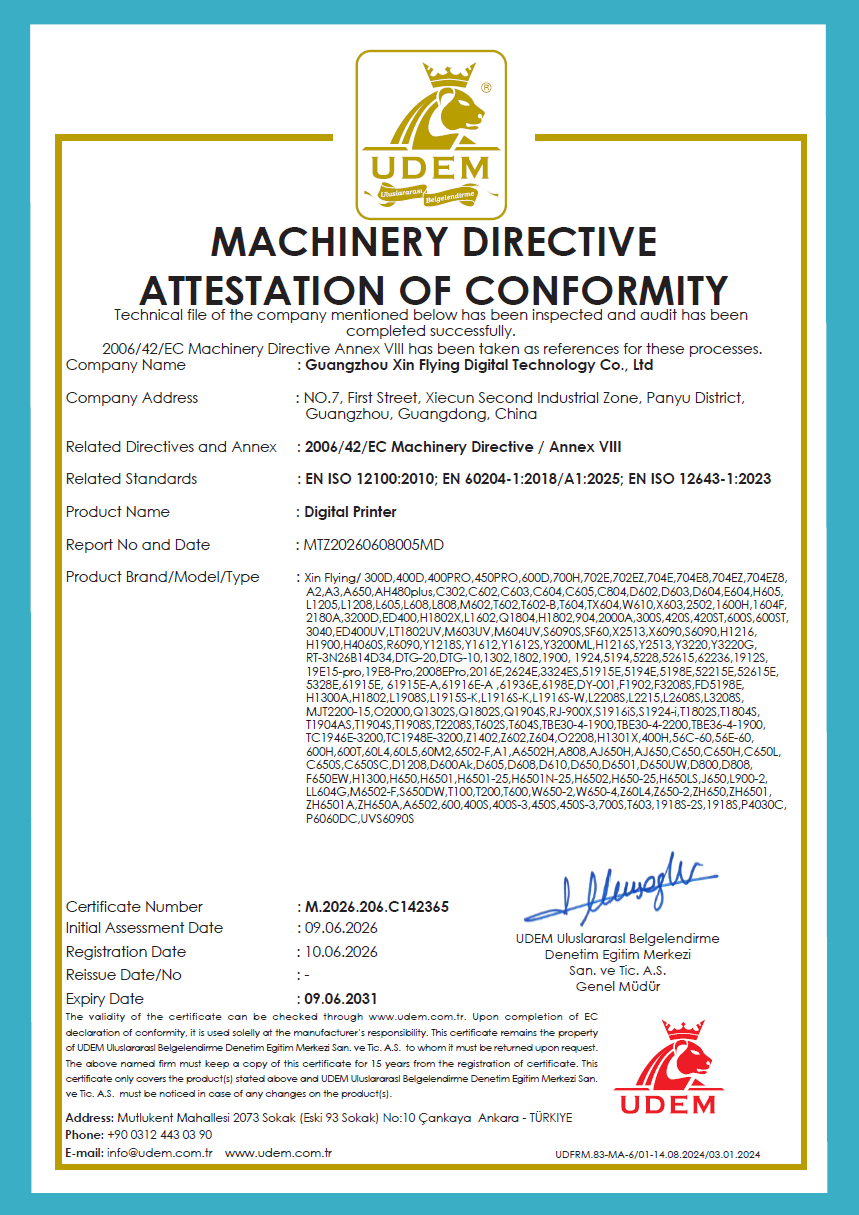
CE MD Certificate of Conformity issued to XINFLYING - the document that supports EU Machinery Directive compliance for the 1900 mm sublimation printer range.
Why "CE certificate" is an unreliable phrase in printer procurement
Every industrial sublimation printer shipped to Europe arrives with a compliance folder. Those folders rarely contain one document. They contain documents from different directives, different laboratories and different certificate numbers, and each one answers a different question.
- MD 2006/42/EC - the machine as machinery: risk assessment, safety-related design and the electrical equipment of the machine.
- LVD 2014/35/EU - the machine as an electrical product.
- EMC 2014/30/EU - what the machine emits electromagnetically and what it must tolerate.
- RoHS 2011/65/EU - restricted substances inside electrical and electronic components.
- Textile chemical schemes such as OEKO-TEX ECO PASSPORT - inks and printing pastes, not the machine.
Because suppliers often bundle these documents together as "CE", the same five failures repeat in real procurement:
- An EMC certificate is supplied, and machinery safety is assumed to be included.
- The MD certificate exists but names a different model or configuration than the unit delivered.
- The certificate number cannot be matched to any product list on the supplier side.
- Issue and expiry dates are never read.
- On OEM and private-label orders, no one confirms which configuration the declarations refer to.
One document cannot satisfy two directives. An EMC certificate is evidence for EMC 2014/30/EU and says nothing about machinery safety under MD 2006/42/EC. Buyers who treat the folder as a single item usually discover the gap when a distributor, tender panel or market surveillance contact asks for the missing piece.
Why 1900 mm printers sit at the centre of this question
Roll-to-roll sublimation printers with widths of 1.9 m (1900 mm) are standard for high-volume textile and soft signage applications, according to FESPA industry insights. That single fact explains why European compliance questions cluster around this machine class: 1900 mm is the width a mill, sportswear producer or signage converter buys when it moves from sampling into continuous production, and it is the width where a missing certificate becomes a commercial problem rather than a paperwork nuisance.
The surrounding market is expanding, which raises the number of transactions in which documentation is checked:
- The global dye sublimation printing market was valued at USD 16.4 billion in 2025 and is projected to reach USD 39.0 billion by 2033, a CAGR of 11.5% from 2026 to 2033 (Grand View Research).
- Asia Pacific held a 36.5% revenue share of that market in 2025, led by China (Grand View Research).
- China's textile and garment exports reached USD 293.6 billion in 2023, sustaining demand for industrial-scale sublimation equipment.
- The dye sublimation printers segment alone was valued at USD 1.88 billion in 2025 and is expected to reach USD 2.53 billion by 2030 (Mordor Intelligence).
On the buying side the consequence is procedural rather than technical. EU purchasers increasingly place the compliance file on the same checklist as print width, printhead count and speed. A machine with an ideal technical specification still becomes an internal risk item if the supplier cannot produce a Machinery Directive certificate for the exact model being delivered. The print side has an equivalent quality standard - ISO 12647-8:2021 defines validation print processes working directly from digital data - which is why colour accuracy and machinery safety tend to be evaluated as two separate questions.
What the 1900 mm XINFLYING models hold for the EU market
XINFLYING (Guangzhou Xin Flying Digital Technology Co., Ltd.) builds both 1.9 m models on the same industrial platform. Both appear on the Machinery Directive documentation, with LVD, EMC and RoHS certificates covering the machine, and an OEKO-TEX ECO PASSPORT covering the printing inks.
CE MD: the certificate that governs the machine itself
The document a European buyer should read first is the CE MD Certificate of Conformity for the machine family. For the 1900 mm range it states:
- Certificate: CE MD Certificate of Conformity
- Certificate number: M.2026.206.C142365
- Issuing body: UDEM
- Scope: Machinery Safety Compliance (MD 2006/42/EC)
- Harmonised standards cited: EN ISO 12100:2010; EN 60204-1:2018/A1:2025; EN ISO 12643-1:2023
- Issue date 2026-06-10, valid until 2031-06-09
- Models listed include XF-19E15-PRO and XF-19E8-PRO
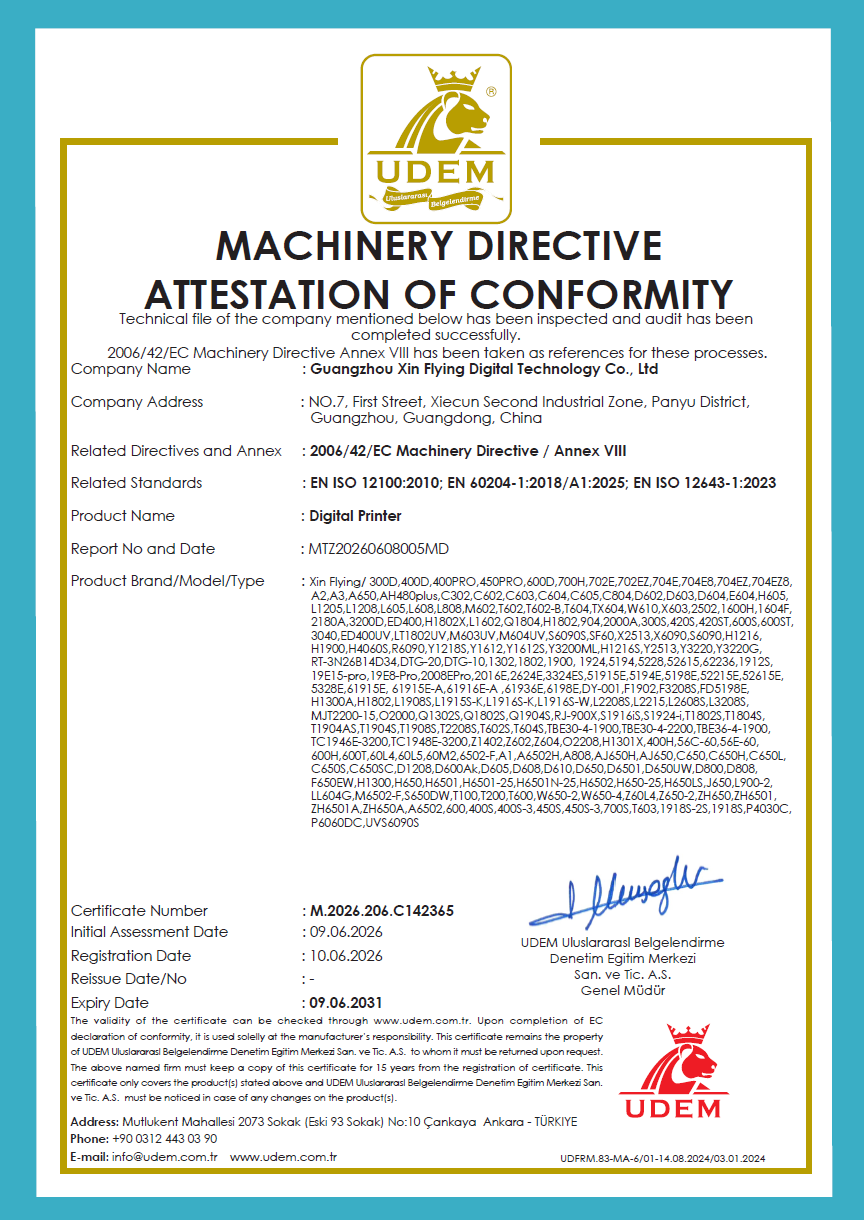
CE MD Certificate of Conformity M.2026.206.C142365, issued by UDEM under MD 2006/42/EC for the 1900 mm industrial sublimation printer models.
The three standards answer three different safety questions. EN ISO 12100:2010 is the risk assessment and risk reduction standard. EN 60204-1:2018/A1:2025 covers the electrical equipment of machines. EN ISO 12643-1:2023 is the safety standard for graphic technology equipment and systems, the family that wide-format printing machines belong to. A second CE MD Certificate of Conformity, M.2026.206.C142385, is issued by the same body against the same standard set and with the same validity window.
CE LVD: electrical safety on a 10.2 kW and 14.5 kW machine
Electrical safety documentation carries more weight on a 1.9 m sublimation printer than on a desktop unit. XF-19E8-PRO is rated 10.2 kW and XF-19E15-PRO 14.5 kW, and both are specified for a 210-230 V, 45 A supply. The LVD documents held for the range are:
- CE LVD Certificate of Compliance TQT1550D271EC, issued by TQT (Shenzhen Tianqi Testing Technology Service Co., Ltd.), scope LVD 2014/35/EU, standard EN IEC 62368-1:2020/A11:2020, issued 2026-05-19.
- CE LVD and EMC attestation M.2026.206.C142475, issued by UDEM, scope LVD 2014/35/EU and EMC 2014/30/EU, standards EN IEC 62368-1:2020/A11:2020; EN 55032:2015/A1:2020; EN 55035:2017; EN 61000-3-2:2014; EN 61000-3-3:2013, issued 2026-06-11, valid until 2031-06-10.
CE EMC: emissions and immunity on a shared production floor
A textile hall rarely runs a single printer in isolation. Several printers, calenders, dryers and drives share the same supply and the same electromagnetic environment, which is why EMC is checked next to LVD rather than instead of it. The EMC document held for the range is CE EMC Certificate of Compliance TQT1550D270EC from TQT, covering EMC Directive 2014/30/EU against EN 55032:2015/A11:2020; EN 55035:2017/A11:2020; EN IEC 61000-3-2:2019+A1:2021; EN 61000-3-3:2013/A2:2021, issued 2026-05-19.
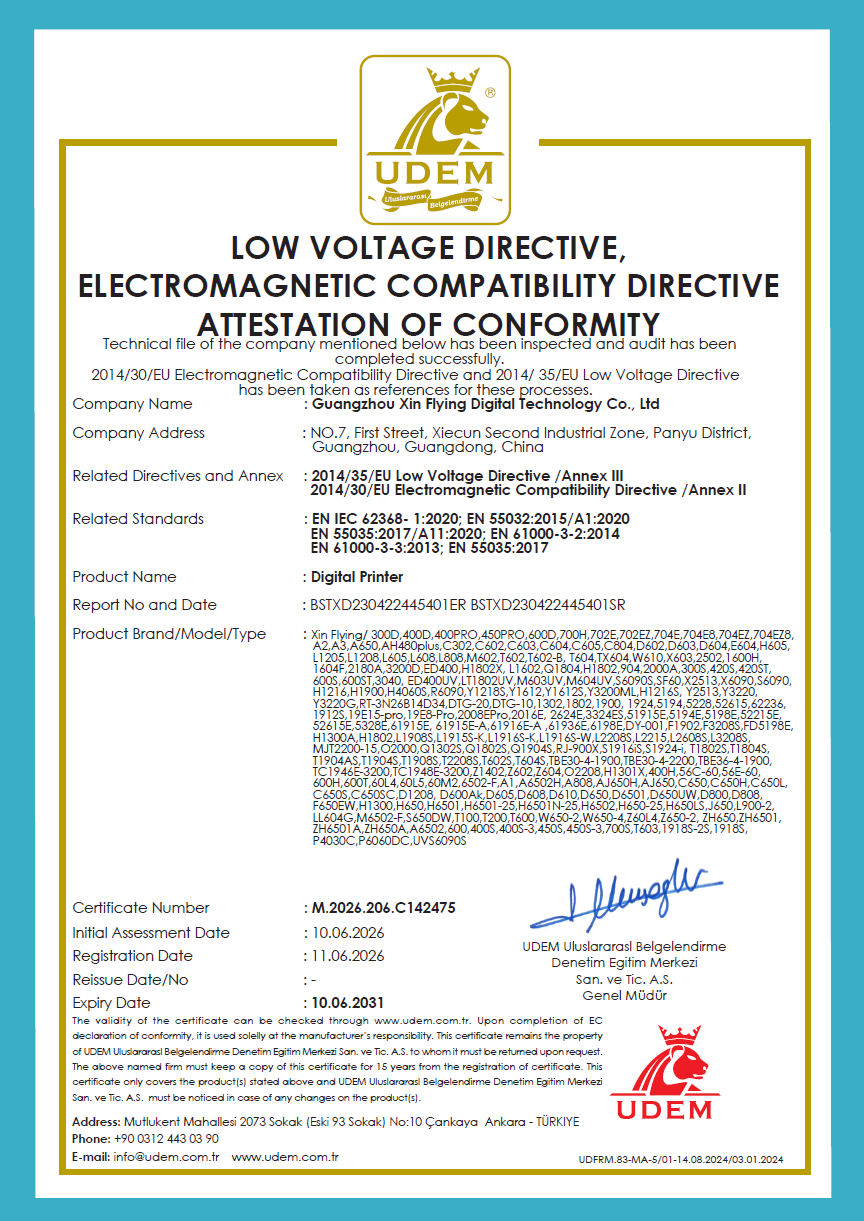
CE LVD and EMC attestation M.2026.206.C142475, issued by UDEM, covering LVD 2014/35/EU and EMC 2014/30/EU for the sublimation printer range.
RoHS and OEKO-TEX: two different environmental layers
RoHS M.2026.206.C142366, issued by UDEM, covers Directive 2011/65/EU for the machine and cites EN IEC 63000:2018 together with the EN IEC 62321 test series, issued 2026-06-10 and valid until 2031-06-09. The OEKO-TEX ECO PASSPORT SH150194016, issued by TESTEX AG for textile printing inks and printing pastes, cites OEKO-TEX ECO PASSPORT and EN ISO 17050-1, was issued 2025-12-11 and is valid until 2026-12-31.
The distinction is worth stating plainly: RoHS is a machine document, ECO PASSPORT is an ink document. The second becomes relevant when the printed textile itself has to satisfy restricted-substance requirements, and it is not evidence of machinery safety.
How the documents line up
| Document | Directive / scheme | What it covers on a 1900 mm printer | Reference and body | Validity on the certificate |
|---|---|---|---|---|
| CE MD Certificate of Conformity | MD 2006/42/EC | Machinery safety: risk assessment, safety-related design, electrical equipment of machines | M.2026.206.C142365 and M.2026.206.C142385 (UDEM) | Issued 2026-06-10, valid to 2031-06-09 |
| CE LVD Certificate of Compliance | LVD 2014/35/EU | Electrical safety of a 10.2 kW / 14.5 kW machine on a 210-230 V, 45 A supply | TQT1550D271EC (TQT) | Issued 2026-05-19; certificate shows 2099-01-01 |
| CE LVD and EMC attestation | LVD 2014/35/EU and EMC 2014/30/EU | Combined electrical safety and electromagnetic compatibility statement | M.2026.206.C142475 (UDEM) | Issued 2026-06-11, valid to 2031-06-10 |
| CE EMC Certificate of Compliance | EMC 2014/30/EU | Electromagnetic emissions and immunity for printers, drives, heaters and controls | TQT1550D270EC (TQT) | Issued 2026-05-19; certificate shows 2099-01-01 |
| RoHS Compliance Certificate | RoHS 2011/65/EU | Restricted substances in electrical and electronic components | M.2026.206.C142366 (UDEM) | Issued 2026-06-10, valid to 2031-06-09 |
| OEKO-TEX ECO PASSPORT | OEKO-TEX ECO PASSPORT; EN ISO 17050-1 | Textile printing inks and printing pastes (consumable, not the machine) | SH150194016 (TESTEX AG) | Issued 2025-12-11, valid to 2026-12-31 |
Two practical readings follow from the table. First, the machine-level file is complete for the two 1900 mm models: machinery safety, electrical safety, electromagnetic compatibility and hazardous substances are covered by separate, traceable certificates. Second, the ink certificate runs on a different clock (2026-12-31) than the machine certificates (2031-06-09 and 2031-06-10), so renewal calendars should be maintained separately.
Step-by-step: how to verify the file before the machine ships
The sequence below catches mismatches early, while the machine is still in the factory rather than standing on a customer floor.
- Match the certificate to the model on the purchase order. Confirm that the model designation on the order - XF-19E15-PRO or XF-19E8-PRO - appears on the MD certificate product list. If the delivered unit is a customized build, the configuration should still be reconcilable with the certified platform.
- Read the MD certificate line by line. Check the certificate number (for example M.2026.206.C142365), the issuing body (UDEM), the directive reference (MD 2006/42/EC), the harmonised standards (EN ISO 12100:2010; EN 60204-1:2018/A1:2025; EN ISO 12643-1:2023), and both dates (issued 2026-06-10, valid until 2031-06-09).
- Treat LVD and EMC as separate evidence. Look for LVD 2014/35/EU under TQT1550D271EC or M.2026.206.C142475, and EMC 2014/30/EU under TQT1550D270EC. Neither substitutes for the MD certificate.
- Add RoHS, and the ink certificate where relevant. RoHS M.2026.206.C142366 covers the machine; OEKO-TEX ECO PASSPORT SH150194016 covers the inks and expires 2026-12-31.
- Confirm the delivered configuration. Ask in writing whether the customization touches parts covered by the MD certificate, and which configuration the conformity documentation describes.
- Verify that the site supports the declared configuration. Both models are declared for a 210-230 V, 45 A supply, 18-30 C ambient temperature and 35-65% relative humidity. XF-19E15-PRO measures 3840 x 1570 x 1800 mm at 1480 kg net; XF-19E8-PRO measures 3840 x 1300 x 1800 mm at 1400 kg net.
- File, monitor and renew. Keep the certificate set with the machine documentation, record the expiry dates, and request updated documents at renewal rather than at the point of a first compliance query.
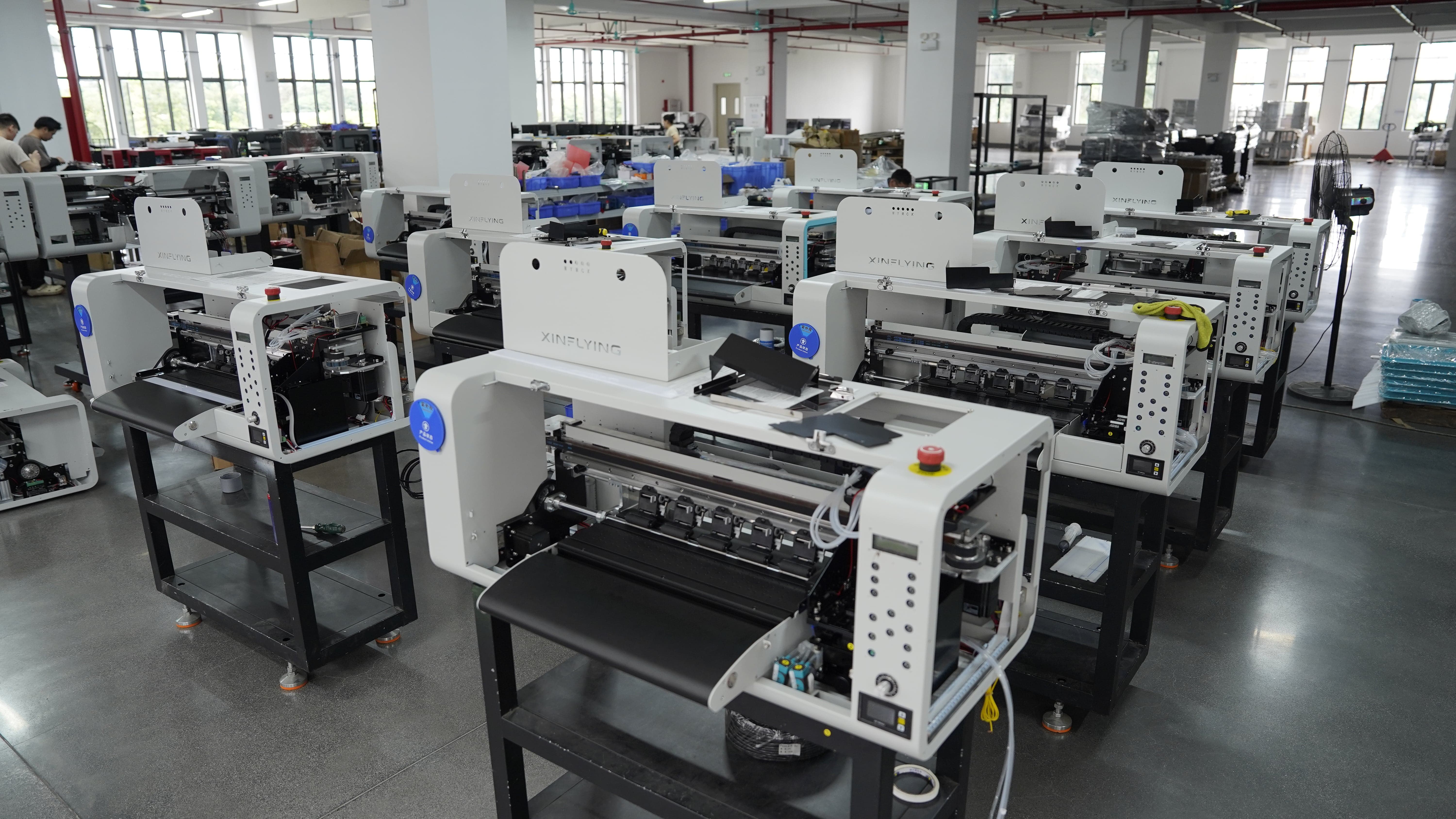
Printers lined up for assembly, testing and quality inspection - pre-shipment testing is also the stage at which the machine-specific compliance file is assembled.
Where the file is checked in practice
Five procurement situations account for most of the demand for a 1900 mm Machinery Directive file.
1. A print house adding its first 1.9 m line
The buyer has operated smaller equipment and now needs to serve EU customers directly. The MD, LVD and EMC set is requested before the order is signed, because the buyer's own customers increasingly ask how the printed textile was produced. A 10.2 kW XF-19E8-PRO is often the entry point here, since it fits sites with a single 45 A supply.
2. Sportswear and team kit production
Sublimation is the dominant process for polyester team apparel, where full-colour graphic coverage is normal rather than exceptional. Documented applications include a sportswear manufacturer producing football jerseys, basketball uniforms and customized sportswear on 15 units over four years, and a sports uniform supplier producing customized football kits and training uniforms on 8 units over five years. In both cases the machines ran polyester production continuously, which is where a 14.5 kW XF-19E15-PRO platform and its electrical documentation become relevant to the site's own electrical planning.
3. Home textiles and decorative fabrics
A home textile manufacturer running 10 units for four years used sublimation for curtains, cushions and decorative polyester fabrics - large-format work where consistent pattern reproduction across batches matters, and where the 1900 mm width reduces panel joining.
4. Print service providers
A digital textile printing service provider running 5 units over three years used the platform to serve sportswear brands and apparel factories, expanding capacity and shortening response times on customized orders. Service providers are usually the party that must forward compliance documentation to their own brand customers.
5. OEM and private-label partners
Distributors and brand owners buying the same platform under their own brand have one additional question to settle before production: which configuration is being declared, and by whom. This is covered in the FAQ below.
XF-19E15-PRO and XF-19E8-PRO on the compliance-relevant specification
Both models share the 190 cm (75 inch) print width, 3200 dpi resolution, CMYK sublimation ink and the same EU certificate set. They differ in printhead count, throughput, power draw and footprint, which is what determines the electrical and floor requirements a buyer must verify.
| Item | XF-19E15-PRO | XF-19E8-PRO |
|---|---|---|
| Printheads | 15 x Epson i3200-A1 | 8 x Epson i3200-A1 |
| Ink colours | CMYK | CMYK |
| Print width | 190 cm (75 inch) | 190 cm (75 inch) |
| Resolution | 3200 dpi | 3200 dpi |
| Fastest print speed | 1PASS 524 sqm/h; 2PASS 254 sqm/h | 1PASS 306 sqm/h; 2PASS 153 sqm/h |
| Standard print speed | 1PASS 394 sqm/h; 2PASS 188 sqm/h | 1PASS 210 sqm/h; 2PASS 109 sqm/h |
| Power | 14.5 kW | 10.2 kW |
| Power supply | 210-230 V, 45 A | 210-230 V, 45 A |
| Media | Sublimation paper, loads 1000 m rolls | Sublimation paper |
| RIP | Maintop (standard); RIIN (Hoson only), PhotoPrint, Printfactory (optional) | Maintop (standard); RIIN (Hoson only), PhotoPrint, Printfactory (optional) |
| Machine size | 3840 x 1570 x 1800 mm | 3840 x 1300 x 1800 mm |
| Net / gross weight | 1480 kg / 1580 kg | 1400 kg / 1500 kg |
| EU certificate set | MD M.2026.206.C142365; LVD TQT1550D271EC; LVD and EMC M.2026.206.C142475; EMC TQT1550D270EC; RoHS M.2026.206.C142366 | Same certificate set |
Frequently asked questions
Which CE documents do the 1900 mm XF-19E15-PRO and XF-19E8-PRO hold for the EU market?
Both models appear on CE MD Certificate of Conformity M.2026.206.C142365, issued by UDEM under MD 2006/42/EC against EN ISO 12100:2010, EN 60204-1:2018/A1:2025 and EN ISO 12643-1:2023, issued 2026-06-10 and valid until 2031-06-09. A second MD certificate, M.2026.206.C142385, is issued by the same body against the same standard set. Electrical safety is covered under LVD 2014/35/EU by TQT1550D271EC, issued by TQT on 2026-05-19 against EN IEC 62368-1:2020/A11:2020, and by the combined LVD and EMC attestation M.2026.206.C142475 issued by UDEM on 2026-06-11, valid until 2031-06-10. EMC 2014/30/EU is covered by TQT1550D270EC, and RoHS 2011/65/EU by M.2026.206.C142366, valid until 2031-06-09.
What is the difference between MD, LVD and EMC, and why does a 1900 mm sublimation printer need all three?
MD 2006/42/EC treats the printer as machinery and addresses risk assessment and safety-related design. LVD 2014/35/EU treats it as an electrical product; on these models it applies to a 10.2 kW (XF-19E8-PRO) or 14.5 kW (XF-19E15-PRO) machine on a 210-230 V, 45 A supply, evaluated to EN IEC 62368-1:2020/A11:2020. EMC 2014/30/EU covers electromagnetic emissions and immunity, evaluated to the EN 55032, EN 55035 and EN 61000-3 series cited on TQT1550D270EC. The three directives are independent, so one certificate cannot replace another: an EMC document is not evidence of machinery safety, and an MD certificate is not evidence of electrical safety testing.
Can an OEM dye sublimation printer manufacturer deliver a customized 1900 mm printer with EU compliance documentation?
XINFLYING offers both OEM and ODM production services, and customization includes product branding, machine appearance, colour, logo, packaging and custom solutions based on customer requirements, with orders accepted from a minimum quantity of one unit. When a unit is customized, the buyer should confirm two points in writing before shipment: whether the customization touches any part covered by the MD certificate, and which configuration the conformity documentation describes. Branding, colour and packaging changes leave the certified platform unchanged; changes to safety-related parts or electrical equipment require the documentation to be re-confirmed against the delivered machine.
What are the minimum order quantity, payment and delivery terms?
The minimum order quantity is 1 unit. Payment methods are T/T, Western Union and PayPal. Delivery uses the standard Incoterms EXW, FOB, CIF and DDP. Acceptance is based on pre-shipment testing, which is also the stage at which the compliance file for the specific machine is assembled and handed over.
What is the lead time, and can a machine be tested before it ships?
Standard lead time is 5-40 days depending on configuration and order volume, supported by a monthly production capacity of 1600+ units. Because the minimum order quantity is a single unit and acceptance is by pre-shipment test, a buyer can place one 1900 mm machine as a pilot unit, validate it in production, and only then scale. After-sales support is provided by more than 50 engineers offering 24/7 online technical support. Buyers preparing an EU file can request the certificate set together with the machine documentation; the XINFLYING corporate brochure is available for download at XINFLYING corporate brochure (PDF), and questions can be sent to info@xin-flying.com or +86 188-1322-1357.
Conclusion
For a 1900 mm sublimation printer, EU Machinery Directive compliance is a document question before it is a technical one. The technical capability is visible in the specification - 190 cm print width, 3200 dpi resolution, up to 524 square metres per hour on XF-19E15-PRO and up to 306 square metres per hour on XF-19E8-PRO - but the machine can only be placed on the EU market with the certificate file behind it.
Three decision rules follow from everything above. First, read the MD certificate for the exact model instead of treating the folder as a whole: M.2026.206.C142365 and M.2026.206.C142385 from UDEM name the 1900 mm models against MD 2006/42/EC and EN ISO 12100:2010, EN 60204-1:2018/A1:2025 and EN ISO 12643-1:2023. Second, keep LVD, EMC and RoHS as separate evidence items, each with its own certificate number and validity window. Third, if the machine is customized under an OEM or private-label order, confirm the declared configuration in writing before shipment rather than after arrival.
XINFLYING (Guangzhou Xin Flying Digital Technology Co., Ltd.) has manufactured digital printing equipment since 2010 from a 37,440 square metre facility with more than 200 employees and 20 R&D engineers, producing over 20,000 units per year and exporting about 80% of output to North America, South America, Europe, Asia, the Middle East and Africa. The company website is www.xin-flying.com, with technical articles published on blog.xin-flying.com.
Next step: request the certificate set (MD, LVD, EMC, RoHS) for the exact model you are evaluating, together with a quotation for a single-unit or multi-unit order. Download the XINFLYING corporate brochure (PDF) or contact the team at info@xin-flying.com / +86 188-1322-1357. Address: No.7, Xiecun 2nd Industrial Zone, Panyu, Guangzhou, Guangdong.