
Flag Manufacturing: Heavy Duty Production with 1900 mm Roll Sublimation
For commercial flag production, the printing decision is narrower than most buyers expect. The job is a long, uninterrupted run of polyester flag fabric on a roll, and the machine that matches it is a 1900 mm roll-to-roll dye sublimation printer with enough printheads to keep a heat press calender fed. In the Xinflying range, that machine is the XF-19E15-PRO: 15 Epson i3200-A1 printheads, 190 cm (75 inch) print width, 3200 dpi, and a fastest quoted speed of 524 m²/h in 1PASS and 254 m²/h in 2PASS. The second half of the decision is not about ink at all. It is about power: a 14.5 kW unit on a 210–230V, 45A supply has to coexist with the rest of a factory, which is why the EMC file — including the EN 61000-3-3 voltage fluctuation and flicker assessment — belongs in the purchase checklist next to the printheads.
XINFLYING (Guangzhou Xin Flying Digital Technology Co., Ltd.) is a digital printing equipment manufacturer founded in 2010 and based in Panyu, Guangzhou, producing DTF, UV DTF, UV, DTG and dye sublimation printers alongside consumables and complete digital printing solutions. Its sublimation platforms run from a 130 cm single-head unit up to the 190 cm, 15-head XF-19E15-PRO that this guide focuses on.
Why Flag Work Stresses a Sublimation Line Differently
Flag manufacturing is a roll-fed, high-volume, repeat-order business, and that combination hits a printer in places a mixed apparel shop never notices. The constraints below are the ones a flag producer should design the line around.
- Runs are long and continuous, not mixed. A flag order is usually hundreds of metres of the same fabric and a repeated layout. The printer has to hold colour and register from the first metre of a 1000 m roll to the last, which is a stability question before it is a speed question.
- Large flat colour fields are unforgiving. National flags, sponsor blocks and club colours put big areas of a single tone on one panel. A weak nozzle or a drifting head shows up immediately in a solid field, where the same defect would disappear inside a photographic print.
- Media handling decides uptime. The XF-19E15-PRO is specified to load 1000 m sublimation paper rolls. Roll changes, tension and rewind behaviour set the real production rhythm, because every stop is a colour-risk point on restart.
- Colour has to repeat across batches. Flags are reordered. A batch printed in spring has to match a batch printed after the summer, which is why RIP-side colour management and ICC control matter as much as the print engine.
- Drying and downstream steps are part of the line. The printer is only one station. The XF-19E15-PRO is specified with an external intelligent air-heat integrated dryer, and in flag production it must be used with a heat press calender and dye sublimation paper before cutting and sewing.
- Power and environment are production variables. At 14.5 kW on a 210–230V, 45A supply, with heaters and dryers cycling, the machine loads the plant network heavily. The stated operating window is 18–30°C and 35–65% RH, so the print room itself becomes part of the specification.
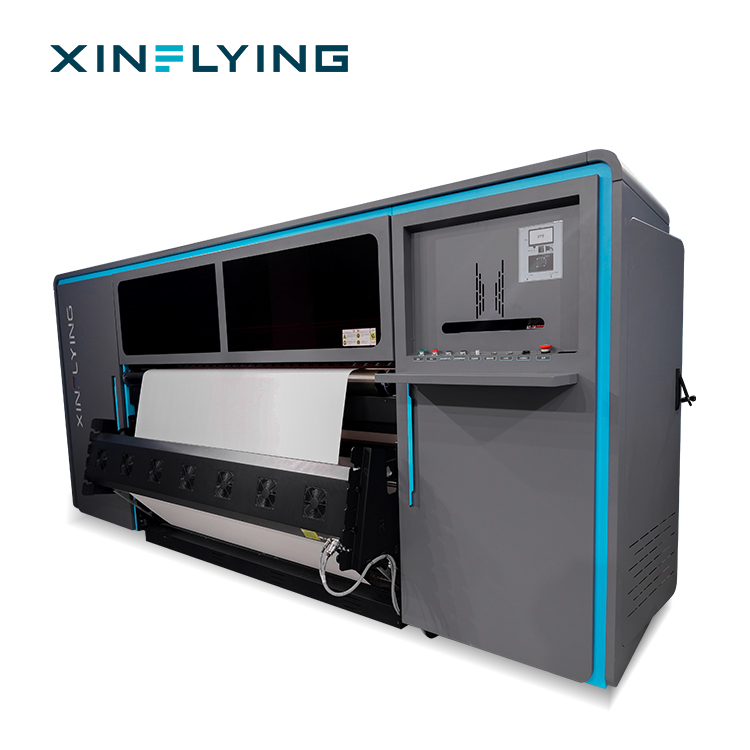
Xinflying XF-19E15-PRO: 190 cm (75 inch) print width, 15 Epson i3200-A1 printheads, built for high-volume textile and flag production.
Industry Background: Why 1900 mm Became the Flag Standard
The demand side of this market is well documented. Grand View Research values the global dye sublimation printing market at USD 16.4 billion in 2025 and projects it to reach USD 39.0 billion by 2033, with a CAGR of 11.5% from 2026 to 2033. The same source puts Asia Pacific at a 36.5% revenue share in 2025, led by China as the largest country market, and identifies demand for personalised apparel and home decor as a primary driver behind a 13.1% CAGR in digital textile sublimation through 2030.
Equipment demand tracks that. Mordor Intelligence values the dye sublimation printer segment at USD 1.88 billion in 2025, rising to USD 2.53 billion by 2030, and third-party tracking of the digital textile dye sublimation printer market placed Epson at a 26.7% share in 2024, followed by Mimaki at 18.6% and Roland DG at 15.5% (Data Insights Reports).
For flag makers, the most useful data point is a width standard rather than a market size. FESPA Insights identifies roll-to-roll sublimation printers with widths of 1.9 m (1900 mm) as standard for high-volume textile and soft signage applications. That is not a marketing preference; it is the width at which a flag panel, a banner drop and a soft signage graphic can be printed without stitching two runs together, while still matching common calender and cutting widths downstream. A 190 cm print width sits directly on that standard.
The Solution: What the XF-19E15-PRO Gives a Flag Plant
Throughput measured in metres, not specifications
The XF-19E15-PRO carries 15 Epson i3200-A1 printheads in a CMYK configuration at 3200 dpi. Published print speeds are 524 m²/h at 1PASS and 254 m²/h at 2PASS in the fastest setting, and 394 m²/h at 1PASS and 188 m²/h at 2PASS in the standard setting. In practice, 1PASS is the mode that keeps a calender busy on large flat flag fields, while 2PASS is where a producer moves when a design carries fine detail or gradients that need the extra pass. The point of a 15-head carriage is not that every job runs at maximum speed; it is that the printer still delivers usable volume when the job is run in a quality mode.
Mechanical stability on long runs
Long runs punish carriage motion and media transport more than they punish ink chemistry. The XF-19E15-PRO uses a linear motor with magnetic grid, a Japan THK silent guide, 27 press rollers and an enlarged beam. Translated into flag production: fewer tension corrections across a 1000 m roll, less lateral drift on wide panels, and a carriage motion that holds register when the machine has been running for hours rather than minutes.
Maintenance designed around unattended hours
Flag orders rarely arrive in convenient eight-hour blocks. The machine is specified with fully sealed automatic moisturising and cleaning, which protects the printhead array between shifts and during short idle windows. Combined with routine nozzle checks and standard cleaning routines, that is the difference between starting a morning run at full colour and starting it with a recovery cycle.
Power, EMC and the EN 61000-3-3 question
This is the part of the specification that flag plants tend to discover late. The XF-19E15-PRO draws 14.5 kW on a 210–230V, 45A supply. A printer of that class shares a low-voltage network with compressors, sewing motors, calenders and lighting, and its heater and dryer cycles produce voltage fluctuations on that network.
European EMC compliance for equipment of this power class is assessed against standards that include EN 61000-3-2 for harmonic current emissions and EN 61000-3-3, which sets limits on the voltage fluctuations and flicker that equipment may impose on the public low-voltage supply. For a flag producer, the practical meaning is simple: an EN 61000-3-3 assessment is what demonstrates that a 14.5 kW sublimation printer can be connected to a shared industrial supply without destabilising the equipment already running on it, and can itself keep printing when the surrounding load varies.
Buyers in the EU should therefore ask for the EMC documentation that matches the exact model being supplied, covering electrical safety, electromagnetic compatibility and product safety under CE, plus RoHS documentation for hazardous substance restrictions. Certification documents that do not correspond to the delivered model create customs delay and sales restriction risk — a paperwork problem that stops a production line just as effectively as a hardware fault.
Installation environment and control hardware
The stated operating window is 18–30°C and 35–65% RH. The machine measures 3840×1570×1800 mm, with a net weight of 1480 kg and a gross weight of 1580 kg; packing dimensions are 3970×1150×2130 mm, and the frame is built from aluminium alloy, stainless steel and ABS plastic. It runs on Windows 11/10 (32/64-bit) and requires a computer with an Intel i7 processor, 4G RAM, ATI discrete graphics, a 500G hard drive, DVD ROM and gigabit LAN. Maintop is the standard RIP, with RIIN supported on Hoson boards and PhotoPrint or Printfactory available as options. Accepted file formats are JPG, TIFF and PDF.
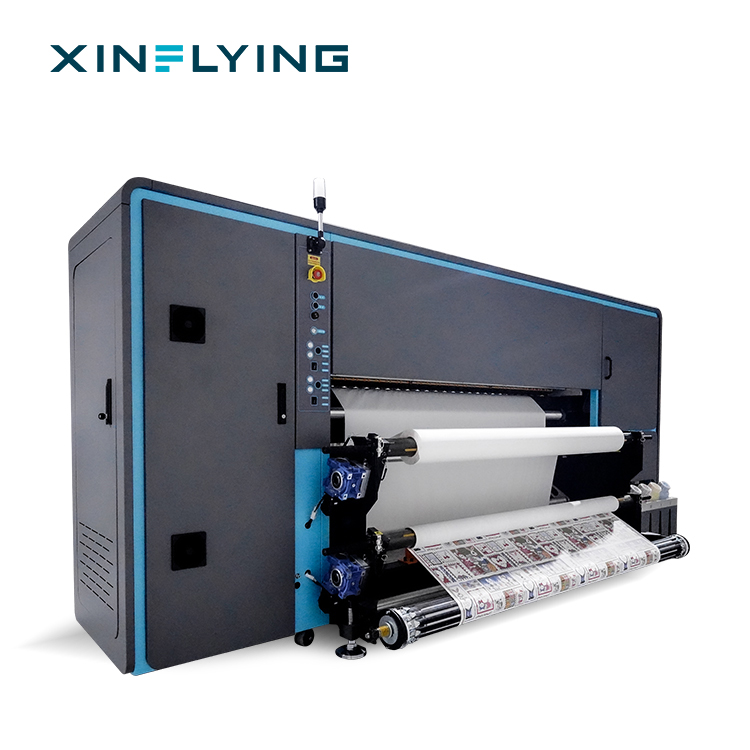
The 15-head carriage of the XF-19E15-PRO: high throughput in 1PASS, with 2PASS reserved for detail-heavy flag and soft signage work.
Step-by-Step: Building a Flag Line Around a 1900 mm Printer
The sequence below reflects how a 1900 mm roll sublimation printer is actually integrated into flag production. Each step is a place where a shortcut costs colour consistency later.
- Confirm the width and downstream match. Fix the 190 cm working width against your calender and cutting table before the machine arrives. A wider printer than the calender simply moves the bottleneck one station down the line.
- Prepare the print room. Hold 18–30°C and 35–65% RH. Stable temperature and humidity support consistent ink performance, colour accuracy and long-term production reliability.
- Verify the electrical supply. Plan a dedicated 210–230V, 45A feed for a 14.5 kW load, and keep the EMC file — including the EN 61000-3-3 assessment — with the machine documentation for audits and site inspections.
- Set up RIP and colour management. Install the RIP (Maintop standard; RIIN on Hoson; PhotoPrint or Printfactory optional), build ICC profiles for the specific flag fabric and ink set, and store the profile with the job file. ISO 12647-8:2021, the standard for validation print processes working directly from digital data, is a useful reference for how tightly colour should be controlled.
- Load and tension the media. Load the sublimation paper roll, set tension, and confirm the 27-roller media path is tracking squarely. On a 1000 m roll, a small tracking error becomes a large one.
- Print with the mode the job deserves. Run large flat colour fields at 1PASS for throughput; move to 2PASS for photographic or gradient-heavy designs. Start production only after nozzle checks and a test print confirm the head array is clean.
- Dry, then transfer. Use the external intelligent air-heat integrated dryer to bring the print to a stable state, then transfer through a heat press calender working with dye sublimation paper. Transfer temperature and dwell time are the variables that decide whether the colour on paper matches the colour in the fabric.
- Inspect, cut and finish. Check colour against the approved reference under consistent lighting, then move to laser cutting, hemming and sewing. Record the print parameters with the batch so that a reorder can be reproduced rather than re-matched.
Use Cases: Where a 1900 mm Roll Sublimation Printer Fits
Flag printing sits inside a broader soft signage and polyester textile workload, and the same machine covers several of them. The XF-19E15-PRO application scenario covers textile manufacturing, apparel manufacturing, sportswear production, home textile, fashion fabric printing and soft signage printing, across roll-to-roll textile printing projects and commercial textile printing facilities worldwide.
- Flags and banners at volume. National flags, event flags, sports flags and banner drops benefit directly from the 190 cm width and continuous roll feeding, because fewer seams and fewer roll changes mean faster finishing.
- Soft signage and decorative fabric. The XF-O2000-4I32A1, a 4-head 195 cm platform, is specified for textile sublimation printing in clothing, home decor, canvas bags, cushions, flags and banners. Shops running flags alongside decor work can use it to print personalised textile products and decorative fabric items on the same floor as a larger unit.
- Service providers absorbing client demand. A digital textile printing service provider running five units uses sublimation printing to serve sportswear brands, apparel factories and customised textile businesses, expanding production capacity and improving response speed on customised orders.
- Home textile manufacturers. A home textile client running ten units applies sublimation to curtains, cushions, decorative fabrics and customised polyester textile products, developing collections with rich patterns and accurate colours.
- Sportswear and team kit production. A sportswear manufacturer running fifteen units prints football jerseys, basketball uniforms and customised sportswear on polyester, and reports improved production flexibility, reduced dependence on outsourced printing and more consistent colour across batches.
Comparison: Xinflying Sublimation Platforms by Production Scale
The table below uses published specifications only. Speed figures are quoted in the pass mode published for each model, so a 1PASS figure and a 4PASS figure are not directly comparable.
| Model | Printheads | Print width | Published speed | Power / supply | Typical fit |
|---|---|---|---|---|---|
| XF-19E15-PRO | 15× Epson i3200-A1 | 190 cm (75″) | 1PASS 524 m²/h (fastest); 2PASS 254 m²/h | 14.5 kW; 210–230V, 45A | High-volume flag and soft signage production, continuous shifts |
| XF-19E8-PRO | 8× Epson i3200-A1 | 190 cm (75″) | 1PASS 306 m²/h (fastest); 2PASS 153 m²/h | 10.2 kW; 210–230V, 45A | Industrial textile sublimation where 190 cm width is required at lower volume |
| XF-O2000-4I32A1 | 4× Epson i3200-A1 | 195 cm | 2PASS 180 m²/h; 4PASS 92 m²/h | 8.5 kW; 220V, 50/60Hz | Mixed shops: flags, banners, clothing, home decor, cushions |
| XF-H1802X-2I32A1 | 2× Epson i3200-A1 | 180 cm | 4PASS 52 m²/h (fastest); 42 m²/h standard | 3.5 kW; 110/220V | Entry-level polyester printing, sampling and small-batch orders |
| XF-H1301X-1I32A1 | 1× Epson i3200-A1 | 130 cm | 4PASS 28 m²/h (fastest) | 2 kW; 110/220V | Sampling, small flags and short runs before scaling up |
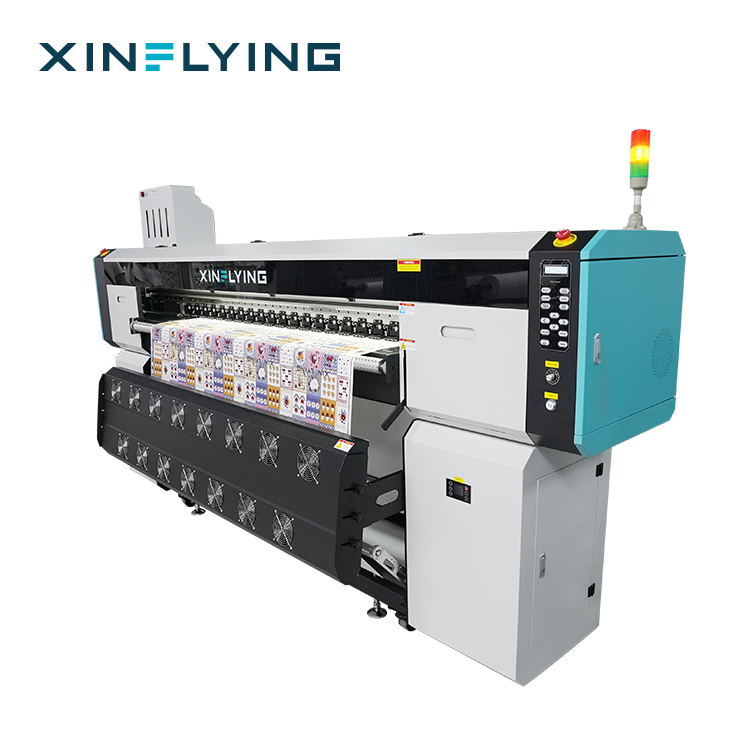
The XF-O2000-4I32A1: 195 cm width and 4 printheads, specified for flags, banners, cushions and decorative fabric.
FAQ
What compliance documents should a flag producer request with a 1900 mm sublimation printer for the EU market?
For the European market, buyers should verify CE compliance covering electrical safety, electromagnetic compatibility and product safety, plus RoHS documentation confirming restrictions on hazardous substances in electrical and electronic components. Because a machine in the 14.5 kW class loads the supply heavily, the EMC file should also address EN 61000-3-3 voltage fluctuation and flicker limits alongside harmonic current requirements. All certificates and test reports should be checked against the exact model being supplied; documents that do not match the delivered machine can trigger customs delays, sales restrictions or additional compliance costs.
Can one 1900 mm roll sublimation printer carry a flag order from blank roll to finished panel?
It carries the printing stage, not the whole workshop. The XF-19E15-PRO prints on sublimation paper with a 1000 m roll capacity at a 190 cm width, and in this application it must be used with a heat press calender and dye sublimation paper; cutting and sewing follow as separate stations. The requirements it has to meet in this scenario are high printing accuracy, stable colour reproduction, continuous production stability and consistent print quality. Its 15 printheads support 524 m²/h at 1PASS in the fastest setting for large flat colour fields, with 2PASS available for detail-heavy designs.
Which Xinflying sublimation printer fits a flag shop that is not yet running continuous shifts?
Match the model to measured monthly output rather than to the largest specification available. The XF-H1802X-2I32A1 offers 180 cm width, 2 printheads and up to 52 m²/h at 4PASS on a 3.5 kW supply, which suits sampling and small-batch polyester work. The XF-O2000-4I32A1 offers 195 cm width, 4 printheads and up to 180 m²/h at 2PASS on 8.5 kW, and is the model explicitly specified for flags, banners, cushions and decorative fabric. The XF-19E15-PRO becomes the correct choice when the press is running long shifts and the constraint is throughput on wide rolls rather than capital budget.
How can a flag maker validate fabric, colour and machine before committing to a full order?
Validation starts with the media and the colour profile, not the brochure. Print your own flag fabric through the RIP that ships with the machine — Maintop is standard, with RIIN on Hoson boards and PhotoPrint or Printfactory as options — and build an ICC profile for that fabric and ink combination before judging output. ISO 12647-8:2021 provides a reference standard for validation print processes working directly from digital data, which helps structure how tightly colour is held across batches. On the commercial side, the minimum order quantity is one unit and pre-shipment testing is part of the process, so a single machine can be evaluated without a volume commitment, with Xinflying's 20-engineer R&D team and 50-plus after-sales engineers available for setup and troubleshooting.
What is the lead time for a 1900 mm sublimation printer, and what does the handover include?
Standard lead time runs 5–40 days depending on configuration and customisation scope. Xinflying offers OEM/ODM customisation covering product branding, machine appearance, colour, logo and packaging, and monthly capacity of 1600+ units; customisation scope is the main variable that moves delivery within that window. Handover includes pre-shipment testing and access to 24/7 online technical support. Before the machine arrives, the site should already be inside the 18–30°C and 35–65% RH window, with a dedicated 210–230V, 45A feed ready and the EN 61000-3-3 documentation filed.
If you are sizing a flag line and want the specification sheet, price indication and delivery slot for the XF-19E15-PRO, send your monthly square-metre target and fabric width to info@xin-flying.com or contact the team on WhatsApp at +86 188-1322-1357 — a sample print on your own flag fabric is the fastest way to close the colour question.
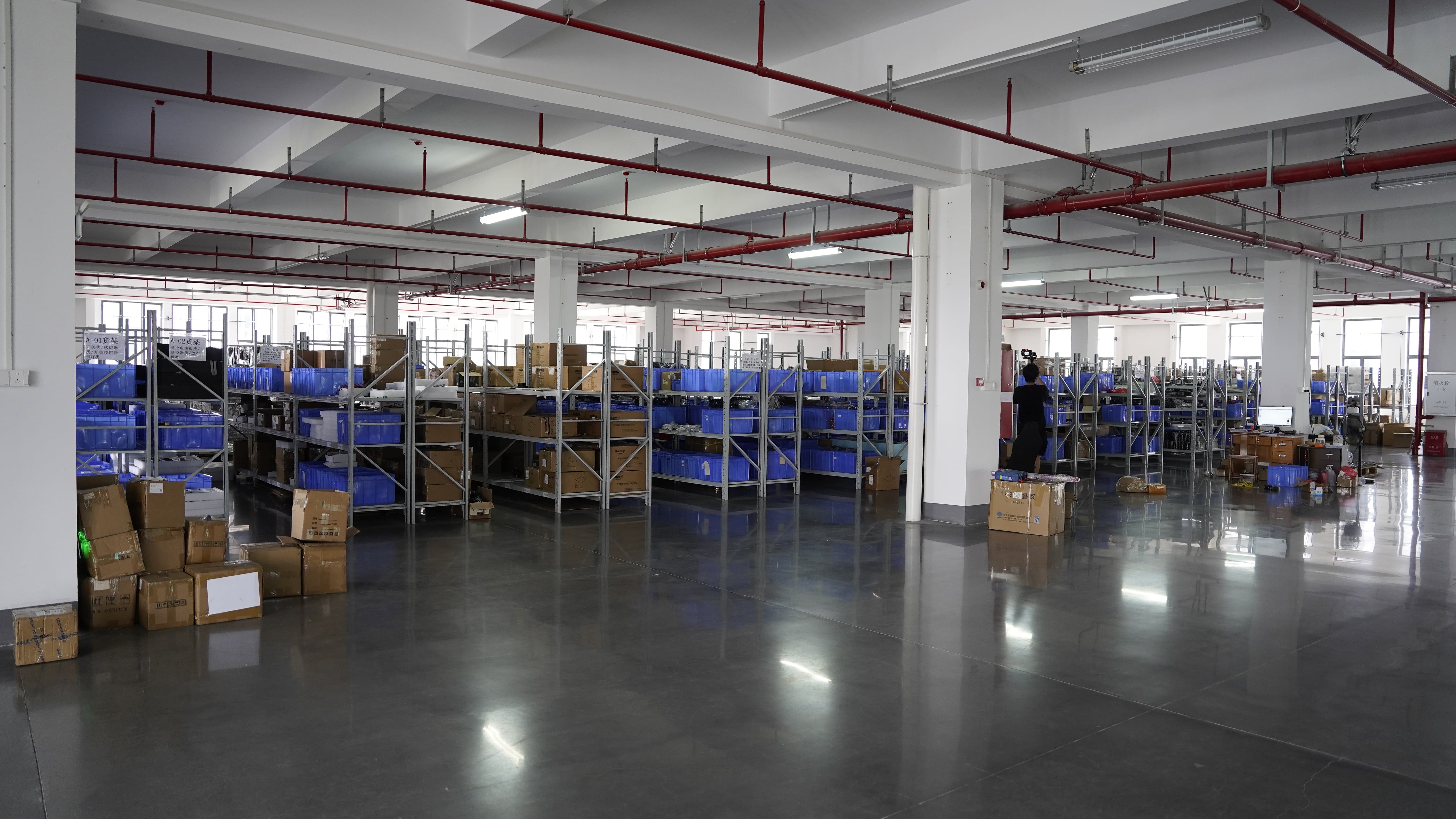
Organised spare-parts warehousing supports the 50-plus engineer after-sales network behind installed sublimation lines.
Conclusion: Specify the Width, Then Specify the Power
Flag manufacturing rewards a narrow, disciplined specification. The 1900 mm width class is the industry standard for high-volume textile and soft signage work because it matches both the product and the downstream equipment, and within that class the XF-19E15-PRO answers the throughput question with 15 Epson i3200-A1 printheads, a 190 cm working width, 3200 dpi, 1000 m roll capacity and speeds up to 524 m²/h at 1PASS. Its linear motor with magnetic grid, Japan THK silent guide, 27 press rollers and fully sealed automatic moisturising put the emphasis where long flag runs actually break down: motion stability and head condition over hours, not minutes.
The second specification is electrical. A 14.5 kW load on a 210–230V, 45A supply is a serious draw on any factory network, and the EN 61000-3-3 voltage fluctuation and flicker assessment is the evidence that the machine can sit on that network without disturbing it — or being disturbed by it. Treat the EMC file, the CE and RoHS documentation, and the 18–30°C / 35–65% RH print room as part of the purchase, and the printer decision stops being reversible only after installation.
Next Step: Sample, Quote or Full Specification
XINFLYING supplies dye sublimation printers from 130 cm single-head platforms up to the 190 cm, 15-head XF-19E15-PRO, with OEM/ODM customisation, a one-unit minimum order and pre-shipment testing on every machine.
Download the company profile and full product catalogue: Xinflying corporate brochure (PDF)
Website: www.xin-flying.com | Email: info@xin-flying.com | Tel / WhatsApp: +86 188-1322-1357
Address: No.7, Xiecun 2nd Industrial Zone, Panyu, Guangzhou, Guangdong
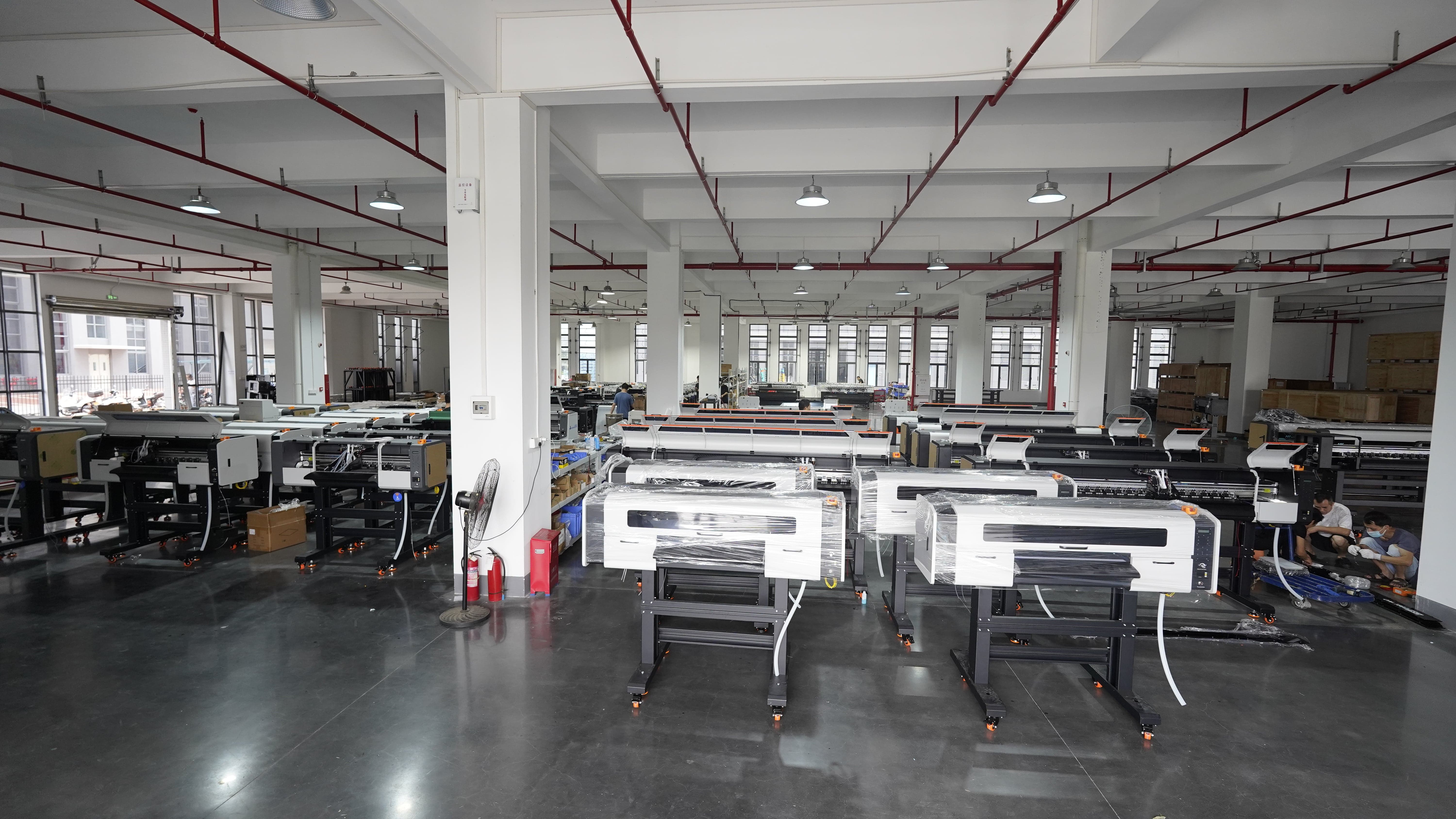
Completed units staged on the Xinflying production floor ahead of pre-shipment testing and dispatch.
Have Questions or Need More Details?
Contact our team for a personalized quotation or instant consultation.
Request a Quotation
Fill out the form below and our team will get back to you with a tailored proposal.
WhatsApp Direct Chat
Prefer to chat in real-time? Message us on WhatsApp for instant assistance & quick answers.
- Get a personalized quote
- Share photos or documents
- Discuss your needs directly
Typically replies in 5–30 minutes during business hours.