High-Relief Textile Production: Keeping Quality with Long-Run Printers
High-Relief Textile Production: Keeping Quality with Long-Run Printers
Quality fade in a long production run is rarely an ink problem or an artwork problem. It is a machine problem — rail and carriage geometry that shifts over hundreds of metres, drive electronics that behave differently at hour eight than at hour one, and media transport that loses tension as a roll empties. In high-relief textile work, where depth is created by dense colour laydown and tight registration, those small drifts become visible defects rather than acceptable variation. Long-run quality is therefore decided before the first print, by the mechanical and electrical architecture of the printer.
This guide explains how quality fade happens, what the XF-O2000-4I32A1 documents on paper for sustained production, and how to structure a run so that the last metre matches the first.
What High-Relief Textile Printing Demands From a Machine
High-relief textile printing refers to designs whose depth effect is produced by dense ink laydown, precise registration and smooth tonal transitions — embossed-look upholstery patterns, sculpted-look cushions, layered wall textiles, deep-shade sportswear panels and soft signage with strong visual depth. The finished look depends on how accurately adjacent dot rows land on the substrate, which makes this category considerably less tolerant of mechanical drift than a low-density graphic print.
Two requirements follow. First, dot placement must remain stable for the entire length of the roll, not just across a short sample. Second, the drying and fixation stage must deliver comparable energy to the first metre and the last metre, because inconsistent transfer changes apparent colour saturation — precisely the variable that destroys a relief effect. A printer that satisfies both conditions on a 200 m test may still fail on a 1,200 m roll, which is why run length has to be part of the specification.
Why Quality Fades Across a Long Run
Quality fade is cumulative. Every source of variation is small at the start of a roll and compounds over distance, so the failure mode is not a sudden breakdown but a slow drift that appears in the final third of the run. Five subsystems account for most of it.
1. Rail and carriage geometry
The rail and carriage assembly defines the path the printheads travel. Any change in that path — wear, insufficient rigidity, vibration transferred from the frame, cleaning residue building up on the guide surface — changes dot placement between the beginning and the end of a long run. In high-relief work this shows up as banding in flat colour areas and as edge softness in fine detail.
2. Drive electronics and power delivery
The motor drive electronics that move the carriage are only as consistent as the power and control signals feeding them. Unstable supply conditions, inadequate electrical protection or poorly shielded control circuits can introduce exactly the kind of micro-variation that a dense pattern reveals. This is why machinery electrical safety and EMC documentation belongs in a long-run purchasing decision, not just in an import checklist.
3. Media transport at long roll lengths
A printer that handles a short roll comfortably may struggle with the mass and inertia of a full production roll. The XF-O2000-4I32A1 is specified for print media up to 1 mm in thickness and up to 200 kg in weight, and for heat-transfer paper supplied in rolls of 1,000–1,500 m. Those are the numbers that determine whether tension control remains consistent in the final third of a roll, when the take-up geometry has changed substantially.
4. Drying and thermal behaviour
If drying energy varies along the run, the transferred colour varies with it. Multi-zone heating exists to hold the drying profile across the full width and length of the substrate. The XF-O2000-4I32A1 uses front, middle and rear break-controlled heating.
5. Environment and idle time
Sublimation output is sensitive to ambient conditions. The XF-O2000-4I32A1 is specified for operating temperatures of 20–25°C and humidity of 45–65% RH, a narrower window than the 18–30°C / 35–65% RH window published for the XF-19E8-PRO and XF-19E15-PRO. Extended idle periods during a long batch are a recognised risk factor for nozzle condition as well.
The metre-900 question. When evaluating any long-run sublimation printer, a short demonstration print proves very little. A more useful evaluation criterion is a ramp test: print the same high-density artwork at the start, middle and end of a long roll, then compare colour, banding and edge definition across the three samples. Any measurable difference between sample one and sample three is the real quality-fade risk.
Industry Background: Why Long-Run Capability Is Being Tested Now
The commercial pressure behind this engineering problem is measurable. Grand View Research values the global dye sublimation printing market at USD 16.4 billion in 2025 and projects USD 39.0 billion by 2033, growing at a CAGR of 11.5% from 2026 to 2033. Mordor Intelligence sizes the dye sublimation printers segment specifically at USD 1.88 billion in 2025, rising to USD 2.53 billion by 2030. Grand View Research also reports that Asia Pacific held a 36.5% revenue share of the dye sublimation printing market in 2025, led by China as the largest country market.
Two adjacent data points explain the buying behaviour. Fortune Business Insights values the large format printer market at USD 10.57 billion in 2025, projected to reach USD 16.52 billion by 2034, and Grand View Research reports that inkjet production printers accounted for 87.3% of the production printer market share by type in 2024. On the demand side, The Cannata Report and Grand View Research place China's textile and garment exports at USD 293.6 billion in 2023.
Width standards matter too. FESPA notes that roll-to-roll sublimation printers at 1.9 m width are standard for high-volume textile and soft signage applications — the class in which the 195 cm (1.95 m) XF-O2000-4I32A1 sits. Brand concentration in this equipment segment remains high: Data Insights Reports puts Epson at a 26.7% share of the digital textile dye sublimation printer market in 2024, followed by Mimaki at 18.6% and Roland DG at 15.5%. Buyers therefore evaluate a small number of established display-head platforms, and long-run stability is what separates them in practice.
Where XINFLYING sits in this landscape
Guangzhou Xin Flying Digital Technology Co., Ltd. (XINFLYING) is a digital printing equipment manufacturer founded in 2010 and based in Panyu, Guangzhou, China. The company builds DTF printers, dye sublimation printers, DTG printers, UV DTF printers, UV flatbed printers and printing consumables, and supplies complete digital printing solutions. Its facility covers 37,440 m², employs more than 200 people, operates a 20-engineer R&D team, and produces over 20,000 units annually, with roughly 80% of output exported to North America, South America, Europe, Asia, the Middle East and Africa.
Where Long-Run Stability Is Actually Built
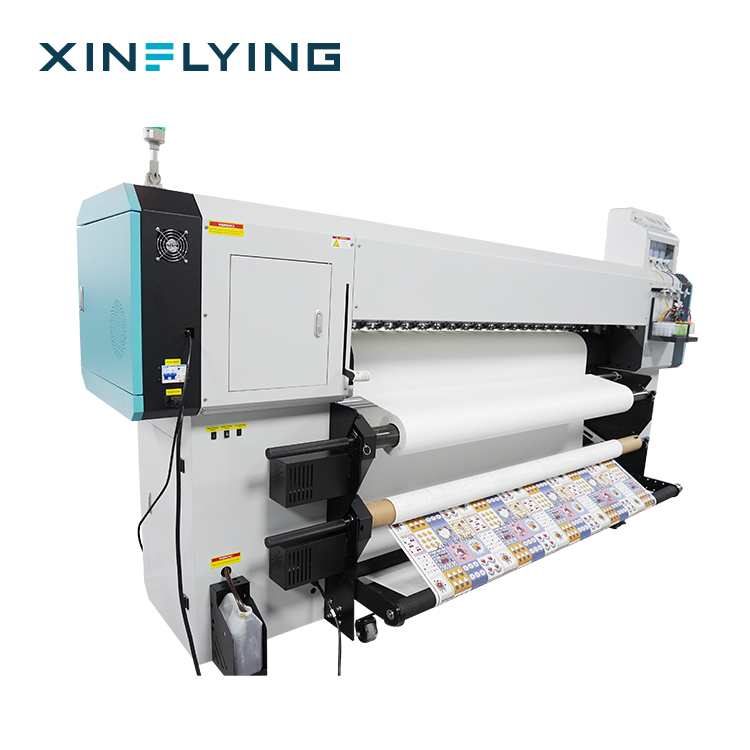
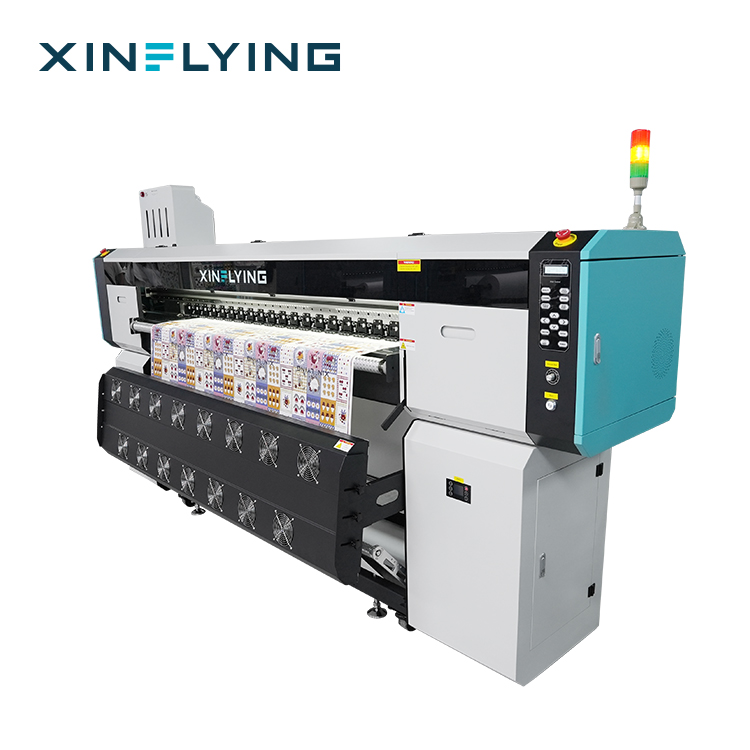
The XF-O2000-4I32A1 is a 195 cm roll-to-roll sublimation printer configured around four Epson i3200-A1 printheads, CMYK ink, piezoelectric inkjet technology and front/middle/rear break-controlled heating. Its relevance to high-relief production is not the headline speed alone — 2PASS 180 m²/h and 4PASS 92 m²/h — but the combination of frame mass, certified electrical equipment and long-roll media handling that keeps that speed consistent.
Rail, frame and carriage geometry
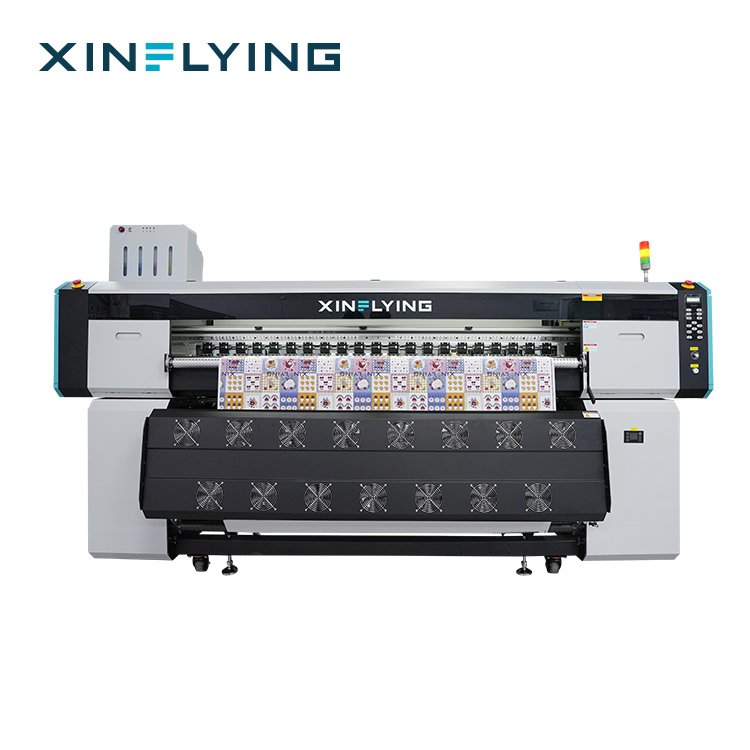
Long-run dot placement depends on how rigid the structure holding the carriage is. The XF-O2000-4I32A1 is built on an aluminium alloy and stainless steel frame, with a net weight of approximately 490 kg and a gross weight of approximately 675 kg, and overall machine dimensions of 3311 × 1278 × 1670 mm. Higher structural mass is a deliberate long-run decision: it reduces the vibration that a fast carriage would otherwise transmit into the rail path, and vibration is one of the mechanisms that produces visible banding in dense colour fields.
The practical consequence for a buyer is maintenance planning. The rail and carriage path is a serviceable subsystem, not a sealed one. If a machine is expected to run 1,000–1,500 m rolls continuously, the cleaning and inspection interval for the carriage path should be defined at installation rather than discovered during production.
Drive electronics inside a certified electrical scope
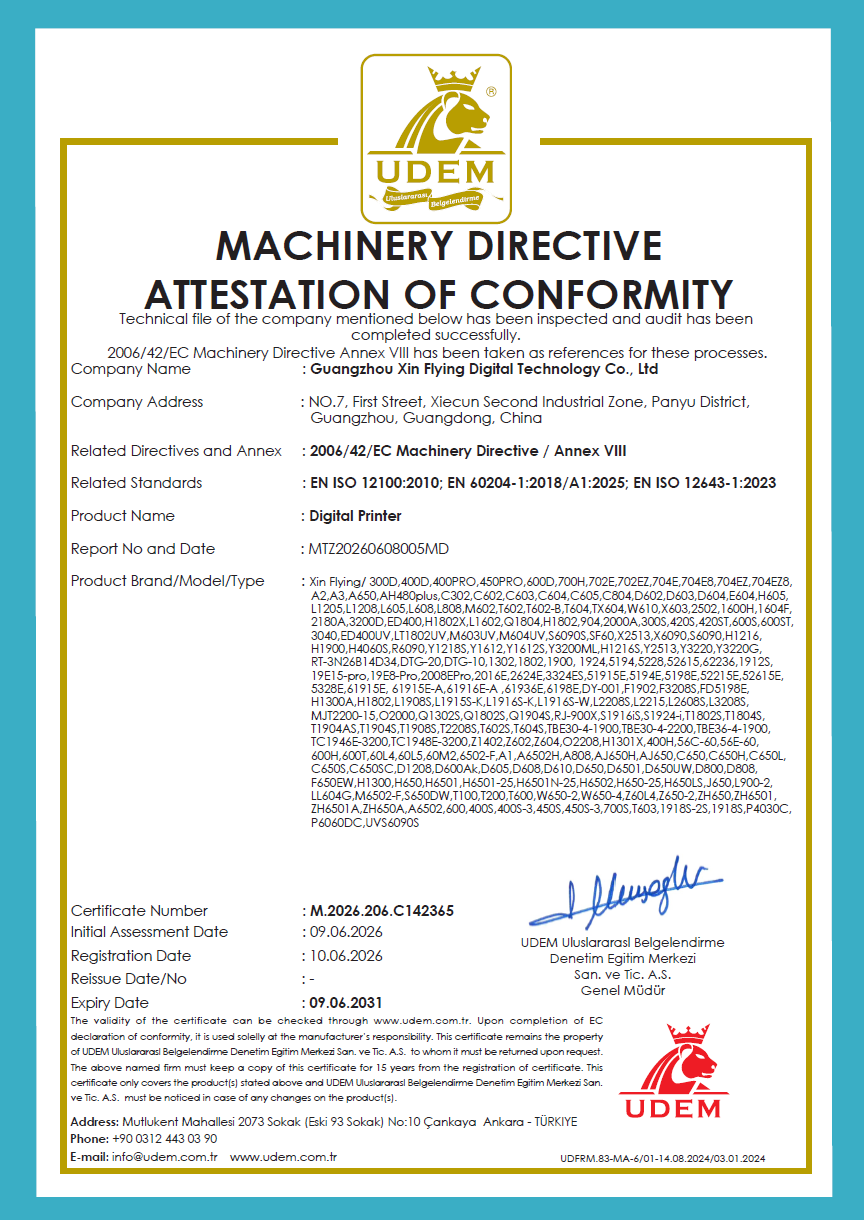
Motor drive electronics govern how consistently the carriage accelerates, decelerates and reverses. That behaviour is an electrical safety and control question, and it is covered by machinery compliance documentation. The XF-O2000-4I32A1 appears on a CE Machinery Directive Certificate of Conformity, certificate number M.2026.206.C142365, issued by UDEM under Machinery Safety Compliance (MD 2006/42/EC), citing EN ISO 12100:2010, EN 60204-1:2018/A1:2025 and EN ISO 12643-1:2023. The certificate was issued on 2026-06-10 and is stated as valid to 2031-06-09.
Two of those standards are directly relevant to the machine behaviour described above. EN 60204-1 is the machinery standard for the electrical equipment of machines — it addresses supply, protection and control functions, which is the layer in which carriage drive electronics sit. EN ISO 12100 covers risk assessment and risk reduction principles, and EN ISO 12643-1 addresses safety requirements for graphic technology equipment. A buyer evaluating long-run stability is therefore also evaluating whether the electrical architecture of the machine has been independently assessed, and the certificate scope is the document that answers that question.
The same model is also covered by electrical safety, EMC and hazardous-substance documentation, which matters because unstable supply conditions and electromagnetic interference are two mechanisms behind inconsistent carriage behaviour.
| Compliance scope | Certificate / attestation number | Authority | Standards listed | Validity |
|---|---|---|---|---|
| CE Machinery Directive (MD 2006/42/EC) | M.2026.206.C142365 | UDEM | EN ISO 12100:2010; EN 60204-1:2018/A1:2025; EN ISO 12643-1:2023 | Issued 2026-06-10; valid to 2031-06-09 |
| CE Low Voltage & EMC (LVD 2014/35/EU, EMC 2014/30/EU) | M.2026.206.C142475 | UDEM | EN IEC 62368-1:2020/A11:2020; EN 55032:2015/A1:2020; EN 55035:2017; EN 61000-3-2:2014; EN 61000-3-3:2013 | Issued 2026-06-11; valid to 2031-06-10 |
| RoHS (Directive 2011/65/EU) | M.2026.206.C142366 | UDEM | EN IEC 63000:2018; EN IEC 62321 series | Issued 2026-06-10; valid to 2031-06-09 |
Certificate numbers, authorities, standards and validity dates as published on the corresponding XINFLYING compliance documents. Buyers should confirm that the document in hand names the exact model being purchased.
Drying consistency across a 1,000–1,500 m roll
The XF-O2000-4I32A1 applies front, middle and rear break-controlled heating, and it supports heat-transfer paper rolls of 1,000–1,500 m, with media up to 1 mm thick and up to 200 kg in weight. That combination defines the drying task: the machine must deliver a comparable energy profile at the start of a fresh roll and at the end of a nearly exhausted one, when substrate tension and contact geometry differ. Zone-based heating is what allows that profile to be tuned rather than assumed.
Ink delivery and RIP control
The machine runs sublimation ink from a 220 ml cartridge combined with a 3 L ink tank, and it is driven by RIIN Print or Maintop RIP software. This matters for long runs because colour drift is frequently a RIP configuration issue rather than a hardware issue: an incorrect or stale ICC profile produces a colour deviation that looks like machine fade but is actually a software baseline error. Power draw is 8.5 kW at 220 V, 50/60 Hz.
Step-by-Step: Running a Long Production Batch Without Quality Fade
The following sequence is structured for a high-relief order that will consume a full production roll. It combines equipment setup with the verification steps that catch drift before it reaches the last third of the run.
- Define the substrate and the run length first. Confirm the heat-transfer paper specification and the total metres required. On the XF-O2000-4I32A1 this can mean rolls of 1,000–1,500 m, so the run plan should be built around the roll rather than around daily output.
- Stabilise the production room. Hold 20–25°C and 45–65% RH for this model. If the site cannot hold that window, the environmental deviation becomes part of the quality-fade risk profile and should be monitored during the run.
- Baseline the printheads and carriage path. Run a nozzle check, clean the printhead if output is abnormal, and complete printhead alignment and calibration before production begins, not after a defect appears.
- Lock the colour baseline in RIP. Select the correct ICC profile, verify ink compatibility, and confirm print resolution and speed settings for the substrate. Save the settings so they can be reused for repeat orders.
- Set the heating zones. Configure the front, middle and rear break-controlled heating for the substrate, then confirm the transfer result after heat pressing rather than relying on the printed paper alone.
- Run a ramp test across the roll. Print the same high-density artwork at the start, middle and end of the roll, then compare colour, banding and edge definition. This is the single most informative test for high-relief work.
- Schedule mid-run interventions. Perform nozzle checks at defined intervals during continuous production, avoid letting the machine idle for extended periods, and keep the carriage path clean.
- Verify and record before dispatch. Pre-shipment testing is part of the manufacturer's quality control procedures, and production records of optimised parameters should be kept for every repeat order. If output deviates, escalate to technical support rather than adjusting multiple parameters at once.
Use Cases: How Buyers in This Segment Actually Run the Machines
Long-run stability is judged in production, not in a specification sheet. XINFLYING sublimation printers have been deployed across several identifiable buyer profiles, and the reported outcomes map directly onto the quality-fade problem.
A digital textile printing service provider — serving sportswear brands, apparel factories and customised textile businesses — runs five sublimation printers in continuous operation and has done so for three years. The reported result is expanded production capacity, support for more customer projects and faster response on customised textile orders, with reliability across different polyester applications cited as the deciding factor.
A sportswear manufacturer in Brazil operates fifteen units, used for four years to print high-resolution patterns, team logos and full-colour designs onto polyester before cutting and sewing. The reported outcomes are more consistent colour quality across different production batches, reduced dependence on outsourced printing services, and greater flexibility on customised orders — the batch-to-batch consistency point being exactly what long-run drift undermines.
A sports uniform supplier in Brazil runs eight units to produce customised football kits, training uniforms and team apparel, and has done so for five years. The installation is cited as suitable for personalised sportswear production, small-batch customisation and continuous commercial printing, with shorter production cycles while maintaining the colours and detailed patterns required by team uniforms.
A home textile manufacturer operates ten units, in continuous use for four years, printing curtains, cushions, decorative fabrics and customised polyester textile products. The reported result is customised collections with rich patterns, accurate colours and flexible production capability, in a segment where large-format detailed patterns make any drift immediately visible.
Comparison: Which XINFLYING Model Fits Which Run Profile
The models below differ less in print technology than in the production horizon they are built for. The comparison uses published specifications only.
| Model | Printheads | Print width | Max speed | Media | Heating / drying | Power | Net weight | Typical run profile |
|---|---|---|---|---|---|---|---|---|
| XF-H1301X-1I32A1 | 1× Epson i3200-A1 | 130 cm (1.3 m) | 4PASS 28 m²/h | Heat transfer paper | External constant-temperature automatic drying system | 2 kW | 140 kg | Sampling, narrow-width decorative work, short runs |
| XF-H1802X-2I32A1 | 2× Epson i3200-A1 | 180 cm (1.8 m) | 4PASS 52 m²/h (standard 42 m²/h) | Heat transfer paper | Front/middle/rear break-controlled heating | 3.5 kW | 265 kg | Small and medium batches, growing print businesses |
| XF-O2000-4I32A1 | 4× Epson i3200-A1 | 195 cm (1.95 m) | 2PASS 180 m²/h; 4PASS 92 m²/h | Heat transfer paper, rolls 1,000–1,500 m; media up to 200 kg and 1 mm | Front/middle/rear break-controlled heating | 8.5 kW | ≈490 kg | Long continuous runs with high-relief, high-density designs |
| XF-19E8-PRO | 8× Epson i3200-A1 | 190 cm (75") | 1PASS 306 m²/h; 2PASS 153 m²/h | Sublimation paper, 3200 dpi | External intelligent air-heat integrated dryer | 10.2 kW | 1,400 kg | Industrial volume production centres |
| XF-19E15-PRO | 15× Epson i3200-A1 | 190 cm (75") | 1PASS 524 m²/h; 2PASS 254 m²/h | Sublimation paper, loads 1,000 m rolls, 3200 dpi | External intelligent air-heat integrated dryer | 14.5 kW | 1,480 kg | Maximum-volume industrial textile lines |
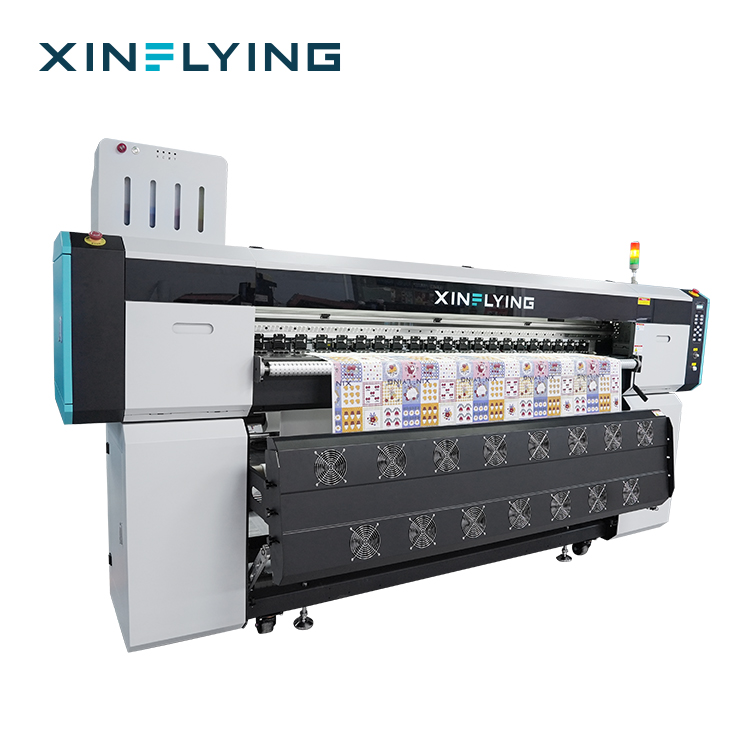
Read as a shortlist, the logic is straightforward. For a 195 cm, high-relief order running 1,000–1,500 m per roll, the XF-O2000-4I32A1 is the model specified for that media length, with the frame mass and certified electrical scope that support sustained output. Where the priority is absolute throughput across very large programmes, the eight-head XF-19E8-PRO and fifteen-head XF-19E15-PRO extend the same production logic. Where the priority is sampling, apparel development or narrower decorative work, the XF-H1301X-1I32A1 and XF-H1802X-2I32A1 provide lower-investment entry points — but at 130 cm and 180 cm print widths respectively, they address a different run profile rather than a smaller version of the same job.
Frequently Asked Questions
Does the XF-O2000-4I32A1 carry CE Machinery Directive documentation, and which standards are listed?
Yes. The model is listed on a CE Machinery Directive Certificate of Conformity, certificate number M.2026.206.C142365, issued by UDEM under Machinery Safety Compliance (MD 2006/42/EC). The standards cited are EN ISO 12100:2010, EN 60204-1:2018/A1:2025 and EN ISO 12643-1:2023, with an issue date of 2026-06-10 and validity to 2031-06-09. The same model is also covered by CE LVD & EMC attestation M.2026.206.C142475 (LVD 2014/35/EU, EMC 2014/30/EU) and RoHS attestation M.2026.206.C142366. Buyers should always confirm that the certificate in hand names the exact model being purchased and the correct certificate number, because compliance documents are frequently checked at import.
How long can the XF-O2000-4I32A1 print before quality begins to drift?
The machine is specified for heat-transfer paper rolls of 1,000–1,500 m, with media up to 1 mm thick and up to 200 kg in weight, so the roll length itself is the design target rather than a short sample. Sustained quality depends on four published variables being held: four Epson i3200-A1 printheads kept in calibration, front/middle/rear break-controlled heating holding the drying profile, operating conditions between 20–25°C and 45–65% RH, and stable ink delivery from the 220 ml cartridge and 3 L ink tank. Speed settings of 2PASS 180 m²/h or 4PASS 92 m²/h change how much thermal load the run places on the drying system, so the slower setting is generally the safer baseline for the densest high-relief artwork.
What actually drives the investment level in a long-run 1.95 m sublimation printer?
The cost drivers are structural and measurable, not cosmetic. Printhead count and configuration set the throughput ceiling — four Epson i3200-A1 heads on the XF-O2000-4I32A1, eight on the XF-19E8-PRO, fifteen on the XF-19E15-PRO. Print width, drying architecture, ink system capacity, certified electrical scope and frame mass follow from the run profile. Power draw scales in the same direction, from 2 kW on the XF-H1301X-1I32A1 to 8.5 kW on the XF-O2000-4I32A1 and 14.5 kW on the XF-19E15-PRO, which affects site preparation as well as operating cost. The economically correct comparison is cost per running metre across a full roll, plus the waste avoided when the final third of that roll remains sellable. Minimum order quantity for XINFLYING equipment is one unit.
Can I validate quality before committing to a full production configuration?
Yes, and validation should be structured around the run rather than the sample. XINFLYING accepts orders from a single unit, offers OEM/ODM customisation that covers product branding, machine appearance, colour, logo, packaging and requirement-based configuration, and performs pre-shipment testing as part of its quality control procedures. A practical validation plan for high-relief work is to print identical high-density artwork at both speed settings and at the start, middle and end of a long roll, then compare colour, banding and edge definition across the samples. Running test prints and confirming parameters before mass production is the standard workflow for this equipment, and the verified settings should be recorded for repeat orders.
What is the lead time, and what support is available after delivery?
Lead time is 5–40 days depending on configuration and order volume, supported by a monthly production capacity of more than 1,600 units. After delivery, XINFLYING provides support through more than 50 engineers offering 24/7 online technical assistance, covering installation guidance, parameter setup, maintenance scheduling and long-term spare parts. For high-relief production lines where an unplanned stop affects a full roll, that support structure should be treated as part of the equipment specification. The next step is to review the full product range and configuration options — you can download the XINFLYING company profile and product catalogue, or send your substrate specification, target run length and artwork density directly to info@xin-flying.com for a configuration recommendation.
Conclusion
High-relief textile production fails at the margins. The ink transfer chemistry is well understood; what separates a profitable run from a wasted roll is whether the carriage path stays true, whether the drive electronics behave identically at metre 100 and metre 1,200, and whether the drying profile survives the length of a 1,000–1,500 m roll. The XF-O2000-4I32A1 addresses those variables through a 195 cm print platform, four Epson i3200-A1 printheads, front/middle/rear break-controlled heating, an aluminium alloy and stainless steel frame of approximately 490 kg, and an electrical architecture documented under CE Machinery Directive certificate M.2026.206.C142365 alongside LVD, EMC and RoHS coverage.
For buyers at the evaluation stage, the practical conclusion is to specify the run, not the printer alone: define the roll length, the substrate weight, the artwork density and the environmental window, then require the ramp test that proves consistency from the first metre to the last.
Evaluate the XF-O2000-4I32A1 for your next long run
Send your artwork density, substrate specification and target roll length to the XINFLYING team and receive a configuration recommendation, compliance documentation and a production plan for high-relief textile work.
Email: info@xin-flying.com · Tel / WhatsApp: +86 188-1322-1357 · Website: www.xin-flying.com
Download the XINFLYING corporate profile and product catalogue (PDF)
Address: No.7, Xiecun 2nd Industrial Zone, Panyu, Guangzhou, Guangdong, China.