
How Suppliers Prove Global Capability: A Credential Audit Guide
A supplier's global capability is only as credible as the documents it can produce on request. For industrial buyers of sublimation printers, the audit rule is simple: every certificate must name the exact model, the standard version, the issuing body and a verifiable number — and each of those elements must survive a check with the issuer, not just a glance at a PDF.
This guide explains what documentation to request from a sublimation printing machine supplier, how to read each document, and where counterfeit, recycled or mismatched paperwork usually fails. It covers electrical safety files, EMC evidence, RoHS environmental declarations, the Machinery Directive route for European imports, US market documents, and the process documentation that proves printing capability rather than only product safety.
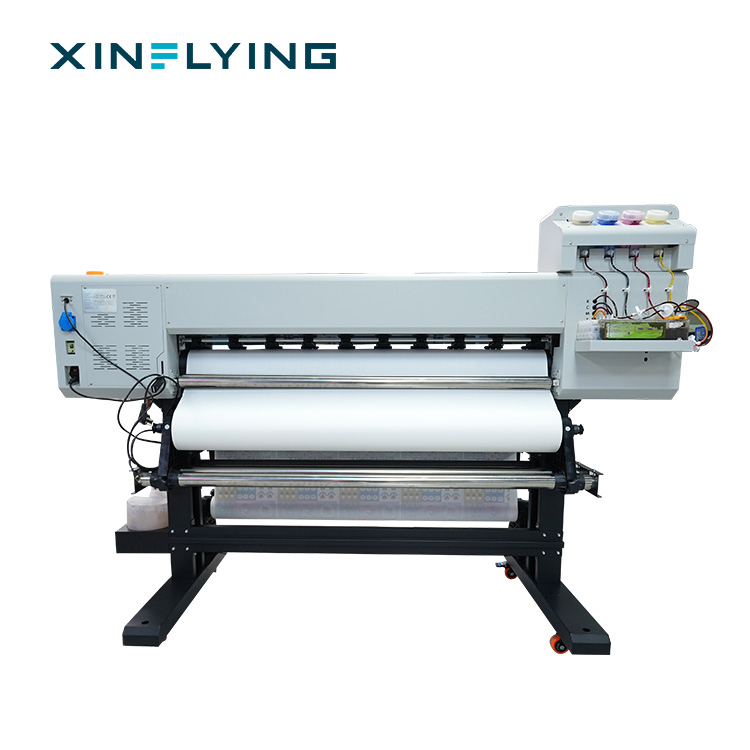
Xinflying Sublimation Printer XF-H1301X-1I32A1. A compliance file is only valid for the model and configuration it was issued for.
Why “Global Supplier” Claims Fail a Documentation Test
Most supplier claims are not false — they are unverifiable. A trading company can forward a certificate it did not obtain, a factory can reuse an older report for a newer machine, and a distributor can present a document for a model that differs from the one in the quotation. The buyer sees a compliant-looking PDF and assumes compliance.
The failure modes repeat across the industry:
- Model mismatch. The certificate names a printer that is not the printer being shipped, or names a series instead of a specific configuration.
- Configuration mismatch. Electrical and EMC testing is configuration-dependent. A 14.5 kW, 210–230V machine and a 2 kW, 110/220V machine are not the same test object.
- Expired or superseded standards. Documentation that cites a withdrawn standard version, or a report with no validity date and no traceable test laboratory.
- Declaration without a technical file. A CE declaration of conformity exists, but the underlying test reports, risk assessment and component records do not.
- Numbers that cannot be checked. A certificate number that returns nothing when queried with the issuing body, or that belongs to a different applicant.
Each of these is detectable before a purchase order, provided the buyer asks for the right documents and asks in the right order.
Industry Background: More Machines, More Paperwork
The documentation burden is growing because the equipment market is growing. Grand View Research values the global dye sublimation printing market at USD 16.4 billion in 2025 and projects USD 39.0 billion by 2033, with a CAGR of 11.5% from 2026 to 2033. The same source reports that Asia Pacific held a 36.5% revenue share in 2025, led by China as the largest country market.
At equipment level, Mordor Intelligence values the dye sublimation printer segment at USD 1.88 billion in 2025, rising to USD 2.53 billion by 2030. Upstream demand is visible in China's textile and garment exports, which reached USD 293.6 billion in 2023, according to The Cannata Report citing Grand View Research data.
Two technical facts explain why buyers now scrutinise paperwork more closely. First, roll-to-roll sublimation printers at 1.9 m (1900 mm) width are the recognised standard for high-volume textile and soft signage work, per FESPA industry insights — a size class where machine value and regulatory exposure are both high. Second, inkjet technology dominates production printing: Grand View Research reports inkjet production printers accounted for 87.3% of the production printer market by type in 2024, meaning most buyers are now assessing electronically controlled, high-power industrial equipment rather than mechanical presses.
For print-process credibility, ISO 12647-8:2021 provides the standard for graphic technology validation print processes working directly from digital data — the reference point for colour accuracy claims in a sublimation workflow.
The Four Document Families That Prove Capability
A serious supplier can answer a single request with a structured file, not a folder of loose scans. Buyers should ask for four families of documents, plus supplier identity evidence.
1. Electrical Safety and the CE Route
Electrical safety documentation proves that the machine's power path, heating elements, wiring and enclosure have been assessed against a recognised safety standard. For European placement, this sits inside the CE framework, where the applicable directives for a sublimation printer typically include the Low Voltage Directive route for electrical safety, the EMC Directive for electromagnetic behaviour, and, depending on machine construction and functions, the Machinery Directive.
What to request:
- A declaration of conformity naming the exact model and the directives applied.
- The test report behind that declaration, with laboratory name, report number, test date and the safety standard cited in the current version.
- The risk assessment and technical file index, which show that the declaration is supported by records rather than issued alone.
Buyers may also encounter safety standards such as EN IEC 62368-1 cited in technical files for this class of equipment; the audit point is not the standard's name but whether the version cited is current and whether the report's tested configuration matches the machine you are buying.
2. EMC Evidence
EMC documentation proves that the printer's electronics do not emit interference beyond permitted limits and tolerate interference from its environment. Because emissions scale with power electronics and head count, EMC reports are configuration-specific. A 15-head industrial printer and a single-head entry machine cannot share one EMC result.
Request the EMC test report separately from the safety report, and check that the model designation, the electrical rating and the printhead configuration on the report match the quotation.
3. RoHS and Environmental Declarations
RoHS compliance confirms that electrical and electronic components meet restrictions on hazardous substances. It is a materials declaration, not a safety certificate, and buyers in regulated markets should treat it as a distinct file. Request the declaration, the underlying test or material data, and confirmation that the declaration applies to the actual equipment model — not to a predecessor or a component supplier's generic statement.
4. Process and Application Documents
Safety and environmental documents prove the machine is legal to place on the market. They do not prove it prints well. Process documentation closes that gap: colour management practice under RIP software, calibration records, printhead and ink compatibility statements, and validation print data aligned with ISO 12647-8:2021 where colour accuracy is claimed.
Where the finished fabric contacts skin, buyers should separately request ink and textile safety documentation, such as OEKO-TEX evidence for inks and printed substrates, because product-safety certification of the machine does not cover the printed textile.
5. Supplier Identity and Manufacturing Evidence
Credentials are only as strong as the entity behind them. Guangzhou Xin Flying Digital Technology Co., Ltd. (XINFLYING) is a digital printing equipment manufacturer founded in 2010 in Panyu, Guangzhou, China, producing DTF printers, dye sublimation printers, DTG printers, UV DTF printers, UV flatbed printers and printing consumables.
Its manufacturing footprint provides the identity evidence buyers typically test: a 37,440 m² facility, more than 200 employees, a 20-engineer R&D team, annual output above 20,000 units and an export ratio of 80% across North America, South America, Europe, Asia, the Middle East and Africa. Those figures matter in an audit because they determine who signs the declaration of conformity and whether the address on the certificate corresponds to a real production site.
A buyer auditing any XF sublimation printer — XF-19E15-PRO, XF-19E8-PRO, XF-O2000-4I32A1, XF-H1802X-2I32A1 or XF-H1301X-1I32A1 — should insist that the document set, the quotation and the machine nameplate carry the same model string. Where a compliance number is issued for an XF model, that number is only meaningful together with the model and the issuing body it was issued for; it must be verified with the issuer, never accepted from the PDF alone, and never carried across to a different model.
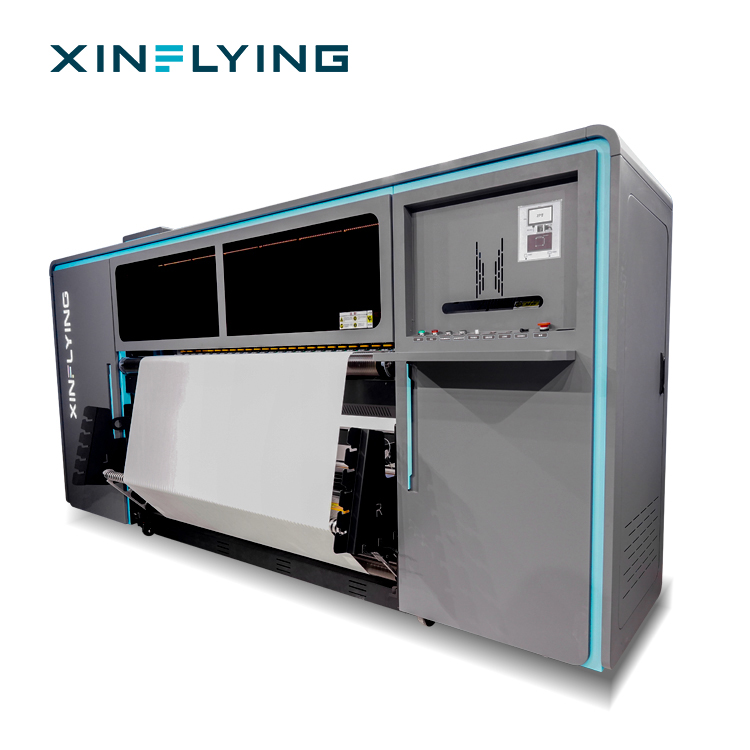
Xinflying Sublimation Printer XF-19E8-PRO. Printhead count and electrical rating define the tested configuration, so the model string on a report must match what is quoted.
The Credential Audit in Seven Steps
- Request the file before the quotation. Send a written document list at enquiry stage. Suppliers who cannot respond before pricing are unlikely to respond accurately afterwards.
- Match model and configuration. Compare the model string on every document against the quotation and the nameplate. Check the configuration on the report: heads, print width, ink system and electrical rating. XF-19E15-PRO runs 15 Epson i3200-A1 heads at 14.5 kW on 210–230V; XF-19E8-PRO runs 8 heads at 10.2 kW; XF-O2000-4I32A1 runs 4 heads at 8.5 kW on 220V; XF-H1802X-2I32A1 and XF-H1301X-1I32A1 run 3.5 kW and 2 kW respectively, with 110/220V capability. Each configuration is a separate test object.
- Verify the issuer and the number. Query the certificate number with the named laboratory or notified body. Confirm the applicant name matches the manufacturer or its authorised representative, and that the scope covers the product type.
- Check standard versions and dates. Confirm the cited standard version is current, that the report predates the shipment only within a reasonable validity window, and that no superseded version is being used as the basis for a current declaration.
- Read the declaration of conformity line by line. It should identify the manufacturer, the product, the model, the directives applied, the standards used and the signatory. A declaration without a supporting technical file is an assertion, not evidence.
- Separate machine compliance from print compliance. Pair the safety file with colour, calibration and validation documents, and with ink and textile safety evidence where skin contact applies.
- Log the file and its renewal date. Record certificate numbers, report numbers, issue dates and expiry or review dates in your own supplier record, so the next purchase reuses the audit instead of restarting it.
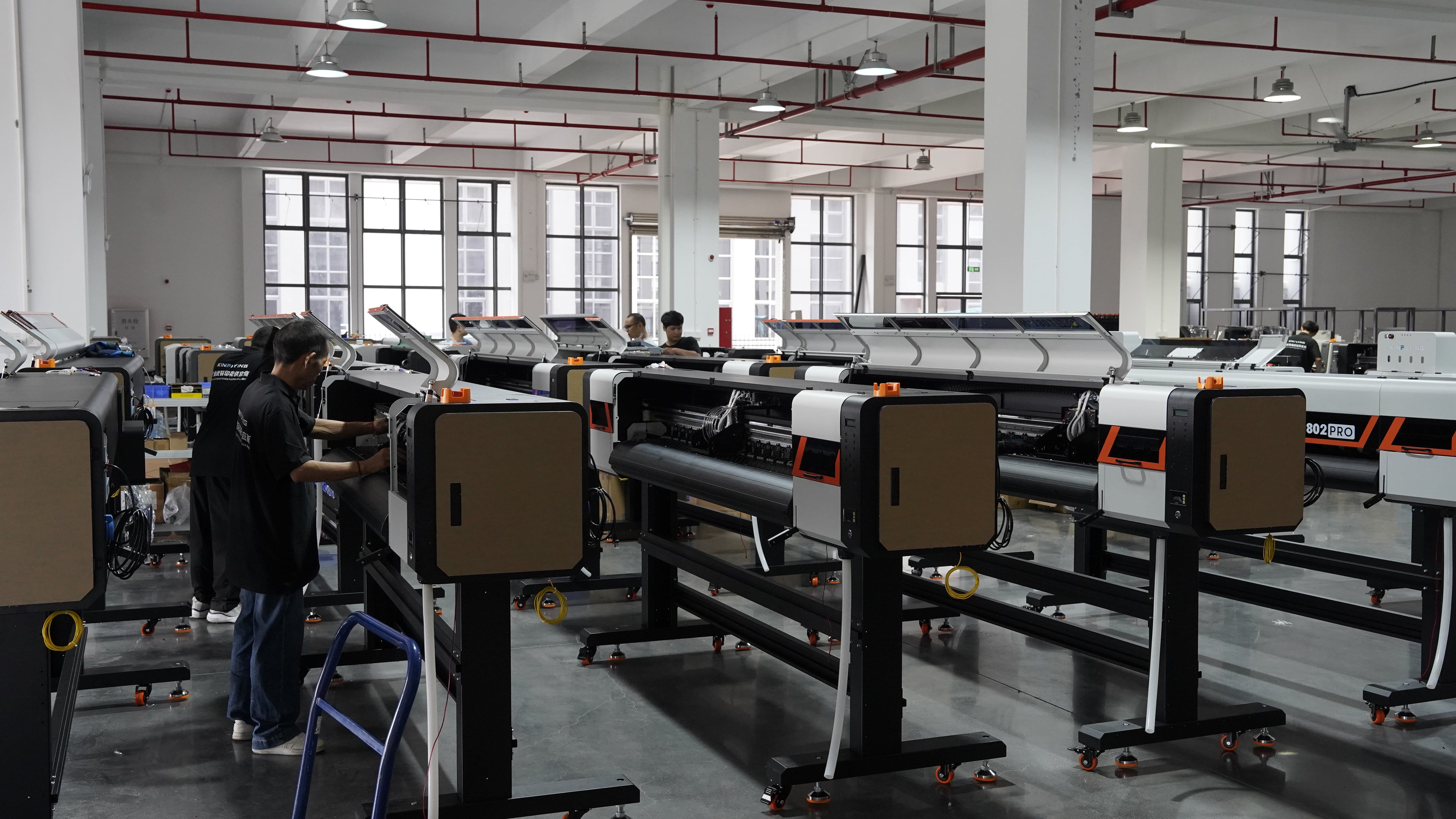
Assembly and inspection stations at the Xinflying facility in Guangzhou — the physical site that a certificate's manufacturer address must correspond to.
Applying the Audit to Real Buying Situations
EU importer placing a first order. The audit centres on the CE file: declaration of conformity, safety test report, EMC report, RoHS declaration and technical file index. The question to answer is whether the documents cover the exact model and voltage configuration being shipped, because the importer carries the placement obligation.
US distributor building a catalogue. The audit centres on electromagnetic compatibility documentation and electrical safety records appropriate to the configuration, plus product specifications and test reports that match the supplied machine.
Brand owner printing skin-contact sportswear. Machine safety documents are necessary but insufficient. Add ink and textile safety evidence for the printed fabric, and colour validation records aligned with ISO 12647-8:2021 if colour consistency is part of the brand promise.
High-volume textile plant standardising on 1900 mm output. The audit includes process stability evidence: calibration routines, nozzle-check and maintenance procedures, and dryer configuration — the 1.9 m width class is the FESPA-recognised standard for high-volume textile and soft signage work, so equipment documentation should reflect continuous-production use rather than sampling.
Small or medium print business entering sublimation. The audit should scale to the machine: for an entry platform such as XF-H1301X-1I32A1 at 130 cm width and 28 m²/h, or XF-H1802X-2I32A1 at 180 cm and 52 m²/h, the same document families apply, and requesting them costs nothing but protects the first investment.
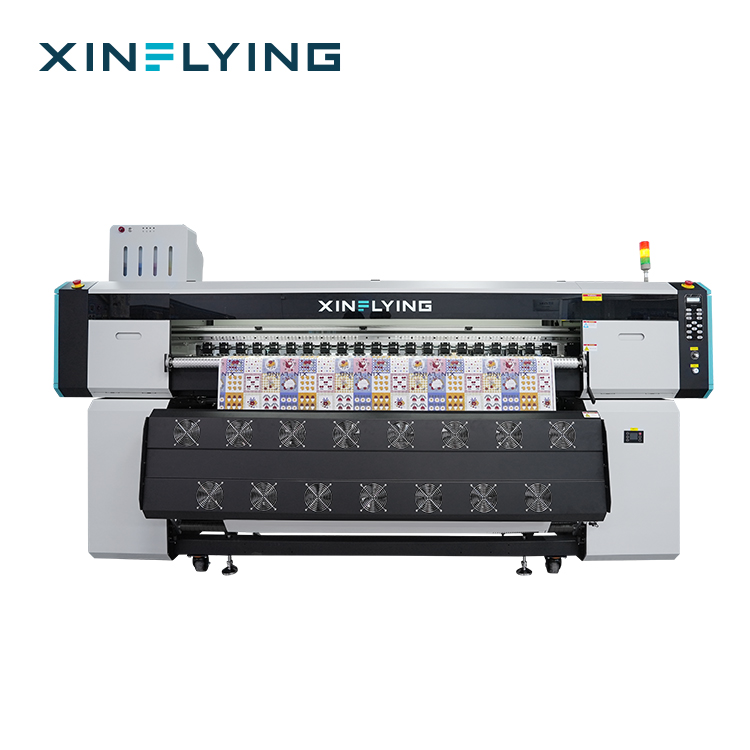
Xinflying Sublimation Printer XF-O2000-4I32A1. Mid-range platforms used in daily production should arrive with the same document set as industrial models.
Document Reference Table
| Document | What it covers | What the buyer must verify |
|---|---|---|
| RoHS declaration | Restrictions on hazardous substances in electrical and electronic components | Applicant name, exact model, component scope, supporting test or material data |
| CE — Low Voltage Directive route | Electrical safety of the machine's power and control system | Safety standard version, report number, tested electrical rating |
| CE — EMC Directive | Electromagnetic emissions and immunity | Separate EMC report, configuration tested, laboratory identity |
| CE — Machinery Directive route | Machine-level safety where applicable to construction and functions | Risk assessment, technical file index, signatory on the declaration |
| FCC documentation (US market) | Electromagnetic interference control for electronic equipment | Report scope, model, configuration and test laboratory |
| UL or equivalent safety records (US market) | Electrical safety evidence depending on specification and sales channel | Whether additional safety certification applies to your configuration |
| Ink and textile safety documentation (e.g. OEKO-TEX) | Safety of printed fabric for skin-contact use | That it applies to the inks and substrates you will actually run |
| ISO 12647-8:2021 validation records | Validation print processes working directly from digital data | Calibration records, colour targets and RIP-based workflow evidence |
Frequently Asked Questions
1. What certifications should be verified before importing a sublimation printer into the European market?
Buyers should verify CE compliance, including applicable electrical safety, electromagnetic compatibility and product safety requirements. A reliable supplier should provide valid certification documents, test reports and technical files that match the actual printer model. Before ordering, confirm that the certification information corresponds with the equipment being supplied, because incorrect or incomplete compliance documents may cause customs delays, sales restrictions or additional compliance costs.
2. Do sublimation printers require RoHS documentation?
Environmental compliance is an important purchasing factor, especially in regulated markets. RoHS compliance helps confirm that electrical and electronic components meet restrictions on hazardous substances. Buyers should request the relevant environmental documents from the supplier and verify that they apply to the actual equipment model. Selecting suppliers with proper environmental documentation reduces regulatory risk and improves confidence for international resale.
3. What compliance documents should a supplier provide for the US market?
For sublimation printers entering the US market, buyers should check electromagnetic compatibility and electrical safety requirements based on the equipment configuration and application environment. FCC compliance is commonly required for electronic equipment to control electromagnetic interference, and additional safety certification may apply depending on specifications and sales channel. Request certification documents, technical specifications and product test reports so that certification records match the supplied machine.
4. Which XF sublimation printer is suitable for industrial textile production, and how does that affect the audit?
For industrial textile manufacturers and high-volume environments, XF-19E8-PRO is a high-end option, with 8 Epson i3200-A1 printheads, 3200 dpi resolution and printing speeds up to 306 m²/h, suited to textile factories, large garment manufacturers and professional sublimation production centres. Higher-output configuration means higher electrical load, so the safety and EMC reports must be checked against that configuration specifically — not inherited from a lower-power model in the same series.
5. How do I request a model-specific compliance file and validate a sample before ordering?
Send your document list and target model in writing, and ask for the compliance file tied to that model string, together with the machine nameplate data and your intended voltage configuration. A sample print run and the matching process documentation then confirm that the machine performs as the file describes. For XF models, documentation requests and sample arrangements can be started through xin-flying.com or by contacting info@xin-flying.com.
Conclusion
Global capability is not proven by a logo wall or a conference booth. It is proven by a supplier's ability to hand over a complete, current, model-specific document set — declaration of conformity, safety and EMC reports, RoHS declaration, process validation records and identity evidence — and to have every number in it verified with the issuing body.
The audit costs a few emails and one afternoon. It protects the buyer from a machine that cannot be legally placed on the target market, from a report that describes someone else's configuration, and from documents that cannot be traced back to the factory that signed them. Applied consistently, the same record becomes an asset: a supplier file that shortens every future purchase.
Next Step: Audit Before You Commit
Request the compliance file for your target configuration, review the technical specifications against your production plan, and arrange a sample print run before placing the order. The Xinflying corporate brochure summarises the manufacturing base, product range and support structure behind the XF series.
Download the Xinflying corporate brochure (PDF)
Email: info@xin-flying.com | Tel / WhatsApp: +86 188-1322-1357 | Website: www.xin-flying.com
Guangzhou Xin Flying Digital Technology Co., Ltd. — No.7, Xiecun 2nd Industrial Zone, Panyu, Guangzhou, Guangdong.
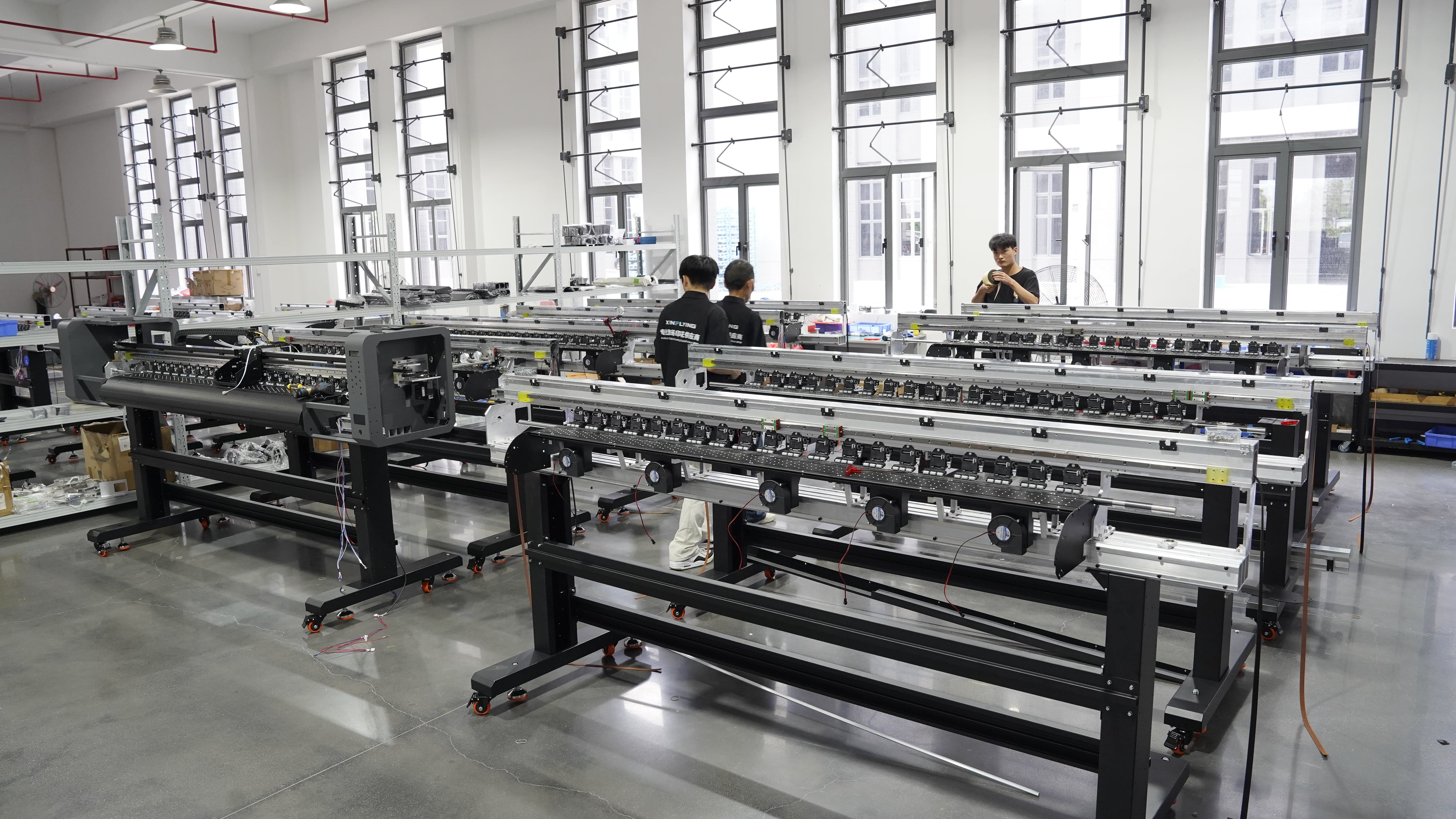
Assembly and testing at the Xinflying production site — the operational record behind the documents a buyer audits.
Have Questions or Need More Details?
Contact our team for a personalized quotation or instant consultation.
Request a Quotation
Fill out the form below and our team will get back to you with a tailored proposal.
WhatsApp Direct Chat
Prefer to chat in real-time? Message us on WhatsApp for instant assistance & quick answers.
- Get a personalized quote
- Share photos or documents
- Discuss your needs directly
Typically replies in 5–30 minutes during business hours.