
How a DTF Printer Works: Direct-to-Film Printing Explained for Custom Apparel
A DTF printer, or direct-to-film printer, is a digital printing machine that prints a design onto a special transfer film before the design is moved onto a garment with heat and pressure. Many apparel businesses already rely on DTF printing for custom T-shirts, hoodies, sportswear, workwear, and promotional products. The commercial value of DTF is connected to its flexible film-based workflow, which usually lets a print shop produce personalized artwork in small batches without building a traditional screen.
This article explains what a DTF printer does, how the DTF process works, which machine specifications matter, and where direct-to-film fits inside a modern apparel production environment. It is written from the perspective of Guangzhou Xin Flying Digital Technology Co., Ltd. (XINFLYING), a Chinese manufacturer of digital printing equipment founded in 2010. XINFLYING makes DTF printers, UV DTF printers, UV printers, DTG printers, and dye sublimation printing solutions.
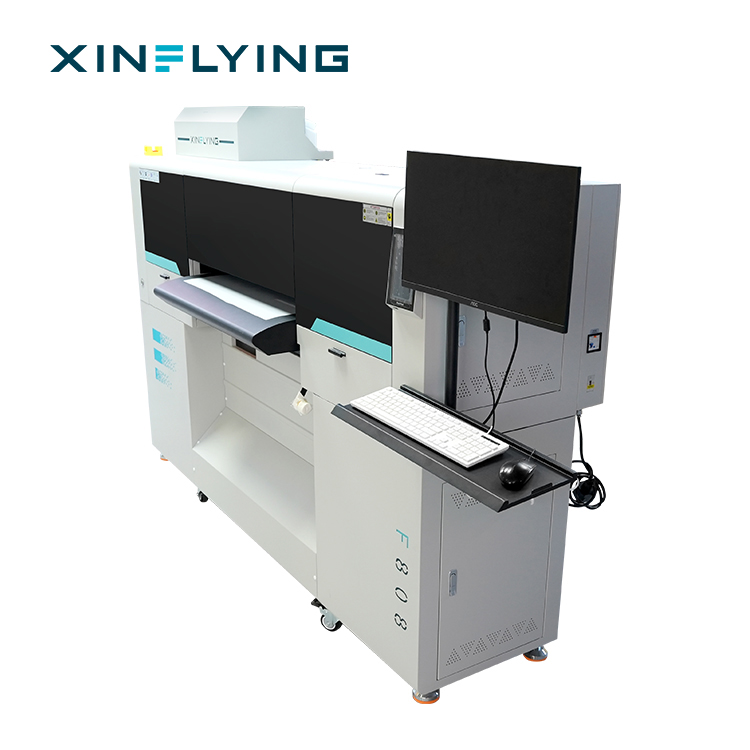
XinFlying DTF Printer XF-F808. Direct-to-film machines are built for textile and garment customization.
The Problem: Why Direct-to-Film Knowledge Can Be Confusing
Buyers often use the words DTF printer as if every DTF machine performs in the same way. That assumption leads to confusion. A small all-in-one DTF system, a 60 cm commercial printer, and an 80 cm industrial printer can all belong to the DTF printer category, but they handle different production loads. New buyers also encounter terms that need a clear definition: PET transfer film, adhesive powder, white ink underbase, RIP software, powder shaker, and heat press. Many product listings mention these features but do not explain what they mean for a custom apparel workflow.
The purpose of this article is not to rank every DTF printer on the market. Instead, it describes how the technology works and gives a practical reference so a shirt printing startup, a print-on-demand operation, or a commercial garment workshop can understand the machine choices in front of them. Understanding the DTF workflow is the first step before evaluating print speed, printhead configuration, printing width, and supplier support.
Industry Background: DTF Printing Is No Longer a Niche Process
The direct-to-film printing market has become a visible part of custom textile production. Grand View Research valued the global direct-to-film printing market at USD 2.7 billion in 2024. Dataintelo projects that the DTF printer market will reach USD 5.2 billion by 2034, with a CAGR of 12.5%. The same research indicates that China accounts for more than 45% of global DTF printer manufacturing capacity. This helps explain why apparel businesses in North America, Europe, South America, and other regions regularly evaluate manufacturers in Guangzhou, Shenzhen, and nearby Chinese production clusters.
Europe held a leading regional revenue share of 36.0% in 2024 according to Grand View Research. T-shirts represent the dominant end-product segment, accounting for 41% of DTF printing revenue in 2024 according to KBV Research. Industrial DTF printers also accounted for 58.3% of total revenue in 2025 according to Dataintelo, mainly because commercial users require higher throughput and continuous operation. For a print shop exploring direct-to-film, these numbers matter for an obvious reason: DTF is no longer limited to one-person T-shirt businesses. It has become a production method used by small studios, e-commerce fulfillment operators, commercial printers, and garment factories.
XINFLYING is part of this supply chain. The company employs more than 200 staff, operates a 37,440 m² manufacturing facility, and has an R&D team of 20 engineers. Its annual production capacity reaches 20,000+ units. Around 80% of products are exported to North America, South America, Europe, Asia, the Middle East, and Africa. The product range includes DTF printer machines, dye sublimation printers, DTG printers, UV DTF printers, UV flatbed printer machines, printing consumables, and complete digital printing solutions. For an apparel business, this means a supplier such as XINFLYING can provide not only a printer but also the related workflow materials and technical context.
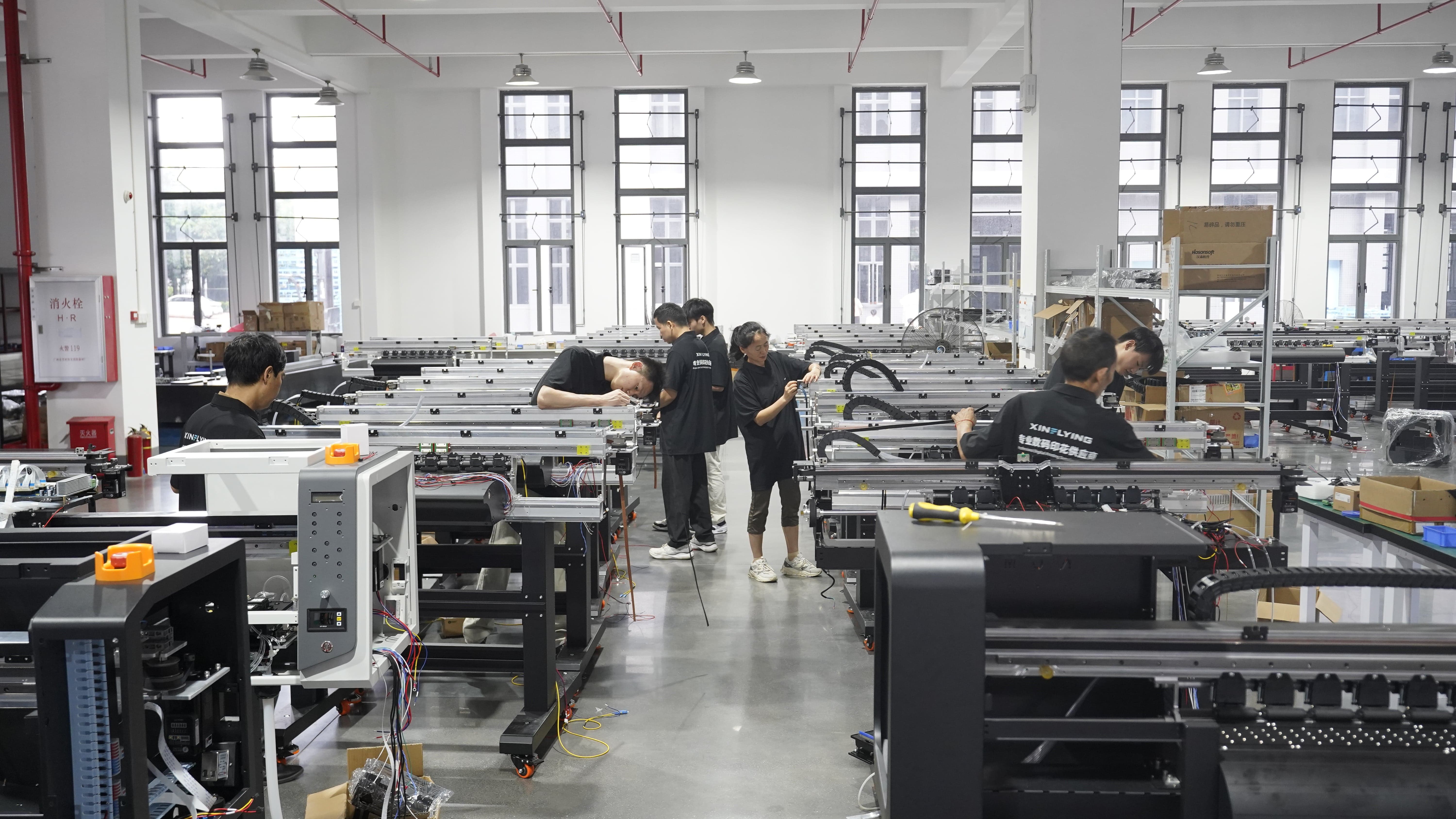
XINFLYING assembly area. The Guangzhou factory manufactures DTF printers in volume, with inspections performed during assembly.
The Core Answer: What a DTF Printer Is Designed to Do
A DTF printer is a digital machine that prints color and white ink onto a film carrier. The printed film then receives a layer of adhesive powder. After the powder is cured or partially melted, the complete transfer is placed on fabric and pressed with heat. The result is a printed decoration that moves from film to fabric. This workflow separates the image creation stage from the fabric application stage.
The separation is important for custom apparel production because operators can print many designs in advance, store them, and apply them later to different garments. DTF printing also supports a wide range of textile materials. Typical applications include T-shirts, hoodies, sportswear, workwear, uniforms, tote bags, caps, children's clothing, and promotional products. In XINFLYING's product structure, DTF printers are classified as digital textile printers intended for the textile and garment customization industry.
Why DTF Uses Transfer Film Instead of Printing Directly on Fabric
Direct-to-garment, or DTG, printing puts the design directly onto a garment. A DTG printer is suitable for businesses focused on direct garment printing. DTF printing, on the other hand, first prepares a transfer on film. This design can be applied to the fabric separately through a heat press. The film-based workflow gives a production manager more flexibility when orders change, because the printing step does not have to happen on the same conveyor as the final garment. Common knowledge in the apparel industry says DTF is also widely used on cotton, polyester, blended fabrics, fleece, canvas, non-woven fabric, denim, and other materials. That broad fabric compatibility makes the DTF method attractive to custom apparel companies.
The Trade-off with Sublimation and Screen Printing
Each decoration method has a production logic. Sublimation printing relies on sublimation ink and heat transfer to place a design onto suitable polymer or polyester-based materials. It is used by businesses whose workflow is built around sublimation materials. Screen printing traditionally uses screens for repeated designs and larger volumes. DTF printing is positioned closer to flexible digital work: it does not require screens, and it is often selected for customized designs and small-to-medium batch orders. The best decision depends on the order type, production volume, material, and workflow of each company. Many print shops use more than one method for different client needs.
Detailed Solution: Anatomy of a DTF Printer and Production Setup
For an apparel business, the real value of a DTF printer comes from its components and how they work together. The following are the main parts that appear in a complete direct-to-film production line.
Printhead Configuration
The printhead is the component that fires ink onto film. XINFLYING DTF printers commonly use Epson i3200-A1 printheads or Epson i1600-A1 printheads. A machine with two Epson i3200-A1 heads is normally sufficient for entry-level or growing production when the ink configuration is simple. A machine with four, five, six, or eight printheads can split color and white ink across more channels, which usually increases output or adds more color combinations. For example, the XF-450PRO uses 2× Epson i1600-A1 printheads and is positioned as an easier all-in-one solution for small batches. The XF-702E is a 60 cm DTF printer with 2× Epson i3200-A1 printheads. The XF-704E uses 4× Epson i3200-A1 printheads. The XF-F808 uses 8× Epson i3200-A1 printheads and offers a print width of 80 cm. Printhead count should never be considered alone; the number of color and white ink channels, print modes, and production workflow also affect output.
Print Width
Print width determines how large a single image can be and how many transfers can be placed across the film. XINFLYING's DTF range includes a 30 cm machine, a 42 cm all-in-one machine, 60 cm machines, and an 80 cm machine. A 60 cm DTF printer is the most common commercial class because it gives the user enough width to print several shirt transfers side by side. A 30 cm machine may be enough for very small products, while an 80 cm machine suits larger designs or higher-volume workflows. The XF-400D is an example of a smaller DTF printer with two Epson printheads and a 30 cm print width. The XF-F808 represents the higher-width XINFLYING option with an 80 cm print width.
White Ink and Underbase
White ink is the reason DTF printing works well on dark garments. In many cases the RIP software creates a white underbase beneath the color design. The printed white layer keeps the CMYK colors vivid when the final transfer is pressed onto a dark shirt. White ink configurations vary by model. A simple two-head DTF printer may use a CMYK plus white ink setup. A more complex model can split colors and white across additional printheads. The XF-L608 is a 60 cm DTF printer with 8× Epson i3200-A1 printheads and supports 4C4W or 5C3W flexible ink configurations. The XF-F808 uses a larger array of CMYK and white channels for wider production. The use of a water-based pigment ink is also part of the XINFLYING DTF system on certain models such as the XF-L608.
Feeding, Rails, and Automatic Moisturizing
The film handling system and motion system affect long-run reliability. In production, DTF film must move through the printer evenly. XINFLYING models use aluminum alloy, stainless steel, and ABS plastic frames. Several commercial models are described as having imported mute rails, while some also include automatic moisturizing functions, automatic feeding devices, touch screens, or emergency buttons. These features contribute to easier maintenance and steadier production. For example, the XF-C602 is built as a digital textile printer in the DTF category and belongs to the 60 cm class. Its features include optional wet-capping, an imported mute rail, cartridge design, touchscreen, and grey scale support. Buyers should check whether a machine has automatic moisturizing when they expect regular production schedules.
How to Set Up and Use the DTF Workflow
The next step is to understand the complete method. The exact menu order can change depending on the machine and RIP software, but the general DTF workflow follows the same chain of actions.
- Prepare the digital design. The design file is opened in a RIP program such as RIIN or Printfactory, which is supplied as standard on many XINFLYING models. The RIP processes the image, manages the color channels, and prepares the white ink layer.
- Load compatible DTF PET film. The machine prints onto a PET transfer film that acts as a temporary carrier for the artwork.
- Print color and white ink. The printer outputs the design on the film. A white layer is normally printed for dark apparel; color layers are printed to create the visible artwork.
- Apply adhesive powder. Hot melt powder is spread over the freshly printed film. In an all-in-one machine, the powder shaker and curing section are integrated into the same production line. In a standard printer package, a separate powder shaker and curing oven is used.
- Cure the powder. The film passes through a heating section so that the adhesive powder melts slightly and bonds to the printed ink. This creates a complete transfer system.
- Place the transfer on the garment. The cured film is laid on the shirt or textile product.
- Use a heat press. Heat and pressure activate the adhesive layer and bond the design to the fabric. After pressing, the film can be peeled away.
- Inspect and finish. The finished garment can be folded, packed, or sent for further decoration such as sewing or quality control.
Every step depends on compatible consumables and a stable environment. XINFLYING application guidance typically recommends a controlled indoor printing environment with a temperature of 20–30°C and humidity of 45–65% RH for many of its DTF models. Some models list a slightly broader working range. A clean room or semi-controlled workshop reduces problems related to dust, ink drying, and film feeding.
XINFLYING DTF Printer Models at a Glance
Because direct-to-film machines are not identical, the following table compares XINFLYING models that are relevant to textile and garment customization. The data is based on public machine specifications supplied by XINFLYING. The fastest speed figures are listed for high-speed print modes and may require the appropriate ink configuration and production conditions.
| Model | Printheads | Print Width | Fastest Speed | Positioning |
|---|---|---|---|---|
| XF-400D | 2× Epson i1600-A1 / XP600 | 30 cm / 12" | 4.5 m²/h in 6PASS | Compact DTF machine for limited-space workflows |
| XF-450PRO | 2× Epson i1600-A1 | 42 cm / 16.5" | 11 m²/h in 6PASS | A2 all-in-one DTF printer with integrated powder shaker and dryer |
| XF-702E | 2× Epson i3200-A1 | 60 cm / 24" | 13 m²/h in 6PASS | 60 cm growing business solution with automatic moisturizing |
| XF-C602 | 2× Epson i3200-A1 | 60 cm / 24" | 16 m²/h in 4PASS | 60 cm DTF printer with touchscreen and optional moisturizing features |
| XF-704E | 4× Epson i3200-A1 | 60 cm / 24" | 38 m²/h in 4PASS | Higher-throughput 60 cm machine for commercial print work |
| XF-C604 | 4× Epson i3200-A1 | 60 cm / 24" | 38 m²/h in 4PASS | 60 cm model with touchscreen and automatic feeding device |
| XF-C605 | 5× Epson i3200-A1 | 60 cm / 24" | 36 m²/h in 6PASS | Industrial-oriented 60 cm DTF printer in package solutions |
| XF-F606 | 6× Epson i3200-A1 | 60 cm / 24" | 28 m²/h in 6PASS | 60 cm model with flexible color and white ink options |
| XF-L608 | 8× Epson i3200-A1 | 60 cm / 0.6 m | 45 m²/h in 5PASS | High-speed 60 cm DTF printer with 4C4W or 5C3W ink configuration |
| XF-F808 | 8× Epson i3200-A1 | 80 cm / 31" | 50 m²/h in 4PASS | Wide-format DTF machine for large-scale transfer production |
Use Cases: Which DTF Setup Fits a Business
Startups and Small Custom Print Shops
A business entering apparel printing usually wants a complete system that is easy to operate and does not occupy too much space. In XINFLYING's recommended product structure, the XF-450PRO All-in-One DTF Printer is positioned for startups, small custom print shops, and businesses entering apparel printing. It combines the DTF workflow in a single A2 configuration with 2× Epson i1600-A1 printheads, an integrated powder shaker and dryer, a white ink circulation system, and RIIN/PrintFactory RIP software. This type of setup is a practical first step for small-batch production because the printer, powder, and drying functions are connected in one machine.
Print-on-Demand and E-Commerce Fulfillment
Print-on-demand businesses need a machine that can handle frequent artwork changes, custom shirts, and small batch orders without resetting a complicated production line. XINFLYING positions the XF-702E + XF-Z650-2 DTF Printer Package as a suitable setup for growing print shops, e-commerce fulfillment businesses, and professional apparel customization companies. The 60 cm XF-702E printer uses 2× Epson i3200-A1 printheads. The package includes an automatic powder shaker and curing system, automatic moisture retention, and white ink circulation support. A 60 cm width gives an operator more usable layout area than a small printer.
Commercial Print Shops with Higher Daily Output
Print businesses that receive steady daily shirt orders often need a faster printer or a more automated workflow. In XINFLYING's stated recommendation, the XF-C605 + XF-A6502H DTF Printer Package is designed as an industrial DTF printing solution for high-volume apparel factories, large printing service providers, and industrial production users. This 60 cm package uses 5× Epson i3200-A1 printheads and includes an automatic powder recycling system, smart touchscreen control, built-in fume purifier, and professional RIP software. The XF-C605 is also described as a DTF printer and digital textile printer intended for the textile and garment customization industry. For a commercial printer that requires continuous production and reduced operator attention, this class of package is worth evaluating.
Garment Manufacturers and Larger Textile Factories
A larger garment manufacturer may prefer an even wider machine so it can produce many transfers in a row or handle designs that exceed 60 cm. The XF-F808 is an 80 cm DTF printer with 8× Epson i3200-A1 printheads, CMYK and white ink channels, and a fastest speed of 50 m²/h in 4PASS. Its frame is built from aluminum alloy, stainless steel, and ABS plastic. This machine is a DTF printer and digital textile printer intended for textile and garment customization scenarios. A factory with an in-house heat press area can use an 80 cm printer to improve the number of transfers produced per shift.
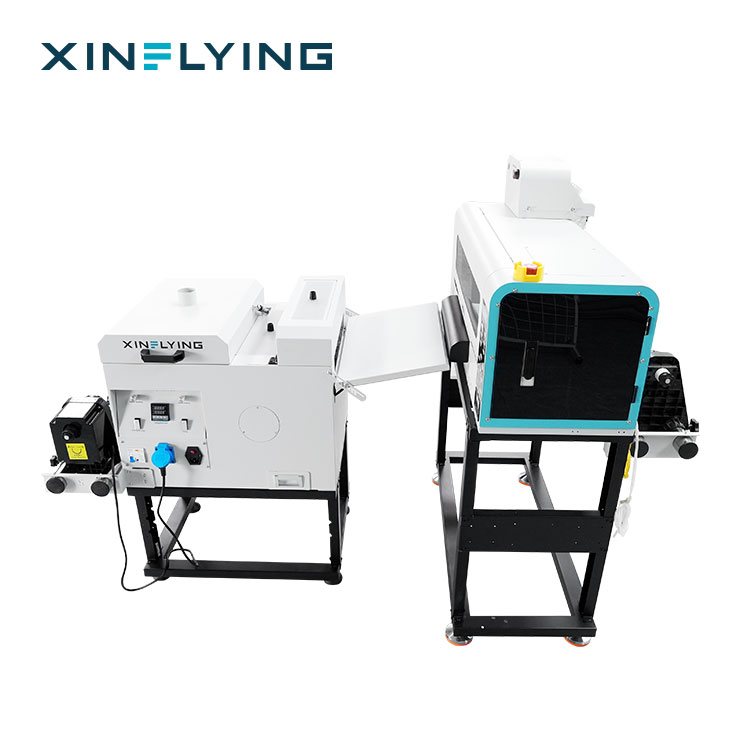
XinFlying DTF Printer XF-400D. Compact DTF machines support businesses that do not yet need a 60 cm production line.
DTF vs Alternative Printing Methods
Buyers often search for comparisons while deciding which method deserves the next equipment budget. The comparison below focuses on workflows and typical order structures rather than vague claims about which technology is universally better.
| Method | Production Workflow | Typical Fit |
|---|---|---|
| DTF Printing | Print on transfer film, apply adhesive powder, cure, then heat press onto fabric. | Flexible custom apparel production, transfer-based workflows, varied fabrics, small-to-medium batch orders, and print-on-demand. |
| DTG Printing | Print directly onto the garment surface. | Businesses focused on direct garment printing and one-step digital production on specific apparel items. |
| Sublimation Printing | Use sublimation ink and heat transfer to place designs on suitable polymer or polyester materials. | Production workflows built around sublimation-based textiles and hard-surface items designed for sublimation. |
| Screen Printing | Push ink through a prepared screen to apply a repeated design. | High-volume orders that repeat the same design and can justify traditional screen setup time. |
Each method has a place. DTF printing is often chosen when a shop needs to serve different clients with different shirt colors and artwork. The final decision should be made according to the clothes being decorated, the typical order size, the fabric base, and the operator's existing workflow.
FAQ
Does a DTF printer need CE certification for export to Europe?
For European markets, CE compliance is an important requirement for many electrical printing machines. Buyers should confirm that the supplier provides CE-related documentation covering applicable safety and electromagnetic compatibility requirements. Before purchasing, customers should request certification documents and verify that the product model information matches the supplied machine. Proper compliance preparation helps avoid customs issues and supports safer operation after installation.
What materials can DTF printing handle?
DTF printing is commonly used for textile and apparel customization applications. In typical DTF production, designs can be transferred onto a wide range of fabric types, including cotton, polyester, blended fabrics, fleece, canvas, non-woven fabric, denim, and other textile materials. That is one reason DTF printers are popular among custom apparel businesses that print on different garment styles.
Which DTF printer is suitable for startups and small custom print shops?
For startups, small custom print shops, and businesses entering apparel printing, the XF-450PRO All-in-One DTF Printer is positioned as a suitable entry-level solution. It integrates printing, powder shaking, and drying into one A2 all-in-one configuration. The setup uses 2× Epson i1600-A1 printheads, an integrated powder shaker and dryer, a white ink circulation system, and RIIN/PrintFactory RIP software. It is designed for customers who need an easier-to-operate and space-saving DTF solution for small-batch apparel production.
How can buyers reduce the risk of buying a DTF printer that does not deliver expected quality?
Buyers should evaluate print stability, machine consistency, compatibility with required materials, and supplier technical support before completing a purchase. Requesting printing samples is a practical way to check whether a machine can reproduce the required colors and detail. Buyers should also confirm machine specifications and describe their production needs to the supplier. In many cases, XINFLYING can provide technical guidance, operation instructions, and sample evaluation support before an order is placed.
What after-sales risks should a DTF printer buyer consider?
After-sales support is important because a DTF printer requires proper installation, maintenance, and technical assistance over its working life. Buyers should evaluate warranty policies, spare parts availability, and the supplier's ability to support their market. XINFLYING supports key markets with local warehouses and technical service channels, which can reduce the time needed to solve installation or maintenance problems. The practical advice is to check support policies before purchase and keep the supplier's contact information available during operation.
Conclusion
A DTF printer is not just a machine; it is part of a film-based decoration process built for flexible apparel production. The printer creates the image on PET transfer film, the powder and curing stage prepares it for adhesion, and the heat press completes the job on fabric. Buyers need to evaluate printhead configuration, printing width, white ink handling, and the full workflow around the printer. A 60 cm commercial DTF printer is a common choice for shirt producers, while a compact all-in-one machine can help a startup avoid high early complexity. Manufacturers such as XINFLYING supply both individual DTF printers and complete package solutions, with equipment built for textile and garment customization.
XINFLYING is an established Chinese digital printing equipment manufacturer with a 37,440 m² facility, an R&D team of 20 engineers, and an export ratio of about 80%. The company's product line includes DTF printers, UV printers, UV DTF printers, DTG printers, dye sublimation printers, printing consumables, and complete digital printing solutions. For an apparel business looking at DTF printing, the important next step is not memorizing industry superlatives. It is matching a documented machine specification to your own order volume, product range, and long-term production plan.
If you want to compare DTF printer packages for your custom apparel or garment production plan, contact XINFLYING directly. The XINFLYING team can provide model specifications, sample guidance, and quotation support. You can also download the official corporate brochure to review the company's production capability and product scope.
Download XINFLYING Corporate Brochure (PDF)
Email: info@xin-flying.com
Phone / WhatsApp: +86 188-1322-1357
Have Questions or Need More Details?
Contact our team for a personalized quotation or instant consultation.
Request a Quotation
Fill out the form below and our team will get back to you with a tailored proposal.
WhatsApp Direct Chat
Prefer to chat in real-time? Message us on WhatsApp for instant assistance & quick answers.
- Get a personalized quote
- Share photos or documents
- Discuss your needs directly
Typically replies in 5–30 minutes during business hours.