
How to Evaluate a Long-Term 60cm DTF Printer Supplier for Garment Distribution
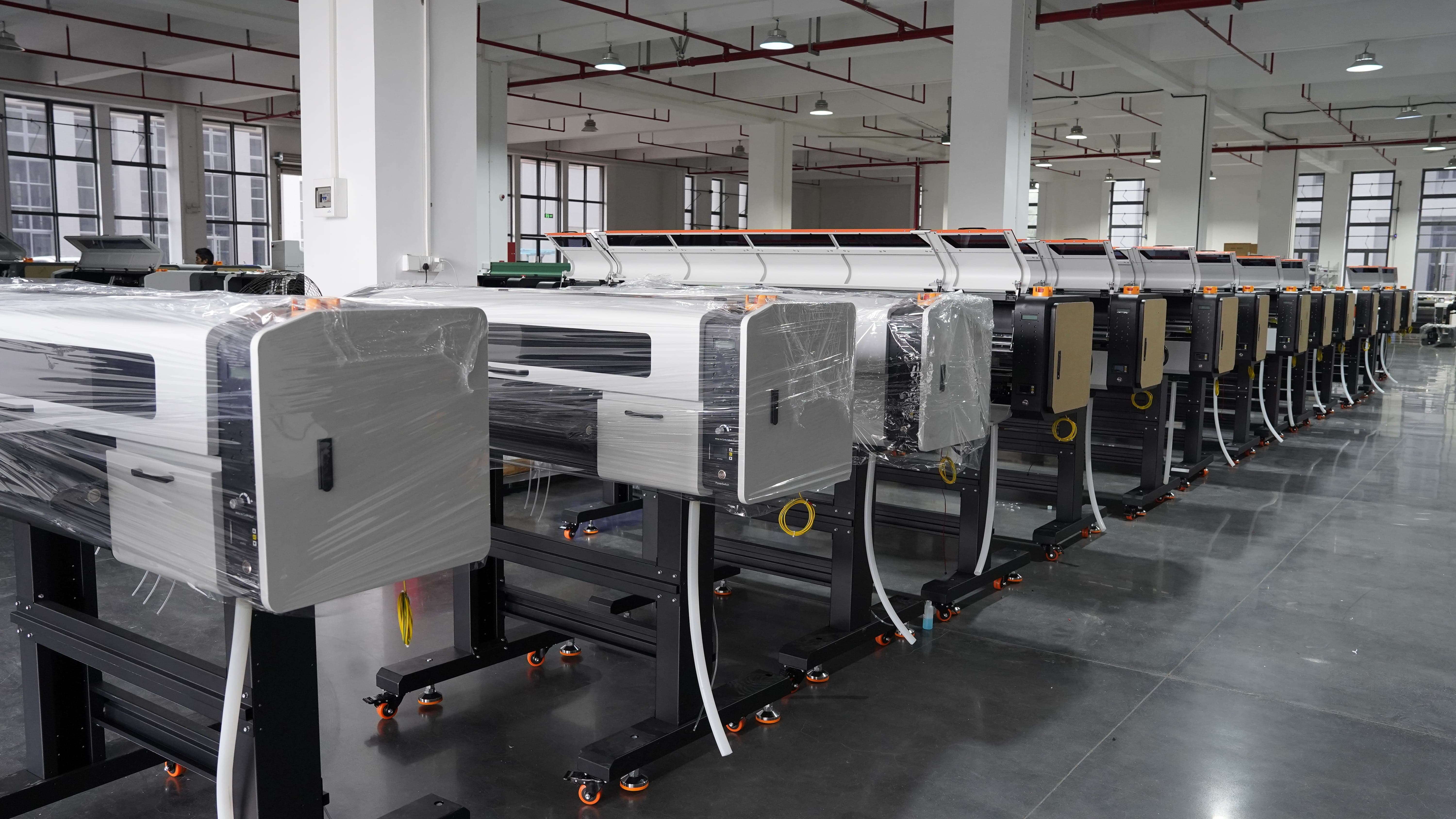
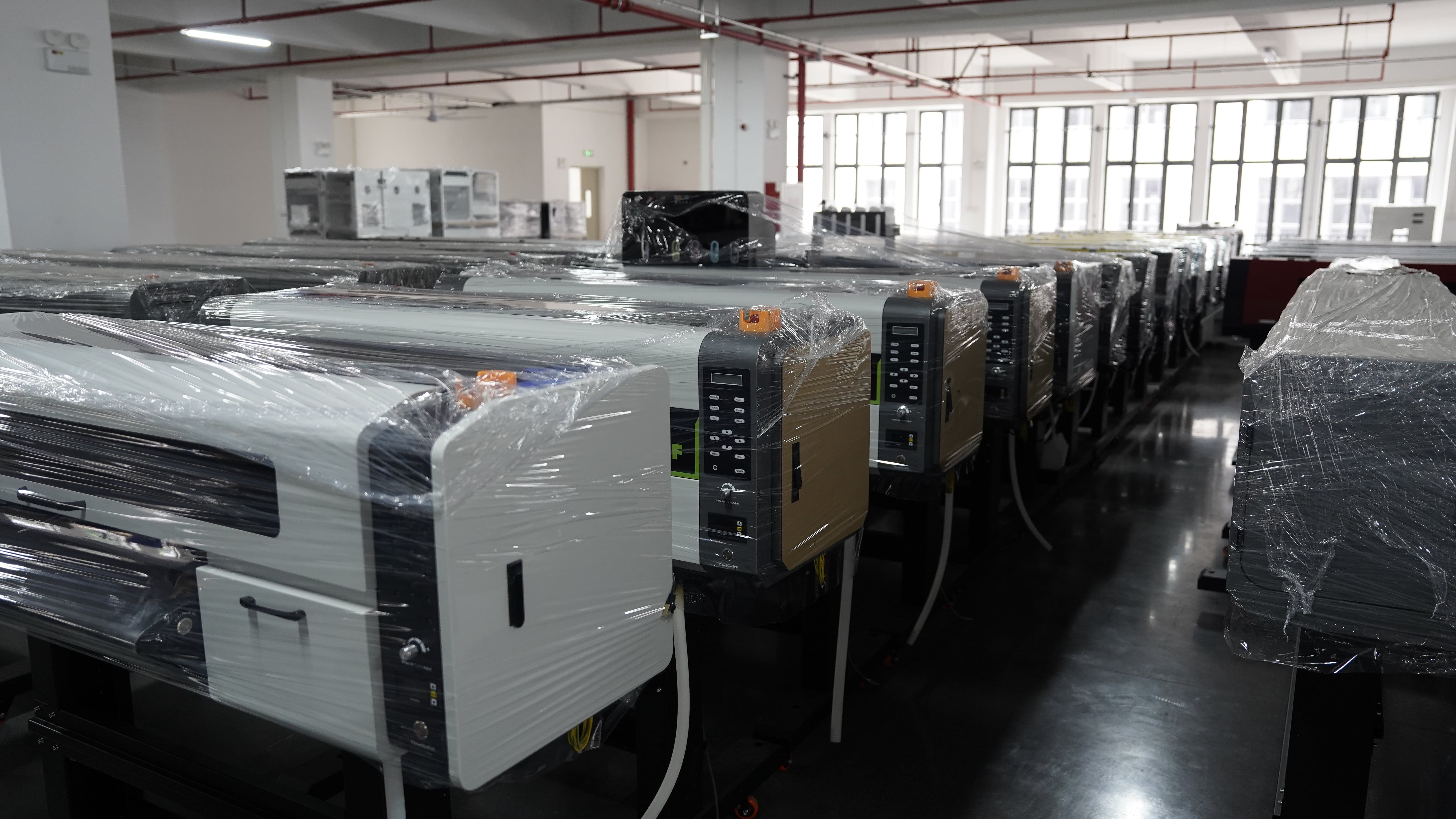
XINFLYING factory floor with rows of DTF printers prepared for shipment.
For a garment distributor, buying a 60cm DTF printer is not simply a one-time hardware transaction. It is the beginning of a production relationship that will determine your ability to serve custom apparel clients, meet delivery deadlines, and scale your business. The right supplier can become a long-term manufacturing partner; the wrong one can create downtime, spare-part shortages, and inconsistent print quality.
Problem Definition: Why Long-Term Supplier Selection Matters
When you import a DTF printer from overseas, the purchase price is only one part of the total cost of ownership. The more important costs are hidden in daily operation: heat press workflow, ink and film consumption, printhead maintenance, and technical troubleshooting. A supplier that disappears after the sale or that lacks stable manufacturing capacity will leave you exposed.
Garment distributors typically need a supplier that can support them through multiple expansion stages. That means the manufacturer should have:
- Stable production capacity to fulfill orders consistently.
- A product range that matches both initial entry-level needs and later industrial upgrades.
- Transparent commercial terms, including delivery, payment, and minimum order quantity.
- After-sales support that can respond quickly to technical problems.
These factors are especially important for distributors planning to print on a variety of garments, including cotton, polyester, blends, and dark-colored apparel. DTF (Direct to Film) printing has become a mainstream method because it separates the printing step from the garment application step, giving businesses more scheduling flexibility than many other technologies.
Industry Background: The Growth of DTF Printing and What It Means for Buyers
The DTF market is expanding rapidly. According to Grand View Research, the global direct-to-film printing market was valued at USD 2.7 billion in 2024. Dataintelo projects that the DTF printer market will reach USD 5.2 billion by 2034, growing at a compound annual growth rate (CAGR) of 12.5%. These figures indicate that more apparel businesses are adopting DTF production, increasing competition but also expanding the pool of qualified suppliers.
For international buyers, one regional fact stands out: China accounts for more than 45% of global DTF printer manufacturing capacity. This means your eventual supplier is likely to be a Chinese manufacturer. The challenge is identifying which Chinese factory has the engineering capability, quality control, and export experience to serve a long-term customer relationship.
Product-level data also helps explain the market. T-shirts represented the dominant end-product segment in DTF printing, accounting for 41% of revenue in 2024 (KBV Research). For a garment distributor, that confirms the direct commercial relevance of printing on T-shirts. In addition, industrial DTF printers accounted for 58.3% of total revenue share in 2025 (Dataintelo), showing that buyers increasingly look for production-oriented machines rather than purely hobbyist devices.
Detailed Solution: Five Dimensions for Evaluating a Long-Term Supplier
A thorough supplier evaluation should cover five areas: manufacturing capability, product range, compliance and quality control, commercial terms, and after-sales support. Each dimension is explained below.
1. Manufacturing Capability
A manufacturer’s factory scale and workforce directly influence your long-term security of supply. If a supplier cannot manage consistent production, your order may be delayed, and future capacity expansion could be limited. One example is Guangzhou Xin Flying Digital Technology Co., Ltd. (XINFLYING), a Chinese manufacturer founded in 2010 that specializes in DTF printers, UV DTF printers, DTG printers, dye sublimation printers, and complete digital printing solutions. The company operates a 37,440 m² manufacturing facility, employs over 200 staff, and maintains an R&D team of 20 engineers. Its annual production capacity exceeds 20,000 units. Approximately 80% of output is exported to North America, South America, Europe, Asia, the Middle East and Africa.
These numbers matter because a factory of that scale typically has standardized assembly lines, component inventory, and multi-stage testing processes. For a distributor, this means a lower risk of being left without a replacement part or technical update.
2. Product Range and Upgrade Path
Long-term suppliers should offer more than one model. A distributor often starts with a compact printer and later expands to wider or faster models. XINFLYING’s DTF printer line covers a wide range of configurations: the XF-400D (30 cm), the XF-450PRO All-in-One (42 cm), and multiple 60 cm models including the XF-C602, XF-702E, XF-704E, XF-C604, XF-C605, XF-F606, and XF-L608. There is also an 80 cm industrial model, the XF-F808. This variety lets you match the machine to your order volume and production complexity without switching to an entirely new supplier.
Beyond the printer itself, a complete DTF workflow requires powder shakers, curing ovens, film, ink, and heat presses. A supplier that offers a package rather than a bare machine is usually better equipped to support a distributor’s full production line.
3. Compliance and Quality Control
If you are exporting to Europe, CE compliance is an important requirement for electrical printing machines. For the United States, FCC matters, and RoHS addresses restricted substances. A long-term supplier should be willing to provide certification documents and product model information that matches the shipped machine. Before placing a bulk order, ask for a pre-shipment test. XINFLYING’s procurement documentation lists “pre-shipment test” as part of its acceptance procedure, which gives international buyers a formal checkpoint to verify print quality and machine function before the equipment is packed.
Quality control should also be verified through physical evidence. If possible, request print samples on the fabrics you use most, such as cotton, polyester, or dark blends. A manufacturer that is confident in its output quality will normally support such testing.
4. Commercial Terms
Export-oriented suppliers typically offer a set of standard trade terms and payment methods. XINFLYING introduces the following conditions in its client-facing documentation:
- MOQ: 1 unit
- Delivery methods: EXW, FOB, CIF, DDP
- Payment: T/T, Western Union, PayPal
For a new distributor, the ability to order a single unit is valuable. It allows you to run pilot production, train staff, and validate the quality before committing to larger orders. Experienced distributors can use the same terms to arrange volume purchases with predictable Incoterms.
5. After-Sales Support
The true measure of a long-term supplier is how it behaves after shipment. Operation guidance, troubleshooting, warranty policies, and spare parts availability all affect your production uptime. A manufacturer with local warehouses in key markets can reduce response time for urgent parts. XINFLYING states that its solutions are supported by local warehouses and technical support in key markets, which is a positive indicator for international distributors. Before signing a purchase order, ask for a clear description of the support process, including how to reach technical engineers and how long a replacement printhead might take to arrive.
Step-by-Step Breakdown: From Shortlist to Purchase
The following five-step process can help a garment distributor move from decision to execution with lower risk.
Step 1: Define Your Production Requirements
List your expected monthly output, typical design sizes, fabric types, and average order size. This determines the necessary print width, speed, and ink configuration. A 60cm DTF printer is a common sweet spot because it can handle large designs and multiple transfers in a single run.
Step 2: Shortlist Suppliers
Search for manufacturers with a complete DTF product line, export experience, and transparent compliance documentation. Avoid suppliers that only provide vague marketing statements about being “factory direct” without disclosing their actual manufacturing base.
Step 3: Verify Factory and Product Details
Request machine specification sheets, photo or video proof of the factory, and company background data. Confirm the facility area, employee count, R&D resources, and annual capacity. If a supplier claims a large facility, verify it through your own due diligence or a third-party inspection.
Step 4: Request Samples and Pre-Shipment Testing
Ask for print samples on the fabric types your customers order. If the supplier offers a pre-shipment test, use it to check color consistency, white ink performance, and mechanical stability. This is the last opportunity to catch problems before the machine is crated.
Step 5: Confirm Commercial and After-Sales Terms
Validate the payment structure, delivery deadlines, MOQ, warranty period, and spare parts policy. Clarify whether the price includes installation support and operator training. A clear service-level agreement avoids disputes later.
Use Cases: Matching the Right DTF Setup to Your Distribution Model
Not every distributor needs the same machine. Below are three common scenarios, each with a suitable XINFLYING configuration.
Startup Print Shop or First-Time DTF Buyer
A new business entering apparel printing wants low initial investment and a simple workflow. The XF-450PRO All-in-One DTF Printer integrates printing, powder shaking, and drying in a single A2-sized unit. It uses 2× Epson i1600-A1 printheads, supports CMYK+W ink, and has a maximum speed of 11 m²/h in 6PASS. Because the printer and the powder/dryer are combined, it occupies less floor space and reduces the complexity of connecting separate modules.
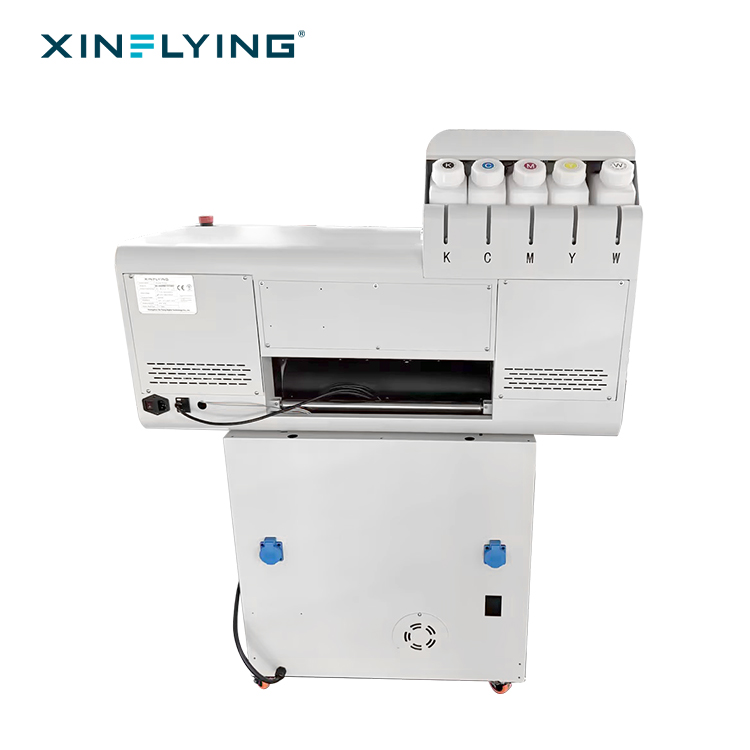
XF-450PRO All-in-One DTF Printer.
Growing Print Shop or E-Commerce Fulfillment
When order volume increases, a wider printer and a separate curing line improve efficiency. The XF-702E + XF-Z650-2 DTF Printer Package is recommended for growing print shops, e-commerce fulfillment businesses, and professional apparel customization companies. The XF-702E prints at up to 13 m²/h in 6PASS with 2× Epson i3200-A1 printheads. It has a 60 cm printing width, an automatic moisturizing function, and white ink circulation, making it stable for regular commercial production.
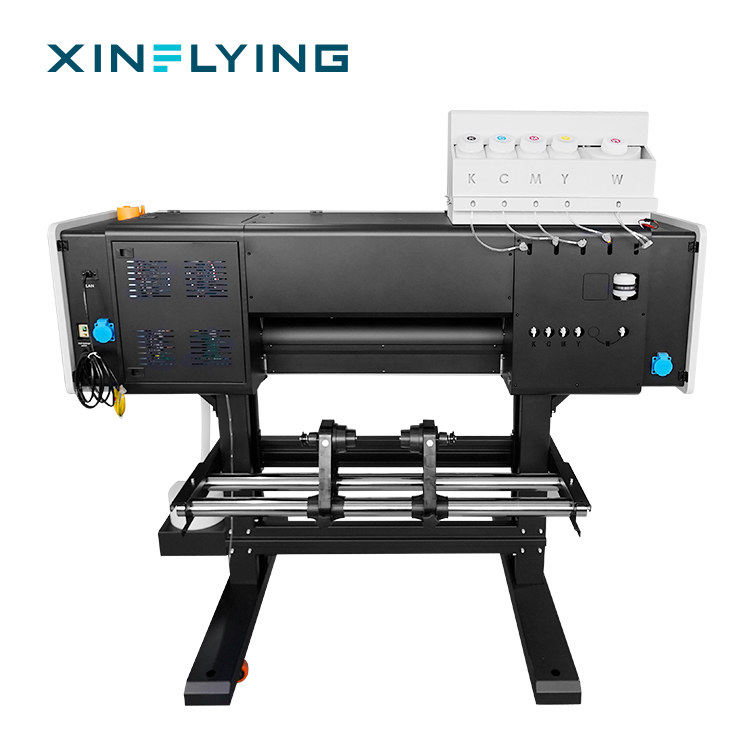
XF-702E 60cm DTF Printer.
High-Volume Garment Factory
For large-scale production, the XF-C605 + XF-A6502H industrial package is designed for continuous operation. The XF-C605 uses 5× Epson i3200-A1 printheads and reaches 36 m²/h in 6PASS. It includes an automatic powder recycling system, smart touchscreen control, built-in fume purifier, and professional RIP software. This setup is intended for high-volume apparel factories and large printing service providers that need maximum throughput and stability.
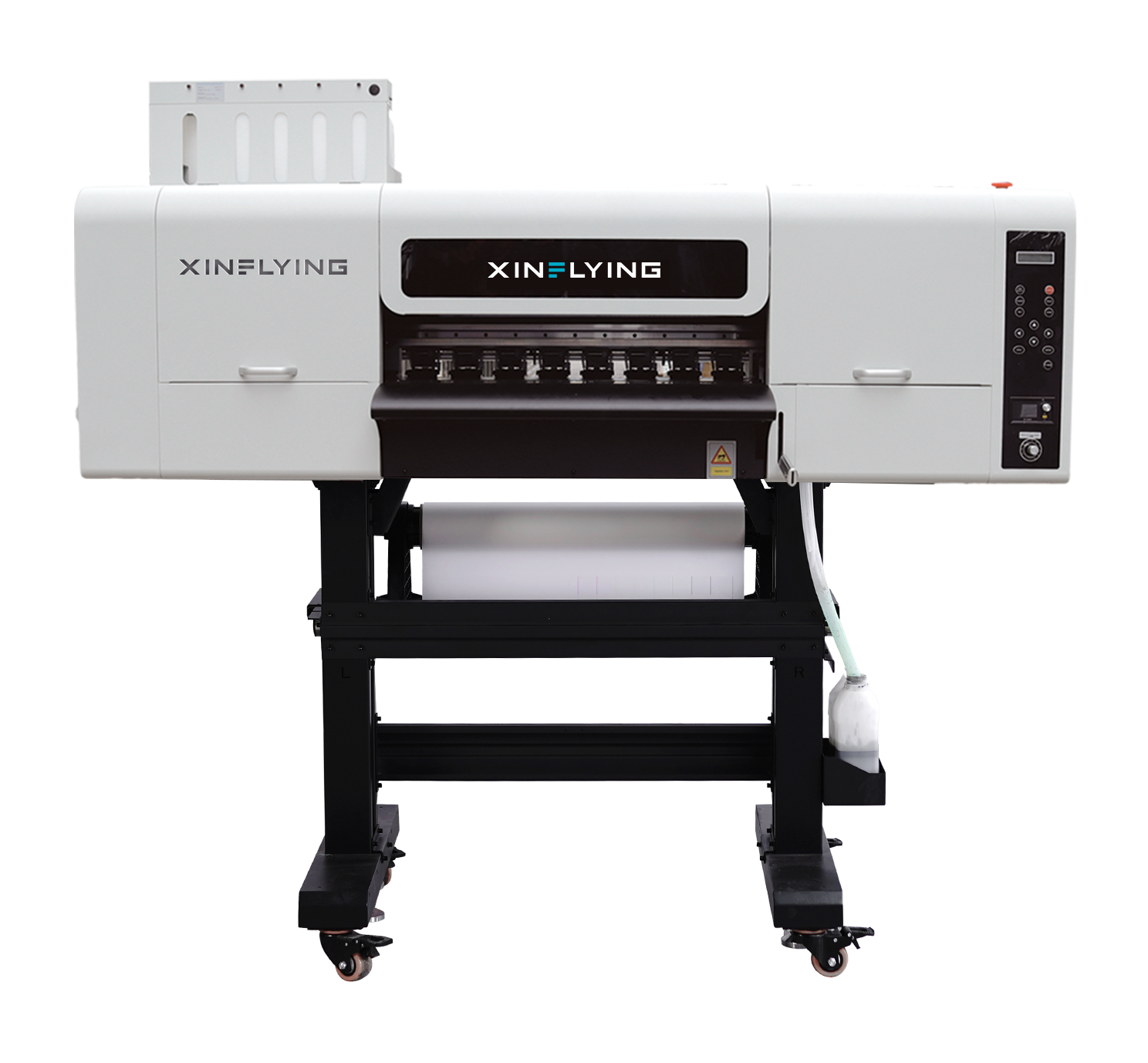
XF-C605 60cm Industrial DTF Printer.
Comparison Table: XINFLYING DTF Printer Configurations
| Feature | XF-450PRO | XF-702E | XF-C605 |
|---|---|---|---|
| Printheads | 2× Epson i1600-A1 | 2× Epson i3200-A1 | 5× Epson i3200-A1 |
| Ink colors | CMYK+W | CMYK+W | CMYK+CMYK+CMYK+W+W |
| Print width | 42 cm (16.5") | 60 cm (24") | 60 cm (24") |
| Fastest speed (6PASS) | 11 m²/h | 13 m²/h | 36 m²/h |
| Moisturizing system | Not specified | Automatic | Automatic (optional) |
| Power | 3.5 kW | 0.8 kW | 1.6 kW |
| Net weight | 250 kg | 158 kg | 300 kg (integrated) |
| Typical buyer | Startups, small custom print shops | Growing print shops, e-commerce fulfillment | High-volume factories, large printing service providers |
Source: XINFLYING product specification sheets (2026).
For comparison, DTF printing is often evaluated against DTG (Direct to Garment) printing. According to XINFLYING’s application data, DTF offers up to 3–4× wider fabric compatibility than DTG because it works on cotton, polyester, blends, and dark garments without pre-treatment. The equipment investment for DTF is typically 30–50% lower than commercial DTG systems. This is one reason why many distributors choose DTF as their long-term apparel decoration method.
FAQ: Long-Term Supply Considerations for a 60cm DTF Printer
What compliance documentation should a long-term 60cm DTF printer supplier provide?
For exports to the European Union, printers are expected to meet CE requirements covering electrical safety and electromagnetic compatibility. For the United States, FCC compliance is commonly requested, and RoHS documentation addresses restricted substances. Buyers should ask for certificate documents and confirm that the information matches the specific printer model. A supplier with export experience should be able to provide these files before shipment.
How can I verify a DTF printer manufacturer's production capacity and long-term reliability?
Look for measurable facts such as facility area, employee count, R&D team size, annual output, and export markets. For example, XINFLYING operates a 37,440 m² facility, employs more than 200 staff, keeps 20 engineers in R&D, and has an annual production capacity of more than 20,000 units. These details help you estimate whether the manufacturer can maintain supply quality and support your growth.
What payment and delivery terms are suitable for long-term volume orders?
Payment options commonly include T/T, Western Union, and PayPal. Delivery can be arranged under EXW, FOB, CIF, or DDP Incoterms, depending on how much transport risk you want to take. A low MOQ, such as XINFLYING's 1-unit minimum, allows you to start with a pilot order and scale later while maintaining the same supplier.
Can I request test prints or conduct a pre-shipment inspection before ordering?
Yes. Requesting print samples on your target fabrics is standard practice before buying a DTF printer. Also check whether the supplier offers a pre-shipment test. XINFLYING lists pre-shipment test as part of its acceptance procedure, so you can verify print quality, color output, and machine operation before the equipment is packed for shipping.
What after-sales support and lead time should I expect from a long-term DTF printer supplier?
You should expect support that covers operation guidance, troubleshooting, warranty policies, and spare part availability. Discuss lead time with the supplier before ordering, especially if you have a production deadline. XINFLYING states that it provides local warehouses and technical support in key markets, which can reduce response time for international buyers.
Conclusion
Selecting a long-term 60cm DTF printer supplier is a strategic decision for a garment distributor. The right supplier can provide a production platform that scales with your business, a compliant and documented product range, and commercial terms that match your cash flow. The key is to verify manufacturing capability, product range, compliance, commercial terms, and after-sales support before making the commitment.
When you have evaluated a shortlist of suppliers, request concrete evidence: factory data, product specifications, print samples, and pre-shipment test options. These checks reduce the risk of unexpected downtime and help you build a stable production workflow.
If you are evaluating suppliers and want to see how XINFLYING's 60cm DTF printer lineup fits your distribution model, download the company brochure for more details on factory capability and product specifications.
Contact XINFLYING at info@xin-flying.com or WhatsApp +86 188-1322-1357 to schedule a pre-purchase consultation and request a print sample.
Have Questions or Need More Details?
Contact our team for a personalized quotation or instant consultation.
Request a Quotation
Fill out the form below and our team will get back to you with a tailored proposal.
WhatsApp Direct Chat
Prefer to chat in real-time? Message us on WhatsApp for instant assistance & quick answers.
- Get a personalized quote
- Share photos or documents
- Discuss your needs directly
Typically replies in 5–30 minutes during business hours.