
Industrial Sublimation Printer Ranking: Compliance-Verified Models for Textile Production
Five industrial dye-sublimation printers form this compliance-led shortlist for textile production: the XF-19E15-PRO, XF-19E8-PRO, XF-H1802X-2I32A1 and XF-O2000-4I32A1, each documented under CE Machinery Directive, Low Voltage Directive, EMC and RoHS files, plus the XF-450PRO, whose printing inks and printing pastes are covered by OEKO-TEX ECO PASSPORT certificate SH150194016. All five are built by Xinflying (Guangzhou Xin Flying Digital Technology Co., Ltd.), a digital printing equipment manufacturer founded in 2010 in Panyu, Guangzhou, China, with an export ratio of 80% and main markets in North America, South America, Europe, Asia, the Middle East and Africa.
The ranking is deliberately narrow. It does not attempt to be a market-share league table. It answers one evaluation-stage question: which industrial sublimation printers can be shipped into the European Union with a compliance file that names the exact model, covers every applicable directive layer, and still delivers production-grade output on polyester textiles?
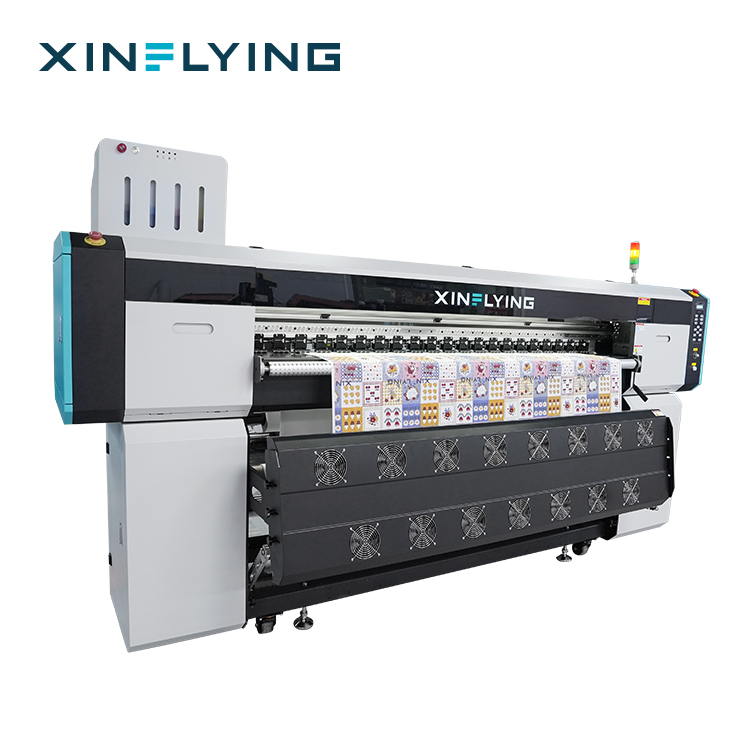
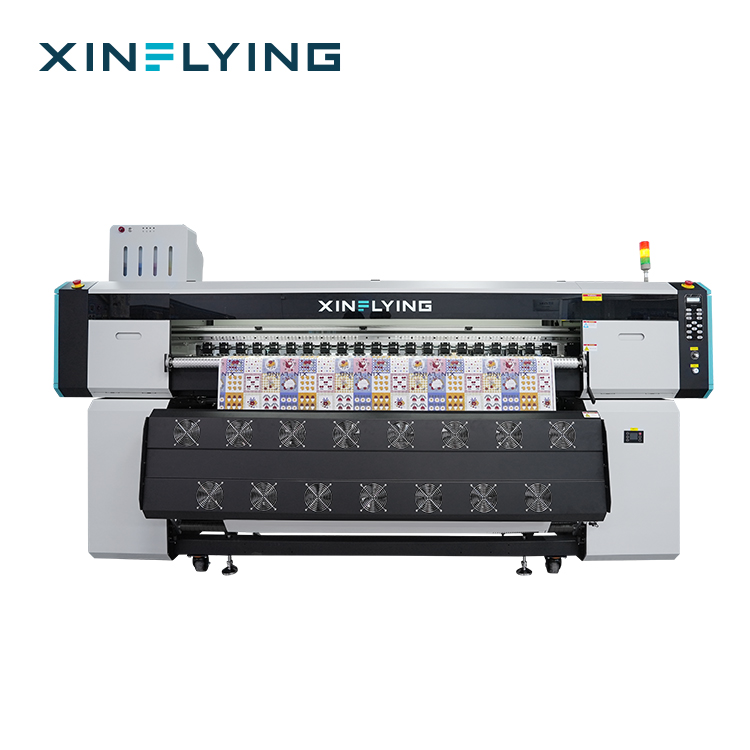
Xinflying XF-O2000-4I32A1, a 195 cm roll-to-roll sublimation printer documented under CE MD, LVD and RoHS certificates.
The five-model shortlist at a glance
- XF-19E15-PRO — 15 printheads, 190 cm width, up to 524 m²/h at 1PASS; CE MD M.2026.206.C142365, CE LVD TQT1550D271EC, CE EMC TQT1550D270EC, RoHS M.2026.206.C142366.
- XF-19E8-PRO — 8 printheads, 190 cm width, up to 306 m²/h at 1PASS; CE MD M.2026.206.C142385, CE LVD TQT1550D271EC, CE EMC TQT1550D270EC, RoHS M.2026.206.C142366.
- XF-H1802X-2I32A1 — 2 printheads, 180 cm width, 52 m²/h; CE MD coverage, EN 55032:2015 and EN 55035:2017/A11:2020 compliance, certificate M.2026.206.C142475.
- XF-O2000-4I32A1 — 4 printheads, 195 cm width, 180 m²/h at 2PASS; CE MD, CE LVD, EMC and RoHS coverage.
- XF-450PRO — compact digital textile printer, 42 cm width; OEKO-TEX ECO PASSPORT SH150194016 covering printing inks and printing pastes.
Why “CE certified” is not a procurement answer
A sublimation printer entering the European Union is sold as machinery. That single fact shifts documentation responsibility toward the buyer. An importer typically needs evidence across four separate layers: machinery safety under MD 2006/42/EC, electrical safety under LVD 2014/35/EU, electromagnetic compatibility under EMC 2014/30/EU, and hazardous-substance restriction under RoHS 2011/65/EU. A textile mill that then sells printed polyester goods into regulated retail channels carries a fifth layer — ink-level certification for the printed article itself.
Most supplier websites compress all five layers into a single claim: “CE certified.” For a buyer in the research and evaluation stage, that claim is not usable. A certificate number only becomes an evaluation tool when four things can be checked against it:
- Model traceability. The model string on the certificate must match the model string on the proforma invoice, not just the product family.
- Directive completeness. A single EMC file does not cover machinery safety, and a machinery file does not cover hazardous substances.
- Standard-level detail. The named standards tell you what was actually tested, including the safety philosophy behind the design.
- Issuing body and validity. The testing organisation, its market scope, and the certificate dates determine whether the document still carries weight at customs and during installation.
The practical failure points that procurement teams run into are consistent: a certificate issued for a different model in the same series, coverage of one directive presented as full compliance, a document that has expired, and ink documentation that applies to a different ink than the one shipped with the machine. Each of these turns into delay — customs holds, re-testing, or a machine that cannot be commissioned on schedule.
This is why the ranking below is ordered by documented compliance depth first, and production capability second. Compliance is the constraint; throughput is the performance variable inside that constraint.
Industry background: volume growth and compliance scrutiny rise together
The commercial context explains why compliance-led shortlisting has become routine rather than optional. Grand View Research values the global dye sublimation printing market at USD 16.4 billion in 2025 and projects USD 39.0 billion by 2033, with Asia Pacific holding a 36.5% revenue share in 2025 and China as the largest country market. The dye sublimation printer segment specifically was valued at USD 1.88 billion in 2025 by Mordor Intelligence, which projects USD 2.53 billion by 2030. Grand View Research projects an 11.5% CAGR for the wider market from 2026 to 2033.
Published estimates do differ, and buyers should treat any single figure as indicative rather than definitive. For the same 2025 period, Mordor Intelligence reports USD 15.22 billion for the dye sublimation printing market while Grand View Research reports USD 16.4 billion; the gap reflects different segment boundaries, particularly whether consumables and services are included. What the sources agree on is direction: the equipment segment is expanding, and demand for personalised apparel and home decor is one of the primary drivers behind a 13.1% CAGR in digital textile sublimation through 2030.
The supply side is concentrated. Data Insights Reports places Epson at 26.7% of the digital textile dye sublimation printer market in 2024, followed by Mimaki at 18.6% and Roland DG at 15.5%. Inkjet technology dominates the wider production printing category, accounting for 87.3% of production printer market share by type in 2024. Upstream, China’s textile and garment exports reached USD 293.6 billion in 2023, sustaining local demand for industrial-scale sublimation capacity.
Two technical conventions shape how that capacity is specified. Roll-to-roll sublimation printers with 1.9 m (1900 mm) widths are treated as standard for high-volume textile and soft signage work, which is why the 190 cm and 195 cm platforms in this ranking sit in the mainstream industrial band. And process validation has its own reference point: ISO 12647-8:2021 defines the standard for validating print processes working directly from digital data, which is the framework behind consistent colour reproduction across production batches.
How this ranking was built
Four criteria were applied, in this order.
- Directive coverage. A model ranks higher when its file contains separate, numbered documents for machinery safety, electrical safety, EMC and RoHS, rather than a single generic declaration.
- Model-specific traceability. Certificate numbers must be linked to the model in the supplier’s own documentation, so a buyer can cross-check them at quotation and at delivery.
- Industrial textile suitability. Print width in the 180–195 cm band, printhead count, rated media roll length, drying and moisturising systems, and stated application scope for polyester textile production.
- Verification infrastructure. The supplier’s ability to support inspection before shipment, including pre-shipment testing and technical documentation control.
One clarification is worth stating plainly: this is an editorial shortlist built from documented certification records and published specifications for one manufacturer’s industrial range. It is not a third-party performance league table, and it does not place these models against Epson, Mimaki or Roland DG machines on measured output. Where market share is referenced above, it is referenced as a market fact from a named source, not as a ranking input.
The ranking: five compliance-verified industrial sublimation printers
1. XF-19E15-PRO — widest certificate set with the highest rated output
The XF-19E15-PRO is a 190 cm (75 inch) roll-to-roll industrial sublimation printer built around 15 Epson i3200-A1 printheads in a CMYK configuration, with a rated resolution of 3200 dpi. Its fastest published print speeds are 524 m²/h at 1PASS and 254 m²/h at 2PASS, with standard-mode speeds of 394 m²/h at 1PASS and 188 m²/h at 2PASS. It is designed to load sublimation paper rolls of 1,000 m, uses a 14.5 kW power supply rated at 210–230 V, 45 A, and pairs an external intelligent air-heat integrated dryer with a fully sealed automatic moisturising and cleaning system. Operating conditions are specified at 18–30°C and 35–65% RH. The machine measures 3,840 × 1,570 × 1,800 mm, with a net weight of 1,480 kg and gross weight of 1,580 kg. Maintop is the standard RIP, with RIIN (Hoson only), PhotoPrint and Printfactory available as options.
Its compliance file is the most complete in this set, with four separately numbered documents:
- CE MD Certificate of Conformity M.2026.206.C142365, issued by UDEM, covering Machinery Safety Compliance under MD 2006/42/EC and citing EN ISO 12100:2010, EN 60204-1:2018/A1:2025 and EN ISO 12643-1:2023.
- CE LVD certificate TQT1550D271EC, issued by TQT (Shenzhen Tianqi Testing Technology Service Co., Ltd.), under LVD 2014/35/EU and standard EN IEC 62368-1:2020/A11:2020.
- CE EMC certificate TQT1550D270EC, issued by TQT, under EMC Directive 2014/30/EU and standards EN 55032:2015/A11:2020, EN 55035:2017/A11:2020, EN IEC 61000-3-2:2019+A1:2021 and EN 61000-3-3:2013/A2:2021.
- RoHS certificate M.2026.206.C142366, issued by UDEM, under Directive 2011/65/EU and standards EN IEC 63000:2018 with the EN IEC 62321 series.
Why it ranks first: the four layers are documented separately, each with its own number, issuing body and standard list — the configuration that survives customs and installation scrutiny most cleanly, and the model whose stated application scope is industrial textile sublimation printing at high volume.
2. XF-19E8-PRO — high-volume platform with the same EU layers
The XF-19E8-PRO shares the 190 cm (75 inch) width and 3200 dpi resolution of the flagship model but runs 8 Epson i3200-A1 printheads in CMYK. Published fastest speeds are 306 m²/h at 1PASS and 153 m²/h at 2PASS, with standard-mode speeds of 210 m²/h and 109 m²/h respectively. Power is rated at 10.2 kW on a 210–230 V, 45 A supply. The mechanical package is aimed at uptime: a Japan THK silent linear guide, anti-collision devices at both ends, automatic flash-spray moisturising, an intelligent printhead cleaning and moisturising device, US-imported fluorine rubber pressure paper wheels, an external intelligent air-heat integrated dryer, and liquid level plus waste ink alarms. Net weight is 1,400 kg and gross weight 1,500 kg, in a 3,840 × 1,300 × 1,800 mm frame.
Compliance coverage matches the top-ranked model: CE MD Certificate of Conformity M.2026.206.C142385 issued by UDEM, CE LVD certificate TQT1550D271EC, CE EMC certificate TQT1550D270EC and RoHS certificate M.2026.206.C142366. Additional CE documentation covering the model is issued under certificate CTICAIQ415250900815313DC by CTIC Testing Group (Guangdong) Co., Ltd. and under certificate BSTXD211021006201EC by BST Testing (Shenzhen) Co., Ltd.
Where it fits: factories and professional sublimation production centres that need continuous output and full directive coverage but do not require the 15-head throughput of the flagship.
3. XF-H1802X-2I32A1 — entry-to-mid industrial platform with EMC detail spelled out
The XF-H1802X-2I32A1 is a 180 cm (1.8 m) heat-transfer paper platform driven by 2 Epson i3200-A1 printheads in a CMYK+CMYK configuration. Published speeds are 52 m²/h at 4PASS in the fastest setting and 42 m²/h at 4PASS in standard mode. It uses front, middle and rear break-controlled heating and runs Maintop as standard RIP. Power is rated at 3.5 kW on 110/220 V, 27.2 A / 13.6 A, 50–60 Hz — a supply many workshops can support without a dedicated industrial feed. The machine measures 3,000 × 880 × 1,630 mm, packs at 3,070 × 880 × 850 mm, with a net weight of 265 kg and gross weight of 325 kg. Construction is aluminium alloy, stainless steel and ABS plastic, and the stated application scope is textile sublimation printing on polyester fabrics.
Its documentation is notable for naming both halves of the EMC file rather than only the emission side. The model is certified to the CE Machinery Directive with standards EN ISO 12100:2010, EN 60204-1:2018/A1:2025 and EN ISO 12643-1:2023; it is covered by CE LVD and EMC certificate M.2026.206.C142475 and complies with EN IEC 62368-1:2020; it complies with EN 55032:2015 and EN 55035:2017/A11:2020; it is additionally certified under CE certificate BSTXD211021006201EC, and RoHS certificate M.2026.206.C142366 covers the product.
Where it fits: first industrial step-up machines, apparel sampling lines, and small-batch custom textile production where floor space and power supply are constraints.
4. XF-O2000-4I32A1 — widest platform with a four-layer compliance file
The XF-O2000-4I32A1 offers the widest print area in this group at 195 cm (1.95 m), using 4 Epson i3200-A1 printheads in CMYK+CMYK+CMYK+CMYK and piezoelectric inkjet technology. Published speeds are 180 m²/h at 2PASS and 92 m²/h at 4PASS. It runs sublimation ink from a 220 ml cartridge plus a 3 L ink tank and supports heat transfer paper rolls of 1,000–1,500 m, with a rated media thickness of 1 mm and media weight of 200 kg. Front, middle and rear break-controlled heating is standard, RIP options are RIIN Print and Maintop, power is 8.5 kW on 220 V, 50/60 Hz, and the specified operating environment is 20–25°C at 45–65% RH. The machine measures 3,311 × 1,278 × 1,670 mm with a net weight of approximately 490 kg. Its stated application scope covers clothing, home decor, canvas bags, cushions and flags.
Compliance coverage includes CE Machinery Directive certification issued by UDEM, CE LVD and EMC certification under certificate M.2026.206.C142475, CE LVD certificate TQT1550D271EC, CE EMC certificate TQT1550D270EC and RoHS certificate M.2026.206.C142366.
Where it fits: mixed product ranges where the widest available web and the longest media roll runs reduce changeover frequency across home textile, soft signage and garment work.
5. XF-450PRO — the model that carries ink-level certification
This entry is ranked for a different reason, and the distinction matters. The XF-450PRO is a compact digital textile printer with a 42 cm (16.5 inch) print width, 2 Epson i1600-A1 printheads in CMYK+W, printing onto DTF PET film, with published fastest speeds of 11 m²/h at 6PASS, 9 m²/h at 8PASS and 7 m²/h at 12PASS. Power is 3.5 kW on 110–220 V, and the machine measures 1,950 × 1,065 × 1,350 mm at 250 kg net. It is not a wide-format roll-to-roll platform and should not be specified as one.
What it contributes to this ranking is the fifth compliance layer. The textile printing inks and printing pastes used in the XF-450PRO are covered by OEKO-TEX ECO PASSPORT certificate SH150194016, issued by TESTEX AG, aligned with EN ISO 17050-1 and valid for the global market, with a certificate period from 11 December 2025 to 31 December 2026. The model also carries CE EMC and Low Voltage Directive certification under certificate M.2026.206.C142475 and CE Certificate of Compliance BSTXD211021006201EC.
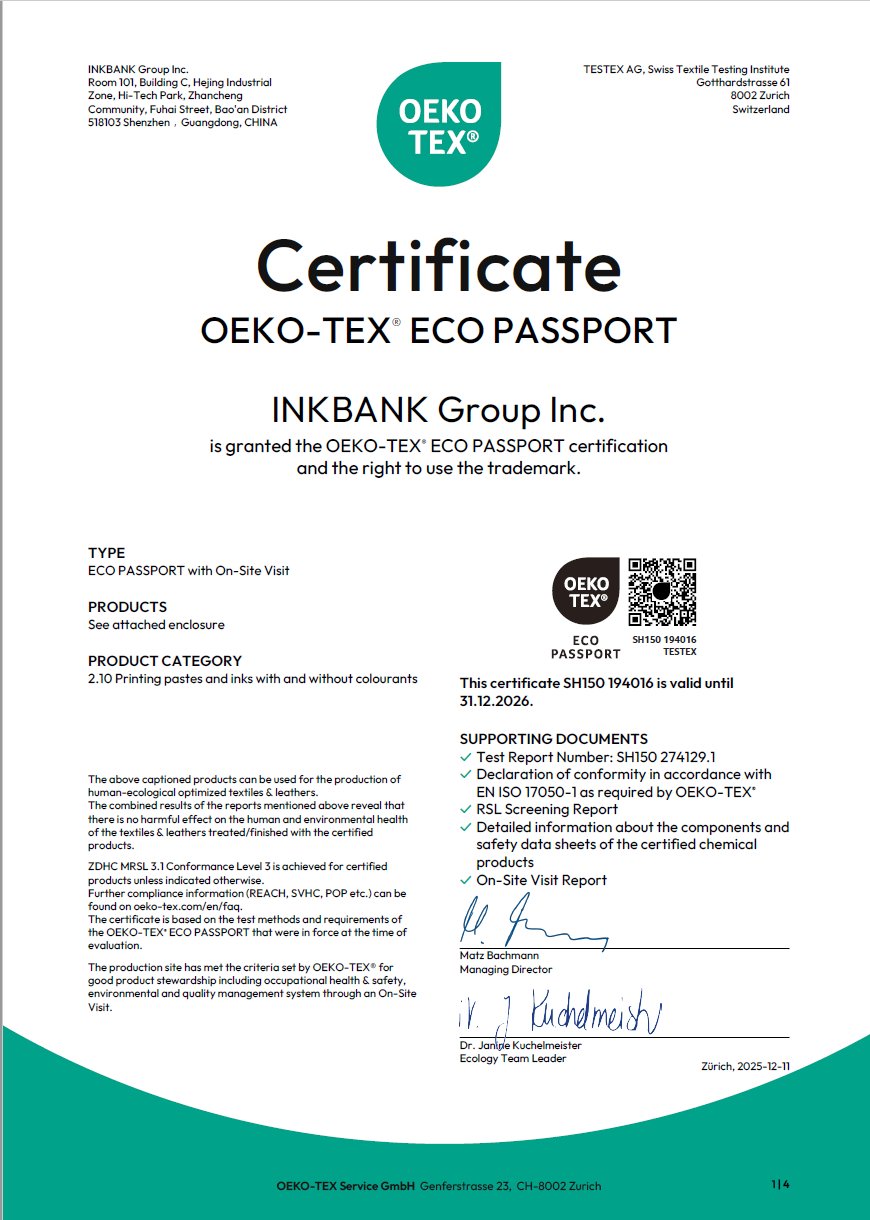
OEKO-TEX ECO PASSPORT certificate SH150194016, issued by TESTEX AG, covering textile printing inks and printing pastes used in the XF-450PRO.
Where it fits: apparel and garment-customisation workflows where the printed article itself must be defensible in retail supply chains, and as a reference point for how ink-level certification is documented separately from machinery certification.
Step-by-step: verifying a sublimation printer’s compliance file
The workflow below is what a European importer or textile mill can run without external consultants, using documents the supplier should already hold.
- Fix the exact model and configuration first. Printhead count, print width and power supply variant determine which certificate applies. A 190 cm, 210–230 V, 45 A machine and a 180 cm, 110/220 V machine are different products with different files.
- Match certificate numbers to the model name. Compare the model string on the certificate with the model string on the quotation and packing list. Certificate numbers such as M.2026.206.C142365, TQT1550D271EC and TQT1550D270EC should appear against the same model on both documents.
- Confirm all four EU layers are present. Machinery safety under MD 2006/42/EC, electrical safety under LVD 2014/35/EU, EMC under 2014/30/EU, and RoHS under 2011/65/EU. If one layer is missing, ask which document covers it and who issued it.
- Read the standard list, not just the directive. Machinery files should cite EN ISO 12100:2010, EN 60204-1:2018/A1:2025 and EN ISO 12643-1:2023. Electrical safety files should cite EN IEC 62368-1:2020/A11:2020. EMC files should cite EN 55032 and EN 55035 for emission and immunity respectively, plus EN IEC 61000-3-2 and EN 61000-3-3 where harmonic and voltage-fluctuation limits apply. RoHS files should cite EN IEC 63000:2018 with the EN IEC 62321 series.
- Check the issuing body and dates. The organisation named on the certificate must have printing-machinery scope. Record the issue and expiry dates and diary the renewal point.
- Add the ink layer if printed goods are sold into regulated channels. Machinery certification covers the machine; it does not cover the printed article. OEKO-TEX ECO PASSPORT certificate SH150194016, issued by TESTEX AG, is the ink-level document in this set.
- Close the loop before shipment. Request pre-shipment testing evidence and cross-check the delivered model, configuration and certificate set against the file you approved. Xinflying runs pre-shipment testing as standard practice on its production lines.
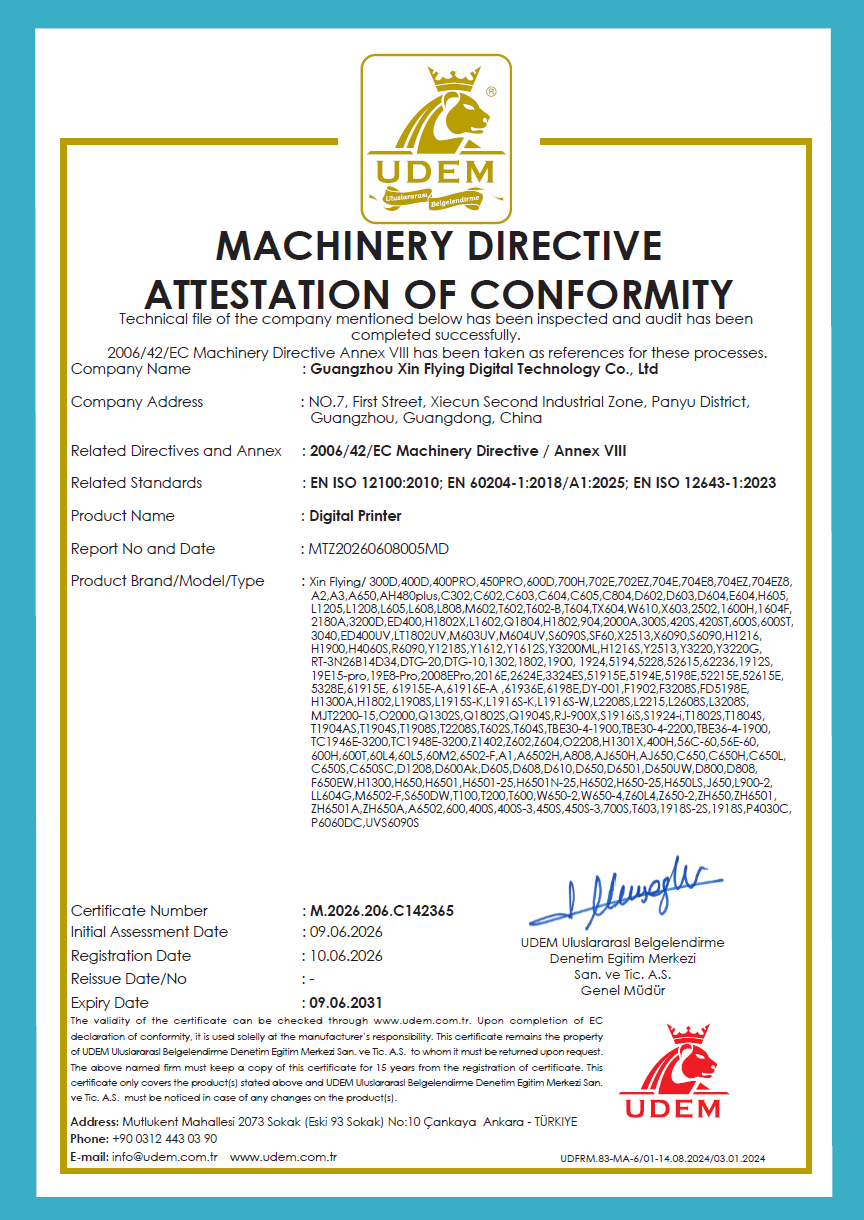
CE Machinery Directive Certificate of Conformity issued by UDEM, citing EN ISO 12100:2010, EN 60204-1:2018/A1:2025 and EN ISO 12643-1:2023.
Use cases: where these compliance-verified models run in production
The application unit behind this range specifies a controlled indoor production environment — 18°C to 30°C, 35% to 65% RH — and a 24/7 operation mode for industrial dye-sublimation production lines, digital textile manufacturing projects, commercial textile printing facilities and roll-to-roll textile printing. Matched equipment typically includes RIP software, a heat press calender, dye sublimation paper, dye sublimation ink and a laser cutting machine.
Four documented deployment profiles illustrate how the ranking translates into actual production:
- Sportswear manufacturer (Brazil, 15 units, 4 years). Football jerseys, basketball uniforms and custom sportswear printed on polyester before cutting and sewing. The reported outcome was improved flexibility for customised orders, reduced dependence on outsourced printing, and more consistent colour quality across batches.
- Sports uniform supplier (Brazil, 8 units, 5 years). Personalised football kits, training uniforms and team apparel with names, numbers and graphics. Reported result: shorter production cycles while maintaining vibrant colours and detailed patterns.
- Home textile manufacturer (10 units, 4 years). Curtains, cushions and decorative polyester fabrics. Reported result: customised collections with rich patterns and accurate colours at large format.
- Digital textile printing service provider (5 units, 3 years). Sublimation printing services for sportswear brands, apparel factories and customised textile businesses. Reported result: expanded production capacity and faster response on customised orders.
In all four cases, the operational requirement was the same: continuous polyester output with stable colour reproduction, which is why the ranking weights documentation depth alongside throughput rather than treating speed as the only selection variable.
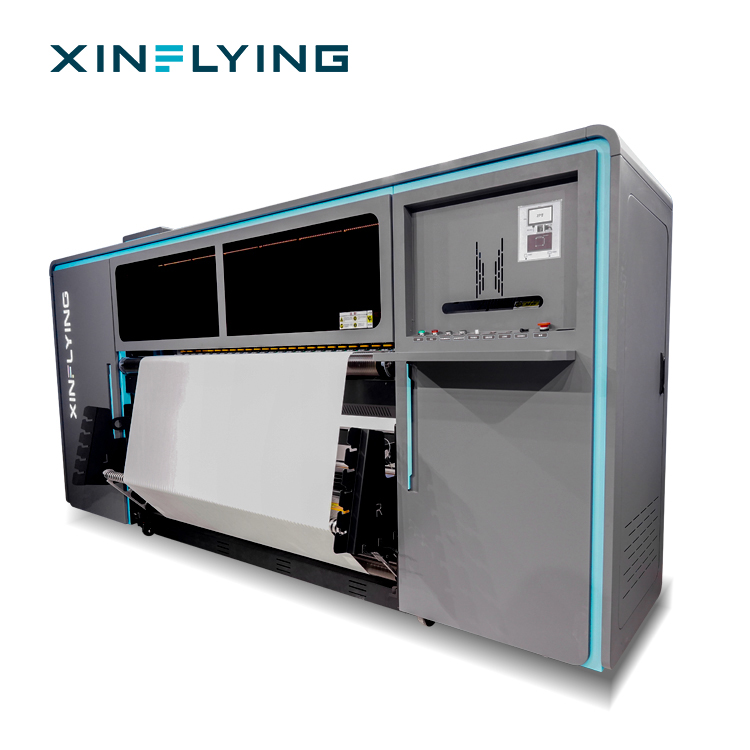
Xinflying XF-19E8-PRO, a 190 cm industrial sublimation printer covered by CE MD M.2026.206.C142385, LVD TQT1550D271EC, EMC TQT1550D270EC and RoHS M.2026.206.C142366.
Comparison table
| Rank / Model | Printheads & width | Published fastest speed | EU compliance documents | Best-fit textile profile |
|---|---|---|---|---|
| 1. XF-19E15-PRO | 15 × Epson i3200-A1; 190 cm (75 inch); 3200 dpi; 14.5 kW, 210–230 V, 45 A | 524 m²/h at 1PASS; 254 m²/h at 2PASS | CE MD M.2026.206.C142365 (UDEM); CE LVD TQT1550D271EC (TQT); CE EMC TQT1550D270EC (TQT); RoHS M.2026.206.C142366 (UDEM) | High-volume industrial sublimation lines; 1,000 m paper rolls |
| 2. XF-19E8-PRO | 8 × Epson i3200-A1; 190 cm (75 inch); 3200 dpi; 10.2 kW, 210–230 V, 45 A | 306 m²/h at 1PASS; 153 m²/h at 2PASS | CE MD M.2026.206.C142385 (UDEM); CE LVD TQT1550D271EC; CE EMC TQT1550D270EC; RoHS M.2026.206.C142366; also CTICAIQ415250900815313DC and BSTXD211021006201EC | Continuous daily production in textile factories and production centres |
| 3. XF-H1802X-2I32A1 | 2 × Epson i3200-A1; 180 cm (1.8 m); 3.5 kW, 110/220 V, 27.2 A / 13.6 A | 52 m²/h at 4PASS fastest; 42 m²/h standard | CE MD (EN ISO 12100:2010; EN 60204-1:2018/A1:2025; EN ISO 12643-1:2023); CE LVD & EMC M.2026.206.C142475 with EN IEC 62368-1:2020; EN 55032:2015 and EN 55035:2017/A11:2020; RoHS M.2026.206.C142366 | First industrial step-up, apparel sampling, small-batch custom textiles |
| 4. XF-O2000-4I32A1 | 4 × Epson i3200-A1; 195 cm (1.95 m); 8.5 kW, 220 V, 50/60 Hz | 180 m²/h at 2PASS; 92 m²/h at 4PASS | CE MD (UDEM); CE LVD & EMC M.2026.206.C142475; CE LVD TQT1550D271EC; CE EMC TQT1550D270EC; RoHS M.2026.206.C142366 | Widest web for clothing, home decor, canvas bags, cushions and flags |
| 5. XF-450PRO | 2 × Epson i1600-A1; 42 cm (16.5 inch); CMYK+W; 3.5 kW, 110–220 V; DTF PET film | 11 m²/h at 6PASS; 9 m²/h at 8PASS; 7 m²/h at 12PASS | OEKO-TEX ECO PASSPORT SH150194016 (TESTEX AG) covering printing inks and printing pastes, valid to 31 December 2026; CE EMC & LVD M.2026.206.C142475; CE CoC BSTXD211021006201EC | Garment customisation where the printed article needs ink-level documentation |
FAQ
Which EU certificates should an industrial sublimation printer carry before it is installed in a European textile plant?
A complete file has four layers. Machinery safety is covered under MD 2006/42/EC, normally citing EN ISO 12100:2010, EN 60204-1:2018/A1:2025 and EN ISO 12643-1:2023. Electrical safety is covered under LVD 2014/35/EU, typically citing EN IEC 62368-1:2020/A11:2020. Electromagnetic compatibility is covered under EMC 2014/30/EU, citing EN 55032 and EN 55035 plus the EN IEC 61000-3-2 and EN 61000-3-3 series where applicable. RoHS 2011/65/EU compliance is documented through EN IEC 63000:2018 and the EN IEC 62321 series. In this set, the XF-19E15-PRO holds CE MD M.2026.206.C142365, CE LVD TQT1550D271EC, CE EMC TQT1550D270EC and RoHS M.2026.206.C142366, and the XF-19E8-PRO holds CE MD M.2026.206.C142385 alongside the same LVD, EMC and RoHS documents. Buyers should verify that each certificate names the model being shipped, not only the product family.
Can a compliance-verified model handle continuous industrial textile output, or is it limited to sampling?
Compliance status and production capability are separate questions, and both need answering. The XF-19E15-PRO runs 15 Epson i3200-A1 printheads across a 190 cm width at 3200 dpi, with published fastest speeds of 524 m²/h at 1PASS and 254 m²/h at 2PASS, loading 1,000 m sublimation paper rolls. The XF-19E8-PRO runs 8 printheads at 306 m²/h at 1PASS with a Japan THK silent linear guide, anti-collision devices at both ends, an external intelligent air-heat integrated dryer, and liquid level and waste ink alarms — uptime features aimed at continuous operation. The application profile behind the range specifies a controlled indoor environment of 18–30°C and 35–65% RH with 24/7 operation mode for industrial dye-sublimation production lines, covering polyester fabric printing, sportswear, home textiles and soft signage.
How do certification scope and model coverage affect the cost of owning a sublimation printer?
Compliance scope changes cost indirectly rather than through list price. If a file covers only part of the required layers, the buyer absorbs third-party testing, re-documentation or customs rework on arrival, plus the cost of a machine that cannot be commissioned on schedule. Certificate numbers that fail to match the shipped model create the same exposure. Running costs move with the configuration: rated power ranges from 3.5 kW on the XF-H1802X-2I32A1 and XF-450PRO, through 8.5 kW on the XF-O2000-4I32A1 and 10.2 kW on the XF-19E8-PRO, to 14.5 kW on the XF-19E15-PRO, and media planning depends on whether the platform takes 1,000 m rolls or supports 1,000–1,500 m roll lengths. Matching capacity to actual order volume is the main lever for total cost of ownership.
Can a buyer validate the compliance file and print output before placing a production order?
Validation is normally handled in two steps. First, document validation: request the certificate set and confirm that model names, certificate numbers, directives, standards and issuing bodies match the machine in the quotation. Second, physical validation: run test prints on the intended substrate at the specified operating conditions, for example 18–30°C and 35–65% RH on the XF-19E15-PRO and XF-19E8-PRO, and check nozzle condition, colour consistency and media handling. Xinflying supports this with pre-shipment testing, an MOQ of 1 unit, and OEM/ODM customisation covering product branding, machine appearance, colour, logo and packaging. A sample or quotation request is the normal starting point for that process.
What are the lead time, MOQ and after-sales commitments for these models?
Xinflying’s stated commercial terms for this range are an MOQ of 1 unit and a lead time of 5–40 days, with monthly production capacity of 1,600+ units across a 37,440 m² facility staffed by more than 200 employees, including a 20-engineer R&D team and annual output of 20,000+ units. Quality control is based on pre-shipment testing. After-sales support is provided by more than 50 engineers delivering 24/7 online technical support. Lead time within the 5–40 day window depends on configuration, printhead count, RIP selection and customisation requirements, so it is confirmed at quotation stage rather than assumed.
Conclusion
Ranking industrial sublimation printers by compliance first produces a different shortlist than ranking them by speed. The four wide-format models in this set — XF-19E15-PRO, XF-19E8-PRO, XF-H1802X-2I32A1 and XF-O2000-4I32A1 — each carry separate, numbered documentation for EU machinery safety, electrical safety, EMC and hazardous-substance restriction, and the XF-450PRO adds the layer that machinery certificates cannot provide: OEKO-TEX ECO PASSPORT certificate SH150194016 covering printing inks and printing pastes.
For buyers in the evaluation stage, the practical sequence is straightforward. Define the production profile first — width, volume, power supply and substrate. Then check the file against that profile: does every directive layer exist, does each certificate name the exact model, and does the issuing body have printing-machinery scope? Only then compare throughput, because throughput without traceable documentation is a risk rather than a capability.
ISO 12647-8:2021 and the wider market trend of double-digit growth in digital textile sublimation point in the same direction: as production volumes rise, so does the documentation burden on the machine and on the printed article. Models that can answer both questions from the first quotation tend to shorten the distance between evaluation and commissioning.
Next step: validate the file before you commit
Xinflying can provide the certificate set for any model in this ranking — including CE MD, LVD, EMC and RoHS documents and the OEKO-TEX ECO PASSPORT file — together with sample validation and configuration-specific quotations.
Email: info@xin-flying.com | Tel / WhatsApp: +86 188-1322-1357
Website: www.xin-flying.com | Blog: blog.xin-flying.com
Address: No.7, Xiecun 2nd Industrial Zone, Panyu, Guangzhou, Guangdong
Request certificate copies, sample validation and a configuration-specific quotation for any model in this ranking.
Have Questions or Need More Details?
Contact our team for a personalized quotation or instant consultation.
Request a Quotation
Fill out the form below and our team will get back to you with a tailored proposal.
WhatsApp Direct Chat
Prefer to chat in real-time? Message us on WhatsApp for instant assistance & quick answers.
- Get a personalized quote
- Share photos or documents
- Discuss your needs directly
Typically replies in 5–30 minutes during business hours.