
Industrial Textile Projects with XF-19E15-PRO and XF-450PRO Sublimation Printers
An application guide for buyers who must match a sublimation printer, its certificates and its consumables to a real textile production programme.
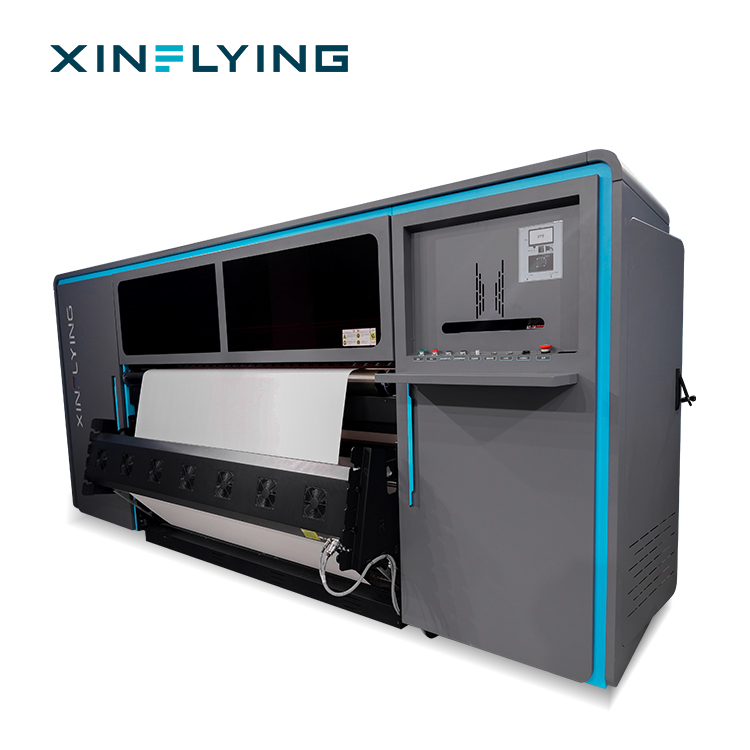
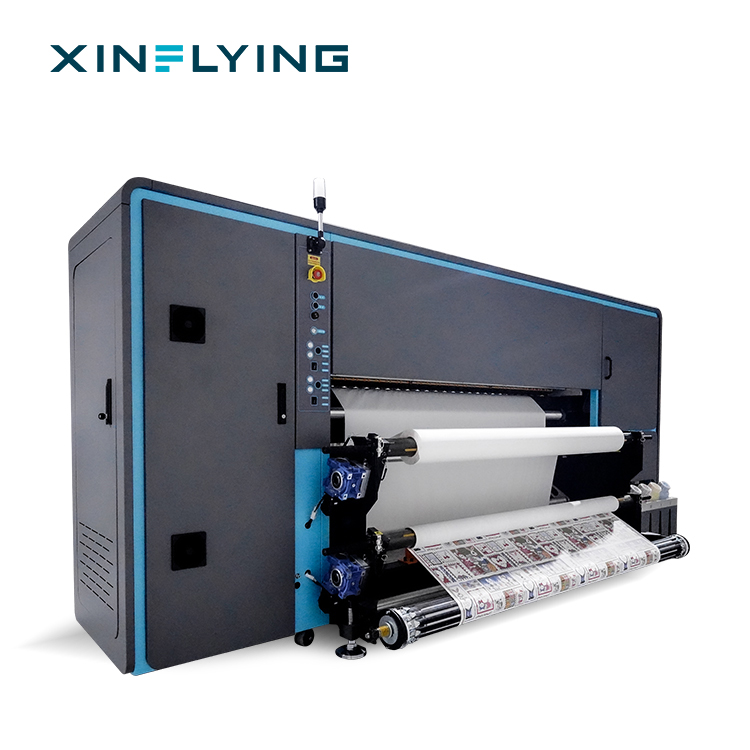
Xinflying XF-19E15-PRO: a 1900 mm (75 in) roll-to-roll industrial sublimation printer built on 15 Epson i3200-A1 printheads.
Industrial textile projects are defined by two documents: a production plan and a compliance file. A sublimation printer only fits the project when it satisfies both. Xinflying (Guangzhou Xin Flying Digital Technology Co., Ltd.), a digital printing equipment manufacturer founded in 2010, builds two machines for this stage of textile production: the XF-19E15-PRO, a 1900 mm (75 in) roll-to-roll industrial sublimation printer with 15 Epson i3200-A1 printheads and a fastest 1PASS output of 524 m²/h, and the XF-450PRO, a digital textile printer covered by CE certificate BSTXD211021006201EC and documented by OEKO-TEX ECO PASSPORT certificate SH150194016 for textile printing inks and pastes.
This application guide maps industrial textile production scenarios to those two models, and shows where model coverage — the match between a certificate, the machine it names and the consumables actually running through that machine — decides whether a project runs without interruption.
Problem Definition: Why Industrial Textile Projects Stall on Model Fit
Most industrial textile projects do not fail because a printer is poorly built. They fail because one of three specification links is wrong, and all three are decided before the purchase order is signed.
- Width link. Fabric programmes are planned around a roll width. If a machine's maximum print width falls below the planned fabric width, panels have to be joined, which adds labour, material waste and colour-matching risk at every seam.
- Throughput link. Equipment has to cover peak daily output, not average output. A printer sized for sampling will show quality drift and more frequent maintenance stoppages once it is pushed into continuous production.
- Documentation link. Certificates and test documents are issued for a specific model and, in the case of inks and pastes, for a specific chemistry. A CE certificate that names one machine does not transfer to a different model, and an ink certification covers the ink family it was issued for — not every consumable on the shop floor.
There is no single best sublimation printer for industrial textile production, because the three links pull in different directions: the widest and fastest machine is not automatically the one whose documentation matches the buyer's file. The XF-19E15-PRO answers the width and throughput links through configuration. The XF-450PRO answers the documentation link through named certificate coverage. The rest of this guide shows how a buyer checks all three before committing capital.
Industry Background: Where Industrial Textile Demand Is Moving
Industrial textile printing is expanding on both the equipment and the consumable side. Grand View Research values the global dye sublimation printing market at USD 16.4 billion in 2025, with a projected value of USD 39.0 billion by 2033 and a compound annual growth rate of 11.5% from 2026 to 2033. Mordor Intelligence segments the dye sublimation printer portion of that market at USD 1.88 billion in 2025, rising to USD 2.53 billion by 2030.
Capacity follows geography. Grand View Research records Asia Pacific at a 36.5% revenue share in 2025, with China as the largest country market — consistent with China's textile and garment exports reaching USD 293.6 billion in 2023. Wider printing equipment follows the same curve: Fortune Business Insights sizes the large format printer market at USD 10.57 billion in 2025, reaching USD 16.52 billion by 2034, while Grand View Research records inkjet production printers at 87.3% of the production printer market by type in 2024.
Three structural facts shape equipment choice in this segment.
- 1.9 m is the working standard. Roll-to-roll sublimation printers at a 1900 mm width are the industry standard for high-volume textile and soft signage applications, which is why the XF-19E15-PRO and the XF-19E8-PRO are both built at a 190 cm (75 in) print width.
- Personalisation drives mix, not just volume. Grand View Research identifies demand for personalised apparel and home decor as the primary driver behind a 13.1% CAGR in the digital textile sublimation market through 2030 — a growth pattern that rewards printers able to move between long runs and short, variable jobs without new tooling.
- Printhead platforms are shared across the industry. Data Insights Reports places Epson at a 26.7% share of the digital textile dye sublimation printer market in 2024, which is one reason industrial printers in this class — including Xinflying's large format sublimation printers — are commonly built on Epson i3200-A1 industrial-grade printheads.
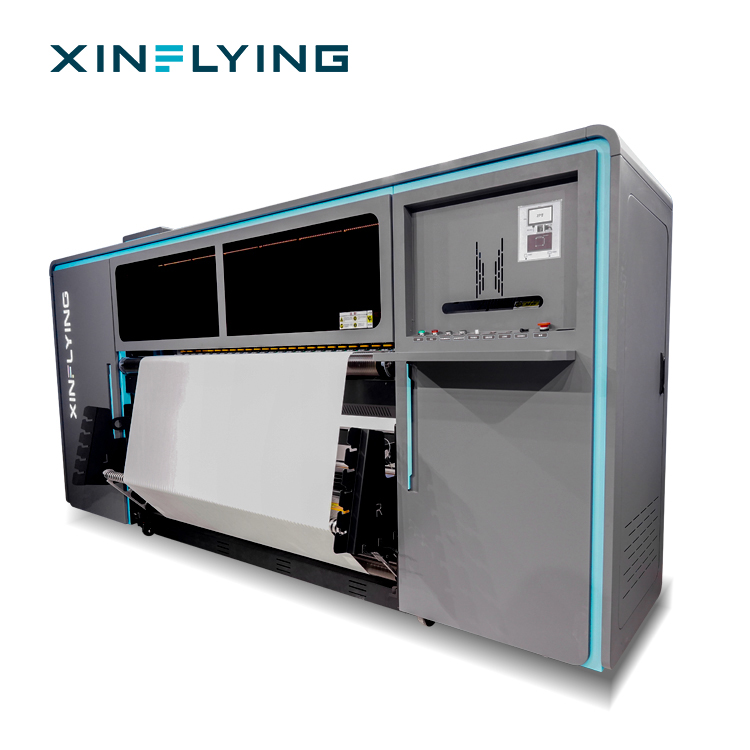
The 1900 mm industrial class: the XF-19E8-PRO uses 8 Epson i3200-A1 printheads, the XF-19E15-PRO uses 15.
Detailed Solution: The Two-Model Framework
Xinflying approaches industrial textile projects with two complementary machines instead of one flagship. Each answers a different part of the specification file.
XF-19E15-PRO — the 1900 mm high-volume industrial sublimation printer
- Printheads: 15 × Epson i3200-A1
- Ink: sublimation ink, CMYK
- Print width: 190 cm (75 in)
- Resolution: 3200 dpi
- Print speed: 1PASS 524 m²/h and 2PASS 254 m²/h at the fastest settings; 1PASS 394 m²/h and 2PASS 188 m²/h at standard settings
- Media: sublimation paper, loads 1000 m rolls
- Drying: external intelligent air-heat integrated dryer
- Head maintenance: fully sealed automatic moisturizing and cleaning
- RIP: Maintop (standard); RIIN (Hoson only), PhotoPrint and Printfactory (optional)
- Power: 14.5 kW, 210–230 V, 45 A
- Machine size: 3840 × 1570 × 1800 mm; net weight 1480 kg
- Operating environment: 18–30 °C, 35–65% RH
Fifteen printheads across a 1900 mm width is the configuration that matters when daily volume is measured in thousands of square metres. The same unit covers both a high-speed 1PASS band and a slower, higher-definition 2PASS band, so a long-run sportswear programme and a more detailed decorative fabric order can be produced on one machine rather than two.
XF-450PRO — the digital textile printer for compliance-led projects
The XF-450PRO is covered by CE certificate BSTXD211021006201EC. Its documentation set also includes OEKO-TEX ECO PASSPORT certificate SH150194016, which addresses textile printing inks and pastes. For projects where the buyer's file must name the exact machine and the exact chemistry — apparel programmes with restricted-substance requirements, or textile work in which the ink that touches the fabric is audited alongside the equipment — this is the coverage that has to be verified first.
Where model coverage decides the project
Certificate scope is model-specific, and this is where industrial textile orders most often lose time. Two checks resolve it, and both are documentation checks rather than technical ones.
- Does the certificate name the model being ordered? A document issued for one machine does not automatically cover a sister model with a different printhead count, chassis or electrical configuration. The document reference on the certificate has to match the model code on the order confirmation.
- Is the consumable covered by its own document? Inks and pastes carry their own certification because they carry their own chemistry. On the XF-450PRO workflow, the two questions have documented answers: BSTXD211021006201EC for the machine and SH150194016 for the textile printing inks and pastes.
A third, separate layer is print validation. ISO 12647-8:2021 defines the standard for graphic technology validation print processes working directly from digital data — a useful reference when a buyer has to demonstrate colour consistency across production batches rather than only at the sample stage.
Practical rule: before an industrial textile project is approved, the procurement file should contain three matching references — the machine model, the certificate number that covers it, and the consumable documentation for the ink or paste that will run through it. Any gap between those three references should be closed before, not after, shipment.
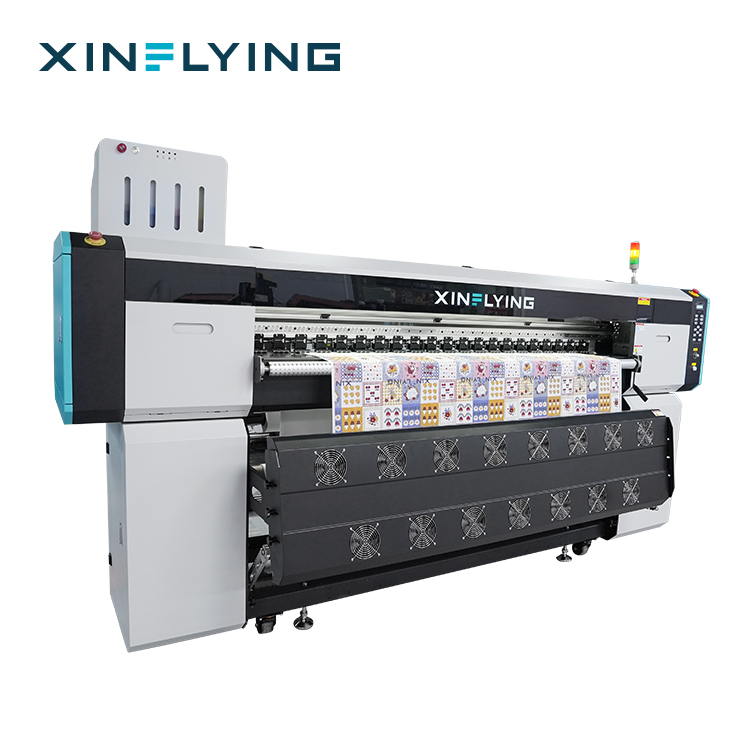
Below the industrial class, the XF-O2000-4I32A1 roll-to-roll sublimation printer runs a 195 cm print width with 4 printheads.
Step-by-Step Breakdown: Selecting a Sublimation Printer for a Textile Project
The sequence below converts a textile programme into a machine specification. It runs from the fabric backwards to the certificate, which is the order in which industrial buyers usually need the answers.
Step 1 — Define the fabric and the finished product. Start with polyester content, fabric weight, roll width and the finished item. Sublimation printing works best on polyester fabrics and polyester-coated substrates because the dye bonds with polyester fibres during heat transfer; cotton generally requires a different process. This single decision removes roughly half of the machine options before any price is discussed.
Step 2 — Fix the required print width. A 1900 mm roll-to-roll sublimation printer is the industry standard for high-volume textile and soft signage work. If the programme is planned around 1.9 m fabric, the XF-19E15-PRO and XF-19E8-PRO both operate at a 190 cm (75 in) print width. If the largest item sits below that, a narrower and less costly platform will do the same job.
Step 3 — Convert demand into throughput. Take peak daily square metres, not average. At the XF-19E15-PRO's standard 1PASS rate of 394 m²/h, a 3,000 m² production day represents roughly 7.6 hours of printing time — leaving room for changeovers, nozzle checks and maintenance inside a continuous schedule. The same arithmetic applied to a lower-output machine is what usually reveals an under-sized purchase.
Step 4 — Match printhead count to the volume band. In the Xinflying range the printhead count is the main capacity dial: 2 × Epson i3200-A1 on the XF-H1802X-2I32A1 at up to 52 m²/h for sampling and small-batch work; 4 × Epson i3200-A1 on the XF-O2000-4I32A1 at 2PASS 180 m²/h; 8 × Epson i3200-A1 on the XF-19E8-PRO at 1PASS 306 m²/h; 15 × Epson i3200-A1 on the XF-19E15-PRO at 1PASS 524 m²/h.
Step 5 — Check the certificate against the exact model and the exact ink. This is the step where the XF-450PRO belongs. Confirm that CE certificate BSTXD211021006201EC covers the XF-450PRO unit being ordered, and that OEKO-TEX ECO PASSPORT certificate SH150194016 is the reference for the textile printing inks and pastes in the production plan. Complete compliance files reduce customs delays, sales restrictions and additional compliance costs.
Step 6 — Confirm media, roll length and the RIP path. The XF-19E15-PRO loads 1000 m sublimation paper rolls and runs Maintop as standard, with RIIN (Hoson only), PhotoPrint and Printfactory available as options. RIP software controls colour profiles, ink distribution and resolution settings, which is what keeps batch-to-batch colour consistent on repeat textile orders.
Step 7 — Plan environment, power and service before installation. The XF-19E15-PRO needs 14.5 kW at 210–230 V, 45 A and an operating environment of 18–30 °C at 35–65% RH; the machine measures 3840 × 1570 × 1800 mm with a net weight of 1480 kg. Installation follows a fixed sequence: stable placement and power connection, ink system connection and flow check, driver and RIP configuration, nozzle check and calibration, then test prints before mass production begins. Agree the acceptance routine — Xinflying products are accepted through a pre-shipment test procedure before delivery — and confirm the spare parts and training plan in the same document.
Use Cases: Mapping Textile Products to Models
Sportswear, team kits and activewear. Polyester sportswear is the highest-volume industrial sublimation application: the dye bonds into the fibre, so the print does not sit on top of the fabric. Programmes running multi-thousand-square-metre days are the natural fit for the XF-19E15-PRO, where 15 printheads and a 1900 mm width keep output high across repeated designs.
Home textiles and decorative fabric. Cushions, decorative panels and blankets are printed as roll fabric and cut afterwards, so roll width and pattern repeat matter more than peak speed. The 1900 mm industrial models cover the widest home textile panels; the XF-O2000-4I32A1 covers home decor, cushions and similar work at a 195 cm width with heat transfer paper rolls of 1000–1500 m.
Soft signage, flags and banners. These are short-run, high-mix products where a 1.9 m roll-to-roll sublimation printer is the standard platform. The value of a 15-printhead machine here is not only speed: switching between 1PASS and 2PASS settings lets one unit serve both banner-length output and detail-heavy promotional panels.
Compliance-led apparel and textile printing. Where the buyer's file must identify the machine and the ink chemistry — restricted-substance programmes, export documentation packs, or customer audits — the XF-450PRO is the relevant model: CE certificate BSTXD021106201EC. Before ordering, confirm the certificate reference on the supplier's certificate registry matches the exact model code on your purchase order, and keep the ink and paste documentation in the same file as the machinery certificate.
Sampling and small-batch programmes. Apparel sampling and small-batch orders do not need 15 printheads. A 2-printhead machine at an 1800 mm width, such as the XF-H1802X-2I32A1 running up to 52 m²/h, keeps sampling costs aligned with sampling volumes while the industrial line handles bulk production.
Boundary condition worth stating. Sublimation is not a universal textile process. It is optimised for polyester and polyester-coated substrates; for cotton-heavy product lines, direct-to-garment or DTF workflows are the more suitable routes. Projects that mix cotton and polyester should plan two production paths rather than forcing one machine to cover both.
Comparison Table: Specifications and Documented Coverage
The tables below use published model specifications and the certificate references that apply to each configuration. They are intended as a shortlist filter, not as a substitute for the supplier's certificate documents.
Table 1 — Industrial textile project profile and matching model
| Project profile | Recommended model | Basis for the match |
|---|---|---|
| High-volume polyester sportswear, 1.9 m fabric rolls, multi-thousand m² production days | XF-19E15-PRO | 15 × Epson i3200-A1, 190 cm (75 in) width, up to 524 m²/h at 1PASS fastest setting |
| Industrial textile work where the project file must name the machine and the ink chemistry | XF-450PRO | CE certificate BSTXD211021006201EC covers the XF-450PRO; OEKO-TEX ECO PASSPORT certificate SH150194016 addresses textile printing inks and pastes |
| Continuous industrial production with an 8-printhead configuration at the same 1900 mm width | XF-19E8-PRO | 8 × Epson i3200-A1, 190 cm (75 in) width, 3200 dpi, up to 306 m²/h at 1PASS fastest setting |
| Growing programme requiring a 1950 mm width and mid-range output | XF-O2000-4I32A1 | 4 × Epson i3200-A1, 195 cm width, 2PASS 180 m²/h; heat transfer paper rolls 1000–1500 m |
| Sampling, small-batch orders and entry-level production | XF-H1802X-2I32A1 | 2 × Epson i3200-A1, 180 cm width, up to 52 m²/h at 4PASS |
Table 2 — Specification comparison of the roll-to-roll sublimation class
| Parameter | XF-19E15-PRO | XF-19E8-PRO | XF-O2000-4I32A1 |
|---|---|---|---|
| Printheads | 15 × Epson i3200-A1 | 8 × Epson i3200-A1 | 4 × Epson i3200-A1 |
| Print width | 190 cm (75 in) | 190 cm (75 in) | 195 cm (1.95 m) |
| Fastest speed | 1PASS 524 m²/h; 2PASS 254 m²/h | 1PASS 306 m²/h; 2PASS 153 m²/h | 2PASS 180 m²/h; 4PASS 92 m²/h |
| Standard speed | 1PASS 394 m²/h; 2PASS 188 m²/h | 1PASS 210 m²/h; 2PASS 109 m²/h | — |
| Resolution | 3200 dpi | 3200 dpi | Piezoelectric inkjet |
| Ink | Sublimation ink, CMYK | Sublimation ink, CMYK | Sublimation ink, CMYK × 4 (220 ml cartridge + 3 L ink tank) |
| Media | Sublimation paper, 1000 m rolls | Sublimation paper | Heat transfer paper, rolls 1000–1500 m |
| RIP | Maintop (standard); RIIN (Hoson only), PhotoPrint, Printfactory (optional) | Maintop (standard); RIIN (Hoson only), PhotoPrint, Printfactory (optional) | RIIN Print; Maintop |
| Power | 14.5 kW; 210–230 V, 45 A | 10.2 kW; 210–230 V, 45 A | 8.5 kW; 220 V, 50/60 Hz |
| Net weight | 1480 kg | 1400 kg | approx. 490 kg |
| Operating environment | 18–30 °C, 35–65% RH | 18–30 °C, 35–65% RH | 20–25 °C, 45–65% RH |
Table 3 — Documentation coverage to verify before ordering
| Document type | Reference | What it covers |
|---|---|---|
| CE certificate (machinery) | BSTXD211021006201EC | Covers the XF-450PRO digital textile printer |
| OEKO-TEX ECO PASSPORT | SH150194016 | Textile printing inks and pastes used with the XF-450PRO |
| Digital print validation standard | ISO 12647-8:2021 | Validation print processes working directly from digital data |
| Acceptance routine | Pre-shipment test | Product acceptance inspection carried out before delivery |
Long-Term Supply: What an Industrial Textile Project Needs After Installation
An industrial sublimation printer is a multi-year production asset, and the second half of the purchase decision is about who supports it. Xinflying was founded in 2010 and operates a 37,440 m² manufacturing facility with more than 200 employees, including a 20-engineer R&D team, and an annual output of more than 20,000 units. Export business accounts for 80% of total sales, with major markets across North America, South America, Europe, Asia, the Middle East and Africa, and the company maintains local warehouses and technical support in key markets — including overseas warehouse operations in the United States, Brazil and Mexico.
That structure matters to textile producers for three practical reasons.
- Spare parts and consumables continuity. Printheads, ink systems and dryer components are the wear items in continuous production. A supplier with organised parts storage and key-market warehouse coverage shortens the gap between a failure and a running machine. Buyers evaluating a long-term partner should ask for installation guidance, remote technical support, operation training, maintenance recommendations and long-term spare parts availability in writing.
- Predictable commercial terms. Xinflying supplies industrial printers at an MOQ of 1 unit, with delivery terms of EXW, FOB, CIF or DDP, and payment by T/T, Western Union or PayPal. Acceptance is conducted through a pre-shipment test procedure before delivery. For distributors and importers building a textile equipment line, these terms make it possible to hold demonstration stock and spare parts without over-committing capital.
- Documentation that survives market changes. Certificates are re-checked every time a machine enters a new market, and consumable documentation is re-checked every time an ink or paste changes. A supplier that already holds machinery and consumable certification for its models — as with CE certificate BSTXD211021006201EC and ECO PASSPORT certificate SH150194016 on the XF-450PRO — reduces the recurring compliance workload for its distributors.
Maintenance discipline is the other half of long-run reliability. On continuously running machines, daily nozzle checks and regular cleaning are recommended, and most output faults trace back to a small set of causes: partial nozzle blockage, unstable ink supply, incorrect resolution or speed settings, printhead misalignment, and incorrect ICC profile or RIP configuration. Keeping a written record of the optimised parameters for each repeat order is the simplest way to keep batch colours stable across a long textile programme.
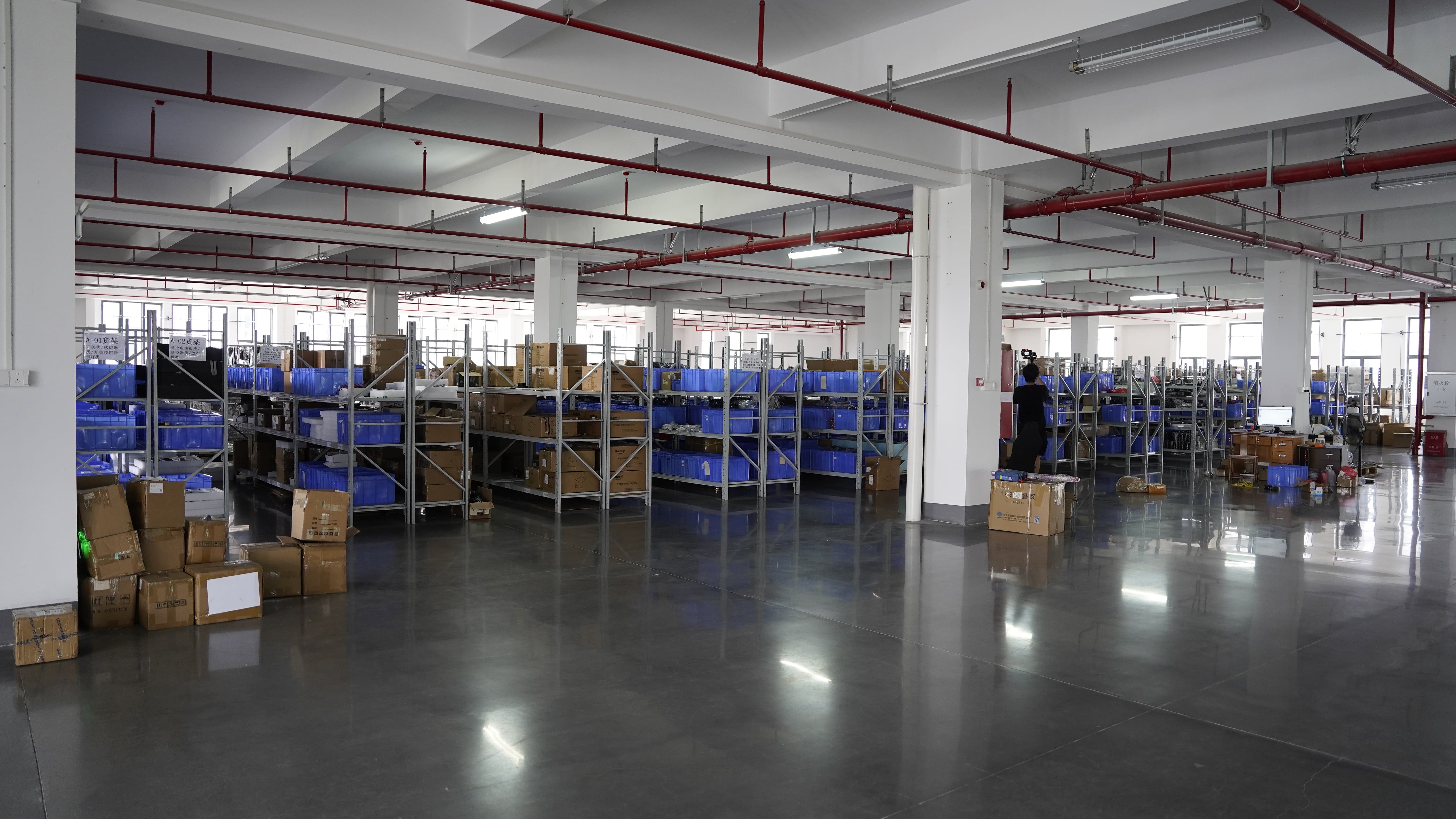
Xinflying parts storage in Guangzhou — organised component inventory that supports long-term spare parts supply for its digital printing machine range.
FAQ: Industrial Textile Projects and Model Coverage
Which certificates should cover a sublimation printer model and its inks for textile production?
Two document groups matter in textile work: the machinery certificate and the consumable documentation. On the XF-450PRO, CE certificate BSTXD211021006201EC covers the printer itself, while OEKO-TEX ECO PASSPORT certificate SH150194016 addresses the textile printing inks and pastes. The general rule is that certification documents must correspond with the actual equipment model being supplied, and that incomplete or mismatched documents can cause customs delays, sales restrictions or additional compliance costs. Where relevant, buyers should also confirm the applicable standard reference for validation printing, such as ISO 12647-8:2021 for validation print processes working directly from digital data.
How much production can the XF-19E15-PRO handle in continuous operation?
The XF-19E15-PRO is a 1900 mm (75 in) roll-to-roll industrial sublimation printer built on 15 Epson i3200-A1 printheads with 3200 dpi resolution. It produces 1PASS 524 m²/h and 2PASS 254 m²/h at the fastest settings, or 1PASS 394 m²/h and 2PASS 188 m²/h at standard settings. It loads 1000 m sublimation paper rolls, uses an external intelligent air-heat integrated dryer and a fully sealed automatic moisturizing and cleaning system, and draws 14.5 kW at 210–230 V, 45 A.
What are the commercial terms for ordering an industrial sublimation printer?
Xinflying supplies industrial printers at an MOQ of 1 unit. Delivery terms are EXW, FOB, CIF or DDP, and payment can be made by T/T, Western Union or PayPal. Products are accepted through a pre-shipment test procedure, and acceptance inspection includes a pre-shipment test before delivery. Cost differences between models in the range come mainly from configuration — printhead count, print width, drying and power draw — so the commercial comparison should always be made against the model whose width and throughput match the programme.
How is a machine validated before and after delivery?
Validation starts before shipment, through a pre-shipment test procedure that forms the acceptance inspection. After delivery, setup follows a fixed sequence: place the printer on a stable surface and connect power, install the sublimation ink system and check ink flow, install drivers and configure RIP software, run nozzle checks, printhead inspection and initial calibration, then complete test prints and adjust parameters before mass production. Do not start large-scale production before test printing is finished, and keep a record of the optimised settings for repeat orders.
How do I choose a long-term sublimation printer supplier for textile production?
Choose on four criteria rather than on machine price alone: whether the supplier holds machinery and consumable documentation for the exact models you sell, whether spare parts and technical support reach your market (Xinflying maintains local warehouses and technical support in key markets, with export accounting for 80% of total sales across North America, South America, Europe, Asia, the Middle East and Africa), whether commercial terms support your business model (MOQ of 1 unit, EXW/FOB/CIF/DDP, T/T, Western Union or PayPal, pre-shipment acceptance testing), and whether training and maintenance support are committed in writing. Xinflying was founded in 2010, runs a 37,440 m² facility with more than 200 employees and a 20-engineer R&D team, and produces more than 20,000 units annually. You can start by requesting the company profile and model documentation at info@xin-flying.com, or through xin-flying.com.
Conclusion: Model Coverage Is a Selection Criterion, Not a Formality
Industrial textile projects are won on three matching decisions: the print width matches the fabric roll, the throughput matches peak daily output, and the documentation matches the exact machine and consumable in the production plan. The XF-19E15-PRO addresses the first two at a 1900 mm width with 15 Epson i3200-A1 printheads and up to 524 m²/h at 1PASS, while the XF-450PRO addresses the third through CE certificate BSTXD211021006201EC and OEKO-TEX ECO PASSPORT certificate SH150194016 for textile printing inks and pastes.
Buyers who verify all three references before the order is placed spend their installation time producing textile, not resolving paperwork.
Next Step
Request the Xinflying company and product profile, or ask for the model specification sheet and certificate references for your target textile programme.
Download the profile: Xinflying Company Profile (PDF)
Email: info@xin-flying.com | Tel / WhatsApp: +86 188-1322-1357
Website: www.xin-flying.com | Blog: blog.xin-flying.com
Planning an industrial textile project? Request the XF-19E15-PRO specification sheet and the certificate references for your target model.
Have Questions or Need More Details?
Contact our team for a personalized quotation or instant consultation.
Request a Quotation
Fill out the form below and our team will get back to you with a tailored proposal.
WhatsApp Direct Chat
Prefer to chat in real-time? Message us on WhatsApp for instant assistance & quick answers.
- Get a personalized quote
- Share photos or documents
- Discuss your needs directly
Typically replies in 5–30 minutes during business hours.