
Navigating EU Certification Changes for Textile Hardware
An EMC certificate is not a permanent property of a factory or a brand — it is a snapshot of one tested configuration. That single fact explains most of the certification friction EU importers meet with textile printing hardware, and it is also why a properly managed model update can keep compliance continuity intact: in the Xinflying range, the XF-19E8-PRO and the XF-19E15-PRO are documented under the same EMC certificate number, TQT1550D270EC.
Guangzhou Xin Flying Digital Technology Co., Ltd. (XinFlying) is a digital printing equipment manufacturer established in 2010 in Panyu, Guangzhou, China. The company specializes in DTF printers, UV DTF printers, UV printers, DTG printers, and dye sublimation printing solutions, and its main products include DTF printer machines, dye sublimation printers, DTG printers, UV DTF printers, UV flatbed printer machines, printing consumables, and complete digital printing solutions. XinFlying operates a manufacturing facility covering 37,440 square meters, employs more than 200 staff including an R&D team of 20 engineers, and reports annual production capacity exceeding 20,000 units.
In this article, “textile hardware” means the printing machinery that textile producers actually install on the factory floor — in this case, industrial roll-to-roll dye sublimation printers. The question is not whether these machines carry a CE mark. The question is whether the paperwork behind that mark still matches the machine that arrives at the loading dock.
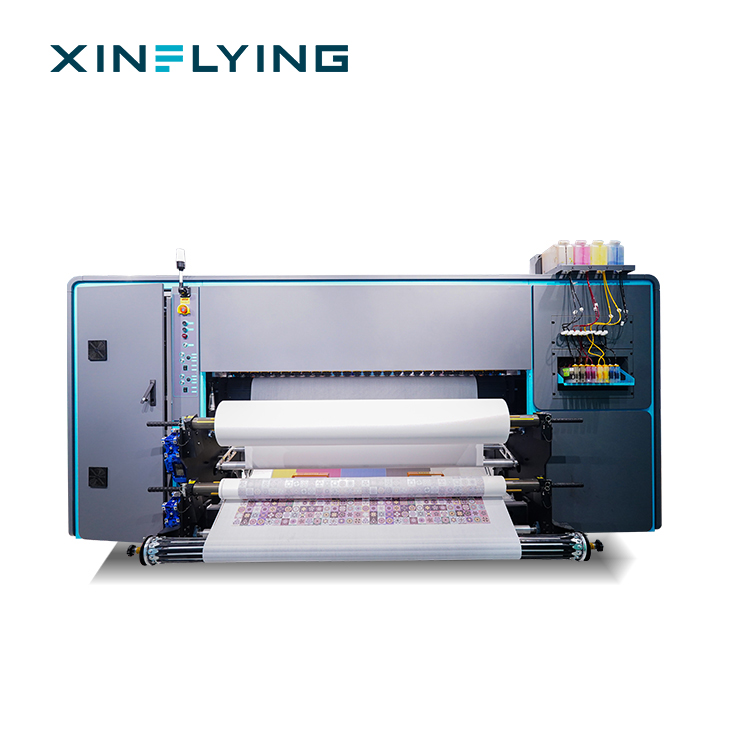
The XF-19E8-PRO: a 190 cm (75") roll-to-roll sublimation printer with 8× Epson i3200-A1 printheads and a 210–230V, 45A power supply.
What “EU Certification Changes” Actually Means for Textile Hardware Buyers
“Certification changed” is a phrase that hides three different situations. Buyers who separate them usually find that only one of the three requires real action.
- The document itself changed. A test report or certificate is reissued, updated, or replaced because the tested configuration changed or because the file version is no longer current.
- The equipment changed. A new printhead count, a different drive board, a different power supply rating, a different dryer, or a modified enclosure can move the electromagnetic profile of a machine. When that happens, the EMC file has to be refreshed even if the product family name looks familiar.
- The nameplate and the file stopped matching. This is the most common and most expensive version. The buyer holds a valid certificate for the product family, but the certificate lists a configuration that is not the configuration on the machine — or does not list the exact model designation at all.
The practical consequence is that certification is not a one-time purchase. It is a document set that has to be maintained alongside the production line. For an importer who adds a second or third machine from the same manufacturer, the difference between a maintained file and a fragmented one is measured in customs days, not in paperwork hours.
Why This Matters More in 2026: The Market Behind the Paperwork
The pressure on documentation is a direct consequence of volume. According to Grand View Research, the global dye sublimation printing market was valued at USD 16.4 billion in 2025 and is projected to reach USD 39.0 billion by 2033, growing at a CAGR of 11.5% from 2026 to 2033. The same source reports that Asia Pacific dominated the market in 2025 with a 36.5% revenue share, led by China as the largest country market.
The equipment slice alone is substantial. Mordor Intelligence values the dye sublimation printers segment at USD 1.88 billion in 2025, with a projected USD 2.53 billion by 2030. Fortune Business Insights puts the wider large format printer market at USD 10.57 billion in 2025, projected to reach USD 16.52 billion by 2034. On the supply side, Grand View Research notes that inkjet production printers accounted for 87.3% of the production printer market by type in 2024 — the technology category that most roll-to-roll textile printers belong to.
The export channel is equally relevant. China’s textile and garment exports reached USD 293.6 billion in 2023, which is the demand pool that industrial-scale sublimation machines are built to serve. And on the application side, FESPA Insights identifies 1.9 m (1900 mm) roll-to-roll width as the standard for high-volume textile and soft signage production — which is why so many industrial platforms, including the XF-19E8-PRO and XF-19E15-PRO, are built at 190 cm (75 inches).
Market structure matters too. Data Insights Reports places Epson at the top of the digital textile dye sublimation printer market with a 26.7% share, followed by Mimaki at 18.6% and Roland DG at 15.5% (2024). That concentration is visible at component level as well: the Epson i3200-A1 printhead is the head used across XinFlying’s sublimation range, including the XF-H1301X-1I32A1, XF-H1802X-2I32A1, XF-O2000-4I32A1, XF-19E8-PRO, and XF-19E15-PRO.
What this means for a buyer: the more units that cross borders, and the more configurations a single supplier offers, the higher the chance that a certificate found online does not correspond to the exact machine on the pallet. Verification is now part of procurement, not part of after-sales administration.
The Document Set Behind a CE Mark on a Sublimation Printer
Before looking at refresh timing, it is worth being precise about what is actually in the file. For sublimation printers entering the European market, buyers should verify CE compliance, which includes applicable electrical safety, electromagnetic compatibility, and product safety requirements. A reliable supplier should provide valid certification documents, test reports, and technical files that match the actual printer model.
Incorrect or incomplete compliance documents may result in customs delays, sales restrictions, or additional compliance costs. That is not a theoretical risk statement — it is the operational reason why compliance documentation is checked before an order is confirmed rather than after a container is booked.
Environmental documentation sits alongside the CE file. RoHS compliance helps confirm that electrical and electronic components meet restrictions on hazardous substances, and buyers should request the relevant environmental documents and verify that they apply to the actual equipment model. Suppliers with proper environmental documentation reduce regulatory risk for the importers who resell or install their machines.
For comparison, the equivalent American checkpoints are different in name but similar in logic: buyers entering the US market typically look for electromagnetic compatibility and electrical safety documentation, with FCC compliance commonly required for electronic equipment and additional safety certification depending on specifications and sales channels. The lesson transfers: the document set must describe the machine, not the company.
Why an EMC Certificate Must Be Refreshed When the Hardware Changes
EMC certification is configuration-specific. The tested object is not “a sublimation printer” in the abstract; it is a specific assembly with a specific printhead count, specific drive electronics, a specific power supply rating, a specific drying unit, and a specific internal cable routing.
Change any of those and the file has to be refreshed. In practice, an EMC certificate needs to be renewed or re-confirmed whenever one of the following changes:
- The number or type of printheads changes, which alters drive signal timing and current draw.
- The power supply specification changes. The XF-19E8-PRO and XF-19E15-PRO, for example, both run on 210–230V at 45A, but at different rated power — 10.2 kW and 14.5 kW respectively.
- The drying system changes. Both models use an external intelligent air-heat integrated dryer, which is part of the tested assembly, not an accessory outside it.
- The mainboard, motor drive, or control electronics are replaced with a different generation.
- The enclosure or internal shielding layout is modified.
There is a second, quieter reason for refresh cycles: the standards that test reports are written against are revised over time, and the validation methodology for digital print processes itself has a formal reference point — ISO 12647-8:2021 provides the standard for graphic technology validation print processes working directly from digital data. A file that was current when a model launched is not automatically current when the same model ships three years later.
This is why “the certificate exists” and “the certificate is current for this machine” are different claims. The first is a marketing answer. The second is a procurement answer.
Documented Model Continuity: XF-19E8-PRO and XF-19E15-PRO
Model continuity is the clearest test of whether a manufacturer treats compliance as a maintained process or as a launch task. In the XinFlying range, the update history from the XF-19E8-PRO to the XF-19E15-PRO is documented under the same EMC certificate number, TQT1550D270EC.
That matters because the two machines are a genuine performance step up while remaining the same platform class:
- XF-19E8-PRO: 8× Epson i3200-A1 printheads, CMYK, 190 cm (75") print width, 3200 dpi resolution, fastest print speed 1PASS 306 m²/h and 2PASS 153 m²/h, standard print speed 1PASS 210 m²/h and 2PASS 109 m²/h, 10.2 kW, 210–230V 45A, Windows 11/10 (32/64bit), external intelligent air-heat integrated dryer, fully sealed automatic moisturizing and cleaning, net weight 1,400 kg.
- XF-19E15-PRO: 15× Epson i3200-A1 printheads, CMYK, 190 cm (75") print width, 3200 dpi resolution, fastest print speed 1PASS 524 m²/h and 2PASS 254 m²/h, standard print speed 1PASS 394 m²/h and 2PASS 188 m²/h, 14.5 kW, 210–230V 45A, media loading of 1000 m sublimation paper rolls, external intelligent air-heat integrated dryer, fully sealed automatic moisturizing and cleaning, net weight 1,480 kg.
Both models share the same print width, the same resolution, the same ink family, the same RIP baseline (Maintop standard, with RIIN for Hoson, PhotoPrint, and Printfactory as options), and the same power supply specification. What changes is throughput and head count — and that is precisely why the EMC documentation has to be handled deliberately rather than assumed.
For an importer, the practical value of continuity under one certificate number is administrative: a company that has already cleared the 8-head model into the EU has a compliance file that already references TQT1550D270EC, so adding the 15-head model to the portfolio does not mean starting the documentation process from zero. The buyer should still confirm that the certificate on file lists the exact configuration printed on the nameplate of the unit being delivered — continuity reduces work, it does not remove verification.
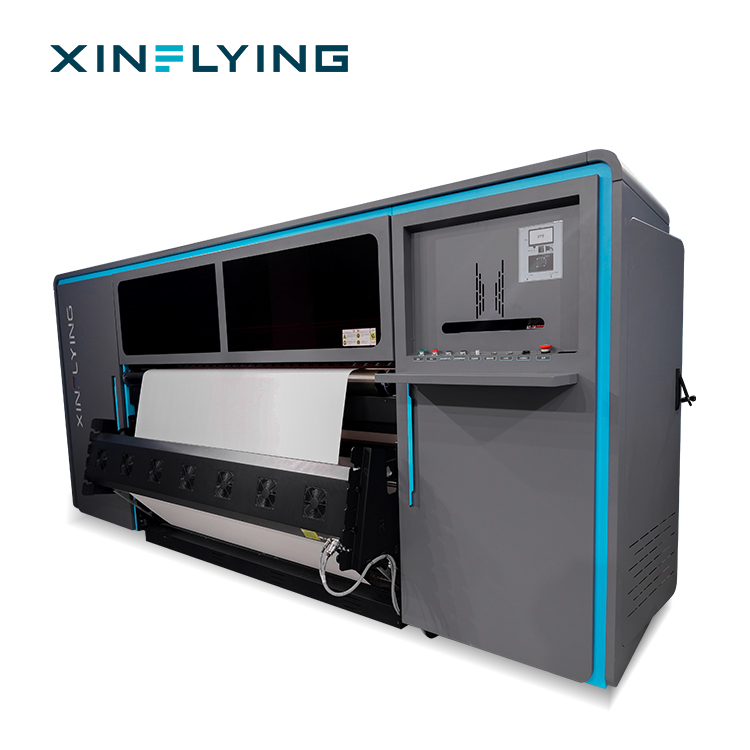
The XF-19E15-PRO carries 15× Epson i3200-A1 printheads and reaches a fastest speed of 524 m²/h in 1PASS mode.
Step-by-Step: How to Verify an EMC Certificate Refresh
The following sequence is written for the buyer side — the importer, distributor, or compliance officer who has to sign off on a machine before it is released into production.
Step 1: Start from the nameplate, not the brochure
Record the model designation, serial number, rated voltage, rated current, and rated power as printed on the machine. For example, a 210–230V, 45A, 10.2 kW rating points to the XF-19E8-PRO, while 210–230V, 45A, 14.5 kW points to the XF-19E15-PRO. The nameplate is the object that customs and the buyer’s own auditor will compare against the certificate.
Step 2: Match the certificate number and the listed model
Check the certificate number itself, for example TQT1550D270EC, and confirm which model designations appear on that document. A certificate that covers a platform but lists a different head configuration is a mismatch, not a shortcut.
Step 3: Confirm the tested configuration against the ordered configuration
Head count, dryer type, power supply rating, and control electronics must correspond. Two machines from the same family can differ in every one of these parameters while sharing a chassis.
Step 4: Compare issue and update dates against your delivery date
A valid file for a 2026 delivery is a file whose issue or update date is reasonably close to the build date of the unit. An old file on a new machine is the classic documentation gap.
Step 5: Ask for the test report, not only the certificate page
The certificate is the conclusion; the test report is the evidence. Buyers should request certification documents, technical specifications, and product test reports together, and check that all three describe the same equipment.
Step 6: Cross-check the electrical data against your facility
Documentation and installation planning overlap here. The XF-19E8-PRO and XF-19E15-PRO run on 210–230V, 45A; the XF-O2000-4I32A1 runs on 220V, 50/60Hz at 8.5 kW; the XF-H1802X-2I32A1 runs on 110/220V, 27.2A/13.6A, 50–60Hz; and the XF-H1301X-1I32A1 runs on 110/220V, 18A/9A, 50–60Hz. The declared rating on the certificate must match the load your site is prepared for.
Step 7: Ask what happens at the next revision
This is the question that separates a one-off purchase from a supply relationship. Ask the supplier how the EMC file will be handled when the next configuration is released, and ask for the certificate number that will carry the update. Continuity between the XF-19E8-PRO and the XF-19E15-PRO under TQT1550D270EC is an example of what a managed answer looks like.
Use Cases: Who Meets This Problem First
Certification refresh is rarely an abstract concern. It shows up in five recurring situations.
EU importers and distributors expanding a portfolio
A distributor that already sells one industrial sublimation platform and wants to add a higher-output model from the same manufacturer needs the compliance file to extend cleanly. A shared certificate number across a model update is exactly the continuity that a distributor’s own reseller documentation depends on.
Sportswear and teamwear mills upgrading capacity
A mill running polyester sportswear production may move from an 8-head platform at 306 m²/h to a 15-head platform at 524 m²/h. The production case is straightforward; the compliance case is the part that has to be planned, because the hardware change is what triggers the EMC refresh in the first place.
Home textile, soft signage, and flag producers
Applications such as clothing, home decor, canvas bags, cushions, and flags are covered by mid-range platforms like the XF-O2000-4I32A1, which offers 4× Epson i3200-A1 printheads, CMYK×4 ink configuration, a 195 cm print width, 2PASS 180 m²/h and 4PASS 92 m²/h, and support for 1000–1500 m heat transfer paper rolls. For these buyers, the documentation question is usually about matching a mid-range machine’s file to a mixed fleet rather than about a capacity step-up.
Apparel sampling and small-batch producers
Entry platforms such as the XF-H1802X-2I32A1 (2× Epson i3200-A1, 180 cm, 4PASS 52 m²/h at fastest, 3.5 kW) and the XF-H1301X-1I32A1 (1× Epson i3200-A1, 130 cm, 4PASS 28 m²/h, 2 kW) are typically bought by smaller operations with less in-house compliance capacity. These buyers benefit most from a supplier that supplies the documents as a package rather than on request.
Operations running continuous production
Industrial dye sublimation production lines are commonly specified for 24/7 operation in a controlled indoor environment at 18°C–30°C and 35%–65% RH. In that setting, a documentation gap is not an administrative annoyance — it can stall an installation that is already scheduled against customer orders.
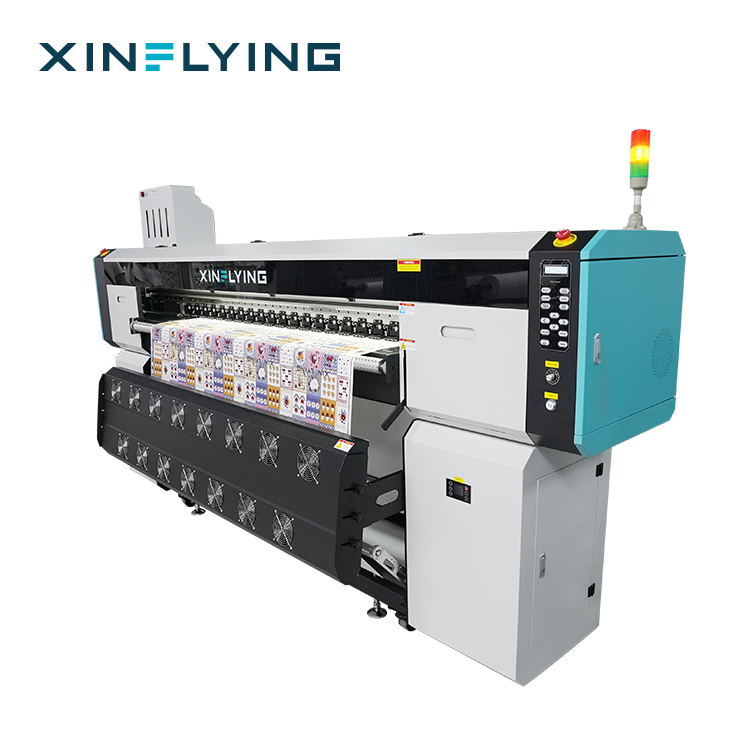
The XF-O2000-4I32A1: 4× Epson i3200-A1 printheads, 195 cm print width, up to 180 m²/h in 2PASS mode.
Documented Specifications Across the Xinflying Sublimation Range
The table below lists only parameters that are documented for each model. It is intended as a comparison of platform position rather than as a recommendation ranking.
| Model | Printheads | Print width | Fastest print speed | Power | Typical production position |
|---|---|---|---|---|---|
| XF-H1301X-1I32A1 | 1× Epson i3200-A1 | 130 cm (1.3 m) | 4PASS 28 m²/h | 2 kW; 110/220V, 18A/9A, 50–60Hz | Entry / sampling and narrow-width work |
| XF-H1802X-2I32A1 | 2× Epson i3200-A1 | 180 cm (1.8 m) | 4PASS 52 m²/h (standard 4PASS 42 m²/h) | 3.5 kW; 110/220V, 27.2A/13.6A, 50–60Hz | Entry / small-batch and custom textile orders |
| XF-O2000-4I32A1 | 4× Epson i3200-A1 | 195 cm (1.95 m) | 2PASS 180 m²/h; 4PASS 92 m²/h | 8.5 kW; 220V, 50/60Hz | Mid-range / continuous daily production |
| XF-19E8-PRO | 8× Epson i3200-A1 | 190 cm (75") | 1PASS 306 m²/h; 2PASS 153 m²/h | 10.2 kW; 210–230V, 45A | Industrial / high-volume textile runs |
| XF-19E15-PRO | 15× Epson i3200-A1 | 190 cm (75") | 1PASS 524 m²/h; 2PASS 254 m²/h | 14.5 kW; 210–230V, 45A | High-volume industrial / maximum throughput |
Two facts are worth reading out of that table. First, the two 190 cm industrial models share a power supply specification and differ in rated power — which is exactly the kind of change that must be reflected in refreshed EMC documentation. Second, the 3200 dpi resolution figure is documented for both industrial models, while the entry and mid-range models are positioned by width, head count, and output rather than by resolution.
Certification documents at a glance
| Document focus | Market | What the buyer should verify |
|---|---|---|
| CE (electrical safety, EMC, product safety) | European Union | Valid CE documentation, electromagnetic compatibility testing, electrical safety compliance, technical documentation, and consistency between the certification documents and the actual sublimation printer model. |
| RoHS | European Union / Global | Compliance with hazardous substance restrictions, environmentally compliant electronic components, and supporting supplier documentation that names the actual equipment model. |
| EMC continuity across a model update | European Union | Whether the updated configuration is covered by the existing certificate number — for example TQT1550D270EC across the XF-19E8-PRO to XF-19E15-PRO update history. |
| FCC / UL-type checks | United States | Electromagnetic compatibility compliance, electrical safety documentation, product specifications, and certification records matching the supplied sublimation printer. |
Frequently Asked Questions
What certification documents should I verify before importing a sublimation printer into the EU?
For importing sublimation printers into the European market, buyers should verify CE compliance, including applicable electrical safety, electromagnetic compatibility, and product safety requirements. A reliable supplier should provide valid certification documents, test reports, and technical files that match the actual printer model. Before placing an order, buyers should confirm that the certification information corresponds with the equipment being supplied. Incorrect or incomplete compliance documents may result in customs delays, sales restrictions, or additional compliance costs, so working with a supplier that provides complete certification support reduces import risk.
Do EMC certificates have to be refreshed when a sublimation printer model is updated?
An EMC certificate describes a tested configuration rather than a company or a brand, so it must be refreshed whenever the tested configuration changes — a different printhead count, drive electronics, power supply rating, dryer, or enclosure. Refreshing means the file is re-confirmed or reissued so that the document matches the machine being shipped. In the XinFlying range, the update history from the XF-19E8-PRO (8× Epson i3200-A1, 10.2 kW) to the XF-19E15-PRO (15× Epson i3200-A1, 14.5 kW) is documented under the same EMC certificate number, TQT1550D270EC, which maintains continuity in the compliance file while the production capacity changes. Buyers should still confirm that the certificate lists the exact configuration printed on the nameplate of the delivered unit.
Which XinFlying sublimation printer models are built for high-volume industrial textile production?
The XF-19E15-PRO and the XF-19E8-PRO are the two industrial models in the range. Both are 190 cm (75") roll-to-roll sublimation printers with 3200 dpi resolution, CMYK ink, a 210–230V 45A power supply, an external intelligent air-heat integrated dryer, and fully sealed automatic moisturizing and cleaning. The XF-19E15-PRO uses 15× Epson i3200-A1 printheads with a fastest speed of 1PASS 524 m²/h and a standard speed of 1PASS 394 m²/h at 14.5 kW. The XF-19E8-PRO uses 8× Epson i3200-A1 printheads with a fastest speed of 1PASS 306 m²/h and a standard speed of 1PASS 210 m²/h at 10.2 kW.
How should a buyer decide between an entry-level and an industrial sublimation printer?
The decision should be driven by the order profile rather than by the purchase price alone. For small and medium-sized sublimation printing businesses, the XF-H1802X-2I32A1 is positioned as an entry-level solution: 2× Epson i3200-A1 printheads, a 180 cm print width, and a fastest speed of 4PASS 52 m²/h at 3.5 kW, suited to businesses starting sublimation printing, custom textile production, apparel sampling, and small-batch orders. For growing printing companies that need higher productivity, the XF-O2000-4I32A1 offers 4× Epson i3200-A1 printheads, a 195 cm print width, and up to 180 m²/h in 2PASS mode at 8.5 kW. For industrial textile manufacturers and high-volume environments, the XF-19E8-PRO and XF-19E15-PRO are the industrial options. Selection parameters to compare across the range include print speed, printhead configuration, printing width, ink system, RIP software compatibility, media compatibility, machine stability, maintenance requirements, and power consumption.
What should a buyer request from a sublimation printer supplier before placing an order?
Before ordering, buyers should request certification documents that match the exact model, technical specifications, product test reports, and environmental compliance documents such as RoHS evidence. It is equally reasonable to ask about installation guidance, remote technical support, operation training, maintenance recommendations, and long-term spare parts availability, because after-sales support directly affects how quickly a printing operation recovers from downtime. XinFlying supplies its full machine catalogue and certification documentation on request — buyers can reach the team at info@xin-flying.com or via WhatsApp at +86 188-1322-1357 to request documentation for a specific model and configuration.
Conclusion: Compliance Is a Maintenance Task, Not a Launch Task
EU certification changes do not usually arrive as a single announcement. They arrive as a pile of small mismatches: a certificate issued for one configuration, a machine shipped in another; a file that was current at launch and is three revisions old at delivery; a model update that nobody re-tested because the family name stayed the same.
The way to stay ahead of it is procedural. Start from the nameplate, match the certificate number to the exact model and configuration, ask for the test report rather than the certificate page alone, compare dates, and ask the supplier how the next revision will be handled. Where a manufacturer manages that process properly, the result is visible in the documentation itself — as with the XF-19E8-PRO to XF-19E15-PRO update history carried under the same EMC certificate number, TQT1550D270EC.
XinFlying has manufactured digital printing equipment since 2010, with a 37,440 square meter facility, more than 200 staff, a 20-engineer R&D team, and annual production capacity exceeding 20,000 units. The company’s roll-to-roll sublimation printers are built for polyester fabric printing, sportswear, home textiles, soft signage, and industrial textile production, and are supported by documentation that buyers can verify against the machine they receive.
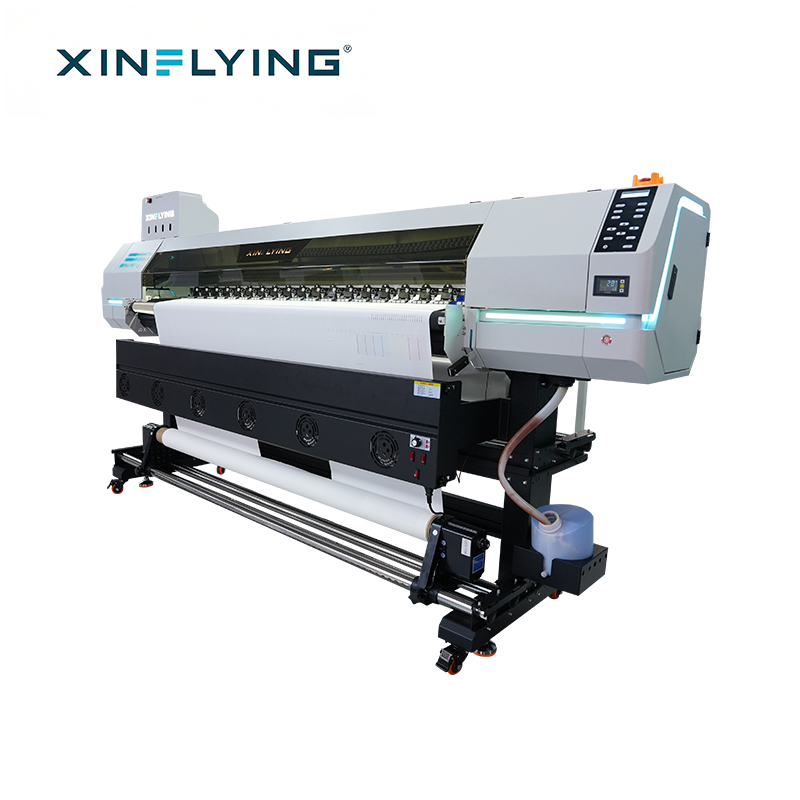
From entry platforms to 15-head industrial systems, XinFlying builds the full sublimation printer range on the same Epson i3200-A1 head platform.
Next Step: Request the Documentation Pack
If you are preparing an EU import and need the certificate set, technical specifications, or model-to-model comparison for a specific configuration, send your target model and production requirement to the XinFlying team. The full company and product catalogue is available for download here:
Download the XinFlying company and product brochure (PDF)
Email: info@xin-flying.com | Tel / WhatsApp: +86 188-1322-1357 | Chat on WhatsApp
Website: www.xin-flying.com | Address: No.7, Xiecun 2nd Industrial Zone, Panyu, Guangzhou, Guangdong
Have Questions or Need More Details?
Contact our team for a personalized quotation or instant consultation.
Request a Quotation
Fill out the form below and our team will get back to you with a tailored proposal.
WhatsApp Direct Chat
Prefer to chat in real-time? Message us on WhatsApp for instant assistance & quick answers.
- Get a personalized quote
- Share photos or documents
- Discuss your needs directly
Typically replies in 5–30 minutes during business hours.