
Print Width vs. Speed: A Sublimation Printer Comparison Guide
Print Width vs. Speed: A Sublimation Printer Comparison Guide
Print width decides which jobs a sublimation printer is allowed to accept. Print speed decides how many of those jobs it can finish before the shift ends. They are two separate constraints that are almost always quoted side by side, which is exactly why buyers merge them into one number and mis-specify the machine.
This guide compares four Xinflying roll-to-roll dye sublimation printers — XF-19E15-PRO, XF-19E8-PRO, XF-H1301X-1I32A1 and XF-O2000-4I32A1 — across the 1900 mm, 1950 mm and 1300 mm width bands, with the 1800 mm XF-H1802X-2I32A1 included as an entry-level reference. Xinflying is the brand of Guangzhou Xin Flying Digital Technology Co., Ltd., a digital printing equipment manufacturer founded in 2010 that produces DTF, UV DTF, UV, DTG and dye sublimation printing systems.
Every figure in the comparison tables below is taken from the manufacturer's published specifications for those models. Where a machine is commonly assumed to have a width or a speed that its published data does not state, the published data is used instead.
Problem Definition: Why Width and Speed Get Compared the Wrong Way
Three measurement errors account for most mis-specified sublimation printer purchases, and all three appear when width and speed are read from the same line of a specification sheet.
- The pass mode is missing from the speed claim. A rated figure such as 524 m²/h is produced at 1PASS. The same machine is rated differently at 2PASS, and other suppliers may quote 4PASS numbers. Two printers quoted at different pass modes have not been measured on the same basis, so the larger number is not automatically the faster printer.
- Width is treated as a proxy for throughput. It is not. Print width defines the widest continuous piece of transfer paper the machine can carry — the job envelope. Throughput is set by printhead count, pass mode, and the drying and media-handling system behind the carriage.
- Facility limits are checked after the decision instead of before it. A 1900 mm industrial printer may require a 210–230 V, 45 A supply and weigh 1480 kg, while a 1300 mm machine runs on 110/220 V at 18 A/9 A and weighs 140 kg. Finding this out after the order is placed is the expensive version of the mistake.
The rest of this guide separates those three items, then recombines them into a single comparison table and a selection workflow.
Industry Background: Where the Width Bands Come From
Width bands in sublimation printing are a market convention rather than an engineering invention, and the market data explains why the 1.9 m class is so crowded.
- The global dye sublimation printing market was valued at USD 16.4 billion in 2025 and is projected to reach USD 39.0 billion by 2033, with an 11.5% CAGR projected for 2026–2033 (Grand View Research).
- The dye sublimation printers segment alone was valued at USD 1.88 billion in 2025 and is expected to reach USD 2.53 billion by 2030 (Mordor Intelligence).
- Asia Pacific accounted for 36.5% of 2025 revenue share, led by China as the largest country market (Grand View Research).
- Demand for personalized apparel and home decor is identified as the primary driver behind a 13.1% CAGR in the digital textile sublimation market through 2030 (Grand View Research).
Roll-to-roll sublimation printers at 1.9 m (1900 mm) width are described as standard for high-volume textile and soft signage applications (FESPA market insights). That convention is visible directly in this comparison: XF-19E8-PRO and XF-19E15-PRO share the same 190 cm (75 inch) width but are separated by seven printheads. The width band is standardised; the capacity inside it is not.
Colour output is also governed by a formal reference. ISO 12647-8:2021 provides the standard for graphic technology validation print processes working directly from digital data — the framework behind repeatable colour validation on digital textile output.
Detailed Solution: Reading Width and Speed as Separate Constraints
Width is the job envelope
The published widths of the five models in this guide fall into four bands:
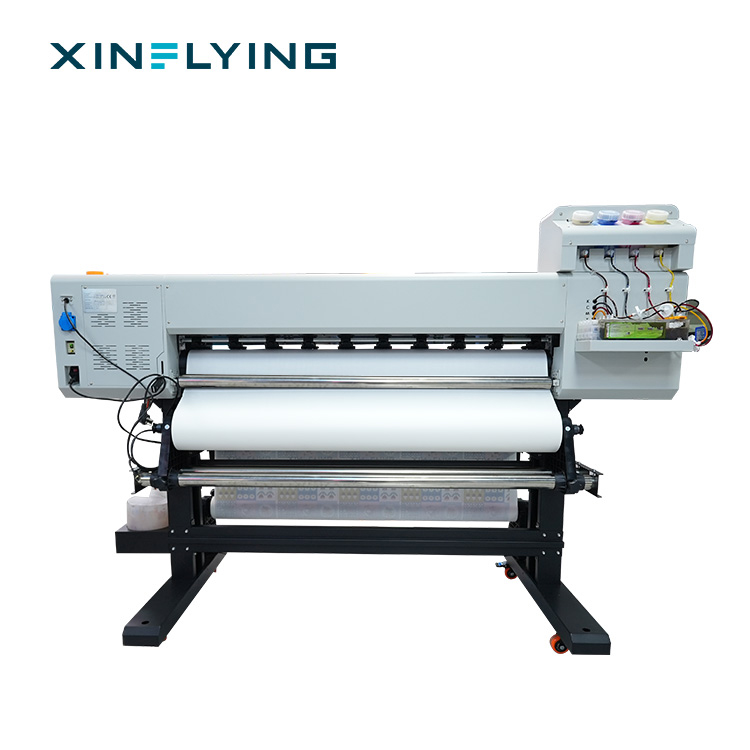
- 130 cm (1.3 m): XF-H1301X-1I32A1 — 1 × Epson i3200-A1 printhead, CMYK, 4PASS 28 m²/h, 2 kW, net weight 140 kg.
- 180 cm (1.8 m): XF-H1802X-2I32A1 — 2 × Epson i3200-A1 printheads, CMYK+CMYK, 4PASS 52 m²/h fastest and 4PASS 42 m²/h standard, 3.5 kW, net weight 265 kg.
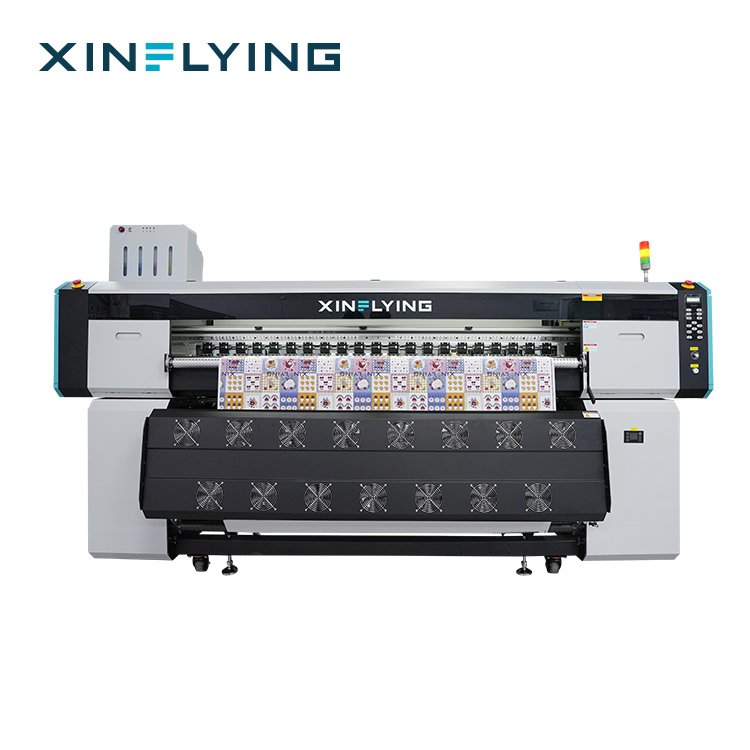
- 190 cm (75 inches): XF-19E8-PRO and XF-19E15-PRO — both 3200 dpi, both on sublimation paper, with the 15-head model loading 1000 m rolls and the 8-head model rated at 10.2 kW against the 15-head model's 14.5 kW.
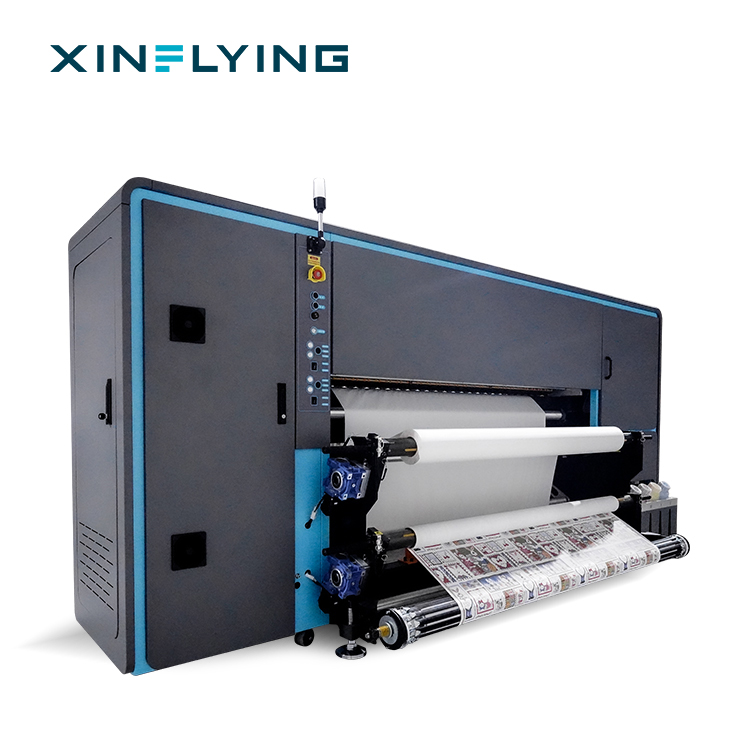
- 195 cm (1.95 m): XF-O2000-4I32A1 — 4 × Epson i3200-A1 printheads, piezoelectric inkjet, 2PASS 180 m²/h and 4PASS 92 m²/h, heat transfer paper rolls of 1000–1500 m, net weight ≈490 kg.
A buyer who needs an uninterrupted all-over print for a wide panel cannot solve that with a narrower machine without introducing seams, so the width band is usually decided first and rarely negotiated afterwards.
Printhead count is the real speed lever
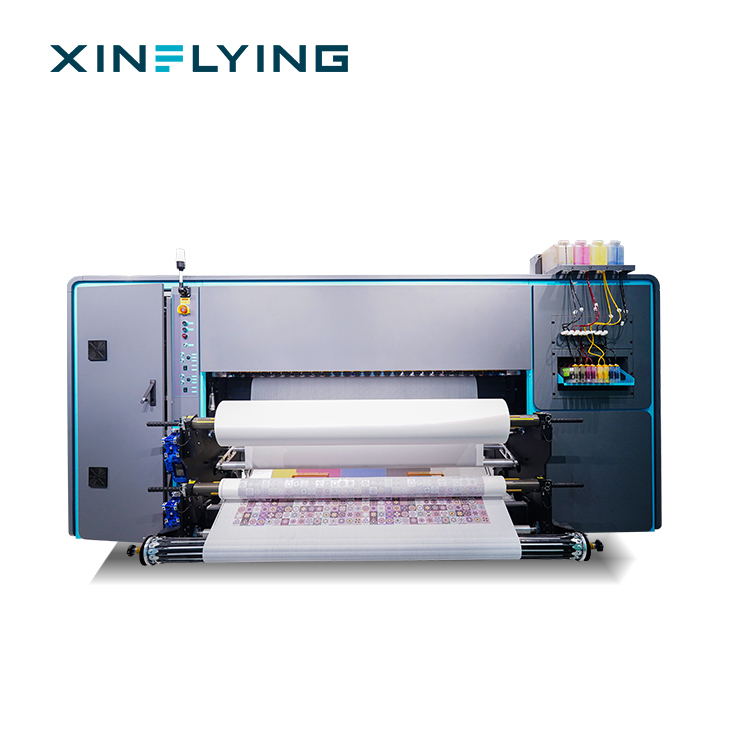
The clearest evidence that width does not create speed comes from the two 1900 mm models. At identical width, XF-19E8-PRO (8 printheads) is rated 1PASS 306 m²/h and 2PASS 153 m²/h in fastest mode; XF-19E15-PRO (15 printheads) is rated 1PASS 524 m²/h and 2PASS 254 m²/h. In standard mode the same gap appears: 1PASS 210 m²/h and 2PASS 109 m²/h for the 8-head machine, against 1PASS 394 m²/h and 2PASS 188 m²/h for the 15-head machine.
Both models also share the same drying concept — an external intelligent air-heat integrated dryer — and the same fully sealed automatic moisturizing and cleaning system, so the output difference tracks the printhead configuration rather than the chassis.
Pass mode is the comparison rule
Speed figures are only comparable inside the same pass mode. XF-O2000-4I32A1 publishes 2PASS 180 m²/h and 4PASS 92 m²/h; XF-H1802X-2I32A1 publishes 4PASS 52 m²/h; XF-H1301X-1I32A1 publishes a single 4PASS 28 m²/h figure. A practical method is to fix the pass mode your order quality requires, compare only machines that publish a figure at that pass mode, and treat any machine that publishes only a different pass mode as unresolved until its data is supplied.
Facility constraints decide which of the two winners you can actually install
Power, footprint, weight and operating environment are published per model and vary far more than the width figure suggests. The industrial 1900 mm machines specify 210–230 V at 45 A and net weights of 1400 kg and 1480 kg; the 1950 mm XF-O2000-4I32A1 runs on 220 V, 50/60 Hz at 8.5 kW with a net weight of ≈490 kg; the 1800 mm and 1300 mm models run on 110/220 V supplies at 3.5 kW and 2 kW.
The industrial dye sublimation production profile that these machines are applied to specifies a controlled indoor environment at 18–30°C and 35–65% RH, with 24/7 operation as the design intent. Stable temperature and humidity are recommended to hold ink performance and colour consistency across long production runs.
Step-by-Step Breakdown: Choosing a Width and Speed Combination
- Measure the widest single-piece job, not the average job. Check the artwork plus bleed against the four bands: 130 cm, 180 cm, 190 cm and 195 cm. If any recurring order has to be printed as one continuous piece, that order sets the minimum width.
- Convert demand into square metres per shift, then fix the pass mode. Decide the pass mode your quality standard requires for the substrate and end product, and compare only models that publish a speed at that pass mode.
- Choose the printhead count inside your width band. At 190 cm the choice is 8 heads (1PASS 306 m²/h fastest, 210 m²/h standard) or 15 heads (1PASS 524 m²/h fastest, 394 m²/h standard). At 195 cm, 4 heads give 2PASS 180 m²/h. At 180 cm, 2 heads give 4PASS 52 m²/h.
- Verify the facility limits against the model you selected. Confirm the supply type (110/220 V or 210–230 V), the amperage, the machine footprint, the net weight for floor loading, and the operating temperature and humidity range the machine specifies.
- Confirm documentation and pre-shipment testing before production starts. Check that CE, RoHS and ink-related documentation names the exact model, and that the unit passes pre-shipment testing in the configuration you ordered.
Comparison Table: Width, Speed and Constraint Data
| Model | Print width | Printheads | Speed (fastest mode) | Speed (standard mode) | Rated power | Machine size | Net weight |
|---|---|---|---|---|---|---|---|
| XF-H1301X-1I32A1 | 130 cm (1.3 m) | 1 × Epson i3200-A1 | 4PASS 28 m²/h | Not separately published | 2 kW | 2220×870×1540 mm | 140 kg |
| XF-H1802X-2I32A1 | 180 cm (1.8 m) | 2 × Epson i3200-A1 | 4PASS 52 m²/h | 4PASS 42 m²/h | 3.5 kW | 3000×880×1630 mm | 265 kg |
| XF-19E8-PRO | 190 cm (75") | 8 × Epson i3200-A1 | 1PASS 306 m²/h; 2PASS 153 m²/h | 1PASS 210 m²/h; 2PASS 109 m²/h | 10.2 kW | 3840×1300×1800 mm | 1400 kg |
| XF-19E15-PRO | 190 cm (75") | 15 × Epson i3200-A1 | 1PASS 524 m²/h; 2PASS 254 m²/h | 1PASS 394 m²/h; 2PASS 188 m²/h | 14.5 kW | 3840×1570×1800 mm | 1480 kg |
| XF-O2000-4I32A1 | 195 cm (1.95 m) | 4 × Epson i3200-A1 | 2PASS 180 m²/h; 4PASS 92 m²/h | Not separately published | 8.5 kW | 3311×1278×1670 mm | ≈490 kg |
Both 190 cm machines resolve at 3200 dpi, use sublimation ink and Maintop as standard RIP software, with RIIN (Hoson only), PhotoPrint and Printfactory available as options. XF-O2000-4I32A1 lists RIIN Print and Maintop, uses a 220 ml cartridge plus 3 L ink tank, and applies front/middle/rear break-controlled heating. XF-H1301X-1I32A1 uses an external constant-temperature automatic drying system with Maintop as standard RIP.
| Model | Power supply | Operating temperature | Operating humidity |
|---|---|---|---|
| XF-H1301X-1I32A1 | 110/220 V, 18 A/9 A, 50–60 Hz | 20–35°C | 45–65% RH |
| XF-H1802X-2I32A1 | 110/220 V, 27.2 A/13.6 A, 50–60 Hz | 20–35°C | 45–65% RH |
| XF-19E8-PRO | 210–230 V, 45 A | 18–30°C | 35–65% RH |
| XF-19E15-PRO | 210–230 V, 45 A | 18–30°C | 35–65% RH |
| XF-O2000-4I32A1 | 220 V, 50/60 Hz | 20–25°C | 45–65% RH |
Use Cases: Matching Width and Speed to Production Scale
- Sampling, apparel panels and small-batch custom orders: the 130 cm XF-H1301X-1I32A1 keeps the facility requirement low at 2 kW and 140 kg net weight, with a 4PASS 28 m²/h output.
- Small and medium printing businesses, custom textile production and short-run work: Xinflying's published selection guidance places the 180 cm XF-H1802X-2I32A1 as the entry-level option, with 2 printheads and up to 4PASS 52 m²/h.
- Growing businesses running continuous daily production: the same guidance places the 195 cm XF-O2000-4I32A1 as the mid-range option — 4 printheads, 1950 mm width, up to 2PASS 180 m²/h, and heat transfer paper rolls of 1000–1500 m for longer uninterrupted runs.
- Large-scale and high-volume textile production: the 190 cm XF-19E8-PRO and XF-19E15-PRO are positioned as the high-end options for factories and professional sublimation production centres, differentiated by printhead count rather than width.
- Home textiles, decorative fabric and soft signage: the listed application scope for XF-O2000-4I32A1 includes clothing, home decor, canvas bags, cushions and flags, which is where the 1950 mm width and 1 mm / 200 kg media handling specification becomes relevant.
Field cases follow the same pattern. A sportswear manufacturer in Brazil running 15 units over four years reported improved flexibility on customized orders, reduced dependence on outsourced printing, and more consistent colour across batches. A digital textile printing service provider running five units over three years reported expanded capacity and faster response on customized textile orders. A home textile manufacturer running ten units over four years reported being able to develop customized collections across curtains, cushions and decorative fabrics.
FAQ
Which CE, RoHS and OEKO-TEX documents cover these sublimation printer models?
Xinflying publishes model-specific certification. XF-19E15-PRO holds CE Machinery Directive Certificate of Conformity M.2026.206.C142365 issued by UDEM, CE LVD certificate TQT1550D271EC and CE EMC certificate TQT1550D270EC. XF-19E8-PRO is covered by CE MD Certificate of Conformity M.2026.206.C142385 and the same LVD and EMC certificates. XF-O2000-4I32A1 and XF-H1301X-1I32A1 are covered by CE LVD & EMC certificate M.2026.206.C142475 issued by UDEM, and XF-H1301X-1I32A1 conforms to EN ISO 12100:2010, EN 60204-1:2018/A1:2025 and EN ISO 12643-1:2023 for machinery safety. RoHS documentation is issued under certificate M.2026.206.C142366, and OEKO-TEX ECO PASSPORT certificate SH150194016 covers the textile printing inks, valid until 31 December 2026. Confirm that the certificate lists the exact model being purchased.
At the same 1900 mm width, how much does printhead count change output?
Substantially. XF-19E8-PRO and XF-19E15-PRO share the same 190 cm (75 inch) print width, but XF-19E8-PRO uses 8 Epson i3200-A1 printheads and XF-19E15-PRO uses 15. In fastest mode at 1PASS, the ratings are 306 m²/h and 524 m²/h respectively; in standard mode at 1PASS they are 210 m²/h and 394 m²/h. At 2PASS the same pattern holds at 153 m²/h against 254 m²/h. Equal width, different capacity — the printhead count is what changes.
How should print width and speed be weighed when planning the machine budget?
Budget should be built around three linked items: the width band, the printhead count, and the facility work the machine requires. Rated power ranges from 2 kW on the 1300 mm XF-H1301X-1I32A1 and 3.5 kW on the 1800 mm XF-H1802X-2I32A1, to 8.5 kW on the 1950 mm XF-O2000-4I32A1 and 14.5 kW on the 1900 mm XF-19E15-PRO, while net machine weight rises from 140 kg to 1480 kg across the same range. Electrical supply, floor loading, dryer configuration, spare printheads and media handling therefore belong in the same budget as the printer. List pricing is not published here; cost should be requested against a defined configuration.
Can a width and speed combination be validated before full-scale production?
Yes. Xinflying accepts a minimum order quantity of 1 unit, so a buyer can install a single machine, run production-representative artwork at the pass mode intended for the job, and confirm output before scaling up. Every unit is subject to pre-shipment testing before dispatch. Because sublimation results depend on the ink, transfer paper, calender settings and the specific polyester substrate, validation should be performed with the buyer's own fabric rather than a generic test file.
What is the lead time, and what technical support follows delivery?
Lead time is 5–40 days depending on model, configuration and whether OEM/ODM customization is requested. Xinflying offers product branding, machine appearance, colour, logo and packaging customization, with monthly capacity of 1600+ units and 80% of output exported across North America, South America, Europe, Asia, the Middle East and Africa. After delivery, more than 50 engineers provide 24/7 online technical support. To have a width and speed configuration reviewed against your production data, or to request a quotation or the company brochure, write to info@xin-flying.com or message +86 188-1322-1357 on WhatsApp.
Conclusion
Print width and print speed answer two different questions. Width determines whether a job can be produced as one continuous piece — 130 cm, 180 cm, 190 cm or 195 cm in this lineup. Speed determines how much of that width the machine can process per hour, and it is set by printhead count and pass mode rather than by the width figure itself. Two 1900 mm models separated by seven printheads demonstrate the point: identical width, ratings of 306 m²/h and 524 m²/h at 1PASS.
The practical sequence is short: fix the pass mode your quality standard requires, compare only machines that publish a figure at that pass mode, choose the width band that covers your widest single-piece job, then select the printhead count that meets demand. Finish by verifying the electrical supply, floor loading, operating environment and model-specific certification — those constraints are published per machine and cannot be assumed across a range.
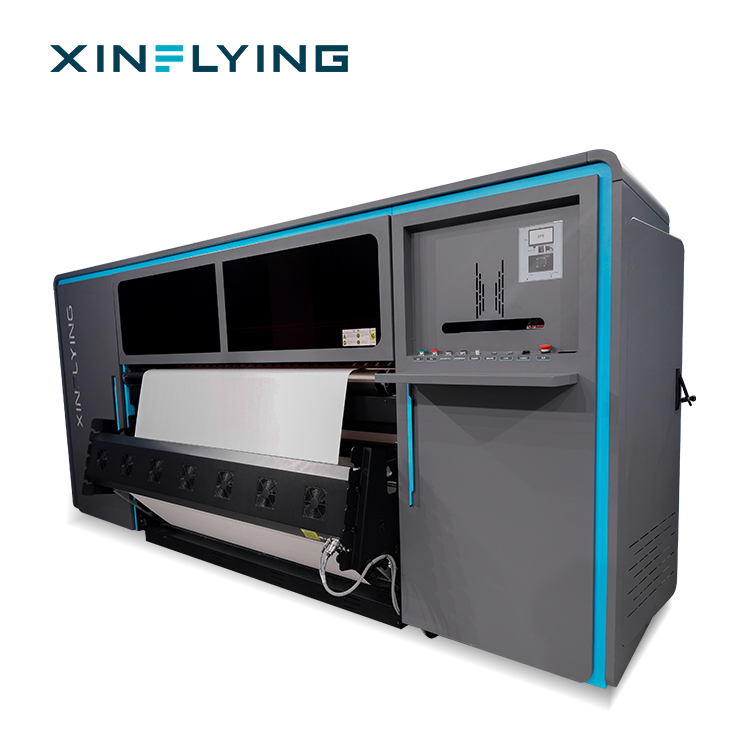
Next step: send your widest single-piece job size, required pass mode and target output per shift, and Xinflying will map them to the matching width band and printhead configuration. Request a quotation, a configuration review or a sample discussion at info@xin-flying.com, or download the Xinflying company brochure (PDF). Full product information is available at xin-flying.com.