
RoHS Directive 2011/65/EU: Hazardous Substances in Sublimation Printing
RoHS Directive 2011/65/EU: Hazardous Substances in Sublimation Printing
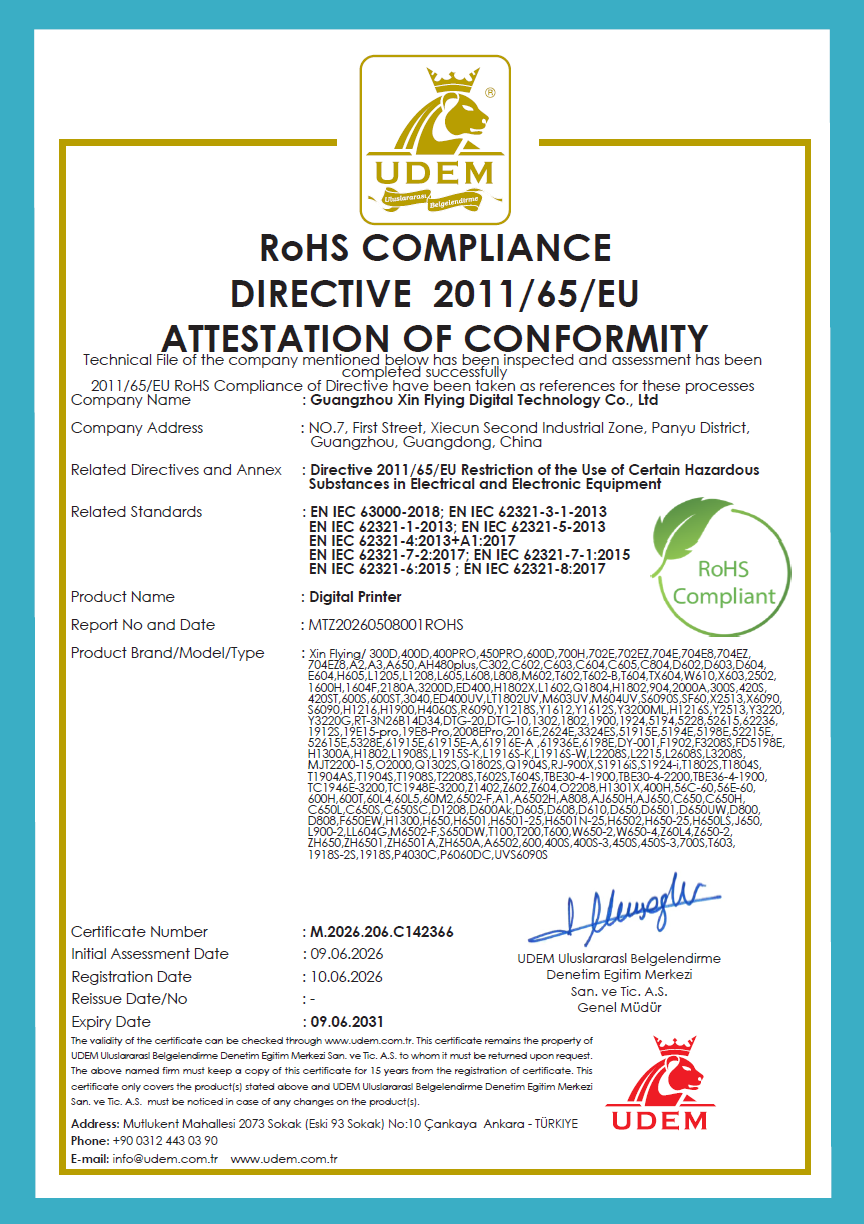
RoHS Directive 2011/65/EU is the European Union regulation that restricts hazardous substances in electrical and electronic equipment, and EN IEC 63000:2018 is the technical-documentation standard used to demonstrate that restriction for digital printing machinery. XINFLYING (Guangzhou Xin Flying Digital Technology Co., Ltd.) holds RoHS attestation M.2026.206.C142366, issued by UDEM, which covers product lines including the XF-F606 and XF-L608. This FAQ is written for the people who actually have to check that paperwork: EU importers, textile printers, distributors and OEM brand owners buying a dye sublimation printer.
One framing point matters before the details. RoHS is a restriction on the machine, not on the ink and not on the printed fabric. What a buyer needs is therefore a model-specific attestation that names the directive and the standards applied — not a general statement about environmental responsibility.
Quick answers
- Regulation: RoHS Directive 2011/65/EU (European Union).
- Documentation standard: EN IEC 63000:2018, with the EN IEC 62321 series cited for test methods.
- XINFLYING attestation: M.2026.206.C142366, issued by UDEM on 10 June 2026 and valid until 9 June 2031.
- Covered product lines include the XF-F606 and XF-L608.
Problem Definition: What RoHS Restricts and Where a Sublimation Printer Is Exposed
RoHS restricts the presence of certain hazardous substances in electrical and electronic equipment placed on the EU market. The restricted substance families include heavy metals such as lead, mercury, cadmium and hexavalent chromium, certain brominated flame retardants (polybrominated biphenyls and polybrominated diphenyl ethers), and certain phthalate plasticizers.
Assessment happens at the level of homogeneous materials, which means conformity is decided component by component rather than by the appearance of the finished machine. On a commercial sublimation printer this reaches the control board and printhead electronics, the power supply, the wiring harness and cable insulation, connectors and their plating, heating control elements, and enclosure parts made from plastic or coated metal.
For a buyer, the practical consequence is that a CE mark on the machine does not answer a RoHS question. CE marking pulls together several directives at once — machinery safety, electrical safety and electromagnetic compatibility — while RoHS is the substance-specific file. If a supplier cannot produce a document that names both the directive and the model, the buyer has nothing to place in their own technical file and nothing to show a downstream customer.
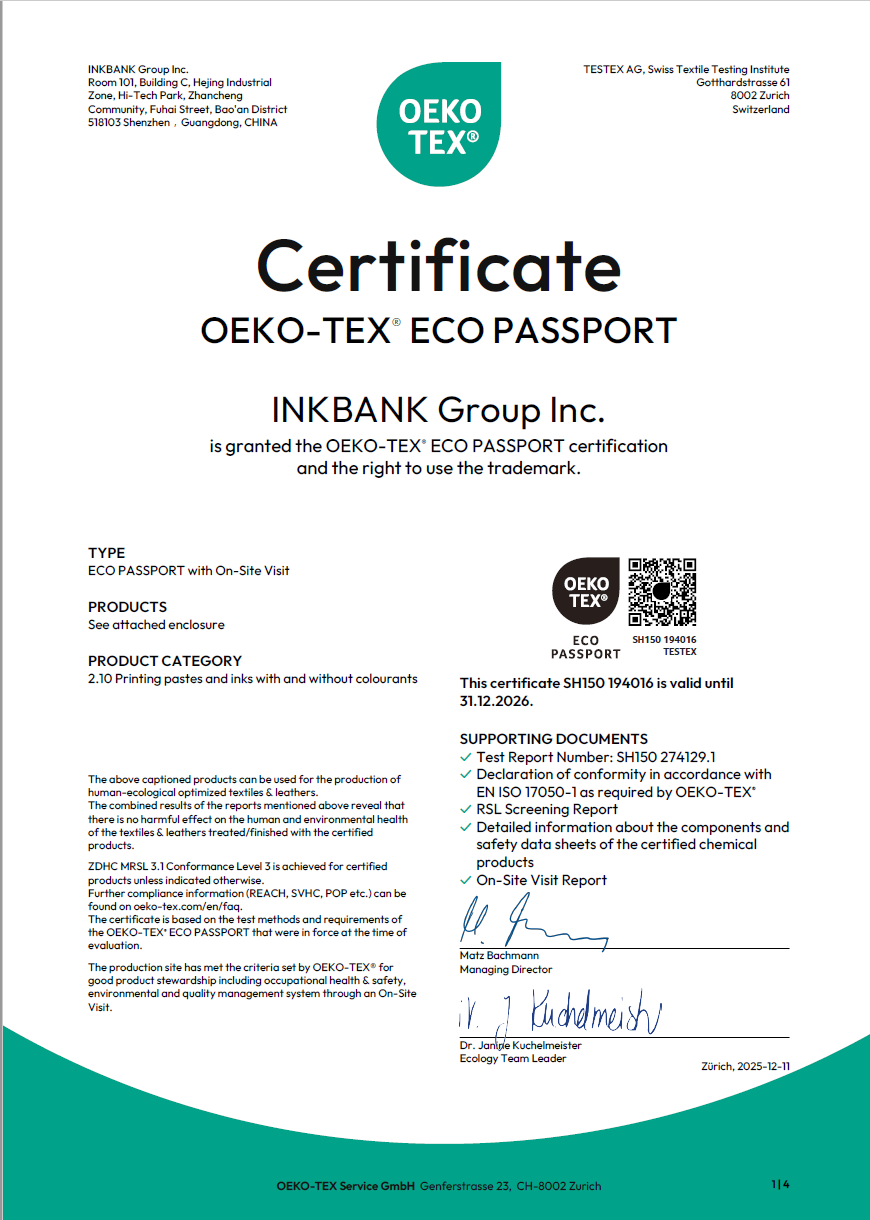
It is equally important not to overload the document. RoHS covers the equipment; textile printing inks and printing pastes are governed by separate market schemes. XINFLYING's OEKO-TEX ECO PASSPORT certificate SH150194016, issued by TESTEX AG for textile printing inks and printing pastes and valid until 31 December 2026, is the consumables-side document. Keeping machine documentation and consumable documentation separate is a useful discipline on both sides of a purchase.
Industry Background: Why Compliance Paperwork Now Sits Next to Price
The wider market gives the compliance question its commercial weight. Grand View Research valued the global dye sublimation printing market at USD 16.4 billion in 2025 and projects USD 39.0 billion by 2033, a CAGR of 11.5% from 2026 to 2033; Asia Pacific held a 36.5% revenue share in 2025, led by China as the largest country market. Mordor Intelligence sizes the dye sublimation printer segment specifically at USD 1.88 billion in 2025, rising to USD 2.53 billion by 2030. FESPA's market insights treat 1.9 m (1900 mm) roll-to-roll widths as the working standard for high-volume textile and soft signage production.
Published figures differ between research houses because some count total printing value while others count equipment only — a useful reminder that the methodology behind a number matters as much as the number, exactly as it does with certificates.
What this means in procurement terms is straightforward. As production moves toward 1.9 m roll-to-roll sublimation printers and continuous industrial lines, the equipment enters the purchasing rules of European mills, distributors and brand owners. Documentation travels with the machine: an EU distributor reselling a large format sublimation printer will be asked for the same files by its own customers, and a textile mill selling printed polyester goods into the EU is routinely asked how its production process is controlled.
Detailed Solution: How XINFLYING Documents RoHS Conformity
The core document for this product range is RoHS attestation M.2026.206.C142366, issued by UDEM (UDEM International Certification Auditing Training Centre Industry and Trade Inc. Co.). Its scope is RoHS compliance under Directive 2011/65/EU for the EU market. The standards cited are EN IEC 63000:2018 and the EN IEC 62321 series. It was issued on 10 June 2026 and is valid until 9 June 2031.
What EN IEC 63000:2018 actually contributes
EN IEC 63000:2018 defines how a manufacturer builds and controls the technical documentation used to assess electrical and electronic products against hazardous-substance restrictions. Rather than testing every unit, the framework links the product to material and component data — supplier declarations, material declarations, and analytical results where a declaration is not sufficient — and keeps that evidence under document control. That is why the standard reference matters on a RoHS attestation: it indicates that the conformity claim rests on a technical file rather than on a logo.
What the EN IEC 62321 series contributes
The EN IEC 62321 series provides the analytical test methods used to determine restricted substances in electrotechnical products. Where a material declaration cannot be obtained, or where a declaration needs verification, these methods are what produce a measurable result. XINFLYING's attestation cites the 62321 series alongside EN IEC 63000:2018, covering both the documentation framework and the test-method basis.
Which models sit inside the attestation
The covered product list includes the XF-F606 and XF-L608 lines, together with sublimation models such as the XF-H1301X-1I32A1, XF-H1802X-2I32A1, XF-19E8-PRO, XF-19E15-PRO and XF-O2000-4I32A1. Coverage is model-specific by design: a certificate naming the XF-F606 and XF-L608 is evidence for those machines, not automatically for a different model number or a different electrical configuration. A mismatch should be treated as an open question, not a formality.
The rest of the EU compliance stack
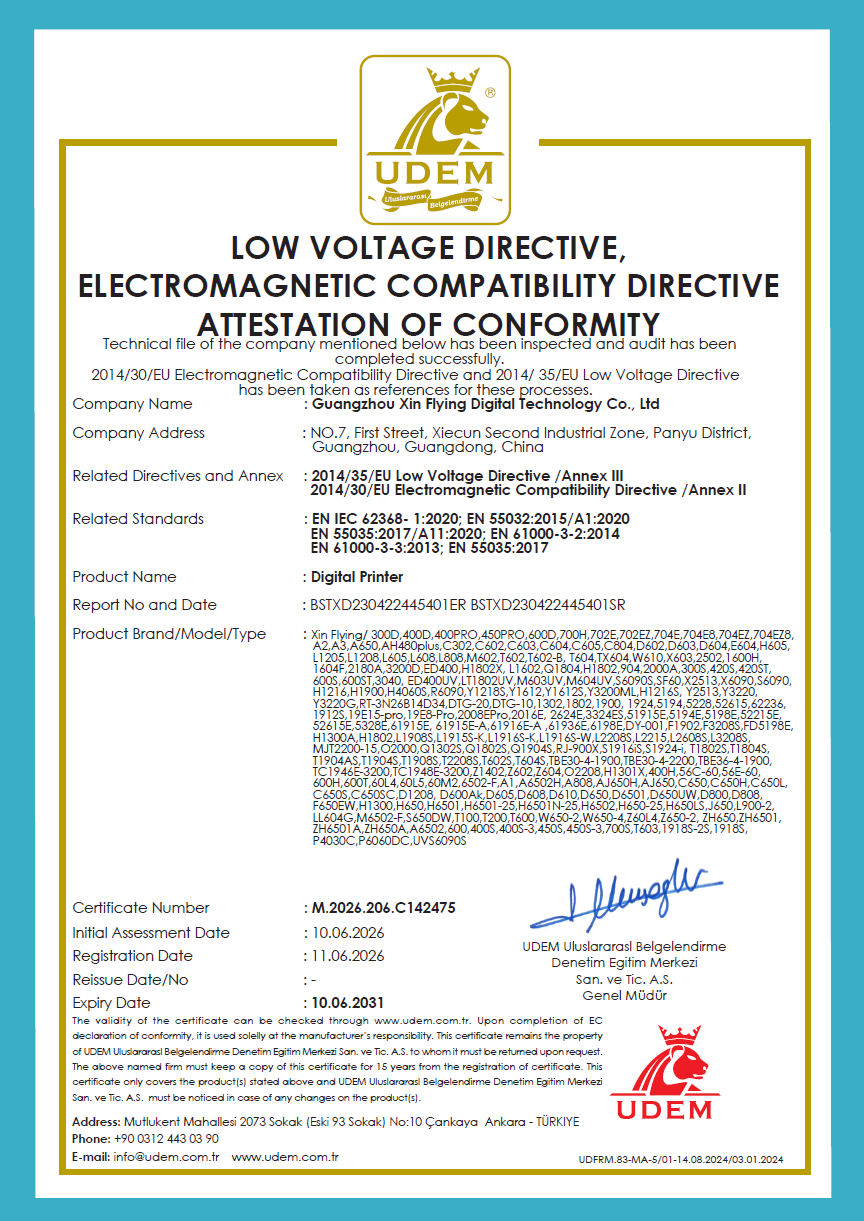
RoHS rarely travels alone. On the same equipment XINFLYING also holds CE documentation for machinery safety under M.2026.206.C142365 (citing EN ISO 12100:2010, EN 60204-1:2018/A1:2025 and EN ISO 12643-1:2023), for electrical safety under the Low Voltage Directive with certificate TQT1550D271EC (EN IEC 62368-1:2020/A11:2020), and for electromagnetic compatibility with certificate TQT1550D270EC (citing EN 55032:2015/A11:2020, EN 55035:2017/A11:2020, EN IEC 61000-3-2:2019+A1:2021 and EN 61000-3-3:2013/A2:2021). A combined LVD and EMC attestation is additionally held under M.2026.206.C142475.
Manufacturing context behind the documents
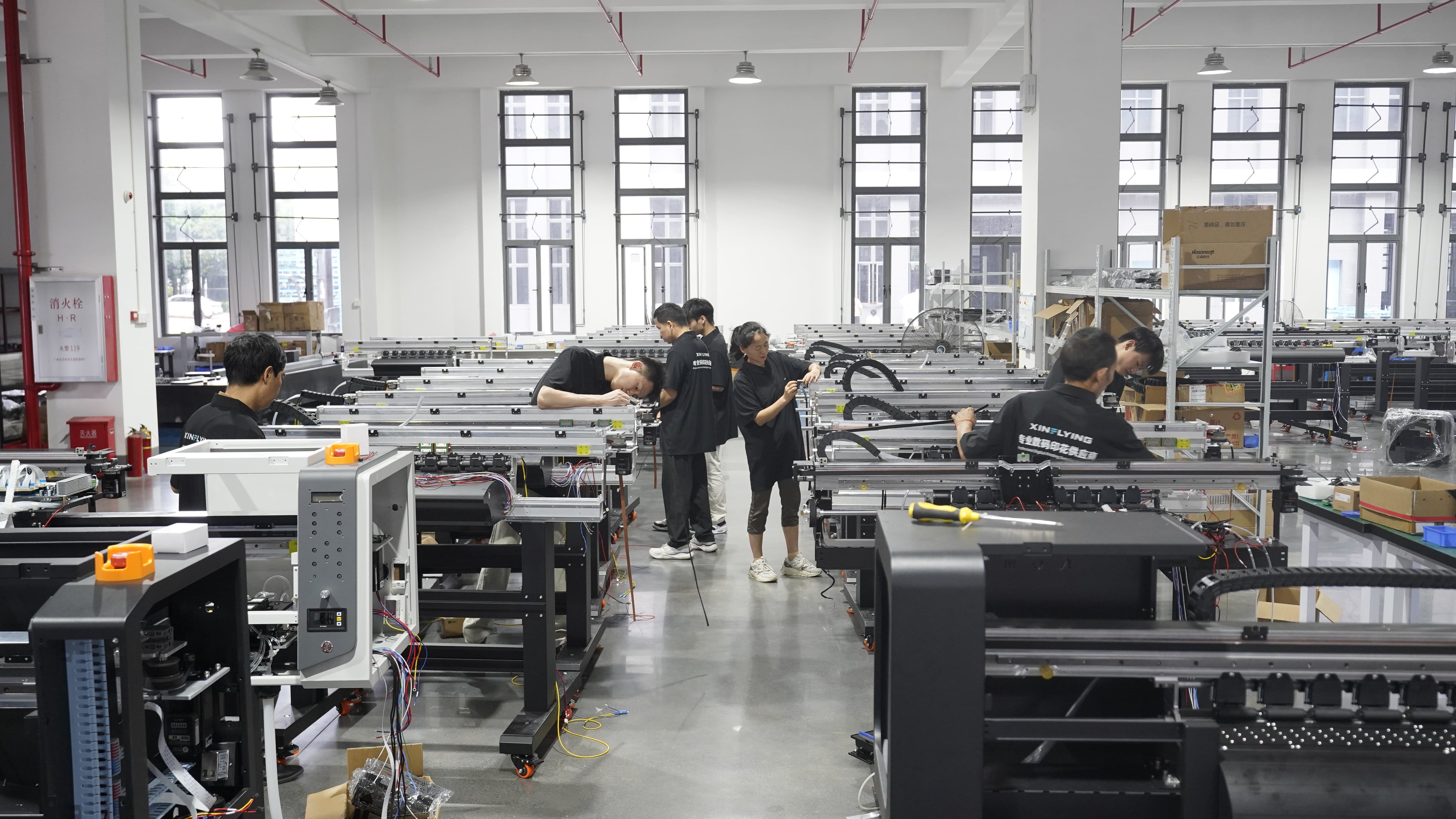
XINFLYING was founded in 2010 and operates a 37,440 m² facility with more than 200 employees, an R&D team of 20 engineers and annual output above 20,000 units. Around 80% of production is exported to North America, South America, Europe, Asia, the Middle East and Africa. Quality control is documented as pre-shipment testing, and the same pre-shipment test is used as the acceptance criterion in purchasing terms.
Step-by-Step Breakdown: Verifying a RoHS Document Before You Pay a Deposit
- Request the document by number. Ask for the attestation itself, not a screenshot of a logo. For this range the reference is M.2026.206.C142366.
- Check the regulation and the standard. The document should name Directive 2011/65/EU as the regime and EN IEC 63000:2018 as the documentation standard, with the EN IEC 62321 series as the test-method basis.
- Match the model designation exactly. Compare the covered model list with the model on your quotation or proforma invoice — XF-F606, XF-L608, XF-19E8-PRO and so on. A partial match is not a match.
- Confirm the validity window. M.2026.206.C142366 runs from 10 June 2026 to 9 June 2031. A document outside its validity window should not enter your technical file.
- Identify the issuing body and record it. The attestation for this range was issued by UDEM. Note the certificate number, issue date and scope wording so that a downstream customer can trace it.
- Cross-check the rest of the stack. RoHS (substances), Directive 2006/42/EC (machinery safety), Directive 2014/35/EU (electrical safety) and Directive 2014/30/EU (EMC) should be covered by documents describing the same machine configuration.
- Check configuration consistency. Voltage and frequency, printhead count and machine size should correspond to the configuration quoted — the XF-H1802X-2I32A1 is specified for 110/220 V at 50–60 Hz, while the XF-19E15-PRO is specified for 210–230 V.
- Archive the file with the order. Keep certificate, invoice and machine serial together. That is the record an EU distributor or a customs query will ask for.
Use Cases: Where RoHS Paperwork Decides the Order
An EU importer or distributor adding a sublimation line. The buyer needs the full document stack before listing the machine: RoHS for substances, plus machinery safety, LVD and EMC. A missing RoHS file stalls the listing regardless of print quality.
A European textile mill buying a 1.9 m roll-to-roll machine. The mill's own customers ask about substances in the printing process, so the mill maintains two separate files: the RoHS attestation for the machine, and the OEKO-TEX ECO PASSPORT record for the inks and pastes used in production.
An OEM brand owner private-labelling a printer. The compliance documents must name the model that will carry the buyer's brand. XINFLYING provides OEM and ODM production services, with customization covering product branding, machine appearance, colour, logo, packaging, and solutions tailored to customer requirements, at a minimum order quantity of one unit.
A printing service provider scaling production. XINFLYING's case records include a digital textile printing service provider that added five units over three years to expand capacity for sportswear brands and apparel factories, a sportswear manufacturer in Brazil running fifteen units across four years for jerseys and team uniforms, a sports uniform supplier in Brazil with eight units over five years, and a home textile manufacturer with ten units over four years producing curtains, cushions and decorative fabrics. Long-running fleets like these are where document continuity matters most, because renewal dates arrive during the equipment's working life.
Comparison Table: RoHS Within the EU Compliance Stack
The table below lists the compliance documents held for this equipment range. RoHS is one row; the others explain why a single CE-style claim is not enough on its own.
| Document | Regime / scope | Certificate no. | Issuing body | Standards cited |
|---|---|---|---|---|
| RoHS attestation | Hazardous substances, Directive 2011/65/EU (EU) | M.2026.206.C142366 | UDEM | EN IEC 63000:2018; EN IEC 62321 series |
| Machinery safety | Machinery Directive 2006/42/EC (EU) | M.2026.206.C142365 | UDEM | EN ISO 12100:2010; EN 60204-1:2018/A1:2025; EN ISO 12643-1:2023 |
| Electrical safety (LVD) | Low Voltage Directive 2014/35/EU (EU) | TQT1550D271EC | TQT (Shenzhen Tianqi Testing Technology Service Co., Ltd.) | EN IEC 62368-1:2020/A11:2020 |
| Electromagnetic compatibility | EMC Directive 2014/30/EU (EU) | TQT1550D270EC | TQT | EN 55032:2015/A11:2020; EN 55035:2017/A11:2020; EN IEC 61000-3-2:2019+A1:2021; EN 61000-3-3:2013/A2:2021 |
| LVD & EMC combined | Directives 2014/35/EU and 2014/30/EU (EU) | M.2026.206.C142475 | UDEM | EN IEC 62368-1:2020/A11:2020; EN 55032:2015/A1:2020; EN 55035:2017; EN 61000-3-2:2014; EN 61000-3-3:2013 |
| Textile printing inks & pastes | OEKO-TEX ECO PASSPORT (Global) | SH150194016 | TESTEX AG | OEKO-TEX ECO PASSPORT; EN ISO 17050-1 |
For buyers matching equipment to production scale, the RoHS-covered range also spans several print widths. The values below come from the published specifications for each model.
| Model | Machine type | Print width | Printheads | Typical production role |
|---|---|---|---|---|
| XF-H1301X-1I32A1 | Sublimation printer | 130 cm (1.3 m) | 1× Epson i3200-A1 | Sampling and short runs (4PASS 28 m²/h) |
| XF-H1802X-2I32A1 | Sublimation printer | 180 cm (1.8 m) | 2× Epson i3200-A1 | Small to medium textile batches (4PASS 52 m²/h) |
| XF-19E8-PRO | Sublimation printer | 190 cm (75") | 8× Epson i3200-A1 | Industrial roll-to-roll production (1PASS 306 m²/h) |
| XF-19E15-PRO | Sublimation printer | 190 cm (75") | 15× Epson i3200-A1 | High-volume industrial printing (1PASS 524 m²/h) |
| XF-O2000-4I32A1 | Sublimation printer | 195 cm (1.95 m) | 4× Epson i3200-A1 | Wide format textile, home decor and soft signage (2PASS 180 m²/h) |
| XF-F606 | DTF printer | 60 cm (24") | 6× Epson i3200-A1 | DTF transfer film production (6PASS 28 m²/h) |
| XF-L608 | DTF printer | 60 cm (0.6 m) | 8× Epson i3200-A1 | DTF transfer film production (4C4W 4PASS 42 m²/h) |
FAQ: RoHS and Sublimation Printer Purchasing
Does a dye sublimation printer need RoHS documentation for the EU market?
RoHS Directive 2011/65/EU restricts hazardous substances in electrical and electronic equipment placed on the EU market, and EU importers, distributors and brand owners routinely ask for substance-level documentation when they buy a large format sublimation printer. XINFLYING holds RoHS attestation M.2026.206.C142366, issued by UDEM, which covers RoHS compliance under Directive 2011/65/EU and cites EN IEC 63000:2018 together with the EN IEC 62321 series. It was issued on 10 June 2026 and is valid until 9 June 2031. Before ordering, confirm that the certificate names the exact model on your quotation.
Which product lines are covered by certificate M.2026.206.C142366?
The attestation covers the XF-F606 and XF-L608 lines, and its covered product list also includes sublimation models such as the XF-H1301X-1I32A1, XF-H1802X-2I32A1, XF-19E8-PRO, XF-19E15-PRO and XF-O2000-4I32A1. RoHS documentation is model-specific: a certificate naming one configuration does not automatically cover a different model number or a different electrical configuration. If the machine you are quoting is not named on the document, ask for the document that names it.
Can an OEM dye sublimation printer manufacturer provide RoHS documentation for private-label machines?
OEM and ODM production services are part of the range, along with customization of product branding, machine appearance, color, logo and packaging, plus solutions tailored to customer requirements. The minimum order quantity is 1 unit and monthly production capacity is 1600+ units, with lead times of 5–40 days depending on configuration. For private-label projects, raise the compliance requirement at the quotation stage so that the model designation on the certificate, the proforma invoice and the machine label stay consistent.
Two suppliers both sent a certificate — how should I compare RoHS documents?
Compare documents on identity rather than on price claims. Check four things: the certificate number and issuing body; the directive named (RoHS Directive 2011/65/EU); the standards cited (EN IEC 63000:2018 for technical documentation, plus the EN IEC 62321 series for test methods); and the covered model list with its validity dates. Note also that a single CE mark can refer to several directives — on this equipment range, machinery safety is documented under M.2026.206.C142365 (Directive 2006/42/EC), electrical safety under TQT1550D271EC (Low Voltage Directive, EN IEC 62368-1:2020/A11:2020) and EMC under TQT1550D270EC. RoHS is the substance-specific document, and the others do not replace it.
Can I evaluate a single machine before a full order, and how long does delivery take?
The minimum order quantity is 1 unit, so a single machine can be ordered for evaluation. Acceptance criteria are based on pre-shipment testing, delivery is available under EXW, FOB, CIF and DDP, and payment terms include T/T, Western Union and PayPal. Lead time is 5–40 days depending on model, configuration and customization scope, and after-sales support is handled by more than 50 engineers providing 24/7 online technical support. To start a compliance discussion or request a quotation with the relevant certificate attached, email info@xin-flying.com or message +86 188-1322-1357 on WhatsApp, or download the company brochure for the full product and documentation overview.
Conclusion
RoHS Directive 2011/65/EU asks a narrow question — which hazardous substances are present in the equipment — and EN IEC 63000:2018 defines how that answer is documented. For buyers of sublimation printing machines, the practical test is simple: can the supplier produce a valid attestation that names the directive, the standards and your exact model? On the XF-F606 and XF-L608 lines the answer is yes, under attestation M.2026.206.C142366 issued by UDEM, supported by the wider CE file for machinery safety, electrical safety and EMC.
Put the documentation question into the first RFQ rather than the final round of negotiation. Ask for the certificate number, check the model list against the machine you are buying, confirm the validity window, and keep the file with the order. That single habit removes most of the compliance risk from an EU-facing sublimation printer purchase.
Next step
Request a quotation with the RoHS attestation M.2026.206.C142366 and the related CE documents attached, or ask for the model that matches your print width and production volume.
Email: info@xin-flying.com | Tel / WhatsApp: +86 188-1322-1357
Website: www.xin-flying.com
Company brochure (PDF): XINFLYING company introduction and product overview