
RoHS and Its Role in Industrial Sublimation Printer Specification Reviews
Specification review guide · Industrial dye sublimation
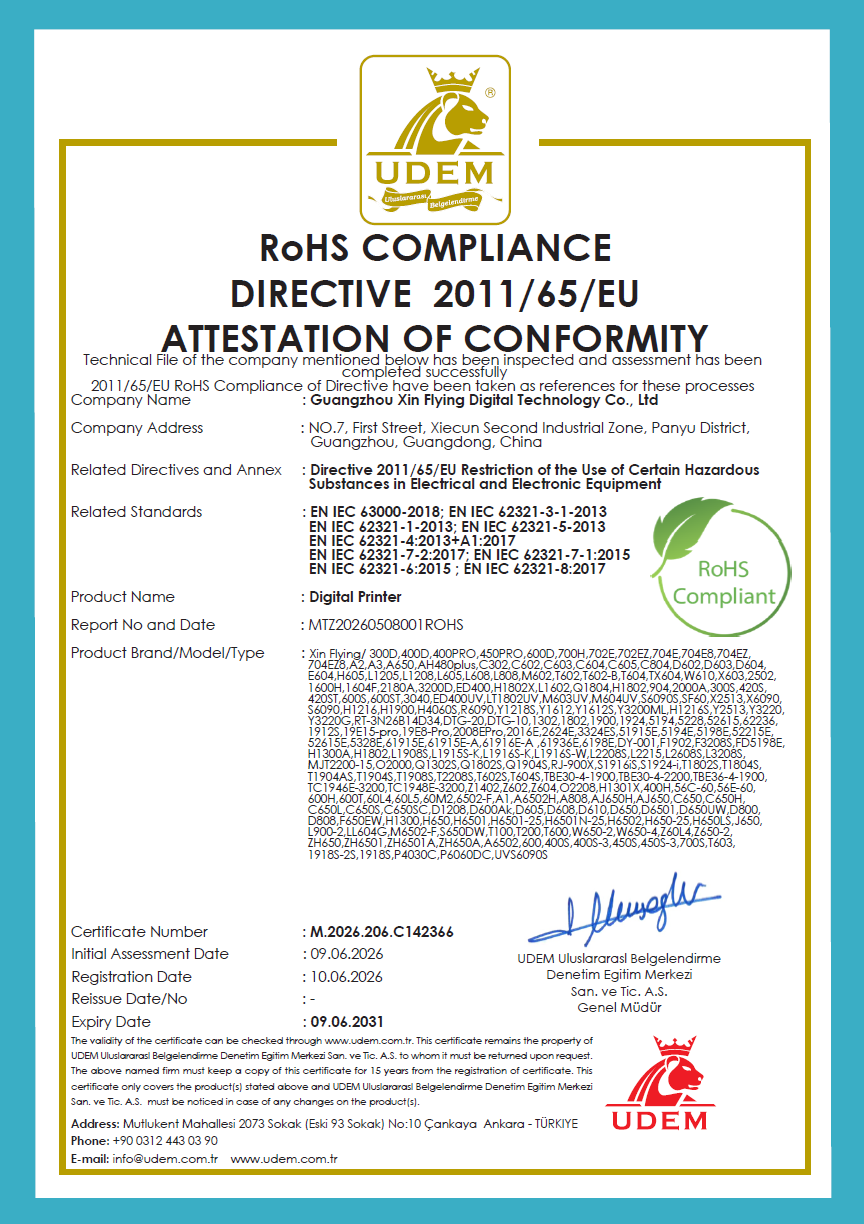
A RoHS check inside an industrial sublimation printer specification review answers one question: can the supplier produce a restricted-substances document that names the exact machine the buyer is evaluating? For XINFLYING (Guangzhou Xin Flying Digital Technology Co., Ltd.), that document exists for the XF-19E15-PRO. It is RoHS Compliance Certificate M.2026.206.C142366, issued by UDEM under Directive 2011/65/EU, assessed against EN IEC 63000:2018 and the EN IEC 62321 series, dated 10 June 2026 and valid until 9 June 2031.
Why RoHS Is Misread in Most Printer Specification Reviews
RoHS is rarely the line item that decides which large format sublimation printer a buyer purchases. It is, however, frequently the line item that delays an order, blocks a customs file, or surfaces after installation when a distributor tries to resell the machine into a regulated market.
The reason is structural. A dye sublimation printer is one product made of many regulated parts: a control cabinet, motion control electronics, heater and dryer modules, wiring harnesses, sensors, and an ink circulation system. Environmental compliance for that assembly is a documentation obligation attached to the electrical and electronic equipment as a whole, not to a single purchased component. When a buyer treats RoHS as a checkbox rather than a document review, three failure patterns appear.
- Scope mismatch. The buyer receives a compliance statement that covers a component, an ink, or a printer family name, but not the specific industrial printer press being quoted.
- Standard mismatch. A certificate exists but does not reference an evaluation standard or a test-method series that a technical reviewer can trace.
- Date mismatch. The document is presented as permanent when it carries an issue date and an expiry date that must be re-verified before shipment or resale.
None of these are exotic risks. They are ordinary consequences of purchasing a machine whose specification sheet lists forty parameters and one compliance line. The fix is procedural: treat RoHS as a document with fields that can be checked, in the same way a printhead count or a 1900mm printing width is checked.
Industry Background: Why Environmental Documents Now Sit Beside Machine Specs
Digital textile printing has moved from sampling rooms into continuous production. Sublimation printers now run polyester fabric for sportswear, jerseys, home textiles, flags, banners, and soft signage, often in 24/7 operation inside controlled indoor environments. As that shift happened, the purchasing conversation widened. Buyers comparing a commercial sublimation printer today ask about supported fabrics and throughput, but also about which legal documents travel with the machine.
For European market entry, the answer is not a single certificate. A digital printing machine is assessed under several instruments, each with its own scope and its own paperwork. XINFLYING holds a set of these documents for its digital textile printer range, and the set is worth understanding because buyers frequently confuse one with another.
- RoHS — Directive 2011/65/EU, restricted substances in electrical and electronic equipment. Certificate M.2026.206.C142366.
- Machinery safety — Directive 2006/42/EC, assessed against EN ISO 12100:2010, EN 60204-1:2018/A1:2025 and EN ISO 12643-1:2023. Certificate of conformity M.2026.206.C142365.
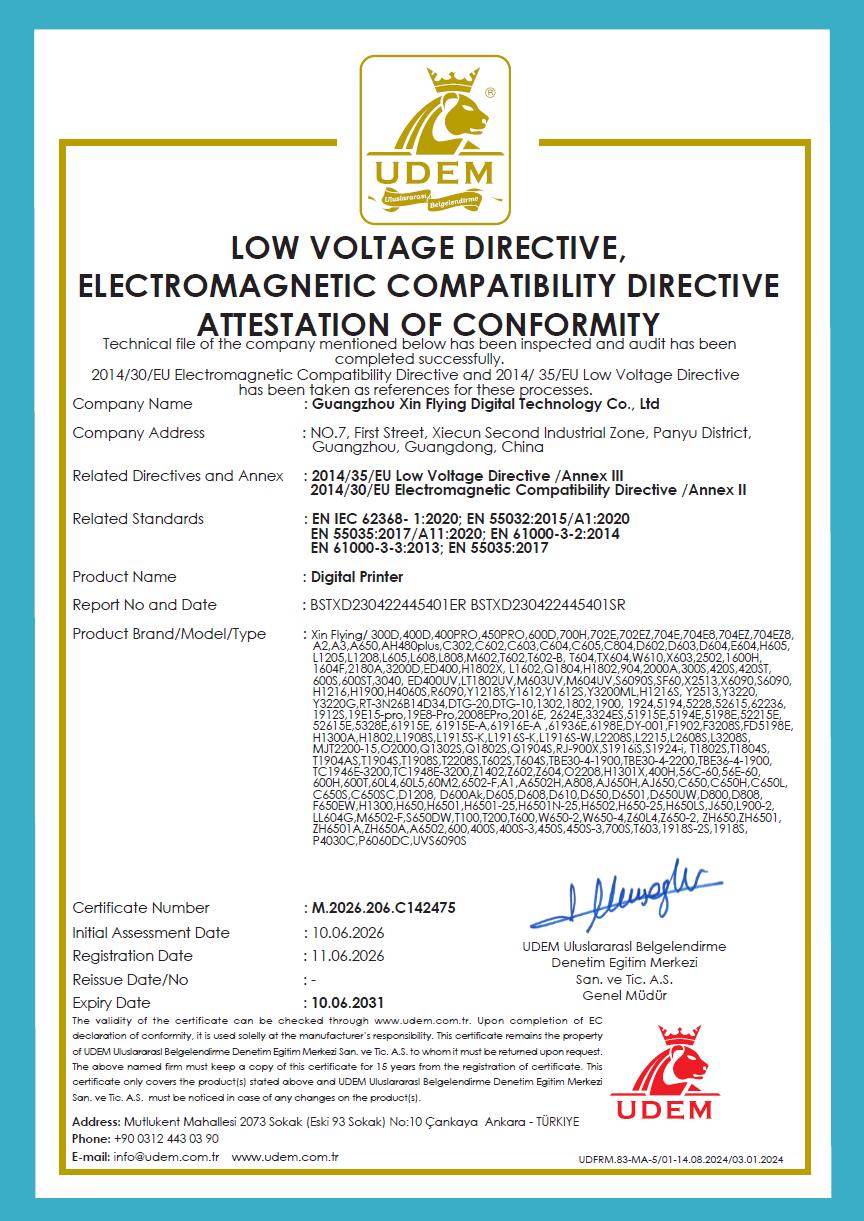
- Electrical safety and electromagnetic compatibility — LVD 2014/35/EU and EMC 2014/30/EU. Attestation M.2026.206.C142475, plus the TQT-issued certificates TQT1550D271EC and TQT1550D270EC.
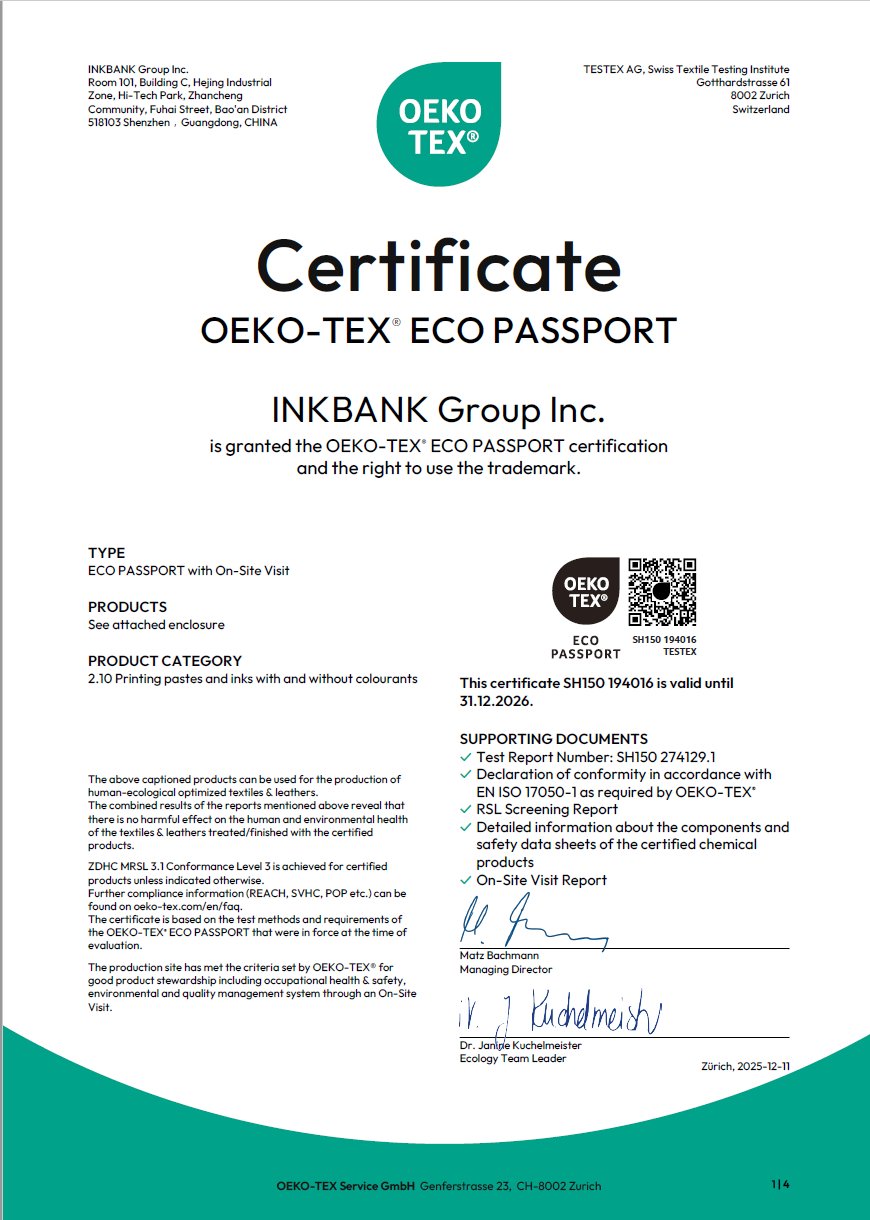
- Ink safety — OEKO-TEX® ECO PASSPORT SH150194016, held by TESTEX AG and covering textile printing inks and printing pastes, valid to 31 December 2026.
The important point for a specification review is that RoHS and OEKO-TEX answer different questions. RoHS addresses what the machine is built from. OEKO-TEX ECO PASSPORT addresses what goes onto the fabric. A buyer who asks for one and assumes it covers the other will leave a gap in the file.
What Certificate M.2026.206.C142366 Actually Covers
Read field by field, the certificate is unusually specific, and each field maps to a question a procurement reviewer should be asking.
| Certificate field | Recorded value | What it tells the buyer |
|---|---|---|
| Document type | RoHS Compliance Certificate | Restricted-substances document, not a general quality certificate |
| Certificate number | M.2026.206.C142366 | A traceable identifier that can be requested, matched and archived |
| Issuing body | UDEM | Third-party certification body, not a self-declaration by the manufacturer |
| Market | EU | Prepared for European market expectations |
| Scope | RoHS Compliance (Directive 2011/65/EU) | Names the legal instrument being addressed |
| Standard | EN IEC 63000:2018; EN IEC 62321 series | Gives the technical evaluation route and the test-method family |
| Issue date | 2026-06-10 | Start of the documented validity window |
| Expiry date | 2031-06-09 | End of the documented validity window |
| Covered models | XF-19E15-PRO and 14 further models | Confirms the machine under review is inside the scope |
Two details deserve emphasis. First, the certificate is model-linked. The covered list includes XF-19E15-PRO, XF-19E8-PRO, XF-O2000-4I32A1, XF-H1802X-2I32A1, XF-H1301X-1I32A1, XF-C602, XF-C604, XF-C605, XF-702E, XF-704E, XF-F606, XF-F808, XF-L608, XF-400D and XF-450PRO. A buyer comparing two 1900mm machines inside that list does not need to restart the RoHS conversation when the model choice changes.
Second, the certificate is dated, not open-ended. A five-year window from June 2026 to June 2031 is a working validity period, but it is still a period. Any buyer holding stock, reselling equipment, or filing technical documentation should record the expiry date and set a review reminder rather than treating the file as permanent. A related attestation of conformity issued under the same certificate number carries a 9 June 2026 issue date and the same 9 June 2031 expiry, so the two documents in the pack stay aligned.
Reading the standards behind the certificate
The standard field is where technical reviewers separate a real document from a decorative one. EN IEC 63000:2018 is the technical documentation route for assessing electrical and electronic equipment against hazardous substance restrictions. The EN IEC 62321 series supplies the test methods used to screen materials and components. On the accompanying attestation, the series is listed individually as EN IEC 62321-3-1:2013, EN IEC 62321-4:2013+A1:2017, EN IEC 62321-5:2013, EN IEC 62321-7-1:2015, EN IEC 62321-7-2:2017 and EN IEC 62321-8:2017.
For a buyer, the practical meaning is straightforward: the certificate does not rest on a supplier statement alone. It points to a recognised evaluation standard and a recognised testing family, which is what an importer needs when a downstream customer or an authority asks how the declaration was established. A certificate that names only the directive and nothing else is weaker evidence, even if it looks similar on the page.
Where RoHS stops
Restricted-substances compliance does not cover operator safety, guarding, emergency stops, electrical shock protection, or electromagnetic behaviour. Those sit under the machinery, low-voltage and EMC documents in the same pack. Nor does RoHS cover the printed output. Textile printing inks and printing pastes are addressed separately through OEKO-TEX® ECO PASSPORT SH150194016, issued by TESTEX AG under OEKO-TEX® ECO PASSPORT and EN ISO 17050-1, valid from 11 December 2025 to 31 December 2026.
A buyer assembling a file for a European textile customer should therefore hold both: the machine-level RoHS certificate and the ink-level ECO PASSPORT. Together they answer the two questions that end customers and auditors ask, and neither substitutes for the other.
A Six-Step RoHS Review for Sublimation Printer Buyers
The process below can be applied to any supplier, not only to XINFLYING. It uses the structure of certificate M.2026.206.C142366 as the working example.
Step 1 — Confirm the document type and issuing body
Ask for the certificate itself, not a screenshot of a compliance statement inside a brochure. Check that the issuing body is named and identifiable. On this document the issuer is UDEM, recorded in full on the attestation as UDEM International Certification Auditing Training Centre Industry and Trade Inc. Co.
Step 2 — Match the legal instrument
Confirm that the scope field names the RoHS directive rather than a generic environmental phrase. The recorded scope here is RoHS Compliance (Directive 2011/65/EU). If a supplier returns a document whose scope reads as a voluntary environmental pledge, it is not the same thing and should not be filed as RoHS evidence.
Step 3 — Check the evaluation standard
Look for a standard that a reviewer can trace. The combination of EN IEC 63000:2018 with the EN IEC 62321 series shows both the assessment route and the test-method family. Note both, and record them in your own file so a future audit does not require re-requesting the document.
Step 4 — Verify the model against your quotation
This is the step that most often fails. Compare the covered model list against the exact model on your proforma invoice. The certificate covers 15 XINFLYING digital textile printer models including XF-19E15-PRO. If your quotation names a model outside that list, ask for the correct document before paying a deposit.
Step 5 — Record issue and expiry dates
Write both dates into the purchase file. Certificate M.2026.206.C142366 runs from 10 June 2026 to 9 June 2031. An expiry date is not a warning sign, it is normal practice; the risk lies in not knowing when the document lapses, particularly for buyers who keep machines in a rental fleet or resell them into the EU.
Step 6 — Cross-check the surrounding compliance pack
RoHS should never travel alone. Confirm that the same model also appears on the machinery safety and the LVD/EMC documents. XINFLYING issues machinery safety conformity under M.2026.206.C142365 (Directive 2006/42/EC) and combined LVD and EMC attestation under M.2026.206.C142475 (LVD 2014/35/EU and EMC 2014/30/EU), with TQT-issued certificates TQT1550D271EC and TQT1550D270EC covering the same product range. A pack where the model names agree across all documents is a pack that will survive scrutiny.
Reviewer shortcut: if the certificate number, the directive, the standard, the model name and the expiry date all reconcile with the quotation, the RoHS line in the specification review is closed. If any single one of those five elements fails to reconcile, the line stays open regardless of how the document looks.
Applying the Review to Real Buying Situations
RoHS questions do not arrive in the same shape for every buyer. Three situations cover most of the cases where this document matters.
The EU importer building a customs and resale file
An importer bringing an industrial sublimation printer into the European Union needs a document set that can be produced on request. RoHS certificate M.2026.206.C142366, machinery conformity M.2026.206.C142365 and LVD/EMC attestation M.2026.206.C142475 all carry the same model scope, which means a single model list can be filed once and reused. For an importer, the value is not the certificate itself but the consistency of the pack across three legal instruments.
The distributor reselling under its own brand structure
A distributor selling equipment onward to textile producers is often asked by its own customers whether the machine is compliant. Being able to forward a named certificate, with a named issuing body, a named directive and a defined validity window, is faster and more defensible than answering in general terms. It also protects the distributor when a customer later reads a competitor page that claims certification without specifying scope.
The printer running continuous textile production
A digital textile printing service provider buying multiple units cares about uptime first. RoHS does not change print quality, but it does belong in the vendor file that supports long-run contracts with brand customers. XINFLYING production cases show this pattern in practice: a digital textile printing service provider running five units over three years for sportswear brands and apparel factories, a sports uniform supplier in Brazil running eight units over five years, and a sportswear manufacturer in Brazil running 15 units over four years for jerseys and team uniforms. In each case the equipment decision was about capacity and colour consistency; the compliance file was what allowed those relationships to be formalised with the buyers downstream.
Compliance Comparison: Four Document Types Buyers Confuse
The table below uses only the recorded values from XINFLYING certificate and attestation documents. It is intended to show overlap and boundaries, not to rank one document above another.
| Document | Legal basis / scope | Standards referenced | Issuer | Valid to | What it covers |
|---|---|---|---|---|---|
| RoHS Compliance Certificate M.2026.206.C142366 | RoHS Directive 2011/65/EU | EN IEC 63000:2018; EN IEC 62321 series | UDEM | 2031-06-09 | XF-19E15-PRO plus 14 further digital textile printer models |
| CE MD Certificate of Conformity M.2026.206.C142365 | Machinery Directive 2006/42/EC | EN ISO 12100:2010; EN 60204-1:2018/A1:2025; EN ISO 12643-1:2023 | UDEM | 2031-06-09 | Same 15-model scope |
| CE LVD & EMC Attestation M.2026.206.C142475 | LVD 2014/35/EU and EMC 2014/30/EU | EN IEC 62368-1:2020/A11:2020; EN 55032:2015/A1:2020; EN 55035:2017; EN 61000-3-2:2014; EN 61000-3-3:2013 | UDEM | 2031-06-10 | Same 15-model scope |
| CE EMC Certificate of Compliance TQT1550D270EC | EMC Directive 2014/30/EU | EN 55032:2015/A11:2020; EN 55035:2017/A11:2020; EN IEC 61000-3-2:2019+A1:2021; EN 61000-3-3:2013/A2:2021 | TQT | 2099-01-01 | Same model range |
| CE LVD Certificate of Compliance TQT1550D271EC | LVD 2014/35/EU | EN IEC 62368-1:2020/A11:2020 | TQT | 2099-01-01 | Digital printer products |
| OEKO-TEX® ECO PASSPORT SH150194016 | Textile printing inks and printing pastes | OEKO-TEX® ECO PASSPORT; EN ISO 17050-1 | TESTEX AG | 2026-12-31 | Inks and pastes, not the machine |
Read across the rows and one pattern is clear: the machine-level documents share a model list, while the ink document follows a different scope entirely. That is why a buyer who files only the RoHS certificate has a machine file but no consumable file, and a buyer who files only the ECO PASSPORT has neither.
Note also that the OEKO-TEX document expires earlier than any of the others — 31 December 2026. For a textile producer supplying skin-contact garments, that date belongs in the renewal calendar alongside the machine documents, because ink certification and machine certification renew on different cycles.
What the Supplier Side Looks Like
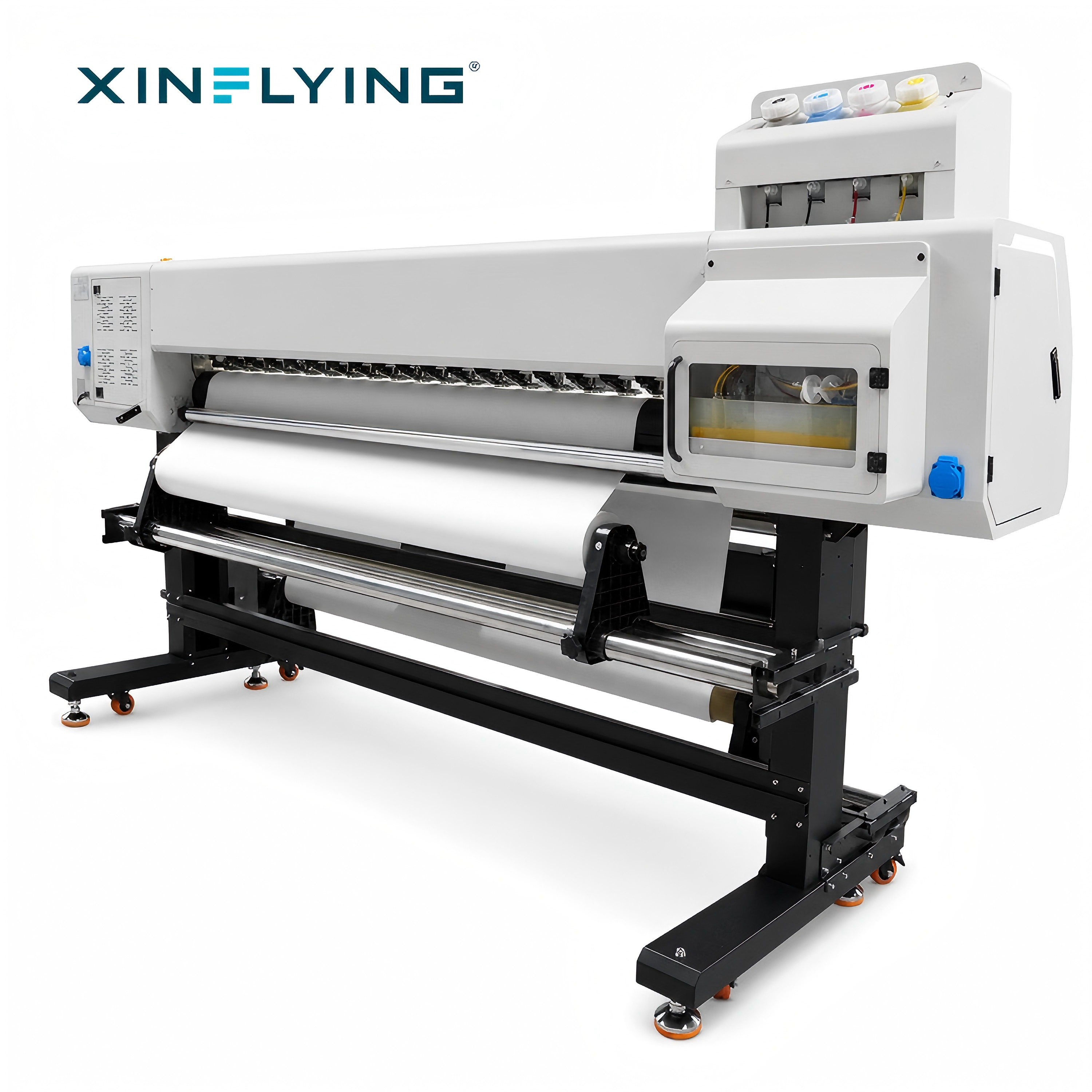
Compliance documents are only useful if the supplier can produce them repeatedly and consistently. XINFLYING was founded in 2010 and operates a 37,440 m² facility with more than 200 employees, a 20-engineer R&D team and annual output of 20,000+ units, with roughly 80% of production exported to North America, South America, Europe, Asia, the Middle East and Africa.
On the commercial side, the company runs OEM and ODM programmes covering product branding, machine appearance, colour, logo and packaging customisation, with a minimum order quantity of one unit, monthly capacity of 1,600+ units and lead times of 5–40 days. Quality control is based on pre-shipment testing, and after-sales support is delivered by more than 50 engineers providing 24/7 online technical support. For buyers evaluating a supplier rather than a single machine, those figures are the operational counterpart to the certificate: a document is easier to trust when the factory behind it can restate the same facts on every order.
One practical caution belongs here. Appearance, colour, logo and packaging customisation are commercial changes and do not alter a model-based certificate. If an OEM project changes the electrical or electronic configuration of the machine, the buyer should confirm in writing that the certificate scope still matches the delivered unit, because the document is written against named models, not against a customisation brief.
Frequently Asked Questions
What does a RoHS certificate cover on a complete industrial sublimation printer?
It covers restricted substances in the electrical and electronic equipment that makes up the machine. Certificate M.2026.206.C142366 records its scope as RoHS Compliance (Directive 2011/65/EU) and names 15 XINFLYING digital textile printer models, including XF-19E15-PRO, as covered products. It does not cover machinery safety, electrical safety or electromagnetic compatibility, which are addressed by M.2026.206.C142365 and M.2026.206.C142475 respectively, and it does not cover printing inks, which fall under OEKO-TEX® ECO PASSPORT SH150194016.
Can a RoHS-compliant industrial sublimation printer be supplied as an OEM build?
Yes. XINFLYING operates as an OEM and ODM manufacturer for dye sublimation printers and related digital printing equipment, with customisation covering product branding, machine appearance, colour, logo, packaging and solutions built around specific customer requirements. The minimum order quantity is one unit. Buyers contracting an OEM build should still confirm that the delivered configuration matches the model named on RoHS certificate M.2026.206.C142366, because the certificate is written against model names rather than against customisation requests.
What payment and delivery terms apply when ordering a certified unit?
Standard purchasing terms are a minimum order quantity of one unit, delivery under EXW, FOB, CIF or DDP, and payment by T/T, Western Union or PayPal. Acceptance is based on pre-shipment testing. Buyers should confirm the exact delivery term in the proforma invoice, since EXW and DDP place very different obligations on the importer when compliance documents are being filed at destination.
Can I request the RoHS documentation and a sample before placing an order?
Yes. Documentation and pre-order evaluation are reasonable requests at the quotation stage, and a minimum order quantity of one unit means a single machine can be evaluated before a larger commitment. To start, contact XINFLYING at info@xin-flying.com or WhatsApp +86 188-1322-1357 and request the RoHS certificate M.2026.206.C142366 together with the covered model list, so the document can be matched against the model you intend to buy before any deposit is paid.
What is the lead time for the models listed on the certificate?
Lead time is 5–40 days depending on model and configuration, supported by a monthly capacity of 1,600+ units. Because the same 15-model scope appears across the RoHS, machinery and LVD/EMC documents, a model substitution within that list does not restart the compliance file — but it should still be confirmed in writing on the order.
Conclusion
RoHS earns its place in a sublimation printer specification review because it is one of the few lines on the sheet that can be verified rather than estimated. A certificate number, an issuing body, a named directive, an evaluation standard, a validity window and a model list either reconcile with the quotation or they do not. For the XF-19E15-PRO, they reconcile: certificate M.2026.206.C142366, issued by UDEM under Directive 2011/65/EU, assessed against EN IEC 63000:2018 and the EN IEC 62321 series, valid to 9 June 2031, with the model named on the covered list alongside 14 other XINFLYING digital textile printers.
The wider lesson is that machine compliance and consumable compliance travel on different tracks, and neither replaces the other. Buyers who build the file at quotation stage — RoHS for the machine, ECO PASSPORT for the ink, machinery and LVD/EMC for safety — spend far less time resolving document questions after the container arrives.
Review the documents before you review the price
XINFLYING supplies industrial dye sublimation printers with a complete EU compliance pack, OEM and ODM customisation from one unit, pre-shipment testing and 24/7 technical support from over 50 engineers.
Request RoHS certificate M.2026.206.C142366 with the covered model list, or download the company profile: XINFLYING corporate brochure (PDF).
Website: www.xin-flying.com · Email: info@xin-flying.com · WhatsApp: +86 188-1322-1357
Have Questions or Need More Details?
Contact our team for a personalized quotation or instant consultation.
Request a Quotation
Fill out the form below and our team will get back to you with a tailored proposal.
WhatsApp Direct Chat
Prefer to chat in real-time? Message us on WhatsApp for instant assistance & quick answers.
- Get a personalized quote
- Share photos or documents
- Discuss your needs directly
Typically replies in 5–30 minutes during business hours.