
Safety Standards and Voltage Compliance in Industrial Sublimation Printers
Safety Standards and Voltage Compliance in Industrial Sublimation Printers
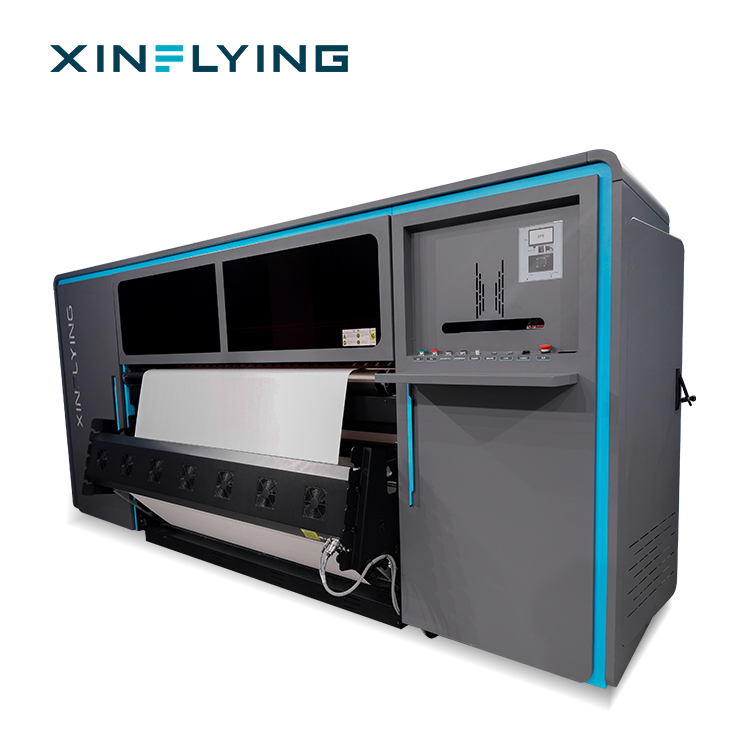
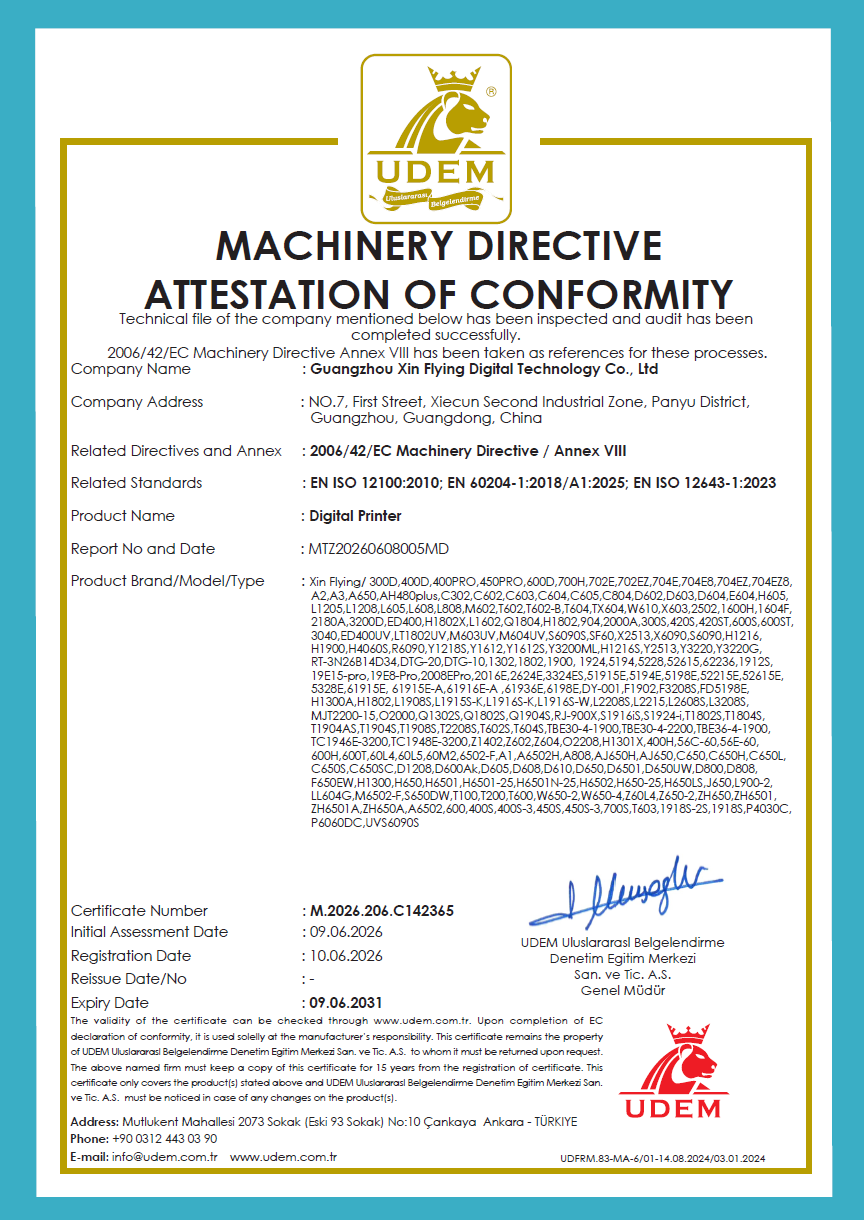
Two separate verification tracks decide whether an industrial sublimation printer can be legally installed, insured and operated in the European Union: the machinery safety standards cited in its CE documentation, and the electrical supply the machine actually demands on the production floor. Xinflying's XF-19E15-PRO and XF-19E8-PRO are covered by CE Machinery Directive certificates that cite EN ISO 12100:2010, EN 60204-1:2018/A1:2025 and EN ISO 12643-1:2023. The same two models are documented at 210–230 V and 45 A, with rated power of 14.5 kW and 10.2 kW respectively.
That combination — standards discipline plus voltage and load discipline — is what EHS managers, maintenance engineers and technical procurement teams are asked to sign off on before a machine is commissioned. This guide separates the parts that actually get audited: the scope of each standard, the certificate evidence that should sit in the project file, the electrical figures that determine whether a site is ready, and the checks that catch a mismatch before the machine leaves the factory.
Problem Definition: Why “CE Certified” Is Not One Answer
Industrial sublimation printers enter the EU market under four different legal instruments, and a complete supplier file normally contains evidence for all four: Machinery Directive 2006/42/EC, Low Voltage Directive 2014/35/EU, Electromagnetic Compatibility Directive 2014/30/EU, and RoHS Directive 2011/65/EU. Each instrument has its own declaration, its own harmonised standards, and its own technical justification.
The most common evaluation error is treating the CE mark as a single pass/fail attribute. In practice, the four tracks answer four different questions:
- Machinery safety — how were mechanical, thermal and process hazards identified and reduced?
- Electrical safety — how is the machine's electrical equipment protected against electric shock, overcurrent and fault conditions?
- Electromagnetic compatibility — what does the machine emit, and what interference can it tolerate?
- Restricted substances — do materials and components comply with hazardous-substance limits?
A second risk sits entirely outside the machine: facility readiness. A certificate of conformity confirms that the machine conforms; it does not confirm that the building has the circuit, the disconnecting device or the earthing arrangement the machine needs. A 15-printhead industrial sublimation printer is documented at 14.5 kW and 45 A. A site designed around a standard 16 A industrial socket cannot commission that machine, regardless of how complete the certificate file is.
Industry Background: Why Compliance Scrutiny Is Rising
The global dye sublimation printing market was valued at USD 16.4 billion in 2025 and is projected to reach USD 39.0 billion by 2033, with a projected CAGR of 11.5% between 2026 and 2033 (Grand View Research). Asia Pacific accounted for 36.5% of 2025 revenue, led by China as the largest single country market. The dye sublimation printer segment alone was valued at USD 1.88 billion in 2025 and is expected to reach USD 2.53 billion by 2030 (Mordor Intelligence).
That scale has changed who reviews the equipment. In China alone, textile and garment exports reached USD 293.6 billion in 2023, which means a substantial share of the world's sublimated fabric passes through facilities that must satisfy buyer audits, retailer compliance programmes and customs checks alongside their own internal EHS requirements.
Machine format is standardising as well. Roll-to-roll sublimation printers with widths of 1.9 m (1900 mm) are the established format for high-volume textile and soft signage production (FESPA). Standardised formats produce standardised expectations: buyers compare models on the same specification sheet, which is why certificate numbers and rated power now appear next to print width and print speed in the same evaluation table.
Duty cycle raises the stakes further. Industrial sublimation lines are commonly specified for 24/7 operation inside a controlled environment of 18–30 °C and 35–65% relative humidity. Continuous operation is precisely the condition under which electrical protection, thermal management and maintenance access stop being theoretical questions.
The Three Machinery Safety Standards Applied to Sublimation Printers
Xinflying's CE Machinery Directive certificates for the XF-19E15-PRO and XF-19E8-PRO cite three standards. They are not interchangeable: one is a methodology standard, one governs the electrical equipment of the machine, and one addresses printing-specific hazards.
EN ISO 12100:2010 — Risk Assessment and Risk Reduction
EN ISO 12100:2010 sets the methodology for machinery safety: define the limits of the machine, identify hazards, estimate and evaluate risk, then reduce risk in a defined order — inherently safe design first, safeguarding and complementary protective measures second, and information for use third. For a sublimation printer, the hazard inventory spans mechanical hazards at the carriage and media path, thermal hazards from heating and drying assemblies, contact with inks and cleaning agents, and electrical hazards.
What an EHS manager should expect to see behind this standard: a documented risk assessment, a residual-risk statement, guarding design consistent with that assessment, and warning markings and manual content that match the machine as delivered.
EN 60204-1:2018/A1:2025 — Electrical Equipment of Machines
EN 60204-1 is the standard that connects the machine to the building. It governs the electrical equipment of machines, covering the supply interface and everything downstream of it: the supply disconnecting device, protection against electric shock, overcurrent and short-circuit protection, protective bonding, conductor sizing and identification, control functions, and verification and testing before commissioning.
The amendment reference matters when reading a certificate. A declaration citing EN 60204-1:2018/A1:2025 records that the amended edition was assessed; older documentation may cite an earlier edition. Confirming the edition in the certificate takes seconds and indicates whether the technical file has been maintained.
EN ISO 12643-1:2023 — Safety Requirements for Graphic Technology Equipment
EN ISO 12643-1:2023 addresses safety requirements for graphic technology equipment and systems, the equipment family that industrial inkjet and sublimation printers belong to. It brings printing-specific hazards into scope: access to moving parts during threading, cleaning and maintenance; nip and entanglement points along the media path; exposure to inks and cleaning agents; and the information-for-use requirements that must accompany the equipment.
| Standard | What it governs | What it drives in the project file |
|---|---|---|
| EN ISO 12100:2010 | Risk assessment and risk reduction methodology for machinery | Risk assessment record, residual-risk statement, guarding description, warning markings |
| EN 60204-1:2018/A1:2025 | Electrical equipment of machines: supply interface, shock protection, bonding, control, verification | Electrical documentation, supply disconnecting device specification, pre-commissioning verification records |
| EN ISO 12643-1:2023 | Safety requirements for graphic technology equipment and systems | Machine-specific hazard analysis, information for use, guard and access specifications |
Certificate Evidence for the XF-19E15-PRO and XF-19E8-PRO
Guangzhou Xin Flying Digital Technology Co., Ltd. (XINFLYING) is a digital printing equipment manufacturer founded in 2010 in Panyu, Guangzhou, China, producing DTF printers, dye sublimation printers, DTG printers, UV DTF printers and UV flatbed printers, with a 37,440 m² manufacturing facility, a 20-engineer R&D team and an 80% export ratio across North America, South America, Europe, Asia, the Middle East and Africa.
Because the two flagship 1900 mm sublimation models share the same print width and printhead family, buyers sometimes assume the compliance files are identical. They are not: the machinery safety certificate numbers differ, and each certificate names the models it covers.
- XF-19E15-PRO — machinery safety: CE MD Certificate of Conformity M.2026.206.C142365, issued by UDEM, scope Machinery Safety Compliance under MD 2006/42/EC, citing EN ISO 12100:2010; EN 60204-1:2018/A1:2025; EN ISO 12643-1:2023. Issued 10 June 2026, valid to 9 June 2031.
- XF-19E8-PRO — machinery safety: CE MD Certificate of Conformity M.2026.206.C142385, issued by UDEM, same scope and the same three standards. Issued 10 June 2026, valid to 9 June 2031.
- Electrical safety (both models): CE LVD Certificate of Compliance TQT1550D271EC issued by TQT (Shenzhen Tianqi Testing Technology Service Co., Ltd.) under EN IEC 62368-1:2020/A11:2020, for LVD 2014/35/EU. Issued 19 May 2026.
- EMC (both models): CE EMC Certificate of Compliance TQT1550D270EC issued by TQT under EMC Directive 2014/30/EU, citing EN 55032:2015/A11:2020; EN 55035:2017/A11:2020; EN IEC 61000-3-2:2019+A1:2021; EN 61000-3-3:2013/A2:2021. Issued 19 May 2026.
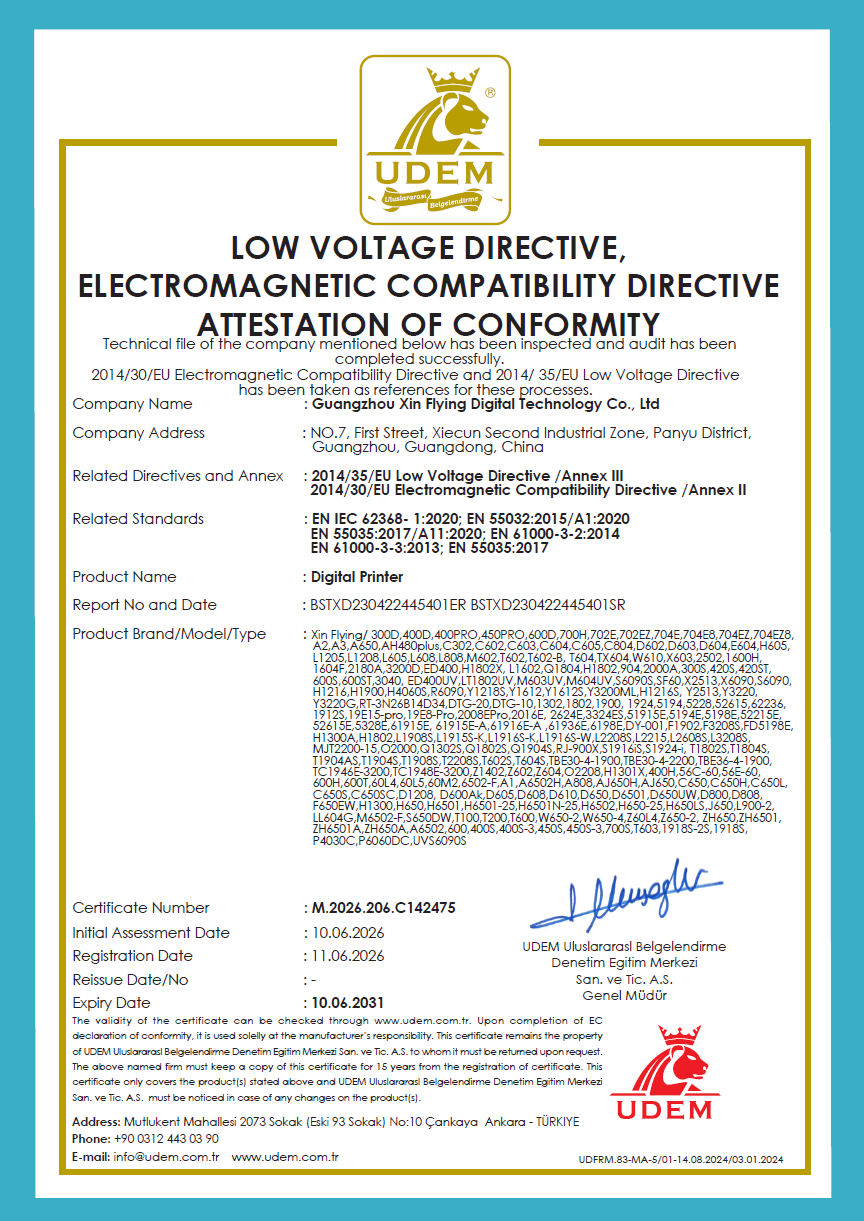
- Combined LVD & EMC: certificate M.2026.206.C142475 issued by UDEM covering LVD 2014/35/EU and EMC 2014/30/EU. Issued 11 June 2026, valid to 10 June 2031.
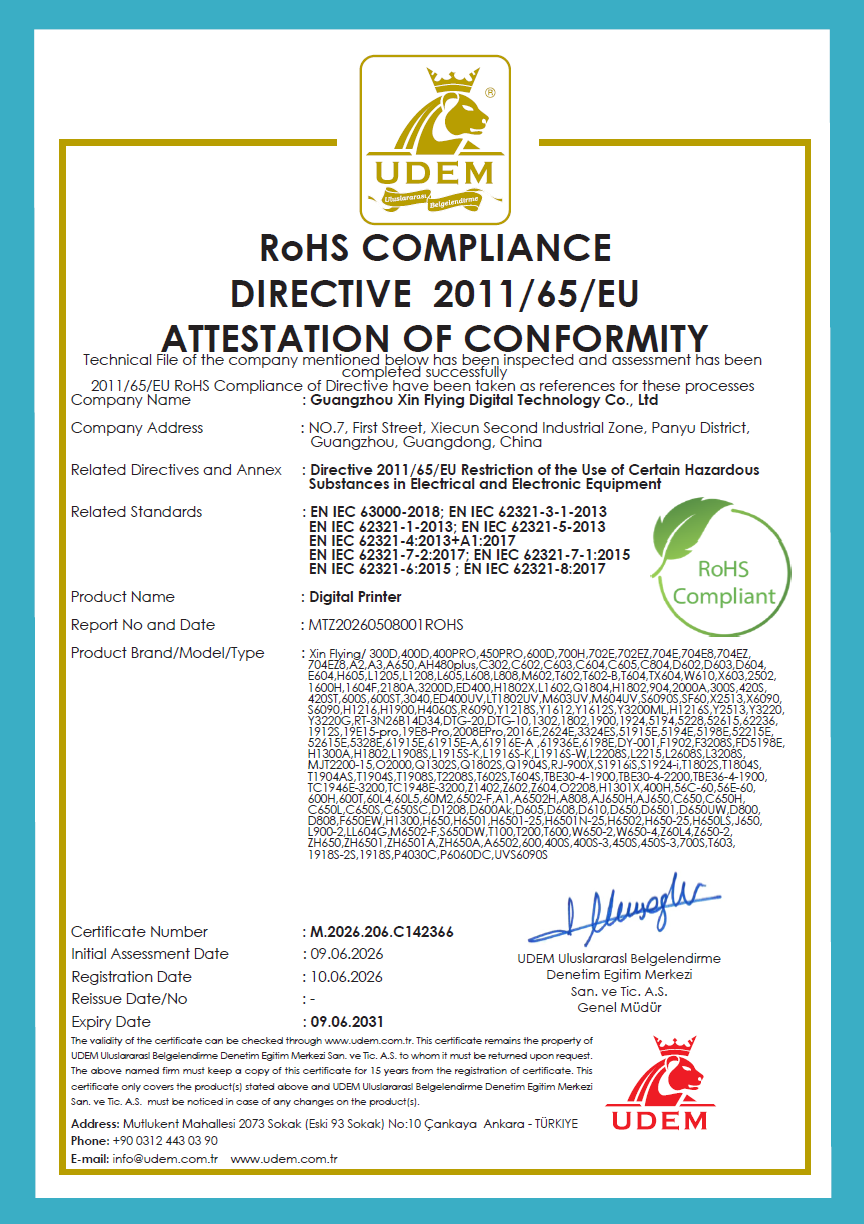
- RoHS: certificate M.2026.206.C142366 issued by UDEM under Directive 2011/65/EU, citing EN IEC 63000:2018 and the EN IEC 62321 series. Issued 10 June 2026, valid to 9 June 2031.
- Ink and paste compliance: OEKO-TEX ECO PASSPORT certificate SH150194016 issued by TESTEX AG for textile printing inks and printing pastes, referencing EN ISO 17050-1, valid to 31 December 2026.
Voltage and Power Supply Compliance: The Numbers That Decide Site Readiness
Machinery safety and electrical safety are assessed on the machine. Voltage compliance is assessed on the machine and the building together, which is why the power figures belong in the same review as the certificates.
- XF-19E15-PRO: rated power 14.5 kW; power supply 210–230 V, 45 A; operating environment 18–30 °C, 35–65% RH; machine size 3840×1570×1800 mm; net weight 1480 kg.
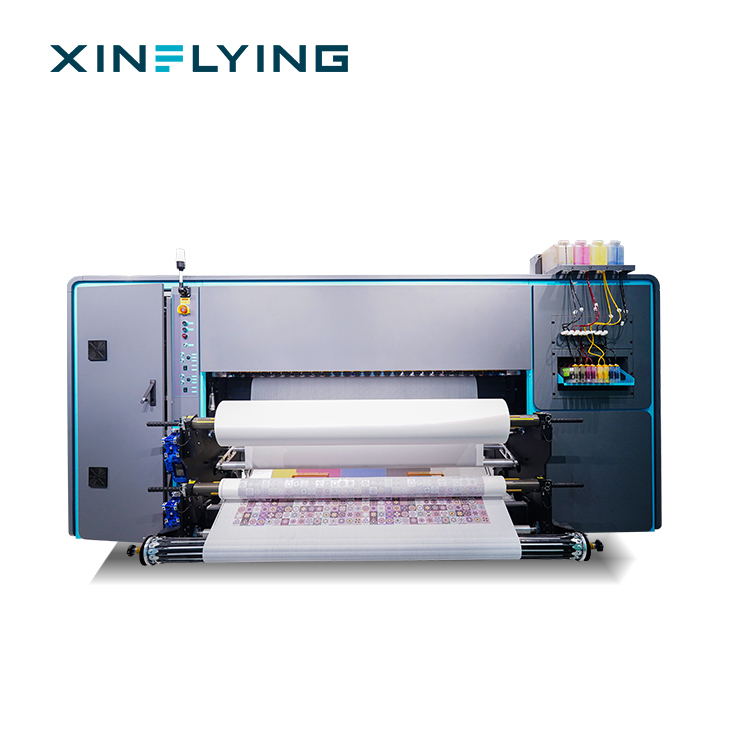
- XF-19E8-PRO: rated power 10.2 kW; power supply 210–230 V, 45 A; operating environment 18–30 °C, 35–65% RH; machine size 3840×1300×1800 mm; net weight 1400 kg.
The electrical safety certificate for the Xinflying digital printer range is based on EN IEC 62368-1:2020/A11:2020, the equipment safety standard cited in the CE LVD certificate issued for LVD 2014/35/EU. The EMC file covers both directions of electromagnetic behaviour: EN 55032 for emission, EN 55035 for immunity, EN IEC 61000-3-2 for harmonic current, and EN 61000-3-3 for voltage fluctuations and flicker.
One practical constraint for buyers outside Europe: the 1900 mm industrial sublimation models are documented at a 210–230 V supply. Where a site runs on 110 V, dual-range supplies are documented on other models in the range — the XF-H1301X-1I32A1 at 110/220 V, 18 A/9 A and 2 kW rated power, and the XF-H1802X-2I32A1 at 110/220 V, 27.2 A/13.6 A and 3.5 kW rated power, both 50–60 Hz. Matching model to site voltage is a specification decision made before the order, not an after-sales adjustment.
Step-by-Step: Verifying Safety and Voltage Compliance Before Purchase
- Define the market and the legal route. For the EU, the file must cover MD 2006/42/EC, LVD 2014/35/EU, EMC 2014/30/EU and RoHS 2011/65/EU. For the United States, electromagnetic compatibility and electrical safety documentation is assessed against US requirements appropriate to the equipment configuration.
- Request the certificate set and match model numbers. Certificates name the models they cover. Confirm that the exact model string you are ordering appears in the scope, not a similar model from the same series.
- Read the standards list, not just the certificate title. Verify that EN ISO 12100:2010, EN 60204-1:2018/A1:2025 and EN ISO 12643-1:2023 appear, and note the edition and amendment years.
- Cross-check electrical certificates against the electrical specification. Match the LVD certificate standard (EN IEC 62368-1:2020/A11:2020) and the EMC standards list to the model's declared voltage, current and rated power.
- Size the site supply. Plan a dedicated circuit per machine at the documented 45 A rating for the 1900 mm models, confirm the supply disconnecting device and protective bonding arrangement, and calculate total connected load for multi-unit installations.
- Confirm the physical and environmental envelope. Check machine footprint, net weight, floor loading, service access, and the 18–30 °C / 35–65% RH operating window against the actual production room.
- Verify the information-for-use package. Request the operator manual, warning markings list and the training material that the EHS file will reference during induction.
- Confirm lifecycle support. Check spare parts availability, pre-shipment testing practice, and the technical support route you will rely on after commissioning.
Use Cases: Where Safety and Voltage Compliance Actually Bites
Compliance work is triggered by real production patterns rather than by abstract regulation. Four project profiles show where the verification effort concentrates.
- Digital textile printing service provider (5 units, 3 years). Serving sportswear brands, apparel factories and customised textile businesses. Because the printer serves third-party brand customers, the certification file is regularly requested during supplier audits — machinery safety, LVD/EMC and RoHS documentation must be model-matched and current.
- Sportswear manufacturer (15 units, 4 years). Producing football jerseys, basketball uniforms and customised sportswear, with patterns, team logos and full-colour designs printed on polyester before cutting and sewing. For multi-unit installations of this type, the documented 45 A supply rating per machine becomes a facility-level design input rather than a single-machine detail.
- Sports uniform supplier (8 units, 5 years). Producing customised football kits, training uniforms and team apparel with personalised names, numbers and graphics, where short production cycles and continuous commercial printing drive the duty cycle.
- Home textile manufacturer (10 units, 4 years). Printing curtains, cushions and decorative fabrics in wide formats, where large-format applications require consistent quality across long production runs.
Across all four profiles, the same operating condition applies: 24/7 production inside a controlled indoor environment of 18–30 °C and 35–65% RH, with matched equipment that includes RIP software, a heat press calender, dye sublimation paper, dye sublimation ink and cutting equipment.
Model Comparison: Print Width, Power and Certification
The table below consolidates the specification and certification facts that a compliance review needs in one place. It covers five sublimation models in the Xinflying range and separates the machinery safety track from the electrical and materials compliance track.
| Model | Print width / printheads | Rated power / supply | Machinery safety (CE MD) | LVD / EMC / RoHS references |
|---|---|---|---|---|
| XF-19E15-PRO | 190 cm (75") / 15× Epson i3200-A1 | 14.5 kW; 210–230 V, 45 A | M.2026.206.C142365 (UDEM) — EN ISO 12100:2010; EN 60204-1:2018/A1:2025; EN ISO 12643-1:2023 | LVD TQT1550D271EC; EMC TQT1550D270EC; LVD & EMC M.2026.206.C142475; RoHS M.2026.206.C142366 |
| XF-19E8-PRO | 190 cm (75") / 8× Epson i3200-A1 | 10.2 kW; 210–230 V, 45 A | M.2026.206.C142385 (UDEM) — EN ISO 12100:2010; EN 60204-1:2018/A1:2025; EN ISO 12643-1:2023 | LVD TQT1550D271EC; EMC TQT1550D270EC; LVD & EMC M.2026.206.C142475; RoHS M.2026.206.C142366 |
| XF-O2000-4I32A1 | 195 cm (1.95 m) / 4× Epson i3200-A1 | 8.5 kW; 220 V, 50/60 Hz | CE MD coverage issued by UDEM — EN ISO 12100:2010 cited | LVD & EMC M.2026.206.C142475; LVD TQT1550D271EC; EMC TQT1550D270EC; RoHS M.2026.206.C142366 |
| XF-H1802X-2I32A1 | 180 cm (1.8 m) / 2× Epson i3200-A1 | 3.5 kW; 110/220 V, 27.2 A/13.6 A, 50–60 Hz | CE MD — EN ISO 12100:2010; EN 60204-1:2018/A1:2025; EN ISO 12643-1:2023 | LVD M.2026.206.C142475 and TQT1550D271EC; RoHS M.2026.206.C142366 |
| XF-H1301X-1I32A1 | 130 cm (1.3 m) / 1× Epson i3200-A1 | 2 kW; 110/220 V, 18 A/9 A, 50–60 Hz | CE MD Certificate of Conformity (UDEM) — EN ISO 12100:2010; EN 60204-1:2018/A1:2025; EN ISO 12643-1:2023 | LVD & EMC M.2026.206.C142475; RoHS citing EN IEC 63000:2018 and the EN IEC 62321 series |
All figures in this table come from Xinflying product specification data and the certificate records listed earlier in this article. Where a model falls outside the scope of a specific certificate, that certificate should not be presented as evidence for it.
Frequently Asked Questions
Which safety standards must an industrial sublimation printer meet to be placed on the EU market?
Four legal instruments apply: Machinery Directive 2006/42/EC, Low Voltage Directive 2014/35/EU, EMC Directive 2014/30/EU and RoHS Directive 2011/65/EU. Xinflying's XF-19E15-PRO and XF-19E8-PRO cite EN ISO 12100:2010, EN 60204-1:2018/A1:2025 and EN ISO 12643-1:2023 under CE MD Certificates of Conformity M.2026.206.C142365 and M.2026.206.C142385 issued by UDEM, with CE LVD certificate TQT1550D271EC based on EN IEC 62368-1:2020/A11:2020 and CE EMC certificate TQT1550D270EC.
What power supply do the XF-19E15-PRO and XF-19E8-PRO require?
Both 1900 mm models are documented at 210–230 V and 45 A, with rated power of 14.5 kW for the 15-printhead XF-19E15-PRO and 10.2 kW for the 8-printhead XF-19E8-PRO. Both are specified for an operating environment of 18–30 °C and 35–65% RH. Buyers on 110 V sites should confirm model-to-supply matching during specification; dual-range 110/220 V supplies are documented on other models in the range, including the XF-H1301X-1I32A1 at 2 kW and the XF-H1802X-2I32A1 at 3.5 kW.
How can a buyer confirm that a certificate actually covers the machine being purchased?
Read the certificate in four passes: the legal instrument, the exact model string, the standards list with edition and amendment years, and the validity dates. For example, machinery safety certificate M.2026.206.C142365 covers the XF-19E15-PRO and M.2026.206.C142385 covers the XF-19E8-PRO, both issued by UDEM on 10 June 2026 and valid to 9 June 2031. The combined LVD & EMC certificate M.2026.206.C142475 runs to 10 June 2031, and the RoHS certificate M.2026.206.C142366 runs to 9 June 2031. Ask the supplier to confirm scope in writing for the exact configuration ordered.
What verification happens before the machine is shipped?
Pre-shipment testing is part of Xinflying's stated quality control process, and the supporting document set should travel with the machine: the model-matched certificates, the standards list, and the information-for-use material. Where printed textiles are intended for markets with restricted-substance requirements, the ink and paste certificate also matters — Xinflying holds OEKO-TEX ECO PASSPORT certificate SH150194016, issued by TESTEX AG for textile printing inks and printing pastes and referencing EN ISO 17050-1, valid to 31 December 2026.
What are the delivery timelines, and how do I obtain the full compliance document pack?
Xinflying supports OEM and ODM projects with a minimum order quantity of 1 unit and lead times of 5–40 days depending on configuration and order volume, with production capacity of more than 1,600 units per month. Documentation requests are handled together with the commercial process: request the compliance pack — certificates, standards lists and the product brochure — alongside a sample or quotation by contacting the team at info@xin-flying.com or via WhatsApp on +86 188-1322-1357, and the relevant certificate set for your model and destination market will be provided for your EHS review.
Conclusion
Safety standards and voltage compliance are two different verification jobs on the same machine. The machinery safety side is settled by reading the certificate properly: EN ISO 12100:2010 for risk assessment methodology, EN 60204-1:2018/A1:2025 for the electrical equipment of the machine, and EN ISO 12643-1:2023 for printing-specific hazards, all named in the CE Machinery Directive Certificates of Conformity M.2026.206.C142365 (XF-19E15-PRO) and M.2026.206.C142385 (XF-19E8-PRO).
The electrical side is settled by reading the specification properly: 14.5 kW at 210–230 V / 45 A for the 15-printhead XF-19E15-PRO, 10.2 kW at 210–230 V / 45 A for the 8-printhead XF-19E8-PRO, supported by LVD and EMC certification and RoHS documentation, and backed by alternative models with documented 110/220 V dual-range supplies where a site requires them. Check the certificate scope, check the standard editions, check the site supply — in that order, before the order.
Next Step: Compliance Documents, Samples and Quotations
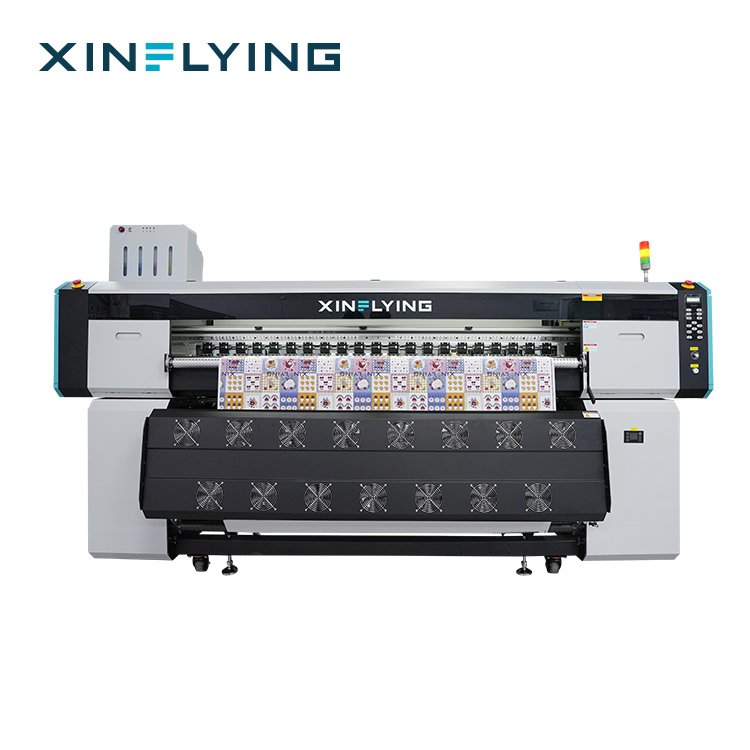
Guangzhou Xin Flying Digital Technology Co., Ltd. (XINFLYING) supplies dye sublimation printers, DTF printers, DTG printers, UV DTF printers and UV flatbed printers to importers, distributors, brand owners and textile manufacturers in more than 80% export markets across North America, South America, Europe, Asia, the Middle East and Africa.
Download the full company and product brochure: Xinflying Corporate Brochure (PDF)
Website: www.xin-flying.com | Email: info@xin-flying.com | Tel / WhatsApp: +86 188-1322-1357
Address: No.7, Xiecun 2nd Industrial Zone, Panyu, Guangzhou, Guangdong, China