
Sportswear Challenges: The XF-F606 vs XF-C604 Debate
The short answer: the XF-F606 and the XF-C604 are not two answers to the same question. The XF-F606 is a six-head production platform built around roll-based throughput. The XF-C604 is an A4-format DTF platform built around sampling, short runs and mixed-material orders. Both appear in the covered product list of the same EU Low Voltage Directive certificate — TQT1550D271EC, tested to EN IEC 62368-1:2020/A11:2020 — so the compliance question is settled before the capacity question begins. What separates them is the shape of your sportswear order book, not the certificate folder.
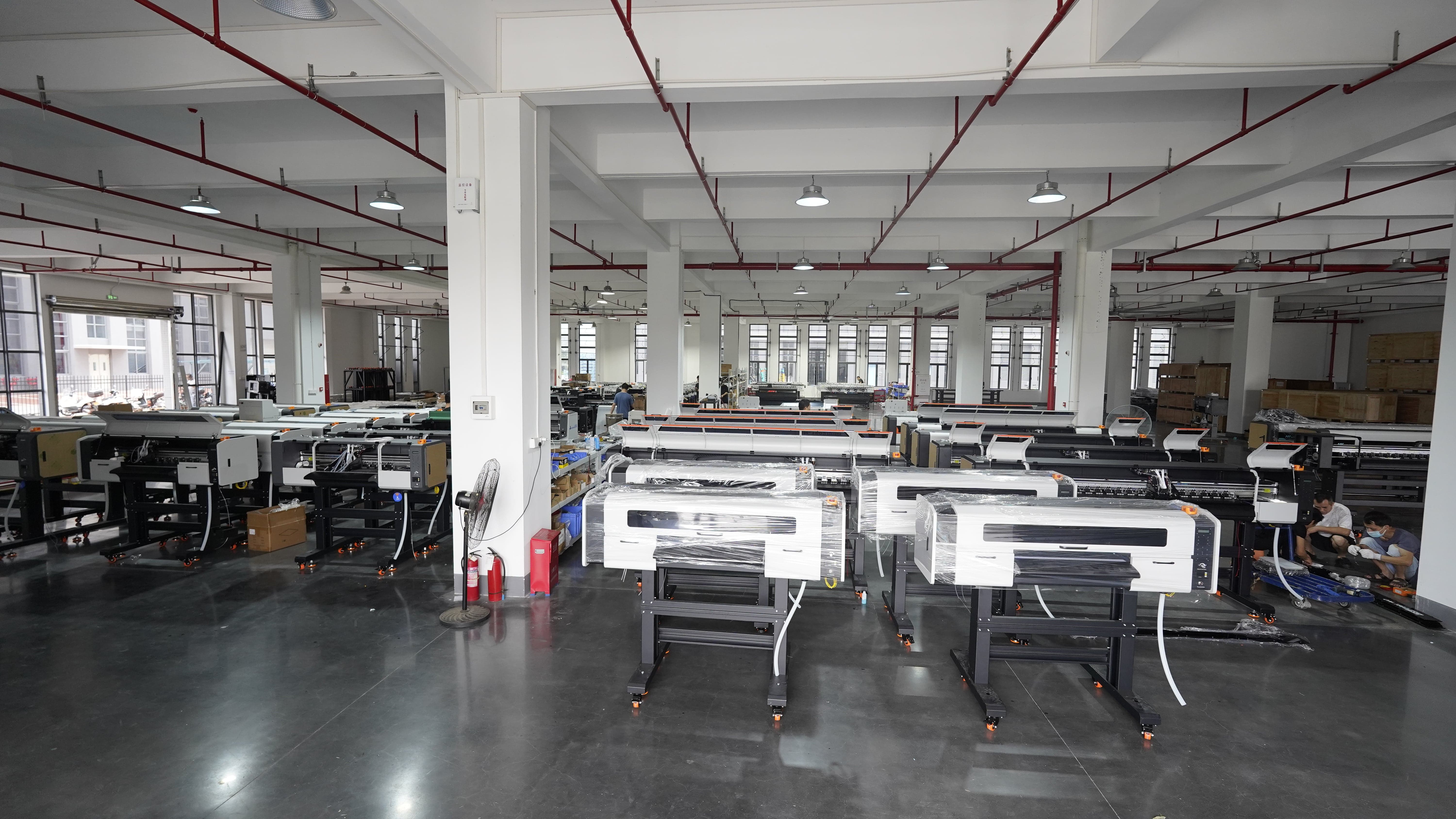
A XINFLYING production area where completed printers are staged before configuration, testing and shipment. The same assembly discipline applies whether the unit is a six-head platform or a compact DTF machine.
Why the Sportswear Buyer Faces a Harder Decision Than the General Textile Buyer
Sportswear compresses three pressures into one purchasing decision. First, order granularity: a club order for 40 jerseys, a league order for 600, and a retail drop of 12 colourways can land in the same week. Second, substrate discipline: dye sublimation printing only reaches full colour fastness on polyester-based materials, because the disperse dye must convert to gas and bond inside the fibre. Third, document discipline: EU-facing buyers increasingly audit certification at model level, not at brand level.
A sublimation printer that is technically capable of printing a jersey is not automatically the right machine for a sportswear business. The mismatch usually appears in one of two places — a production platform that is idle half the week because the order book is small and varied, or a compact machine that becomes the bottleneck the moment a team order with 14 sizes and 3 colour blocks arrives.
Decision rule in one line: if your output is measured in continuous rolls of polyester for repeating team programmes, the six-head XF-F606 fits the arithmetic. If your output is measured in samples, prototypes, mixed-fabric jobs and small custom runs, the A4-format XF-C604 fits the arithmetic. If both descriptions are true of your business, you are looking at a two-machine layout, not a compromise.
Industry Background: Why Polyester Sportswear Sets the Machine Specification
Dye sublimation printing is a heat transfer process in which solid dye becomes gas and permanently embeds into polyester-based materials. The chemistry is the reason sportswear and sublimation became linked: polyester fibres accept the dye into the fibre structure, so the print does not sit on top of the fabric. The practical result is a soft hand feel, breathability and colour that survives washing without a surface layer to crack.
The same chemistry sets the boundary. Cotton and other natural fibres do not offer the same bonding behaviour, which is why cotton-heavy apparel usually moves to DTF or DTG workflows instead. A sportswear manufacturer whose catalogue drifts toward cotton-blend teamwear is therefore not just changing fabric — it is changing printing technology. This is the single most common reason a buyer ends up evaluating a roll-to-roll sublimation platform and an A4 DTF platform in the same purchasing cycle.
On the compliance side, the European market has moved from 'does the supplier have CE' to 'does this certificate name this model'. A CE mark on a brochure proves nothing. The document set that matters is model-specific: the LVD certificate, the EMC certificate, the Machinery Directive attestation and the RoHS attestation, each cross-checked against the exact model string on the purchase order.
The Compliance Baseline Both Machines Inherit
This is the part of the debate that is often argued incorrectly. The XF-F606 and the XF-C604 are frequently discussed as if they sit in different compliance tiers because they sit in different production tiers. They do not. Both model numbers appear in the covered product list of the same core EU documentation issued to Guangzhou Xin Flying Digital Technology Co., Ltd.
The Low Voltage Directive certificate is TQT1550D271EC, issued by TQT (Shenzhen Tianqi Testing Technology Service Co., Ltd.) on 19 May 2026 under LVD 2014/35/EU, tested against EN IEC 62368-1:2020/A11:2020, with an expiry date of 2099-01-01. The EMC certificate is TQT1550D270EC, issued by the same body on the same date, tested against EN 55032:2015/A11:2020, EN 55035:2017/A11:2020, EN IEC 61000-3-2:2019+A1:2021 and EN 61000-3-3:2013/A2:2021.
A second layer of documentation comes from UDEM International Certification Auditing Training Centre. Machinery Directive attestation M.2026.206.C142365 and M.2026.206.C142385 are issued against MD 2006/42/EC, tested to EN ISO 12100:2010, EN 60204-1:2018/A1:2025 and EN ISO 12643-1:2023, valid to 2031-06-09. The RoHS attestation M.2026.206.C142366 is issued under Directive 2011/65/EU against EN IEC 63000:2018 and the EN IEC 62321 series, valid to 2031-06-09. A combined LVD and EMC attestation, M.2026.206.C142475, is valid to 2031-06-10.
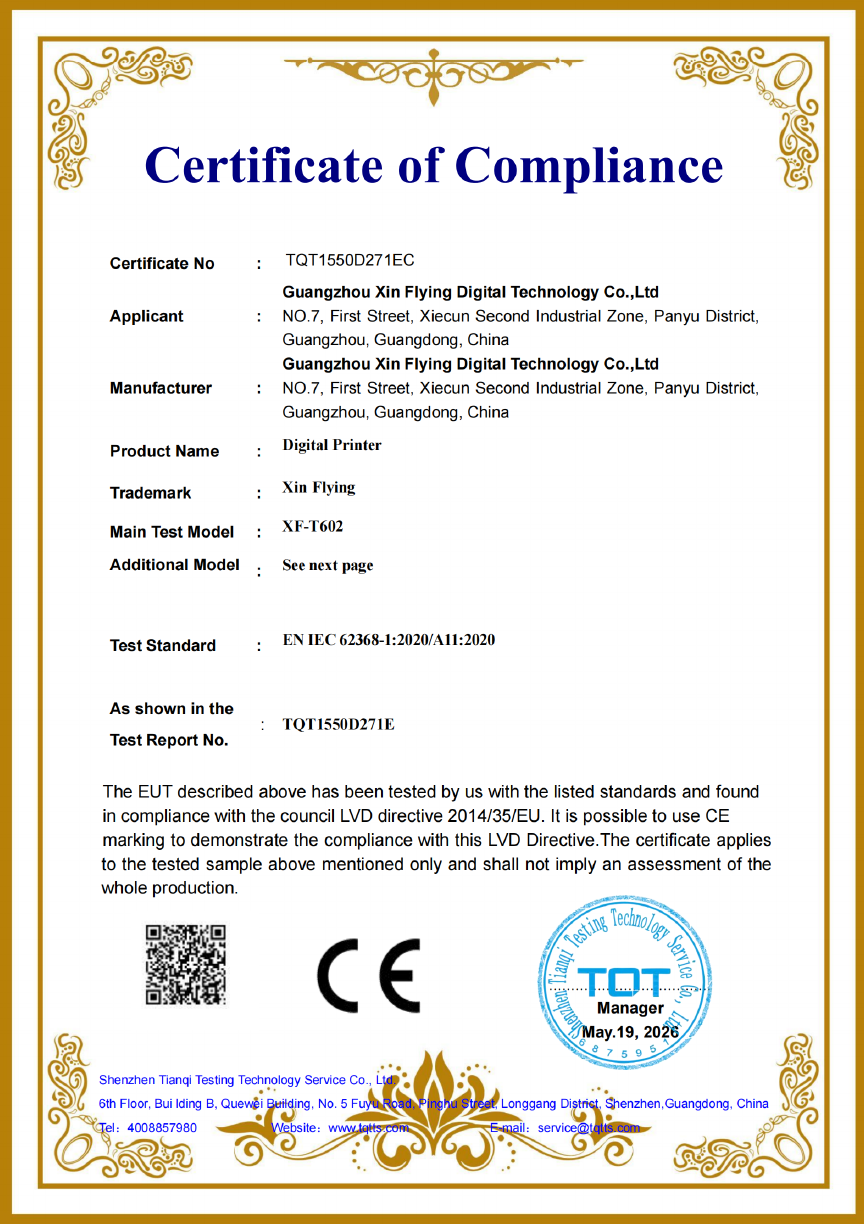
CE LVD Certificate of Compliance TQT1550D271EC, issued by TQT on 19 May 2026 against EN IEC 62368-1:2020/A11:2020. Both the XF-F606 and the XF-C604 appear in the covered product list.
One distinction is worth stating plainly, because it causes real procurement errors. OEKO-TEX® ECO PASSPORT certificate SH150194016, issued by TESTEX AG and valid from 11 December 2025 to 31 December 2026, covers textile printing inks and printing pastes. It is a consumable-level certificate, not a machine-level certificate. When a European buyer asks 'is this printer OEKO-TEX certified', the accurate answer is that the ECO PASSPORT applies to the ink chemistry used in the workflow, while the machine itself is governed by the LVD, EMC, MD and RoHS documents.
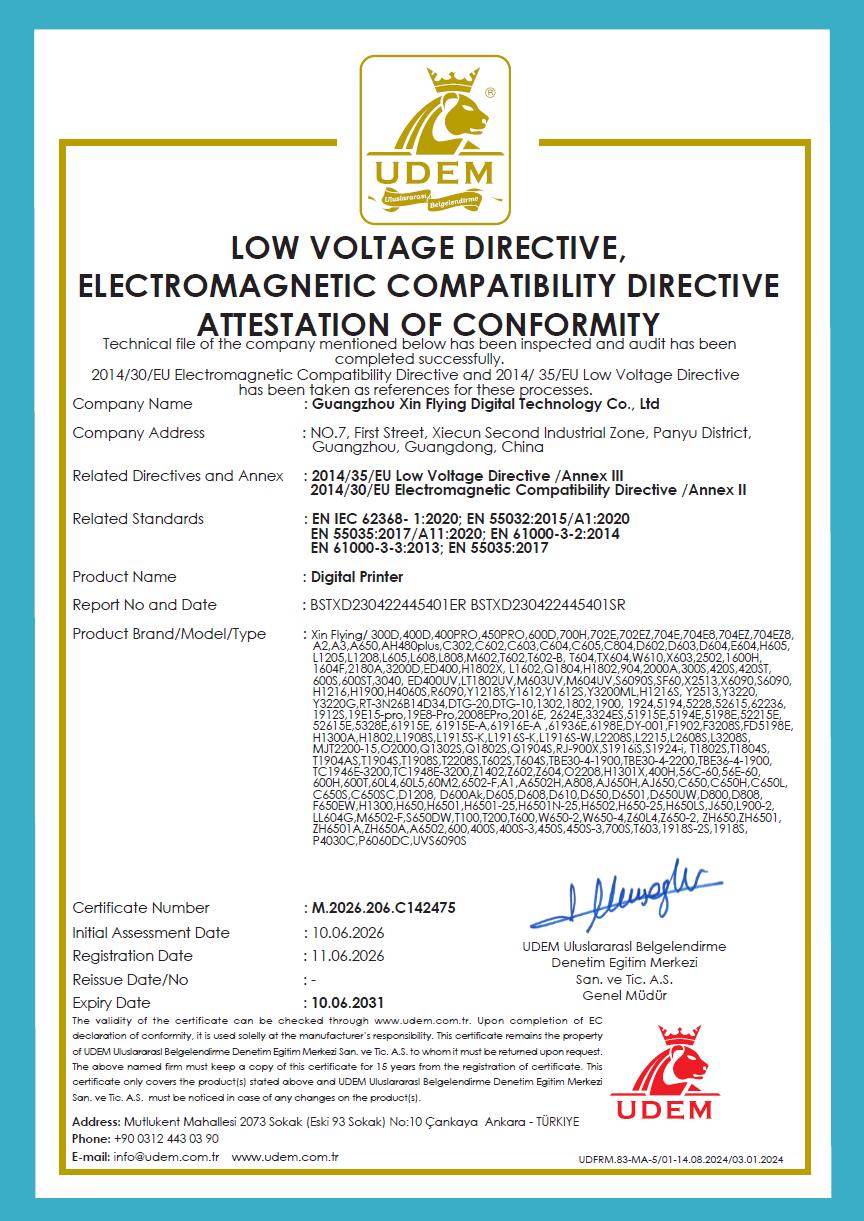
CE LVD and EMC Attestation of Conformity M.2026.206.C142475, issued by UDEM, valid to 10 June 2031. It consolidates electrical safety and electromagnetic compatibility for the covered model list.
What the Six-Head XF-F606 Changes
Print head count is the most direct lever on a sublimation printing machine, and it is the lever most buyers misread. Six heads do not simply mean 'faster'. They change three things at once: the throughput ceiling per shift, the redundancy available when a single nozzle group needs attention, and the acceptable length of a production run before changeover cost dominates.
For a sportswear manufacturer running repeating team programmes — a club season, a school district contract, a league kit cycle — the constraint is rarely design complexity. It is metres per hour sustained across a full shift without colour drift between rolls. A six-head platform is designed for that regime. The machine earns its place when the order book already contains enough continuous polyester volume to keep the heads productive, and when the finishing line downstream (calender, cutter, sewing) can absorb the same rate.
The honest limitation is equally clear. A six-head platform is a poor fit for a business whose weekly output is twelve jerseys, four samples and one colour approval round. In that environment the machine spends more time in maintenance idle state than in production, and the capital sits in print heads rather than in customer response speed. Buyers who purchase upward 'for future growth' without a dated volume plan usually discover this within the first two quarters.
What the A4 DTF XF-C604 Changes
The XF-C604 sits at the opposite end of the same decision. As an A4-format DTF platform, it moves the print into a film-based transfer workflow rather than a paper-to-polyester sublimation workflow. That single architectural difference answers two sportswear problems that sublimation cannot: cotton and cotton-blend teamwear, and very short runs where setting up a roll is disproportionate to the order.
In practice the C604 functions as the flexibility unit. It handles sponsor logos on cotton warm-up jackets, name-and-number panels on blended hoodies, sample approvals before a sublimation run is committed, and the small custom orders that keep a sportswear shop commercially alive between team contracts. It is not a substitute for a production sublimation platform and should not be specified as one.
The limitation runs the other way. If a buyer tries to run continuous polyester roll production on an A4 DTF platform, the workflow economics collapse — film consumption, powder handling and manual transfer steps scale badly against a roll-to-roll sublimation line. The C604 is a response-speed machine, not a volume machine.
Step-by-Step: How to Settle the Debate for Your Own Factory
Step 1 — Map the order book by substrate, not by customer. Split the last twelve months of orders into polyester-only, cotton-only and blended. The polyester share sets the ceiling for how much value a sublimation platform can capture. If polyester is below roughly half of order volume, a six-head platform is difficult to justify.
Step 2 — Verify the certificate against the model string. Request the LVD, EMC, MD and RoHS documents and confirm that the exact model you are ordering appears in the covered product list. For the XF-F606 and the XF-C604 this check resolves against TQT1550D271EC, TQT1550D270EC, M.2026.206.C142365 / M.2026.206.C142385, M.2026.206.C142366 and M.2026.206.C142475. Confirm issuer, standard reference and validity date on each page.
Step 3 — Match the media path to the finishing line. A six-head platform feeds a calender and cutter at a rate that the sewing floor must match. If the bottleneck already sits downstream, adding head count upstream increases work-in-progress, not revenue.
Step 4 — Validate on a real order before committing. XINFLYING operates with a minimum order quantity of 1 unit and a production lead time of 5–40 days, which allows a single-unit evaluation. Use it. Print a live job, not a test chart: a multi-size team kit reveals colour drift, registration behaviour and drying performance that a calibration file will not.
Step 5 — Confirm the support path before shipment, not after. Guangzhou Xin Flying Digital Technology Co., Ltd. was founded in 2010, operates a 37,440 m² facility with 200+ employees and an annual output of 20,000+ units, and supports installations through over 50 engineers providing 24/7 online technical support. Ask who will answer at 2 a.m. during your first peak season.
Use Cases: How the Split Plays Out in Real Sportswear Operations
High-volume teamwear manufacturing. A sportswear manufacturer producing football jerseys, basketball uniforms and custom team apparel uses roll-based sublimation to print high-resolution patterns, team logos and full-colour designs onto polyester before cutting and sewing. In one documented XINFLYING deployment, a sportswear manufacturer in Brazil operating 15 units over four years reported improved production flexibility for customised orders, reduced dependence on outsourced printing and more consistent colour quality across batches. That is the profile where a six-head platform belongs.
Sports uniform supply with mixed-fabric catalogues. A sports uniform supplier in Brazil running 8 units over five years produces customised football kits, training uniforms and team apparel with personalised names, numbers and graphics. Suppliers at this scale typically pair a roll-based platform with a compact transfer unit, because teamwear catalogues rarely stay 100% polyester.
Printing service providers serving sportswear brands. A digital textile printing service provider supporting sportswear brands, apparel factories and customised textile businesses, running 5 units over three years, uses sublimation capacity to absorb client projects and shorten response time on customised orders. Service providers feel the A4-versus-six-head question most acutely, because their order mix changes month to month.
Sampling and fit-approval stages. Before any team contract is confirmed, colour and fabric behaviour must be approved. This is the stage where an A4 DTF platform removes days from the cycle — and where buying only a six-head machine leaves a visible gap in the workflow.
XF-F606 vs XF-C604: Comparison Table
| Criterion | XF-F606 | XF-C604 |
|---|---|---|
| Platform architecture | Six-head production platform | A4-format DTF platform |
| Best-fit order type | Continuous roll-based polyester programmes | Sampling, short runs, cotton and blended teamwear |
| CE LVD certificate | TQT1550D271EC — covered | TQT1550D271EC — covered |
| CE EMC certificate | TQT1550D270EC — covered | TQT1550D270EC — covered |
| CE Machinery Directive | M.2026.206.C142365 / M.2026.206.C142385 — covered | M.2026.206.C142365 / M.2026.206.C142385 — covered |
| RoHS attestation | M.2026.206.C142366 — covered | M.2026.206.C142366 — covered |
| Combined LVD + EMC attestation | M.2026.206.C142475 — covered | M.2026.206.C142475 — covered |
| OEKO-TEX® ECO PASSPORT | SH150194016 — applies to printing inks, not the machine | SH150194016 — applies to printing inks, not the machine |
| Primary constraint | Requires sustained polyester volume to stay productive | Film-based workflow scales poorly for roll volume |
| Typical pairing | Calender, cutter and sewing line alignment | Sample room and mixed-fabric order desk |
Comparison is limited to verified compliance coverage and published platform positioning. Buyers should still confirm the exact model string on the certificate copy supplied with the order.
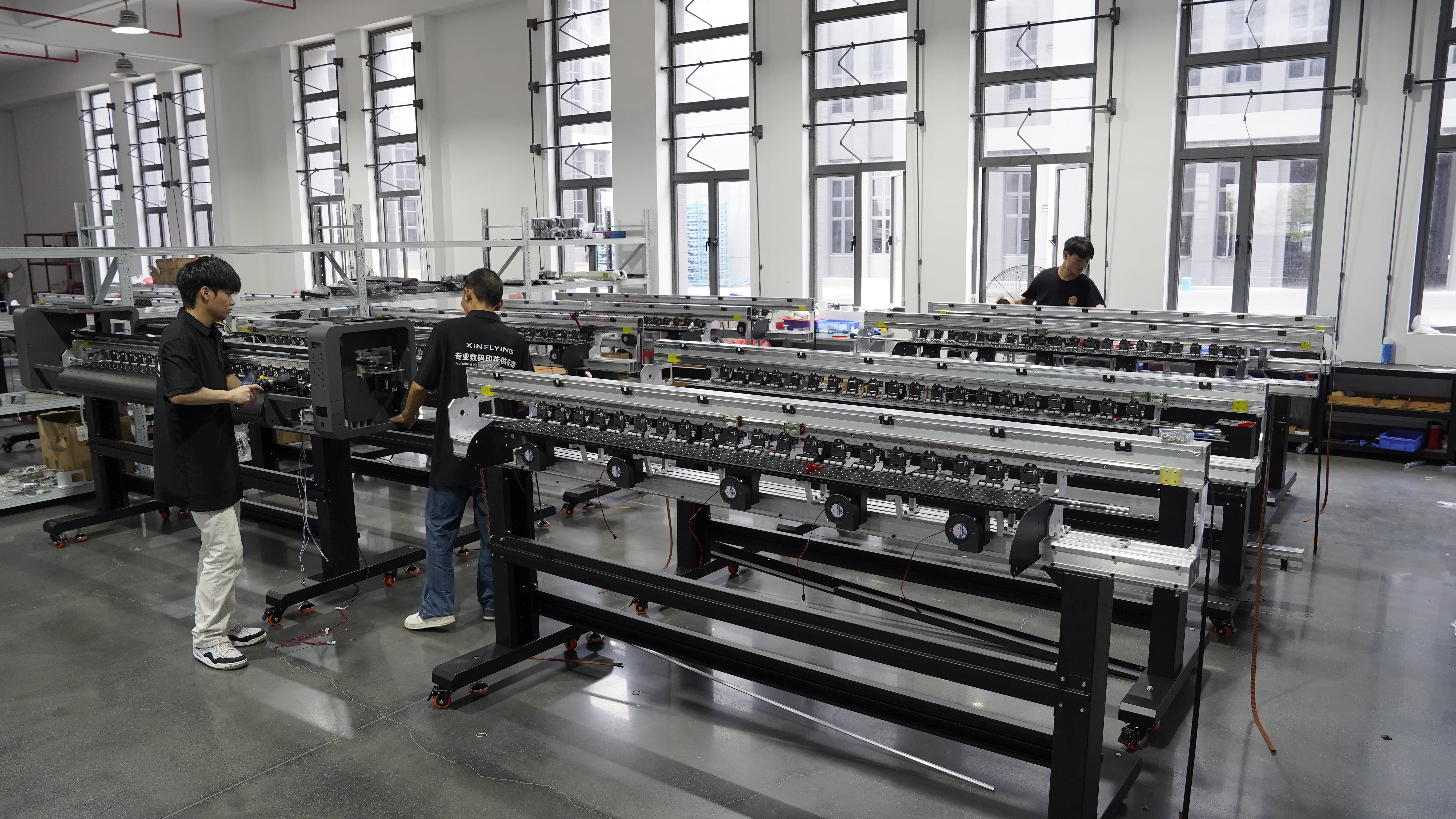
Technicians connect and inspect internal components during assembly. Pre-shipment testing is where the specification on paper becomes the machine on your floor.
FAQ
Do the XF-F606 and the XF-C604 hold the same EU LVD certificate?
Yes. Both model numbers appear in the covered product list of CE LVD Certificate of Compliance TQT1550D271EC, issued by TQT on 19 May 2026 under LVD 2014/35/EU and tested to EN IEC 62368-1:2020/A11:2020, with an expiry date of 2099-01-01. A combined LVD and EMC attestation, M.2026.206.C142475, issued by UDEM on 10 June 2026 and valid to 10 June 2031, also covers both models. The certificate number alone is not sufficient evidence — the buyer should confirm the exact model string appears in the covered product list on the actual document copy.
Can the A4-format XF-C604 replace the six-head XF-F606 for sportswear production?
No, not for the same job. The XF-C604 is an A4-format DTF platform suited to sampling, short runs and mixed-material teamwear including cotton and blends. The XF-F606 is a six-head production platform built for continuous roll-based polyester output. They differ in throughput architecture, media handling and the scale at which changeover cost stops mattering. A business running repeating team programmes on polyester needs the production platform; a business running approvals and small custom orders needs the A4 unit.
What actually drives the commercial difference between these two machines?
The cost structure differs by architecture rather than by brand tier. The XF-F606 carries six print heads, a roll-based media path and a substantially larger frame, all of which affect head count, media handling, drying capacity, power infrastructure and floor space. The XF-C604 carries an A4-format film workflow, which changes consumable behaviour and handling steps rather than roll capacity. Both inherit the same certification set, so documentation cost is not a differentiator between them.
Can I validate the machine on a real order before placing a volume purchase?
XINFLYING operates with a minimum order quantity of 1 unit, which allows a single-machine evaluation before any fleet decision. Production is supported by pre-shipment testing, and OEM/ODM customisation covers product branding, machine appearance, colour, logo and packaging. For sportswear buyers the practical validation is a live team kit rather than a calibration target, because colour drift and registration behaviour only appear across multiple sizes and colour blocks.
What is the production lead time and what support comes after delivery?
Production lead time runs from 5 to 40 days depending on configuration, against a monthly capacity of 1,600+ units. Guangzhou Xin Flying Digital Technology Co., Ltd. was founded in 2010 and operates a 37,440 m² facility with 200+ employees, a 20-engineer R&D team and an annual output of 20,000+ units, exporting to North America, South America, Europe, Asia, the Middle East and Africa. After-sales support is delivered by over 50 engineers providing 24/7 online technical support. Buyers planning a sportswear season launch should confirm the lead time against their first drop date rather than against the order date — request a sample or quotation through www.xin-flying.com and specify the exact model and configuration in the enquiry.
Conclusion
The XF-F606 versus XF-C604 debate resolves once the question is framed correctly. It is not a competition between a better and a lesser machine. It is a boundary line between two production logics: roll-based polyester volume on one side, flexible short-run transfer work on the other.
What genuinely deserves scrutiny is the assumption that compliance separates them. It does not. Both are named in the same LVD certificate TQT1550D271EC, the same EMC certificate TQT1550D270EC, the same Machinery Directive attestations M.2026.206.C142365 and M.2026.206.C142385, the same RoHS attestation M.2026.206.C142366 and the same combined LVD and EMC attestation M.2026.206.C142475. The machine-level documentation is a shared baseline, and the OEKO-TEX® ECO PASSPORT SH150194016 sits one layer below it, on the ink chemistry.
That leaves the decision where it belongs — with your order book. Count the polyester metres, count the mixed-fabric jobs, and check whether the finishing line downstream can absorb what a six-head platform produces. If the arithmetic points in both directions, the correct answer is a two-machine layout rather than a forced compromise.
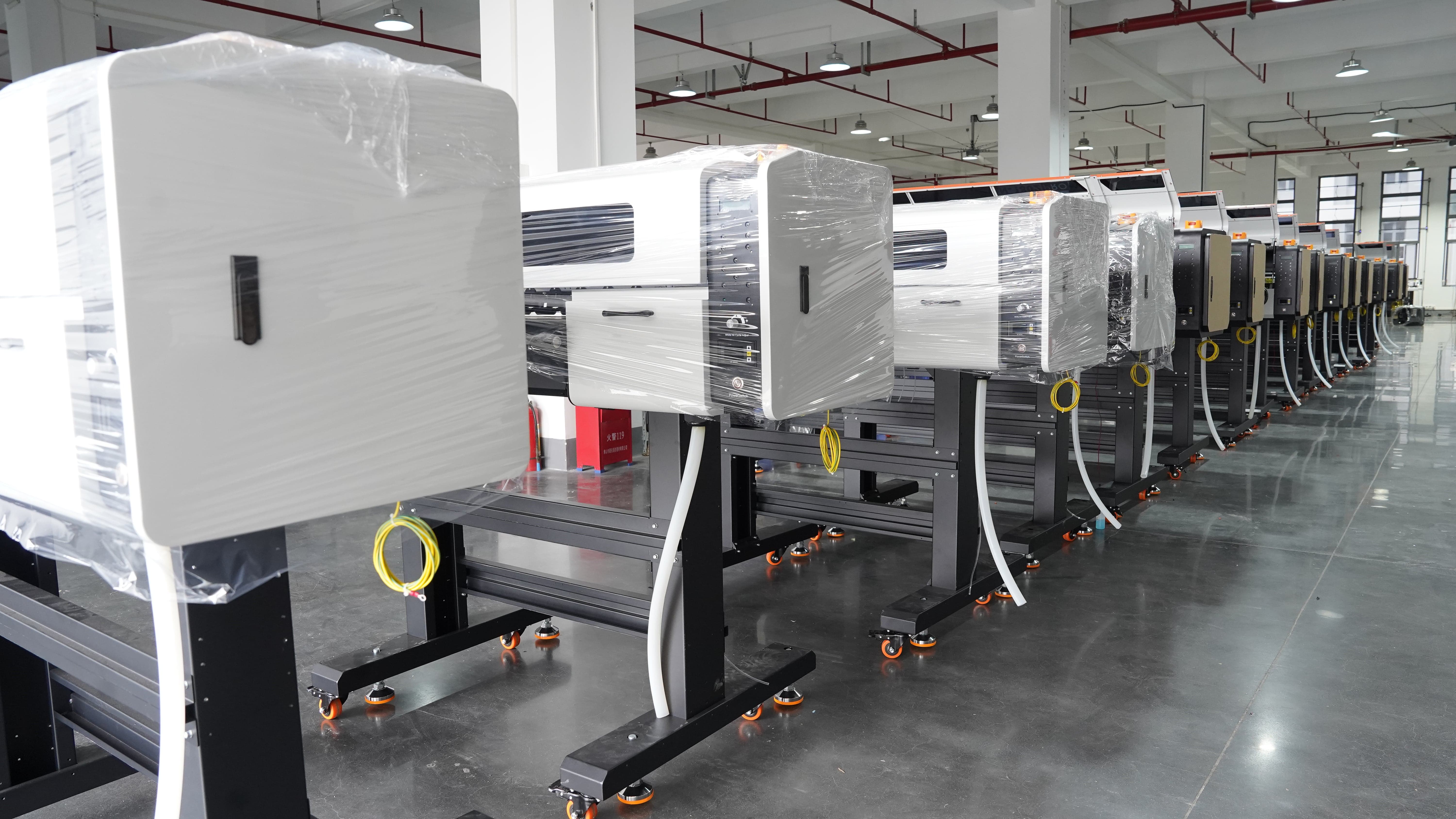
Completed units wrapped and staged for international shipment. Lead time runs 5–40 days depending on configuration.
Next step: validate the configuration on a live order
Request a sample run or a model-specific quotation for the XF-F606 or the XF-C604. Specify your substrate mix, target output and destination market so the correct certificate set is supplied with the offer. The full product and capability overview is available in the XINFLYING company brochure (PDF).
Email: info@xin-flying.com | Tel / WhatsApp: +86 188-1322-1357 | Website: www.xin-flying.com
No.7, Xiecun 2nd Industrial Zone, Panyu, Guangzhou, Guangdong, China
Have Questions or Need More Details?
Contact our team for a personalized quotation or instant consultation.
Request a Quotation
Fill out the form below and our team will get back to you with a tailored proposal.
WhatsApp Direct Chat
Prefer to chat in real-time? Message us on WhatsApp for instant assistance & quick answers.
- Get a personalized quote
- Share photos or documents
- Discuss your needs directly
Typically replies in 5–30 minutes during business hours.