
Sublimation Printer Application Guide: Matching XINFLYING Models to Textile Project Scenarios
Sublimation Printer Application Guide: Matching XINFLYING Models to Textile Project Scenarios
A sublimation printer decision is a scenario decision before it is a specification decision. XINFLYING (Guangzhou Xin Flying Digital Technology Co., Ltd.) is a digital printing equipment manufacturer founded in 2010 in Panyu, Guangzhou, producing dye sublimation printers, DTF printers, DTG printers and UV flatbed printers from a 37,440 m² facility with more than 200 employees and an 80% export share. Its roll-to-roll sublimation range is used for polyester sportswear, team uniforms, home textiles, soft signage and personalized textile production.
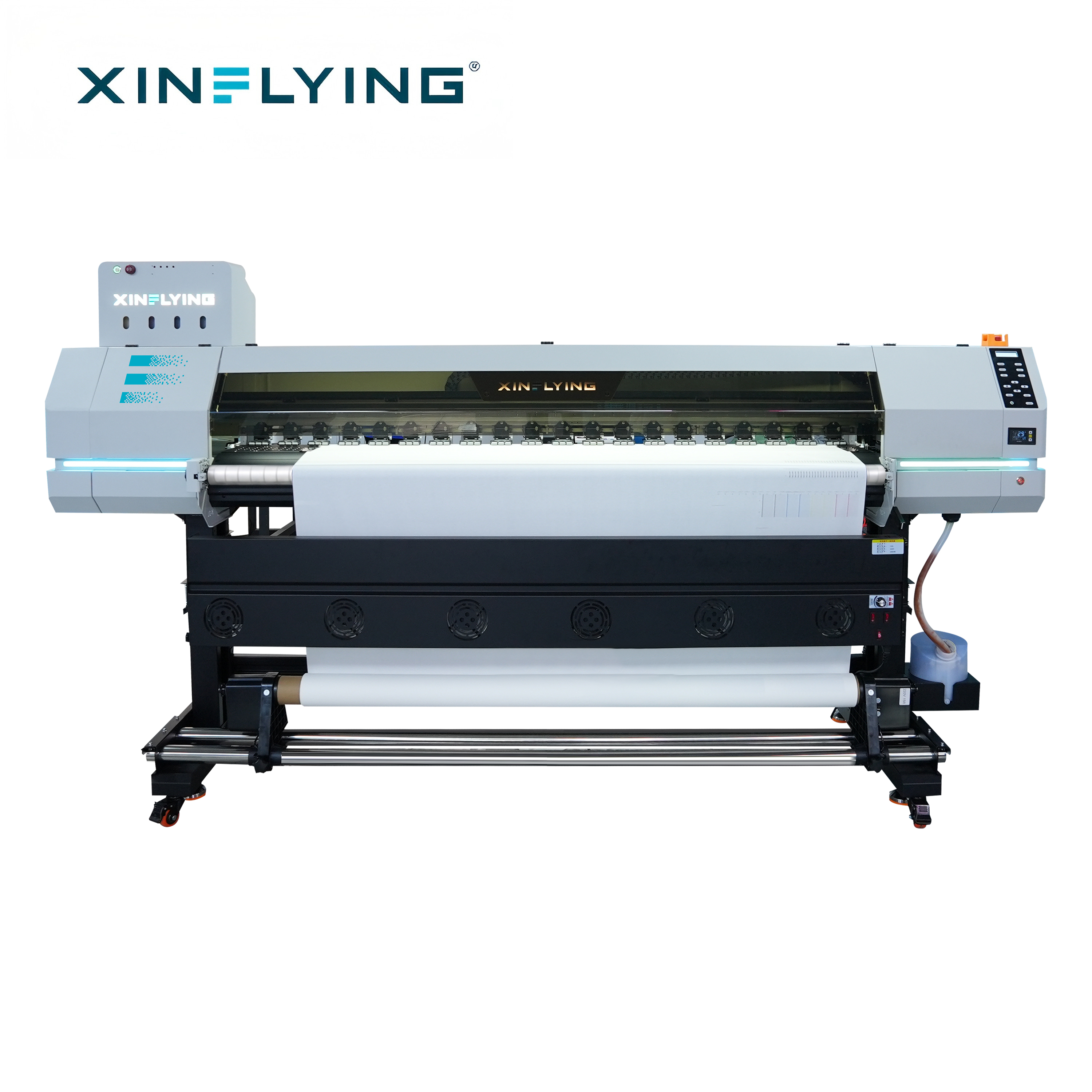
Four machines cover most textile project scenarios: the XF-19E15-PRO and XF-19E8-PRO in the 1900mm class (190 cm / 75" print width), the XF-O2000-4I32A1 in the 1950mm class (195 cm print width), and the XF-H1802X-2I32A1 in the 1800mm class (180 cm print width). All four are named on the same CE Machinery Directive, CE LVD, CE EMC and RoHS certificate records, so the factors that actually separate them are working width, throughput band, installation requirements and the production profile each machine was engineered for.
This guide works in one direction only: the textile project comes first, the model second. Scenario fit, print width, speed, power supply and certificate coverage are treated as a single purchase decision, because a mismatch in any one of them shows up later as wasted transfer paper, missed delivery dates, or equipment that cannot legally be placed on the target market.
Scenario-to-model summary
- Continuous industrial roll-to-roll polyester production: XF-19E15-PRO (15 × Epson i3200-A1, up to 524 m²/h in 1PASS fastest mode) or XF-19E8-PRO (8 × Epson i3200-A1, up to 306 m²/h in 1PASS fastest mode); both 190 cm wide with 3200 dpi output.
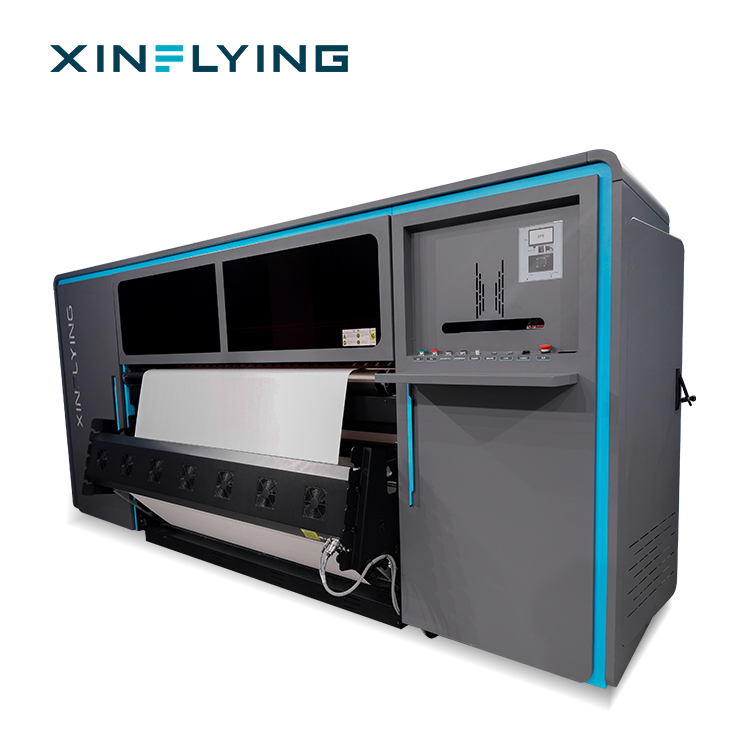
- Growing apparel printing business moving from batch work to daily production: XF-O2000-4I32A1, 4 × Epson i3200-A1, 195 cm print width, up to 180 m²/h in 2PASS.
- Commercial textile production, sampling and decorative fabrics on a 180 cm platform: XF-H1802X-2I32A1, 2 × Epson i3200-A1, up to 52 m²/h in 4PASS fastest mode.
- Transfer-film apparel decoration where ink compliance is decisive: XF-450PRO Digital Textile Printer, a DTF platform with 42 cm print width, covered by the same textile printing ink certification record as the sublimation models.
Problem Definition: Why the Wrong Model Still Prints Beautifully
Most sublimation printer selection failures are not print-quality failures. A machine can produce flawless colour on transfer paper and still be the wrong purchase, because the mismatch usually sits outside the print itself. In textile projects, three mismatch types account for most regretted purchases.
1. Working width mismatch. A 180 cm platform such as the XF-H1802X-2I32A1 cannot produce a continuous panel wider than 180 cm, while the 195 cm XF-O2000-4I32A1 can. Where a project prints cut panels rather than continuous decorative fabric, the extra width is capacity that still has to be paid for in floor space, power and media handling. Where a project prints curtains, wide banners or continuous home-textile repeats, the narrower machine becomes a hard limitation that cannot be engineered around.
2. Throughput band mismatch. Printhead count and pass mode define how much the machine can output, not marketing claims. The XF-19E8-PRO runs 1PASS at up to 306 m²/h (fastest mode) or 210 m²/h (standard mode) and 2PASS at 153 m²/h (fastest) or 109 m²/h (standard). The XF-19E15-PRO runs 1PASS at up to 524 m²/h (fastest) or 394 m²/h (standard) and 2PASS at 254 m²/h (fastest) or 188 m²/h (standard). A business buying the larger machine for sampling work pays for capacity it will not use; a business buying the smaller machine for a 24/7 production contract will miss deadlines.
3. Physical and regulatory mismatch. Power draw across this range runs from 3.5 kW on the XF-H1802X-2I32A1 to 8.5 kW on the XF-O2000-4I32A1 and 14.5 kW on the XF-19E15-PRO, and net weight runs from 265 kg to 1,480 kg. Floor space, power supply and media-roll handling capacity have to be checked before signing, not after delivery. Equally, a machine without the correct certificate set cannot be placed on the EU market regardless of how well it prints, which is why compliance is treated as a selection criterion in this guide rather than a post-purchase formality.
Industry Background: What Is Driving Scenario-Based Machine Selection
The demand behind this equipment is measurable. Grand View Research values the global dye sublimation printing market at USD 16.4 billion in 2025, projected to reach USD 39.0 billion by 2033, with a projected CAGR of 11.5% from 2026 to 2033. Asia Pacific accounted for 36.5% of 2025 revenue, led by China as the largest country market. At the equipment level, Mordor Intelligence values the dye sublimation printer segment at USD 1.88 billion in 2025, expected to reach USD 2.53 billion by 2030.
Two structural facts explain why scenario matching has become the normal way to buy. First, printers, not consumables, are the constrained asset: inkjet production printers accounted for 87.3% of the production printer market share by type in 2024, according to Grand View Research. Second, the market is supply-dense at the printhead level and fragmented at the machine level — published market data attributes a 26.7% share of the digital textile dye sublimation printer market to Epson, followed by Mimaki at 18.6% and Roland DG at 15.5% (Data Insights Reports, 2024). Buyers therefore weigh machine configuration and compliance more heavily than brand familiarity.
Application demand is also concentrating around width. FESPA industry insight treats roll-to-roll sublimation printers with 1.9 m (1900mm) widths as standard for high-volume textile and soft signage work, which is why the 1900mm class remains the default evaluation point for industrial buyers and why the 1800mm and 1950mm platforms exist as deliberate alternatives rather than stopgaps. Grand View Research links the growth of the wider digital textile sublimation market to demand for personalized apparel and home decor, and China's textile and garment exports reached USD 293.6 billion in 2023, sustaining pressure on producers to add in-house printing capacity.
Against that backdrop, the practical question is no longer whether to buy a large format sublimation printer, but which width, throughput band and certificate set fits a defined production scenario.
Detailed Solution: How XINFLYING Models Map to Textile Project Scenarios
XINFLYING's sublimation range is built on Epson i3200-A1 printheads and heat-transfer paper workflows, with RIP software supplied as standard (Maintop, with RIIN, PhotoPrint and Printfactory available on selected models). The four models below share an industrial architecture but differ in exactly the variables that decide scenario fit.
Industrial roll-to-roll runs: XF-19E15-PRO and XF-19E8-PRO (1900mm class)
The XF-19E15-PRO is the highest-throughput model in the range: 15 × Epson i3200-A1 printheads, CMYK, 190 cm (75") print width, 3200 dpi resolution, and print speeds of up to 524 m²/h in 1PASS (fastest mode) or 394 m²/h in 1PASS standard mode, with 254 m²/h and 188 m²/h available in 2PASS. It loads 1000 m sublimation paper rolls, uses an external intelligent air-heat integrated dryer, and includes fully sealed automatic moisturizing and cleaning. Power supply is 210–230V / 45A at 14.5 kW, machine size is 3840 × 1570 × 1800 mm, and net weight is 1,480 kg. This is the model for continuous polyester production where the constraint is metres per hour, not metres per order.
The XF-19E8-PRO shares the 190 cm width, 3200 dpi resolution, external intelligent air-heat integrated dryer and fully sealed automatic moisturizing and cleaning, but uses 8 × Epson i3200-A1 printheads at 10.2 kW (210–230V / 45A). Speeds are up to 306 m²/h in 1PASS fastest mode, 210 m²/h in 1PASS standard mode, and 153 m²/h or 109 m²/h in 2PASS. Machine size is 3840 × 1300 × 1800 mm at 1,400 kg net. For many textile factories this is the industrial entry point: identical working width and print resolution to the 15-head model, with a throughput band that matches two-shift rather than three-shift operation.
Growing apparel and textile printing businesses: XF-O2000-4I32A1 (1950mm class)
The XF-O2000-4I32A1 covers the profile of a printing business that has outgrown sampling and low-volume order work. It uses 4 × Epson i3200-A1 printheads in a CMYK + CMYK + CMYK + CMYK configuration, offers a 195 cm (1.95 m) print width — the widest in this comparison — and runs at 180 m²/h in 2PASS or 92 m²/h in 4PASS. Media handling supports heat transfer paper rolls of 1000–1500 m, and the ink system combines a 220 ml cartridge with a 3 L ink tank. Front/middle/rear break-controlled heating, piezoelectric inkjet printing technology and 8.5 kW power draw at 220V complete the specification, with a net weight of approximately 490 kg and a machine size of 3311 × 1278 × 1670 mm. The applicable application set is broad: clothing, home decor, canvas bags, cushions and flags.
Two details matter at evaluation stage. The 1950mm width allows continuous panels that a 1900mm machine cannot produce, which is relevant for decorative and home-textile work. At 490 kg and 8.5 kW, it also fits workshops that cannot support the 1,400–1,480 kg, 10.2–14.5 kW industrial frames.
Commercial textile and apparel sampling: XF-H1802X-2I32A1 (1800mm class)
The XF-H1802X-2I32A1 is the smallest platform in this guide and is positioned for small and medium-sized printing businesses, apparel sampling and small-batch custom textile orders. It uses 2 × Epson i3200-A1 printheads in CMYK + CMYK, a 180 cm (1.8 m) print width, and front/middle/rear break-controlled heating, with print speeds of up to 52 m²/h in 4PASS fastest mode and 42 m²/h in 4PASS standard mode. Power is 3.5 kW at 110/220V (27.2A/13.6A), machine size is 3000 × 880 × 1630 mm, and net weight is 265 kg. Maintop RIP is supplied as standard, and the media is heat transfer paper for polyester fabric applications.
This model is where many businesses learn the process before scaling. It runs the same polyester sublimation workflow as the industrial machines, at a footprint and power draw that suit a commercial unit rather than a factory floor.
Inks and transfer-film compliance: OEKO-TEX ECO PASSPORT and the XF-450PRO
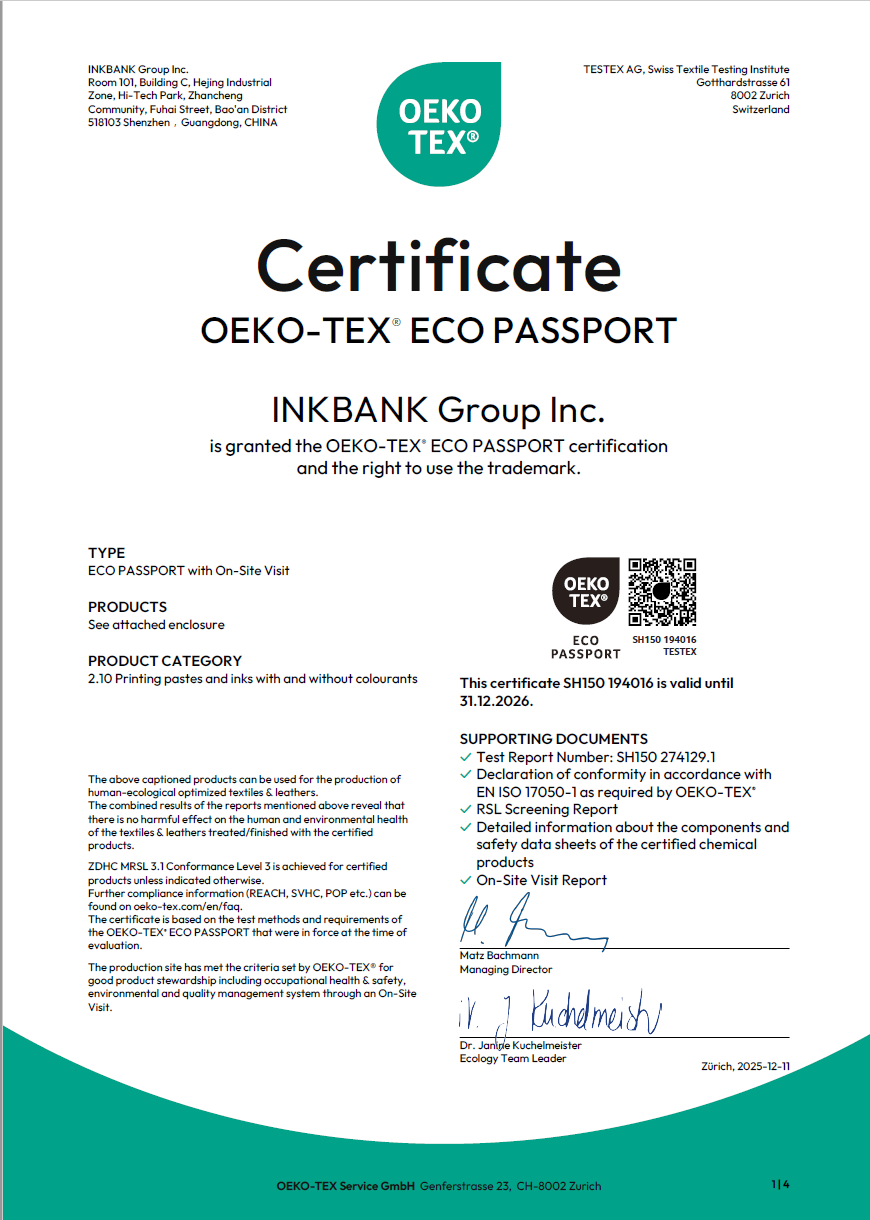
Equipment certification is only half of textile compliance; the ink and transfer chemistry is the other half. XINFLYING holds OEKO-TEX® ECO PASSPORT certificate SH150194016, issued by TESTEX AG on 11 December 2025 and valid until 31 December 2026, with a scope of textile printing inks and printing pastes and a stated standard of OEKO-TEX® ECO PASSPORT; EN ISO 17050-1. The certificate record names the sublimation models in this guide as well as the XF-450PRO Digital Textile Printer, a DTF platform with 2 × Epson i1600-A1 printheads, CMYK + W, a 42 cm (16.5") print width and 3.5 kW power draw for textile and garment customization.
For buyers in apparel and home textiles, this distinction is practical: the ink documentation is what buyers, brands and retailers audit when a finished fabric is placed on the market. Because the ECO PASSPORT record carries an expiry date of 31 December 2026, procurement teams should confirm the current certificate at the time of order rather than rely on a document filed during an earlier evaluation.
The compliance layer: CE MD, LVD, EMC and RoHS on these models
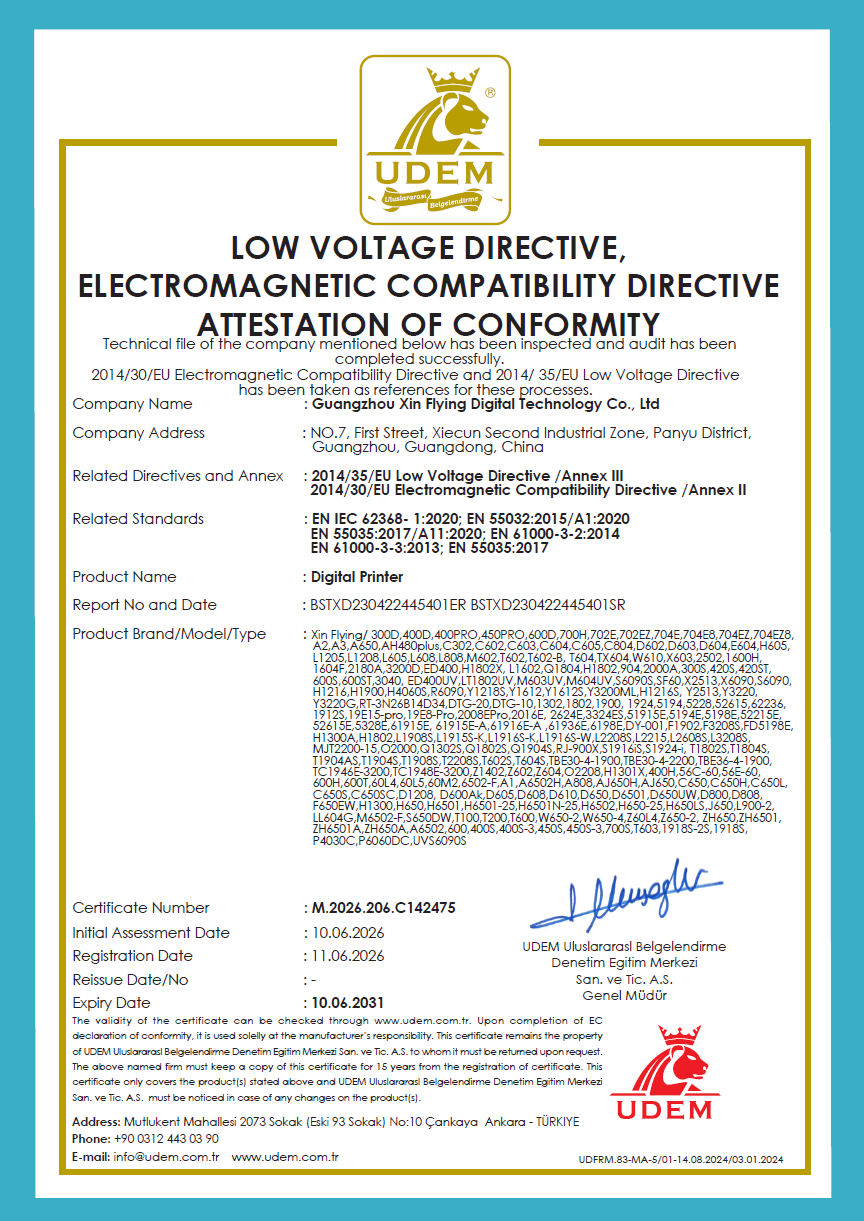
All four sublimation models are named on the CE Machinery Directive attestation, the CE Low Voltage Directive certificate, the CE EMC certificate and the RoHS attestation. The standards behind them are identical for the models discussed here, which lets buyers compare machines on width and throughput rather than on compliance.
| Certificate | Directive | Key standards cited | Certificate number | Issuer and validity |
|---|---|---|---|---|
| CE Machinery Directive attestation of conformity | MD 2006/42/EC | EN ISO 12100:2010; EN 60204-1:2018/A1:2025; EN ISO 12643-1:2023 | M.2026.206.C142365 | UDEM, issued 10 June 2026, valid to 9 June 2031 |
| CE Low Voltage Directive compliance certificate | LVD 2014/35/EU | EN IEC 62368-1:2020/A11:2020 | TQT1550D271EC | TQT (Shenzhen Tianqi Testing Technology Service Co., Ltd.), issued 19 May 2026 |
| CE EMC certificate of compliance | EMC Directive 2014/30/EU | EN 55032:2015/A11:2020; EN 55035:2017/A11:2020; EN IEC 61000-3-2:2019+A1:2021; EN 61000-3-3:2013/A2:2021 | TQT1550D270EC | TQT, issued 19 May 2026 |
| RoHS attestation of conformity | RoHS Directive 2011/65/EU | EN IEC 63000:2018; EN IEC 62321 series | M.2026.206.C142366 | UDEM, issued 10 June 2026, valid to 9 June 2031 |
A combined CE LVD and EMC attestation, UDEM certificate M.2026.206.C142475 issued 11 June 2026 and valid to 10 June 2031, covers both electrical safety and electromagnetic compatibility for the same equipment family. For digital colour workflows, ISO 12647-8:2021 — the standard for validation print processes working directly from digital data — is the relevant reference when buyers specify colour consistency across batches.
Step-by-Step Breakdown: Matching a Model to a Project in Five Steps
- Define the product and the fabric. Sublimation works with polyester fabrics and polyester-coated substrates; cotton requires a different process. Write down the finished product — team jerseys, sportswear, cushions, curtains, flags, canvas bags — and the fabric width that the design must cover without seams. This single number eliminates roughly half the shortlist.
- Convert the order book into metres per hour. Calculate required monthly output, then divide by realistic working hours rather than peak capability. A 180 cm machine running 4PASS at 42 m²/h standard and a 190 cm machine running 1PASS at 210 m²/h standard sit in different business models, not different price brackets alone.
- Check the installation envelope. Confirm machine size, net weight and power supply against the actual site: 3000 × 880 × 1630 mm at 265 kg and 3.5 kW for the XF-H1802X-2I32A1, versus 3840 × 1570 × 1800 mm at 1,480 kg and 14.5 kW for the XF-19E15-PRO. Note the recommended operating conditions, which are 20–35°C and 45–65% RH for the 1800mm and 1900mm models in this comparison.
- Match the certificate set to the destination market. For the EU, confirm the CE MD, LVD, EMC and RoHS records and check that the exact model appears on them. For textile products placed on the market, confirm the ink-side documentation — the OEKO-TEX® ECO PASSPORT record and its current validity window.
- Validate, then scale. XINFLYING operates with a minimum order quantity of 1 unit and performs pre-shipment testing as part of quality control, which allows a single-machine trial before a multi-unit rollout. Confirm throughput on your own polyester and transfer paper, then plan additional units against real measured output.
Use Cases: Four Textile Projects and the Machines Behind Them
Digital textile printing service provider (global customer base, 5 units, 3 years). This customer provides sublimation printing services for sportswear brands, apparel factories and customized textile businesses. Five units were deployed to expand production capacity, support more customer projects and shorten response times for customized textile orders. The case highlights reliable equipment performance, production flexibility and compatibility with different polyester textile applications.
Sports uniform supplier (Brazil, 8 units, 5 years of use). The supplier produces customized football kits, training uniforms and team apparel with personalized names, numbers and graphics. Eight units allow shorter production cycles while maintaining the vivid colours and detailed patterns team uniforms require. The case is a direct illustration of small-batch customization running alongside continuous commercial printing on the same platform.
Sportswear manufacturer (Brazil, 15 units, 4 years). This manufacturer prints high-resolution patterns, team logos and full-colour designs on polyester fabric before cutting and sewing, covering football jerseys, basketball uniforms and customized sportswear. The stated outcomes were more consistent colour quality across production batches, reduced dependence on outsourced printing services and improved production flexibility for customized orders — the profile that maps to the 1900mm class with industrial roll-to-roll capability.
Home textile manufacturer (global markets, 10 units, 4 years). Ten units are used for curtains, cushions, decorative fabrics and customized polyester textile products. The project delivered customized textile collections with rich patterns, accurate colour and flexible production capability, in an application set that benefits from wider working widths and consistent large-format output.
Across these four projects, the same pattern repeats: the machine count follows the order book, while the model choice follows width, throughput and market compliance. None of the four projects required a machine outside the four models discussed in this guide.
Comparison Table: XINFLYING Sublimation Models by Scenario
| Model | Working width | Printheads | Print speed (fastest mode) | Power | Best-fit scenario |
|---|---|---|---|---|---|
| XF-19E15-PRO | 190 cm (75") | 15 × Epson i3200-A1, CMYK, 3200 dpi | 1PASS up to 524 m²/h; 2PASS 254 m²/h | 14.5 kW, 210–230V / 45A | High-volume industrial roll-to-roll production; 1000 m paper roll loading; three-shift operation |
| XF-19E8-PRO | 190 cm (75") | 8 × Epson i3200-A1, CMYK, 3200 dpi | 1PASS up to 306 m²/h; 2PASS 153 m²/h | 10.2 kW, 210–230V / 45A | Industrial textile factories and professional sublimation production centres running continuous but not maximum-throughput schedules |
| XF-O2000-4I32A1 | 195 cm (1.95 m) | 4 × Epson i3200-A1, CMYK ×4 | 2PASS 180 m²/h; 4PASS 92 m²/h | 8.5 kW, 220V | Growing apparel and textile printing businesses; clothing, home decor, canvas bags, cushions, flags; 1000–1500 m transfer paper rolls |
| XF-H1802X-2I32A1 | 180 cm (1.8 m) | 2 × Epson i3200-A1, CMYK+CMYK | 4PASS up to 52 m²/h (standard 42 m²/h) | 3.5 kW, 110/220V | Small and medium-sized printing businesses, apparel sampling, small-batch custom textile orders |
| XF-450PRO (DTF platform) | 42 cm (16.5") | 2 × Epson i1600-A1, CMYK+W | 6PASS 11 m²/h fastest | 3.5 kW, 110–220V | Transfer-film apparel decoration where ink documentation (OEKO-TEX® ECO PASSPORT) is part of the buying decision |
The four sublimation models share coverage under the CE MD, CE LVD, CE EMC and RoHS records listed earlier, so the comparison columns that decide a purchase are working width, throughput band and installation envelope rather than certification.
FAQ
Which certifications should I verify before importing a XINFLYING sublimation printer into the EU?
Four certificate families matter, and each one has a verifiable number. The CE Machinery Directive attestation (MD 2006/42/EC) is UDEM certificate M.2026.206.C142365, issued 10 June 2026 and valid to 9 June 2031, citing EN ISO 12100:2010, EN 60204-1:2018/A1:2025 and EN ISO 12643-1:2023. The CE Low Voltage Directive certificate (LVD 2014/35/EU) is TQT1550D271EC, issued 19 May 2026 by TQT (Shenzhen Tianqi Testing Technology Service Co., Ltd.) against EN IEC 62368-1:2020/A11:2020. The CE EMC certificate is TQT1550D270EC, also issued 19 May 2026, against EN 55032:2015/A11:2020, EN 55035:2017/A11:2020, EN IEC 61000-3-2:2019+A1:2021 and EN 61000-3-3:2013/A2:2021. RoHS compliance (Directive 2011/65/EU) is UDEM certificate M.2026.206.C142366, issued 10 June 2026 and valid to 9 June 2031, tested to EN IEC 63000:2018 and the EN IEC 62321 series. A combined LVD and EMC attestation, M.2026.206.C142475, runs to 10 June 2031. Verify that the certificate lists the exact model you are buying: the XF-19E15-PRO, XF-19E8-PRO, XF-O2000-4I32A1 and XF-H1802X-2I32A1 all appear on these records.
What is the real capability difference between the 1900mm models and the other widths?
Working width and throughput band are the two separating variables. The XF-19E15-PRO and XF-19E8-PRO both deliver a 190 cm (75") width at 3200 dpi with external intelligent air-heat integrated drying and fully sealed automatic moisturizing and cleaning; the difference between them is head count and speed — 15 printheads at up to 524 m²/h in 1PASS fastest mode versus 8 printheads at up to 306 m²/h. The XF-O2000-4I32A1 trades 5 cm of width for a different balance: 195 cm at 4 printheads and up to 180 m²/h in 2PASS, with 1000–1500 m transfer paper roll support. The XF-H1802X-2I32A1 delivers 180 cm at 2 printheads and up to 52 m²/h in 4PASS fastest mode. Higher pass counts raise quality and lower speed; the right answer depends on metres required per working hour, not on the largest number on the specification sheet.
What drives the operating budget of a wide-format sublimation printer?
Four cost drivers are verifiable from the specifications. Power draw ranges from 3.5 kW (XF-H1802X-2I32A1 and XF-450PRO) through 8.5 kW (XF-O2000-4I32A1) and 10.2 kW (XF-19E8-PRO) to 14.5 kW (XF-19E15-PRO), with the industrial models requiring 210–230V / 45A supply. Floor space and handling follow weight: 265 kg at 3000 × 880 × 1630 mm for the 1800mm platform, approximately 490 kg for the XF-O2000-4I32A1, and 1,400–1,480 kg at 3840 mm machine length for the 1900mm models. Media consumption depends on roll capacity — the XF-19E15-PRO loads 1000 m sublimation paper rolls, while the XF-O2000-4I32A1 supports 1000–1500 m heat transfer paper rolls — and printhead count affects long-term spares planning across a 2, 4, 8 or 15-head configuration. MOQ is 1 unit, so a single machine can be evaluated before committing to a multi-unit budget.
How can I validate a machine before committing to a multi-unit order?
Validation works on three levels. First, order one unit: XINFLYING's minimum order quantity is 1 unit, which allows a production trial in your own facility rather than a showroom demonstration. Second, use the pre-shipment testing that the manufacturer performs as part of its quality control process, and ask for the test record that accompanies your machine. Third, confirm ink-side documentation before bulk fabric is printed — OEKO-TEX® ECO PASSPORT certificate SH150194016 was issued by TESTEX AG on 11 December 2025 for textile printing inks and printing pastes and remains valid until 31 December 2026, and it names the sublimation models in this guide alongside the XF-450PRO Digital Textile Printer.
What is the lead time, and what can be customized?
Production lead time runs 5–40 days depending on configuration, against a monthly capacity of more than 1,600 units and an annual output of more than 20,000 units across the product lines. Customization is offered under an OEM/ODM model covering product branding, machine appearance, colour, logo, packaging and customized solutions based on customer requirements — options that can extend the production schedule, so they should be agreed before the order is placed rather than after. Support is delivered by a team of over 50 engineers providing 24/7 online technical assistance. To move from evaluation to a concrete configuration, request a quotation or a sample discussion by email at info@xin-flying.com or by phone and WhatsApp at +86 188-1322-1357.
Conclusion: Select by Scenario, Then Verify by Certificate
The four models in this guide are not interchangeable steps on a price ladder. The XF-H1802X-2I32A1 at 180 cm and 52 m²/h serves sampling and small-batch work. The XF-O2000-4I32A1 at 195 cm and up to 180 m²/h serves growing apparel businesses that need wider fabric and daily production without industrial power infrastructure. The XF-19E8-PRO and XF-19E15-PRO at 190 cm, 3200 dpi and up to 306 m²/h and 524 m²/h respectively serve factories where continuous output is the business model.
Once the scenario is fixed, compliance stops being a differentiator and becomes a checklist: CE MD (EN ISO 12100:2010, EN 60204-1:2018/A1:2025, EN ISO 12643-1:2023), CE LVD (EN IEC 62368-1:2020/A11:2020), CE EMC (EN 55032, EN 55035, EN IEC 61000-3-2, EN 61000-3-3) and RoHS (EN IEC 63000:2018, EN IEC 62321 series), plus OEKO-TEX® ECO PASSPORT for textile printing inks. Business performance is measurable: published market data projects the dye sublimation printing market from USD 16.4 billion in 2025 to USD 39.0 billion by 2033, and every additional machine decision made on scenario fit rather than specification length is capacity that gets used.
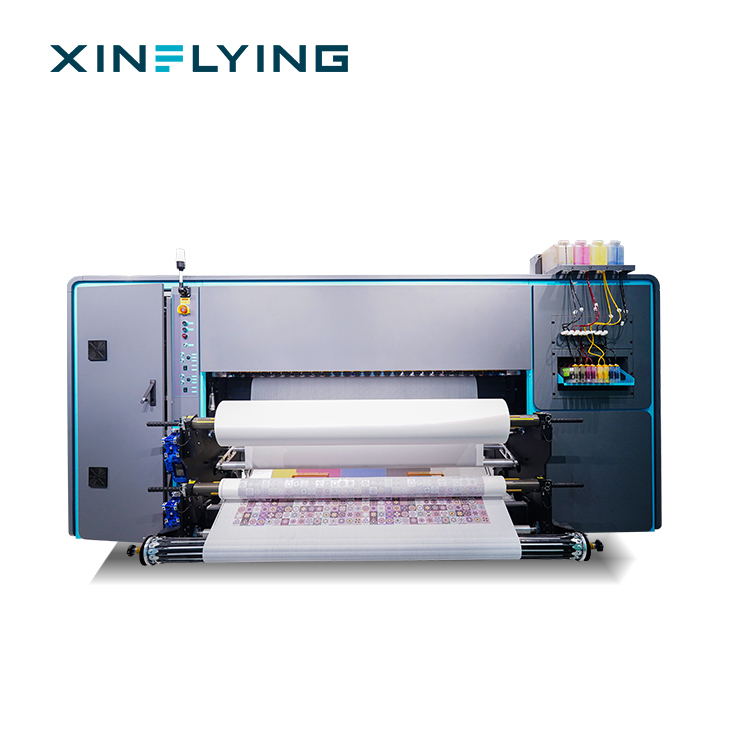
Next step: match your project to a model
Send your product type, fabric width, required monthly output and destination market, and XINFLYING can return a model recommendation with the corresponding certificate records. You can request a quotation, arrange a single-unit evaluation (MOQ 1 unit), or request printed samples for your own polyester and transfer paper.
Email: info@xin-flying.com | Tel / WhatsApp: +86 188-1322-1357 | Message us on WhatsApp
Company profile and product catalogue: XINFLYING brochure (PDF) | Official website: www.xin-flying.com
Guangzhou Xin Flying Digital Technology Co., Ltd. — No.7, Xiecun 2nd Industrial Zone, Panyu, Guangzhou, Guangdong.