
Sublimation Printer Buying Guide: How to Choose the Right Dye Sublimation Printer
Sublimation Printer Buying Guide: Matching the Right Machine to Your Textile Production
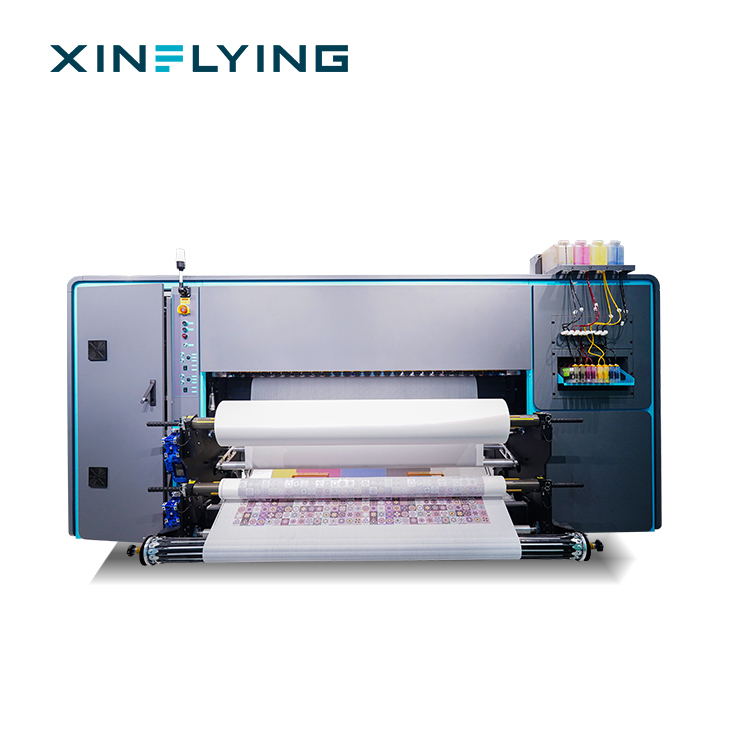
What Is a Sublimation Printer?
A sublimation printer is a specialized digital printing machine that uses dye sublimation ink to transfer designs onto polyester fabrics and coated materials through a heat-activated process. The ink is printed onto transfer paper, then, under controlled temperature and pressure, the solid dye turns into gas and permanently bonds with polyester fibers. This produces vivid, durable, and soft-feeling prints that do not crack or peel under normal use.
Sublimation printing is widely applied in sportswear, activewear, team jerseys, custom apparel, home textiles, flags, banners, and soft signage. Because the dye becomes part of the material, the printed area remains breathable and flexible — a key requirement for garments and textile products.
The Challenge: Choosing the Right Sublimation Printer
For many apparel manufacturers, textile producers, and printing businesses, selecting a sublimation printer is not a simple task. The market offers a broad range of configurations — from compact single-head models for sample production to 15-head industrial machines capable of printing hundreds of square meters per hour. Buyers often struggle with questions such as:
- What print width do I need for my products?
- How many printheads are necessary for my target output?
- What is the real production speed of a dye sublimation printer?
- Should I choose an entry-level, mid-range, or industrial model?
- What RIP software, ink, and maintenance infrastructure will the machine require?
Choosing a machine that is either too small for your production volume or unnecessarily expensive for your actual needs can lead to lost orders, wasted capital, or high operating costs. The key is to match the printer’s capabilities to your business model, application, and growth plan.
Industry Background: A Growing Market for Dye Sublimation
The global dye sublimation printing market was valued at USD 16.4 billion in 2025 and is projected to reach USD 39.0 billion by 2033, growing at a compound annual growth rate (CAGR) of 11.5% from 2026 to 2033, according to Grand View Research. Asia Pacific dominated the market in 2025 with a 36.5% revenue share, led by China as the largest country market.
The dye sublimation printers segment specifically was valued at USD 1.88 billion in 2025 and is expected to reach USD 2.53 billion by 2030, as reported by Mordor Intelligence. Another industry estimate indicates that the large format printer market, which includes wide-format sublimation models, was valued at USD 10.57 billion in 2025 and is projected to reach USD 16.52 billion by 2034 (Fortune Business Insights). These figures reflect the expanding adoption of digital textile printing across apparel, home decor, and promotional product manufacturing.
This growth is partly driven by the demand for personalized apparel and home decor, which is a primary driver for the digital textile sublimation market. For manufacturers, this means the choice of sublimation equipment directly impacts their ability to capture new orders and maintain competitive quality.
Detailed Solution: XINFLYING Sublimation Printers
XINFLYING — formally Guangzhou Xin Flying Digital Technology Co., Ltd. — is a digital printing equipment manufacturer established in 2010. The company operates a manufacturing facility covering 37,440 square meters, employs more than 200 staff, and maintains an R&D team of 20 engineers. Annual production capacity exceeds 20,000 units, and the company’s solutions are exported to North America, South America, Europe, Asia, the Middle East, and Africa.
XINFLYING offers a complete range of dye sublimation printers designed for different stages of textile production. Below is an overview of the five main models, each built around Epson i3200-A1 industrial printheads.
XF-H1301X-1I32A1 — Entry-Level Sublimation Printer
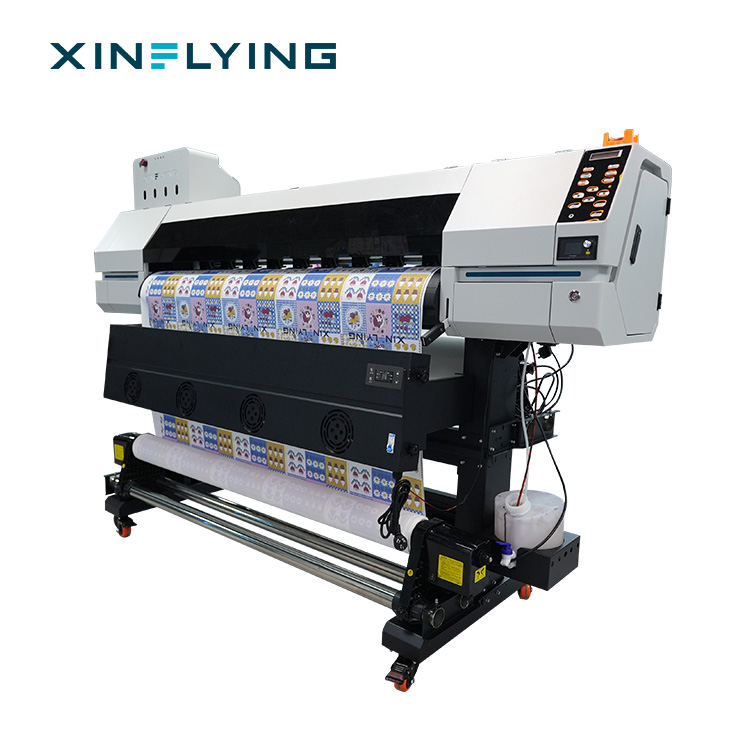
The XF-H1301X-1I32A1 is a digital textile printer classified as a sublimation printer, designed for textile sublimation printing on polyester fabrics. It features one Epson i3200-A1 printhead with CMYK colors and a print width of 130 cm (1.3 m). Its fastest printing speed is 28 m²/h in 4-pass mode, and it includes an external constant-temperature automatic drying system. With a power consumption of 2 kW and a compact footprint of 2220×870×1540 mm, this model is a practical entry point for small businesses, sample production, and low-volume custom orders.
XF-H1802X-2I32A1 — Wide-Format Sublimation Printer for Small and Medium Businesses
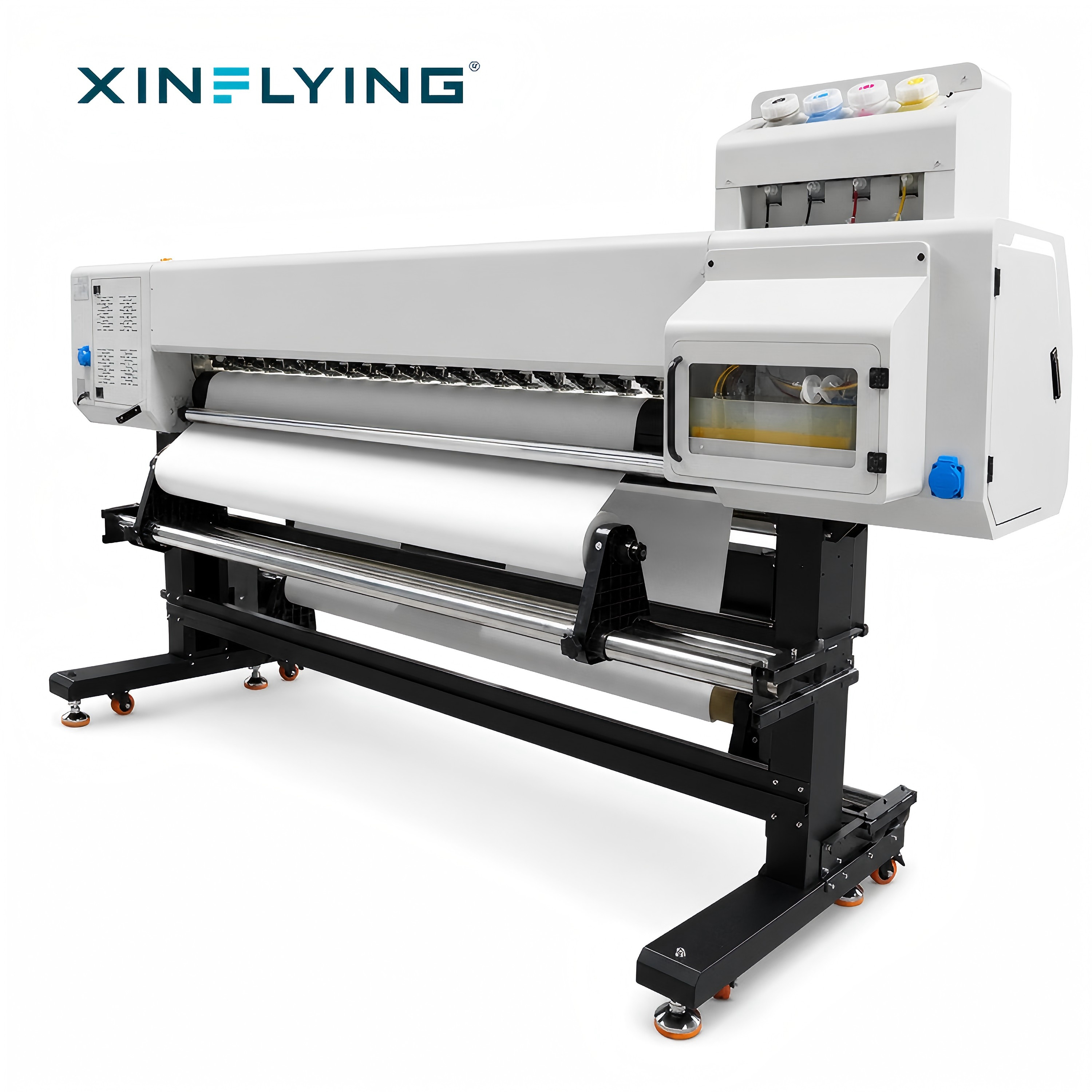
The XF-H1802X-2I32A1 is a wide-format digital textile printer manufactured by XINFLYING. Classified as a sublimation printer, it is intended for the textile sublimation printing industry and designed for printing on polyester fabrics. It has a print width of 180 cm and is constructed from aluminum alloy, stainless steel, and ABS plastic.
Equipped with two Epson i3200-A1 printheads (CMYK+CMYK), the XF-H1802X-2I32A1 reaches a fastest speed of 52 m²/h in 4-pass mode. It uses Maintop RIP software as standard and features front, middle, and rear break-controlled heating. This machine is suitable for small and medium-sized printing businesses, custom textile production, apparel sampling, and small-batch orders.
XF-O2000-4I32A1 — Mid-Range Sublimation Printer for Growing Companies
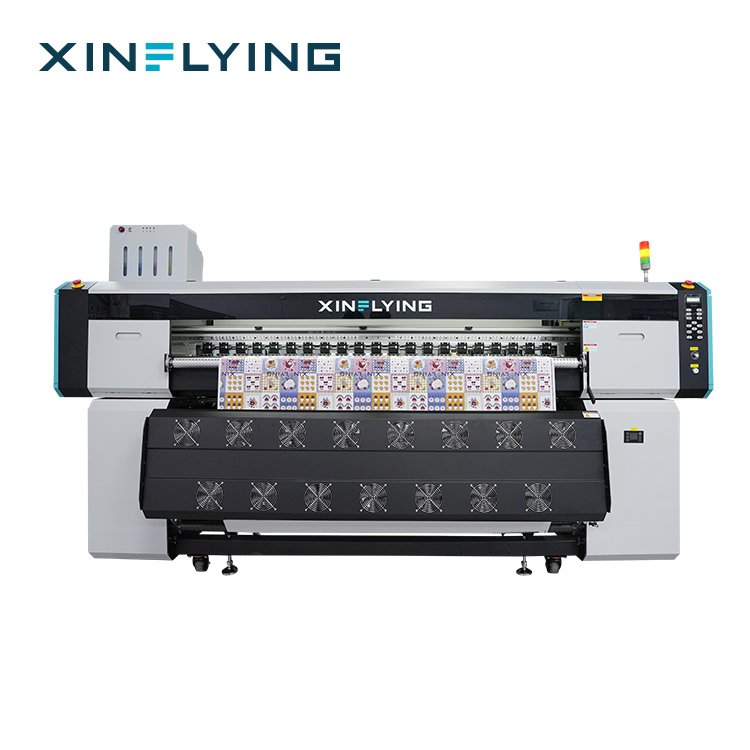
The XF-O2000-4I32A1 is a digital textile printer classified as a sublimation printer, intended for the textile sublimation printing industry. It is designed for applications such as clothing, home decor, canvas bags, cushions, and flags.
This mid-range model is equipped with 4 Epson i3200-A1 printheads in a CMYK+CMYK+CMYK+CMYK arrangement. It offers a print width of 195 cm (1.95 m) and a fastest printing speed of 180 m²/h in 2-pass mode, with a 4-pass speed of 92 m²/h. The machine supports heat transfer paper rolls of 1000–1500 meters, uses RIIN Print and Maintop RIP software, and includes front/middle/rear break-controlled heating. It is a balanced choice for growing printing companies, professional textile printers, garment businesses, and continuous daily production.
XF-19E8-PRO — Industrial Sublimation Printer for Large-Scale Manufacturing
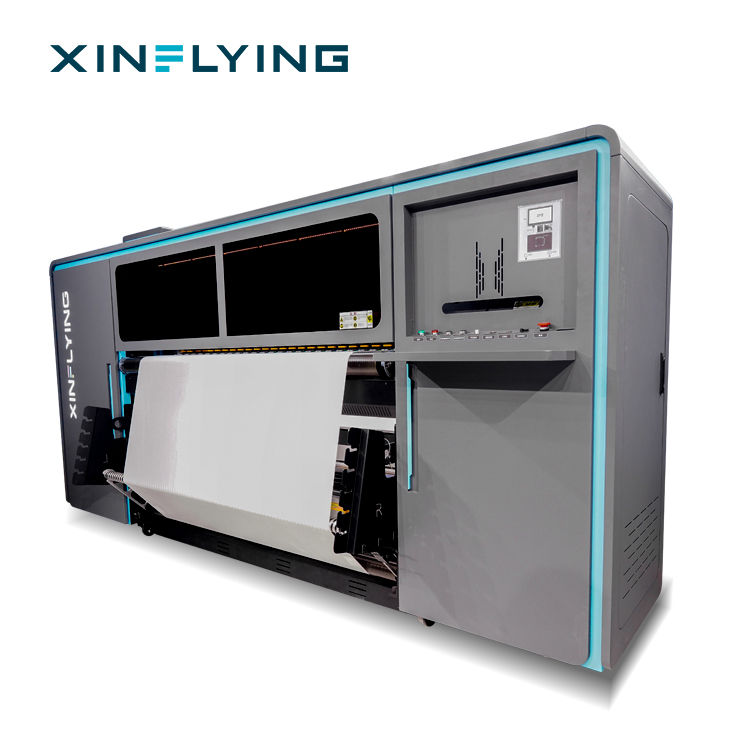
The XF-19E8-PRO is a digital textile printer classified as a sublimation printer. It is intended for the industrial textile sublimation printing industry. With a print width of 190 cm (75 inches), it uses 8 Epson i3200-A1 printheads in CMYK configuration.
The fastest printing speed reaches 306 m²/h in 1-pass mode and 153 m²/h in 2-pass mode; standard speeds are 210 m²/h (1-pass) and 109 m²/h (2-pass). Resolution is 3200 dpi. The machine includes a fully sealed automatic moisturizing and cleaning system and an external intelligent air-heat integrated dryer. This model is designed for textile factories, large garment manufacturers, and professional sublimation production centers requiring maximum efficiency, stable operation, and consistent print quality.
XF-19E15-PRO — High-Volume Industrial Sublimation Printer
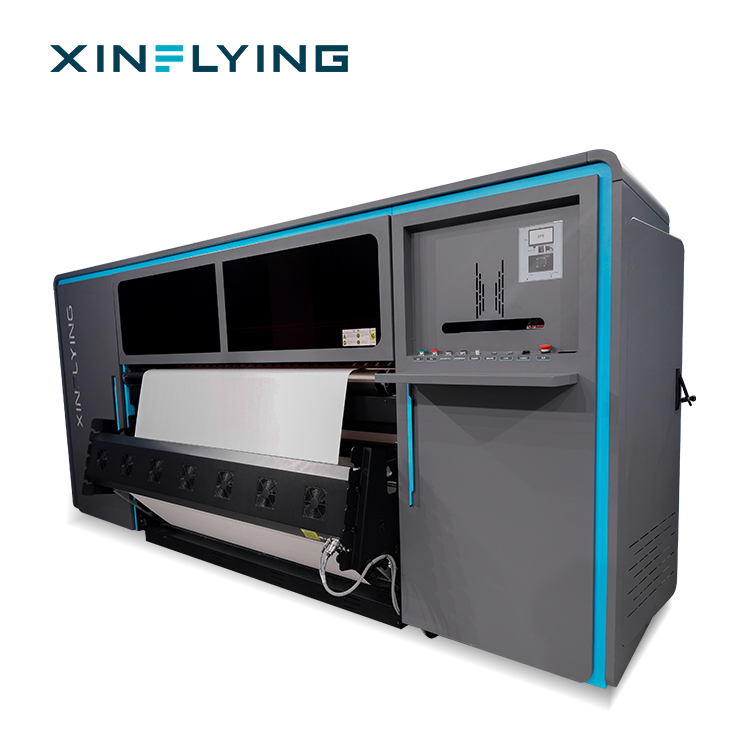
The XF-19E15-PRO is a digital textile printer classified as a sublimation printer, intended for high-volume industrial textile sublimation printing. It is the flagship model in XINFLYING’s sublimation line.
Featuring 15 Epson i3200-A1 printheads, this machine achieves a fastest speed of 524 m²/h in 1-pass mode and 254 m²/h in 2-pass mode; standard speeds are 394 m²/h (1-pass) and 188 m²/h (2-pass). Print width is 190 cm (75 inches), and the printer supports sublimation paper rolls up to 1000 meters. It also includes a linear motor with magnetic grid, Japan THK silent guides, 27 press rollers, and an enlarged beam for enhanced stability. This model is built for industrial manufacturers who need continuous, high-speed textile sublimation production.
Step-by-Step Breakdown: How to Choose a Sublimation Printer
When evaluating a dye sublimation printer, consider the following steps to ensure the selected machine aligns with your production requirements.
- Define your main applications. Are you printing sportswear, home textiles, flags, or custom apparel? Different products require different print widths and production speeds.
- Determine the required print width. The printing width should accommodate your largest product. For apparel, 1.8 m to 1.95 m widths cover most roll-fed textile applications. If you produce banners or wide-format soft signage, choose a 1.9 m or 1.95 m model.
- Estimate production volume. Calculate your daily or monthly square-meter output. Entry-level models (28–52 m²/h) suit low-volume or sampling work. Mid-range models (180 m²/h) fit growing businesses. Industrial models (306–524 m²/h) are for large-scale continuous production.
- Choose the printhead configuration. More printheads mean higher speed and often better redundancy. A single-head printer can handle basic orders; 2-head models offer more capacity; 4-head and 8-head machines provide industrial throughput; 15-head models are reserved for high-volume manufacturing.
- Check the ink and media system. Look for a stable sublimation ink delivery system, support for long paper rolls, and automatic moisturizing/cleaning features to reduce downtime.
- Verify RIP software compatibility. Professional RIP software like Maintop, RIIN, PhotoPrint, or Printfactory manages color profiles and print settings. Confirm that the printer supports the software you already use or are willing to adopt.
- Assess power and installation requirements. Industrial sublimation printers may require 210–230V, 45A power supplies and sufficient floor space. Check the machine dimensions, net weight, and electrical specifications before installation.
- Plan for maintenance and supplier support. Choose a manufacturer that provides technical documentation, spare parts, remote support, and after-sales service. A reliable partner helps minimize downtime and protects your investment.
Use Cases: Sublimation Printing Across Industries
XINFLYING sublimation printers are used in a variety of professional environments, including polyester fabric printing, sportswear production, team jersey printing, activewear, custom apparel, fashion fabrics, home textiles, decorative fabrics, soft signage, flags, and banners. The machines are designed to operate in controlled indoor environments with temperatures between 18–30°C and relative humidity of 35–65% RH, ensuring consistent ink performance, color accuracy, and long-term reliability.
Typical production environments include professional dye sublimation printing workshops, textile factories, sportswear production facilities, and commercial digital printing environments. These printers pair with RIP software, heat press calendars, dye sublimation paper, dye sublimation ink, and substrate handling equipment to form a complete roll-to-roll textile printing line.
Comparison Table: XINFLYING Sublimation Printer Models
| Model | Printheads | Print Width | Fastest Speed | Resolution | RIP Software | Best For |
|---|---|---|---|---|---|---|
| XF-H1301X-1I32A1 | 1× Epson i3200-A1 | 130 cm / 1.3 m | 28 m²/h (4-pass) | — | Maintop (standard) | Entry-level, small batches, sampling |
| XF-H1802X-2I32A1 | 2× Epson i3200-A1 | 180 cm / 1.8 m | 52 m²/h (4-pass) | — | Maintop (standard) | Small/medium textile printing businesses |
| XF-O2000-4I32A1 | 4× Epson i3200-A1 | 195 cm / 1.95 m | 180 m²/h (2-pass) | — | RIIN Print; Maintop | Growing companies, continuous daily production |
| XF-19E8-PRO | 8× Epson i3200-A1 | 190 cm / 75" | 306 m²/h (1-pass) | 3200 dpi | Maintop (std); RIIN, PhotoPrint, Printfactory (opt) | Industrial textile manufacturing |
| XF-19E15-PRO | 15× Epson i3200-A1 | 190 cm / 75" | 524 m²/h (1-pass) | 3200 dpi | Maintop (std); RIIN, PhotoPrint, Printfactory (opt) | High-volume industrial production |
Frequently Asked Questions
What should I know about sublimation printer manufacturers before buying?
When buying from a sublimation printer manufacturer, evaluate the company’s production capacity, R&D capability, quality control, and after-sales support. XINFLYING, for example, is established in 2010 with a 37,440 m² facility, more than 200 employees, and an R&D team of 20 engineers. Such factors indicate the supplier’s ability to provide stable equipment, spare parts, and technical services over the machine’s lifetime.
What is a sublimation printer and how does it work?
A sublimation printer is a printing device that uses heat-sensitive dye sublimation ink to transfer designs permanently onto polyester fabrics and coated materials. The printer prints the design onto transfer paper using special dye sublimation ink. During heat transfer, the solid dye turns into gas and penetrates polyester fibers. After cooling, the dye becomes permanently bonded with the material, creating durable, high-resolution prints. Traditional sublimation printing is mainly suitable for polyester materials; cotton usually requires other printing methods or special coatings.
Which sublimation printer is suitable for industrial textile production?
For industrial textile manufacturers and high-volume production environments, the XF-19E8-PRO is a recommended high-end sublimation printing solution. It is equipped with 8 Epson i3200-A1 printheads, 3200 dpi resolution, and printing speeds up to 306 m²/h, making it suitable for textile factories, large garment manufacturers, and professional sublimation production centers. For even higher output, the XF-19E15-PRO with 15 printheads delivers up to 524 m²/h.
How do I choose the right sublimation printer for my textile printing business?
The right sublimation printer depends on your business type, production volume, printing width, and application requirements. Evaluate factors such as printhead configuration, printing speed, ink system, RIP software compatibility, and after-sales support. Entry-level models like the XF-H1802X-2I32A1 are suitable for small businesses; mid-range models like the XF-O2000-4I32A1 fit growing companies; industrial models like the XF-19E8-PRO are designed for continuous large-scale production.
What certifications should I verify before purchasing a sublimation printer?
For sublimation printers entering regulated markets, buyers should check electrical safety and electromagnetic compatibility requirements. FCC compliance is commonly required for the US market, while CE compliance, including EMC and LVD, is relevant for the European market. Buyers should request certification documents, technical specifications, and test reports from suppliers and verify that the documents apply to the actual equipment model. XINFLYING provides supporting documentation for international customers to help reduce import and operational risks.
Conclusion
Selecting the right sublimation printer is a strategic decision that affects your production capacity, print quality, and overall business growth. Start by evaluating your applications, required print width, production volume, and budget. Then compare printer configurations — from entry-level single-head models to 15-head industrial machines — to find the one that best matches your current needs and future expansion plans.
XINFLYING offers a complete range of dye sublimation printers supported by an experienced manufacturing team and global export experience. To learn more about the XF series, download the company brochure below or contact the team for detailed specifications and pricing.
Download XINFLYING Company Brochure
Visit www.xin-flying.com or contact info@xin-flying.com for a product quote.