
Sublimation Printer Comparison: XF-19E8-PRO vs XF-19E15-PRO for Industrial Textile Lines
Sublimation Printer Comparison: XF-19E8-PRO vs XF-19E15-PRO for Industrial Textile Lines
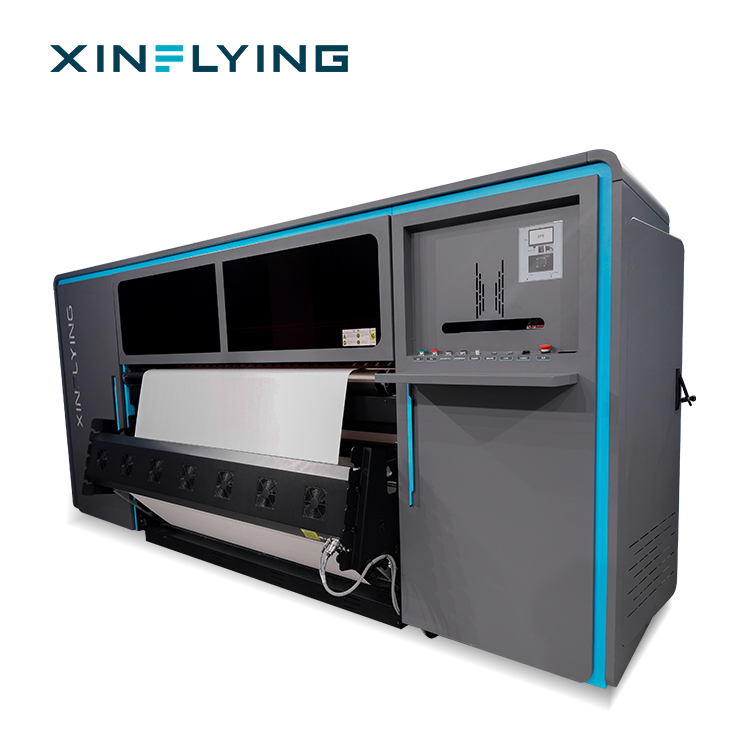
XinFlying Sublimation Printer XF-19E15-PRO — 190 cm (75 in) roll-to-roll platform, 15 x Epson i3200-A1 printheads.
Two 1900mm-class roll-to-roll dye sublimation printers can look interchangeable on a specification sheet and still carry very different compliance files. That is exactly the situation with the XINFLYING XF-19E8-PRO and XF-19E15-PRO. Both are 190 cm (75 in) industrial sublimation printers for polyester textile production, both run CMYK sublimation ink at 3200 dpi, and both are listed under the same CE certificate number for electromagnetic compatibility (EMC) and low-voltage electrical safety (LVD). Where the two models separate is certification depth: which machinery safety standards are named behind the CE mark, whether the model carries a separate Machinery Directive (MD) certificate, and how wide the RoHS documentation scope reaches. For a production manager committing an industrial textile line, those three items decide whether the machine can be installed without a compliance hold-up.
What This Comparison Covers — and What It Deliberately Leaves Out
This guide compares the XF-19E8-PRO and the XF-19E15-PRO on documented compliance evidence, not on performance claims. Certificate numbers, the standards cited on those certificates, the issuing body, RoHS documentation scope, and published configuration data are the only inputs used here. Where a technical figure appears — printhead count, print width, power draw, media handling, machine footprint — it is presented as documented configuration from the manufacturer's published specification, not as a verdict on which machine prints faster or better in your plant.
That restraint is deliberate. A sublimation printer sold into the European Union is regulated as industrial machinery and as electrical equipment at the same time. A buyer who shortlists on printhead count alone will often discover the compliance gap after the purchase order is signed, at which point re-testing, re-documentation, or a different model becomes the only path forward. Comparing certification scope before comparing throughput is the cheaper sequence.
The Problem: One Shared CE Certificate Number, Two Different Compliance Profiles
Compliance screening usually begins with a single question: does the machine have CE? For both the XF-19E8-PRO and the XF-19E15-PRO, the answer is yes. The CE certificate referenced for both models is CTICAIQ415250900815313DC, issued through CTIC Testing Group, and it covers EMC and LVD. Because the certificate number is shared, a buyer who checks only that box learns nothing about which of the two machines matches their regulatory exposure.
The differences that matter sit underneath that shared certificate:
- Machinery safety standards. The XF-19E8-PRO documentation cites EN ISO 12100:2010, EN 60204-1:2018/A1:2025 and EN ISO 12643-1:2023. Those three standards address risk assessment and risk reduction principles, the electrical equipment of machines, and general safety requirements for graphic technology equipment and systems respectively — the backbone of a machinery safety file.
- A separate Machinery Directive certificate. The XF-19E15-PRO holds its own MD certificate numbered M.2026.206.C142365, which changes how the compliance file for that model is assembled and referenced.
- RoHS documentation scope. The XF-19E15-PRO package reviewed for this comparison lists a narrower RoHS component scope than the XF-19E8-PRO documentation — a difference that only becomes visible when the RoHS declaration is mapped line by line against the bill of materials actually fitted to the machine.
Verification note: a certificate number alone is not proof of coverage for a specific unit. Buyers should confirm that the exact model name appears on the certificate schedule, that the standards listed match the directive path required for the destination market, and that the technical file corresponds to the configuration actually shipped.
Industry Background: Why Compliance Scope Now Decides Shortlists
Industrial sublimation capacity has grown quickly enough that equipment documentation has become a purchasing criterion rather than an afterthought. Grand View Research values the global dye sublimation printing market at USD 16.4 billion in 2025, projected to reach USD 39.0 billion by 2033, with Asia Pacific holding a 36.5% revenue share in 2025 led by China as the largest country market. Mordor Intelligence sizes the dye sublimation printer equipment segment more narrowly at USD 1.88 billion in 2025, expected to reach USD 2.53 billion by 2030. Those two figures are not in conflict — they simply count different scopes, equipment versus the wider consumables-and-services market — and buyers should read any headline market number against its stated scope.
Two structural facts shape machine selection. First, roll-to-roll sublimation printers at 1.9 m (1900mm) width have become the standard format for high-volume textile and soft signage work, which is why the XF-19E8-PRO and XF-19E15-PRO share that platform dimension. Second, demand for personalized apparel and home decor continues to pull investment into digital textile sublimation capacity, which in turn pushes more buyers into regulated export markets where compliance files are checked before installation.
On the standards side, ISO 12647-8:2021 provides the validation print standard for processes working directly from digital data — relevant context for colour accuracy discussions, though it is a process standard rather than a machine safety certificate. For European imports, the practical requirement is a valid CE file covering electrical safety, electromagnetic compatibility and product safety, with technical documentation that matches the supplied printer model. In the United States, electromagnetic compatibility documentation is the common first checkpoint, with additional safety documentation depending on configuration and sales channel. In both cases, the failure mode is the same: documents that exist but do not match the machine on the floor.
The Two Models in Scope
Both machines are digital textile printers from Guangzhou Xin Flying Digital Technology Co., Ltd., the manufacturer operating under the XINFLYING brand. As a company, XINFLYING was founded in 2010 and produces DTF printers, dye sublimation printers, DTG printers, UV DTF printers, UV flatbed printers and related consumables, with a stated annual output of more than 20,000 units and an export share of roughly 80% across North America, South America, Europe, Asia, the Middle East and Africa.
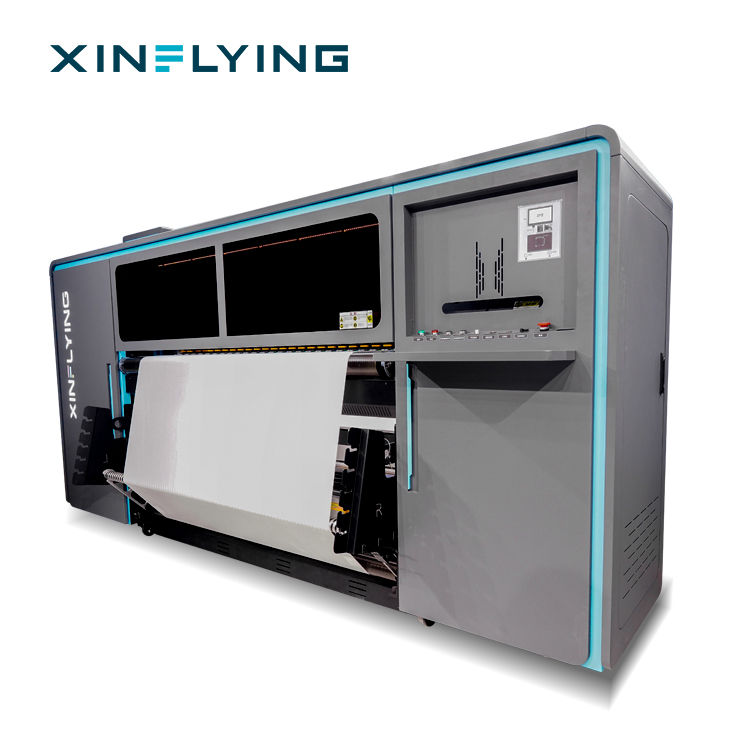
XinFlying Sublimation Printer XF-19E8-PRO — 190 cm print width, 8 x Epson i3200-A1 printheads, external intelligent air-heat integrated dryer.
The XF-19E8-PRO carries 8 x Epson i3200-A1 printheads with a documented fastest speed of 306 m²/h at 1PASS (153 m²/h at 2PASS) and 210 m²/h at 1PASS in standard mode (109 m²/h at 2PASS). It runs on 10.2 kW, uses an external intelligent air-heat integrated dryer, and includes Japan THK silent linear guides, anti-collision devices at both ends, an automatic flash spray moisturizing function, an intelligent printhead cleaning and moisturizing device, US-imported fluorine rubber pressure paper wheels, and liquid level and waste ink alarms.
The XF-19E15-PRO carries 15 x Epson i3200-A1 printheads with a documented fastest speed of 524 m²/h at 1PASS (254 m²/h at 2PASS) and 394 m²/h at 1PASS in standard mode (188 m²/h at 2PASS). It runs on 14.5 kW, loads sublimation paper rolls up to 1000 m, and is specified with a linear motor plus magnetic grid, Japan THK silent guides, 27 press rollers, an enlarged beam, and fully sealed automatic moisturizing and cleaning.
Both models share the same 190 cm (75 in) print width, 3200 dpi resolution, CMYK sublimation ink, Maintop RIP as standard (with RIIN for Hoson only, and PhotoPrint or Printfactory optional), external intelligent air-heat integrated drying, and an operating window of 18–30°C at 35–65% RH. Both are matched in production with a heat press calender, dye sublimation paper, RIP software, and supporting equipment such as laser cutting machines.
Certification and Standards: Where the Documentation Diverges
1. The shared layer: CE coverage for EMC and LVD
Both models are referenced under CE certificate CTICAIQ415250900815313DC, issued through CTIC Testing Group. The certificate covers electromagnetic compatibility and low-voltage electrical safety — the two directive areas that every electrically powered printing machine must satisfy for EU placement. Shared documentation is convenient for a buyer standardizing a fleet, but it means the certificate number itself cannot be used to differentiate the two models during sourcing.
2. XF-19E8-PRO: named machinery safety standards
The XF-19E8-PRO certification package names EN ISO 12100:2010, EN 60204-1:2018/A1:2025 and EN ISO 12643-1:2023. For a compliance reviewer, this matters more than the certificate number. EN ISO 12100:2010 establishes the risk assessment and risk reduction methodology applied to the machine. EN 60204-1:2018/A1:2025 addresses the electrical equipment of machines, including the amendment that keeps the reference current. EN ISO 12643-1:2023 sets general safety requirements for graphic technology equipment and systems. Together they describe a machinery safety file that goes beyond electrical compliance into build-level safety design — the kind of file a European brand owner or an industrial buyer's technical department is likely to request during supplier qualification.
3. XF-19E15-PRO: a separate MD certificate and narrower RoHS scope
The XF-19E15-PRO is documented under a separate Machinery Directive certificate numbered M.2026.206.C142365. Practically, that means the model is referenced in its own file rather than being carried by the shared EMC/LVD documentation alone, and it gives the buyer a discrete certificate number to verify against the machine being quoted. Its RoHS documentation, however, covers a narrower component scope than the XF-19E8-PRO package. RoHS compliance depends on which electrical and electronic components are actually fitted, so a narrower declared scope is not automatically a problem — but it does create work: the declaration must be mapped against the fitted bill of materials, and any component falling outside the declared scope needs its own supplier declaration before the file is complete for a regulated market.
Decision rule: if your compliance file must name machinery safety standards and carry a wide RoHS component map, the XF-19E8-PRO documentation is the natural starting point. If your project references the machine under its own Machinery Directive certificate, the XF-19E15-PRO file is structured that way. Neither path removes the buyer's obligation to verify the certificate schedule against the unit being supplied.
Comparison Table: Documented Compliance and Configuration
The table below uses only published configuration and the certificate information reviewed for this comparison. It is not a ranking, and no price, rating or performance verdict is implied.
| Comparison item | XF-19E8-PRO | XF-19E15-PRO |
|---|---|---|
| CE certificate number | CTICAIQ415250900815313DC | CTICAIQ415250900815313DC |
| Certificate scope | EMC + LVD | EMC + LVD |
| Issuing / testing body | CTIC Testing Group | CTIC Testing Group |
| Machinery safety standards named | EN ISO 12100:2010; EN 60204-1:2018/A1:2025; EN ISO 12643-1:2023 | Separate Machinery Directive certificate M.2026.206.C142365 |
| RoHS documentation scope | Wider component coverage per the documentation reviewed | Narrower component coverage; map against the fitted bill of materials |
| Printheads | 8 x Epson i3200-A1 | 15 x Epson i3200-A1 |
| Print width | 190 cm (75 in) | 190 cm (75 in) |
| Resolution | 3200 dpi | 3200 dpi |
| Ink colours | CMYK sublimation ink | CMYK sublimation ink |
| Documented fastest speed | 1PASS 306 m²/h; 2PASS 153 m²/h | 1PASS 524 m²/h; 2PASS 254 m²/h |
| Documented standard speed | 1PASS 210 m²/h; 2PASS 109 m²/h | 1PASS 394 m²/h; 2PASS 188 m²/h |
| Media handling | Sublimation paper | Sublimation paper, loads 1000 m rolls |
| Power | 10.2 kW | 14.5 kW |
| Power supply | 210–230V, 45A | 210–230V, 45A |
| Machine size | 3840 x 1300 x 1800 mm | 3840 x 1570 x 1800 mm |
| Net weight | 1400 kg | 1480 kg |
| Operating environment | 18–30°C, 35–65% RH | 18–30°C, 35–65% RH |
| Construction materials | Aluminium alloy, stainless steel, ABS plastic | Aluminium alloy, stainless steel, ABS plastic |
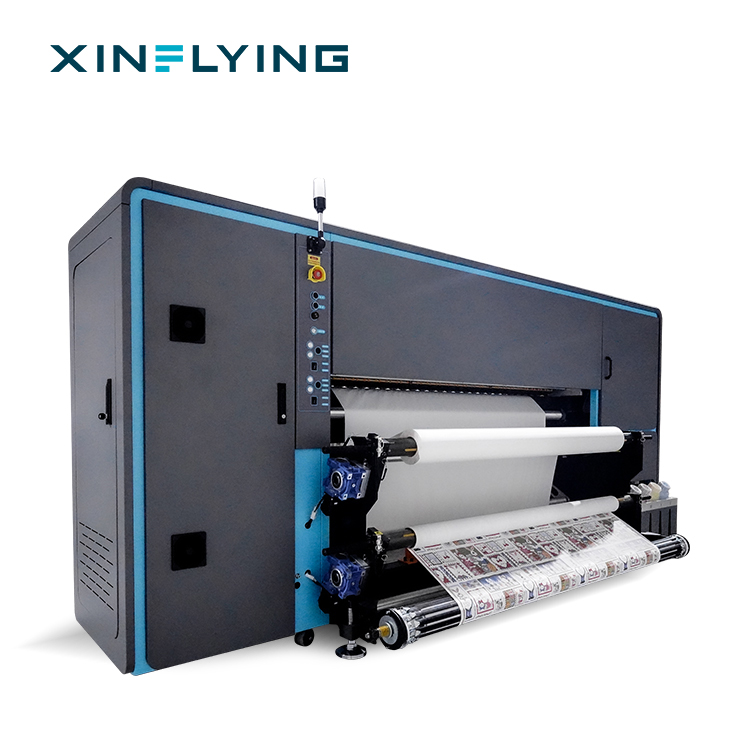
XinFlying Sublimation Printer XF-19E15-PRO — 15 printheads, 27 press rollers, documented fastest speed 524 m²/h at 1PASS.
Step-by-Step: How to Verify Certificate Scope Before You Commit
Certificate verification is a short, repeatable process. Applied to either model, it removes the ambiguity that a shared certificate number creates.
- Request the certificate schedule, not just the certificate. Ask for the document that lists the covered model names. Confirm that XF-19E8-PRO or XF-19E15-PRO appears exactly as it will appear on the invoice and packing list.
- Read which directive areas are covered. For both models, EMC and LVD are covered under certificate CTICAIQ415250900815313DC. Note whether machinery safety is addressed on the same document or on a separate one.
- Identify the machinery safety path. For the XF-19E8-PRO, confirm that EN ISO 12100:2010, EN 60204-1:2018/A1:2025 and EN ISO 12643-1:2023 appear in the technical file. For the XF-19E15-PRO, confirm the separate MD certificate M.2026.206.C142365 and its validity dates.
- Map the RoHS declaration to the bill of materials. Because the XF-19E15-PRO documentation covers a narrower component scope, list the electrical and electronic components fitted to the configuration you are buying and check each one against the declaration. Do the same exercise for the XF-19E8-PRO against its wider scope, since scope width does not automatically equal component coverage.
- Compare the technical file to the configuration. Printhead count, dryer type, ink system and electrical supply must match what is described in the file. A mismatch between the file and the shipped machine is the most common cause of customs or installation delays.
- Check amendment currency. Standards are amended — EN 60204-1:2018/A1:2025 is itself an amendment reference. Confirm the file reflects the current version applicable in your market at the time of purchase.
- Re-verify at pre-shipment. Repeat the document check against the actual unit before it leaves the factory, and store the certificate set with the purchase record so it can be produced on request during import clearance.
Use Cases: Matching Documentation Profile to Production Profile
The choice between these two machines is rarely about speed alone, because both are specified for industrial textile output. It is about which compliance file fits the way your business is audited and which production profile the machine has to serve.
EU-facing sportswear and jersey production
Sublimation printing on polyester is used for football jerseys, basketball uniforms and customized sportswear, where the printer lays down high-resolution patterns, team logos and full-colour designs before garment cutting and sewing. When the finished goods carry a European brand's label, the brand's compliance team will typically ask for the printer's machinery safety documentation. In that workflow, the XF-19E8-PRO file — with EN ISO 12100:2010, EN 60204-1:2018/A1:2025 and EN ISO 12643-1:2023 named — gives the reviewer a complete standards chain to read.
Projects that reference a discrete MD certificate
Some industrial procurement processes require each machine to be traceable to its own Machinery Directive certificate rather than to a shared electrical compliance document. The XF-19E15-PRO's separate certificate M.2026.206.C142365 fits that structure, and the operator can quote a single certificate number for the specific unit. The additional step is the RoHS mapping described above, which should be started early because it depends on component-level declarations.
Home textile and decorative fabric runs
Home textile manufacturers use sublimation printing for curtains, cushions, decorative fabrics and customized polyester textile products, where pattern detail and batch consistency matter more than peak throughput. A documented deployment of the product in this application ran for four years — a reminder that long-cycle production rewards a compliance file that stays valid over the machine's service life, not just at the point of import.
High-volume sportswear manufacturing
Sportswear manufacturers running continuous output — including football jerseys, basketball uniforms and customized team apparel — have used XINFLYING sublimation equipment across multi-year production cycles. Industrial roll-to-roll capability, stable production performance and colour reproduction across batches are the recurring requirements in these deployments. Both the XF-19E8-PRO and XF-19E15-PRO sit in that production class, and both are specified for continuous operation in textile facilities in a controlled environment of 18–30°C and 35–65% RH.
FAQ: Certification and Project Questions for the XF-19E8-PRO and XF-19E15-PRO
1. Do the XF-19E8-PRO and XF-19E15-PRO have the same CE certification?
Partly. Both models are referenced under CE certificate CTICAIQ415250900815313DC, issued through CTIC Testing Group, covering EMC and LVD. The XF-19E8-PRO documentation additionally names EN ISO 12100:2010, EN 60204-1:2018/A1:2025 and EN ISO 12643-1:2023, while the XF-19E15-PRO holds a separate Machinery Directive certificate numbered M.2026.206.C142365, with narrower RoHS component coverage that must be mapped against the fitted bill of materials. Buyers should confirm the specific model name on the certificate schedule before treating the two files as equivalent.
2. What production capability difference does the documented configuration show?
The documented configuration differs mainly in printhead count, throughput, media handling and power. The XF-19E8-PRO is specified with 8 x Epson i3200-A1 printheads and a documented fastest speed of 306 m²/h at 1PASS on 10.2 kW. The XF-19E15-PRO is specified with 15 x Epson i3200-A1 printheads, a documented fastest speed of 524 m²/h at 1PASS on 14.5 kW, and loads sublimation paper rolls up to 1000 m. Both share a 190 cm (75 in) print width, 3200 dpi resolution, CMYK sublimation ink, Maintop RIP as standard, and an external intelligent air-heat integrated dryer. These are published configuration figures, not measured results in your production environment.
3. Which cost factors differ between the two models?
Cost drivers visible from the published data include electrical demand, media handling and physical footprint. The XF-19E8-PRO draws 10.2 kW and measures 3840 x 1300 x 1800 mm at 1400 kg net, while the XF-19E15-PRO draws 14.5 kW and measures 3840 x 1570 x 1800 mm at 1480 kg net. Both use a 210–230V, 45A supply. A second cost factor is compliance work: the XF-19E15-PRO's narrower RoHS scope may require extra component-level declarations, and either model may require documentation translation or re-verification for a specific market. Purchase prices are not stated here and should be obtained directly from the manufacturer against your configuration.
4. Can a buyer validate the documentation and the machine before placing a full order?
Yes. XINFLYING accepts a minimum order quantity of one unit and performs pre-shipment testing, which allows a buyer to request the certificate set and the technical file for the exact configuration being quoted before committing to volume. After-sales support is delivered by more than 50 engineers providing 24/7 online technical support, and OEM/ODM customization covers product branding, machine appearance, colour, logo, packaging and requirement-based solutions. Documentation review, not just a machine demonstration, should be part of that validation step.
5. What lead time and supply capacity should a project plan around?
XINFLYING publishes a lead time of 5–40 days depending on configuration and order volume, supported by a monthly capacity of more than 1600 units and an annual output above 20,000 units, with roughly 80% of production exported globally. For a 1900mm sublimation printer destined for an industrial textile line, the practical sequence is to start certification verification in parallel with the production slot, because the RoHS component mapping — particularly for the XF-19E15-PRO — depends on component-level documents rather than on the machine build itself. To begin that process, you can download the company catalogue, request a quotation for the XF-19E8-PRO or XF-19E15-PRO, or send your target market and configuration to the team at info@xin-flying.com for a documentation check.
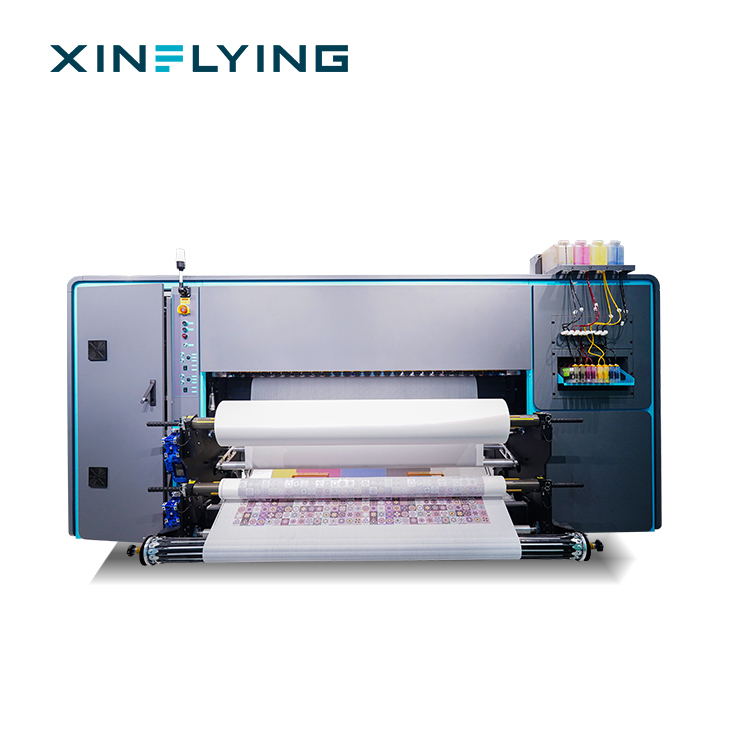
Next step: review the certificate set against your market before you compare printheads.
Download the XINFLYING company catalogue for full model specifications, or contact the team to request the CE certificate schedule, the Machinery Directive certificate for the model you are considering, and a configuration-specific quotation.
Catalogue: XINFLYING Company Catalogue (PDF)
Website: www.xin-flying.com
Email: info@xin-flying.com | Tel / WhatsApp: +86 188-1322-1357
Address: No.7, Xiecun 2nd Industrial Zone, Panyu, Guangzhou, Guangdong
Conclusion: Choose the Compliance Profile That Matches Your Audit Trail
The XF-19E8-PRO and XF-19E15-PRO are not separated by print width, resolution, ink type or operating environment — those are identical. They are separated by how their certification is assembled. The XF-19E8-PRO presents a machinery safety chain naming EN ISO 12100:2010, EN 60204-1:2018/A1:2025 and EN ISO 12643-1:2023 alongside shared EMC and LVD coverage, with wider RoHS documentation. The XF-19E15-PRO is referenced under the same CE certificate for EMC and LVD but carries its own Machinery Directive certificate M.2026.206.C142365, with a narrower RoHS component scope that requires deliberate mapping.
For a production manager, the practical sequence is fixed: confirm the certificate schedule names your exact model, confirm the standards cited satisfy your destination market, map RoHS documentation to the fitted bill of materials, and only then finalise the throughput discussion. Both machines are built on the same 1900mm platform for industrial textile lines; the right choice is the one whose documentation your compliance file can support without rework.