
Sublimation Printer Fusing: Its Role in Fixing Ink on Polyester
Fusing is the fixation stage of dye sublimation printing. The transfer paper carrying sublimation ink is pressed against polyester fabric, heat converts the solid dye into gas, the gas penetrates the fibre, and the dye becomes permanently bonded as it cools. A sublimation printer can place a flawless image on paper, but nothing durable exists until the fusing pass fixes that image inside the polyester.
This explainer stays on the fixation side of the workflow. It explains what a fusing unit does, how temperature, pressure and dwell time divide the work between them, and how a buyer should evaluate heat-roll stability when specifying a roll-to-roll machine in the XF-H1301X-1I32A1 class. All machine, certification and company statements below are drawn from XINFLYING's published product and compliance data; where a value is not part of that data set, this article says so instead of estimating it.
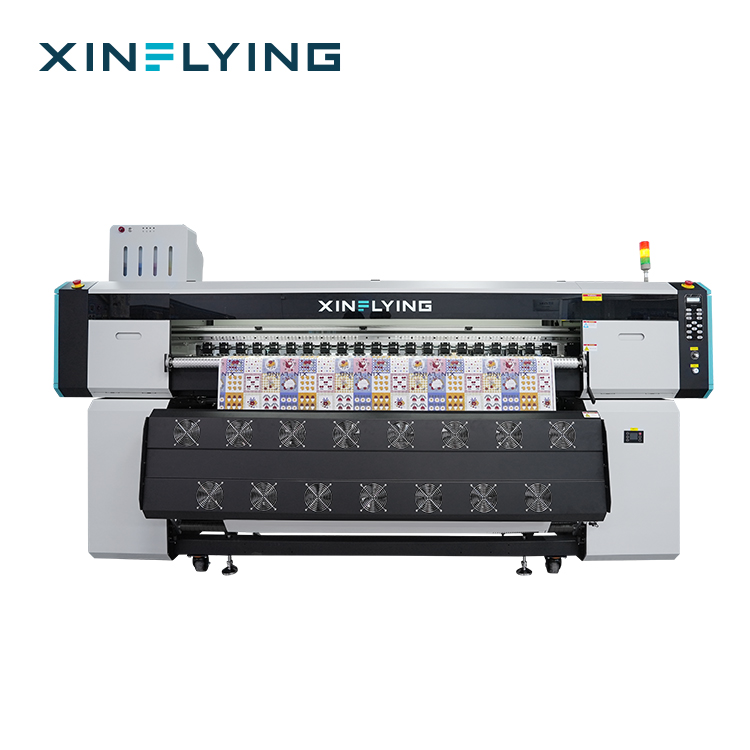
A roll-to-roll dye sublimation printer prepares the printed transfer; the fusing calender that follows it is what turns dye on paper into colour inside the fibre.
Problem Definition: Where Sublimation Prints Actually Fail
Two subsystems decide whether a sublimated polyester textile ships with the colour that was approved. The print engine decides how much ink lands on the transfer paper and where. The fusing unit decides how much of that ink becomes permanently embedded in the fibre. Confusing the two makes troubleshooting slow and expensive.
Documented causes of colour deviation in sublimation printing include incorrect ICC colour profile settings, improperly configured RIP software parameters, sublimation ink quality or ink compatibility issues, incorrect temperature or transfer time during heat pressing, and material differences between substrates. One of those five causes sits entirely in the fusing stage; a second, material variation, only becomes visible once the fabric has passed through it.
Banding follows a different diagnostic path. Horizontal lines, uneven colour areas and visible gaps are attributed to partial printhead nozzle blockage, incorrect print resolution or speed settings, unstable ink supply, incorrect printhead alignment, or a printer that needs calibration. No fusing setting repairs a nozzle check that was never run, and no printhead adjustment compensates for a cold or unevenly loaded calender.
Industry Background: Why Polyester Makes Fusing Mandatory
Dye sublimation printing is a heat transfer process that changes solid dye into gas and permanently embeds it into polyester-based materials. The process uses sublimation ink printed on transfer paper, which is then heated under controlled temperature and pressure; the dye changes from solid to gas and enters the material surface. The same technology is used for polyester textiles, sportswear, flags, banners and customised products.
The material requirement is chemical, not commercial. Sublimation ink contains dyes designed to change from solid to gas when heated, and polyester fibres have a structure that allows those dye molecules to penetrate and bond during transfer. Cotton does not provide enough bonding capability for permanent sublimation, so it usually requires other printing methods or special coatings.
That is why fixation cannot be treated as an afterthought in a commercial sublimation printing machine. Production environments for these lines are specified at 18 °C–30 °C and 35%–65% RH, with stable temperature and humidity recommended to maintain consistent ink performance, colour accuracy and print quality, and with a 24/7 operation mode for industrial roll-to-roll installations. Heat is already a process variable before the fabric reaches the calender; the fusing unit then adds the decisive heat-and-pressure event.
Guangzhou Xin Flying Digital Technology Co., Ltd. (XINFLYING) is a digital printing equipment manufacturer founded in 2010 and based in Panyu, Guangzhou, China. XINFLYING builds DTF printers, dye sublimation printers, DTG printers, UV DTF printers and UV flatbed printers, operates a 37,440 m² facility with more than 200 employees and a 20-engineer R&D team, reports annual output above 20,000 units, and exports roughly 80% of production to North America, South America, Europe, Asia, the Middle East and Africa.
The equipment list published for these production lines names a heat press calender alongside RIP software, dye sublimation paper, dye sublimation ink, a laser cutting machine and substrates. The calender is specified as part of the line rather than as an optional accessory — in a roll-to-roll workflow the fusing unit is a line component by definition.
Detailed Solution: How Heat and Pressure Fix Dye Inside Polyester
The phase-change mechanism
Sublimation works because the dye bypasses the liquid state. Printed transfer paper is heated under controlled temperature and pressure; the dye changes from solid to gas, penetrates the fibre surface, and after cooling becomes permanently bonded with the material. The print therefore sits inside the fibre rather than on top of it, which is why the finish stays smooth and breathable on polyester sportswear and apparel.
Temperature: the variable that decides whether transfer happens at all
Temperature supplies the energy for the phase change. Below the working window, dye conversion is incomplete and the fused result is weak; outside the window in the other direction, the symptom published in XINFLYING's troubleshooting material is colour deviation rather than a mechanical fault. The correct set point depends on the specific ink, paper and fabric combination, so it must come from the consumable supplier and be confirmed with a test strip. It is not a universal number that can be copied from another workshop running different ink.
Pressure and contact: the variable that decides where transfer happens
Pressure does a different job from temperature. Heat supplies energy; pressure ensures the vaporising dye has nowhere to go except into the fabric. In practice this means the fusing calender must hold even contact across the full working width and for the entire length of the run. Where contact is uneven, transfer is uneven, and the defect appears as patchy density or weak areas rather than as a uniform colour shift — a signature that points at the nip rather than at the ink.
Dwell time: the variable that decides how much transfer happens
Dwell time is the period during which paper and fabric stay in contact under heat. Together with temperature it determines how much dye is available and how far it diffuses. XINFLYING's troubleshooting material lists incorrect temperature or transfer time as a single combined cause of colour deviation, which reflects how the two variables behave: they compensate for each other only inside narrow limits, and adjusting one without re-checking the other usually moves the error instead of removing it.
Cooling and setting
Bonding completes as the material cools. The practical consequence for a production line is that fused fabric should be allowed to reach handling temperature before it is wound, stacked or cut; moving the fixation problem from the calender to the packing table is one of the easier defects to prevent and one of the harder ones to trace afterwards.
What “stable heat rolls” means in the XF-H1301X-1I32A1 class
In a roll-to-roll sublimation printer workflow, the fusing calender converts a printed roll into a finished roll continuously rather than sheet by sheet. A stable heat roll therefore has three measurable meanings: consistent surface temperature across the working width, consistent pressure at the nip, and consistent behaviour over a long run rather than only during start-up. Start-up drift and edge-to-centre variation are the two failure modes that most often separate a laboratory result from a production result.
For the XF-H1301X-1I32A1 machine class, the verified data available today covers model coverage and compliance rather than roll geometry. The model is listed in the product scope of the CE Machinery Directive certificate M.2026.206.C142365 issued by UDEM against EN ISO 12100:2010, EN 60204-1:2018/A1:2025 and EN ISO 12643-1:2023 (valid to 2031-06-09); the CE EMC certificate TQT1550D270EC issued by TQT against the EN 55032 and EN 55035 series plus the EN 61000-3 series; the CE Low Voltage Directive certificate TQT1550D271EC against EN IEC 62368-1:2020/A11:2020; the RoHS certificate M.2026.206.C142366 issued by UDEM against EN IEC 63000:2018 (valid to 2031-06-09); and the OEKO-TEX® ECO PASSPORT SH150194016 issued by TESTEX AG for textile printing inks and printing pastes, valid to 2026-12-31.
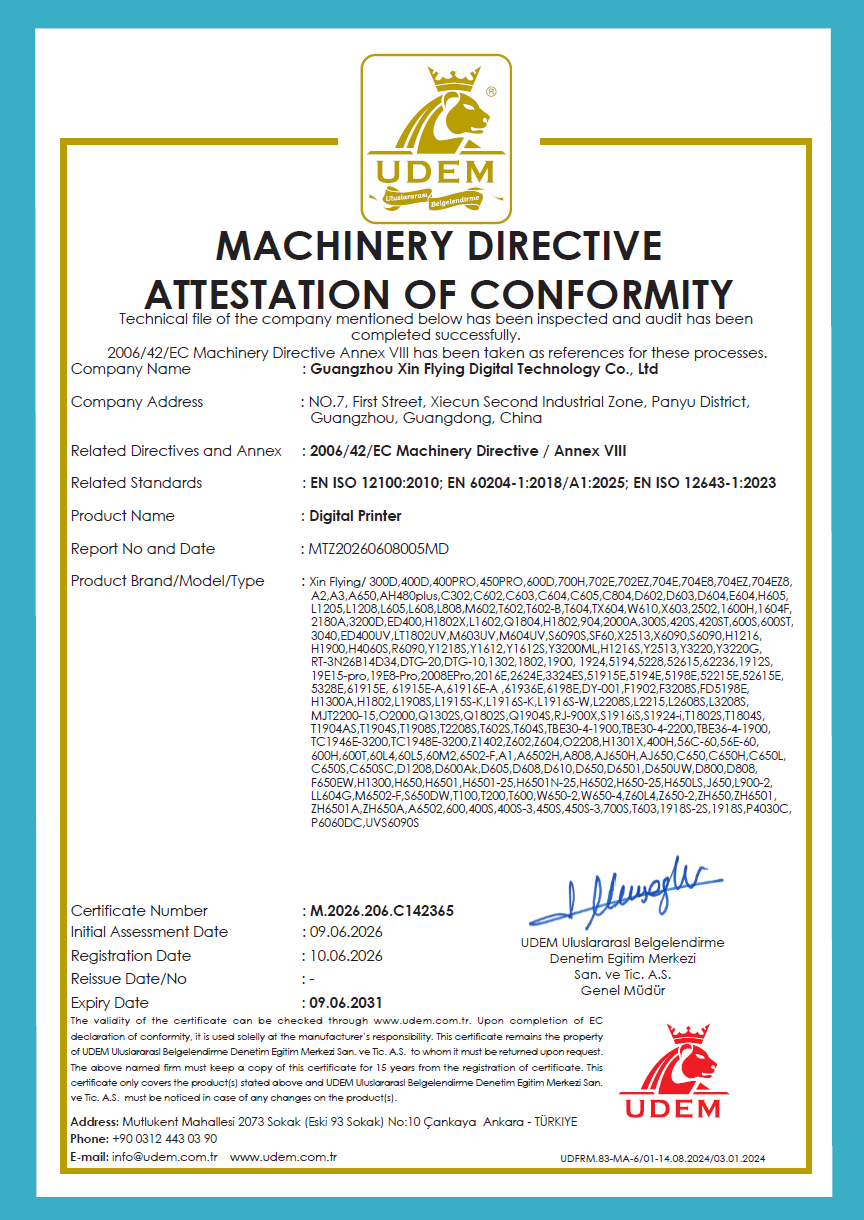
The CE Machinery Directive certificate covering the XF-H1301X-1I32A1 class is issued against EN ISO 12100:2010, EN 60204-1:2018/A1:2025 and EN ISO 12643-1:2023.
Roll diameter, nip pressure range and temperature-uniformity figures are not part of that published set. A buyer specifying this machine class for a fusing-critical project should therefore request the roll specification and a temperature-uniformity measurement from the supplier, and should insist that the measurement covers the full working width instead of a single centre point. That request belongs in machine acceptance and should be documented next to the pre-shipment test.
Step-by-Step Breakdown: Running a Controlled Fusing Pass
- Confirm the substrate. Verify that the fabric is polyester or polyester-coated. Sublimation printing works best with polyester fabrics and polyester-coated substrates because the dye bonds with polyester fibres during heat transfer.
- Build the colour pipeline first. Set the ICC profile, ink density, resolution and speed in RIP software before production, and save the configuration. RIP software converts digital artwork into printing instructions and manages colour profiles, ink distribution and resolution.
- Print the transfer on a machine sized to the order book. Documented configurations are 2 Epson i3200-A1 heads at 1800 mm and up to 52 m²/h for entry-level and sampling work; 4 heads at 1950 mm and up to 180 m²/h for continuous daily production; and 8 heads at up to 306 m²/h with 3200 dpi for industrial volume.
- Inspect the transfer before fusing. Run a nozzle check, clean the printhead if output is abnormal, confirm resolution and speed settings, and look for banding. A defect that already exists on paper will not be removed by heat.
- Set fusing parameters per fabric and ink combination. Take temperature, pressure and dwell values from the ink and paper supplier, record them, and keep a separate record for every fabric you run.
- Fuse a test strip at the start of each shift. Compare the fused strip against the approved reference under the same lighting conditions used for approval, and check centre and both edges rather than the centre alone.
- Cool before handling. Let the fused fabric reach handling temperature before winding, stacking or cutting, because bonding completes only after cooling.
- Log the run. Record substrate, ink batch, fusing parameters and inspection result. When a colour complaint arrives three weeks later, the log is the only way to separate a fusing drift from a material change.
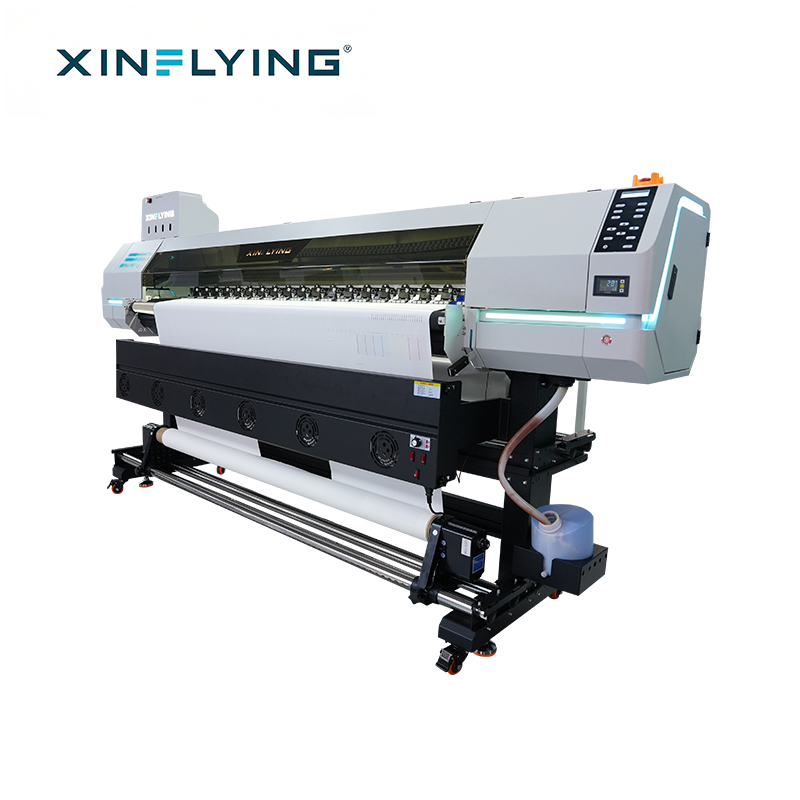
Entry-level roll-to-roll configurations such as the XF-H1802X-2I32A1 handle sampling and small-batch transfer production; fixation quality is set downstream by the calender.
Use Cases: Where Fusing Quality Becomes Visible
XINFLYING's documented customer cases show how fixation performance surfaces in real production rather than in a specification sheet.
Sportswear manufacturing, Brazil. A sportswear manufacturer running 15 units for four years produces football jerseys, basketball uniforms and customised sportswear, printing high-resolution patterns, team logos and full-colour designs on polyester before cutting and sewing. After adopting the sublimation solution the customer improved production flexibility for customised orders, reduced dependence on outsourced printing services and achieved more consistent colour quality across different batches. All-over jersey printing is the clearest test of a fusing unit, because temperature or pressure variation across the working width appears directly on the garment panel.
Sports uniform supply, Brazil. A sports uniform supplier running 8 units for five years produces customised football kits, training uniforms and team apparel with personalised names, numbers and graphics. The solution allows the supplier to handle customised sportswear orders with shorter production cycles while maintaining the vibrant colours and detailed patterns team uniforms require.
Home textiles. A home textile manufacturer running 10 units for four years applies sublimation printing to curtains, cushions, decorative fabrics and customised polyester textile products, developing collections with rich patterns, accurate colours and flexible production. Wide decorative panels are unforgiving of edge-to-centre temperature differences, because a visible colour step between two panels reads as a matching failure rather than a printing failure.
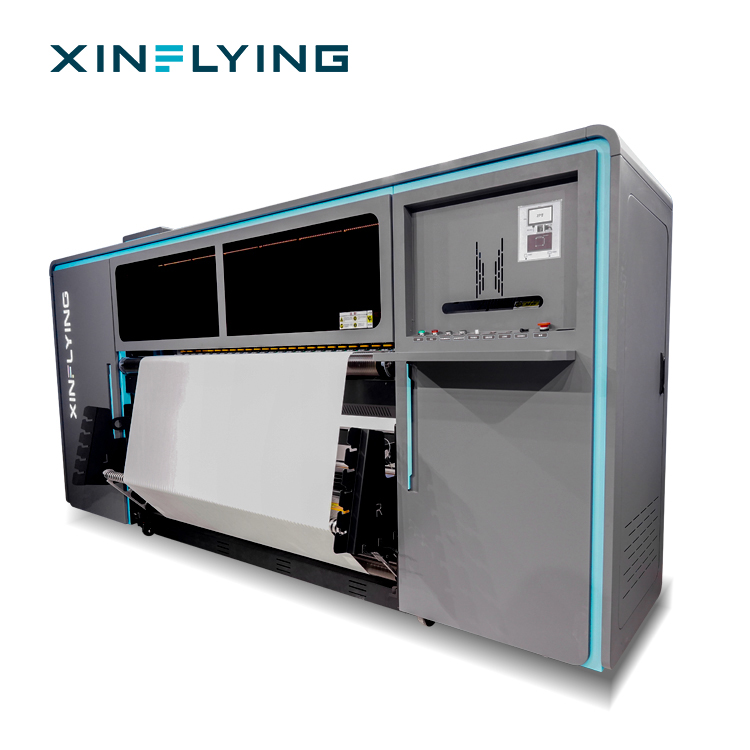
Industrial configurations such as the XF-19E8-PRO feed long, continuous rolls — the workload where heat-roll stability over an entire run matters most.
Sublimation printing services. A digital textile printing service provider running 5 units for three years supplies sublimation printing for sportswear brands, apparel factories and customised textile businesses, and reports that the solution helped expand production capacity, support more customer projects and improve response speed for customised textile orders. For a service provider, the fusing stage is also a quoting variable: throughput is limited by the slowest reliable pass, not by the printer's peak speed.
Comparison Table: Printer Configurations That Feed the Fusing Stage
The table compares the three configurations documented in XINFLYING's published selection data. All values are as published; where a value is not stated for a model it is marked accordingly rather than estimated.
| Model | Printheads | Print width | Max print speed | Documented positioning |
|---|---|---|---|---|
| XF-H1802X-2I32A1 | 2 × Epson i3200-A1 | 1800 mm | up to 52 m²/h | Entry-level; startups, apparel sampling, small-batch orders |
| XF-O2000-4I32A1 | 4 × Epson i3200-A1 | 1950 mm | up to 180 m²/h | Mid-range; continuous daily production for growing printing companies |
| XF-19E8-PRO | 8 × Epson i3200-A1 | Not stated in the reviewed data | up to 306 m²/h at 3200 dpi | Industrial; textile factories and professional production centres |
Source: XINFLYING published selection data. The XF-H1301X-1I32A1 is named in the certification scope, but its print specifications are not part of the reviewed data, so it is excluded from this table.
The second table maps the fusing variables themselves, because a printer comparison without a fixation comparison answers only half of a buyer's question.
| Fusing variable | What it controls | Documented symptom when it is wrong | How to verify |
|---|---|---|---|
| Temperature | Conversion of solid dye into gas | Colour deviation after heat pressing | Supplier set point plus a fused test strip |
| Pressure / nip contact | Whether vaporised dye enters the fibre or escapes | Patchy density and weak areas across the width | Test strip at centre and both edges |
| Transfer time (dwell) | How much dye diffuses into the fibre | Recorded together with temperature as a cause of colour deviation | Timed trials, one variable at a time |
| Cooling | Completion of dye–fibre bonding | Not listed as a colour-deviation cause; bonding completes only after cooling | Confirm cooling before winding or cutting |
FAQ
Which compliance documents should I verify before buying a sublimation printer for polyester textiles?
For EU supply, XINFLYING publishes a CE Machinery Directive certificate from UDEM (M.2026.206.C142365, against EN ISO 12100:2010, EN 60204-1:2018/A1:2025 and EN ISO 12643-1:2023, valid to 2031-06-09), a CE EMC certificate from TQT (TQT1550D270EC, valid to 2099-01-01), a CE Low Voltage Directive certificate from TQT (TQT1550D271EC, EN IEC 62368-1:2020/A11:2020), a RoHS certificate from UDEM (M.2026.206.C142366, EN IEC 63000:2018, valid to 2031-06-09) and an OEKO-TEX® ECO PASSPORT for textile printing inks and printing pastes from TESTEX AG (SH150194016, valid to 2026-12-31). The XF-H1301X-1I32A1 model is listed in the product scope of these documents. Buyers should confirm that the certificate copy names the exact model being shipped.
Can XINFLYING supply an OEM dye sublimation printer under my own brand?
Yes. XINFLYING operates in OEM / ODM mode and offers product branding, machine appearance customisation, colour customisation, logo customisation, packaging customisation and customised solutions based on customer requirements. Minimum order quantity is 1 unit, monthly capacity is 1600+ units, and lead time ranges from 5 to 40 days depending on configuration.
What are the order terms for MOQ, payment and delivery?
MOQ is 1 unit. Delivery terms are EXW, FOB, CIF or DDP. Payment terms are T/T, Western Union and PayPal. Acceptance is based on a pre-shipment test, so the machine is tested before it leaves the factory and the result can be reviewed with the buyer.
How can I validate print and fusing quality before committing to a full production run?
Validation runs in two layers. At the printer level, perform a nozzle check, clean the printhead if output is abnormal, confirm resolution and speed settings, and complete printhead alignment and calibration. At the fusing level, print a test strip on the actual fabric, fuse it with the settings recommended for that ink and paper, and compare the result with the approved reference at centre and both edges. If the printed transfer is clean but the fused result is shifted, the cause is temperature, transfer time or material variation rather than the printheads. Because pre-shipment testing is part of XINFLYING's quality control, both layers can be documented before delivery.
What lead time and after-sales support are available?
Lead time is 5 to 40 days. After-sales support is delivered by more than 50 engineers providing 24/7 online technical support, backed by a 20-engineer R&D team. For fusing-critical projects, request the fusing unit specification and a temperature-uniformity measurement across the full working width, and file the result with the machine documentation. The XINFLYING company brochure can be downloaded here: XINFLYING corporate brochure (PDF).
Conclusion: Fixation Is a Specification, Not a Setting
Fusing is where the chemistry of dye sublimation actually happens. The printer determines how much dye reaches the paper; the fusing unit determines how much of it becomes part of the polyester. Temperature decides whether the phase change occurs, pressure decides where it occurs across the working width, dwell time decides how much dye diffuses into the fibre, and cooling completes the bond. Because incorrect temperature or transfer time is one of the documented causes of colour deviation, a fixation problem that is misdiagnosed as a printhead problem will stay unresolved no matter how many nozzle checks are run.
For buyers in the evaluation and execution stages, the practical conclusion is that heat-roll behaviour belongs in the purchase specification, next to printheads, width and speed. Request the roll specification, request a temperature-uniformity measurement across the full working width, and confirm that the compliance file names the exact model being shipped — for the XF-H1301X-1I32A1 class that means the CE MD, CE EMC, CE LVD, RoHS and OEKO-TEX® documentation issued for that model scope.
Next step: put the fusing question into the quote
XINFLYING supplies dye sublimation printers from 1800 mm entry-level configurations to 8-head industrial machines, with OEM / ODM customisation, MOQ of 1 unit, lead time of 5–40 days and 24/7 online technical support from more than 50 engineers. When you request a quotation, ask for the fusing unit specification and the temperature-uniformity measurement alongside the printer datasheet.
Email: info@xin-flying.com | Tel / WhatsApp: +86 188-1322-1357 | Website: www.xin-flying.com
Brochure: download the XINFLYING company profile
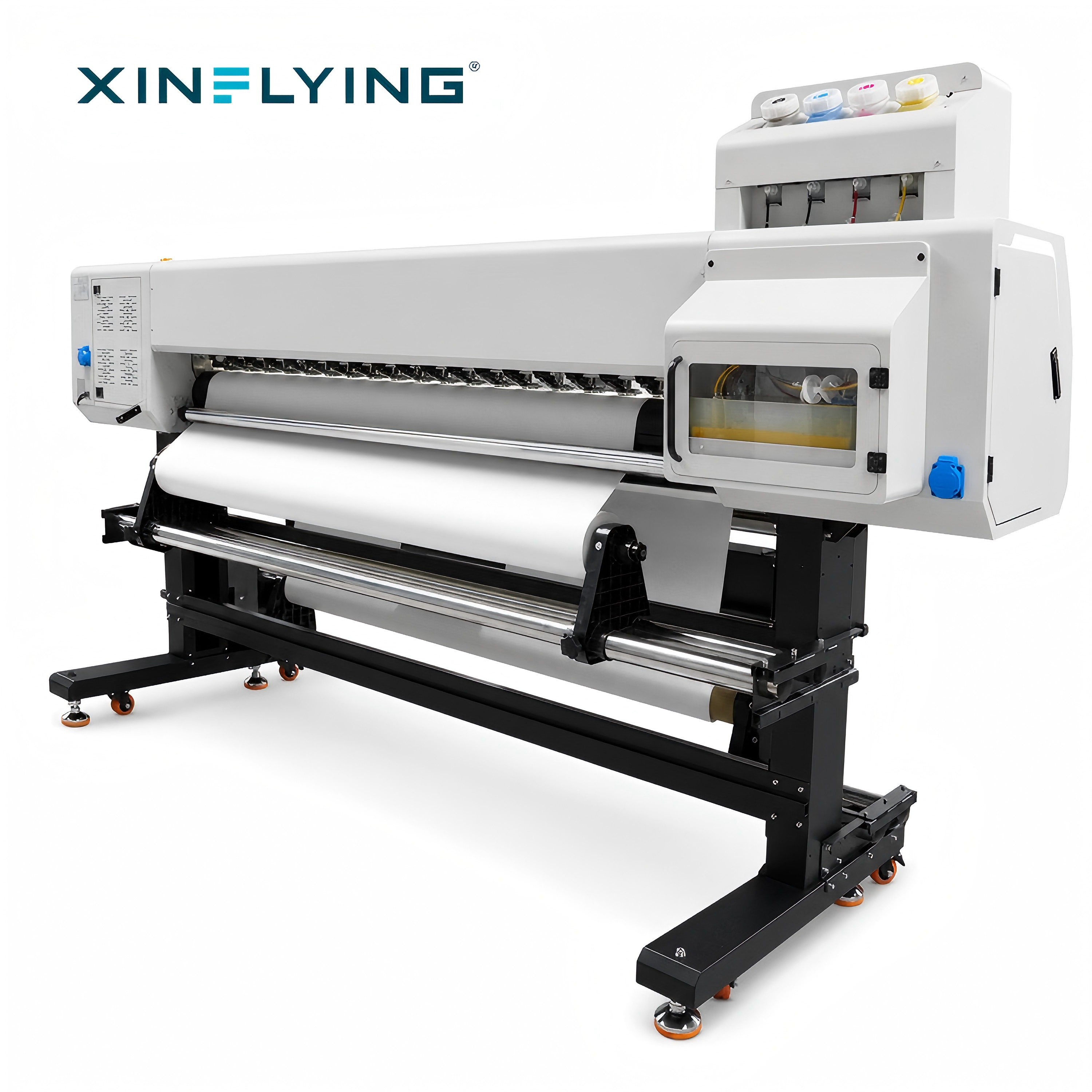
XINFLYING dye sublimation printers — request a configuration review before specifying fusing parameters for your fabric range.
Have Questions or Need More Details?
Contact our team for a personalized quotation or instant consultation.
Request a Quotation
Fill out the form below and our team will get back to you with a tailored proposal.
WhatsApp Direct Chat
Prefer to chat in real-time? Message us on WhatsApp for instant assistance & quick answers.
- Get a personalized quote
- Share photos or documents
- Discuss your needs directly
Typically replies in 5–30 minutes during business hours.