
Sublimation Printer Printheads: The Science of Ink Transfer
Sublimation Printer Printheads: The Science of Ink Transfer
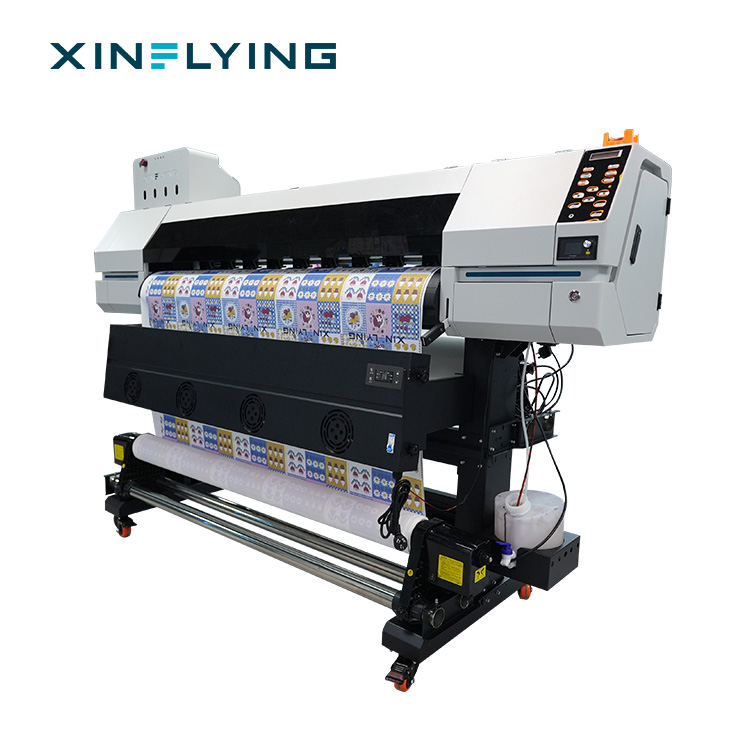
A sublimation printer never places colour directly onto fabric. It fires microscopic droplets of a specialised dye onto transfer paper, and only later — under heat and pressure — does that dye turn into gas, penetrate polyester fibres, and lock permanently into place. The printhead is where that chain begins, and it is also where most beginner misunderstandings begin.
If you are new to dye sublimation printing, the most useful mental model is three parts long. The printhead decides droplet size and droplet placement. The ink decides whether those droplets can change from solid to gas at transfer temperature. The material decides whether that gas can bond and stay bonded. Get any one of the three wrong and the finished textile shows it — as banding, colour drift, weak edge definition, or a print that dulls after the first wash cycle. Beginners often start by searching for the best sublimation printer for beginners and comparing price tags, when the more useful first question is how the machine moves ink.
Why newcomers misjudge sublimation printers
Almost every expensive mistake in this category traces back to one of four assumptions.
1. Treating the machine as a fabric printer. Dye sublimation printing is a heat transfer process. The printer's job is to image transfer paper accurately; the heat press calendar completes the job. A machine that prints beautifully on paper can still fail at the transfer stage if the ink chemistry or the transfer conditions are wrong.
2. Reading printhead count as a marketing badge. Printhead count is a throughput decision, not a quality award. One head is enough for sampling and small-batch work; eight or fifteen heads exist to hold speed across a wide roll in continuous production.
3. Treating ink as a consumable detail. Dried ink inside a printhead, an unstable ink supply, and ink that is not matched to the machine are three of the most common causes of clogged nozzles, missing colour and uneven ink output. Maintenance is not an afterthought in sublimation — it is part of the process design.
4. Assuming an eco claim covers the whole machine. Ink chemistry, electrical safety and hazardous-substance compliance are documented separately. Buyers who ask for “the certificate” instead of “the certificate for this model and this component” usually end up redoing the paperwork after the machine ships.
Industry background: a growing process built on a narrow technology stack
Dye sublimation sits inside a fast-expanding digital textile printing market. Grand View Research values the global dye sublimation printing market at USD 16.4 billion in 2025, projected to reach USD 39.0 billion by 2033, with a CAGR of 11.5% for 2026 to 2033. The printer segment alone was valued at USD 1.88 billion in 2025 by Mordor Intelligence, with an expected USD 2.53 billion by 2030. Adjacent data from Fortune Business Insights puts the broader large format printer market at USD 10.57 billion in 2025.
Geography matters for sourcing. Grand View Research reports that Asia Pacific held a 36.5% revenue share in 2025, led by China as the largest country market — a position reinforced by China's textile and garment exports of USD 293.6 billion in 2023.
Less visible is how concentrated the underlying technology is. Data Insights Reports attributes 26.7% of the digital textile dye sublimation printer market to Epson, followed by Mimaki at 18.6% and Roland DG at 15.5%. Grand View Research notes that inkjet production printers accounted for 87.3% of the production printer market share by type in 2024. In practice this means most sublimation machines — including XINFLYING's roll-to-roll series — are built around a small family of industrial printheads, which is why printhead choice is such a reliable way to compare machines.
Formats have consolidated too. FESPA industry insight describes 1.9 m (1900 mm) roll-to-roll widths as standard for high-volume textile and soft signage applications, which is why 190 cm appears repeatedly across the industrial end of XINFLYING's range.
Inside the printhead: how a design becomes droplets
A sublimation printhead is a piezoelectric inkjet device. Rather than heating ink to form a bubble, a piezo element changes shape when voltage is applied and pushes a measured volume of ink out of a nozzle. The XF-O2000-4I32A1 specification lists piezoelectric inkjet as its printing technology for exactly this reason: the mechanism is gentler on dye-based inks and more repeatable across long production runs.
Two numbers describe most of a printhead's behaviour. The first is nozzle count — the more nozzles firing per pass, the more image data is laid down per unit of time. The second is drop variability — the ability to fire different droplet sizes so that highlights stay smooth while solid areas stay dense. XINFLYING's XF-19E15-PRO is built around 15 Epson i3200-A1 printheads, each with 3200 nozzles and variable ink drop capability.
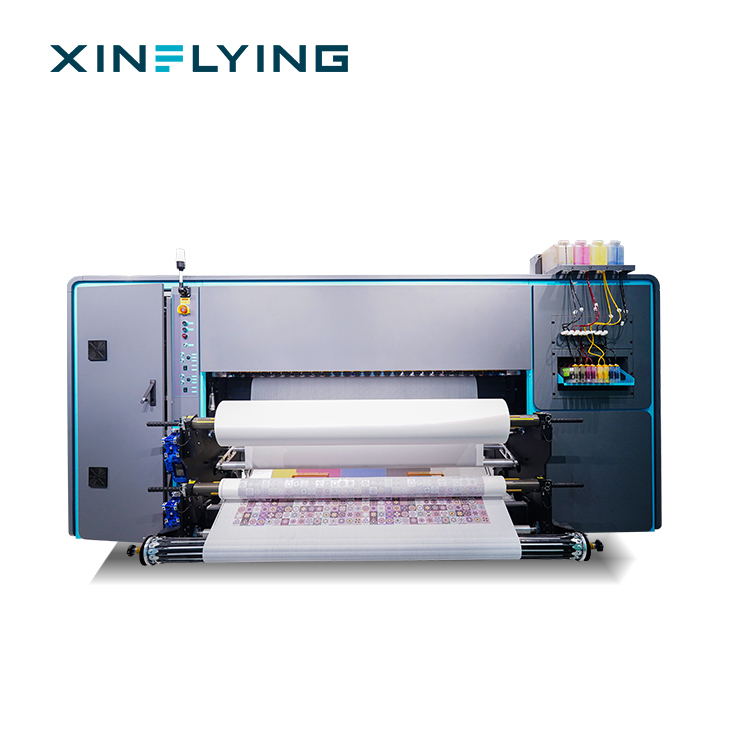
Motion accuracy decides whether the science survives production
Droplets that land in the wrong place produce banding no matter how good the ink is. That is why industrial machines pair printheads with precision motion systems. The XF-19E15-PRO uses a linear motor with magnetic grid and a Japan THK silent linear guide across a carriage carrying 27 press rollers, while the XF-19E8-PRO pairs its 8 printheads with a Japan THK silent linear guide and anti-collision devices at both ends.
Ink delivery and moisture control are equally mechanical. The XF-19E8-PRO specification includes fully sealed automatic moisturising and cleaning, an intelligent printhead cleaning and moisturising device, automatic flash spray moisturising, and liquid level plus waste ink alarms. These are not convenience features; they are the machine's defence against the dried-ink clogging that ends printhead life early.
The four stages of dye-sublimation ink transfer
The chemistry happens in sequence, and each stage has a failure mode a newcomer can learn to recognise.
Stage 1 — Image preparation and RIP. RIP software converts digital artwork into printing instructions the machine can execute, managing colour profiles, ink distribution, resolution settings and printer communication. ISO 12647-8:2021, the standard for validating print processes working directly from digital data, is the reference point for this stage. Skip it and colour consistency between batches becomes guesswork.
Stage 2 — Droplet deposition on transfer paper. The printhead images the design onto sublimation transfer paper. Droplet placement and paper transport accuracy determine edge sharpness and whether banding appears. Handling components such as the US-imported fluorine rubber pressure paper wheel used on the XF-19E8-PRO exist to keep the web stable during this stage.
Stage 3 — Heat-driven gas transition. During transfer, the printed paper is pressed against the fabric under controlled temperature and time. The dye changes from solid to gas. Because polyester fibres have a structure that allows these dye molecules to penetrate, the gas enters the fibre instead of sitting on its surface.
Stage 4 — Cooling and permanent bonding. After cooling, the dye becomes permanently bonded with the material. This is why dye sublimation printing delivers vibrant colour and a soft hand feel compared with surface-printed decoration — and why cotton, which does not provide sufficient bonding capability, is unsuitable without special coatings.
Step by step: from digital file to finished fabric
- Prepare artwork. Supply files in supported formats — the XF-19E8-PRO and XF-19E15-PRO document format list includes JPG, TIFF and PDF.
- Configure the RIP. Select the colour profile that matches your ink and material rather than accepting default settings.
- Run a nozzle check. Confirm that no nozzles are missing before committing metres of paper to a job.
- Print onto transfer paper. Choose the pass mode that matches the order: fast passes for volume, slower passes for fine detail.
- Dry the printed paper. XINFLYING machines use an external intelligent air-heat integrated dryer on the XF-19E8-PRO and XF-19E15-PRO, or a constant-temperature automatic drying system on the XF-H1301X-1I32A1.
- Transfer with heat and pressure. Use a heat press calendar with parameters matched to the fabric and the ink.
- Cool and inspect. Check colour, edge definition and repeat accuracy against the approved target.
- Record and maintain. Save optimised settings for repeat orders and keep the maintenance rhythm — nozzle checks, printhead cleaning and ink system inspection — that prevents clogging.
Beginner rule of thumb: change one variable at a time. Adjusting speed, resolution, ink density and colour profiles at once makes it impossible to identify which change produced the result.
Where the science shows up in real production
Polyester fabric printing, sportswear, team jerseys, activewear, custom apparel, home textiles, decorative fabrics, soft signage, flags and banners all rely on the same transfer mechanism — but they stress different parts of it.
High-volume sportswear and jersey output stresses throughput and colour repeatability, which is why the 8-head XF-19E8-PRO and 15-head XF-19E15-PRO sit in this segment. Home textiles and decorative fabrics stress width and long-run stability, so print width matters as much as speed. Sampling, apparel trial runs and small-batch custom orders stress setup flexibility rather than raw square metres per hour — the domain of the 1-head XF-H1301X-1I32A1 and 2-head XF-H1802X-2I32A1.
Environment conditions belong to the science as well. XINFLYING's textile sublimation application profile specifies a controlled indoor production environment of 18–30°C and 35–65% RH, because stable temperature and humidity support consistent ink performance, colour accuracy and long-term production reliability.
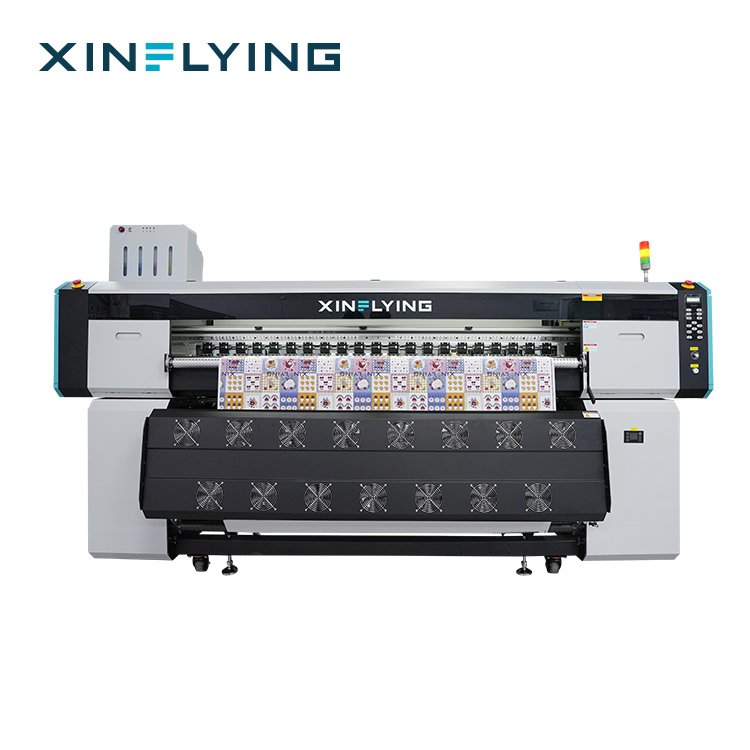
Matching printhead count and print width to production stage
The table below uses manufacturer-published specifications. Print speeds are the fastest published figures for the stated pass mode.
| Model | Printheads | Ink colours | Print width | Published max speed | Power |
|---|---|---|---|---|---|
| XF-H1301X-1I32A1 | 1 × Epson i3200-A1 | CMYK | 130 cm (1.3 m) | 28 m²/h (4-pass) | 2 kW |
| XF-H1802X-2I32A1 | 2 × Epson i3200-A1 | CMYK+CMYK | 180 cm (1.8 m) | 52 m²/h (4-pass) | 3.5 kW |
| XF-O2000-4I32A1 | 4 × Epson i3200-A1 | CMYK × 4 | 195 cm (1.95 m) | 180 m²/h (2-pass) | 8.5 kW |
| XF-19E8-PRO | 8 × Epson i3200-A1 | CMYK | 190 cm (75 in) | 306 m²/h (1-pass) | 10.2 kW |
| XF-19E15-PRO | 15 × Epson i3200-A1 | CMYK | 190 cm (75 in) | 524 m²/h (1-pass) | 14.5 kW |
The XF-19E8-PRO and XF-19E15-PRO are specified at 3200 dpi, and both are intended for industrial textile sublimation printing, with the XF-19E15-PRO positioned for high-volume production. The XF-H1802X-2I32A1 and XF-H1301X-1I32A1 are designed for textile sublimation printing on polyester fabrics at smaller scale, with print widths of 180 cm and 130 cm respectively.
Read the table the way the physics suggests: head count buys speed, print width buys product size, and printhead family buys consistency. Where two machines share the i3200-A1 printhead, the difference between them is throughput — not image formation.
Eco-friendly ink systems: what to verify before trusting a claim
Because the ink is what physically enters the fibre, questions about ink and the environment are reasonable — and they deserve document-level answers rather than adjectives. Printers must be matched with compatible sublimation ink. Unsuitable or low-quality ink is a documented cause of printhead clogging, and ink quality is one of the factors that can shift colour output away from the approved profile.
Two separate files are usually involved. The machine-level file covers the hardware: for markets with substance restrictions, RoHS compliance confirms that electrical and electronic components meet restrictions on hazardous substances, and buyers should request that documentation and confirm it applies to the actual equipment model. The ink-level file covers the chemistry. Chemical-safety programmes such as OEKO-TEX ECO PASSPORT are assessed at that chemical or ink level rather than at the machine level, so an ink file and a printer compliance file answer two different questions. For a specific model such as the XF-450PRO in XINFLYING's range, the practical question is not simply whether a programme is named, but which document covers what — and whether the model number or ink set on the certificate matches what is being shipped.
The same discipline applies to every certificate a supplier presents: check the scope, the model coverage and whether the document is current. This is a documentation habit rather than a criticism of any brand — it is how textile buyers in regulated markets avoid customs delays and sales restrictions later.
FAQ
Do sublimation printers need special ink and printheads?
Yes. Sublimation printing requires dedicated sublimation ink because the ink must change from solid to gas under heat and then bond with a suitable material. The process works best on polyester fabrics and polyester-coated substrates; natural fibres such as cotton do not provide enough bonding capability without special coatings. Because the ink is dye-based and sensitive to drying, the printhead must be maintained: regular nozzle checks, printhead cleaning and a stable ink supply are the standard measures against clogging, missing colour and uneven ink output.
What environmental compliance documents should I request for a sublimation printer?
Request documents that apply to the actual equipment model. RoHS compliance confirms that electrical and electronic components meet restrictions on hazardous substances, and buyers operating in regulated markets should verify that the environmental documentation covers the specific machine being supplied. Ink-related programmes are documented separately at the ink or chemical level. Ask for the certificate, its scope and the model coverage, and keep the file with the machine records — incomplete or mismatched documents are one of the common causes of import complications.
How many printheads does a business actually need?
Match printhead count to production stage rather than to budget alone. A 1-head machine such as the XF-H1301X-1I32A1 (130 cm, up to 28 m²/h) suits sampling and small-batch work. A 2-head XF-H1802X-2I32A1 (180 cm, up to 52 m²/h) suits small and medium-sized printing businesses, apparel sampling and small-batch orders. A 4-head XF-O2000-4I32A1 (195 cm, up to 180 m²/h) is aimed at growing printing companies handling continuous daily production. The 8-head XF-19E8-PRO and 15-head XF-19E15-PRO, both 190 cm wide, are intended for textile factories and high-volume production centres.
How do I validate ink transfer before committing to full production?
Run the checks in order. Perform a nozzle check and inspect for missing nozzles; clean the printhead if the output is abnormal; confirm print speed and resolution settings; verify colour management in the RIP software and that the correct ICC profile is selected; check the heat press temperature and transfer time; then print a test and compare it with the approved target. Record the optimised parameters so repeat orders start from a known baseline instead of from memory.
How should I evaluate sublimation printer manufacturers?
Evaluate manufacturers on the same variables the process depends on: printhead configuration and availability of replacement parts, print width and speed against your real order profile, RIP software compatibility, ink supply and printhead-care design (moisturising, cleaning, level alarms), compliance documentation that matches the supplied model, and after-sales capability — installation guidance, technical support, operator training and spare parts. Guangzhou Xin Flying Digital Technology Co., Ltd. (XINFLYING) was established in 2010 and manufactures digital printing equipment including dye sublimation printers, DTF printers, UV DTF printers, UV printers, DTG printers, printing consumables and complete digital printing solutions. The company operates a 37,440 m² manufacturing facility in Panyu, Guangzhou, employs more than 200 staff, maintains a 20-engineer R&D team, and reports annual production capacity exceeding 20,000 units.
Conclusion: three variables, one chain
Sublimation printing rewards buyers who understand the sequence. The printhead determines how large each droplet is and where it lands. The ink determines whether those droplets can convert into gas during the transfer stage. The material determines whether the gas can penetrate, bond and stay bonded. Compliance paperwork sits alongside all three, but it documents rather than replaces them. Once you can trace a finished garment back through those stages, you can read any specification sheet — including the printhead count, print width and speed figures in the table above — as a description of production capability rather than a list of numbers.
Validate the ink-transfer chain on your own fabric
XINFLYING supplies dye sublimation printers and complete digital printing solutions from Guangzhou, China, with local warehouses and technical support in key markets. If you are moving from research to a decision, the practical next step is a sample run or a quotation against your actual production profile — print width, daily volume and fabric type.
Email info@xin-flying.com, call or WhatsApp +86 188-1322-1357, or visit www.xin-flying.com to review the full sublimation printer range. You can also download the XINFLYING company brochure (PDF) for the complete equipment and solutions overview.
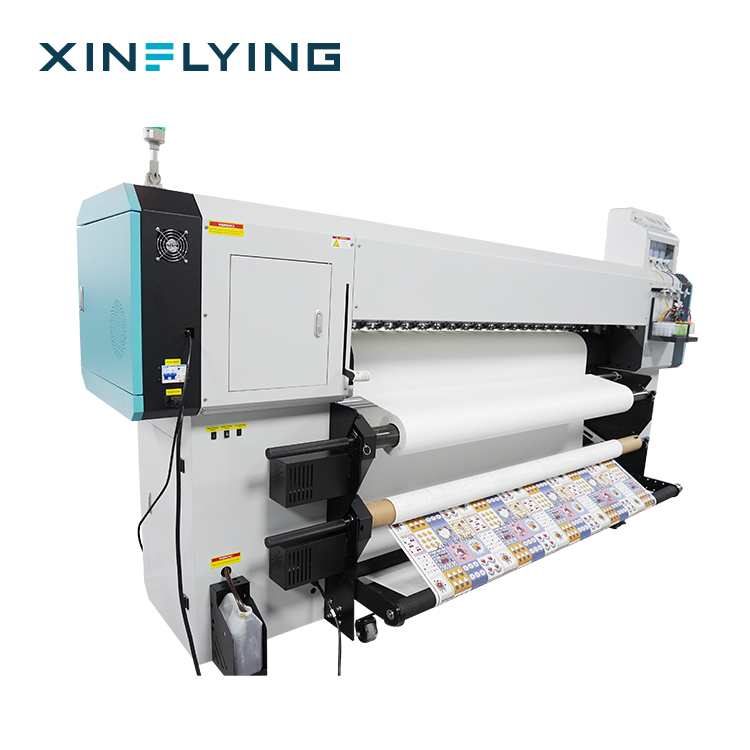
Note: the XF-19E8-PRO image above shows an eight-printhead carriage configuration used for industrial textile sublimation printing. Model specifications quoted in this article are manufacturer-published figures for the stated models.