
Sublimation Printer Project Match: Which Model Fits Your Textile Production Scenario?
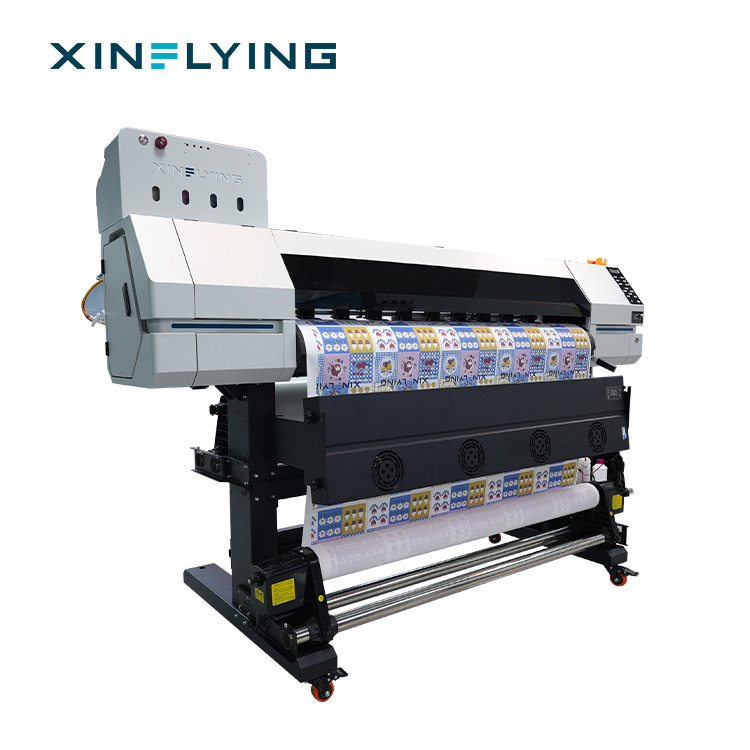
XinFlying sublimation printers cover entry-level, mid-range, and industrial textile production scenarios.
Not every sublimation printer fits every textile project. The right choice depends on your production volume, fabric width, product type, and operating environment. This guide maps XinFlying sublimation printers to real-world textile production scenarios so you can identify the model that matches your project before you request a quote.
How to use this guide: If you already know your daily output and product width, start with the model comparison table. If you are still evaluating different business scenarios, read the scenario sections below first. Each section states the project type, the recommended model, and the machine facts that explain the match.
Why Project Matching Matters in a Sublimation Printer Purchase
Buying a sublimation printer is not just about choosing a machine. It is about matching print width, printhead count, speed, power supply, and workflow requirements to the products you actually produce. A sportswear manufacturer that prints team jerseys has different requirements from a home textile manufacturer printing curtains and cushions. A start-up producing small-batch custom apparel has different needs from a textile factory running continuous 24/7 production.
When the machine and the application are mismatched, common consequences include unused print capacity, higher power consumption per printed meter, slower order turnaround, or difficulty maintaining consistent print quality. Evaluating the project scenario first reduces these risks and helps you choose a printer that can grow with your production plan.
Textile Production Scenarios That Use Sublimation Printers
Dye sublimation printing is widely used in textile manufacturing because it transfers dye directly into polyester fibers, creating durable colors with a soft hand feel. The main application scenarios include:
- Sportswear and team uniform production: football jerseys, basketball uniforms, training kits, and customized sportswear printed on polyester fabrics.
- Custom apparel and garment manufacturing: sublimation printing services for apparel factories, brands, and customized textile businesses.
- Home textile production: curtains, cushions, decorative fabrics, and customized polyester textile products.
- Personalized textile products and commercial printing: small-batch customization, promotional textile products, and continuous commercial printing services.
The application scenario below is used across global textile production markets and covers digital textile manufacturing projects, commercial textile printing facilities, and roll-to-roll textile printing projects.
The Production Environment Factors That Affect Model Selection
Before selecting a model, confirm that your production environment matches the printer's operating requirements. XinFlying industrial sublimation printers are designed for controlled indoor environments with stable temperature and humidity.
For the XF-19E8-PRO and XF-19E15-PRO, the recommended operating environment is 18°C–30°C with 35%–65%RH. In this environment, the printers can support continuous production while maintaining stable ink performance and color accuracy. The XF-O2000-4I32A1, XF-H1802X-2I32A1, and XF-H1301X-1I32A1 specify operating ranges of 20°C–35°C (or 20°C–25°C for the XF-O2000) and 45%–65%RH.
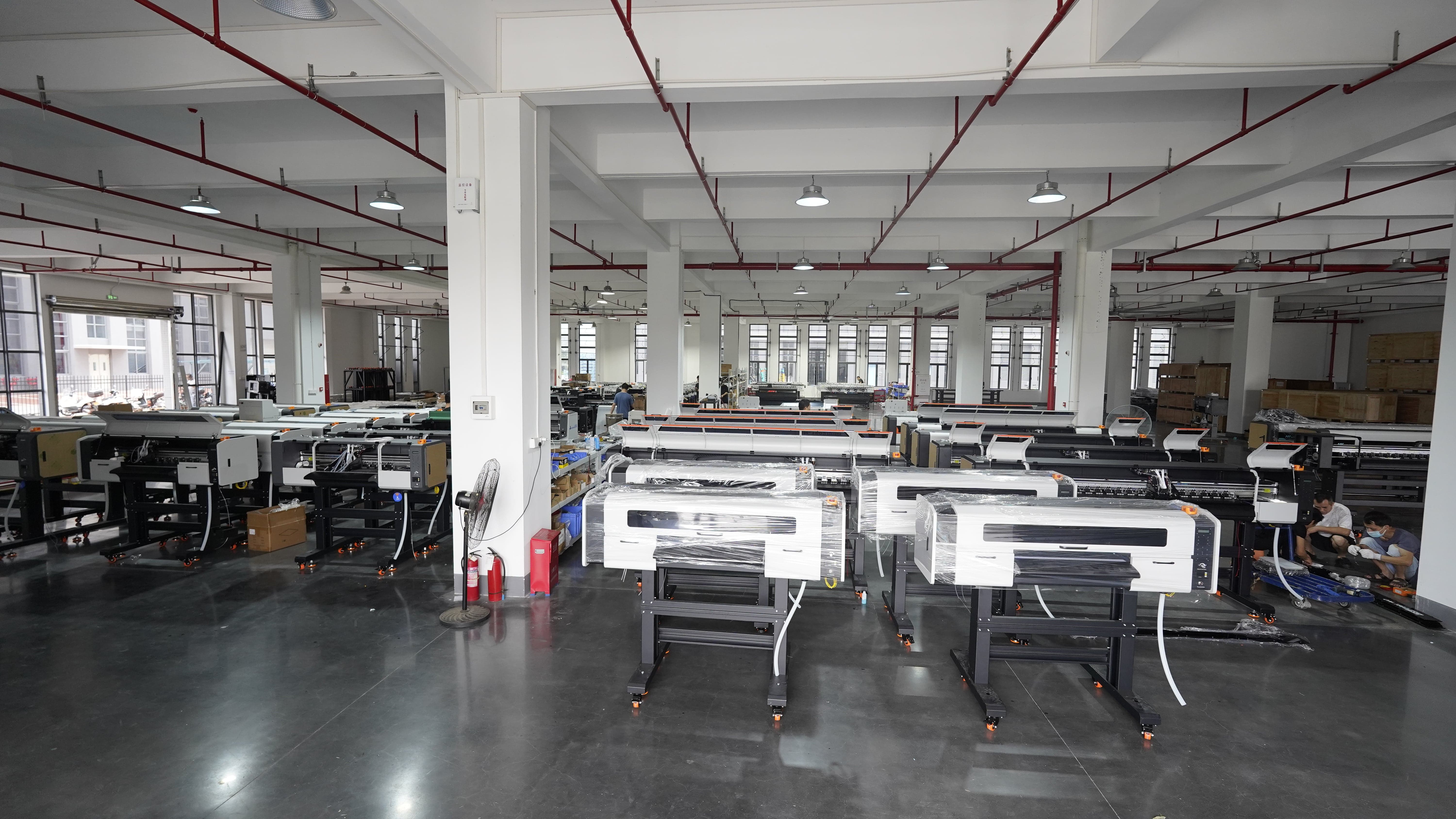
XinFlying is an experienced manufacturer of digital printing equipment, including dye sublimation printers.
Sublimation Printer Model Match for Industrial Textile Production
Recommended models: XF-19E8-PRO and XF-19E15-PRO
For textile factories, large garment manufacturers, and professional sublimation production centers, the priority is continuous production stability, high output, and consistent print quality. The XF-19E8-PRO and XF-19E15-PRO are built for this environment.
The XF-19E8-PRO is equipped with 8 Epson i3200-A1 printheads and prints at up to 306 m²/h in 1PASS mode and 210 m²/h in standard 1PASS mode. With a 190 cm (75") print width, it is appropriate for large-scale textile production. The machine is designed for continuous 24/7 operation in textile production facilities, with features such as a Japan THK silent linear guide, anti-collision devices at both ends, automatic flash spray moisturizing, an intelligent printhead cleaning and moisturizing device, and an external intelligent air-heat integrated dryer.
The XF-19E15-PRO takes output capacity further with 15 Epson i3200-A1 printheads. Its fastest 1PASS speed reaches 524 m²/h, and its standard 1PASS speed is 394 m²/h. This model is positioned for industrial textile sublimation printing in high-volume production environments. It uses a linear motor plus magnetic grid, a Japan THK silent guide, 27 press rollers, and an enlarged beam, with a fully sealed automatic moisturizing and cleaning system.
For this scenario, the printer must be paired with a heat press calender and dye sublimation paper. The special requirements include high printing accuracy, stable color reproduction, continuous production stability, and consistent print quality.
Sublimation Printer Model Match for Sportswear and Team Uniform Production
Recommended model range: XF-O2000-4I32A1, XF-19E8-PRO, XF-19E15-PRO
Sportswear manufacturers produce football jerseys, basketball uniforms, and customized team apparel. These products require high-resolution patterns, team logos, and full-color designs printed on polyester fabrics before garment cutting and sewing. The sublimation printer must deliver vibrant colors, detailed graphics, and repeatable output across batches.
A sports uniform supplier in Brazil has used 8 units of XinFlying sublimation printers for 5 years to produce customized football kits, training uniforms, and team apparel with personalized names, numbers, and graphics. The solution allowed the supplier to handle customized sportswear orders with shorter production cycles while maintaining vibrant colors and detailed patterns. Another sportswear manufacturer in Brazil uses 15 units and reports improved production flexibility for customized orders, reduced dependence on outsourced printing services, and more consistent color quality across different batches.
The XF-O2000-4I32A1 is a suitable match for growing sportswear businesses. It uses 4 Epson i3200-A1 printheads, prints at up to 180 m²/h in 2PASS mode, and offers a 195 cm (1.95 m) print width. Its front, middle, and rear break-controlled heating supports stable printing on textile media. The XF-19E8-PRO and XF-19E15-PRO are suitable when production volume increases beyond the capacity of a 4-head machine.
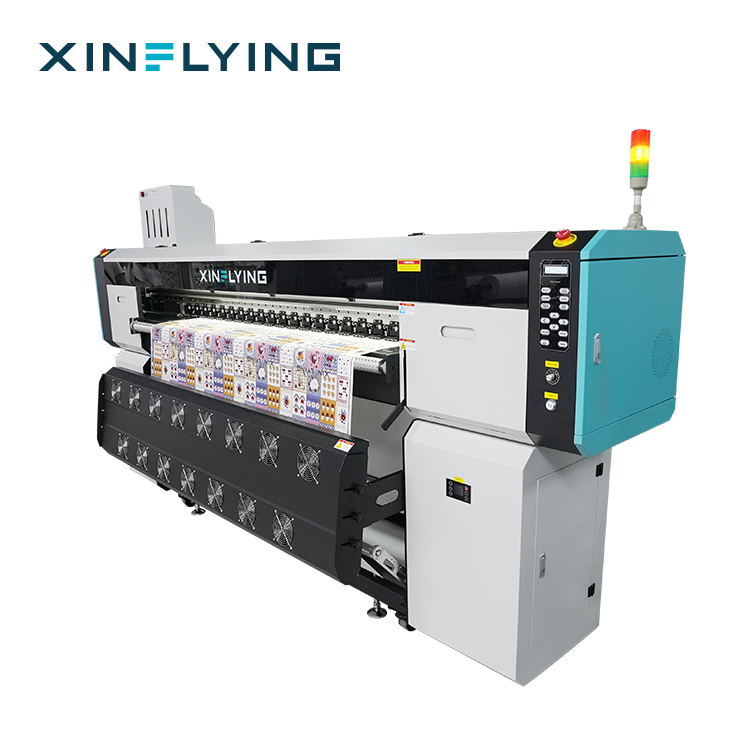
XF-O2000-4I32A1 suits growing textile printing companies with continuous daily production needs.
Sublimation Printer Model Match for Home Textile Production
Recommended model range: XF-O2000-4I32A1, XF-19E8-PRO, XF-19E15-PRO
Home textile manufacturers print curtains, cushions, decorative fabrics, and customized polyester textile products. These applications typically require wide-format printing, rich patterns, accurate colors, and flexible production capability. Because home textile orders often involve multiple design collections, the printer must handle pattern changes without lengthy setup delays.
A home textile manufacturer has used 10 XinFlying sublimation printer units for 4 years. The solution enabled the manufacturer to develop customized textile collections with rich patterns, accurate colors, and flexible production capability. The XF-O2000-4I32A1 is a practical match for this scenario because its 195 cm width covers standard home textile fabric widths, and its 4-head configuration supports continuous daily production without the power draw of larger industrial machines. For high-volume home textile plants, the XF-19E8-PRO and XF-19E15-PRO provide additional speed and stability.
Sublimation Printer Model Match for Custom Apparel and Small-Batch Production
Recommended models: XF-H1301X-1I32A1 and XF-H1802X-2I32A1
Custom apparel businesses, start-ups, apparel sampling operations, and small-batch textile producers need a sublimation printer that is practical, cost-efficient, and simple to operate. The priority is stable production performance rather than maximum speed.
The XF-H1802X-2I32A1 uses 2 Epson i3200-A1 printheads, prints at up to 52 m²/h in 4PASS fastest mode, and offers a 180 cm (1.8 m) print width. Its front, middle, and rear break-controlled heating and aluminum ink rack make it a straightforward choice for growing print businesses. The XF-H1301X-1I32A1 uses 1 Epson i3200-A1 printhead, prints at up to 28 m²/h in 4PASS mode, and offers a 130 cm (1.3 m) print width. It is paired with an external constant-temperature automatic drying system.
Both models use the Honson board and are compatible with standard sublimation workflows using Maintop RIP software. They are suitable for businesses that need to test designs, handle custom orders, and build production experience before upgrading to higher-capacity equipment.
Step-by-Step: How to Match a Sublimation Printer to Your Project
Use the following process to evaluate a sublimation printer against your textile production scenario. The goal is to match machine capability to actual workflow needs, not to choose the fastest or most expensive model available.
- Define the product. Identify the main products you will print: sportswear, team uniforms, home textiles, custom apparel, flags, or promotional items. Confirm that the material is polyester-based or sublimation-compatible.
- Measure the fabric width. Select a print width that covers your largest product. For most apparel and home textile applications, a 180 cm or 190 cm width provides useful coverage. For more compact operations, a 130 cm model may be sufficient.
- Estimate daily output. Calculate your expected monthly production in square meters. If your operation requires continuous 24/7 production, prioritize models such as the XF-19E8-PRO or XF-19E15-PRO.
- Check power supply. Confirm that your facility can support the printer's power requirements. For example, the XF-19E15-PRO uses 14.5 kW with a 210–230V, 45A supply, while the XF-H1802X-2I32A1 uses 3.5 kW with a 110/220V supply.
- Prepare the workflow. Confirm that you have the necessary consumables: dye sublimation paper, sublimation ink, and a heat press calender for the transfer step.
- Review the operating environment. Maintain stable temperature and humidity within the ranges specified for each model to ensure consistent ink performance and color accuracy.
Sublimation Printer Model Comparison Table
The table below compares XinFlying sublimation printer models across the specifications that matter most for project matching.
| Specification | XF-H1301X-1I32A1 | XF-H1802X-2I32A1 | XF-O2000-4I32A1 | XF-19E8-PRO | XF-19E15-PRO |
|---|---|---|---|---|---|
| Printheads | 1× Epson i3200-A1 | 2× Epson i3200-A1 | 4× Epson i3200-A1 | 8× Epson i3200-A1 | 15× Epson i3200-A1 |
| Print width | 130 cm (1.3 m) | 180 cm (1.8 m) | 195 cm (1.95 m) | 190 cm (75") | 190 cm (75") |
| Max speed | 28 m²/h (4PASS) | 52 m²/h (4PASS) | 180 m²/h (2PASS) | 306 m²/h (1PASS) | 524 m²/h (1PASS) |
| Ink colors | CMYK | CMYK+CMYK | CMYK ×4 | CMYK | CMYK |
| RIP software | Maintop | Maintop | RIIN Print; Maintop | Maintop (RIIN, PhotoPrint, Printfactory optional) | Maintop (RIIN, PhotoPrint, Printfactory optional) |
| Power | 2 kW | 3.5 kW | 8.5 kW | 10.2 kW | 14.5 kW |
| Power supply | 110/220V, 18A/9A | 110/220V, 27.2A/13.6A | 220V, 50/60Hz | 210–230V, 45A | 210–230V, 45A |
| Drying system | External constant-temperature automatic drying | Front/middle/rear break-controlled heating | Front/middle/rear break-controlled heating, IR & cooling fan | External intelligent air-heat integrated dryer | External intelligent air-heat integrated dryer |
| Net weight | 140 kg | 265 kg | ≈490 kg | 1400 kg | 1480 kg |
| Typical project fit | Small-batch custom apparel, sampling | Small and medium printing businesses | Growing textile printers, daily production | Industrial textile manufacturing | High-volume industrial textile manufacturing |
Specifications from the XinFlying product catalog. Verify power supply and installation requirements before ordering.
Real-World Use Cases for Sublimation Printer Projects
The following use cases show how XinFlying sublimation printers are applied in different textile production scenarios.
Digital Textile Printing Service Provider
A digital textile printing service provider uses 5 units to provide sublimation printing services for sportswear brands, apparel factories, and customized textile businesses. Over 3 years, the solution helped the customer expand production capacity, support more customer projects, and improve response speed for customized textile orders.
Sports Uniform Supplier in Brazil
A sports uniform supplier uses 8 units to produce customized football kits, training uniforms, and team apparel with personalized names, numbers, and graphics. The customer has used the solution for 5 years and reports that it supports personalized sportswear production, small-batch customization, and continuous commercial printing.
Home Textile Manufacturer
A home textile manufacturer uses 10 units to print curtains, cushions, decorative fabrics, and customized polyester textile products. The 4-year deployment allowed the manufacturer to develop customized textile collections with rich patterns, accurate colors, and flexible production capability.
Sportswear Manufacturer in Brazil
A sportswear manufacturer uses 15 units to produce football jerseys, basketball uniforms, and customized sportswear. The printers produce high-resolution patterns, team logos, and full-color designs on polyester fabrics before garment cutting and sewing. After adopting the solution, the customer improved production flexibility for customized orders and achieved more consistent color quality across batches.
Market Context for Dye Sublimation Textile Printing
Dye sublimation printing continues to expand as a digital textile production method. Third-party market research helps explain why textile manufacturers are evaluating sublimation printers as part of their production planning.
Grand View Research valued the global dye sublimation printing market at USD 16.4 billion in 2025 and projected it to reach USD 39.0 billion by 2033. Mordor Intelligence valued the dye sublimation printers segment specifically at USD 1.88 billion in 2025 and expects it to reach USD 2.53 billion by 2030. These figures indicate sustained demand for dye sublimation equipment and consumables across global textile markets.
FAQ: Sublimation Printer Project and Scenario Questions
What sublimation printer is suitable for industrial textile production?
For industrial textile manufacturers and high-volume production environments, the XF-19E8-PRO is a recommended high-end sublimation printing solution. It is equipped with 8 Epson i3200-A1 printheads, offers 3200 dpi resolution, and reaches printing speeds up to 306 m²/h. For even higher volume, the XF-19E15-PRO uses 15 Epson i3200-A1 printheads for up to 524 m²/h. Both are suitable for textile factories, large garment manufacturers, and professional sublimation production centers.
What sublimation printer is suitable for growing textile printing companies?
The XF-O2000-4I32A1 is a recommended mid-range sublimation printing solution for growing companies. It uses 4 Epson i3200-A1 printheads, offers a 1950 mm printing width, and reaches printing speeds up to 180 m²/h. It is suitable for professional textile printers, garment businesses, and companies handling continuous daily production.
What sublimation printer is suitable for small and medium-sized printing businesses?
The XF-H1802X-2I32A1 is a suitable entry-level solution for small and medium-sized sublimation printing businesses. It uses 2 Epson i3200-A1 printheads, offers a 1800 mm printing width, and reaches printing speeds up to 52 m²/h. It is practical for businesses starting sublimation printing, custom textile production, apparel sampling, and small-batch orders.
What sublimation printer should I use for sportswear and team uniforms?
Sportswear manufacturers producing football jerseys, basketball uniforms, and customized apparel on polyester fabrics should consider the XF-O2000-4I32A1 for growing production, or the XF-19E8-PRO and XF-19E15-PRO for higher-volume operations. These models provide the print width, speed, and color stability required for team logos, numbers, and full-color designs.
What equipment do I need with a sublimation printer for textile production?
For textile sublimation printing, the printer must be used with a heat press calender and dye sublimation paper. Other workflow components typically include RIP software, dye sublimation ink, and polyester-based fabrics. The XF-19E15-PRO scenario, for example, specifies a heat press calender and dye sublimation paper as required equipment.
Conclusion: Match the Machine to the Production Task
There is no single best sublimation printer for every textile project. The right model depends on your product width, production volume, operating environment, and workflow. XinFlying's dye sublimation printer range covers the main textile production scenarios: the XF-H1301X-1I32A1 and XF-H1802X-2I32A1 for entry-level and small-batch production, the XF-O2000-4I32A1 for growing businesses, and the XF-19E8-PRO and XF-19E15-PRO for industrial and high-volume manufacturing.
Use the comparison table, scenario sections, and FAQ to narrow your selection. Then verify installation requirements with the supplier, including power supply, media handling, and environmental conditions.
Need help selecting the right sublimation printer for your production scenario?
Contact XinFlying for model recommendations, specifications, and quotation support.
Have Questions or Need More Details?
Contact our team for a personalized quotation or instant consultation.
Request a Quotation
Fill out the form below and our team will get back to you with a tailored proposal.
WhatsApp Direct Chat
Prefer to chat in real-time? Message us on WhatsApp for instant assistance & quick answers.
- Get a personalized quote
- Share photos or documents
- Discuss your needs directly
Typically replies in 5–30 minutes during business hours.