Sublimation Printer Setup: Voltage, Harmonics & Safety Parameters
Sublimation Printer Setup: Voltage, Harmonics & Safety Parameters
An industrial sublimation printer is an electrical load before it is a printing machine. The XINFLYING XF-19E8-PRO, for example, is declared at 10.2 kW total power on a 210–230 V supply with a 45 A supply current. Those values decide the circuit, the protective device, the conductor cross-section and the earthing arrangement long before colour management is discussed.
This article is a technical reference for the electrical installation of an industrial dye sublimation printer. It covers the declared voltage and current values that define a safe operating window, the way harmonic current emissions are limited under EN IEC 61000-3-2:2019+A1:2021, and how the LVD documentation of the XF-19E8-PRO converts into an installation plan. It is written for importers, plant engineers and production managers who have to sign off a large format sublimation printer, a 1900mm roll-to-roll machine, or a multi-unit textile printing line.
Problem Definition: Most Commissioning Failures Are Supply-Design Failures
Across industrial dye sublimation installations, the recurring failure pattern is not a defective printer. It is a supply designed around an assumed number rather than the declared rating of the delivered unit. Five failure modes account for most commissioning delays.
- Protection sized from the wrong figure. A protective device selected from a general power figure instead of the declared supply current trips when the drying system and the heating elements energise together.
- Shared circuits. A sublimation printer, a heat press calendar and a laser cutter fed from one circuit produce voltage sag under load. The visible symptom is banding or colour drift, which is then misdiagnosed as a printhead fault rather than a supply fault.
- Missing technical documentation. Without the technical file, the site electrician cannot verify rated voltage, declared current, protection type or harmonic emission classification, and the installation stops at the distribution board.
- Voltage configuration mismatch. Dual-voltage models declare separate current values for 110 V and 220 V. A circuit built for the lower-current column is undersized when the machine is configured for the other voltage.
- Harmonics left out of the survey. Harmonic current emissions are a documented requirement in regulated markets, and remediation after commissioning costs more than planning before it.
The practical decision rule is straightforward: treat the electrical documentation as a purchase gate item, not as post-delivery paperwork.
Industry Background: Print Loads Are Growing Faster Than Site Electrical Plans
The pressure behind these installations is measurable. Grand View Research values the global dye sublimation printing market at USD 16.4 billion in 2025 and projects USD 39.0 billion by 2033, with Asia Pacific holding a 36.5% revenue share in 2025 and China as the largest country market. The same source projects a CAGR of 11.5% for the period 2026 to 2033.
The printer segment moves with the wider market. Mordor Intelligence values dye sublimation printers at USD 1.88 billion in 2025, rising to USD 2.53 billion by 2030. Fortune Business Insights places the broader large format printer market at USD 10.57 billion in 2025 and USD 16.52 billion by 2034. China's textile and garment exports reached USD 293.6 billion in 2023, according to data cited by The Cannata Report, which supports continuing local demand for industrial-scale sublimation machines.
Two structural consequences matter for electrical planning. First, 1.9 m roll-to-roll widths are the standard platform for high-volume textile and soft signage production, as described by FESPA Insights, and wider platforms carry larger drying and media-transport loads. Second, growth is driven largely by demand for personalized apparel and home decor — the segment Grand View Research associates with a 13.1% CAGR in digital textile sublimation through 2030 — which means a significant share of machines are installed in retrofitted workshops rather than purpose-built plants.
In regulated markets, the electrical file is also a market-access file. Equipment entering the European Union is expected to carry CE compliance covering applicable electrical safety, electromagnetic compatibility and product safety requirements, with certification documents that correspond to the actual printer model being supplied.
Voltage, Harmonics and Safety Parameters: A Working Vocabulary
- Rated voltage window. The supply range within which the manufacturer declares safe operation. The 190 cm models covered in this article are declared at 210–230 V.
- Declared supply current. The current the machine draws at its declared rating. On the XF-19E8-PRO this is 45 A.
- Total connected load. The machine's declared total power, 10.2 kW on the XF-19E8-PRO. Other equipment on the same site must be added to reach the site total.
- Harmonic current emission. Current distortion that equipment injects back into the supply network. In European practice the reference standard cited in technical files is EN IEC 61000-3-2:2019+A1:2021, which sets harmonic current emission limits for equipment connected to public low-voltage supply systems. The part of the IEC 61000-3 series cited in a technical file has to match the rated input current stated on the machine nameplate; for higher-current industrial configurations the applicable part of the series changes. For that reason the citation is verified against the delivered unit rather than assumed from a generic datasheet.
- LVD documentation. The technical file supporting the Low Voltage Directive element of CE marking. It defines the safe operating window of the machine: rated voltage, rated current, insulation and protection requirements.
- EMC documentation. Covers electromagnetic compatibility and is normally requested together with the LVD file.
- Start-up behaviour. The short current peak when motors and heaters energise. It determines which protective device type tolerates normal starting without nuisance tripping.
Detailed Solution: What the Declared Electrical Data of XINFLYING Sublimation Printers Contains
Guangzhou Xin Flying Digital Technology Co., Ltd. (XINFLYING) is a digital printing equipment manufacturer founded in 2010 in Panyu, Guangzhou, China, producing DTF printers, UV DTF printers, UV flatbed printers, DTG printers and dye sublimation printers for apparel businesses, textile manufacturers, printing companies, distributors and entrepreneurs. The company operates a 37,440 m² manufacturing facility with more than 200 employees and a 20-engineer R&D team, exports to North America, South America, Europe, Asia, the Middle East and Africa, and reports an export ratio of 80%.
XF-19E8-PRO: The Model Used to Define the LVD Operating Window
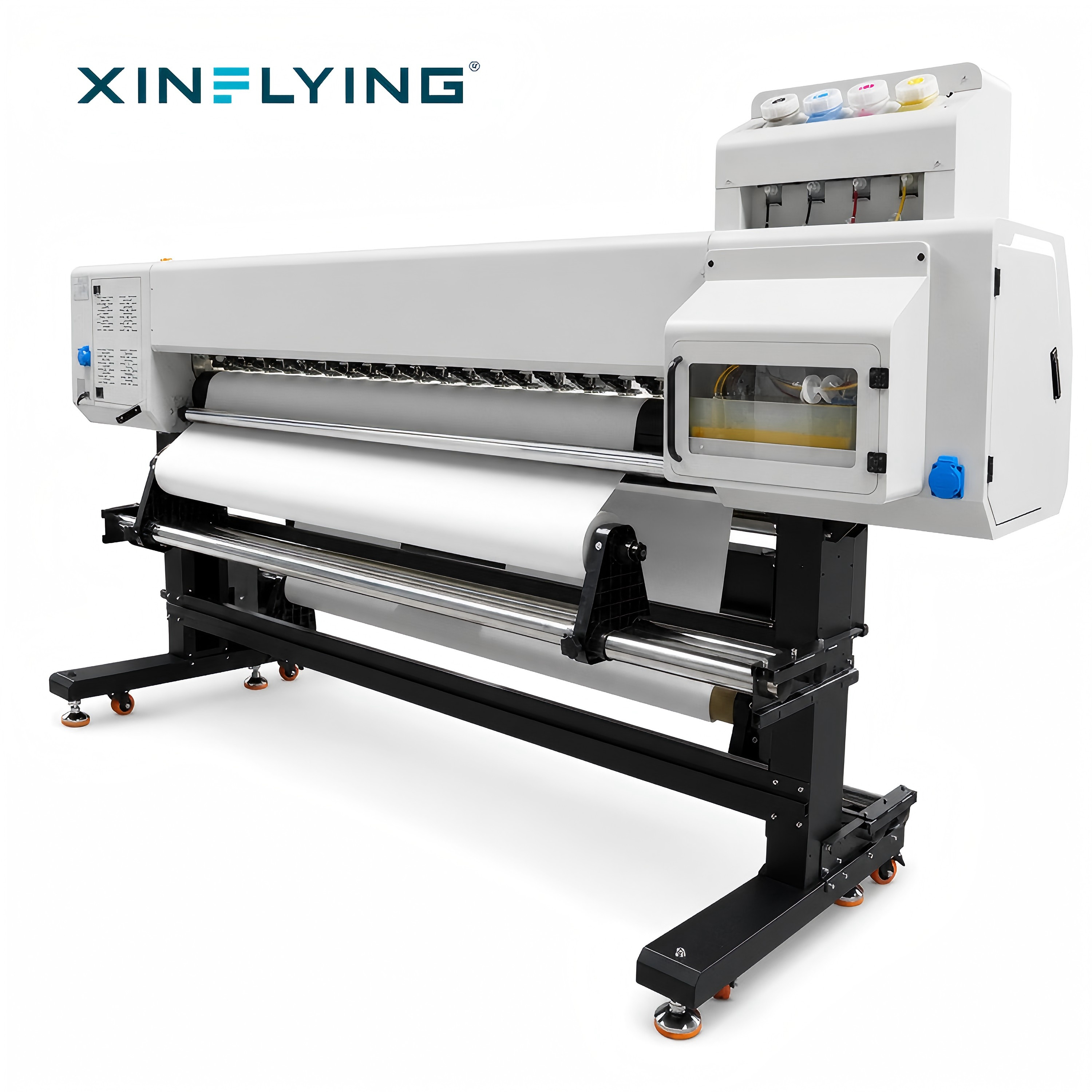
The XF-19E8-PRO is a 190 cm (75 inch) roll-to-roll digital textile printer with 8 Epson i3200-A1 printheads, CMYK sublimation ink, 3200 dpi resolution and declared print speeds of 306 m²/h at 1PASS fastest and 210 m²/h at 1PASS standard, with 153 m²/h and 109 m²/h respectively at 2PASS. Its electrical declaration is 210–230 V supply voltage, 45 A supply current and 10.2 kW total power.
That declaration is the anchor for the LVD file. The safe operating window for this model is defined by four items that the certificate and technical documentation should support: the nominal voltage band of 210–230 V, the declared supply current of 45 A, the total connected load of 10.2 kW, and the protection and insulation requirements that follow from them. Buyers should read the certificate number, issuing body and validity date directly from the document supplied with the unit, and confirm that the rated values on that document match the nameplate of the machine being installed.
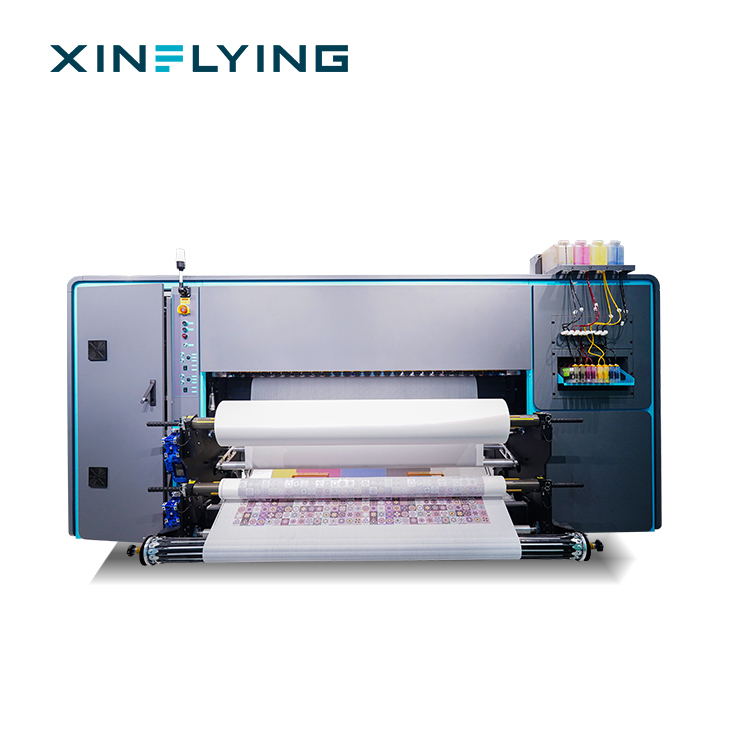
Three further points belong to the same electrical calculation. The machine is designed for continuous 24/7 operation in textile production facilities, and for environments held within 18–30°C and 35%–65% RH. Its external intelligent air-heat integrated dryer is part of the unit, so the drying load is not a separate accessory to be estimated later. And the fully sealed automatic moisturizing and cleaning system, together with the RIP workstation specified for the machine (Windows 11 or 10, Intel i7, 4 GB RAM, gigabit LAN), should be included in the circuit and earthing plan rather than added afterwards. The machine measures 3840×1300×1800 mm and weighs 1400 kg net, which affects cable routing and floor layout as much as it affects print planning.
XF-19E15-PRO: Higher Connected Load, Same Voltage Window
The XF-19E15-PRO shares the 190 cm platform and the 210–230 V, 45 A supply declaration, but carries 15 Epson i3200-A1 printheads and a declared total power of 14.5 kW, with print speeds of 524 m²/h at 1PASS fastest and 394 m²/h at 1PASS standard. It loads 1000 m sublimation paper rolls, measures 3840×1570×1800 mm and weighs 1480 kg net.
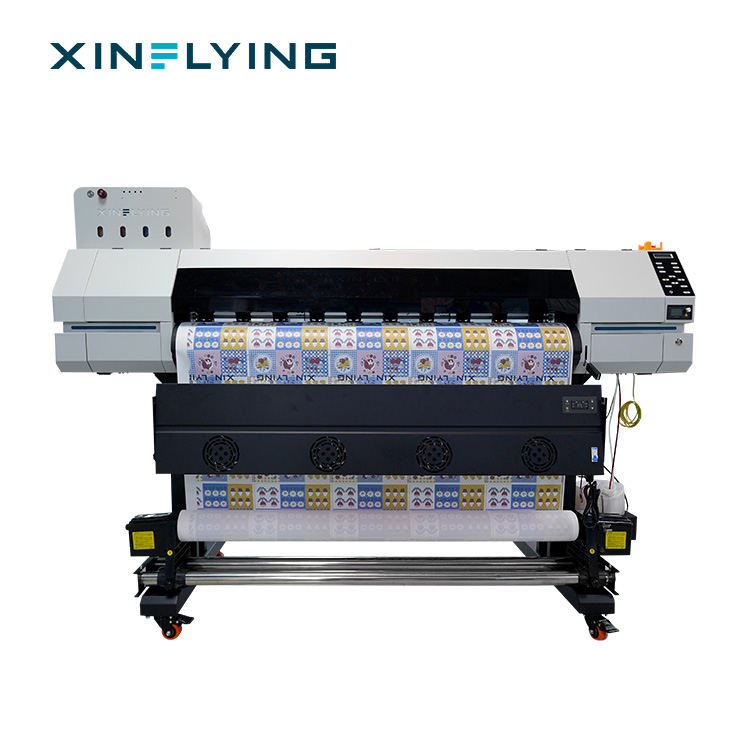
In project terms, this model must be used with a heat press calendar and dye sublimation paper, and the scenario requires high printing accuracy, stable colour reproduction, continuous production stability and consistent print quality. That combination is exactly where electrical planning matters: the calendar is an additional load, and the declared printer specifications assume a supply that stays inside the declared window during long production runs.
XF-O2000-4I32A1, XF-H1802X-2I32A1 and XF-H1301X-1I32A1: Smaller Loads, Different Supply Questions
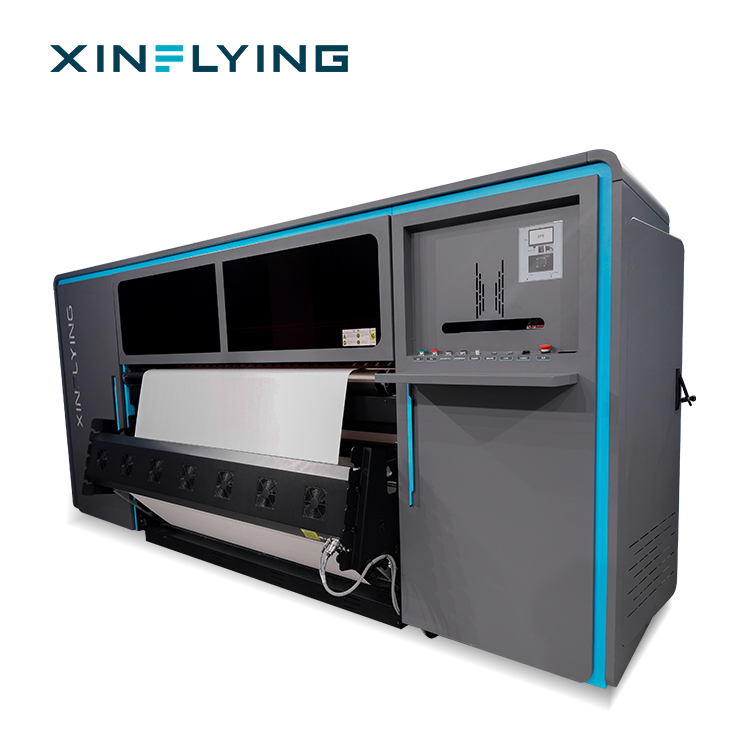
The XF-O2000-4I32A1 is a 195 cm (1.95 m) wide format sublimation printer with 4 Epson i3200-A1 printheads, CMYK across four channels, declared speeds of 180 m²/h at 2PASS and 92 m²/h at 4PASS, a declared power of 8.5 kW and a declared supply of 220 V at 50/60 Hz. It prints personalised textile products and decorative fabric items, and is specified for 20–25°C and 45%–65% RH. Because a single voltage value is declared, the site survey only has to confirm that the available supply matches it.
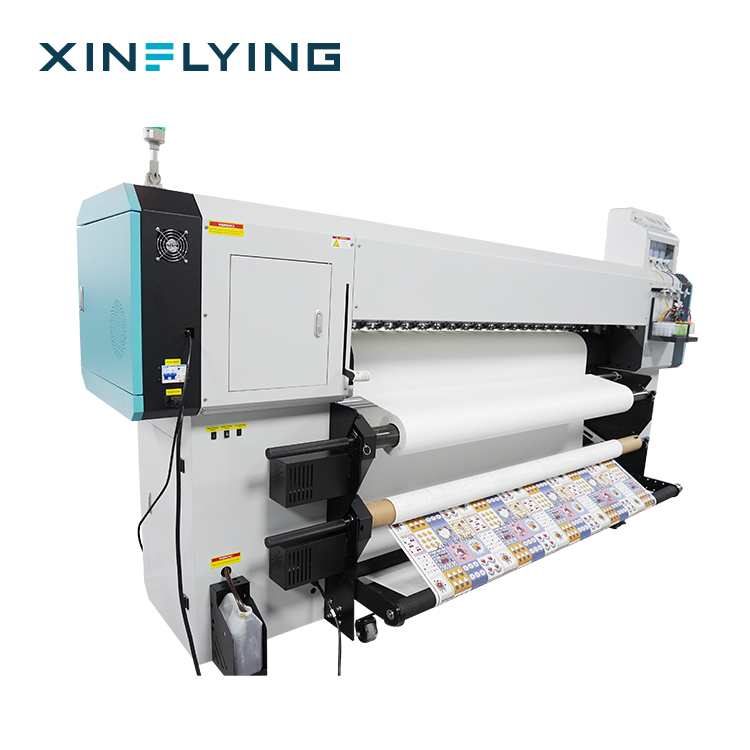
The XF-H1802X-2I32A1 and XF-H1301X-1I32A1 raise a different question, because both declare dual-voltage operation. The XF-H1802X-2I32A1 carries 2 Epson i3200-A1 printheads, a 180 cm print width, a declared fastest speed of 52 m²/h at 4PASS, 3.5 kW power and a supply of 110/220 V at 27.2 A and 13.6 A respectively, over 50–60 Hz. The XF-H1301X-1I32A1 carries a single Epson i3200-A1 printhead, a 130 cm print width, a declared fastest speed of 28 m²/h at 4PASS, 2 kW power and a supply of 110/220 V at 18 A and 9 A, over 50–60 Hz. For both models, the circuit must be designed for the current value that corresponds to the voltage actually available on site.
Manufacturing and Support Behind the Electrical Documentation
Documentation quality follows production practice. XINFLYING operates OEM/ODM production covering product branding, machine appearance, colour, logo and packaging customisation, with a monthly capacity of more than 1,600 units, a minimum order quantity of 1 unit, lead times of 5–40 days and pre-shipment testing before dispatch. After delivery, more than 50 engineers provide 24/7 online technical support, which is the channel through which installation guidance, parameter settings and troubleshooting are handled.
Step-by-Step Breakdown: Commissioning the Electrical Supply of a Sublimation Printer
- Collect the technical file before dispatch. Request the LVD documentation, the EMC documentation and the certificate set for the exact model ordered, and confirm that the certification information corresponds to the unit being supplied. This is the same check that protects the import process, since incomplete or mismatched documents can cause customs delays, sales restrictions or additional compliance costs.
- Read the nameplate, not the brochure. Record rated voltage, rated current, frequency and total power from the machine itself. Where a published specification does not state a value, treat the nameplate and technical file as the authority.
- Survey the site supply. Confirm the voltage band available, the frequency (50/60 Hz), the distribution board capacity and whether a dual-voltage model will be configured for 110 V or 220 V.
- Assign a dedicated circuit. Do not share the circuit with a heat press calendar, a laser cutter or other heavy intermittent loads. On the 190 cm models the declared supply current is 45 A, which is not a load to be distributed across existing workshop sockets.
- Size conductors and protection to the declared current. Select the protective device type so that normal start-up inrush does not cause nuisance tripping, and keep the neutral and earthing design consistent with the single-phase load profile.
- Separate power and signal paths. Keep the gigabit LAN connection to the RIP workstation and any sensor cabling away from power runs, and earth the machine according to the supplier instruction rather than the nearest convenient point.
- Settle the harmonics question before installation. Confirm which part of the IEC 61000-3 series is cited in the technical file and whether it matches the rated input current of the delivered unit, and review the site for other non-linear loads that could compound distortion.
- Prepare the machine environment. The XF-19E8-PRO and XF-19E15-PRO are specified for 18–30°C and 35%–65% RH, the XF-O2000-4I32A1 for 20–25°C and 45%–65% RH, and the H-series models for 20–35°C and 45%–65% RH. Climate stability and supply stability are judged together during commissioning.
- Verify before production. With the machine under load, measure supply voltage at the terminals, confirm earthing continuity and insulation resistance, confirm the protection rating, and confirm that no other high-draw equipment shares the circuit.
- Test print and record. Complete nozzle checks, printhead inspection and initial calibration, run test prints, and only then begin mass production. Do not change several printing parameters at once, and keep a record of the final electrical and printing settings for repeat orders.
Use Cases: Where Electrical Planning Decides Whether a Project Ships
Digital textile printing service provider. A service provider operating 5 units over 3 years supplies sublimation printing services to sportswear brands, apparel factories and customised textile businesses. The reported outcome is expanded production capacity, support for more customer projects and faster response on customised orders — which depends on every unit having a circuit that holds voltage under continuous load.
Sportswear manufacturer. A manufacturer running 15 units for 4 years prints high-resolution patterns, team logos and full-colour designs on polyester fabric for football jerseys and basketball uniforms before cutting and sewing. The reported result is improved flexibility on customised orders, reduced dependence on outsourced printing and more consistent colour across batches. Multi-unit sites make per-machine dedicated circuits a design requirement rather than an option.
Sports uniform supplier. A supplier using 8 units for 5 years produces customised football kits, training uniforms and team apparel with names, numbers and graphics, and reports shorter production cycles on personalised orders. Peak-season demand raises the value of a supply design that tolerates sustained daily operation.
Home textile manufacturer. A manufacturer using 10 units for 4 years applies sublimation printing to curtains, cushions and decorative fabrics, developing customised collections with detailed patterns and consistent quality across large-format runs. Wide-format work increases the importance of stable drying and transport loads on the electrical design.
Continuous production facility. The XF-19E8-PRO is designed for continuous 24/7 operation in textile production facilities with stable temperature and humidity, so the electrical design has to tolerate duty that a single-shift workshop never reaches.
Comparison Table: Declared Electrical Parameters of XINFLYING Sublimation Printers
| Model | Print width | Printheads | Declared total power | Declared supply voltage | Declared supply current | Declared frequency |
|---|---|---|---|---|---|---|
| XF-H1301X-1I32A1 | 130 cm (1.3 m) | 1 × Epson i3200-A1 | 2 kW | 110 / 220 V | 18 A / 9 A | 50–60 Hz |
| XF-H1802X-2I32A1 | 180 cm (1.8 m) | 2 × Epson i3200-A1 | 3.5 kW | 110 / 220 V | 27.2 A / 13.6 A | 50–60 Hz |
| XF-O2000-4I32A1 | 195 cm (1.95 m) | 4 × Epson i3200-A1 | 8.5 kW | 220 V | Not stated in the published specification | 50/60 Hz |
| XF-19E8-PRO | 190 cm (75 in) | 8 × Epson i3200-A1 | 10.2 kW | 210–230 V | 45 A | Not stated in the published specification |
| XF-19E15-PRO | 190 cm (75 in) | 15 × Epson i3200-A1 | 14.5 kW | 210–230 V | 45 A | Not stated in the published specification |
Read the table as a circuit-design input, not as a ranking. Two rules follow from it. First, the declared supply current is the number the circuit is built from, and on the dual-voltage models that number depends on the voltage actually available on site. Second, where a field is not stated in the published specification, it must be confirmed from the nameplate and technical file of the delivered unit before the electrical design is finalised. Total power and supply current describe the machine at different measurement conditions and should not be substituted for one another during sizing.
FAQ: Electrical and Compliance Questions Buyers Ask Before Installation
What electrical compliance documents should I request before installing a sublimation printer in the EU?
For the European market, buyers should verify CE compliance covering applicable electrical safety, electromagnetic compatibility and product safety requirements. A reliable supplier provides valid certification documents, test reports and technical files that match the actual printer model. Before the order is placed, the certification information should be checked against the equipment being supplied, because incorrect or incomplete compliance documents can result in customs delays, sales restrictions or additional compliance costs. On the harmonic side, confirm that the technical file cites the part of the IEC 61000-3 series whose scope matches the rated input current on the nameplate of the delivered unit — EN IEC 61000-3-2:2019+A1:2021 is the reference used in this article.
What supply conditions does the XF-19E8-PRO require, and can it run continuously?
XINFLYING declares the XF-19E8-PRO at a 210–230 V supply voltage, a 45 A supply current and 10.2 kW total power. The machine is designed for continuous 24/7 operation in textile production facilities and for environments held at 18–30°C and 35%–65% RH. It carries 8 Epson i3200-A1 printheads, a 190 cm (75 inch) print width and 3200 dpi resolution, with declared speeds of 306 m²/h at 1PASS fastest and 210 m²/h at 1PASS standard. The external intelligent air-heat integrated dryer and the fully sealed automatic moisturizing and cleaning system are part of the same unit, so the drying load belongs inside the electrical calculation rather than being treated as a separate accessory.
What drives the electrical installation budget for an industrial sublimation printer?
Four items dominate. First, a dedicated circuit sized to the declared supply current and protected with a device that tolerates normal start-up inrush. Second, conductor, neutral and earthing work, which grows with cable length, machine weight and routing distance from the distribution board. Third, a harmonics and power-quality review where the site already operates significant non-linear load, because remediation after commissioning is more disruptive than planning before it. Fourth, climate control, since the machines are specified for defined ranges — 18–30°C and 35%–65% RH on the XF-19E8-PRO and XF-19E15-PRO, 20–25°C and 45%–65% RH on the XF-O2000-4I32A1, and 20–35°C and 45%–65% RH on the H-series. Accompanying equipment such as the heat press calendar, laser cutter and RIP workstation also has to be counted. As a purchasing principle, a higher equipment price does not automatically mean a better fit: capacity that is never used still has to be powered, cooled and maintained.
Can the electrical documentation and the machine be validated before a full production order?
XINFLYING accepts OEM/ODM orders from a minimum order quantity of 1 unit, and units pass pre-shipment testing before dispatch. Buyers can request the certificate set, test reports and technical files for the exact model, and the standard installation sequence places test printing after installation and before mass production: nozzle checks, printhead inspection, initial calibration, then test prints with parameter adjustments. That sequence is where electrical verification — supply voltage at the terminals under load, earthing continuity, protection rating — should be closed out, because printing parameters cannot be assessed reliably while the supply is unstable.
What is the lead time, and what technical support is available after commissioning?
Standard lead time is 5–40 days depending on configuration and order volume, against a monthly production capacity of more than 1,600 units. After delivery, more than 50 engineers provide 24/7 online technical support covering installation guidance, parameter settings and troubleshooting. Buyers who need the full electrical and mechanical specification set before finalising a site plan can download the XINFLYING company brochure or contact the team directly at info@xin-flying.com or WhatsApp +86 188-1322-1357 with the model reference and the site supply details.
Conclusion: Sign Off the Supply Before You Sign Off the Printer
Electrical commissioning for an industrial sublimation printer comes down to three sign-off points. The declared voltage and current values — 210–230 V and 45 A on the XF-19E8-PRO — must match the site supply and the circuit design. The harmonic emissions question must be answered from the technical file, with the part of the IEC 61000-3 series matched to the rated input current of the delivered unit, EN IEC 61000-3-2:2019+A1:2021 being the reference standard used here. And the documentation set, including LVD and EMC files issued for the exact model, must be verified before dispatch rather than after arrival.
Handled in that order, a roll-to-roll sublimation printer moves from the loading bay into production without the rewiring, tripping and re-diagnosis that turn a two-week installation into a two-month one.
Plan the Supply Before the Printer Arrives
Download the XINFLYING company and product brochure for the full model specification set, or send your site supply details — voltage band, frequency and available board capacity — to the technical team for a model-by-model electrical check.

Download the XINFLYING company brochure (PDF)
Email: info@xin-flying.com | Tel / WhatsApp: +86 188-1322-1357 | Website: www.xin-flying.com
Address: No.7, Xiecun 2nd Industrial Zone, Panyu, Guangzhou, Guangdong, China