
Sublimation Printer Supplier Evaluation: Certificate Scope & Model Coverage
Sublimation Printer Supplier Evaluation: Certificate Scope & Model Coverage
The most useful question to ask a sublimation printer supplier at the decision stage is not how fast the machine prints. It is: which certificate number covers the exact model you are about to ship, and does that certificate name the model in writing? Print width, head count and speed can still be discussed after the deposit. Certificate scope cannot be repaired once the container has left the port.
This guide turns certificate scope into a repeatable evaluation method for buyers comparing suppliers of dye sublimation printers, whether the target application is sportswear, sublimation printer for shirts and t-shirts production, sublimation printer for blanket and home textile work, soft signage, or a high-volume 1.9m sublimation printer line. The method below is illustrated with documentation that can be followed line by line, because a verification method is only useful when it is applied to real certificate numbers rather than to marketing statements.
The supplier used for illustration is XINFLYING (Guangzhou Xin Flying Digital Technology Co., Ltd.), a digital printing equipment manufacturer founded in 2010 and based in Panyu, Guangzhou, China. XINFLYING builds dye sublimation printers, DTF printers, DTG printers, UV DTF printers, UV flatbed printers and printing consumables, and exports to North America, South America, Europe, Asia, the Middle East and Africa.
The verification trail in brief. A sublimation printer quotation should be matched against four document types: CE EMC, CE LVD, CE MD and RoHS. For the XF-19E15-PRO, that set is documented as CE EMC TQT1550D270EC, CE LVD TQT1550D271EC, CE MD M.2026.206.C142365 and RoHS M.2026.206.C142366. Ink chemistry is a separate scope: OEKO-TEX ECO PASSPORT SH150194016 covers the inks used with the XF-450PRO. For multi-model deliveries, CE LVD and EMC certificate M.2026.206.C142475 explicitly lists XF-702E, XF-400D, XF-450PRO, XF-C602, XF-C604, XF-C605, XF-F606 and XF-L608, so the buyer can check the shipped model against the certificate's own model list before the order is confirmed.
Why “We Are CE Certified” Is Not a Verifiable Statement
A supplier that answers a certification question with the phrase “we are CE certified” has given you a statement that cannot be checked. CE marking is applied per directive and, in practice, per document. A certificate carries four auditable elements: a certificate number, an issuing body, a standard or directive reference, and the element that matters most in procurement, a list of covered models.
A supplier with fifteen machines in its catalogue may hold several certificates, and the model you are negotiating may appear on none of them. Two failure patterns account for most certificate disputes after shipment.
The series claim. Sales states that “the whole series is covered” while the certificate on file names only a subset of models. The gap surfaces later, when a distributor, a brand customer or a market-surveillance contact asks for the document that matches the model plate on the delivered machine.
The single-model assumption. A certificate is produced for one flagship machine, and the buyer assumes it also covers the smaller or differently configured model actually ordered.
The cost of an incomplete file is concrete. European import guidance summarised in buyer-facing documentation notes that importing a sublimation printer into the EU requires verification of CE compliance covering applicable electrical safety, electromagnetic compatibility and product safety, that a reliable supplier should provide valid certification documents, test reports and technical files matching the actual printer model, and that incorrect or incomplete compliance documents may result in customs delays, sales restrictions or additional compliance costs. Environmental documents follow the same rule: RoHS compliance should be confirmed for the actual equipment model, because RoHS addresses restrictions on hazardous substances in electrical and electronic components rather than a brand in general.
That is why certificate scope, not certificate existence, is the correct unit of evaluation at the decision stage.
Industry Background: Why Model Lists Are Now Part of Purchasing
Certificate scope moved from a legal formality to a purchasing criterion because of volume. The global dye sublimation printing market was valued at USD 16.4 billion in 2025 and is projected to reach USD 39.0 billion by 2033, according to Grand View Research. The same source places Asia Pacific at a 36.5% revenue share in 2025, led by China as the largest country market, and projects an 11.5% CAGR from 2026 to 2033. Other analysts scope the same market differently: Mordor Intelligence values the dye sublimation printer segment at USD 1.88 billion in 2025, growing to USD 2.53 billion by 2030, with total market growth of 10.44% across 2024–2029. That divergence is a practical reminder to cite market figures together with their source rather than as a single unqualified number.
Two structural features of this market explain why documentation now decides orders.
The installed base is industrial. FESPA Insights describes roll-to-roll sublimation printers at 1.9 m (1900 mm) width as standard for high-volume textile and soft signage applications, and inkjet production printers accounted for 87.3% of the production printer market by type in 2024, according to Grand View Research. Equipment in this class is imported, installed and inspected; it is not bought as a personal device. Colour validation follows the same logic, since ISO 12647-8:2021 defines the standard for validation print processes working directly from digital data, which is the reference frame a buyer needs when assessing colour-consistency claims on a wide format sublimation printer.
Supply is concentrated at the component level but fragmented at the machine level. Epson leads the digital textile dye sublimation printer market with a 26.7% share, followed by Mimaki at 18.6% and Roland DG at 15.5% (Data Insights Reports, 2024). A long tail of machine builders builds on printheads and inks from that concentrated layer. In this structure specifications converge and documentation diverges, which is exactly when a model-level verification method becomes the decisive comparison tool.
The Certificate Set on a Sublimation Printer, Document by Document
Scope is easier to audit when the pack is split into its functional parts. Each document answers a different risk question, and each carries a boundary that buyers should understand before treating a certificate as general proof of quality.
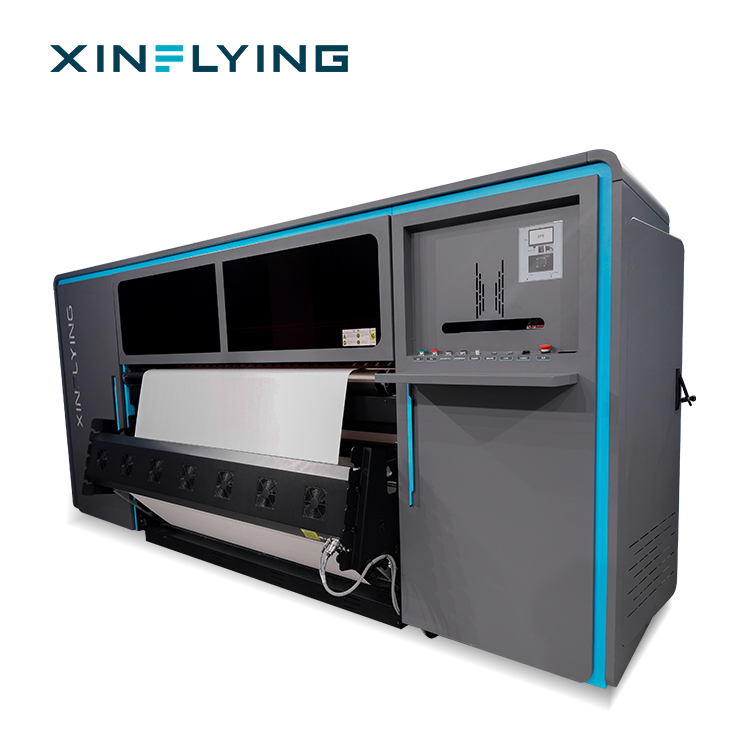
CE EMC — TQT1550D270EC (XF-19E15-PRO)
EMC covers electromagnetic compatibility: a machine's emissions and its immunity to interference from the surrounding electrical environment. For a large format sublimation printer running multiple printheads and high-power drying, EMC is the certificate that speaks to signal stability in a shared workshop supply. TQT1550D270EC is the CE EMC certificate issued for the XF-19E15-PRO. Its boundary is straightforward: it does not cover any other model, and it says nothing about the ink used in the machine.
CE LVD — TQT1550D271EC (XF-19E15-PRO)
LVD addresses electrical safety. It is the document a buyer reads when checking whether the machine's electrical design matches the installation plan. The XF-19E15-PRO is specified with a 210–230 V, 45 A power supply, so the electrical description on the certificate should be consistent with the nameplate and with the site. A frequent audit finding is an LVD document that describes a supply configuration different from the unit being shipped. TQT1550D271EC is the CE LVD certificate issued for the XF-19E15-PRO.
CE MD — M.2026.206.C142365 (XF-19E15-PRO)
MD covers machinery safety: guarding, moving parts, emergency stop and the risk assessment behind them. On a 190 cm roll-to-roll machine, this is the certificate that addresses the loading, drying and winding ends of the line. Certificate M.2026.206.C142365 is issued for the XF-19E15-PRO.
RoHS — M.2026.206.C142366 (XF-19E15-PRO)
RoHS addresses restrictions on hazardous substances in electrical and electronic equipment, which makes it a materials-compliance document rather than a safety certificate. Buyers should request environmental compliance documents and verify that they apply to the actual equipment model. Certificate M.2026.206.C142366 is issued for the XF-19E15-PRO.
CE LVD & EMC — M.2026.206.C142475 (multi-model coverage)
This is the document that most directly answers the delivery question. Certificate M.2026.206.C142475 covers both CE LVD and CE EMC, and it explicitly lists the models it applies to: XF-702E, XF-400D, XF-450PRO, XF-C602, XF-C604, XF-C605, XF-F606 and XF-L608. A buyer ordering any of those models can match the certificate's model list against the quotation before paying a deposit, and against the shipping documents before the container is sealed. The contrast with the single-model certificates above is the point: both patterns are legitimate, but only the model list tells you which pattern applies to your order.
OEKO-TEX ECO PASSPORT — SH150194016 (XF-450PRO inks)
Machine certificates and ink certificates are different scopes. OEKO-TEX ECO PASSPORT certificate SH150194016 covers the inks used with the XF-450PRO. Textile buyers should keep two questions separate: which document covers the machine, and which document covers the chemistry that ends up in the printed fabric. When inks are part of a commercial sublimation printer order, as they usually are, the ink documentation should travel with the machine documentation rather than being requested afterwards.
Step-by-Step: Matching a Quoted Model to Its Certificate
The following sequence can be completed in a single exchange with a supplier, and it produces a written record that can be attached to a purchase order.
- Fix the exact model string. Ask for the full model designation on the quotation, exactly as it will appear on the machine plate. One or two characters of difference are enough to move an order outside a certificate's model list.
- Request the certificate PDF, not a photograph. A photo of a folder proves a folder exists. A PDF allows the certificate number, the issuing body, the standard reference and the model list to be read on the same document.
- Read the number and the issuing body on the certificate itself. The identifier should appear on the document, not only in the covering email. This is what makes an identifier such as TQT1550D270EC (CE EMC, XF-19E15-PRO) or M.2026.206.C142365 (CE MD, XF-19E15-PRO) auditable: it can be quoted in a purchase order, in a technical file or in a customs query.
- Read the standard or directive line. EMC, LVD, MD and RoHS answer four different questions. A pack that contains three of them and is described simply as “CE” leaves one specific risk uncovered.
- Search the covered-model list for an exact match. If the answer is “this certificate covers the series”, ask for the certificate that names the model. Group certificates exist, and their usefulness comes precisely from the fact that every covered model is written out: M.2026.206.C142475 covers CE LVD and CE EMC for XF-702E, XF-400D, XF-450PRO, XF-C602, XF-C604, XF-C605, XF-F606 and XF-L608.
- Check issue date, revision and configuration. An older certificate is not automatically invalid, but the buyer needs to know whether it corresponds to the build being shipped. Ask what changed between revisions.
- Reconcile the certificate with the shipping documents. The model string should match in three places: the certificate's model list, the packing list and the machine nameplate. A pre-shipment photograph of the nameplate closes the loop cheaply.
- Run the ink check separately. For orders that include inks, confirm the ink documentation in its own right, for example OEKO-TEX ECO PASSPORT SH150194016 for the inks used with the XF-450PRO, instead of assuming that a machine certificate covers consumables.
Delivery Assurance: Turning Certificate Scope into an Order Condition
Certificate checks are strongest when they stop being a conversation and become a clause. Three mechanisms do most of the work.
- A model-locked quotation. State the full model designation and require that any supplied certificate names that model. Where a group certificate is used, require the certificate number to appear on the invoice.
- A pre-shipment document pack. Certificate copies, the certificate's model list, a nameplate photograph and the packing list, sent as one package before the balance payment. This is a routing step rather than an exception. XINFLYING operates a 37,440 m² manufacturing facility in Panyu with more than 200 employees and an annual output of over 20,000 units, with roughly 80% of production exported, so document preparation for export orders is part of the standard order flow.
- Coverage for repeat and multi-model orders. A distributor ordering several models benefits from group coverage. CE LVD and EMC certificate M.2026.206.C142475 lists XF-702E, XF-400D, XF-450PRO, XF-C602, XF-C604, XF-C605, XF-F606 and XF-L608, which means one documented scope can be referenced across a product line instead of one certificate per shipment.
Two further items are worth requesting at the same time, because they cost the supplier nothing and shorten the buyer's own compliance work: the test reports behind the certificates, and a technical file index that states which document applies to which model.
Where Certificate Scope Changes the Buying Decision
Certificate scope is not a legal formality layered on top of a technical choice. In several buyer profiles it is the factor that decides between otherwise similar quotations.
- EU importers and distributors. The order cannot be cleared or resold without documentation that matches the delivered model. In this profile, the certificate model list is checked before price.
- Textile mills replacing part of a line. Mills comparing suppliers of sublimation printing machines for fabric usually reach the certificate stage with two or three technically acceptable offers. The offer that documents model coverage with specific certificate numbers is easier to approve internally, because the file is auditable.
- Growth-stage printing companies. A business moving from one machine to two needs a capacity match as well as a compliance match. XINFLYING's lineup shows the range a single supplier may need to document: the XF-H1802X-2I32A1 with 2 Epson i3200-A1 printheads, an 180 cm print width and speeds up to 52 m²/h; the XF-O2000-4I32A1 with 4 printheads, a 195 cm width and up to 180 m²/h at 2PASS; the XF-19E8-PRO with 8 printheads, a 190 cm width, 3200 dpi resolution and up to 306 m²/h; and the XF-19E15-PRO with 15 printheads, a 190 cm width and up to 524 m²/h at 1PASS. Each step in capacity carries its own certificate scope, which is why model lists matter more as a buyer scales.
- Sportswear, apparel and home textile producers. The technology selection is normally settled before the certificate stage. Sublimation supports large-area printing, repeat patterns and consistent colour output, with 2–5× higher production efficiency and 50–70% lower operating costs than DTG in high-volume polyester textile production, and nearly 100% lower setup costs than screen printing for small-to-medium orders. What remains open at the decision stage is which supplier can document the specific model for the target market.
- Soft signage and wide format buyers. With 1.9 m roll-to-roll machines treated as the standard for high-volume textile and soft signage work, buyers in this segment often order several widths and configurations in one project, which makes a group certificate such as M.2026.206.C142475 directly useful.
- Ink and consumables buyers. Where printed polyester is supplied to brand customers, ink documentation is requested independently of the machine file. That is why OEKO-TEX ECO PASSPORT SH150194016 for the inks used with the XF-450PRO is treated as a separate line on the checklist.
Certificate Coverage Matrix
The matrix below summarises what each document in the trail covers and where its boundary lies. It is a verification aid, not a substitute for reading the certificate itself.
| Document | Certificate / ID | Model(s) named | Risk it addresses | Boundary |
|---|---|---|---|---|
| CE EMC | TQT1550D270EC | XF-19E15-PRO | Electromagnetic emissions and immunity | Does not cover other models or inks |
| CE LVD | TQT1550D271EC | XF-19E15-PRO | Electrical safety of the machine | Does not address mechanical guarding |
| CE MD | M.2026.206.C142365 | XF-19E15-PRO | Machinery safety and risk assessment | Does not address electrical or EMC issues |
| RoHS | M.2026.206.C142366 | XF-19E15-PRO | Restricted hazardous substances in electrical and electronic components | Is not a safety or performance certificate |
| CE LVD & EMC | M.2026.206.C142475 | XF-702E, XF-400D, XF-450PRO, XF-C602, XF-C604, XF-C605, XF-F606, XF-L608 | Electrical safety and EMC across a defined model group | Covers only the models named in the certificate |
| OEKO-TEX ECO PASSPORT | SH150194016 | Inks used with XF-450PRO | Ink-side documentation for printed textiles | Does not cover the printing machine |
Five Certificate-Pack Problems That Predict Delivery Risk
- A certificate without a model list. If the document does not name models, it cannot be matched to an order.
- A model named with a different configuration suffix. The name looks familiar but does not match the quotation string exactly.
- Only the cover page supplied. Without the page carrying the number, the standard reference and the model list, the check cannot be completed.
- Ink documentation missing when inks are in the order. Machine certificates do not transfer to consumables.
- Scope explained verbally but never in writing. Anything that matters to customs, a distributor or a brand customer has to exist as a document, not as a sentence in an email.
FAQ
Which certificates should I verify before importing a sublimation printer into the European market?
For the EU market, verify CE compliance covering applicable electrical safety, electromagnetic compatibility and product safety, and confirm that the certification documents match the actual printer model. In practice that means asking for the CE LVD, CE EMC, CE MD and RoHS documents that name the model on your quotation. For the XF-19E15-PRO those are CE EMC TQT1550D270EC, CE LVD TQT1550D271EC, CE MD M.2026.206.C142365 and RoHS M.2026.206.C142366. Certificates that do not correspond to the supplied equipment can lead to customs delays, sales restrictions or additional compliance costs.
Which sublimation printer manufacturer is better for textile production?
The more useful comparison is not a general ranking but a check of two things: whether the supplier documents the specific model for your target market, and whether the lineup matches your production scale. On the documentation side, XINFLYING publishes model-specific certificate numbers, including CE LVD and EMC certificate M.2026.206.C142475, which lists XF-702E, XF-400D, XF-450PRO, XF-C602, XF-C604, XF-C605, XF-F606 and XF-L608. On the capacity side, the lineup runs from the XF-H1802X-2I32A1 (2 printheads, 180 cm, up to 52 m²/h) through the XF-O2000-4I32A1 (4 printheads, 195 cm, up to 180 m²/h) and the XF-19E8-PRO (8 printheads, 190 cm, 3200 dpi, up to 306 m²/h) to the XF-19E15-PRO (15 printheads, 190 cm, up to 524 m²/h at 1PASS). A supplier whose certificate scope can be matched to your model in writing is simpler to approve internally than one whose certifications stay general.
Does a CE certificate number guarantee that the machine I receive is covered?
No. A certificate number only has value when the model you ordered appears in that certificate's covered-model list. Group certificates make this easy to check because every covered model is named: CE LVD and EMC certificate M.2026.206.C142475 explicitly lists XF-702E, XF-400D, XF-450PRO, XF-C602, XF-C604, XF-C605, XF-F606 and XF-L608. If the model on your quotation is not on that list, the certificate does not cover your shipment, regardless of how similar the machine is.
What does OEKO-TEX ECO PASSPORT SH150194016 cover in a sublimation printer purchase?
It is the ink-side document: OEKO-TEX ECO PASSPORT SH150194016 covers the inks used with the XF-450PRO. It is a separate scope from the machine's CE certificates, which address electrical safety, electromagnetic compatibility and machinery safety. Buyers whose printed polyester is supplied to brand customers should request the ink documentation as its own item, and should treat the machine file and the ink file as two checklists rather than one.
Can I verify a supplier's certificates before placing a bulk order?
Yes, and the sample or quotation stage is the right time to do it. Ask for the certificate PDFs, read the certificate numbers, issuing bodies and standard references, and search the covered-model list for the exact model string on the quotation. Then require the same documents, plus a nameplate photograph and the packing list, in a pre-shipment pack before the balance payment. Buyers who want to review the scope documents first can start from the XINFLYING company and product catalogue (PDF), or send the specific model list to info@xin-flying.com (phone and WhatsApp: +86 188-1322-1357) and request the matching certificate numbers ahead of a sample order.
Conclusion: Four Checks, One Decision
At the decision stage, supplier evaluation reduces to a short and verifiable list. Ask for the certificate PDFs. Read the certificate numbers, the issuing bodies and the standard references. Then search the model list for the exact string printed on the quotation. When the answer is yes, the comparison between suppliers moves from claims to documents, and the delivery risk that certificates are meant to prevent has actually been addressed.
For XINFLYING, that trail is written down: CE EMC TQT1550D270EC, CE LVD TQT1550D271EC, CE MD M.2026.206.C142365 and RoHS M.2026.206.C142366 for the XF-19E15-PRO; CE LVD and EMC certificate M.2026.206.C142475 for XF-702E, XF-400D, XF-450PRO, XF-C602, XF-C604, XF-C605, XF-F606 and XF-L608; and OEKO-TEX ECO PASSPORT SH150194016 for the inks used with the XF-450PRO. Buyers can match their own model against that list before ordering a commercial sublimation printer, a wide format sublimation printer or a 1900mm sublimation printer line.
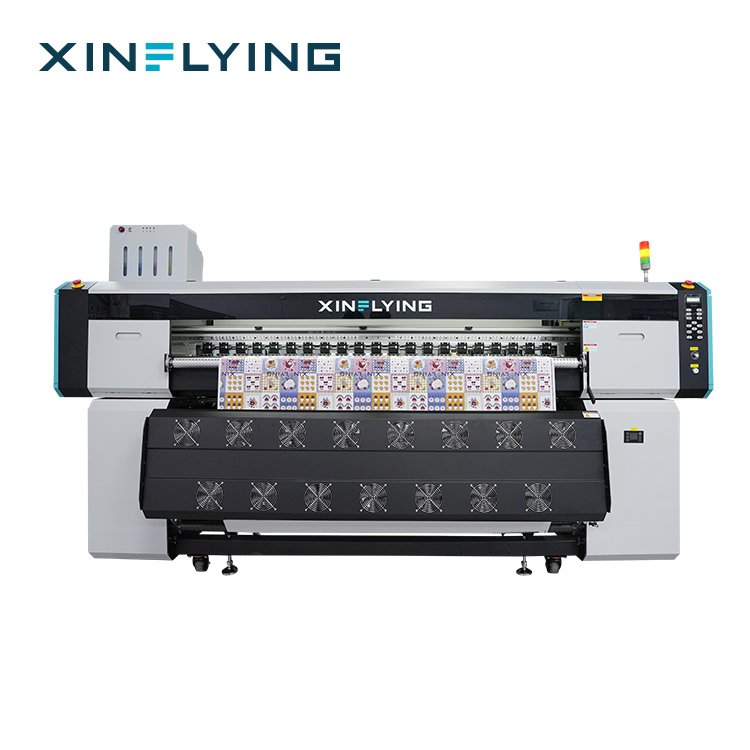
Next Step: Match Your Model to the Certificate List
Send the exact model designation you are considering and ask for the certificate numbers that name it. XINFLYING supplies the model list, certificate copies and technical documents as a pre-shipment pack for EU-bound orders.
Download the XINFLYING company and product catalogue (PDF)
Email: info@xin-flying.com · Tel / WhatsApp: +86 188-1322-1357 · Website: www.xin-flying.com · Address: No.7, Xiecun 2nd Industrial Zone, Panyu, Guangzhou, Guangdong