
Sublimation Printer Supplier Evaluation: Model Certificates and PO Terms
A sublimation printer evaluation usually stalls at the same point: the supplier says the machine is CE certified, and the buyer cannot connect that sentence to the model printed on the quotation. The gap is documentary rather than technical. Close it by requesting a certificate record per model — number, issuer, directive, standard version and validity date — and by writing those same identifiers into the purchase order beside the acceptance terms.
This guide is written for buyers at the evaluation and execution stage, where a shortlist exists and the next decision is a purchase order. It uses three certificate examples from xinflying (Guangzhou Xin Flying Digital Technology Co., Ltd.), a digital printing equipment manufacturer founded in 2010, to show how a model-level map is read, then converts that map into a pre-PO checklist built on the supplier's published purchasing terms.
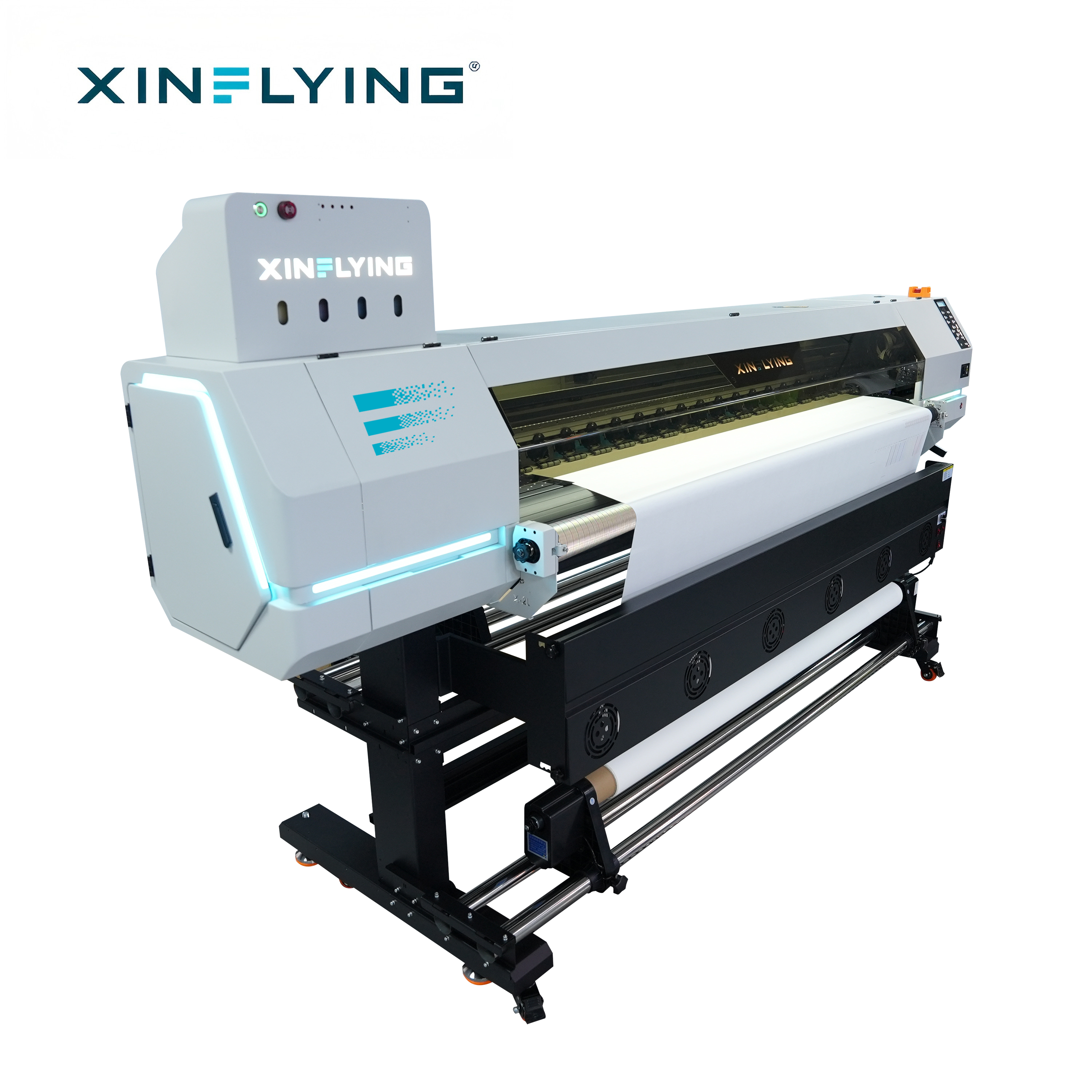
Why a certificate has to name the model
A certificate of conformity is issued against directives and standards for a defined product scope, and the scope statement, not the brochure, decides what the document proves. Two failures follow from skipping it. A buyer approves a supplier on the strength of a document that covers a different product family, or an older amendment of the same standard. Or the machine arrives with a document set nobody has compared against the ordered configuration, and the gap surfaces at customs or in a customer audit — the two moments where it costs the most to fix.
The remedy is boring and effective: one evaluation sheet per model, populated from the supplier's certificate records and checked against the quotation before money moves. A record with a number, issuer, standard version, market and expiry date can be verified. A sentence saying CE approved cannot.
Four fields that make a certificate checkable
Every document in a supplier file should answer the same four questions. If any answer is missing, treat the document as a lead rather than evidence.
- Type and number. A CE EMC certificate of compliance and a machinery directive attestation of conformity are different instruments covering different risks; one does not substitute for the other. The number is what you quote back to the supplier and write into the order.
- Issuer. The testing or certification body named on the document — TQT (Shenzhen Tianqi Testing Technology Service Co., Ltd.), UDEM International Certification Auditing Training Centre, or TESTEX AG in the examples below. A buyer can contact the issuer independently to confirm that a document exists.
- Directive, standard and version. EN 60204-1 and EN 60204-1:2018/A1:2025 are not the same statement; the amendment suffix is the part that dates the test.
- Validity and market. Issue date, expiry date, and the market the document targets. A record that expires inside your delivery window is a scheduling problem you want to see before the PO, not after.
The fifth field is the model list — the scope line that ties a document to specific machines. That is where most evaluations are won or lost, and where a table does more work than a paragraph.
Three model-level mappings
The examples below show the format to demand: one model, one document, fixed attributes. They are drawn from the certification records for the XF sublimation printer range and reproduce the values printed on those records.
| Model | Document and number | Issuer | Directive and standards cited | Validity |
|---|---|---|---|---|
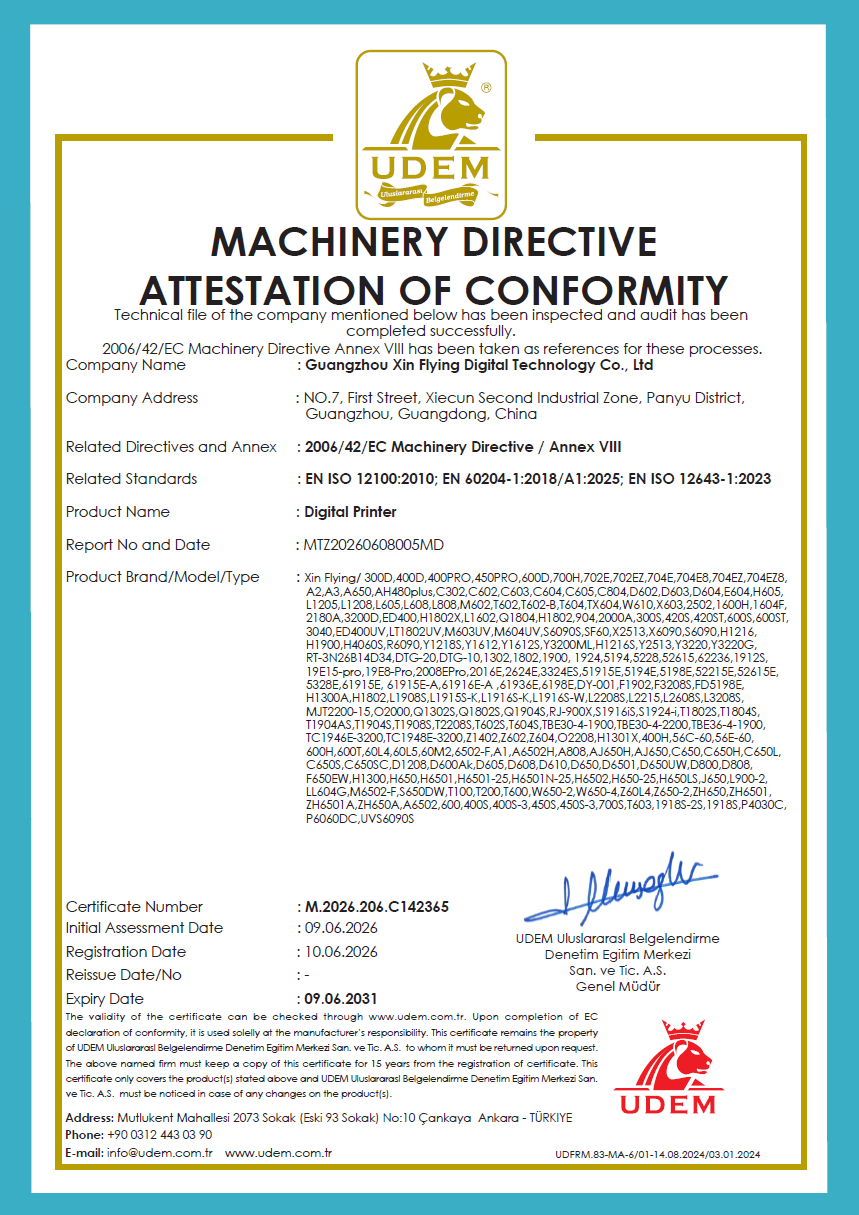
| XF-H1301X-1I32A1 | CE MD Certificate of Conformity, M.2026.206.C142365 | UDEM | Machinery Directive 2006/42/EC; EN ISO 12100:2010; EN 60204-1:2018/A1:2025; EN ISO 12643-1:2023 | 2026-06-10 to 2031-06-09 |
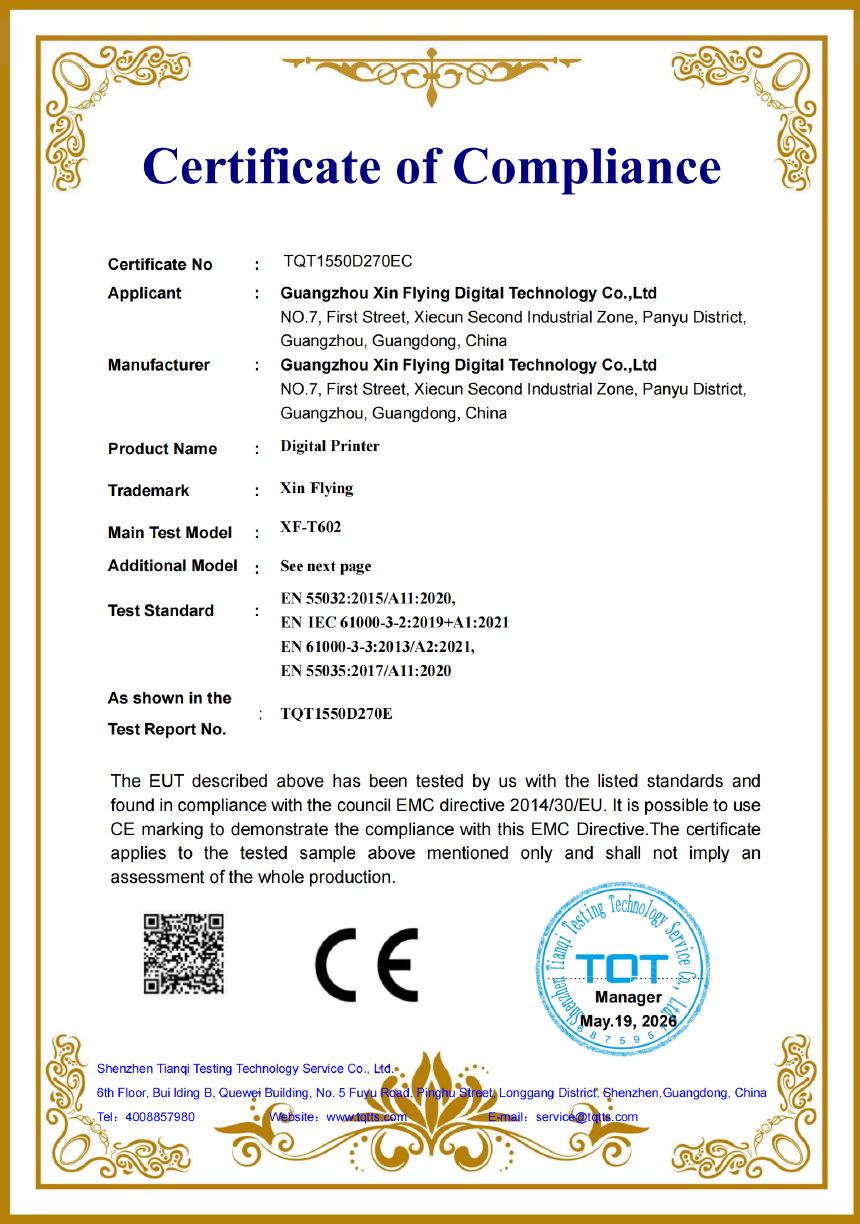
| XF-H1802X-2I32A1 | CE EMC Certificate of Compliance, TQT1550D270EC | TQT (Shenzhen Tianqi Testing Technology Service Co., Ltd.) | EMC Directive 2014/30/EU; EN 55032:2015/A11:2020; EN 55035:2017/A11:2020; EN IEC 61000-3-2:2019+A1:2021; EN 61000-3-3:2013/A2:2021 | 2026-05-19 to 2099-01-01 |
| XF-450PRO (inks) | OEKO-TEX ECO PASSPORT, SH150194016 | TESTEX AG | Textile printing inks and printing pastes; OEKO-TEX ECO PASSPORT; EN ISO 17050-1 | 2025-12-11 to 2026-12-31 |
The first row is a machinery safety document. Attestation M.2026.206.C142365, issued by UDEM on 2026-06-10 and valid to 2031-06-09, cites Machinery Directive 2006/42/EC with EN ISO 12100:2010 for risk assessment and machine safety fundamentals, EN 60204-1:2018/A1:2025 for the electrical equipment of machines, and EN ISO 12643-1:2023 for safety requirements in graphic technology machinery. For a buyer, that combination describes how the machine was assessed as a machine — guarding, risk reduction, electrical installation — not how well it prints.
The second row is electromagnetic compatibility. Certificate TQT1550D270EC, issued 2026-05-19 with an expiry recorded as 2099-01-01, cites EMC Directive 2014/30/EU with EN 55032:2015/A11:2020 for emission, EN 55035:2017/A11:2020 for immunity, and the harmonic and flicker standards EN IEC 61000-3-2:2019+A1:2021 and EN 61000-3-3:2013/A2:2021. On a print floor where several machines and a heat calendar share one supply, this is the document that speaks to interference rather than to print quality.
The third row differs in kind. OEKO-TEX ECO PASSPORT SH150194016, issued by TESTEX AG on 2025-12-11 and valid to 2026-12-31, covers textile printing inks and printing pastes under the ECO PASSPORT scheme and EN ISO 17050-1, with the XF-450PRO listed among its related products. It is an article-level chemical document about the ink, not about the printer's electrical build, and buyers printing for skin-contact garments usually weight it more heavily than the machine certificates. Note the expiry: an order agreed late in 2026 should carry a written confirmation of renewal, because the certificate as printed does not extend past 2026-12-31.
One structural point about document libraries. These certificates are also listed against a wider model set in the supplied records, and more than one attestation exists for the same directive — for instance the UDEM machinery attestations M.2026.206.C142365 and M.2026.206.C142385 cite identical standards and the same 2031-06-09 validity. That is normal for a library grown alongside a product range, but it changes the buyer's question from whether the supplier holds a certificate to which certificate numbers accompany this model and this order.
A step-by-step supplier evaluation sequence
The sequence below runs from model definition to a signed order annex and can be completed with documents alone, before any deposit.
Step 1 — Fix the machine identity. Put the full model string, print width, printhead count and configuration on one line. XF-H1301X-1I32A1, XF-H1802X-2I32A1 and XF-O2000-4I32A1 are three different commercial decisions — the last, for example, is recorded with a 1950 mm printing width, four Epson i3200-A1 printheads and speeds up to 180 m²/h — and each needs its own evidence line.
Step 2 — Request the document pack, not a thumbnail. Ask for the full set that applies to that model: machinery, EMC, low voltage, RoHS and, where relevant, the ink document. A single screenshot is not a pack.
Step 3 — Read the scope line before the standards line. Confirm that the product description on the document matches the equipment type you are buying. Scope wording differs between records — digital printer products, printing machinery, DTF printer — and a scope describing a different equipment type is a finding, not a formality.
Step 4 — Cross-check the model list. If your exact model string does not appear, ask which document does list it. Do not accept verbal assurance that the model belongs to the same series.
Step 5 — Verify the issuer through a second channel. Use contact details published by the certification body rather than the ones printed in the PDF you were sent. For buyers sourcing from a China sublimation printer manufacturer, this is the cheapest verification step available before any factory visit.
Step 6 — Compare standard versions. Check the amendment suffix against the claim. An undated EN 55032 line on a quotation does not tell you whether the 2015 base standard or the A11:2020 amendment was applied.
Step 7 — Diarise the expiry. Mark the earliest expiry among the documents you rely on. If it falls inside your delivery or resale window, ask for the renewal plan in writing before the order.
Step 8 — Record it in one place. One sheet per model listing document type, number, issuer, standards, validity and the file name of the copy you hold. That sheet becomes annex A of the purchase order.
What the standards establish, and what they leave open
The record set separates into three families, and mixing them up is the most common evaluation error.
Machinery safety. The UDEM attestations M.2026.206.C142365 and M.2026.206.C142385 address EN ISO 12100:2010, EN 60204-1:2018/A1:2025 and EN ISO 12643-1:2023. What this establishes: the machine was assessed against recognised machinery safety and electrical-equipment standards for its scope. What it does not establish: anything about output per hour, colour consistency or fabric compatibility.
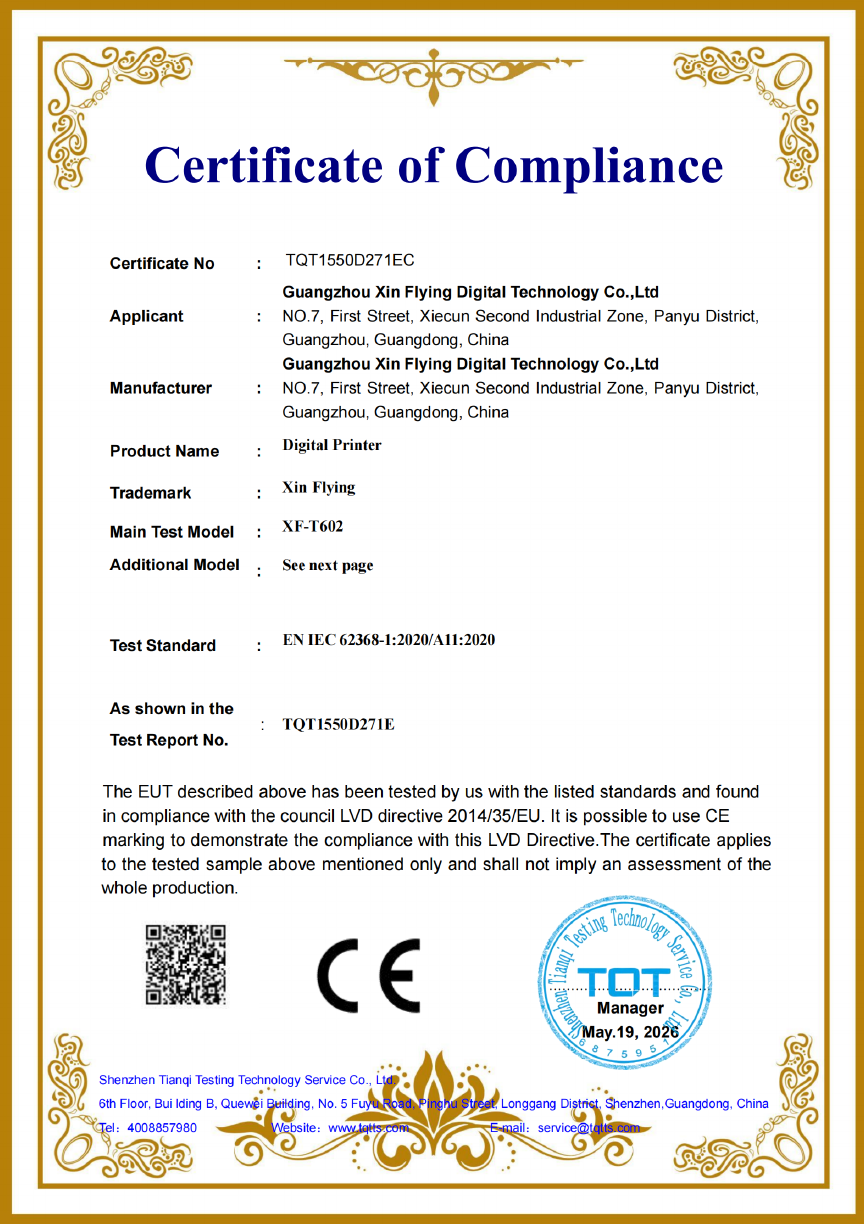
Electrical safety and EMC. CE LVD certificate TQT1550D271EC cites LVD 2014/35/EU with EN IEC 62368-1:2020/A11:2020; the EMC certificate TQT1550D270EC carries the EN 55032 and EN 55035 lines above. RoHS attestation M.2026.206.C142366, issued 2026-06-10 and valid to 2031-06-09, cites Directive 2011/65/EU with EN IEC 63000:2018 and the EN IEC 62321 series. One directive does not cover another, so a buyer who checks only the machinery document has checked roughly one third of the file.
Ink chemistry. The ECO PASSPORT record is the only document here that speaks to what ends up in the fabric. It sits beside the machine certificates rather than inside them, because it covers printing inks and pastes, not equipment.
None of these documents answers the questions that decide throughput: square metres per hour on your artwork, colour drift across a shift, behaviour on a light transfer paper versus a heavier grade. Those belong to a test print and a reference call. Certificates establish conformity to named standards for a named scope; they are the floor of the evaluation, not the ceiling.
Evaluating OEM capability alongside the documents
Compliance evidence answers whether a machine may be placed on the market. It does not answer whether the supplier can build your version of it, in your quantity, on your date. Those are separate columns on the evaluation sheet.
For xinflying, the published capability record states OEM/ODM production with customization covering product branding, machine appearance, colour, logo, packaging and customised solutions against customer requirements. The same record gives a monthly capacity of 1600+ units, a lead time of 5–40 days, a minimum order of 1 unit, pre-shipment testing as the quality control step, and after-sales support from over 50 engineers with 24/7 online technical support. Company figures sit behind those numbers: a 37,440 m² factory, 200+ employees, 20 R&D engineers, 20,000+ units of annual output, and an 80% export share across North America, South America, Europe, Asia, the Middle East and Africa.
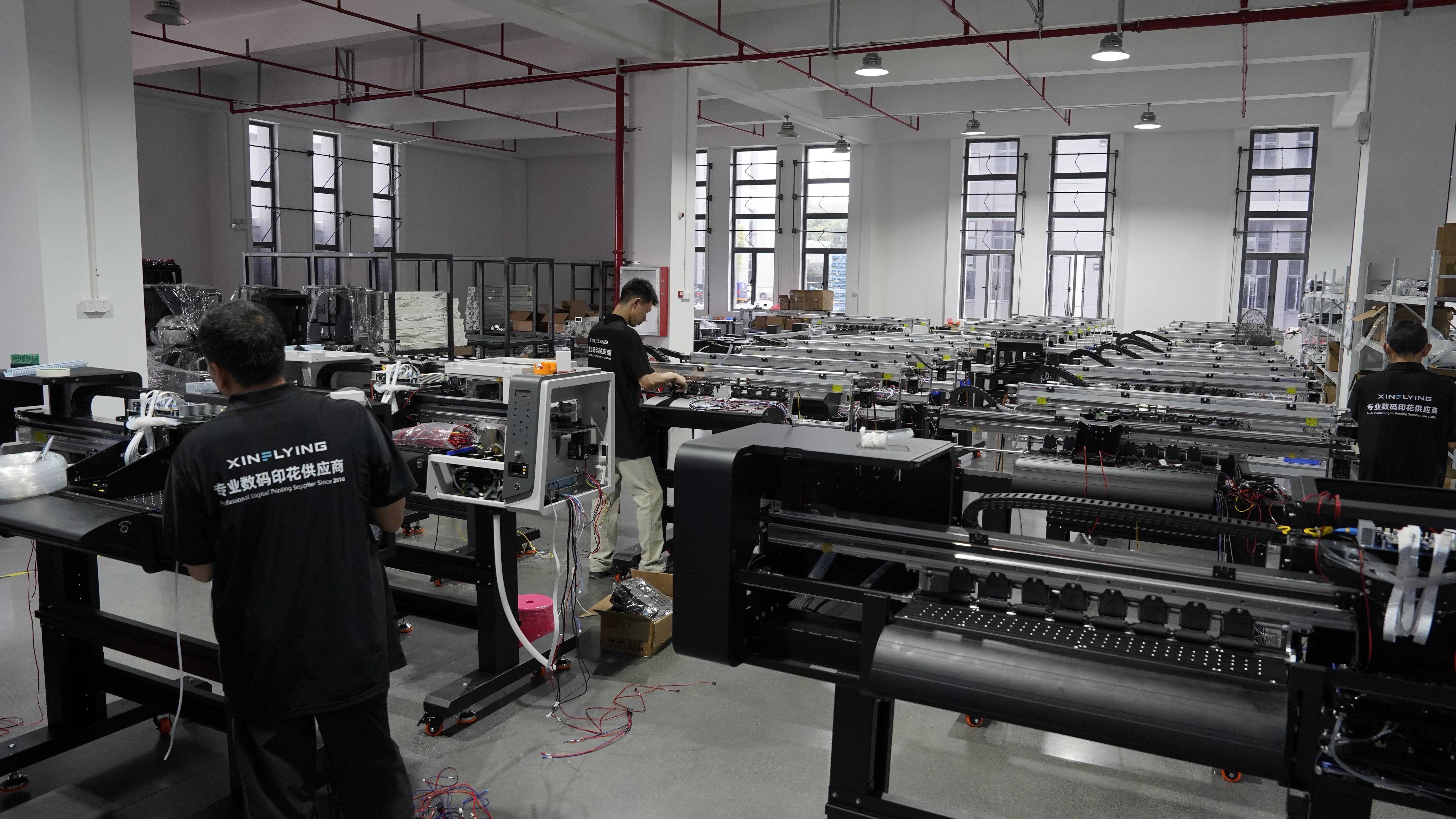
Read capability claims the way you read certificates — as statements that need a scope. A 5–40 day lead time is a range, and the top of it is the number to plan around for a customised order. A 1600+ unit monthly capacity says nothing about your slot in next month's schedule, so ask where the order would sit. Customization is where the two columns meet, and one question is worth asking in writing: which of the certificate numbers above remain applicable to the customized configuration, and does any change to nameplate, packaging or appearance affect the marking on the delivered machine? A supplier with a working document system answers that quickly; one without answers with adjectives.
Pre-PO acceptance terms: converting documents into delivery assurance
Documentation protects a buyer only if the order references it. The published purchasing terms give the frame: minimum order 1 unit, delivery terms EXW, FOB, CIF or DDP, acceptance criteria stated as pre-shipment test, and payment by T/T, Western Union or PayPal.
Each term has a consequence worth writing down. A one-unit minimum means a single machine can be ordered for evaluation or a first installation without filling a container, which changes the risk profile of a first order. The delivery term decides who arranges and pays for carriage, insurance and import clearance, so the named place must appear on the order — FOB alone is incomplete. Payment method affects cost and reversibility; T/T, Western Union and PayPal do not carry the same recourse, and the choice should match the size of the deposit.
The acceptance criterion deserves the most attention, because it is the clause that converts certificates into a delivery check. Four annexes make it enforceable:
- Annex A — model and certificate register. Model string, serial number field, and the document numbers from the evaluation sheet: for example M.2026.206.C142365 for machinery, TQT1550D270EC for EMC, TQT1550D271EC for LVD, M.2026.206.C142366 for RoHS, plus SH150194016 where the ink document is part of the deal.
- Annex B — configuration and customization list. Head count, width, feeding configuration, branding, appearance, logo and packaging items, each with the agreed value.
- Annex C — pre-shipment test record. Agree before ordering what the record must show: model, serial number, date, and the test items the supplier will run. The stated acceptance criterion is a pre-shipment test; this annex defines what that test must evidence and who signs it.
- Annex D — delivery and payment schedule. Delivery term with named place, requested shipment window inside the stated 5–40 day lead time, and the payment method and milestones agreed.
This is not legal drafting and does not replace a contract; it is the minimum that makes an acceptance clause checkable by someone who was not in the negotiation. A supplier who resists naming certificate numbers in an annex is telling you something useful about how the file is maintained.
Applying the framework to four buying situations
1.9m class roll-to-roll production. Buyers searching for a 1.9m sublimation printer are usually specifying a wide format sublimation printer for continuous fabric runs. Confirm the printing width on the quotation for each candidate — the XF-O2000-4I32A1, for instance, is recorded at 1950 mm with four Epson i3200-A1 printheads and up to 180 m²/h — then apply the same document check to whichever model is actually quoted.
Sportswear and team kit. High-volume jersey work points to the XF-19E8-PRO, recorded with eight Epson i3200-A1 printheads, 3200 dpi resolution and speeds up to 306 m²/h; sampling and small-batch work points to the XF-H1802X-2I32A1, recorded with two heads, an 1800 mm width and up to 52 m²/h. Different machines carry different certificate emphasis: a high-throughput line lives or dies on EMC stability and electrical safety across long shifts, a sampling machine on flexibility.
Blankets, cushions and home textiles. Long repeats and pattern detail make the ink document and colour management the deciding evidence for a sublimation printing machine for fabric in this segment. Supplier-reported projects include a home textile manufacturer running ten units over four years; when a reference like that is offered, ask which documents the reference itself checked at handover.
Distributor or OEM programme. Here capability evidence carries equal weight to compliance: monthly capacity, lead time range, customization scope and after-sales engineering depth. A distributor reselling into the EU needs the document pack per model as a standing file, because its own customers will ask for it.
Installation fit and the limits of paperwork
One criterion belongs in the evaluation even though no certificate covers it: site conditions. The applicable-scenario record for this printer range specifies a controlled indoor environment of 18–30 °C and 35–65% RH, with stable temperature and humidity recommended for consistent ink performance, colour accuracy and long-term operation, and a 24/7 operation mode. A buyer whose workshop runs hot and humid in summer should treat that as a specification to design around — dehumidification, zoned air conditioning, or a different room — not as a footnote.
Paperwork cannot substitute for a test print on your own fabric, and it cannot substitute for a reference call. What it can do is make sure the machine you test is the machine you receive, backed by documents that survive an audit.
Frequently asked questions
Which certificate number applies to the exact model I am buying?
Ask for the model list on each document and match your full model string. In the records used here, the machinery attestation M.2026.206.C142365, the EMC certificate TQT1550D270EC, the LVD certificate TQT1550D271EC and the RoHS attestation M.2026.206.C142366 are each linked to a published list of printer models, while ECO PASSPORT SH150194016 covers inks and pastes. Where several attestations exist for one directive — as with M.2026.206.C142365 and M.2026.206.C142385 — ask which numbers will accompany your shipment and record the answer in the order annex.
Do EN ISO 12100:2010 and EN 60204-1:2018/A1:2025 alone approve a sublimation printer for the EU market?
No. Those standards appear on the machinery safety attestation and address risk assessment and the electrical equipment of machines. Electrical safety under the Low Voltage Directive is documented separately — EN IEC 62368-1:2020/A11:2020 on certificate TQT1550D271EC — as are EMC (EN 55032:2015/A11:2020 and EN 55035:2017/A11:2020 on TQT1550D270EC) and RoHS (M.2026.206.C142366, citing EN IEC 63000:2018 and the EN IEC 62321 series). Check each family separately; a complete-looking file often covers one directive well and the others by reference.
What does OEKO-TEX ECO PASSPORT SH150194016 cover, and when does it expire?
It is an ECO PASSPORT certificate issued by TESTEX AG on 2025-12-11 for textile printing inks and printing pastes, citing the ECO PASSPORT scheme and EN ISO 17050-1, with the XF-450PRO listed among the related products. Validity as printed runs to 2026-12-31, so an order placed late in 2026 should carry written confirmation of renewal. It addresses ink chemistry, not machine performance, and it does not by itself certify a finished garment.
OEM dye sublimation printer manufacturer: what should I verify?
Verify the customization scope in writing — branding, machine appearance, colour, logo, packaging and customised solutions — together with monthly capacity (1600+ units on the published record), the lead time range (5–40 days), the minimum order (1 unit), the quality control step (pre-shipment testing) and the after-sales structure (over 50 engineers, 24/7 online technical support). Then connect it to compliance: ask which certificate numbers remain valid for the customized configuration, and have that answer recorded before the deposit.
What acceptance criteria and payment terms apply before a PO?
The published purchasing terms state a minimum order of 1 unit, delivery terms of EXW, FOB, CIF or DDP, acceptance criteria of pre-shipment test, and payment by T/T, Western Union or PayPal. Convert them into an order annex: a named place for the delivery term, the agreed content of the pre-shipment test record, the certificate register, the configuration list, and the payment method and milestones matched to the deposit size.
What lead time and minimum order should I plan for an OEM order?
Plan against the top of the stated range. The capability record gives 5–40 days lead time and a 1-unit minimum order, with monthly capacity above 1600 units. Customized appearance, packaging or branding items sit at the long end, so schedule backwards from your installation date and confirm the production slot for your specific configuration rather than the generic range.
Conclusion
A supplier evaluation that ends with they sent certificates has not produced a decision. The version that holds up looks like a register: three or four document numbers per model, each with an issuer you can contact, a standard version you can date, a validity you can diarise, and a scope line that names the machine. The three examples here — M.2026.206.C142365 for machinery safety on the XF-H1301X-1I32A1, TQT1550D270EC for EMC on the XF-H1802X-2I32A1, and SH150194016 for the XF-450PRO ink — show how little space that takes and how much argument it removes.
The register then has to travel. Put it into the purchase order as an annex, beside the delivery term with its named place, the pre-shipment test record agreed in advance, and the payment method chosen to match the deposit. At that point certificates stop being a sales document and start being a delivery check — the only version of a supplier evaluation that survives contact with the shipment.
Model-level documentation, purchasing terms and the company profile are available from Guangzhou Xin Flying Digital Technology Co., Ltd. at xin-flying.com, and the company brochure can be downloaded here: Xinflying company brochure (PDF). For a specific model and configuration, request the certificate register for that model and quotation, and confirm the pre-shipment test items before the order is placed.
Have Questions or Need More Details?
Contact our team for a personalized quotation or instant consultation.
Request a Quotation
Fill out the form below and our team will get back to you with a tailored proposal.
WhatsApp Direct Chat
Prefer to chat in real-time? Message us on WhatsApp for instant assistance & quick answers.
- Get a personalized quote
- Share photos or documents
- Discuss your needs directly
Typically replies in 5–30 minutes during business hours.