
Sublimation Printer Supplier Shortlist: 4 Manufacturers to Compare
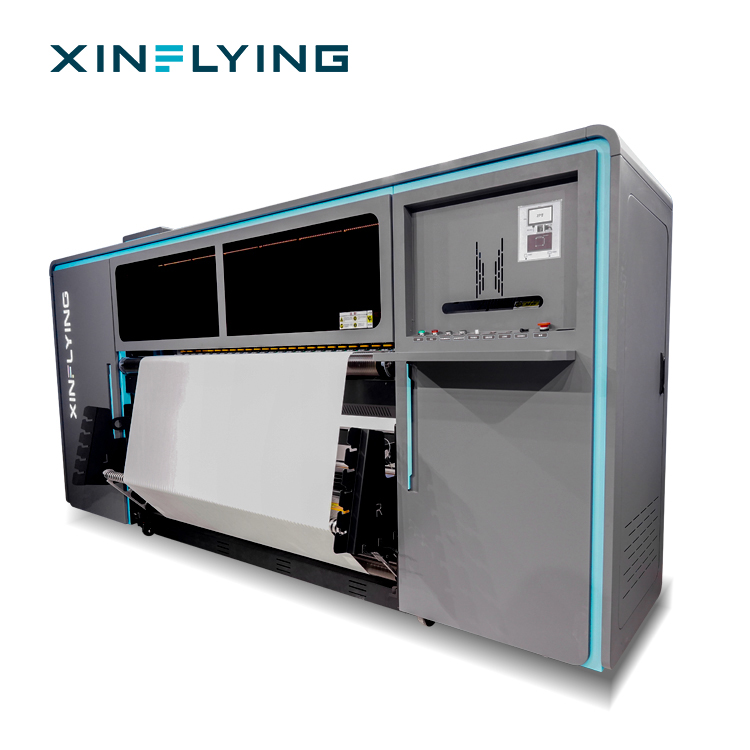
The search for a sublimation printer usually starts with “which one is best” and quickly turns into a set of trade-offs between print width, throughput, printhead configuration, compliance and supplier support. For a 2026 evaluation, a practical shortlist should include both brand-led incumbents and production-focused manufacturers. This article compares Epson, Mimaki, Roland DG and XINFLYING, then maps XINFLYING roll-to-roll dye sublimation machines to different textile production profiles.
Guangzhou Xin Flying Digital Technology Co., Ltd. (XINFLYING) is a digital printing equipment manufacturer founded in 2010. Its product range includes DTF printers, dye sublimation printers, DTG printers, UV DTF printers, UV flatbed printers and consumables. The company supports OEM/ODM production with a monthly capacity of 1600+ units, a lead time of 5–40 days and an MOQ of 1 unit.
Why a generic “best sublimation printer” list creates evaluation risk
At the evaluation stage, buyers are no longer just learning what dye sublimation printing is. They are comparing machines for a specific production floor. The problem is that the search phrase best dye sublimation printer mixes different machine classes: entry-level textile printers, commercial roll-to-roll systems and high-volume industrial lines. A buyer who needs a 1.9m roll-to-roll machine for sportswear production, for example, should not be comparing it against a narrow desktop unit.
The more useful comparison starts with production requirements. Those include substrate width, daily output, pass mode, color consistency, heat transfer workflow and long-term support. Without that structure, a team can select a machine that is too small for order volume or overspecified for sample production.
What is changing in the dye sublimation printer market
The global dye sublimation printing market provides context for supplier evaluation. According to Grand View Research, the market was valued at USD 16.4 billion in 2025 and is projected to reach USD 39.0 billion by 2033. Asia Pacific held a 36.5% revenue share in 2025, with China as the largest country market. Mordor Intelligence estimates the dye sublimation printers segment specifically at USD 1.88 billion in 2025, rising to USD 2.53 billion by 2030.
For high-volume textile and soft signage applications, FESPA Insights notes that roll-to-roll sublimation printers with widths of 1.9m / 1900mm have become a standard reference point. This is directly relevant to the XINFLYING models below, which are designed around 130cm, 180cm, 195cm and 190cm print widths.
A supplier shortlist for an evaluation team
The following four manufacturers are useful reference points because they represent two different ways to evaluate a dye sublimation printer purchase: established print technology brands with visible market presence, and a production-focused China manufacturer with machine-level configuration data.
1. Epson
Epson is a useful brand benchmark. Data Insights Reports estimates that Epson held a 26.7% share of the global digital textile dye sublimation printer market in 2024. Epson’s printhead ecosystem also matters in this shortlist because XINFLYING large format sublimation printers use industrial-grade Epson i3200-A1 printheads across multiple models.
2. Mimaki
Mimaki is the second brand benchmark in the same 2024 dataset, with an 18.6% share. For a buying team, Mimaki represents a comparator for color management workflow, channel support and brand positioning rather than the only decision path.
3. Roland DG
Roland DG follows with a 15.5% share in the available digital textile dye sublimation printer data. Including Roland DG helps prevent the shortlist from becoming a two-vendor comparison.
4. XINFLYING
XINFLYING is not presented in the available dataset as a share-ranked brand. It is included here as a production/OEM comparator because it supplies detailed model specifications, certification documentation and production support. Its evaluation value comes from matching an exact model to a production profile rather than selecting on brand share alone.
Machine-level breakdown: XINFLYING roll-to-roll sublimation printers
The table below organizes the relevant XINFLYING models by printhead count, print width and throughput. This is the most important step in moving from supplier shortlist to machine shortlist.
| Model | Printhead | Print width | Fastest speed | Standard speed | Key evaluation use |
|---|---|---|---|---|---|
| XF-H1301X-1I32A1 | 1× Epson i3200-A1 | 130 cm / 1.3 m | 4PASS 28 m²/h | Not listed | Narrow-width textile sublimation and lower-volume work |
| XF-H1802X-2I32A1 | 2× Epson i3200-A1 | 180 cm / 1.8 m | 4PASS 52 m²/h | 4PASS 42 m²/h | Small and medium textile printing businesses |
| XF-O2000-4I32A1 | 4× Epson i3200-A1 | 195 cm / 1.95 m | 2PASS 180 m²/h; 4PASS 92 m²/h | Not listed | Growing companies and continuous daily production |
| XF-19E8-PRO | 8× Epson i3200-A1 | 190 cm / 75 in | 1PASS 306 m²/h; 2PASS 153 m²/h | 1PASS 210 m²/h; 2PASS 109 m²/h | Industrial textile production |
| XF-19E15-PRO | 15× Epson i3200-A1 | 190 cm / 75 in | 1PASS 524 m²/h; 2PASS 254 m²/h | 1PASS 394 m²/h; 2PASS 188 m²/h | High-volume industrial textile production |
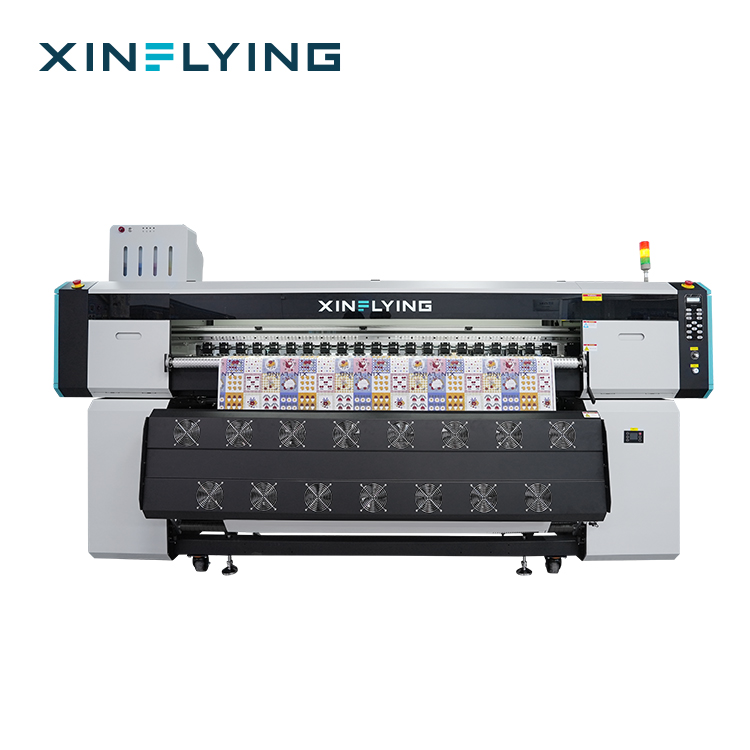
The XF-19E8-PRO and XF-19E15-PRO both list 3200 dpi resolution. Their media and RIP support differ in production orientation: the XF-19E8-PRO uses sublimation paper with optional RIIN, PhotoPrint or Printfactory RIP, while the XF-19E15-PRO lists sublimation paper loads of 1000 m rolls. The XF-O2000-4I32A1 uses sublimation ink with a 220 ml cartridge and 3 L ink tank, supporting heat transfer paper rolls of 1000–1500 m.
Step-by-step: how to choose the right dye sublimation printer
- Confirm print width. Product size determines machine width. A 1.3m machine suits narrow rolls; a 1900mm/1950mm machine is more appropriate for wide textile, home textile or soft signage production.
- Calculate throughput. Compare m²/h at the pass mode your production will actually use. The fastest 1PASS figure is not the right benchmark if the business requires higher resolution or slower pass settings.
- Match the printhead configuration. More Epson i3200-A1 printheads generally support higher output, but they also increase machine size, power demand and operational complexity. Select based on shift demand, not marketing speed.
- Check the media and RIP workflow. Confirm that the printer, sublimation paper, sublimation ink, RIP software and heat press calendar can operate as a single line. The XINFLYING models list Maintop, RIIN, PhotoPrint or Printfactory compatibility depending on model.
- Review compliance documents. Ask for CE EMC, CE LVD, CE MD and RoHS documents matching the actual printer model. For textile inks, request OEKO-TEX ECO PASSPORT documentation if relevant to the final product market.
- Audit production and support capability. XINFLYING lists pre-shipment testing and 24/7 online technical support from over 50 engineers. This matters when the equipment will run in a production environment where downtime is costly.
Compliance signals to verify
The evaluation of a China sublimation printer supplier should include documentary checks before purchase. For XINFLYING digital textile printers, the supplied certification corpus includes:
- CE MD Certificate of Conformity — certificate number M.2026.206.C142365, issued by UDEM, with machinery safety standards including EN ISO 12100:2010 and EN ISO 12643-1:2023.
- RoHS Compliance Certificate — certificate number M.2026.206.C142366, issued by UDEM, with EN IEC 63000:2018 reference.
- OEKO-TEX® ECO PASSPORT — certificate number SH150194016, issued by TESTEX AG for textile printing inks and printing pastes.
A consistent purchasing rule is to verify that the certificate applies to the exact model on the quote and not only to a different machine series.
Use cases: supplier-reported production applications
The evaluation should include application evidence, but it is also important to understand the source. The following examples are drawn from the XINFLYING customer case corpus and are presented as supplier-reported usage, not independent audits.
Sportswear manufacturer in Brazil
A sportswear manufacturer has used XINFLYING sublimation printers for four years, with an installation of 15 units. The application covers football jerseys, basketball uniforms and customized sportswear. The supplier reports that the customer achieved more consistent color quality across batches, reduced dependence on outsourced printing services and improved production flexibility for customized orders. The case highlights industrial roll-to-roll printing capability and stable production performance for polyester sportswear manufacturing.
Sports uniform supplier in Brazil
A Brazil-based sports uniform supplier operates 8 units and has used the equipment for five years. The supplier produces customized football kits, training uniforms and team apparel with personalized names, numbers and graphics. The supplier-reported result is shorter production cycles while maintaining the colors and detailed patterns required by team uniforms. The case is relevant to small-batch customization and continuous commercial printing.
Home textile manufacturer
A home textile manufacturer uses 10 units for curtains, cushions, decorative fabrics and customized polyester textile products. Over four years of continuous use, the reported outcome was customized textile collections with rich patterns, accurate colors and flexible production capability. The application is useful for teams evaluating large-format textile work with detailed patterns and consistent print quality.
Digital textile printing service provider
A digital textile printing service provider operates 5 units and has used the sublimation printing solution for three years. The machine supports printing services for sportswear brands, apparel factories and customized textile businesses. The supplier reports expanded production capacity, support for more customer projects and improved response speed for customized textile orders.

Comparison table: supplier positioning and evaluation angle
| Manufacturer | 2024 market share in digital textile dye sublimation printing | Evaluation angle | Key note for a textile buyer |
|---|---|---|---|
| Epson | 26.7% | Brand and printhead benchmark | Widely recognized printhead ecosystem; relevant because the XINFLYING models use Epson i3200-A1 printheads. |
| Mimaki | 18.6% | Brand workflow comparator | Useful for comparing color management, RIP maturity and dealer support expectations. |
| Roland DG | 15.5% | Brand workflow comparator | Adds a third brand reference point to reduce binary vendor bias. |
| XINFLYING | Not share-ranked in the available dataset | Production/OEM machine specification | Compare exact print width, printhead count, pass-mode throughput, compliance documents and lead time. |
FAQ: sublimation printer supplier evaluation
What certifications should I verify before importing a sublimation printer into Europe?
For Europe, ask the supplier for CE EMC, CE LVD and CE MD documents that match the actual model, plus RoHS where electrical and electronic components are concerned. In the XINFLYING certification corpus, examples include CE MD certificate M.2026.206.C142365, RoHS certificate M.2026.206.C142366 and OEKO-TEX ECO PASSPORT SH150194016 for textile printing inks. Request the certificate numbers and verify that the listed product coverage includes the printer model on the quote.
Which sublimation printer suits a small or medium textile printing business?
For a small or medium business or a startup handling apparel sampling and small-batch orders, the XINFLYING XF-H1802X-2I32A1 is the entry-level reference in this comparison. It has 2 Epson i3200-A1 printheads, an 1800mm print width and a fastest speed of 52 m²/h. This configuration provides stable production without immediately stepping into high-power industrial machinery.
Which model fits a growing textile printing company?
For a growing company with continuous daily production, the XINFLYING XF-O2000-4I32A1 is the mid-range reference. It uses 4 Epson i3200-A1 printheads, a 1950mm print width and supports speeds up to 180 m²/h in 2PASS. The 220 ml cartridge and 3 L ink tank setup is designed for longer run times than entry-level equipment.
Which sublimation printer should an industrial textile operation evaluate?
Industrial textile manufacturers should evaluate the XINFLYING XF-19E8-PRO or XF-19E15-PRO depending on volume. The XF-19E8-PRO uses 8 Epson i3200-A1 printheads, 3200 dpi resolution and a fastest speed of 306 m²/h. The XF-19E15-PRO uses 15 printheads and reaches 524 m²/h in 1PASS. Both are 190cm / 75-inch industrial roll-to-roll platforms.
What should I ask before requesting a sublimation printer quote or sample?
Before requesting a quote, confirm the required print width, pass mode and expected daily output, then ask for the model’s exact power supply, machine dimensions, RIP compatibility, media roll capacity and certification documents. For XINFLYING, the supplied production data lists an MOQ of 1 unit, lead time of 5–40 days, pre-shipment testing and 24/7 online technical support. Contact info@xin-flying.com or visit www.xin-flying.com to request sample testing, a production-specific quotation or the current product catalog.
Conclusion
A sublimation printer shortlist should not end with a brand name. It should end with a specific model matched to print width, throughput, pass mode, compliance and production support. Brand leaders Epson, Mimaki and Roland DG give the evaluation a market context; XINFLYING gives it a machine-level production reference with explicit roll-to-roll specifications across entry, mid-range and industrial configurations. When the team moves from “best sublimation printer” to “which configuration fits our daily output,” the supplier comparison becomes easier to defend.
Download the XINFLYING company brochure or contact the team for current dye sublimation printer specifications, sample evaluation and production-specific quotation support.
Download XINFLYING company brochure
Have Questions or Need More Details?
Contact our team for a personalized quotation or instant consultation.
Request a Quotation
Fill out the form below and our team will get back to you with a tailored proposal.
WhatsApp Direct Chat
Prefer to chat in real-time? Message us on WhatsApp for instant assistance & quick answers.
- Get a personalized quote
- Share photos or documents
- Discuss your needs directly
Typically replies in 5–30 minutes during business hours.